Not your Kuwaiti Dust Storm
This is from Thursday’s Arab Times. Although it is not new news, it contains information I didn’t know – that the sand, full of allergens, was not Kuwaiti dust, and we can expect another storm Tuesday and many through the summer, due to lack of rainfall.
Storm you can ‘taste’
KUWAIT CITY : The sandstorm that raged in parts of Kuwait Wednesday afternoon was carried by Southwesterly winds blowing from North of Saudi Arabia and South of Syria and Iraq at speeds of 55 km/hr, says Musaed Al Hammad, head of Mirzam Observatory. He was talking to the Arab Times soon after his observatory conducted studies on the storm. Musaed said “In Kuwait City and Ahmedi the wind speed was 36 km/hr. The visibility in most parts affected by the dust storm was about 100 m, while in the Kuwait City it was reduced to zero. The sandstorm forced airport authorities to divert incoming flights to neighboring countries, operations manager at Kuwait International Airport, Issam Al Zamel told a news agency.
. . . . . . .
Mirzam Observatory sent samples of the dust to a laboratory, and tests revealed that the dust particles were not from the deserts of Kuwait, and contained cement particles and allergy-causing germs, the astronomer said.
Musaed added breathing in such particles is potentially risky for people prone to bronchitis and other respiratory illnesses. “This finding could open new vistas in the treatment of allergies in Kuwait. “Dust storms arising out of Kuwaiti deserts are usually very slow and linger for a long time, unlike the one that hit Kuwait like a flash on Wednesday. “The visibility was reduced to very low levels because as the storm arrived in Kuwait the wind lost steam and the dust particles gathered in the atmosphere,” Musaed noted. . . . .
As the rainfall was scant this year, all wind conditions in summer will likely turn into dust storms, Musaed said. “So we can expect more dust storms in the future.” Mirzam Observatory has forecasted another dust storm next week on Tuesday. “However, it will not be as bad as Wednesday’s. The dust storms in future will be much milder.”
It’s A Beautiful Day in the Neighborhood
You know how good you feel after you’ve been sick? All of a sudden, you realize just how GOOD it feels just to be normal, not to ache, not to have a sore throat, not to be tired and woozy?
Getting up this morning was that kind of feeling.
WOW. It’s a beautiful NORMAL Kuwait kind of day. We had a humungous thunder storm last night, I know, because I heard it and got up to see it. It was off in the distance and I was too tired to wait for it to come my way, so I went back to bed. I can tell this morning that it rained here, though, too, because my windows are all splothchy.
It rained! It rained! Here are my splotchy windows:

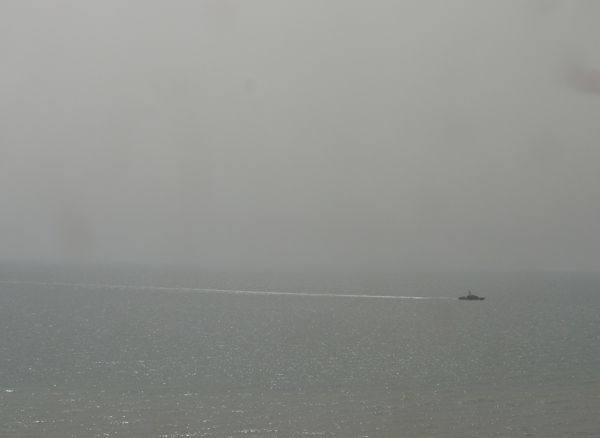
Today, you can see the horizon. There is a haze in the sky, but it is a normal, high haze, cloud like, not the kind of dust haze that fills your nose and makes you cough. You can see the water, and it sparkles. Ahhhh, it’s a beautiful day in the neighborhood, a beautiful normal Kuwait day.
It’s 86° F / 30° at 0900 – yep, I’m up a little later this morning; that’s what happens when you get up in the middle of the night to watch a thunderstorm. 😉
Sunrise 1 May 2008 SSDD
As an Army wife, I was exposed to a lot of rough language through the years, and as I got up this morning and looked at the “sunrise” I had this thought: Same (stuff) different day.
The haze gives me a little headache; I don’t know if it is from the glare of the sun bouncing off all the particles, or whether the particles themselves are headache inducing. The haze seems to be increasing, and I wonder if we are in for another sandstormy day.
I am happy to say that yesterday, as the sandstorm went on, I saw more and more motorists stopping and waiting until the storm had passed, and fewer and fewer idiots driving fast and laying on the horn to warn everyone to get out of their way. Idiots!
Here is today’s sunrise, on May 1, 2008:

It’s 81°F / 27°C at 0730 on a Thursday morning.
Update: LOL, I just looked at yesterday’s photo and it is almost exactly the same. 
Sandstorm Blowing In
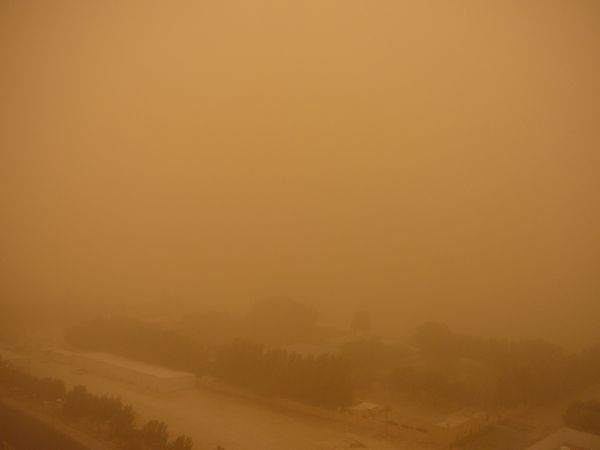
I was back in the project room, making the best use of the day’s light – and Kuwait truly has great light – when all of a sudden, it was as if I had just put sunglasses on. Big orange sunglasses, blocking out a good half the available light.
Here is what it looks like where I normally take the sunrise photos:

Here are more views:

The Magic Bullet
What if someone told you there was a magic pill you could take that would help your body fight off attacks of diabetes, heart disease, osteoporosis – almost anything that ails you – wouldn’t you grab that pill?
You can read the entire article HERE, at the New York Times.
You Name It, and Exercise Helps It
By JANE E. BRODY
Published: April 29, 2008
Randi considers the Y.M.C.A. her lifeline, especially the pool. Randi weighs more than 300 pounds and has borderline diabetes, but she controls her blood sugar and keeps her bright outlook on life by swimming every day for about 45 minutes.
Randi overcame any self-consciousness about her weight for the sake of her health, and those who swim with her and share the open locker room are proud of her. If only the millions of others beset with chronic health problems recognized the inestimable value to their physical and emotional well-being of regular physical exercise.
“The single thing that comes close to a magic bullet, in terms of its strong and universal benefits, is exercise,” Frank Hu, epidemiologist at the Harvard School of Public Health, said in the Harvard Magazine.
I have written often about the protective roles of exercise. It can lower the risk of heart attack, stroke, hypertension, diabetes, obesity, depression, dementia, osteoporosis, gallstones, diverticulitis, falls, erectile dysfunction, peripheral vascular disease and 12 kinds of cancer.
But what if you already have one of these conditions? Or an ailment like rheumatoid arthritis, multiple sclerosis, Parkinson’s disease, congestive heart failure or osteoarthritis? How can you exercise if you’re always tired or in pain or have trouble breathing? Can exercise really help?
You bet it can. Marilyn Moffat, a professor of physical therapy at New York University and co-author with Carole B. Lewis of “Age-Defying Fitness” (Peachtree, 2006), conducts workshops for physical therapists around the country and abroad, demonstrating how people with chronic health problems can improve their health and quality of life by learning how to exercise safely.
Up and Moving
“The data show that regular moderate exercise increases your ability to battle the effects of disease,” Dr. Moffat said in an interview. “It has a positive effect on both physical and mental well-being. The goal is to do as much physical activity as your body lets you do, and rest when you need to rest.”
In years past, doctors were afraid to let heart patients exercise. When my father had a heart attack in 1968, he was kept sedentary for six weeks. Now, heart attack patients are in bed barely half a day before they are up and moving, Dr. Moffat said.
The core of cardiac rehab is a progressive exercise program to increase the ability of the heart to pump oxygen- and nutrient-rich blood more effectively throughout the body. The outcome is better endurance, greater ability to enjoy life and decreased mortality.
The same goes for patients with congestive heart failure. “Heart failure patients as old as 91 can increase their oxygen consumption significantly,” Dr. Moffat said.
Aerobic exercise lowers blood pressure in people with hypertension, and it improves peripheral circulation in people who develop cramping leg pains when they walk — a condition called intermittent claudication. The treatment for it, in fact, is to walk a little farther each day.
In people who have had transient ischemic attacks, or ministrokes, “gradually increasing exercise improves blood flow to the brain and may diminish the risk of a full-blown stroke,” Dr. Moffat said. And aerobic and strength exercises have been shown to improve endurance, walking speed and the ability to perform tasks of daily living up to six years after a stroke.
As Randi knows, moderate exercise cuts the risk of developing diabetes. And for those with diabetes, exercise improves glucose tolerance — less medication is needed to control blood sugar — and reduces the risk of life-threatening complications.
Perhaps the most immediate benefits are reaped by people with joint and neuromuscular disorders. Without exercise, those at risk of osteoarthritis become crippled by stiff, deteriorated joints. But exercise that increases strength and aerobic capacity can reduce pain, depression and anxiety and improve function, balance and quality of life.
Likewise for people with rheumatoid arthritis. “The less they do, the worse things get,” Dr. Moffat said. “The more their joints move, the better.”
Exercise that builds gradually and protects inflamed joints can diminish pain, fatigue, morning stiffness, depression and anxiety, she said, and improve strength, walking speed and activity.
Exercise is crucial to improving function of total hip or knee replacements. But “most patients with knee replacements don’t get intensive enough activity,” Dr. Moffat said.
Water exercises are particularly helpful for people with multiple sclerosis, who must avoid overheating. And for those with Parkinson’s, resistance training and aerobic exercise can increase their ability to function independently and improve their balance, stride length, walking speed and mood.
Meat Eating Drives up Costs
I first heard this idea weeks ago, on BBC, as I was listening back in the project room. “How can this be?” I thought, as I first heard the idea that as the poor become richer, their diets are changing and they are demanding cars. That the burgeoning middle-class in China and India are changing everything, and changing it quickly, in ways we never foresaw.
This article has to do with a shortage of fertilizer, and when you get down to the middle of the article (where I stopped) you learn that what is driving up the cost of fertilizer is that so much food that used to go to human consumption is now going into feeding animals for human consumption.
So how are we, as a world community, going to fairly allocate the world’s resources so that nobody goes hungry, everyone has “enough”?
From today’s New York Times; you can read the entire article by clicking here)
By KEITH BRADSHER and ANDREW MARTIN
Published: April 30, 2008
XUAN CANH, Vietnam — Truong Thi Nha stands just four and a half feet tall. Her three grown children tower over her, just as many young people in this village outside Hanoi dwarf their parents.
The biggest reason the children are so robust: fertilizer.
Ms. Nha, her face weathered beyond its 51 years, said her growth was stunted by a childhood of hunger and malnutrition. Just a few decades ago, crop yields here were far lower and diets much worse.
Then the widespread use of inexpensive chemical fertilizer, coupled with market reforms, helped power an agricultural explosion here that had already occurred in other parts of the world. Yields of rice and corn rose, and diets grew richer.
Now those gains are threatened in many countries by spot shortages and soaring prices for fertilizer, the most essential ingredient of modern agriculture.
Some kinds of fertilizer have nearly tripled in price in the last year, keeping farmers from buying all they need. That is one of many factors contributing to a rise in food prices that, according to the United Nations’ World Food Program, threatens to push tens of millions of poor people into malnutrition.
Protests over high food prices have erupted across the developing world, and the stability of governments from Senegal to the Philippines is threatened.
In the United States, farmers in Iowa eager to replenish nutrients in the soil have increased the age-old practice of spreading hog manure on fields. In India, the cost of subsidizing fertilizer for farmers has soared, leading to political dispute. And in Africa, plans to stave off hunger by increasing crop yields are suddenly in jeopardy.
The squeeze on the supply of fertilizer has been building for roughly five years. Rising demand for food and biofuels prompted farmers everywhere to plant more crops. As demand grew, the fertilizer mines and factories of the world proved unable to keep up.
Some dealers in the Midwest ran out of fertilizer last fall, and they continue to restrict sales this spring because of a limited supply.
“If you want 10,000 tons, they’ll sell you 5,000 today, maybe 3,000,” said W. Scott Tinsman Jr., a fertilizer dealer in Davenport, Iowa. “The rubber band is stretched really far.”
Fertilizer companies are confident the shortage will be solved eventually, noting that they plan to build scores of new factories. But that will probably create fresh problems in the long run as the world grows more dependent on fossil fuels to produce chemical fertilizers. Intensified use of such fertilizers is certain to mean greater pollution of waterways, too.
Agriculture and development experts say the world has few alternatives to its growing dependence on fertilizer. As population increases and a rising global middle class demands more food, fertilizer is among the most effective strategies to increase crop yields.
“Putting fertilizer on the ground on a one-acre plot can, in typical cases, raise an extra ton of output,” said Jeffrey D. Sachs, the Columbia University economist who has focused on eradicating poverty. “That’s the difference between life and death.”
The demand for fertilizer has been driven by a confluence of events, including population growth, shrinking world grain stocks and the appetite for corn and palm oil to make biofuel. But experts say the biggest factor has been the growing demand for food, especially meat, in the developing world.
Need Some Encouragement
I just got sick of myself, not exercising, and decided to start exercising again, and so I did. I have a little running trampoline, I can run, watch the news, watch the ships go by out in the Gulf, and, of course, I count.
Why am I counting? I heard about this program, 1000 Steps, that if you walk 10,000 steps a day, you should be on your way to fitness. I figure if I can knock out a good part of that on the trampoline, also getting my heart rate up, it should be all good – right? Wouldn’t you think so?
I’ve done fairly well. Counting helps me get through the exercise – I’m sort of accomplishment driven, and I need to have goals to achieve. I started out at 2200 and I am now up to 3200 – it’s not that hard, and one day I am hoping to be able to knock out 10,000 steps and then all my other steps all day are gravy.
Except for one thing. Since I’ve started, which was only a week ago, I have actually GAINED weight. It is SO discouraging. I am feeling better, I think I can already see positive changes in the mirror, I am feeling more fit. I love the feeling of burning calories I get when I have finished. I don’t believe I have changed my eating habits – so why would the scales move up???
Come Back!
Law n’ Order Man! EnviroGirl! Come back! Come to Kuwait! We’ll make it worth your while!

Actually, in Kuwait, “coming soon” does not actually mean coming soon. There was a restaurant “coming soon” at The Palms, and we waited. And waited. The sign was up for months, and the restaurant never came!
We’ve heard there is also a Borders Books coming to The Avenues Mall – but we aren’t holding our breaths!
Clear Skies

Look at the sky! It’s clear! It looks like it is going to be a gorgeous day today. AdventureMan and I were out for dinner last night and chose a restaurant so that we could eat outside, figuring there won’t be many more evenings where it will be cool enough. Even though it was comfortable, the fly level was high enough to tell us we won’t be eating out much more this “spring.”
It is 68°F / 20°C at 0600 this morning, looking at a forecast high of 98°F / 37°C. Even though it is clear, I am sneezing, so something seems to be in the air.
Sunrise, April 20, 2008
As you can see, the day is more clear, but not exactly clear:

At 0600, it is 66°F / 19°C and the high today is expected to be 100°F / 38° C.
It is still very . . . ummm. . . .Hazy(?) Cloudy(?) Dusty (?) on the horizon. Visibility down close to the ground is limited. There is definitely less dust than in the last two days, thanks be to God.
Recent Comments
ExpatAlien on What Country am I Living … intlxpatr on Yellowstone: Old Faithful to C… Michelle on Yellowstone: Old Faithful to C… Cathy on No Grown-Ups in Charge intlxpatr on Waiting for Snow Wikipedia Donate Button

Amazina


Early Voting in Florida


 Here There and Everywhere