It’s about Fat, Not Weight
A new study tells us you can be normal weight, but still at high risk, depending on where you carry your weight. Women at highest risk carry more fat around their organs. From BBC Health News:
A test has been designed which can show if people of normal weight are at an increased risk of heart disease because they are carrying “hidden” fat.
Developed by South Korean researchers, it checks blood-flow via a cuff on the ankle or arm.
Professor Paul Stewart, an obesity specialist at the Queen Elizabeth Hospital in Birmingham, said: “The take-home message of this study is that having more fat around your the belly area puts you at increased risk of heart disease.
“it’s not so much about general obesity; it’s about middle-aged spread and where fat lies that’s the problem. . . . .
Writing in Clinical Endocrinology, the team say those with the poorest blood flow had more fat around their organs, and so were most at risk.
“This is one more test that can indicate risk.”
Professor Peter Weissberg, medical director of the British Heart Foundation (BHF), said: “This study confirms what we have known for some time; good heart health seems to depend more on our shape than our weight. ”
”Visceral’ fat inside our abdominal cavity – surrounding our intestines – increases our heart disease risk more than fatness in other parts of our body. “It’s possible in future that measures of waist circumference will be included to refine the heart disease risk assessment.
Read the entire article Here.
Gazpacho
Quick and easy, blender Gazpacho hits the spot as temperatures rise . . .
It’s hitting over 100 degrees fahrenheit in Kuwait this week, and it’s time to make up your first batch of heat-quenching Gazpacho. Not only does it taste good – it has relatively few calories, and lots of vitamins and minerals. It is also very filling for those who are trying to watch their weight.
It was a steamy hot day in Washington DC the first time I saw this made or tasted it, and the heat serves as a condiment, underlining the cool, refreshing, healthy taste of this all-time favorite cold soup. So tasty, and so so EASY!
Beth’s Gazpacho
1 large clove garlic
1 peeled onion
2 cucumbers
2 tomatoes
1/2 large green pepper
1 can condensed consomme
1/4 cup wine vinegar (red vinegar in Kuwait)
1/3 cup olive oil
1/4 teaspoon tabasco
1 teaspoon salt
Fresh, coarsely ground black pepper
2 8 ounce cans of tomato sauce (small packets in Kuwait)
Cut garllic and rub inside of chilled pottery or glass bowl. then crush garlic and put in bowl. Add consomme and tomato sauce. Chop 1/2 onion and 1 tomato and puree in blender with some of tomato – consomme mixture. Pour all into bowl and add other ingredients except vegetables.
(I actually add all the vegetables to the blender and blend to get a thick soup, but I am giving you the original recipe above. I also add some fresh Kuwaiti cilantro – maybe 2 tablespoons)
Chop remaining vegetables as garnish. You can also garnish with some garlic croutons and a dollop of sour cream.
On a hot day, this thick soup can be a meal in itself, with a loaf of French bread or a mezze or two, or you can serve it in smaller portions as an appetizer.

Gazpacho photo courtesy of fotosearch.com.
Oxo Salad Spinner
The first time I ever used the Oxo Salad Spinner in Kuwait, I became a fan. Do you ever buy the Kuwaiti Salad Greens at the Sultan Market? I hope you wash them before you use them!
The Oxo Salad Spinner has three parts; an outer bowl, and inner bowl like a seive, and a top that you press on and it makes the inner bowl spin very very fast inside the outer bowl, and the centripetal force makes all the water fly off the leaves and fall to the bottom of the bowl. So you can just lift out the inner bowl and empty the water out.
No electricity needed, it is entirely mechanical, and so well engineered that the bowl will spin on and on and on unless you stop it.
Before I spin the salad, I put all the salad greens in the inner bowl, put the inner bowl in the outer bowl and run cold water over the greens until the bowl is full. I leave it a couple minutes, then pull the inner bowl out, and empty the water from the outer bowl. The water is BROWN with dirt! I put the inner bowl in the outer bowl and rinse again, and again, until the water comes clear. Then, and only then, do I spin the lettuce/greens dry.
After emptying the spin-off water, I can actually put the spinner in the refrigerator, with the greens inside, or I can transfer them to another bowl or sack. They don’t last too long in our salad-eating house.
This is what the Oxo Salad Spinner looks like:
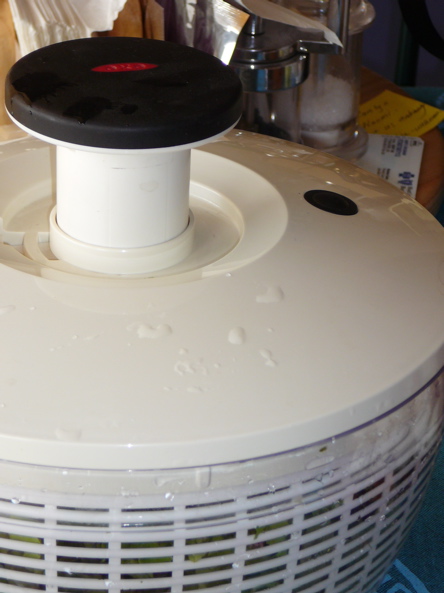
The part sticking out can be locked in the down position for storage. There is also a button that stops the salad spinner’s spinning motion, otherwise it takes a long time for the spinner to slow and stop.
If you are a reader who does not live in Kuwait, but who buys from local markets or farmer’s markets, you will still find this honey incredibly handy.
You can find the salad spinner by Oxo at Amazon.com for $24.95 plus shipping.
Senior Citizens in Kuwait Taking Hospital Beds?
Tacked on to another article in yesterday’s Kuwait Times was this tiny bit of news, with much larger social implications:
“In other news, sources revealed that senior citizens have changed the rooms of public hospitals into old aged homes due to the low fees that are imposed on reserving a room at the hospital.
The rooms at public hospitals are worth KD 1 per day, and if the patient stays for two months, then he will pay only 500 fils per day.
Effective measures must be adopted by the Ministry of Health such as giving a determined time for each patient in order to enable hospitals to receive other patients.”
In a related article several months ago, a article in the same newspaper said that the hospitals were overrun with old people because people couldn’t take care of them at home, and it was much less shameful to say “my Mother is in the hospital” than to say “my mother is in a home for old people.”
It sounds to me like the solution is for the Kuwait government to open a state of the art “hospital” specializing in Gerontology, which in reality would be a retirement center for people unable to take care of their own physical needs, and whose families cannot meet their needs (believe me, after my father’s lengthy and debilitating illness, I know there is only so much a family can do), and they can still say that their parent(s) are in a hospital.
It would meet the need of “hospitalization,” would provide the older people with the intensive and personal services that they need, and would free the beds in traditional hospitals for the seriously ill and damaged citizens.
It’s only words.
Dire Predictions on Earth Day
This is from AOL Top News compiled for Earth Day 2007.
Scientists Offer Frightening Forecast
By Ker Than and Andrea Thompson
LiveScience.com
(April 22) — Our planet’s prospects for environmental stability are bleaker than ever as the world celebrates Earth Day on Sunday. Global warming is widely accepted as a reality by scientists and even by previously doubtful government and industrial leaders. And according to a recent report by the Intergovernmental Panel on Climate Change (IPCC), there is a 90 percent likelihood that humans are contributing to the change.
The international panel of scientists predicts the global average temperature could increase by 2 to 11 degrees Fahrenheit by 2100 and that sea levels could rise by up to 2 feet.
Scientists have even speculated that a slight increase in Earth’s rotation rate could result, along with other changes. Glaciers, already receding, will disappear. Epic floods will hit some areas while intense drought will strike others. Humans will face widespread water shortages. Famine and disease will increase. Earth’s landscape will transform radically, with a quarter of plants and animals at risk of extinction.
While putting specific dates on these traumatic potential events is challenging, this timeline paints the big picture and details Earth’s future based on several recent studies and the longer scientific version of the IPCC report, which was made available to LiveScience.
2007
More of the world’s population now lives in cities than in rural areas, changing patterns of land use. The world population surpasses 6.6 billion. (Peter Crane, Royal Botanic Gardens, UK, Science; UN World Urbanization Prospectus: The 2003 Revision; U.S. Census Bureau)
2008
Global oil production peaks sometime between 2008 and 2018, according to a model by one Swedish physicist. Others say this turning point, known as “Hubbert’s Peak,” won’t occur until after 2020. Once Hubbert’s Peak is reached, global oil production will begin an irreversible decline, possibly triggering a global recession, food shortages and conflict between nations over dwindling oil supplies. (doctoral dissertation of Frederik Robelius, University of Uppsala, Sweden; report by Robert Hirsch of the Science Applications International Corporation)
2020
Flash floods will very likely increase across all parts of Europe. (IPCC)
Less rainfall could reduce agriculture yields by up to 50 percent in some parts of the world. (IPCC)
World population will reach 7.6 billion people. (U.S. Census Bureau)
2030
Diarrhea-related diseases will likely increase by up to 5 percent in low-income parts of the world. (IPCC)
Up to 18 percent of the world’s coral reefs will likely be lost as a result of climate change and other environmental stresses. In Asian coastal waters, the coral loss could reach 30 percent. (IPCC)
World population will reach 8.3 billion people. (U.S. Census Bureau)
Warming temperatures will cause temperate glaciers on equatorial mountains in Africa to disappear. (Richard Taylor, University College London, Geophysical Research Letters:)
In developing countries, the urban population will more than double to about 4 billion people, packing more people onto a given city’s land area. The urban populations of developed countries may also increase by as much as 20 percent. (World Bank: The Dynamics of Global Urban Expansion)
2040
The Arctic Sea could be ice-free in the summer, and winter ice depth may shrink drastically. Other scientists say the region will still have summer ice up to 2060 and 2105. (Marika Holland, NCAR, Geophysical Research Letters)
2050
Small alpine glaciers will very likely disappear completely, and large glaciers will shrink by 30 to 70 percent. Austrian scientist Roland Psenner of the University of Innsbruck says this is a conservative estimate, and the small alpine glaciers could be gone as soon as 2037. (IPCC)
In Australia, there will likely be an additional 3,200 to 5,200 heat-related deaths per year. The hardest hit will be people over the age of 65. An extra 500 to 1,000 people will die of heat-related deaths in New York City per year. In the United Kingdom, the opposite will occur, and cold-related deaths will outpace heat-related ones. (IPCC)
World population reaches 9.4 billion people. (U.S. Census Bureau)
Crop yields could increase by up to 20 percent in East and Southeast Asia, while decreasing by up to 30 percent in Central and South Asia. Similar shifts in crop yields could occur on other continents. (IPCC)
As biodiversity hotspots are more threatened, a quarter of the world’s plant and vertebrate animal species could face extinction. (Jay Malcolm, University of Toronto, Conservation Biology)
2070
As glaciers disappear and areas affected by drought increase, electricity production for the world’s existing hydropower stations will decrease. Hardest hit will be Europe, where hydropower potential is expected to decline on average by 6 percent; around the Mediterranean, the decrease could be up to 50 percent. (IPCC)
Warmer, drier conditions will lead to more frequent and longer droughts, as well as longer fire-seasons, increased fire risks, and more frequent heat waves, especially in Mediterranean regions. (IPCC)
2080
While some parts of the world dry out, others will be inundated. Scientists predict up to 20 percent of the world’s populations live in river basins likely to be affected by increased flood hazards. Up to 100 million people could experience coastal flooding each year. Most at risk are densely populated and low-lying areas that are less able to adapt to rising sea levels and areas which already face other challenges such as tropical storms. (IPCC)
Coastal population could balloon to 5 billion people, up from 1.2 billion in 1990. (IPCC)
Between 1.1 and 3.2 billion people will experience water shortages and up to 600 million will go hungry. (IPCC)
Sea levels could rise around New York City by more than three feet, potentially flooding the Rockaways, Coney Island, much of southern Brooklyn and Queens, portions of Long Island City, Astoria, Flushing Meadows-Corona Park, Queens, lower Manhattan and eastern Staten Island from Great Kills Harbor north to the Verrazano-Narrows Bridge. (NASA GISS)
2085
The risk of dengue fever from climate change is estimated to increase to 3.5 billion people. (IPCC)
2100
A combination of global warming and other factors will push many ecosystems to the limit, forcing them to exceed their natural ability to adapt to climate change. (IPCC)
Atmospheric carbon dioxide levels will be much higher than anytime during the past 650,000 years. (IPCC)
Ocean pH levels will very likely decrease by as much as 0.5 pH units, the lowest it’s been in the last 20 million years. The ability of marine organisms such as corals, crabs and oysters to form shells or exoskeletons could be impaired. (IPCC)
Thawing permafrost and other factors will make Earth’s land a net source of carbon emissions, meaning it will emit more carbon dioxide into the atmosphere than it absorbs. (IPCC)
Roughly 20 to 30 percent of species assessed as of 2007 could be extinct by 2100 if global mean temperatures exceed 2 to 3 degrees of pre-industrial levels. (IPCC)
New climate zones appear on up to 39 percent of the world’s land surface, radically transforming the planet. (Jack Williams, University of Wisconsin-Madison, Proceedings of the National Academy of Sciences)
A quarter of all species of plants and land animals—more than a million total—could be driven to extinction. The IPCC reports warn that current “conservation practices are generally ill-prepared for climate change and effective adaptation responses are likely to be costly to implement.” (IPCC)
Increased droughts could significantly reduce moisture levels in the American Southwest, northern Mexico and possibly parts of Europe, Africa and the Middle East, effectively recreating the “Dust Bowl” environments of the 1930s in the United States. (Richard Seager, Lamont Doherty Earth Observatory, Science)
2200
An Earth day will be 0.12 milliseconds shorter, as rising temperatures cause oceans to expand away from the equator and toward the poles, one model predicts. One reason water will be shifted toward the poles is most of the expansion will take place in the North Atlantic Ocean, near the North Pole. The poles are closer to the Earth’s axis of rotation, so having more mass there should speed up the planet’s rotation. (Felix Landerer, Max Planck Institute for Meteorology, Geophysical Research Letters)
India’s dangerous secret sex lives
In a BBC article by Linda Pressly, we learn that India has the largest HIV case-load in the world with an estimated 5.7 million people living with the virus. And that women are at highest risk of getting the HIV virus – from their husbands.
More people are living with HIV in India than anywhere else but activists in Gujarat say that until sexual diversity is accepted, prevention may be impossible.
In India’s conservative society sex lives are kept very secret
“Just as other people live their lives, my husband and I maintain our normal family life, even though he has boyfriends.”
Gita was relating some of the most intimate details of her marriage.
“We look after each other, so that’s why I don’t have a problem with his homosexuality,” she said.
“At first I was shocked because I didn’t know anything about it. But I discovered that homosexuality is completely natural in some people, so I’m OK with it.
“I never thought it would create any problems for me.”
Gita’s husband Vijay, has been having sexual relationships with men ever since they got married.
You can read the rest of this fascinating article here.
Tudo’s Vietnamese Restaurant in Pensacola
While back in the U.S., we focused on Vietnamese food and Mexican food, two cuisines we miss while living in Kuwait. We ate several times at Tudo’s, and there are still many items on the menu we want to try.
Here is my very favorite thing – Vietnamese salad rolls. In France, they are served with a vinegar-y sauce, but in most places in the U.S., they come with this delicious peanut sauce:

My husband loves Pho, a big bowl of soup with either meat or chicken or tofu, plus tasty vegetables and lemon grass, cilantro, mint leaves, all fresh:

I like Pho, too, but this time I discovered a shrimp and meat dish served over vermicelli, utterly fresh and delicious:

Oh, how I would love to be able to eat Vietnamese food in Kuwait! It is all so fresh, so delicious, and (relatively) healthy food.
UPDATE: When I wrote this blog entry, I never dreamed one day we would be living in Pensacola; it wasn’t part of the plan. Plans change 🙂 Tudos is just one reason we are happy to be here.
Tudos telephone number for take-out: 850-473-8877
Tudo’s is located just north of Creighton on N. Davis, on the right hand side just after Ronnies Car Wash if you are going north on Davis. Coming South, you would have to make a U-turn at the Creighton and Davis light.
Easter Sunday 2007
For the second year in a row, we were able to celebrate Easter in the United States. Today was so special to us. We went to church surrounded by many families. Although we were strangers, people were very friendly and happy to see us. We were very happy because we were with family!
Although it was our style of worship, every church does things a little differently – and this church does two things I have never seen done before. As the priest entered the church, he knocked at three different doors and said . . . something, and the entire congregation responded with “Allelujia! Christ is risen!” and then as the priest and choir processed down the center aisle, they made a joyful NOISE – and it was a huge noise, every choir member and many members of the congregation had BELLS which they rang as they sang the opening hymn and it was unexpectedly marvellous!
Here is a photo from the entry to the church:

The church entry has several shadowboxed collections of crosses from around the world – totally gorgeous. This is just one part of the collection:

After church, we had a wonderful family dinner with the parents of our daughter-in-law. The dinner was fabulous. We are in the Southern part of the United States where the cooks have a reputation for being THE BEST. They are the best because they use all the ingredients that make food truly tasty – fat, sugar, eggs, real cream, etc, things that we forbid ourselves most of the year, and oh, how delicious everything was. We had a big green salad with a choice of dressings, green beans with slivered almonds, a big ham, scalloped potatoes and freshly baked biscuits with butter and jam.
I would have to say, this was a wonderful Easter meal; fabulous food, great conversation, lots of laughter. For dessert, the hostess made two of my husband’s very favorite things, coconut cake with a white/coconut icing, and banana pudding with a baked meringue topping – oh oh oh! We hated to leave.
A note of interest – my neice, Little Diamond says that this is one of the rare years when Easter is celebrated on the same day by all the major Christian religions – a rare occasion indeed.
And for those of you who are going to ask, no, I am not going to take up swearing again just because Lent is over. The whole goal was to break myself of a very bad habit that crept into my life on the roads of Kuwait. I will continue to strive to clean up my act!
Drinking Green Tea Might Prevent Absorption of Cholesterol
Found this fascinating and hopeful article on drinking green tea at E-zine articles.com.
There are many studies being conducted on the effects of drinking green tea and how it can benefit the body. Along with its possible antioxidant qualities, there are also studies pointing to the possibility that green tea can help you maintain and even lower your cholesterol levels.
Cholesterol comes in two forms, ‘good’ or HDL-cholesterol and ‘bad’ or LDL-cholesterol. Doctors are very concerned about the balance of these two types of cholesterol. Ideally, there should be more good cholesterol than bad. Also, there should only be very small amounts of the bad cholesterol in your blood.
Imbalances in your levels of cholesterol can lead to many diseases, one of which is atherosclerosis. Atherosclerosis is a hardening of the arteries caused by damage caused by high levels of bad cholesterol and other factors.
Studies revealed that green tea consumption in rats appears to lower their levels of bad cholesterol and even prevents them from getting high cholesterol when they are on high cholesterol diets. This has significant implications for the use of green tea in humans to prevent high cholesterol and heart disease. There are still more studies and research to be done before researchers can confirm that green tea indeed has such benefits.
Now here’s the rub:
The author of this article is John Stout.
Jon M. Stout is the Chairman of the Golden Moon Tea Company.
You can read more about how the study was conducted, and the positive results it found to drinking green tea and lowering cholesterol here, and keep in mind, the author sells green tea.
Mouth Guard
Last summer, my dentist told me I needed a mouth guard to wear at night to keep me from clenching or grinding my teeth.
I’m a little cynical about what I think of as “dental fundraising”. There always seems to be something beyond teeth cleaning now that my teeth no longer develop cavities. Whitening? Special electric toothbrush? Gum treatments? Hey, lets dig out all those old fillings and replace them with gold? And then let’s replace the gold with porcelain? He is always pushing for something new.
And I think my husband would have said something if I were grinding or clenching my teeth.
But on my way down seventh ring the other day, as one guy whooshed by me doing 40 km/hr over the speed limit and the guy on my right zipped right through the RED light as if it weren’t there, and the Gucci sunglassed dame got right on my bumper even though the passing lane was clear as could be and I had a cement truck on my right, I noticed I was clenching my teeth.
For one thing, although I have not succeeded in my Lenten goal of not saying ANY swear words on the road, I am down to only about one per long trip. For example, I hardly ever swear on the way to go grocery shopping, just a short trip to the co-op.
It is only on the ring roads or the speedways that sometimes a bad word pops out before I can stop it. The exercise in NOT swearing has been good for me in that now I am very aware, even alone in the car, when a word just popped out or almost pops out. And down to one per trip and holding back the others – hey! – all this is good. The goal is still zero-defects. But I have to applaud my progress.
So I am thinking I should probably wear my mouth guard while I am driving, because that is where I am clenching my teeth. But I wish they also made one that would guard my mouth from those very bad words that want to come out.
Recent Comments
Kitchen on Isiais: Winding Down intlxpatr on Shampoo Ginger tigerbutterya0c5ff1d… on Shampoo Ginger intlxpatr on British Soldier Kidnapped, Esc… John on British Soldier Kidnapped, Esc… Wikipedia Donate Button

Amazina


Early Voting in Florida


