Wise Sayings about Governments – LOL for today
Thanks to Kim for a great contribution – my friends, I think you will like these. They sure gave me a grin:
Wise Sayings on Government
1. In my many years I have come to a conclusion that one useless man is a shame, two is a law firm, and three or more is a Congress. — John Adams
2. If you don’t read the newspaper, you are uninformed; if you do read the newspaper, you are misinformed. — Mark Twain
3. Suppose you were an idiot. And suppose you were a member of Congress. But then I repeat myself. — Mark Twain
4. I contend that for a nation to try to tax itself into prosperity is like a man standing in a bucket and trying to lift himself up by the handle. — Winston Churchill
5. A government which robs Peter to pay Paul can always depend on the support of Paul. — George Bernard Shaw
6. A liberal is someone who feels a great debt to his fellow man, which debt he proposes to pay off with your money. – G. Gordon Liddy
7. Democracy must be something more than two wolves and a sheep voting on what to have for dinner. — James Bovard
8. Foreign aid might be defined as a transfer of money from poor people in rich countries to rich people in poor countries. — Douglas Casey
9. Giving money and power to government is like giving whiskey and car keys to teenage boys. — P.J. O’Rourke
10. Government is the great fiction, through which everybody endeavors to live at the expense of everybody else. – Frederic Bastiat
11. Government’s view of the economy could be summed up in a few short phrases: If it moves, tax it. If it keeps moving, regulate it. And if it stops moving, subsidize it. — Ronald Reagan
12. I don’t make jokes. I just watch the government and report the facts. — Will Rogers
13. If you think health care is expensive now, wait until you see what it costs when it’s free. — P.J. O’Rourke
14. In general, the art of government consists of taking as much money as possible from one party of the citizens to give to the other. — Voltaire
15. Just because you do not take an interest in politics doesn’t mean politics won’t take an interest in you. – Pericles (430 B.C.)
16. No man’s life, liberty, or property is safe while the legislature is in session. — Mark Twain
17. Talk is cheap… except when Congress does it. – Anonymous
18. The government is like a baby’s alimentary canal, with a happy appetite at one end and no responsibility at the other. — Ronald Reagan
19. The inherent vice of capitalism is the unequal sharing of the blessings. The inherent blessing of socialism is the equal sharing of misery. — Winston Churchill
20. The only difference between a tax man and a taxidermist is that the taxidermist leaves the skin. — Mark Twain
21. The ultimate result of shielding men from the effects of folly is to fill the world with fools. — Herbert Spencer
22. There is no distinctly native American criminal class…save Congress. — Mark Twain
23. A government big enough to give you everything you want, is strong enough to take everything you have. — Gerald Ford
Sunrise on the Sparkling Water
I broke my own rules this morning. The Qatteri Cat started walking around and saying “Miooooow” around first-call-to-prayer time, and AdventureMan, who has a sweet soft heart sometimes gets up to feed him.
“If you get up to feed him,” I scold in my mean-mommy voice, “he learns that if he comes mioooowing at oh-dark-thirty that someone is going to get up and feed him! You have to ignore him!”
AdventureMan just looks at me sadly, that I could be so mean and cruel. He is a lucky man; he can get up, feed the cat and get back to sleep in like zero seconds flat. Once I am awake, I am awake.
So this morning, I ignored QC two or three times as he came in and said he was hungry, and then, around five, I took pity on him and got up to check his bowl, which was empty to the last grain of cat food. (Have you ever noticed how FOUL cat food smells??)
And since I was up anyway, I went to get a cup of coffee and saw – oh, I could see all the way to the horizon! Not a speck of dust, not a speck of haze! And the sun is coming up and there is a sparkle all across the Gulf!

I couldn’t resist the sparkle on the water:

So the Qatteri Cat gets a few extra snuggles today for getting me up to see this wonderful sunrise. It is a sweet morning, and I hope you have a wonderful day. 🙂
Difference Between Cat-Think and Dog-Think

see more Lolcats and funny pictures

see more Lolcats and funny pictures
Easter Sunrise and Noah’s Ark
Today is the most beautiful day in the church year, Easter Sunday. Mary and Mary go to the tomb where Jesus was laid, only to find the 2 ton stone rolled away from the entrance, and angels waiting there, telling the women that Jesus was not there, that he had arisen. If you have been reading this blog for any time at all, you will know that it delights my heart that women were the first to know, and that Jesus, resurrected, appeared first to a woman. In the Bible, she tells the men and they don’t believe her. LLOOLL.
It is a glorious Easter morning:

As part of her Easter greeting today, a friend sent the following, which I love. Since all three traditions, Jewish, Christian and Moslem, celebrate Noah (Noh) I thought I would share it with you.
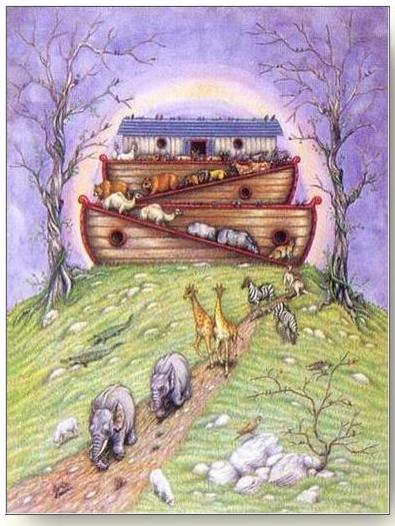
Noah’s Ark
(Everything I need to know, I learned from Noah’s Ark. )
ONE: Don’t miss the boat.
TWO: Remember that we are all in the same boat!
THREE: Plan ahead. It wasn’t raining when Noah built the Ark.
FOUR: Stay fit. When you’re 60 years old, someone may ask you to do something really big.
FIVE: Don’t listen to critics; just get on with the job that needs to be done.
SIX: Build your future on high ground.
SEVEN: For safety’s sake, travel in pairs.
EIGHT: Speed isn’t always an advantage. The snails were on board with the cheetahs.
NINE: When you’re stressed, float awhile.
TEN: Remember, the Ark was built by amateurs; the Titanic by professionals.
ELEVEN: No matter the storm, when you are with God, there’s always a rainbow waiting.
Have a great day, a blessed day, Kuwait.
Today’s Jargon Watch
Jargon Watch: Satellite Sheik, Spitterati, Locasexual
Jonathon Keats
Today, 07:00 AM
(From Wired News Feed
Satellite Sheik n. A televangelist for Islam. These media-savvy religious leaders broadcast moderate Muslim beliefs on satellite TV and social networks, appealing to Arabs alienated by traditional imams.
Spitterati n. Celebrities who attend posh soirees organized to collect saliva for genetic sequencing. Power players like Rupert Murdoch and Harvey Weinstein have hosted spit parties to provide convenient venues for dispensing the requisite half teaspoon of drool.
Sea Grape n. Pet name for the newly discovered Gromia sphaerica. This grape-sized relative of the giant amoeba leaves an animal-like trail as it rolls itself along the seabed. It may be responsible for tracks in Precambrian fossils that were previously attributed to more complex organisms.
Locasexual n. An environmentalist who applies locavore logic to affection and, on principle, will date only locally. Refusing long-distance attachments and coolly calculating “sex miles,” this carbon-conscious canoodler makes love as romantic as a spreadsheet.
“I Look Deep Inside . . .”
We were at one of those official dinners, and, as is my habit, I found someone even more shy than I am and started asking questions. It’s an old trick; it gets me through the most endless affair. She turned out to be very smart, very witty and entertaining, this Nigerian woman, so elegant, so well-mannered. We were having a great conversation.
“So what do you do in Kuwait?” I asked, almost yawning, I was so ashamed of myself for asking such a boring, common question.
She paused, looking at me like she was measuring me.
“I look deep within people, and I tell them things about themselves they never knew,” she responded.
“Oh no!” I thought to myself, “is she some kind of fortune-teller?” (Fortune tellers are strictly forbidden in my religion.) I’m usually pretty good with the old poker-face, but my eyes probably shifted, looking quickly for a polite exit.
She watched me, her eyes twinkling, grinning like a fisherman with a live one on the hook.
“I’m a radiologist,” she added, and we both cracked up. She really had me: baited me, caught me, hooked me good, and then did the old catch-and-release.
Diwaniyya Where No Candidates are Welcome
LOL, he is making his point in such a gentle and delightful way!
Staff Writer
From today’s Al Watan

KUWAIT: Kuwait”s newspapers have been covering the opinions of various former MPs and candidates about the elections and their programs, but the real news and discussions are available in one Kuwait”s oldest traditions, the diwaniya.
Diwaniyas are frequently targeted by political hopefuls to discuss various issues of concern. However, not Bu Hamad”s diwaniya, a retired Kuwaiti customs official who worked at the Salmi and Abdali ports.
Bu Hamid says that that politics is no longer a concern of his after so much disappointment, so it is little wonder that in his own diwaniya in Bayan, Bu Hamid has a large poster clearly saying” “Welcome honorable guests and apologies for not receiving any candidates. May God bless Kuwait. Bu Hamid”s Diwaniya.”
One cannot ignore the sign and equally not be intrigued by its curious message.
Asked about the reasons behind his ban of candidates, Bu Hamid said that in the previous election he discussed an issue of traffic safety near his home, which many candidates promised to sort out.
“I had previously asked candidates who became MPs later to set up speed bumps and traffic lights in front of my diwaniya which overlooks the highway in Bayan, which is notorious for traffic accidents.
“None had carried out their promise after they became MPs. They were only seeking their own interests and the interests of their close circle,” he explained.
“They are good for nothing. They are good for nothing,” he declared.
Bu Hamid expressed his amazement at the MPs whom he has voted for since the 1960’s that continually failed to meet the public’s demands. He is now “fed up with them and their tactics,” adding that when candidates need the voters they are available, “but the minute they become MPs they hardly recognize voters or even bother to meet them, as if they don”t remember them.”
He therefore decided to keep away from candidates and their campaigns.
“I will not cast my vote. I will never vote for any candidate. I have been casting my vote since 1960 and I have seen nothing from them.”
Last updated on Monday 6/4/2009
Drama Queens of the Economic Downfall
Thanks, KitKat, for a hilarious look at the economic downturn. Cats are such drama queens!

“I’m Not Cool Enough to be a Mac Person”
LOL. Found this on the Seattle Time’s Website.
Finally, found it on youTube. This is Microsoft’s swipe against the PC vs Mac commercials, released yesterday.
Groaners!
Oh! You’re going to love these! Thank you, Doha friend, for sending these. 🙂 AdventureMan and Daggero are going to love them!
GROANERS
1) King Ozymandias of Assyria was running low on cash after years of war
with the Hittites. His last great possession was the Star of the Euphrates,
the most valuable diamond in the ancient world. Desperate, he went to
Croesus, the pawnbroker, to ask for a loan. Croesus said, “I’ll give you
100,000 dinars for it.” But I paid a million dinars for it,” the King
protested. “Don’t you know who I am? I am the king!” Croesus replied, “When
you wish to pawn a Star, makes no difference who you are.”
2) Evidence has been found that William Tell and his family were avid
bowlers. However, all the Swiss league records were unfortunately destroyed
in a fire, so we’ll never know for whom the Tells bowled.
3) A man rushed into a busy doctor’s office and shouted, “Doctor! I think
I’m shrinking!!” The doctor calmly responded, “Now, settle down. You’ll just
have to be a little patient.”
4) A marine biologist developed a race of genetically engineered dolphins
that could live forever if they were fed a steady diet of seagulls. One day,
his supply of the birds ran out so he had to go out and trap some more. On
the way back, he spied two lions asleep on the road. Afraid to wake them, he
gingerly stepped over them. Immediately, he was arrested and charged with
transporting gulls across sedate lions for immortal porpoises.
5) Back in the 1800’s the Tates Watch Company of Massachusetts wanted to
produce other products and, since they already made watch cases, they used
them to produce compasses. The new compasses were so bad that people often
ended up in Canada or Mexico rather than California. This, of course, is the
origin of the expression, “He who has a Tates is lost!”
6) A thief broke into the local police station and stole all the toilets and
urinals, leaving no clues. A spokesperson was quoted as saying, “We have
absolutely nothing to go on.”
7) An Indian chief was feeling very sick, so he summoned the medicine man.
After a brief examination, the medicine man took out a long, thin strip of
elk rawhide and gave it to the chief, telling him to bite off, chew, and
swallow one inch of the leather every day. After a month, the medicine man
returned to see how the chief was feeling. The chief shrugged and said, “The
thong is ended, but the malady lingers on.”
8) A famous Viking explorer returned home from a voyage and found his name
missing from the town register. His wife insisted on complaining to the
local civic official who apologized profusely saying, “I must have taken
Leif off my census.”
9) There were three Indian squaws. One slept on a deerskin, one slept on an
elk skin, and the third slept on a hippopotamus skin. All three became
pregnant, and the first two each had a baby boy. The one who slept on the
hippopotamus skin had twin boys. This goes to prove that the squaw of the
hippopotamus is equal to the sons of the squaws of the other two hides.
10) A skeptical anthropologist was cataloging South American folk remedies
with the assistance of a tribal brujo who indicated that the leaves of a
particular fern were a sure cure for any case of constipation. When the
anthropologist expressed his doubts, the brujo looked him in the eye and
said, “Let me tell you, with fronds like these, who needs enemas?”
Recent Comments
intlxpatr on Shampoo Ginger tigerbutterya0c5ff1d… on Shampoo Ginger intlxpatr on British Soldier Kidnapped, Esc… John on British Soldier Kidnapped, Esc… intlxpatr on British Soldier Kidnapped, Esc… Wikipedia Donate Button

Amazina


Early Voting in Florida


