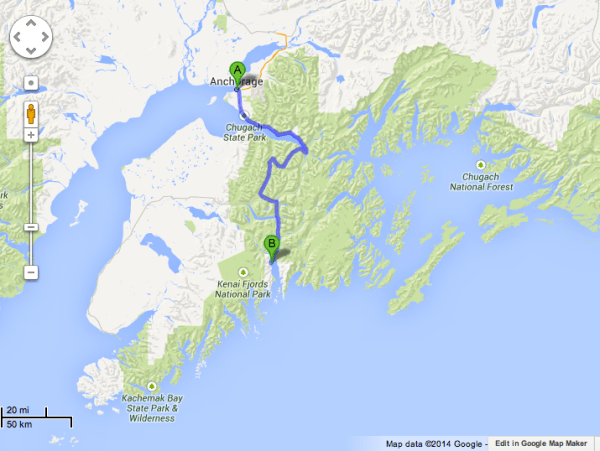
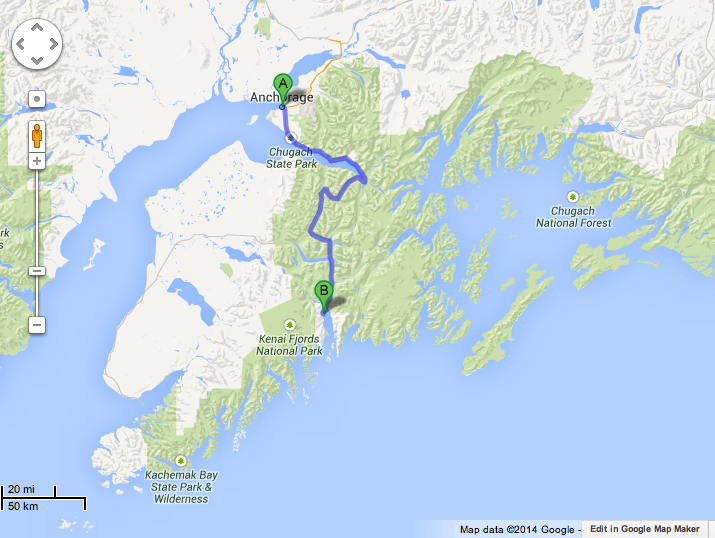
We’d forgotten to think about lunch. We had eaten all our Japanese crackers, the kind you can’t eat on the plane or the smell will make all the other passengers sick, and we still have a couple hours drive ahead of us to Seward where we are going out again to see glaciers and wildlife.
And then, we go past the Turnagain Arm Pit BBQ. We pull up at Turnagain House, a finer restaurant, but it is not open and we drive about half a mile back to the BBQ. As we open our car doors, we are so glad to be there. It smells like home, it smells like Pensacola, BBQ.
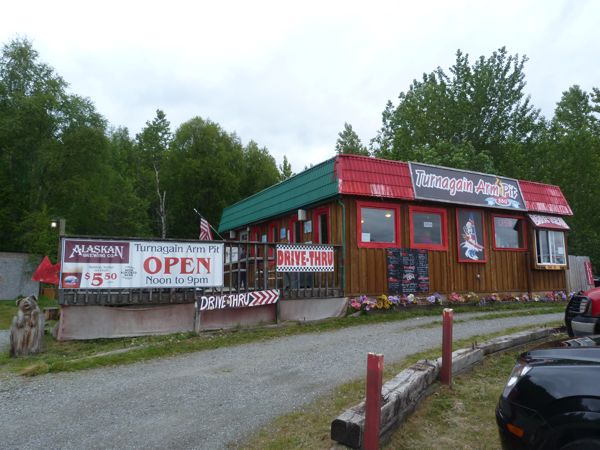
Turnagain Arm is the area we are driving through, so Turnagain Arm Pit BBQ is a clever play on words. This is what it looks like from the road:

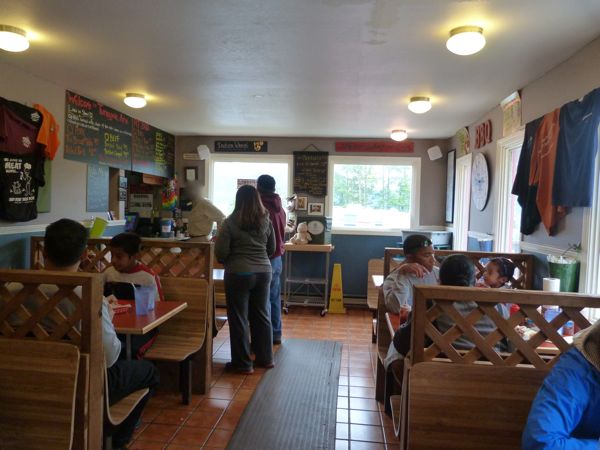
This is what it looks like when you walk in:
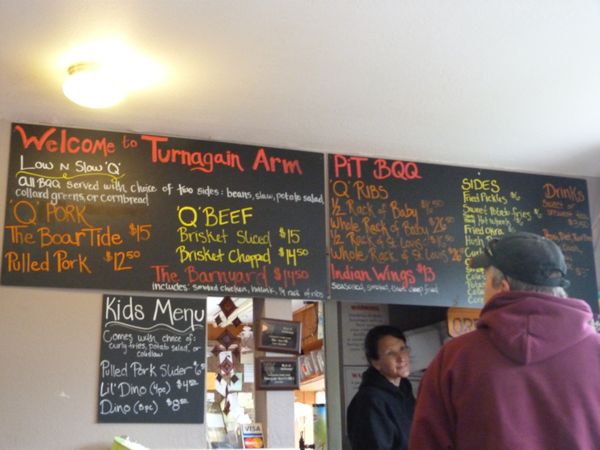
This is the Turnagain Arm Pit BBQ Menu – it’s a little pricey, but hey, it’s Alaska, and you don’t fine real pit BBQ everywhere. Everything is imported . . . and there are not a lot of restaurants along the highway to Seward. . .
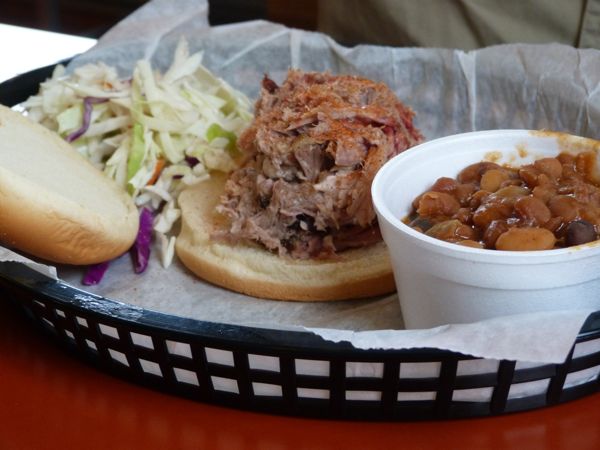
AdventureMan ordered his favorite, pulled pork. It was delicious, but a little fatty. The sauce was great:

I ordered the mixed plate, I ordered it because of the chicken, which I saved to eat later and then, oh aaarrgh, I forgot it. . .

The scenery along this highway is fantastic. I didn’t take a lot of photos because we really wanted to get to Seward:

June 26, 2014
Posted by intlxpatr |
Alaska, Eating Out, ExPat Life, Food, Geography / Maps, GoogleEarth, Interconnected, Living Conditions, Restaurant, Road Trips, Travel | AK, Anchorage, Seward, Seward Highway |
4 Comments

I have such mixed feelings towards Alaska Airlines. I am about to vent, so if venting bores you, just skip down to the pictures.
I love that Alaska Airlines is truly Alaskan, formed of a conglomeration of smaller companies that used to fly Alaska, and that they truly serve Alaskans well. Alaskans get all kinds of perks on Alaskan airline. So when they board, it’s like “these special people, and then these special people, and these special people, and all the rest of you” and like there are six of us not-so-special people still standing there waiting to get on. After my first flight with Alaska, I learned not to carry any carry on baggage; just a large handbag I can tuck under the seat in front of me; all the overhead compartments are full.
Yes. I know. It sounds like sour grapes, and it is a little bit. I’ve been special too, on other airlines, and you get so you kind of like being treated special. I just take a deep breath and tell myself that old saw “every monkey gets his turn in the barrel” which is sort of a karma thing, everybody gets lucky some time and other times everyone has to take a turn in the barrel.
Here’s where the grapes really got sour. I am a cherry picker when it comes to trip planning. I don’t always get it right, but I put a lot of planning into finding the right small tours, the right schedule, the right seats, the right accommodations. I love the special details, and I take pride in juggling all the factors and getting a strategic plan together.
I found the perfect reservations, reservations that got us from Pensacola to Juneau in one day, and then from Anchorage back to Pensacola in one day. For three months, I gloried in the perfection of those reservations, until Chelsea called me and said they had changed everything.
It was horrible. I had to make decisions I wasn’t prepared to make. Chelsea did her best, but I was no longer in control (OH NO!) and I just did the best I could. She really did work with me. I was mad about the circumstances, but she did her best to find a solution. Just about every change cost me money, including the worst of all, because I am not special on Alaskan Airlines or American Airlines, we had to pay $25 every time we checked a bag, and every time we had a (mandatory) overnight, we had to pick up our bags and PAY AGAIN THE NEXT DAY! It irked me because I had us starting off with Delta originally, where our bags go free. Hey, these $50 (for two people) charges add up fast!
Of course, any seasoned traveller will laugh at “perfect” travel plans. It is a set-up. There is no perfect; God-with-a-sense-of-humor will always humble our human arrogance when we think we have achieved perfection.
So you know our trip started badly with the continuing weather delays in Dallas Fort Worth, and that was not American Airlines fault, but even so, neither was it a fun way to start our vacation.
Now, leaving Juneau for Anchorage, it’s a piece of cake. The hotel is five minutes from the airport and car rental drop-off is just out the back door. Juneau airport is small, and friendly feeling. The Alaska Airlines baggage check-in was compassionate. She looked at our trip history so far and said “you guys don’t have to pay today” and that small gesture really made us feel good.
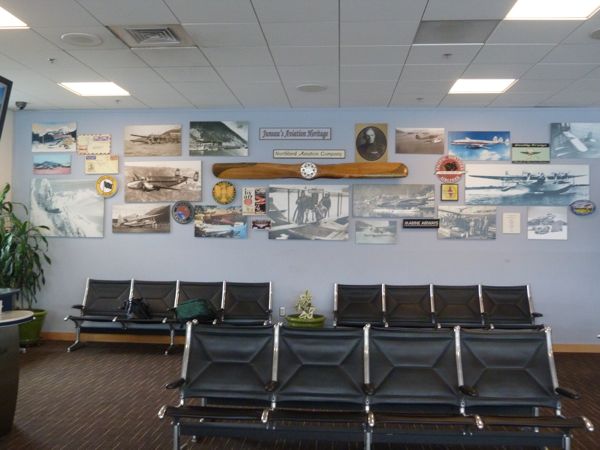
At our gate, I took a photo of the entire upstairs waiting room. This is the whole Juneau airport:

At our gate is a pictorial history of Alaska aviation, but it doesn’t answer my question: What was the other airline that flew alongside Coastal Airlines out of the downtown amphibious airport?

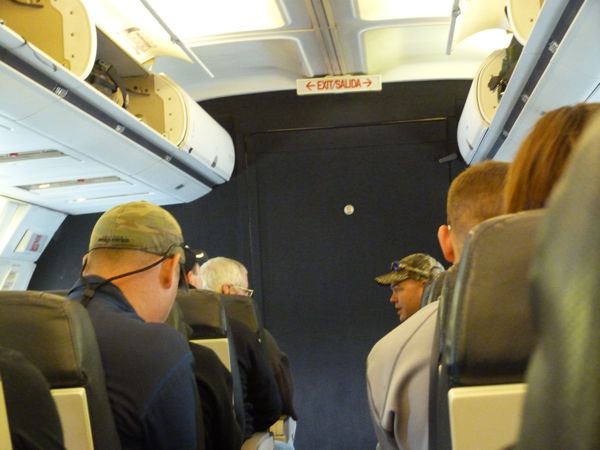
The plane we are on is kind of old-timey, and it is stopping in Yakutat and Cordova, two fishing villages, en route to Anchorage. There is no first class on this flight, but there is freight, and evidently a whole lot of freight. I have never seen this before, but the front part of the airplane is all blocked off with this black curtain/built-in thing for freight:
Sitting next to me is a man exactly my age who grew up across the channel from me. We were the same year in school, and he is cousin to the girls I played with when I was a kid. We didn’t know each other. As a grown-up, he piloted ferries for the Alaskan Marine Highway System and now does special contracts, guiding the large cruise ships through the various ice fields. And, he tells me, the other airline flying out of Juneau when we were kids, the one with the green planes, is Ellis Airlines. Wooo HOOOO! He tells me before we take off so I quickly text my Mom’s old friend because she was stumped, too! I knew it started with an “S”, LOL. Isn’t life funny, how you can end up sitting next to the right person at the right time and place, and ask the right question?
Anchorage airport is much larger than Juneau, but as we pick up our rental car, the man behind the counter learns we are former military and gives us a great car, and map, and lots of good directions to get us headed towards Seward. Life is sweet, in spite of all my griping and sour grapes.
June 25, 2014
Posted by intlxpatr |
Adventure, Alaska, Bureaucracy, Civility, Cultural, Customer Service, ExPat Life, Geography / Maps, GoogleEarth, Humor, Interconnected, Living Conditions, Local Lore |
2 Comments
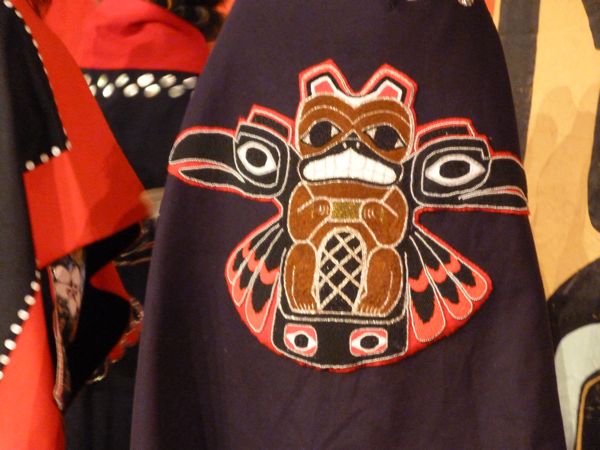
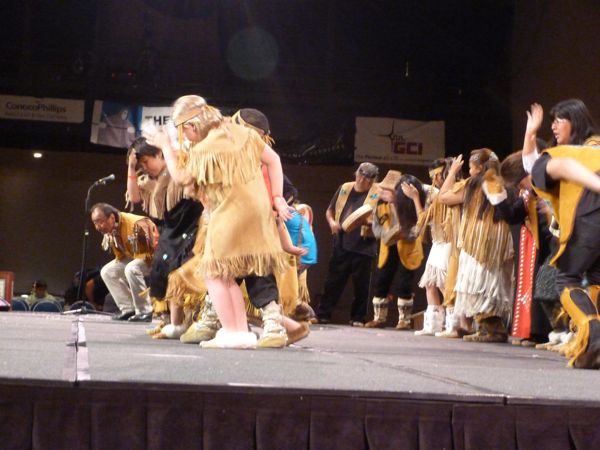
For the first time ever, the announcer tells us, the groups are all ready on time and the dancers ready to go – they are astonishingly ahead of schedule.
We return as a group of mixed dancers, from many Alaskan tribes, and some dancers with roots in classic “lower 48” tribes, so they all respect one another’s traditions, share, and do a little bit of everything. I kind of like this kind of flexibility. Some of the female costumes are a little ummm . . . skimpy . . . for the cold Alaskan climate, LOL, and some of the tattoos a little un-Alaskan and it doesn’t matter, they make it work.
The Celebration Hall is full and brimming over, dancers and their families in the waiting rooms, behind stage, in the halls, in the gift stores, children wailing for their Moms or Dads, it is totally a family affair. Grandma’s step in and help, and the dance goes on.



June 25, 2014
Posted by intlxpatr |
Alaska, Arts & Handicrafts, Beauty, Community, Cross Cultural, Cultural, Events, Friends & Friendship, Generational, Interconnected, Travel | AK, Celebration 2014, Juneau, Sealaska |
Leave a comment
“Are you from the Philippines?” AdventureMan asked the man behind the counter as he dished me up a cone of Huckleberry (Blueberry) ice cream.
“Yes, there are many of us here,” the man answered, and told us how one of the fastest growing demographics in Alaska is the Philippine community.
“At home, we are so poor,” he explained. We are lucky to have a one room shack for a family, and for water we have to walk a long way for running water. It is very bad.” He looked serious.
“How do you like it here?” AdventureMan asked, and the man grinned. “Life is good!” he said, with enthusiasm. He also mentioned the Mexican population in Alaska is growing almost as fast as the Philippine population. Who knew?
Normally, I don’t eat ice cream, but I have been craving something with either blueberries or rhubarb, two fruits that grew in Alaska when I was a kid, fruits we ate, jellied, froze, stored for later use. I had seen neither. Some might argue that huckleberries and blueberries are not the same. I don’t care. It is close enough for me. I also love that the cones are so extraordinary, artistic even, with their Alaskan Haida-esque sculptural quality:

And here is the proud cone-maker, also from the Philippines, who has a view to die for, the same view as from The Hanger on the Wharf, as she makes her specialty cones:

They insisted on giving us a 10% discount when they spotted my husband’s retired military ID card as he pulled out his wallet. They also shook his hand and thanked him for his service, a sweet and unexpected kindness in faraway Alaska.
June 25, 2014
Posted by intlxpatr |
Alaska, Arts & Handicrafts, Community, Cooking, Customer Service, Eating Out, ExPat Life, Interconnected, Quality of Life Issues, Travel |
2 Comments
Taking a break from The Celebration, we get up early, drive to our Juneau friend’s house and park our car and she drives us over and drops us off to catch the AdventureBound trip out to Tracy Arms. For two weeks the weather forecasts have told us that this day will be sunny, bright and warm, and ha ha ha on us, it is cloudy and cold, but not much rain. In Juneau, not much rain is a pretty good day :-).
We meet some really fun people as we wait to board – one couple married four days, one couple of young adventurers who, like us, travel on their own as opposed to group travel or cruise ship travel. Our lively conversation made us late to board, only to discover that everyone else had booked for this “sunny” day and every seat in the cabin would be occupied. Once you sit down, that is YOUR spot, oh ugh, this is the worst kind of tour for us, but we discover we can go in and out at will and this works. We spend a lot of time outside, taking photos, watching for whale and porpoise and bear and eagles – all kinds of wildlife. It’s not so bad.
Before we leave, I shoot this photo. It’s not original; I had a similar poster once from the 1920’s or 1930’s advertising trans-Atlantic boat travel on some French line. I just love the lines:
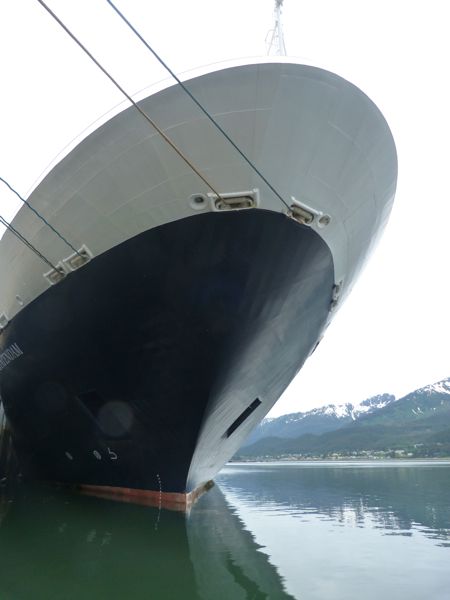
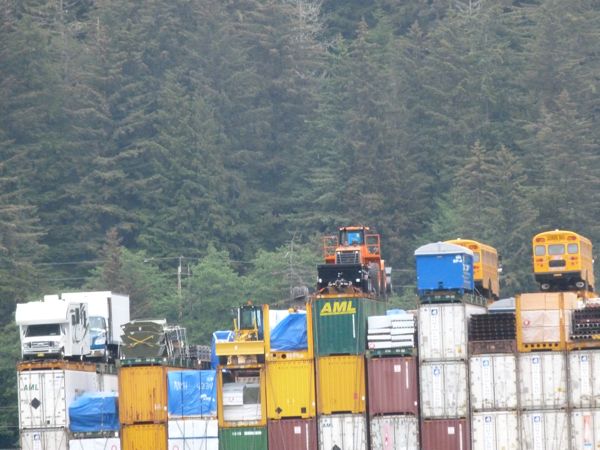
Juneau is landlocked, so everything that comes in or goes out goes by boat or plane. Container barges bring in larger items, and I was amazed how high they can stack a barge. I was also amazed that on top of the containers are vehicles strapped on tight; school buses, campers, snow plows – no wonder everything costs so much more in Alaska!


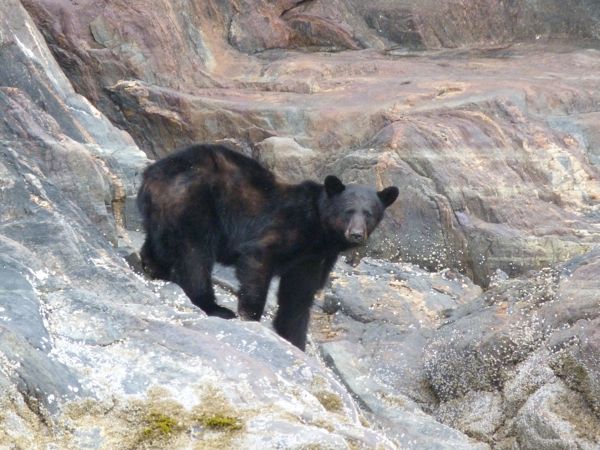
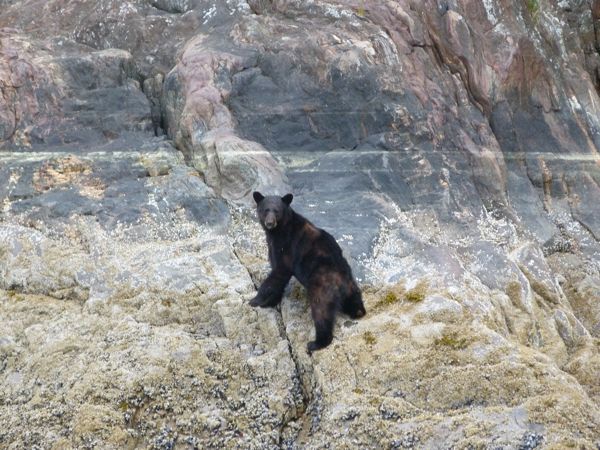
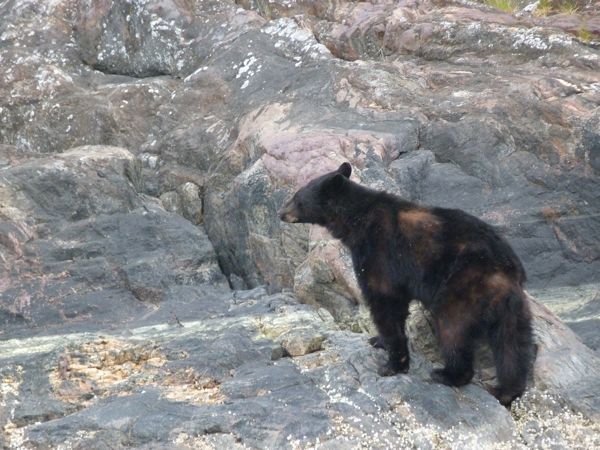
These bear made me so sad. Look how skinny they are, down at the bottom of tall, steep cliffs, eating barnacles. Bear eating barnacles – they must be starving. Some of them look all molty and have fur coming off.


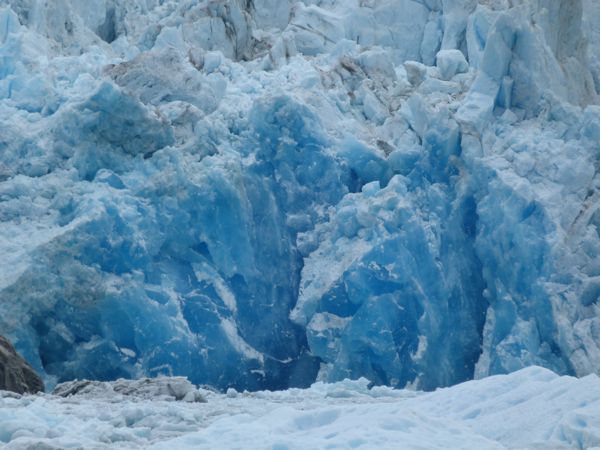
I never saw these glaciers when I was little. The Mendenhall glacier is relatively large compared to the Sawyer glaciers (1) and (2) but the Sawyer glaciers are calving. The sound is unforgettable, the cracking, the thunder, and entire sections of the glacier falling into the bay. Other burgs crack off underwater, and they come up huge, whole and a sparkling, unforgettable icy deep blue:
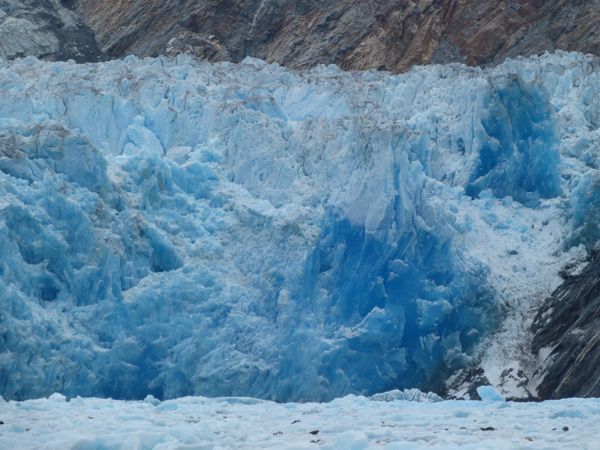

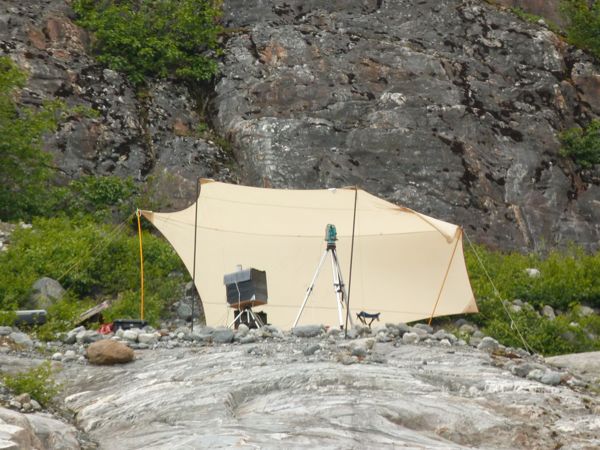
There is equipment going all the time at Tracy Arms to record the calving, the sights and sounds:
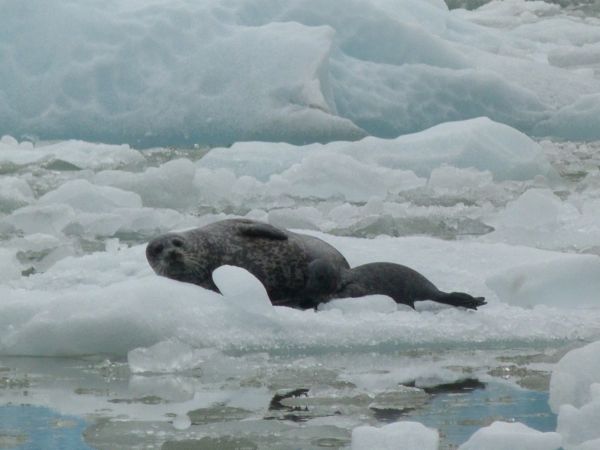
Mama and baby seals catching a few rays at high noon near the glacier:



Here is a piece breaking and falling into the water:



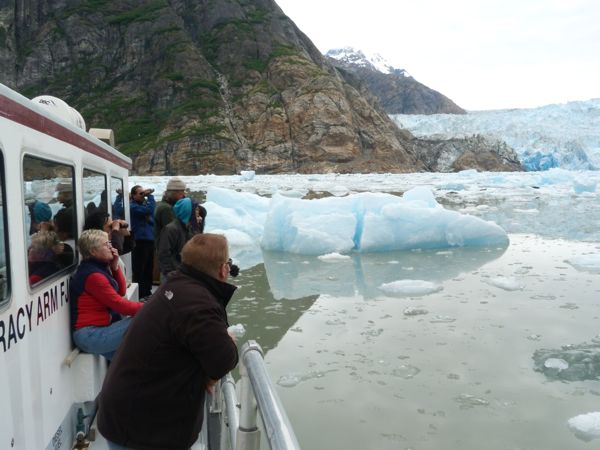
You can see the tour boat is surrounded by ice and icebergs:
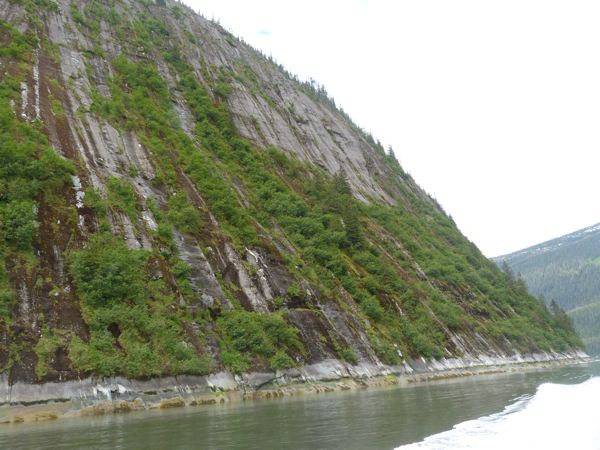
The glaciers are currently neither advancing nor receding, but you can read the trail of the glacier’s recession over thousands of years in the steep, ice-scraped mountains on both sides:
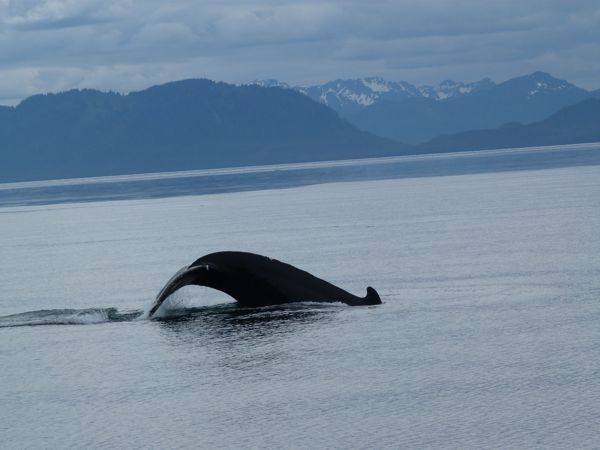
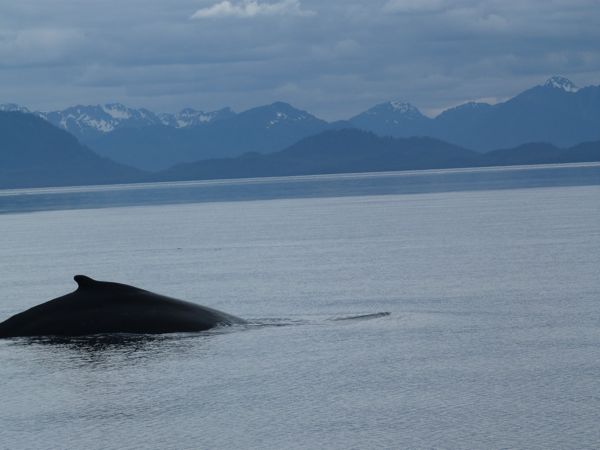
On our way home, we spot whale. You can shoot a lot of shots of a piece of whale, or where the whale was a split-second ago, LOL.

As we reach the dock, I call our friend to tell her we are arriving and she laughs and tells me she is already on her way; she was watching the boat arrive from her place across the channel. Within minutes, she is picking us up for home made fish cakes and chop chop salad. Best of all, great conversation, lots of laughter and wonderful stories of past times in Alaska. Her family was a pioneer family in Nome before she married and came to Juneau, so she has some great tales to share. Our families have had a lot of joint adventures, in Alaska, in Germany and in Edmonds.
She also asks great questions like “how did you buy groceries in Kuwait?” and “what did you do about laundry?”, practical questions, and exactly the kinds of things that made our lives more challenging – and interesting – to us. It was a great evening.

June 23, 2014
Posted by intlxpatr |
Adventure, Alaska, Beauty, Community, Environment, ExPat Life, Family Issues, Generational, Geography / Maps, GoogleEarth, Interconnected, Travel | Sawyer glaciers, Tracy Arms Fjord |
Leave a comment
First, we really love eating at the Hanger at the Wharf. So does just about everyone else. Twice, we got really lucky. It is easier getting a table if you are just two people, and it is easier getting a table if you eat early. As we are still on Pensacola tummy time, we are in luck. As the Celebration 2014 parade ended, we zipped straight over and as larger groups waited, we were immediately shown to a table for two.
No wonder The Hanger is so popular. The food is terrific and this is the view – straight down the Gastineau channel with Douglas and the cruise ships. As the sun slides behind the mountain, it is a stunning view:

Some hardier souls were eating outside on the deck. I used to be this hardy, but my years in the Middle East have softened me, made me not so good at eating in cool and drafty places, even in the middle of the Alaskan summer.

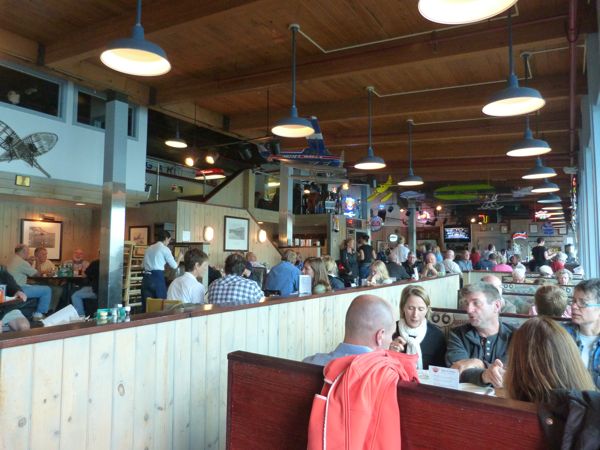
Inside The Hanger: great, courteous, friendly and efficient employees
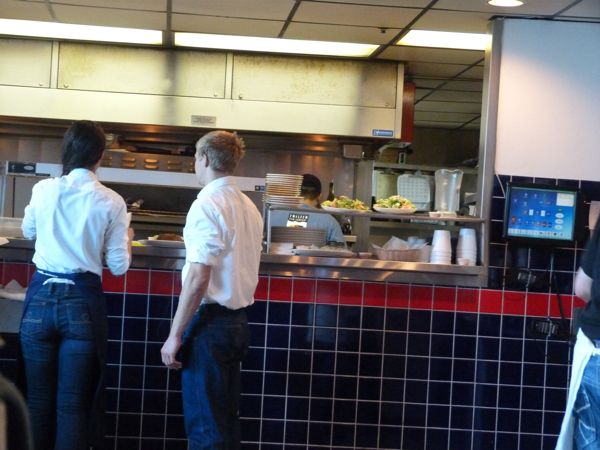
Every table taken, the bar is packed, and people are waiting in the hallway to be seated:

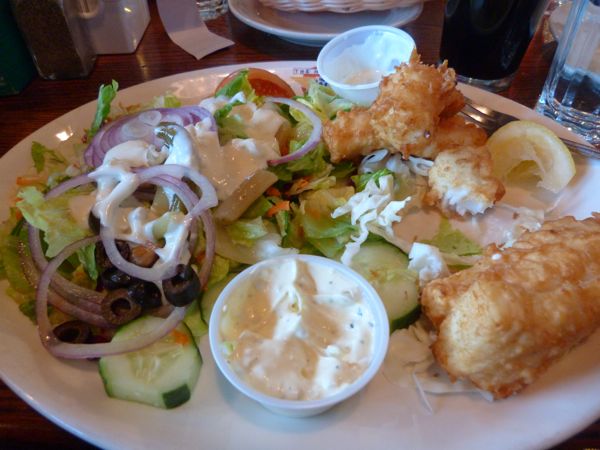
My halibut tempura:

AdventureMan’s halibut burger and fries:
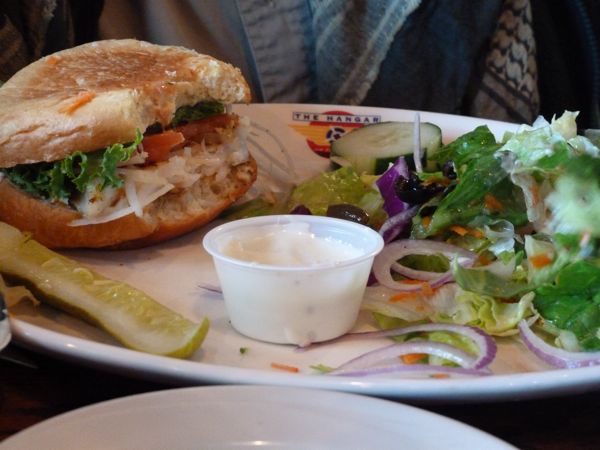
We liked the food and atmosphere so well that we went back a second time during the ceremonial dances and were happy to see a lot of the dancers eating there, too. I had the first mate’s plate, with salmon and halibut and a berry chutney and AdventureMan had grilled halibut. We both left happy. We would go there again in a heartbeat.
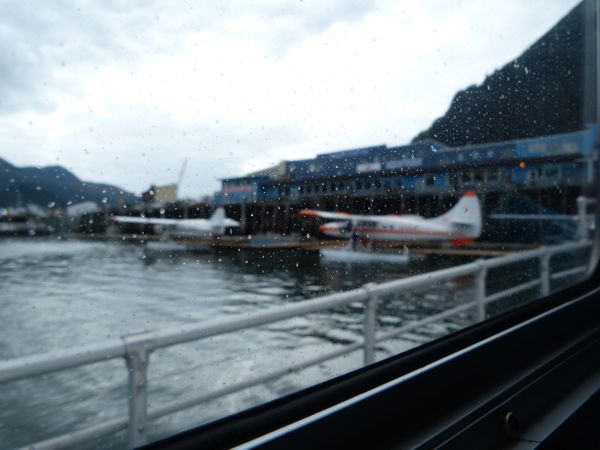
There is only one little thing about The Hanger that makes me uneasy, and it has nothing to do with The Hanger. When I was a little girl, living across the channel, I would watch for my Dad to come home – this was the airport for the amphibious planes, Alaska Coastal Airlines (now part of Alaska Airlines) and Ellis Airlines. When his plane would land, we would all rush to the car and drive like crazy across the bridge to pick him up (no cell phones then, LOL). So I still feel a little frisson and feel the ghosts of the past when I eat there.

June 23, 2014
Posted by intlxpatr |
Alaska, Arts & Handicrafts, Circle of Life and Death, Community, Cultural, Customer Service, Eating Out, ExPat Life, Food, Interconnected, Living Conditions, Local Lore, Photos, Restaurant, Road Trips | AK, Celebration 2014, Juneau |
2 Comments
This is today’s Forward Day by Day reading, and I think it is perfect for Memorial Day, a day in which we celebrate those who fought and gave their lives that we might live free:
MONDAY, May 26 Rogation Day
Matthew 13:14. You will indeed listen, but never understand, and you will indeed look, but never perceive.
The daughter of the young clergyman looked and she did perceive.
She had taken a bus trip with her father to their home country so she could obtain an identification card at the age of eighteen. Before the bus left, the driver asked if someone would pray for a safe journey. Her father walked to the front of the bus and led the passengers in prayer. Later, at a rest stop, the priest noticed some trash littering the area. After other passengers walked past heedlessly, he scooped it up and put it in a trash bin.
The acts seemed minor, and he thought no more about them. But later, his daughter asked him to read her homework—a profile of a leader. He did and was humbled and amazed.
The profile was about him. Citing those two examples and others, the daughter described how his behavior reflected his values. She wrote, “Leadership is not a title, but it is about the way you live your life.”
She had done much more than see her father’s actions. She had perceived their meaning and importance in the context of their faith.
May 26, 2014
Posted by intlxpatr |
Character, Civility, Community, Cultural, Environment, Faith, Hygiene, Interconnected, Leadership, Lectionary Readings |
Leave a comment
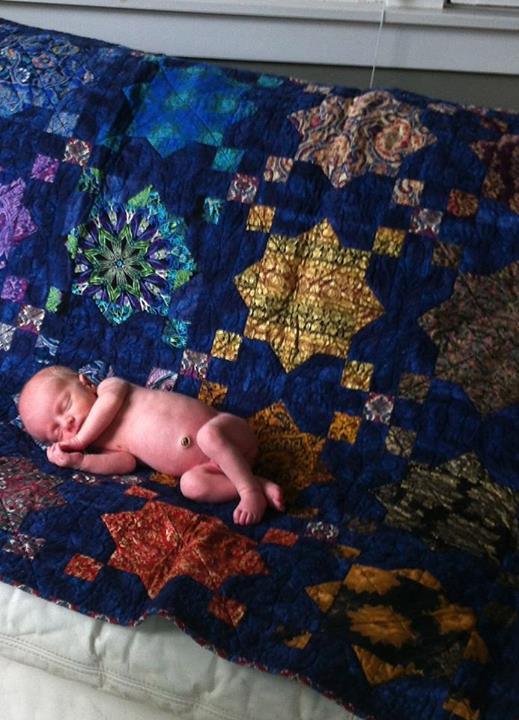
My sweet niece, Little Diamond (Professor Little Diamond 🙂 ) has given birth to two of the most perfectly beautiful little babies, ever. These are the quilts I made for them, and lastly is one of the sweet babies on his quilt. Congratulations, Umm Al Tawaman, God is good and full of mercy and compassion.
 This one is called Interconnected.
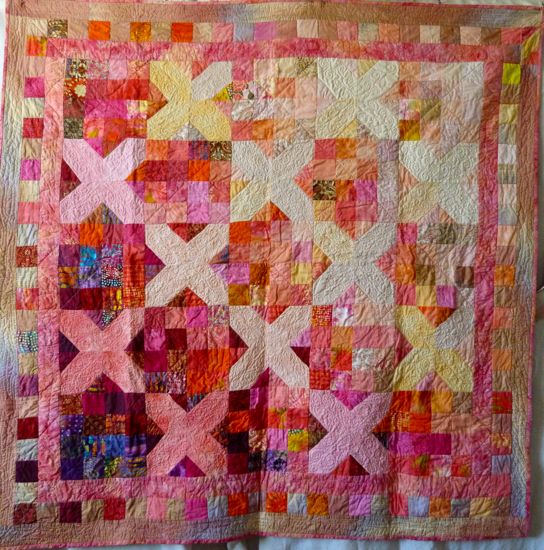 This one is called Desert Rose.
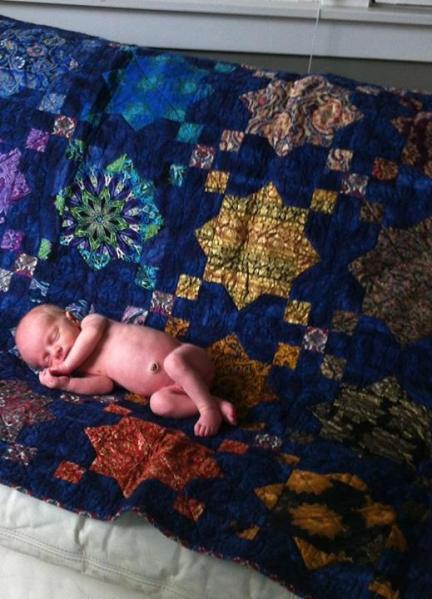
Isn’t that a beautiful little baby? 🙂
May 15, 2014
Posted by intlxpatr |
Arts & Handicrafts, Circle of Life and Death, Family Issues, Generational, Interconnected, Mating Behavior, Parenting |
2 Comments
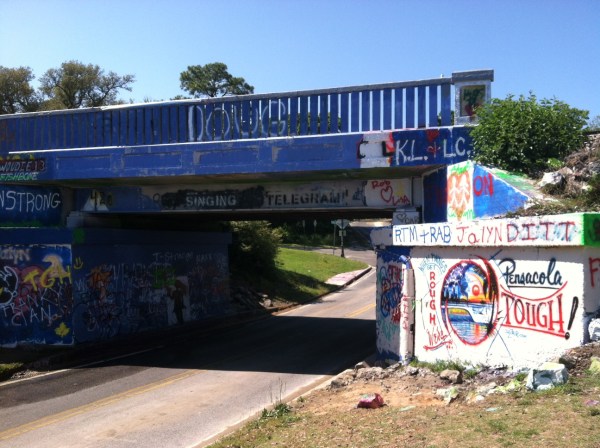
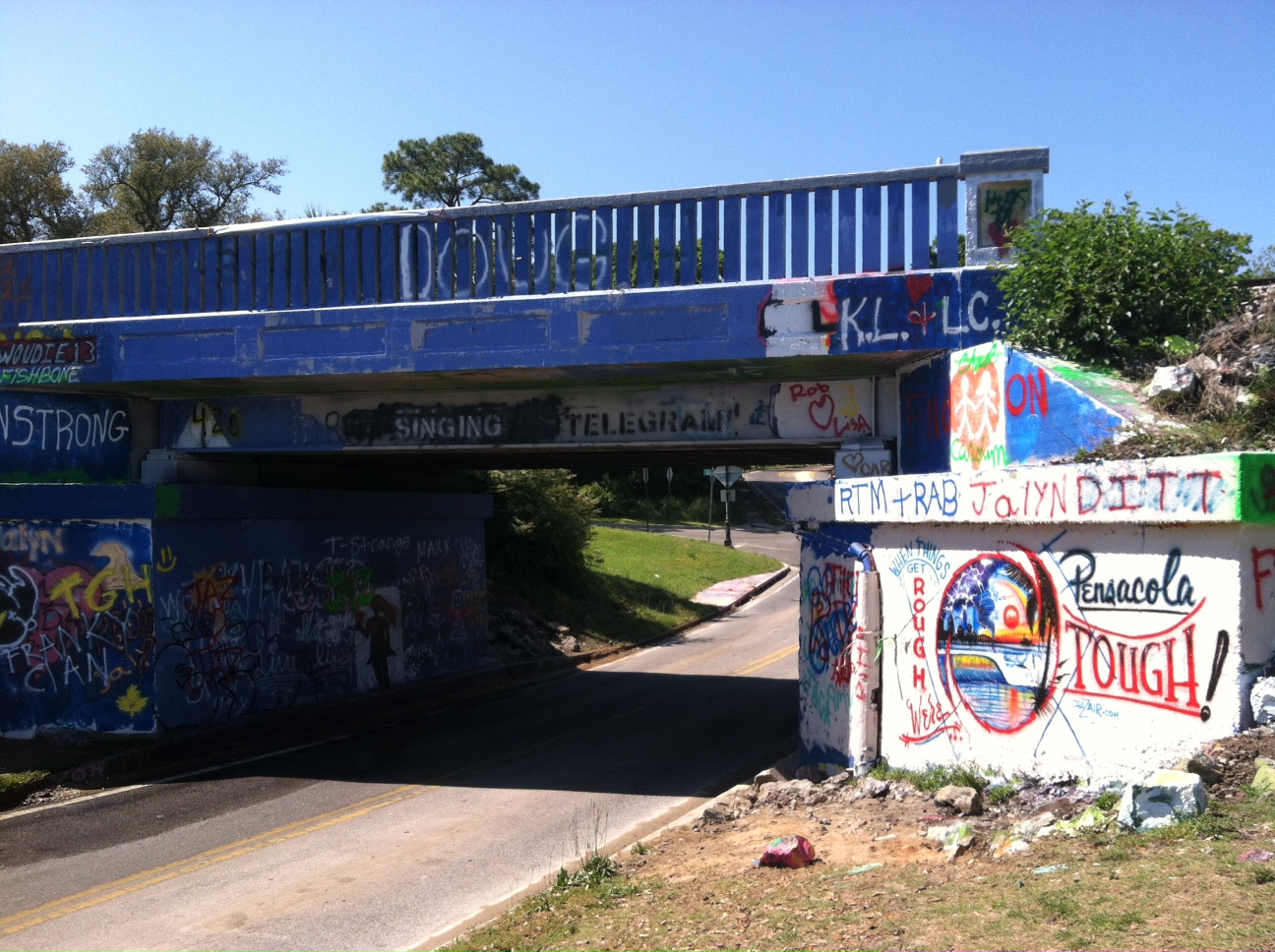
On my way home from a great Algerian pastry treat at SoGourmet, I passed Grafitti Bridge. Grafitti Bridge is one of Pensacola’s quirks. Every month – sometimes every week, even sometimes daily – the bridge is repainted. Sometimes it is that BubbleGum pink of Breast Cancer Awareness, with names of the fallen and names of survivors, sometimes it is Gay Pride, sometimes it is who loves who, or who is a first class jerk, sometimes it is Class of TwoThousandWhatever – it can be whatever someone feels passionate enough about to buy the paint and make it happen. No one gets too bent out of shape about it. Occasionally profanity will show up, but very shortly someone else will spray paint out the offensive word, or, which I love, alter it to have an entirely new meaning.
As I drove past today, I saw a lightning storm, well done, I couldn’t imagine how they had captured what it was like seeing so many strikes at once, and then I saw “Pensacola Tough.” By that time, I was through the bridge, so I had to circle and go back. I had to park, and take a closer look. And then I had to photograph it, and post it here.

Pensacola Tough. Pensacola got an award as the Toughest City in the USA, based on a criteria that measured percentage of felons in the population (it’s OK, it keeps us humble), sports heros, the number of military personnel, violent crime statistics, etc. It isn’t an award cities run for.
And yet, as the raging water abates, tales of heroism and helpfulness abound. While there have been bands of looters at an apartment complex housing the low-income workers in Pensacola, there have also been bands of volunteers scouring the county, helping clean out houses, pull out sodden carpeting, moving soaked furniture to the curbs for pickup, pulling out drywall and ceilings to prevent black mold. In today’s Pensacola News Journal, there is a story of a man who worked just above where the Escambia County Jail exploded and fell through the floor, breaking legs, ribs and assorted bones. He was paralyzed. His co-worker, also hurt, saw him with his head under water and pulled his head out, and held his head out for over an hour while waiting for help to arrive. She got tired, but the alternative was letting him die. She didn’t let go.
Pensacola Tough.
“When Things Get Rough . . . We’re Pensacola Tough.
You gotta love this place
May 5, 2014
Posted by intlxpatr |
Arts & Handicrafts, Beauty, Civility, Communication, Community, Cultural, ExPat Life, Free Speech, Gulf Coast Citizen Diplomacy Council, Interconnected, Living Conditions, Local Lore, Pensacola, Values, Weather |
Leave a comment
CDC confirms first case of MERS virus in American
May 2nd 2014 3:51PM
 |
|
This file photo provided by the National Institute for Allergy and Infectious Diseases shows a colorized transmission of the MERS coronavirus that emerged in 2012. Health officials on Friday, May 2, 2014 said the deadly virus from the Middle East has turned up for the first time in the U.S. (AP Photo/National Institute for Allergy and Infectious Diseases via The Canadian Press, File)
|
By MIKE STOBBENEW YORK (AP) — Health officials on Friday confirmed the first case of an American infected with a mysterious Middle East virus. The man fell ill after arriving in the U.S. about a week ago from Saudi Arabia where he is a health care worker.
The man is hospitalized in Indiana with Middle East respiratory syndrome, or MERS, according to the Centers for Disease Control and Prevention, which is investigating the case along with Indiana health officials.
Saudi Arabia has been the center of an outbreak of MERS that began about two years ago. At least 400 people have had the respiratory illness, and more than 100 people have died. All had ties to the Middle East or to people who traveled there. Infections have been previously reported among health care workers.
MERS belongs to the coronavirus family that includes the common cold and SARS, or severe acute respiratory syndrome, which caused some 800 deaths globally in 2003.
The MERS virus has been found in camels, but officials don’t know how it is spreading to humans. It can spread from person to person, but officials believe that happens only after close contact. Not all those exposed to the virus become ill.
But it appears to be unusually lethal – by some estimates, it has killed nearly a third of the people it sickened. That’s a far higher percentage than seasonal flu or other routine infections. But it is not as contagious as flu, measles or other diseases. There is no vaccine or cure for MERS.
The CDC on Friday released only limited information about the U.S. case: The man flew to the United States about a week ago, with a stop in London. He landed in Chicago and took a bus to the neighboring state of Indiana. He didn’t become sick until arriving in Indiana, the CDC said. Symptoms include fever, cough, breathing problems, which can lead to pneumonia and kidney failure.
CDC officials say they are sending a team to investigate the man’s illness, his travel history and to track down people he may have been in close contact with.
Saudi Arabia health officials have recently reported a surge in MERS illnesses; cases have tended to increase in the spring. Experts think the uptick may party be due to more and better surveillance. Researchers at Columbia University have an additional theory – there may be more virus circulating in the spring, when camels are born.
U.S. health officials have been bracing for the arrival of one or more cases, likely among travelers. Isolated cases of MERS have been carried outside the Middle East. Previously, 163 suspected cases were tested in the U.S. but none confirmed.
May 2, 2014
Posted by intlxpatr |
Circle of Life and Death, ExPat Life, Health Issues, Interconnected, Living Conditions, Saudi Arabia, Travel | MERS virus |
Leave a comment



























 Here There and Everywhere