When I was a kid, I did not like reading the Old Testament, all those old-timey people, and it all seemed very confusing to me. As I grew older, I find I like the Old Testament part of our readings very much, the people come alive in all their faults and bad decisions, and God’s mercy shines through as we continue to rebel against him and follow too much our own devices and desires of our hearts.
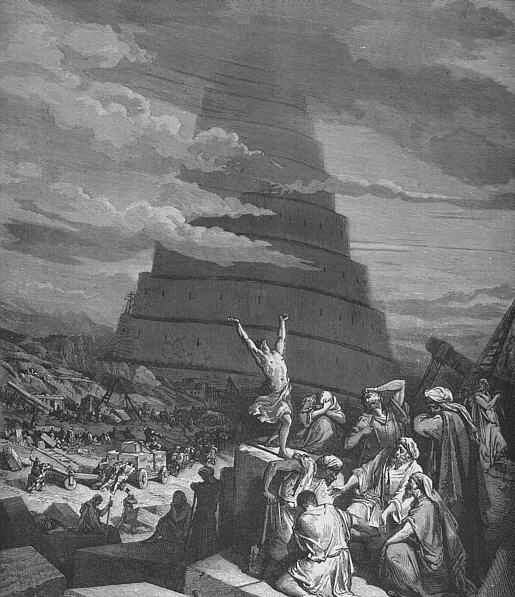
I love Genesis 11, where mankind, in all our pride, decides to build a tower, and it must have been pretty good because it got God’s attention and he didn’t like it. He didn’t like it so much that he created confusion among all the languages spoken, but I bet it was also confusion and dissension among the decision makers, too, to scatter the mighty population.

As the wandering descendants of Abraham began to settle, they often went up against armies and peoples much larger than they were, and God always told them not to worry, he would confuse the armies. He put fear in their hearts, in the confusion, mighty armies collapsed and scattered.
And why am I bringing this up, you might wonder?
This ISIS Army, it seems to me, is already cobbled together. I hear people people talking, people who know, they say ISIS is smart, fights smart. I believe they have some smart leaders, but I am willing to bet that they have some fatal flaws, also. They have overstretched. They are trying to enforce their will by violence and killing off the opposition, which might encourage the appearance of cooperation, but in reality breeds legions of those who will turn on them in a heartbeat.
Yes, we mistakenly dropped weapons which they were able to access. Mistakes happen in war zones all the time, with modern communication we just hear about it a lot sooner, not like 40 years from now when it is declassified and someone writes a book about it. Frankly, it’s not that big a deal.
What I believe is a big deal is their lack of cohesion. Lacking any strategic direct line to important decision makers, I am praying, and what I am praying is this, words from Psalms:
Confuse, O Lord, confound their speech
Disintegrate ISIS from the inside.
Create, Great and Merciful Father, miscommunications, misunderstandings, competing agendas and internal strife among the ISIS force.
All Mighty, All Powerful God, create a massive collapse, let their foot-soldiers drift away, drift home to their mothers and fathers and their families, and leave the Iraqi villages and the Syrian villages in peace.
Dry up the wealth of the Gulf, funneled through corrupt money changers in Kuwait, let it be mishandled, go missing, be stolen, be diverted and find its way to true charitable organizations providing a means of survival to those thousands of refugees who have been displaced.
Oh God! Collapse this abomination, the Islamic State of the Levant and Syria, collapse it utterly from within, strip it of all its power, devastate it like a virulent plague from within!
Oh God, bring good out of this downfall. Teach the remnants who return to their homes to live together in peace, to form peaceful and stable communities and then nations whose lives honor you!
All this is possible for the God who can do all things. Confound their speech, Lord, confuse them utterly, devastate and collapse them utterly from within. You are the one true God, there is no other God.
We are not without resources. We have the mighty fist of prayer.
November 2, 2014
Posted by intlxpatr |
Bureaucracy, Character, Charity, Civility, Counter-terrorism, Cultural, Doha, Interconnected, Living Conditions, Political Issues, Quality of Life Issues, Relationships, Social Issues, Spiritual, Women's Issues, Work Related Issues | Daish, Gulf, ISIS, Kuwait, Qatar, Saudi Arabia |
1 Comment
Again, from the Lectionary readings for today, the devastation of gossip and slander, particularly appropriate during this season of vitriolic campaign ads, each more disgusting than the next:
Sirach 28:14-26
14 Slander* has shaken many,
and scattered them from nation to nation;
it has destroyed strong cities,
and overturned the houses of the great.
15 Slander* has driven virtuous women from their homes,
and deprived them of the fruit of their toil.
16 Those who pay heed to slander* will not find rest,
nor will they settle down in peace.
17 The blow of a whip raises a welt,
but a blow of the tongue crushes the bones.
18 Many have fallen by the edge of the sword,
but not as many as have fallen because of the tongue.
19 Happy is one who is protected from it,
who has not been exposed to its anger,
who has not borne its yoke,
and has not been bound with its fetters.
20 For its yoke is a yoke of iron,
and its fetters are fetters of bronze;
21 its death is an evil death,
and Hades is preferable to it.
22 It has no power over the godly;
they will not be burned in its flame.
23 Those who forsake the Lord will fall into its power;
it will burn among them and will not be put out.
It will be sent out against them like a lion;
like a leopard it will mangle them.
24a As you fence in your property with thorns,
25b so make a door and a bolt for your mouth.
24b As you lock up your silver and gold,
25a so make balances and scales for your words.
26 Take care not to err with your tongue,*
and fall victim to one lying in wait.
October 29, 2014
Posted by intlxpatr |
Character, Charity, Civility, Communication, Community, Interconnected, Quality of Life Issues, Values, Words |
2 Comments
Today’s reading in the Lectionary is from Sirach, one of the books of the Apocrypha, and features wisdom on faithful friends. I especially love “let your advisors be one in a thousand.” I have been greatly blessed to have found a few of those, and they stick with you for a lifetime.
Bless you, bless you, faithful friends!
Sirach 6:5-17
5 Pleasant speech multiplies friends,
and a gracious tongue multiplies courtesies.
6 Let those who are friendly with you be many,
but let your advisers be one in a thousand.
7 When you gain friends, gain them through testing,
and do not trust them hastily.
8 For there are friends who are such when it suits them,
but they will not stand by you in time of trouble.
9 And there are friends who change into enemies,
and tell of the quarrel to your disgrace.
10 And there are friends who sit at your table,
but they will not stand by you in time of trouble.
11 When you are prosperous, they become your second self,
and lord it over your servants;
12 but if you are brought low, they turn against you,
and hide themselves from you.
13 Keep away from your enemies,
and be on guard with your friends.
14 Faithful friends are a sturdy shelter:
whoever finds one has found a treasure.
15 Faithful friends are beyond price;
no amount can balance their worth.
16 Faithful friends are life-saving medicine;
and those who fear the Lord will find them.
17 Those who fear the Lord direct their friendship aright,
for as they are, so are their neighbours also.
October 21, 2014
Posted by intlxpatr |
Character, Community, Cross Cultural, ExPat Life, Faith, Interconnected, Lectionary Readings, Relationships |
2 Comments
We have had a choice of Old Testament readings this week in the Lectionary readings, either Esther or Judith, (Judith is in the Apocrypha). I like both stories 🙂 Judith is a tale to curl your hair, a tale not for children, but an amazing story within that culture, and telling. Meanwhile, I wondered, where is Susa?
As it turned out, I lived almost next door to Susa. So close I could spit across the Gulf. I wonder if I will ever have a chance to visit Iran? As hopeless as the current situation(s) in the Middle East look, I have seen amazing and wondrous things in my life – the fall of the Berlin Wall and the unification of South Africa sans apartheid – and I believe, by God’s grace, anything is possible.
Here is Susa:

September 26, 2014
Posted by intlxpatr |
Cross Cultural, Geography / Maps, Interconnected, Iran, Lectionary Readings, Women's Issues | Holofernes, Iraq, Judith, King Ahasuerus, Mordecai, Susa |
Leave a comment
The Islamic State of Iraq and Syria (ISIS), now threatening Baghdad, was funded for years by wealthy donors in Kuwait, Qatar, and Saudi Arabia, three U.S. allies that have dual agendas in the war on terror.
The extremist group that is threatening the existence of the Iraqi state was built and grown for years with the help of elite donors from American supposed allies in the Persian Gulf region. There, the threat of Iran, Assad, and the Sunni-Shiite sectarian war trumps the U.S. goal of stability and moderation in the region.It’s an ironic twist, especially for donors in Kuwait (who, to be fair, back a wide variety of militias). ISIS has aligned itself with remnants of the Baathist regime once led by Saddam Hussein. Back in 1990, the U.S. attacked Iraq in order to liberate Kuwait from Hussein’s clutches. Now Kuwait is helping the rise of his successors.As ISIS takes over town after town in Iraq, they are acquiring money and supplies including American made vehicles, arms, and ammunition. The group reportedly scored $430 million this week when they looted the main bank in Mosul. They reportedly now have a stream of steady income sources, including from selling oil in the Northern Syrian regions they control, sometimes directly to the Assad regime.
But in the years they were getting started, a key component of ISIS’s support came from wealthy individuals in the Arab Gulf States of Kuwait, Qatar and Saudi Arabia. Sometimes the support came with the tacit nod of approval from those regimes; often, it took advantage of poor money laundering protections in those states, according to officials, experts, and leaders of the Syrian opposition, which is fighting ISIS as well as the regime.
“Everybody knows the money is going through Kuwait and that it’s coming from the Arab Gulf,” said Andrew Tabler, senior fellow at the Washington Institute for Near East Policy. “Kuwait’s banking system and its money changers have long been a huge problem because they are a major conduit for money to extremist groups in Syria and now Iraq.”
Iraqi Prime Minister Nouri al-Maliki has been publicly accusing Saudi Arabia and Qatar of funding ISIS for months. Several reports have detailed how private Gulf funding to various Syrian rebel groups has splintered the Syrian opposition and paved the way for the rise of groups like ISIS and others.
“The U.S. has made the case as strongly as they can to regional countries, including Kuwait. But ultimately when you take a hands off, leading from behind approach to things, people don’t take you seriously and they take matters into their own hands.”
Gulf donors support ISIS, the Syrian branch of al Qaeda called the al Nusrah Front, and other Islamic groups fighting on the ground in Syria because they feel an obligation to protect Sunnis suffering under the atrocities of the Assad regime. Many of these backers don’t trust or like the American backed moderate opposition, which the West has refused to provide significant arms to.
Under significant U.S. pressure, the Arab Gulf governments have belatedly been cracking down on funding to Sunni extremist groups, but Gulf regimes are also under domestic pressure to fight in what many Sunnis see as an unavoidable Shiite-Sunni regional war that is only getting worse by the day.
“ISIS is part of the Sunni forces that are fighting Shia forces in this regional sectarian conflict. They are in an existential battle with both the (Iranian aligned) Maliki government and the Assad regime,” said Tabler. “The U.S. has made the case as strongly as they can to regional countries, including Kuwait. But ultimately when you take a hands off, leading from behind approach to things, people don’t take you seriously and they take matters into their own hands.”
Donors in Kuwait, the Sunni majority Kingdom on Iraq’s border, have taken advantage of Kuwait’s weak financial rules to channel hundreds of millions of dollars to a host of Syrian rebel brigades, according to a December 2013 report by The Brookings Institution, a Washington think tank that receives some funding from the Qatari government.
“Over the last two and a half years, Kuwait has emerged as a financing and organizational hub for charities and individuals supporting Syria’s myriad rebel groups,” the report said. “Today, there is evidence that Kuwaiti donors have backed rebels who have committed atrocities and who are either directly linked to al-Qa’ida or cooperate with its affiliated brigades on the ground.”
Kuwaiti donors collect funds from donors in other Arab Gulf countries and the money often travels through Turkey or Jordan before reaching its Syrian destination, the report said. The governments of Kuwait, Qatar, and Saudi Arabia have passed laws to curb the flow of illicit funds, but many donors still operate out in the open. The Brookings paper argues the U.S. government needs to do more.
“The U.S. Treasury is aware of this activity and has expressed concern about this flow of private financing. But Western diplomats’ and officials’ general response has been a collective shrug,” the report states.
When confronted with the problem, Gulf leaders often justify allowing their Salafi constituents to fund Syrian extremist groups by pointing back to what they see as a failed U.S. policy in Syria and a loss of credibility after President Obama reneged on his pledge to strike Assad after the regime used chemical weapons.
That’s what Prince Bandar bin Sultan, head of Saudi intelligence since 2012 and former Saudi ambassador in Washington, reportedly told Secretary of State John Kerry when Kerry pressed him on Saudi financing of extremist groups earlier this year. Saudi Arabia has retaken a leadership role in past months guiding help to the Syrian armed rebels, displacing Qatar, which was seen as supporting some of the worst of the worst organizations on the ground.
The rise of ISIS, a group that officially broke with al Qaeda core last year, is devastating for the moderate Syrian opposition, which is now fighting a war on two fronts, severely outmanned and outgunned by both extremist groups and the regime. There is increasing evidence that Assad is working with ISIS to squash the Free Syrian Army.
But the Syrian moderate opposition is also wary of confronting the Arab Gulf states about their support for extremist groups. The rebels are still competing for those governments’ favor and they are dependent on other types of support from Arab Gulf countries. So instead, they blame others—the regimes in Tehran and Damascus, for examples—for ISIS’ rise.
“The Iraqi State of Iraq and the [Sham] received support from Iran and the Syrian intelligence,” said Hassan Hachimi, Head of Political Affairs for the United States and Canada for Syrian National Coalition, at the Brookings U.S.-Islamic World Forum in Doha this week.
“There are private individuals in the Gulf that do support extremist groups there,” along with other funding sources, countered Mouaz Moustafa, executive director of the Syrian Emergency Task Force, a Syrian-American organization that supports the opposition “[The extremist groups] are the most well-resourced on the ground… If the United States and the international community better resourced [moderate] battalions… then many of the people will take that option instead of the other one.”
(Thank you for the lead, Muller 🙂 )
September 25, 2014
Posted by intlxpatr |
Bureaucracy, Counter-terrorism, Cross Cultural, ExPat Life, Financial Issues, Fund Raising, Interconnected, Kuwait, Leadership, Middle East, Political Issues, Qatar, Quality of Life Issues, Saudi Arabia, Social Issues, Women's Issues | Kuwait banks, Kuwait moneychangers, Religious Freedom, Shuria Law |
5 Comments
From yesterday’s USA Today, a very brief article in the USA Round Up:
Alaska: Fairbanks
The number of security cameras in Alaska schools is going up. The Fairbanks Daily News-Mirror reported video cameras are being installed in Fairbanks middle and elementary schools and it’s part of a statewide trend aimed at making schools safer.
As I raised our son, I was – well, most of the time – an attentive parent. I would listen, and when necessary, I would correct. It’s a mother’s job to help her children navigate the pitfalls of life, and to have a tool-box full of resources with which to cope.
Perhaps I did my job too well. Our son became a lawyer, and he is very particular about the things I say, especially when I use a term incorrectly, such as irony.
Here is what Wikipedia says irony is:
event characterized by an incongruity, or contrast, between what the expectations of a situation are and what is really the case, with a third element, that defines that what is really the case is ironic because of the situation that led to it.
I am about to use the term “irony” correctly. 🙂

When I read the above article, I remembered the horror of Orwell’s 1984, the book, and then the movie. The movie was terrifying, the presence of cameras everywhere, hidden, not hidden, just knowing they were everywhere and everything you did could be monitored.
The irony comes in that here we are, with cameras everywhere, and we are glad for it. The irony is that our society has slipped so far from its ideal that we cannot trust our neighbor to behave him or herself, and we protect ourself by placing cameras so as to encourage people to behave.
I am not so sure that our moral codes have ever worked well; I think it seems to be the nature of humanity to claim a moral code, but not to adhere strictly to it. I think of people who talk about the safety of the ’50’s, but I don’t believe that safety was truly that safe. I think children disappeared. I think wives were beaten, women raped. I think robberies and assaults happened, and I think the law was more lax than it is today.
But it is an irony, IMHO, that we welcome cameras today as a low-cost policing of ourselves, our neighbors, and those we fear will hurt us or take our property. We trust ourselves and one another so little that we are increasingly installing cameras. We’ve been considering installing them through our home security company; we have motion detectors, cameras are just the next upgrade. Have we exchanged a high value on privacy for a heightened perceived need for protection of life and property?
September 25, 2014
Posted by intlxpatr |
Books, Character, Civility, Community, Crime, Cultural, Family Issues, GoogleEarth, Interconnected, Law and Order, Living Conditions, Privacy, Quality of Life Issues, Social Issues, Technical Issue |
4 Comments

A reading from today’s Forward Day by Day helps us to cope with the resonating horrors of that monstrous day. We are living in a world where we are more and more inextricably interconnected. Where I am living, I often hear people talk about how “Moslems are killing Christians all over the world!” and my heart breaks, thinking of the wonderful friends I have lived among is so many Moslem countries, their kindness, their hospitality, our long pleasant conversations. I learned so much.
I am glad we believe in a God who knows our hearts. I am thankful for grace, and forgiveness. When we talk about killing, we also need to take account for all the civilians we have killed, trying to bring about peace, trying to eradicate Al Qaeda, Al Shebaab, those who would harm us.
God asks us to love one another. He doesn’t say “Christians, you love just the Christians.” He shows us how to love the Samaritans, the lame, the blind, the mentally ill, the “other”. He tells us, clearly, to love our enemies. The Gospel that speaks the loudest is the gospel of our lives lived to honor him.
THURSDAY, September 11
Acts 15:8-9 [Peter said], “And God, who knows the human heart, testified to them…and in cleansing their hearts by faith he has made no distinction between them and us.”
Thirteen years ago, this day became one of those days that divide time into what life was like before, and after; one of those days when you will remember, always, where you were, what you were doing—this time when you heard the news that airplanes had crashed into the World Trade Center and thousands of people had died.
Job asks, “Does not calamity befall the unrighteous?” (31:3), but we learned, vividly, on September 11, 2001, that the righteous and the innocent suffer too.
Psalm 59:6 exhorts God to “show no mercy to those who are faithless and evil.” The terrorists who flew the planes on 9/11 forced us to confront the power of evil and challenged us to find a way to respond with forgiveness. Perhaps we can learn something about that in Peter’s response to the heated discussions about Jews and Gentiles, about who could be saved, and how: “God, who knows the human heart…has made no distinction between them and us” (Acts 15:8-9).
Then, as now, there were good people and evildoers on all sides, religions, and races. Now, as then, judgment and salvation comes only through the mercy and grace of God.
September 11, 2014
Posted by intlxpatr |
Charity, Circle of Life and Death, Civility, Community, Counter-terrorism, Crime, Cross Cultural, Events, ExPat Life, Faith, Friends & Friendship, Interconnected, Lectionary Readings, Pensacola, Political Issues, Quality of Life Issues, Spiritual | 9/11 |
Leave a comment
Big article in AOL news about Dan Gilbert going to Silicon Valley to pitch moving their offices to Detroit because it’s way cool.

Excuse me?
While I appreciate his loyalty to Detroit, the things he is pitching all apply to Pensacola – AND. And in Pensacola you don’t have harsh winters. And in Pensacola you are minutes from one of the most beautiful sugar-white sand beaches, uncrowded, in the world. And Pensacola is family oriented. And Pensacola has affordable housing. And Pensacola has a way-cool culture, with parades, symphony, ballet, opera, theatre and restaurants, and world class National Naval Aviation Museum. And people spend thousands of dollars to come visit Pensacola when they could be living the dream – in Pensacola.
Dan Gilbert is a powerful man – in Detroit. Now he wants to convince Silicon Valley to move to America’s Motor City where they’ll have wide open offices, inexpensive living, and access to amazing talent.
Gilbert, the chairman of Rock Ventures and the owner of Quicken Loans, owns 60 buildings in downtown Detroit that house 12,000 employees. He is also an active backer in startups and has been inviting small companies to come bloom in Detroit over the past half-decade.
Why should you move to Detroit?
“The perception doesn’t do it justice. You have a huge talent pool,” said Gilbert. “And the people are way cooler.”
Gilbert believes that the Midwest work ethic isn’t a myth. He said that, despite the rumors to the contrary, the city has an innovative city government and, thanks to his extensive purchases in Detroit, there is space to spare for new startups. He is also working hard to reduce blight around the city, ensuring that city doesn’t look like it does in the popular “desolation porn” that characterizes the city.
The result is a smaller, more compact city that allows smaller companies to gain a foothold in the tech economy.
The city is, arguably, entering a period of renaissance. Thanks to Quicken Loans and Gilbert’s work in the city, most of the blight has been converted to cheap office space. While it does still seem like a wasteland to the average graduate, we saw a city reborn when we visited in 2012 and things are improving immensely.
In short, he said, Detroit is all about opportunity.
“We have great bones,” said Gilbert.
Detroit has good bones? Pensacola has office space, room to grow, a population of workers that can be trained to fill high tech jobs, several colleges, a university, and low stress living. It’s such an easy sell.
September 10, 2014
Posted by intlxpatr |
Arts & Handicrafts, Beauty, Bureaucracy, Community, Cultural, ExPat Life, Family Issues, Financial Issues, Interconnected, Living Conditions, Local Lore, Pensacola, Quality of Life Issues, Values |
Leave a comment
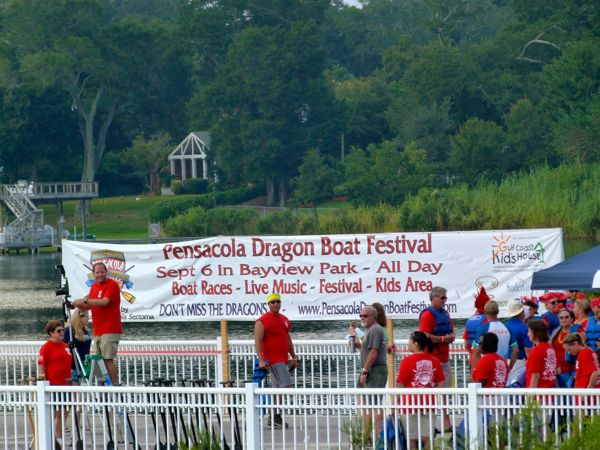
Dragon Boat races! What fun! Oh wait – what exactly is a dragon boat? What is a dragon boat race? This is the first time we have seen this done, benefiting the Gulf Coast Kid’s House, but what is it? Organized by the Northeast SERTOMA (Service to Mankind), there are so many people involved, racers, helpers, supporters, cheering squads, food providers, live music, DJ’s, dogs, children, now this is a Pensacola kind of day. 🙂
AdventureMan invited our grandson to spend the night, and after breakfast we headed over to Bayview Park, where the dragon boats were loading up with 20 rowers and one drummer/leader in each boat for the first heat of the race:




There was a drone flying over the races. I am guessing it was a local news drone, but I find drones creepy and intrusive. I think I would like crime-prevention drones, flying around neighborhoods looking for suspicious activity, but in general, drones creep me out.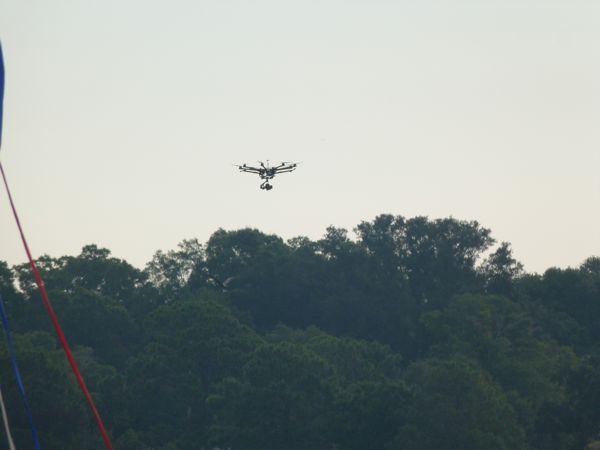
I liked this team; they were called the Justice Dragons and were sponsored by a local law firm. Every team had distinctive T-shirts, but this team also had these colorful hats, which as the day goes on, they will seriously be thankful to have.

It is a GREAT day for a race. And for such a good cause!
Coming in for a finish – I don’t know who is having a better time, the rowers or the audience. Hoots and hollers and bells and whistles and yelling . . . . there is a huge crowd at Bayview, and it is barely 8 in the morning.
Three teams are really close as they near the finish line . . . 
and then THIS team, below, picks up the pace in a serious way and totally WHOOPS the other two teams, catching them by surprise.
By ten, it is getting steamy and we head home. There so many great teams and they are having such a great team. This is a really fun event, and they are having a lot of fun. How cool is that, having so much fun, meeting a lot of people and it’s all going towards a great cause?
Below is the big win 🙂
September 6, 2014
Posted by intlxpatr |
Adventure, Community, Cultural, Events, Exercise, Family Issues, Fund Raising, Interconnected, Living Conditions, Parenting | Dragon Boat Races, Gulf Coast Kids House, Northeast SERTOMA |
Leave a comment
Its been a sad couple of months, starting with our cat’s death, and a friend’s death. We grieve Pete, we miss him, and we ask ourselves if we made a big mistake thinking a knee operation would be the right thing, if he would have lived happily without it? Pete was in pain. There were days he couldn’t go up the stairs. There were days he spent almost the entire day in his heated bed. We didn’t see a lot of options. Other sad news has hit; it feels like a season of losses.
In the Lectionary readings, we are reading Job, Ayyoub, and I think if my friend who said “Al-hamdallah!” when I told her my father is dying. I learned so much from her. She made me understand I am to thank God even for the bad things, it is God’s will, and a part of a bigger picture I will never see. And then this morning, I saw a reference to an old post, a post from 2006, a post I don’t even remember writing.
Thorns
Sandra felt as low as the heels of her shoes as she pushed against a November gust and the florist shop door.
Her life had been easy, like a spring breeze. Then in the fourth month of her second pregnancy, a minor automobile accident stole that from her.
During this Thanksgiving week she would have delivered a son. She grieved over her loss. As if that weren’t enough, her husband’s company threatened a transfer. Then her sister, whose holiday visit she coveted, called saying she could not come for the holiday.
Then Sandra’s friend infuriated her by suggesting her grief was a God-given path to maturity that would allow her to empathize with others who suffer. She has no idea what I’m feeling, thought Sandra with a shudder.
Thanksgiving? Thankful for what? She wondered. For a careless driver whose truck was hardly scratched when he rear-ended her? For an airbag that saved her life but took that of her child?
“Good afternoon, can I help you?” The shop clerk’s approach startled her.
“I….I need an arrangement,” stammered Sandra.
“For Thanksgiving? Do you want beautiful but ordinary, or would you like to challenge the day with a customer favorite I call the Thanksgiving “Special?” asked the shop clerk. “I’m convinced that flowers tell stories,” she continued. “Are you looking for something that conveys ‘gratitude’ this thanksgiving?”
“Not exactly!” Sandra blurted out. “In the last five months, everything that could go wrong has gone wrong.”
Sandra regretted her outburst, and was surprised when the shop clerk said, “I have the perfect arrangement for you.”
Just then the shop door’s small bell rang, and the shop clerk said, “Hi, Barbara…let me get your order.” She politely excused herself and walked toward a small workroom, then quickly reappeared, carrying an arrangement of greenery, bows, and long-stemmed thorny roses. Except the ends of the rose stems were neatly snipped: there were no flowers.
“Want this in a box?” asked the clerk.
Sandra watched for the customer’s response. Was this a joke? Who would want rose stems with no flowers! She waited for laughter, but neither woman laughed.
“Yes, please,” Barbara, replied with an appreciative smile. “You’d think after three years of getting the special, I wouldn’t be so moved by its significance, but I can feel it right here, all over again,” she said as she gently tapped her chest. And she left with her order.
“Uh,” stammered Sandra, “that lady just left with, uh….she just left with no flowers!
“Right, said the clerk, “I cut off the flowers. That’s the Special. I call it the Thanksgiving Thorns Bouquet.”
“Oh, come on, you can’t tell me someone is willing to pay for that!” exclaimed Sandra.
“Barbara came into the shop three years ago feeling much like you feel today,” explained the clerk. “She thought she had very little to be thankful for. She had lost her father to cancer, the family business was failing, her son was into drugs, and she was facing major surgery.”
“That same year I had lost my husband,” continued the clerk, “and for the first time in my life, had just spent the holidays alone. I had no children, no husband, no family nearby, and too great a debt to allow any travel.”
“So what did you do?” asked Sandra.
“I learned to be thankful for thorns,” answered the clerk quietly. “I’ve always thanked God for the good things in my life and never questioned the good things that happened to me, but when bad stuff hit, did I ever ask questions! It took time for me to learn that dark times are important. I have always enjoyed the ‘flowers’ of life, but it took thorns to show me the beauty of God’s comfort. You know, the Bible says that God comforts us when we’re afflicted, and from His consolation we learn to comfort others.”
Sandra sucked in her breath as she thought about the very thing her friend had tried to tell her. “I guess the truth is I don’t want comfort. I’ve lost a baby and I’m angry with God.”
Just then someone else walked in the shop. “Hey, Phil!” shouted the clerk to the balding, rotund man.
“My wife sent me in to get our usual Thanksgiving Special….12 thorny, long-stemmed stems!” laughed Phil as the clerk handed him a tissue-wrapped arrangement from the refrigerator.
“Those are for your wife?” asked Sandra incredulously. “Do you mind me asking why she wants something that looks like that?”
“No…I’m glad you asked,” Phil replied. “Four years ago my wife and I nearly divorced. After forty years, we were in a real mess, but with the Lord’s grace and guidance, we slogged through problem after problem. He rescued our marriage. Jenny here (the clerk) told me she kept a vase of rose stems to remind her of what she learned from “thorny” times, and that was good enough for me. I took home some of those stems. My wife and I decided to label each one for a specific “problem” and give thanks for what that problem taught us.”
As Phil paid the clerk, he said to Sandra, “I highly recommend the Special!”
“I don’t know if I can be thankful for the thorns in my life.” Sandra said. “It’s all too…fresh.”
“Well,” the clerk replied carefully, “my experience has shown me that thorns make roses more precious. We treasure God’s providential care more during trouble than at any other time. Remember, it was a crown of thorns that Jesus wore so we might know His love. Don’t resent the thorns.”
Tears rolled down Sandra’s cheeks. For the first time since the accident, she loosened her grip on resentment. “I’ll take those twelve long-stemmed thorns, please,” she managed to choke out.
“I hoped you would,” said the clerk gently. “I’ll have them ready in a minute.”
“Thank you. What do I owe you?”
“Nothing. Nothing but a promise to allow God to heal your heart. The first year’s arrangement is always on me.” The clerk smiled and handed a card to Sandra. “I’ll attach this card to your arrangement, but maybe you would like to read it first.”
It read: “My God, I have never thanked You for my thorns. I have thanked You a thousand times for my roses, but never once for my thorns. Teach me the glory of the cross I bear; teach me the value of my thorns. Show me that I have climbed closer to You along the path of pain. Show me that, through my tears, the colors of Your rainbow look much more brilliant.”
Praise Him for your roses; thank him for your thorns!
I know God can bring great good out of all things. I have seen this in my own life, out of the worst circumstances can come good I could never have foreseen. I am praying this fervently; that he will bring great good out of all circumstances.
September 1, 2014
Posted by intlxpatr |
Character, Circle of Life and Death, Cultural, ExPat Life, Family Issues, Friends & Friendship, Interconnected, Living Conditions, Relationships, Thanksgiving |
2 Comments