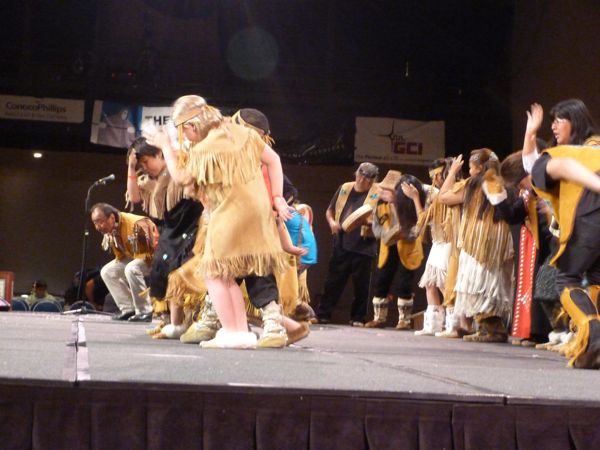
For the first time ever, the announcer tells us, the groups are all ready on time and the dancers ready to go – they are astonishingly ahead of schedule.
We return as a group of mixed dancers, from many Alaskan tribes, and some dancers with roots in classic “lower 48” tribes, so they all respect one another’s traditions, share, and do a little bit of everything. I kind of like this kind of flexibility. Some of the female costumes are a little ummm . . . skimpy . . . for the cold Alaskan climate, LOL, and some of the tattoos a little un-Alaskan and it doesn’t matter, they make it work.
The Celebration Hall is full and brimming over, dancers and their families in the waiting rooms, behind stage, in the halls, in the gift stores, children wailing for their Moms or Dads, it is totally a family affair. Grandma’s step in and help, and the dance goes on.




June 25, 2014
Posted by intlxpatr |
Alaska, Arts & Handicrafts, Beauty, Community, Cross Cultural, Cultural, Events, Friends & Friendship, Generational, Interconnected, Travel | AK, Celebration 2014, Juneau, Sealaska |
Leave a comment
“Are you from the Philippines?” AdventureMan asked the man behind the counter as he dished me up a cone of Huckleberry (Blueberry) ice cream.
“Yes, there are many of us here,” the man answered, and told us how one of the fastest growing demographics in Alaska is the Philippine community.
“At home, we are so poor,” he explained. We are lucky to have a one room shack for a family, and for water we have to walk a long way for running water. It is very bad.” He looked serious.
“How do you like it here?” AdventureMan asked, and the man grinned. “Life is good!” he said, with enthusiasm. He also mentioned the Mexican population in Alaska is growing almost as fast as the Philippine population. Who knew?
Normally, I don’t eat ice cream, but I have been craving something with either blueberries or rhubarb, two fruits that grew in Alaska when I was a kid, fruits we ate, jellied, froze, stored for later use. I had seen neither. Some might argue that huckleberries and blueberries are not the same. I don’t care. It is close enough for me. I also love that the cones are so extraordinary, artistic even, with their Alaskan Haida-esque sculptural quality:

And here is the proud cone-maker, also from the Philippines, who has a view to die for, the same view as from The Hanger on the Wharf, as she makes her specialty cones:

They insisted on giving us a 10% discount when they spotted my husband’s retired military ID card as he pulled out his wallet. They also shook his hand and thanked him for his service, a sweet and unexpected kindness in faraway Alaska.
June 25, 2014
Posted by intlxpatr |
Alaska, Arts & Handicrafts, Community, Cooking, Customer Service, Eating Out, ExPat Life, Interconnected, Quality of Life Issues, Travel |
2 Comments
Taking a break from The Celebration, we get up early, drive to our Juneau friend’s house and park our car and she drives us over and drops us off to catch the AdventureBound trip out to Tracy Arms. For two weeks the weather forecasts have told us that this day will be sunny, bright and warm, and ha ha ha on us, it is cloudy and cold, but not much rain. In Juneau, not much rain is a pretty good day :-).
We meet some really fun people as we wait to board – one couple married four days, one couple of young adventurers who, like us, travel on their own as opposed to group travel or cruise ship travel. Our lively conversation made us late to board, only to discover that everyone else had booked for this “sunny” day and every seat in the cabin would be occupied. Once you sit down, that is YOUR spot, oh ugh, this is the worst kind of tour for us, but we discover we can go in and out at will and this works. We spend a lot of time outside, taking photos, watching for whale and porpoise and bear and eagles – all kinds of wildlife. It’s not so bad.
Before we leave, I shoot this photo. It’s not original; I had a similar poster once from the 1920’s or 1930’s advertising trans-Atlantic boat travel on some French line. I just love the lines:
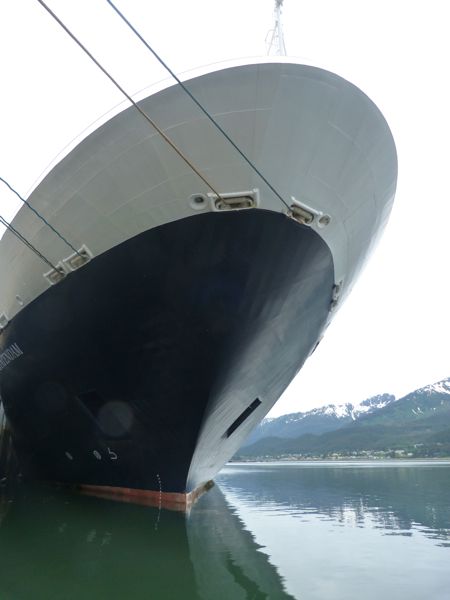
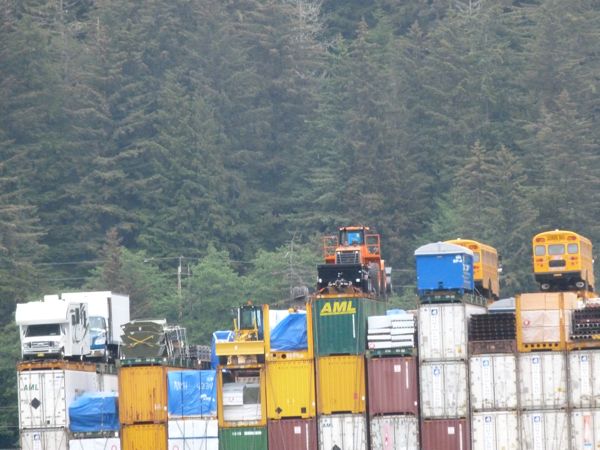
Juneau is landlocked, so everything that comes in or goes out goes by boat or plane. Container barges bring in larger items, and I was amazed how high they can stack a barge. I was also amazed that on top of the containers are vehicles strapped on tight; school buses, campers, snow plows – no wonder everything costs so much more in Alaska!


These bear made me so sad. Look how skinny they are, down at the bottom of tall, steep cliffs, eating barnacles. Bear eating barnacles – they must be starving. Some of them look all molty and have fur coming off.



I never saw these glaciers when I was little. The Mendenhall glacier is relatively large compared to the Sawyer glaciers (1) and (2) but the Sawyer glaciers are calving. The sound is unforgettable, the cracking, the thunder, and entire sections of the glacier falling into the bay. Other burgs crack off underwater, and they come up huge, whole and a sparkling, unforgettable icy deep blue:


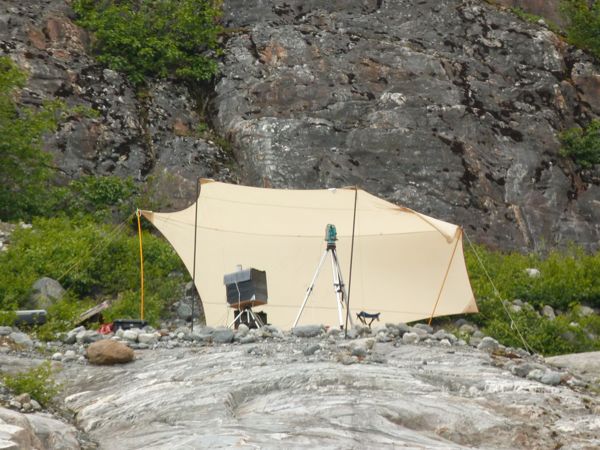
There is equipment going all the time at Tracy Arms to record the calving, the sights and sounds:
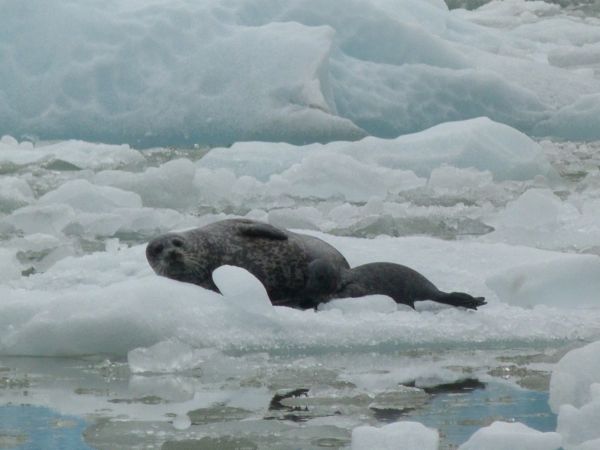
Mama and baby seals catching a few rays at high noon near the glacier:



Here is a piece breaking and falling into the water:



You can see the tour boat is surrounded by ice and icebergs:
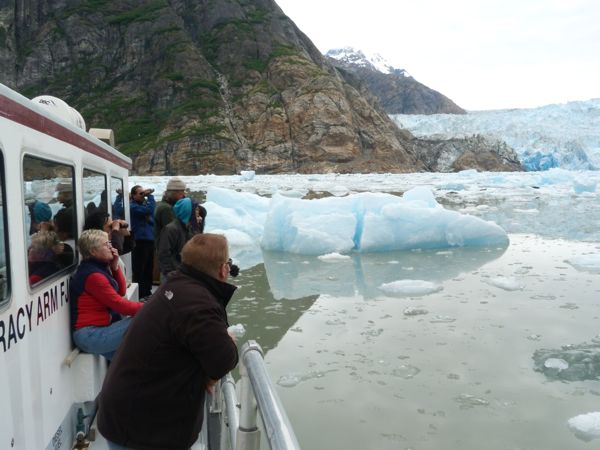
The glaciers are currently neither advancing nor receding, but you can read the trail of the glacier’s recession over thousands of years in the steep, ice-scraped mountains on both sides:

On our way home, we spot whale. You can shoot a lot of shots of a piece of whale, or where the whale was a split-second ago, LOL.


As we reach the dock, I call our friend to tell her we are arriving and she laughs and tells me she is already on her way; she was watching the boat arrive from her place across the channel. Within minutes, she is picking us up for home made fish cakes and chop chop salad. Best of all, great conversation, lots of laughter and wonderful stories of past times in Alaska. Her family was a pioneer family in Nome before she married and came to Juneau, so she has some great tales to share. Our families have had a lot of joint adventures, in Alaska, in Germany and in Edmonds.
She also asks great questions like “how did you buy groceries in Kuwait?” and “what did you do about laundry?”, practical questions, and exactly the kinds of things that made our lives more challenging – and interesting – to us. It was a great evening.

June 23, 2014
Posted by intlxpatr |
Adventure, Alaska, Beauty, Community, Environment, ExPat Life, Family Issues, Generational, Geography / Maps, GoogleEarth, Interconnected, Travel | Sawyer glaciers, Tracy Arms Fjord |
Leave a comment
First, we really love eating at the Hanger at the Wharf. So does just about everyone else. Twice, we got really lucky. It is easier getting a table if you are just two people, and it is easier getting a table if you eat early. As we are still on Pensacola tummy time, we are in luck. As the Celebration 2014 parade ended, we zipped straight over and as larger groups waited, we were immediately shown to a table for two.
No wonder The Hanger is so popular. The food is terrific and this is the view – straight down the Gastineau channel with Douglas and the cruise ships. As the sun slides behind the mountain, it is a stunning view:

Some hardier souls were eating outside on the deck. I used to be this hardy, but my years in the Middle East have softened me, made me not so good at eating in cool and drafty places, even in the middle of the Alaskan summer.

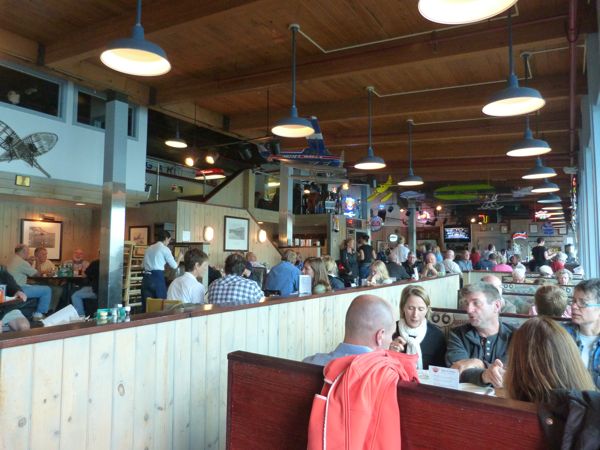
Inside The Hanger: great, courteous, friendly and efficient employees
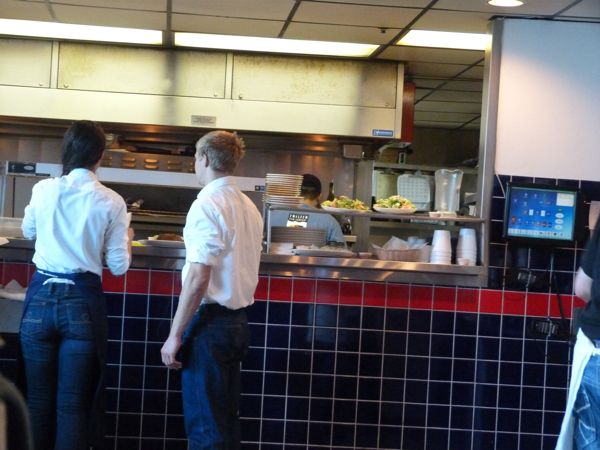
Every table taken, the bar is packed, and people are waiting in the hallway to be seated:

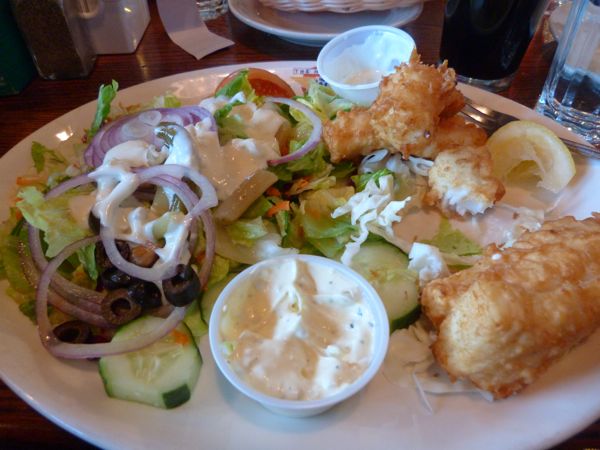
My halibut tempura:

AdventureMan’s halibut burger and fries:
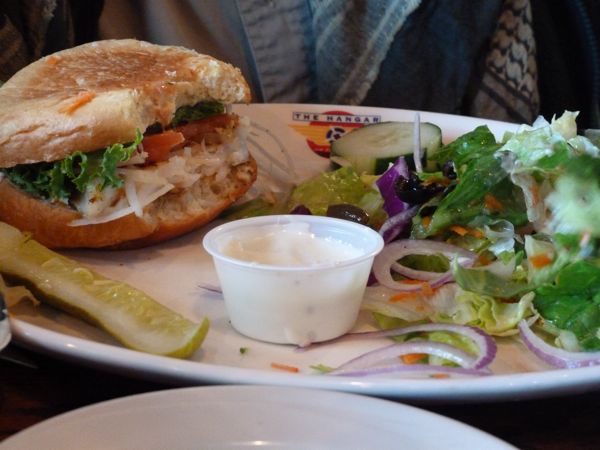
We liked the food and atmosphere so well that we went back a second time during the ceremonial dances and were happy to see a lot of the dancers eating there, too. I had the first mate’s plate, with salmon and halibut and a berry chutney and AdventureMan had grilled halibut. We both left happy. We would go there again in a heartbeat.
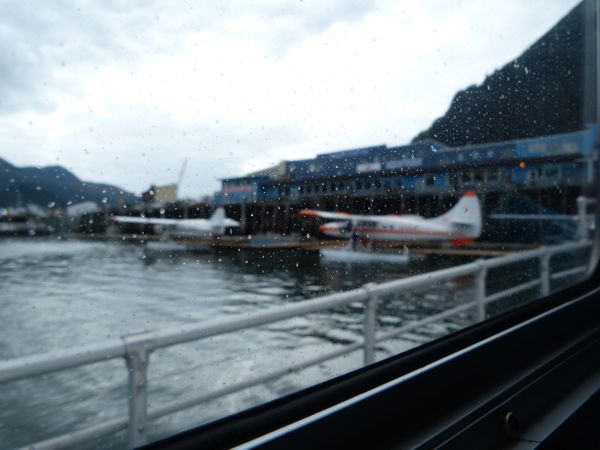
There is only one little thing about The Hanger that makes me uneasy, and it has nothing to do with The Hanger. When I was a little girl, living across the channel, I would watch for my Dad to come home – this was the airport for the amphibious planes, Alaska Coastal Airlines (now part of Alaska Airlines) and Ellis Airlines. When his plane would land, we would all rush to the car and drive like crazy across the bridge to pick him up (no cell phones then, LOL). So I still feel a little frisson and feel the ghosts of the past when I eat there.

June 23, 2014
Posted by intlxpatr |
Alaska, Arts & Handicrafts, Circle of Life and Death, Community, Cultural, Customer Service, Eating Out, ExPat Life, Food, Interconnected, Living Conditions, Local Lore, Photos, Restaurant, Road Trips | AK, Celebration 2014, Juneau |
2 Comments
This is today’s Forward Day by Day reading, and I think it is perfect for Memorial Day, a day in which we celebrate those who fought and gave their lives that we might live free:
MONDAY, May 26 Rogation Day
Matthew 13:14. You will indeed listen, but never understand, and you will indeed look, but never perceive.
The daughter of the young clergyman looked and she did perceive.
She had taken a bus trip with her father to their home country so she could obtain an identification card at the age of eighteen. Before the bus left, the driver asked if someone would pray for a safe journey. Her father walked to the front of the bus and led the passengers in prayer. Later, at a rest stop, the priest noticed some trash littering the area. After other passengers walked past heedlessly, he scooped it up and put it in a trash bin.
The acts seemed minor, and he thought no more about them. But later, his daughter asked him to read her homework—a profile of a leader. He did and was humbled and amazed.
The profile was about him. Citing those two examples and others, the daughter described how his behavior reflected his values. She wrote, “Leadership is not a title, but it is about the way you live your life.”
She had done much more than see her father’s actions. She had perceived their meaning and importance in the context of their faith.
May 26, 2014
Posted by intlxpatr |
Character, Civility, Community, Cultural, Environment, Faith, Hygiene, Interconnected, Leadership, Lectionary Readings |
Leave a comment
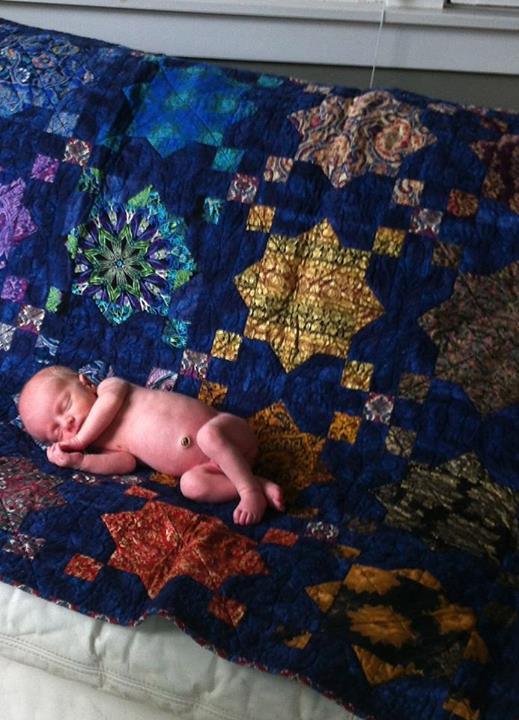
My sweet niece, Little Diamond (Professor Little Diamond 🙂 ) has given birth to two of the most perfectly beautiful little babies, ever. These are the quilts I made for them, and lastly is one of the sweet babies on his quilt. Congratulations, Umm Al Tawaman, God is good and full of mercy and compassion.
 This one is called Interconnected.
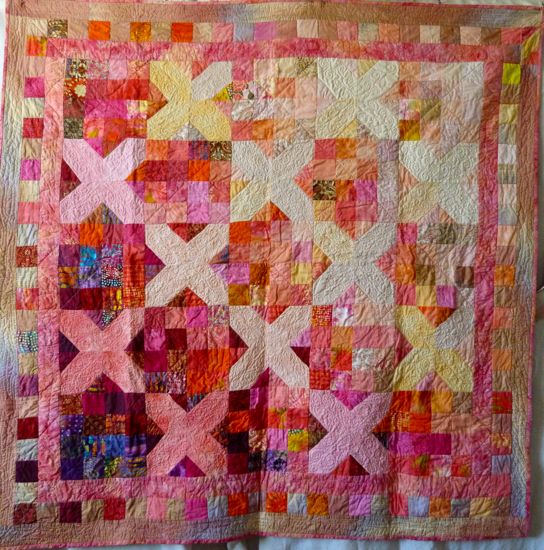 This one is called Desert Rose.
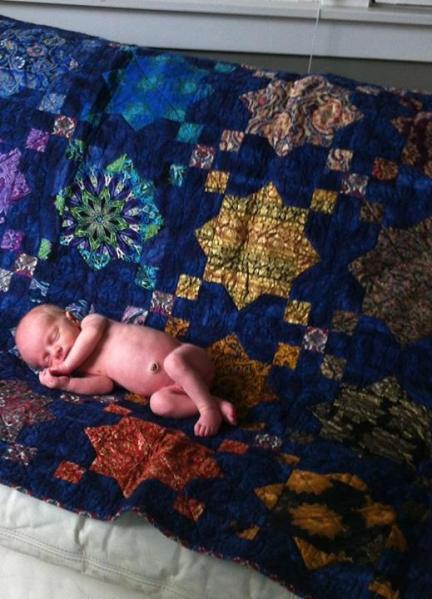
Isn’t that a beautiful little baby? 🙂
May 15, 2014
Posted by intlxpatr |
Arts & Handicrafts, Circle of Life and Death, Family Issues, Generational, Interconnected, Mating Behavior, Parenting |
2 Comments
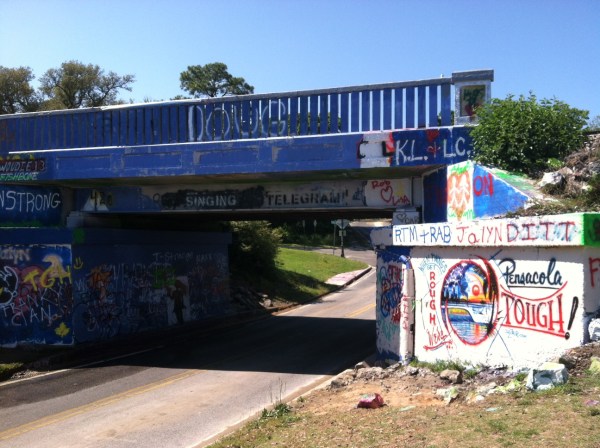
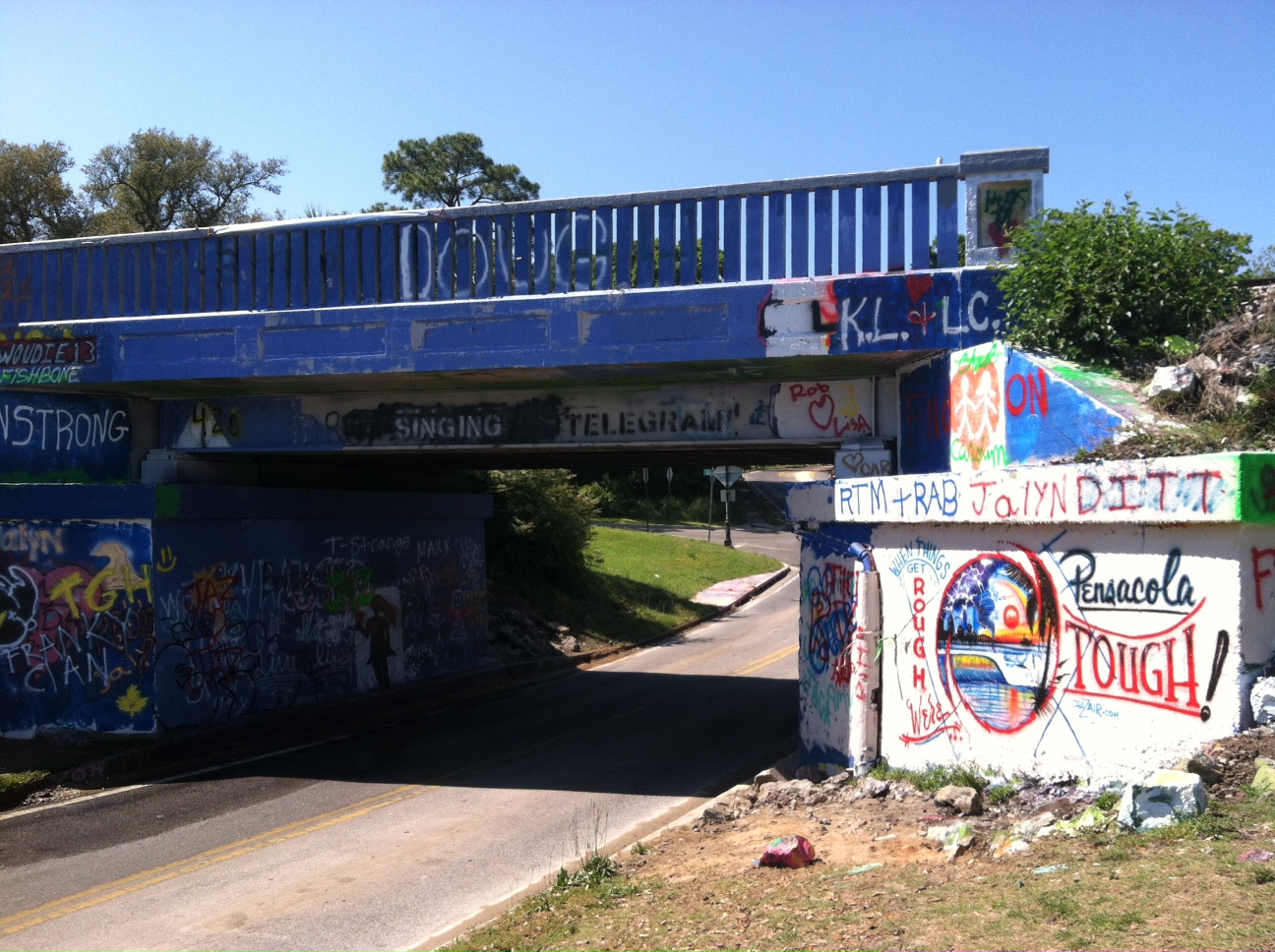
On my way home from a great Algerian pastry treat at SoGourmet, I passed Grafitti Bridge. Grafitti Bridge is one of Pensacola’s quirks. Every month – sometimes every week, even sometimes daily – the bridge is repainted. Sometimes it is that BubbleGum pink of Breast Cancer Awareness, with names of the fallen and names of survivors, sometimes it is Gay Pride, sometimes it is who loves who, or who is a first class jerk, sometimes it is Class of TwoThousandWhatever – it can be whatever someone feels passionate enough about to buy the paint and make it happen. No one gets too bent out of shape about it. Occasionally profanity will show up, but very shortly someone else will spray paint out the offensive word, or, which I love, alter it to have an entirely new meaning.
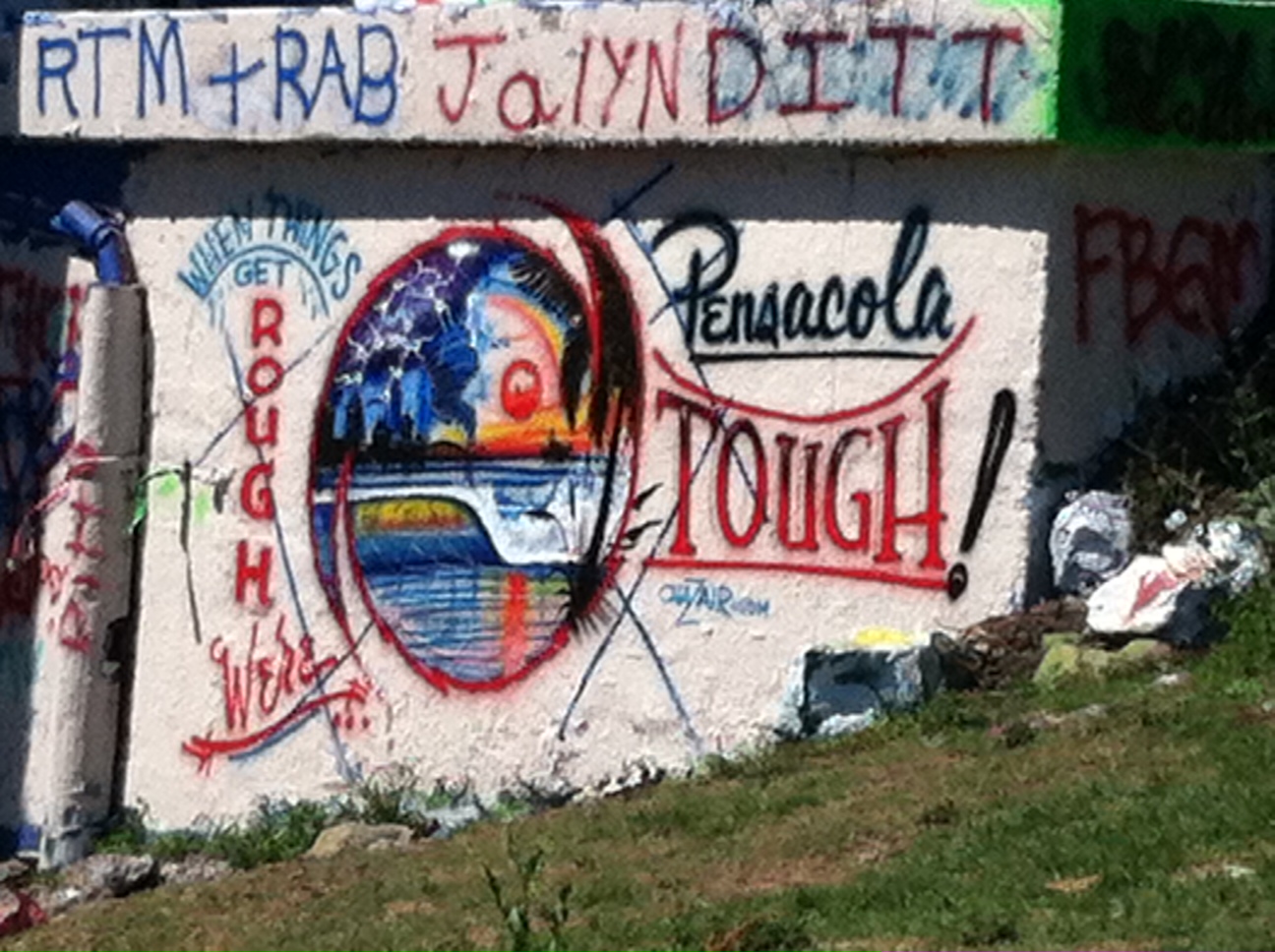
As I drove past today, I saw a lightning storm, well done, I couldn’t imagine how they had captured what it was like seeing so many strikes at once, and then I saw “Pensacola Tough.” By that time, I was through the bridge, so I had to circle and go back. I had to park, and take a closer look. And then I had to photograph it, and post it here.
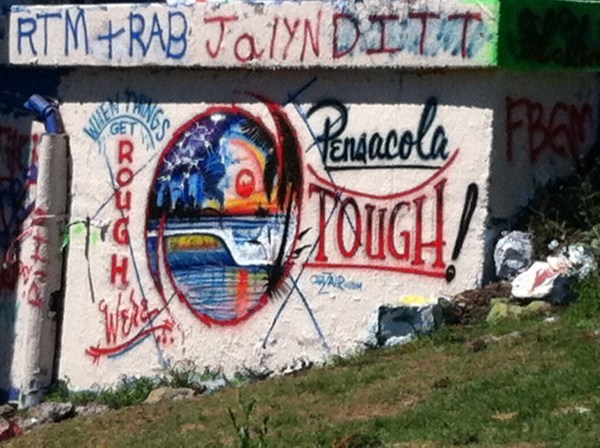
Pensacola Tough. Pensacola got an award as the Toughest City in the USA, based on a criteria that measured percentage of felons in the population (it’s OK, it keeps us humble), sports heros, the number of military personnel, violent crime statistics, etc. It isn’t an award cities run for.
And yet, as the raging water abates, tales of heroism and helpfulness abound. While there have been bands of looters at an apartment complex housing the low-income workers in Pensacola, there have also been bands of volunteers scouring the county, helping clean out houses, pull out sodden carpeting, moving soaked furniture to the curbs for pickup, pulling out drywall and ceilings to prevent black mold. In today’s Pensacola News Journal, there is a story of a man who worked just above where the Escambia County Jail exploded and fell through the floor, breaking legs, ribs and assorted bones. He was paralyzed. His co-worker, also hurt, saw him with his head under water and pulled his head out, and held his head out for over an hour while waiting for help to arrive. She got tired, but the alternative was letting him die. She didn’t let go.
Pensacola Tough.
“When Things Get Rough . . . We’re Pensacola Tough.
You gotta love this place
May 5, 2014
Posted by intlxpatr |
Arts & Handicrafts, Beauty, Civility, Communication, Community, Cultural, ExPat Life, Free Speech, Gulf Coast Citizen Diplomacy Council, Interconnected, Living Conditions, Local Lore, Pensacola, Values, Weather |
Leave a comment
CDC confirms first case of MERS virus in American
May 2nd 2014 3:51PM
 |
|
This file photo provided by the National Institute for Allergy and Infectious Diseases shows a colorized transmission of the MERS coronavirus that emerged in 2012. Health officials on Friday, May 2, 2014 said the deadly virus from the Middle East has turned up for the first time in the U.S. (AP Photo/National Institute for Allergy and Infectious Diseases via The Canadian Press, File)
|
By MIKE STOBBENEW YORK (AP) — Health officials on Friday confirmed the first case of an American infected with a mysterious Middle East virus. The man fell ill after arriving in the U.S. about a week ago from Saudi Arabia where he is a health care worker.
The man is hospitalized in Indiana with Middle East respiratory syndrome, or MERS, according to the Centers for Disease Control and Prevention, which is investigating the case along with Indiana health officials.
Saudi Arabia has been the center of an outbreak of MERS that began about two years ago. At least 400 people have had the respiratory illness, and more than 100 people have died. All had ties to the Middle East or to people who traveled there. Infections have been previously reported among health care workers.
MERS belongs to the coronavirus family that includes the common cold and SARS, or severe acute respiratory syndrome, which caused some 800 deaths globally in 2003.
The MERS virus has been found in camels, but officials don’t know how it is spreading to humans. It can spread from person to person, but officials believe that happens only after close contact. Not all those exposed to the virus become ill.
But it appears to be unusually lethal – by some estimates, it has killed nearly a third of the people it sickened. That’s a far higher percentage than seasonal flu or other routine infections. But it is not as contagious as flu, measles or other diseases. There is no vaccine or cure for MERS.
The CDC on Friday released only limited information about the U.S. case: The man flew to the United States about a week ago, with a stop in London. He landed in Chicago and took a bus to the neighboring state of Indiana. He didn’t become sick until arriving in Indiana, the CDC said. Symptoms include fever, cough, breathing problems, which can lead to pneumonia and kidney failure.
CDC officials say they are sending a team to investigate the man’s illness, his travel history and to track down people he may have been in close contact with.
Saudi Arabia health officials have recently reported a surge in MERS illnesses; cases have tended to increase in the spring. Experts think the uptick may party be due to more and better surveillance. Researchers at Columbia University have an additional theory – there may be more virus circulating in the spring, when camels are born.
U.S. health officials have been bracing for the arrival of one or more cases, likely among travelers. Isolated cases of MERS have been carried outside the Middle East. Previously, 163 suspected cases were tested in the U.S. but none confirmed.
May 2, 2014
Posted by intlxpatr |
Circle of Life and Death, ExPat Life, Health Issues, Interconnected, Living Conditions, Saudi Arabia, Travel | MERS virus |
Leave a comment
This is what I love about New Yorker magazine: they print stories no one prints, they follow stories that need following. They lead, and they do their job, alerting us to issues that matter. My heart goes out to the families, Christian and Muslim, of these girls who were abducted because they were being educated. Boko Haram believes educating women goes against Islam. Someone should read them a Quran.
APRIL 30, 2014
NIGERIA’S STOLEN GIRLS
 “I thought it was the end of my life,” Deborah Sanya told me by phone on Monday from Chibok, a tiny town of farmers in northeastern Nigeria. “There were many, many of them.” Boko Haram, an Islamist terrorist group, kidnapped Sanya and at least two hundred of her classmates from a girls’ secondary school in Chibok more than two weeks ago. Sanya, along with two friends, escaped. So did forty others. The rest have vanished, and their families have not heard any word of them since.
Sanya is eighteen years old and was taking her final exams before graduation. Many of the schools in towns around Chibok, in the state of Borno, had been shuttered. Boko Haram attacks at other schools—like a recent massacre of fifty-nine schoolboys in neighboring Yobe state—had prompted the mass closure. But local education officials decided to briefly reopen the Chibok school for exams. On the night of the abduction, militants showed up at the boarding school dressed in Nigerian military uniforms. They told the girls that they were there to take them to safety. “They said, ‘Don’t worry. Nothing will happen to you,’ ” Sanya told me. The men took food and other supplies from the school and then set the building on fire. They herded the girls into trucks and onto motorcycles. At first, the girls, while alarmed and nervous, believed that they were in safe hands. When the men started shooting their guns into the air and shouting “Allahu Akbar,” Sanya told me, she realized that the men were not who they said they were. She started begging God for help; she watched several girls jump out of the truck that they were in.
It was noon when her group reached the terrorists’ camp. She had been taken not far from Chibok, a couple of remote villages away in the bush. The militants forced her classmates to cook; Sanya couldn’t eat. Two hours later, she pulled two friends close and told them that they should run. One of them hesitated, and said that they should wait to escape at night. Sanya insisted, and they fled behind some trees. The guards spotted them and called out for them to return, but the girls kept running. They reached a village late at night, slept at a friendly stranger’s home, and, the next day, called their families.
Sanya could not tell me more after that. She is not well. Her cousins and her close friends are still missing, and she is trying to understand how she is alive and back home. All she can do now, she said, is pray and fast, then pray and fast again.
The day after the abduction, the Nigerian military claimed that it had rescued nearly all of the girls. A day later, the military retracted its claim; it had not actually rescued any of the girls. And the number that the government said was missing, just over a hundred, was less than half the number that parents and school officials counted: according to their tally, two hundred and thirty-four girls were taken.
In the wake of the military’s failure, parents banded together and raised money to send several of their number into the forest to search for the girls. The group came across villagers who persuaded the parents to turn back. They told the parents that they had seen the girls nearby, but the insurgents were too well armed. Many of the parents had just bows and arrows.
***
The circumstances of the kidnapping, and the military’s deception, especially, have exposed a deeply troubling aspect of Nigeria’s leadership: when it comes to Boko Haram, the government cannot be trusted. Children have been killed, along with their families, in numerous Boko Haram bombings and massacres over the past five years. (More than fifteen hundred people have been killed so far this year.) State schools and remote villages in the north have borne the brunt of Boko Haram’s violence this year. The group is believed to be at least partly waging a campaign against secular values. The kidnapped girls were both Christian and Muslim; their only offense, it seems, was attending school.
Last June, I visited Maiduguri, the capital of Borno state and the birthplace of Boko Haram, to report on the insurgency and the Nigerian government’s counteroffensive, a security operation that placed three northeastern states, including Borno and Yobe, under a state of emergency as troops launched attacks on terrorist hideouts and camps. The military cut phone lines and Internet access, and, while residents were glad for the intervention, there was a sense of living in the dark. Gunshots, a bomb blast: was it Boko Haram or a military attack? Were the hundreds of men disappeared by the military actually terrorists—even the young boys? And was the government, as it claimed, really winning the war?
The military has restored phone lines in Borno. But the sole airline that flew to Maiduguri cancelled the route at the end of last year. The road to Chibok is so hazardous that Borno’s governor visited the town with a heavy military escort. Much of the northeast is now physically isolated. What is happening there that we cannot see?
Nigerians in the rest of the country had, until recently, been able to ignore the deaths. The general mood has been one of weary apathy—from a government waging a heavy-handed crackdown on northerners to civilians far removed from the chaos. That mood may finally change.
***
Sanya’s father, a primary-school teacher named Ishaya Sanya, is struggling with conflicting emotions: gratitude that his daughter has returned to him; guilt that the daughters of his siblings, friends, and neighbors are still somewhere in the bush; and an angry frustration that there seemed to be no effort to rescue the girls.
“We don’t know where they are up until now, and we have not heard anything from the government,” he told me. “Every house in Chibok has been affected by the kidnapping.” The only information that the families had been able to gather about the kidnapped girls, he went on, was from the girls who had escaped.
He remembers the exact time that Deborah appeared in front of him after her escape—4:30P.M.—and how he felt: “very happy.” But his despair soon returned. “Our area has been affected very seriously,” he told me. Parents had fallen physically ill, and some were “going mad.”
The military’s current plans are unclear; the Chibok parents hope that it is acting swiftly and cautiously. There is worry, too, that a rescue operation could result in the deaths of many of the girls; this happened during a previous attempted rescue, of two Western engineers kidnapped by Boko Haram. Last week, a military spokesman, Brigadier-General Chris Olukolade, said only that the search for the girls had “intensified.”
In the meantime, as in so many other ways in Nigeria, each community has to fend for itself. For a while after the abduction, girls trickled back into town—some rolled off trucks, some snuck away while fetching water. That trickle has stopped. “Nobody rescued them,” a government official in Chibok said of the girls who made it back. “I want you to stress this point. Nobody rescued them. They escaped on their accord. This is painful.”
A pastor in Chibok whose daughter is missing told me that he set out with friends on the morning after the abduction to find the girls. “I was forced to come home empty-handed,” he told me by phone. “I just don’t know what the federal government is doing about it. And there is no security here that will defend us. You have to do what you can do to escape for your life.”
I asked the pastor about rumors that Boko Haram has taken the girls outside of Nigeria’s borders, into Cameroon and Chad, and forcibly married them. He paused, and then said, “How will I be happy? How will I be happy?”
Four students walk in Chibok following their escape from Boko Haram. Photograph by Haruna Umar/AP.
May 1, 2014
Posted by intlxpatr |
Community, Crime, Cross Cultural, Cultural, Faith, Interconnected, Law and Order, Leadership, Living Conditions, Marriage, Mating Behavior, Nigeria, Values, Women's Issues | abduction, Abuja, Boko Haram, Nigerian school girls |
Leave a comment
Move 30 times? Check. Manage finances? Check. Buy or sell a house? Check. Buy a car? Check. It’s not that hard. You figure it out, you do it.
Every now and then you have a crisis that’s outside your comfort zone. This week we ran into one of those.
We’ve had a microwave, a wonderful huge microwave, with a platter that runs back and forth, instead of a circular revolving plate. About a year ago, it started stopping in mid-cook and the display would show “F9”, not a big deal, with a little jiggling, a little work around, we could get it working again and it worked most of the time.

We bit the bullet. OK, just time to get a new microwave, go somewhere where we can buy it and have it installed, because installing is outside of what we can do well.
We get to the store and discover that 36″ microwaves are very special. So special that the only one carried runs in the over $1000 range. We go to another store, same story. Evidently 36″ was to go over a 36″ range, which we have, but is no longer so trendy. Oh aarrgh. We decide to go home and do some online research, only to learn that the 36″ version for over $1000 has very poor ratings and the same problem that we currently have, made by the same manufacturer. Double aarrgh, and double aarrgh again because while AdventureMan and I are good problem solvers, we are out of our pay grade when it comes to kitchen design and installation, but we know enough to know that it has to look right.
(Does it seem to you like American appliances don’t last as long as they used to? Some old appliances I have had run forever, but I feel like I am constantly replacing or having repaired the newer appliances)
When we bought our house, we bought it from a man who has a lot of fun redesigning and remodeling and updating houses. The kitchen is small, but beautifully high end. Fortunately, he is local and I have his number so I called him and asked for his design input. He gave me several good ideas, and even better, we had a great, wonderful chat and I was able to tell him how much we enjoy the little touches he put in the house to make it special. By the time I finished, I had a plan, and it dovetails with some other work we have scheduled, to have a tankless water system put in.
Years ago, a friend gave me a book mark I still have, a quote from Bishop Sheen that says “All worry is atheism, because it is a want of trust in God” and while I believe that is true, and have greatly banished worry from my daily life, every now I find myself that squirrel running on that wheel of anxiety, knowing I am worrying for nothing, but unable, in my own strength, to get off the wheel. Thanks be to God, in his mercy, for leading me off that fruitless path!
April 25, 2014
Posted by intlxpatr |
Cultural, Customer Service, ExPat Life, Family Issues, Financial Issues, Florida, Home Improvements, Interconnected, Living Conditions, Pensacola, Shopping |
Leave a comment























 Here There and Everywhere