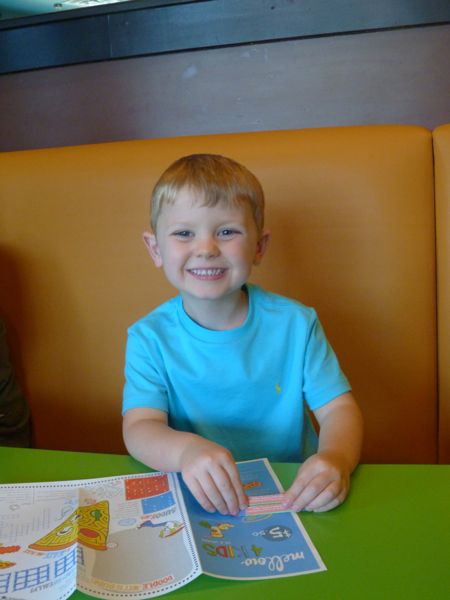
First, we really love eating at the Hanger at the Wharf. So does just about everyone else. Twice, we got really lucky. It is easier getting a table if you are just two people, and it is easier getting a table if you eat early. As we are still on Pensacola tummy time, we are in luck. As the Celebration 2014 parade ended, we zipped straight over and as larger groups waited, we were immediately shown to a table for two.
No wonder The Hanger is so popular. The food is terrific and this is the view – straight down the Gastineau channel with Douglas and the cruise ships. As the sun slides behind the mountain, it is a stunning view:
Some hardier souls were eating outside on the deck. I used to be this hardy, but my years in the Middle East have softened me, made me not so good at eating in cool and drafty places, even in the middle of the Alaskan summer.
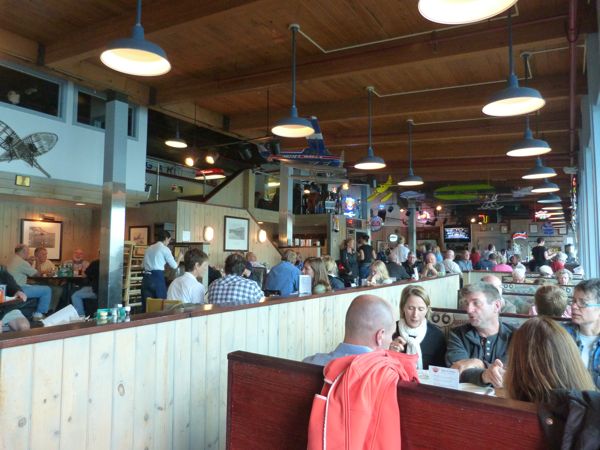
Inside The Hanger: great, courteous, friendly and efficient employees
Every table taken, the bar is packed, and people are waiting in the hallway to be seated:
My halibut tempura:
AdventureMan’s halibut burger and fries:
We liked the food and atmosphere so well that we went back a second time during the ceremonial dances and were happy to see a lot of the dancers eating there, too. I had the first mate’s plate, with salmon and halibut and a berry chutney and AdventureMan had grilled halibut. We both left happy. We would go there again in a heartbeat.
There is only one little thing about The Hanger that makes me uneasy, and it has nothing to do with The Hanger. When I was a little girl, living across the channel, I would watch for my Dad to come home – this was the airport for the amphibious planes, Alaska Coastal Airlines (now part of Alaska Airlines) and Ellis Airlines. When his plane would land, we would all rush to the car and drive like crazy across the bridge to pick him up (no cell phones then, LOL). So I still feel a little frisson and feel the ghosts of the past when I eat there.
This is today’s Forward Day by Day reading, and I think it is perfect for Memorial Day, a day in which we celebrate those who fought and gave their lives that we might live free:
MONDAY, May 26 Rogation Day
Matthew 13:14. You will indeed listen, but never understand, and you will indeed look, but never perceive.
The daughter of the young clergyman looked and she did perceive.
She had taken a bus trip with her father to their home country so she could obtain an identification card at the age of eighteen. Before the bus left, the driver asked if someone would pray for a safe journey. Her father walked to the front of the bus and led the passengers in prayer. Later, at a rest stop, the priest noticed some trash littering the area. After other passengers walked past heedlessly, he scooped it up and put it in a trash bin.
The acts seemed minor, and he thought no more about them. But later, his daughter asked him to read her homework—a profile of a leader. He did and was humbled and amazed.
The profile was about him. Citing those two examples and others, the daughter described how his behavior reflected his values. She wrote, “Leadership is not a title, but it is about the way you live your life.”
She had done much more than see her father’s actions. She had perceived their meaning and importance in the context of their faith.
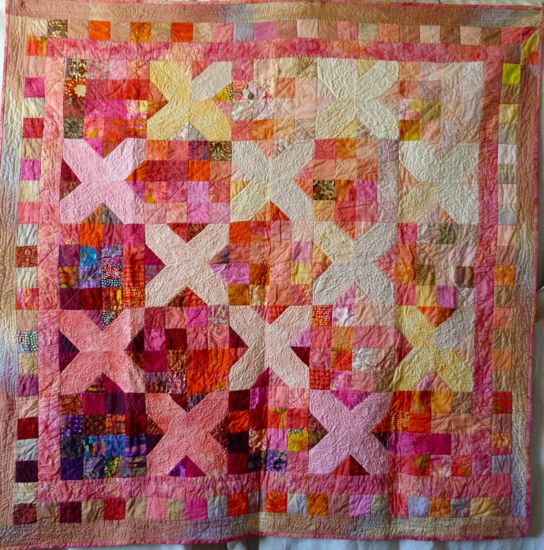
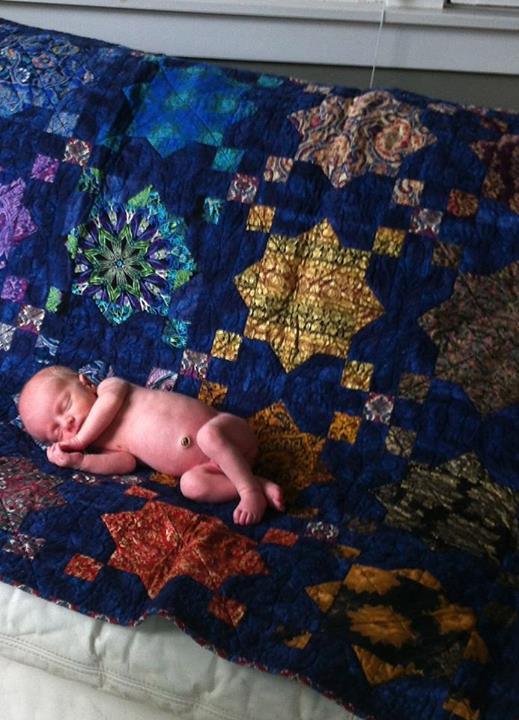
My sweet niece, Little Diamond (Professor Little Diamond 🙂 ) has given birth to two of the most perfectly beautiful little babies, ever. These are the quilts I made for them, and lastly is one of the sweet babies on his quilt. Congratulations, Umm Al Tawaman, God is good and full of mercy and compassion.
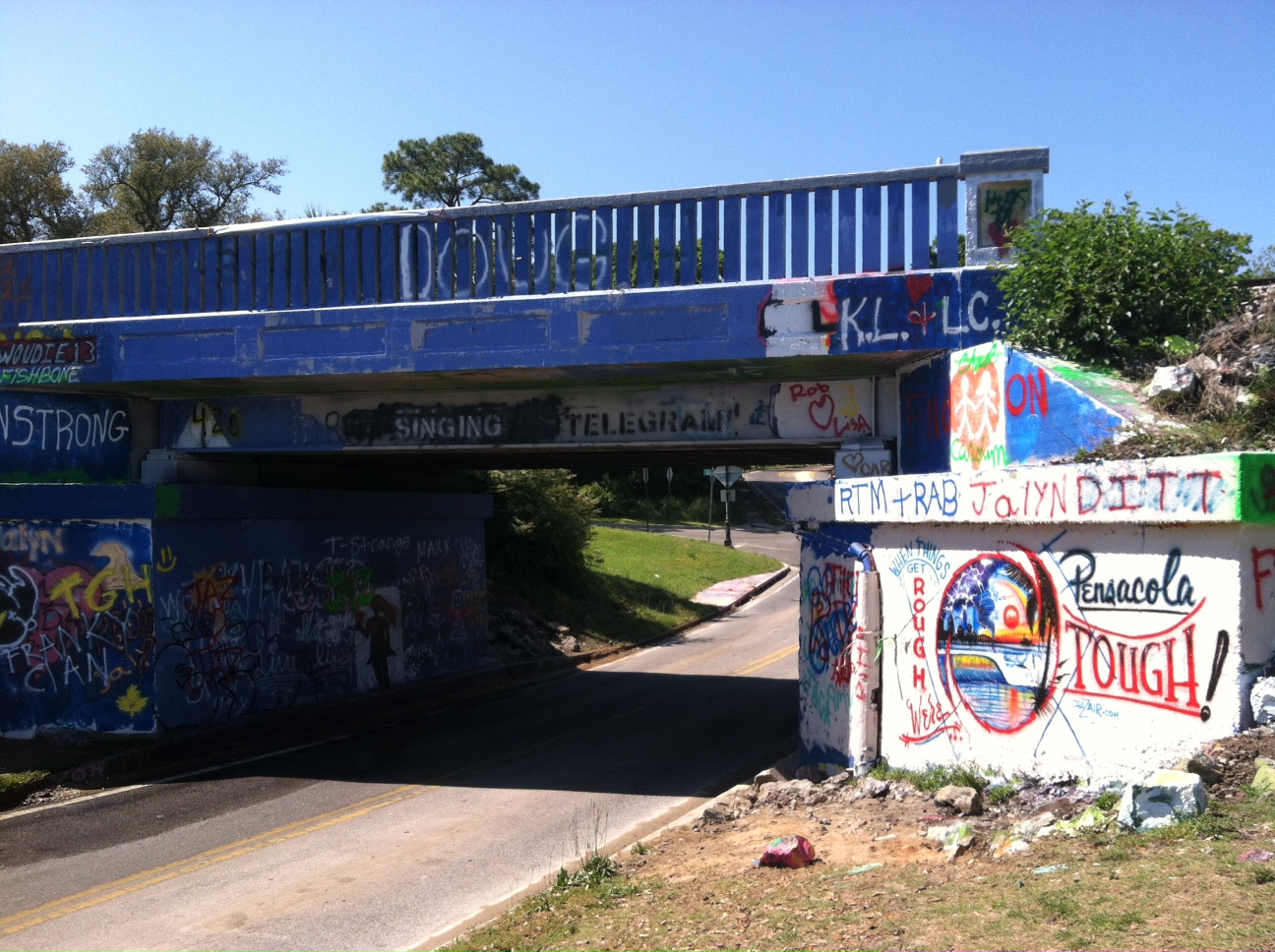
On my way home from a great Algerian pastry treat at SoGourmet, I passed Grafitti Bridge. Grafitti Bridge is one of Pensacola’s quirks. Every month – sometimes every week, even sometimes daily – the bridge is repainted. Sometimes it is that BubbleGum pink of Breast Cancer Awareness, with names of the fallen and names of survivors, sometimes it is Gay Pride, sometimes it is who loves who, or who is a first class jerk, sometimes it is Class of TwoThousandWhatever – it can be whatever someone feels passionate enough about to buy the paint and make it happen. No one gets too bent out of shape about it. Occasionally profanity will show up, but very shortly someone else will spray paint out the offensive word, or, which I love, alter it to have an entirely new meaning.
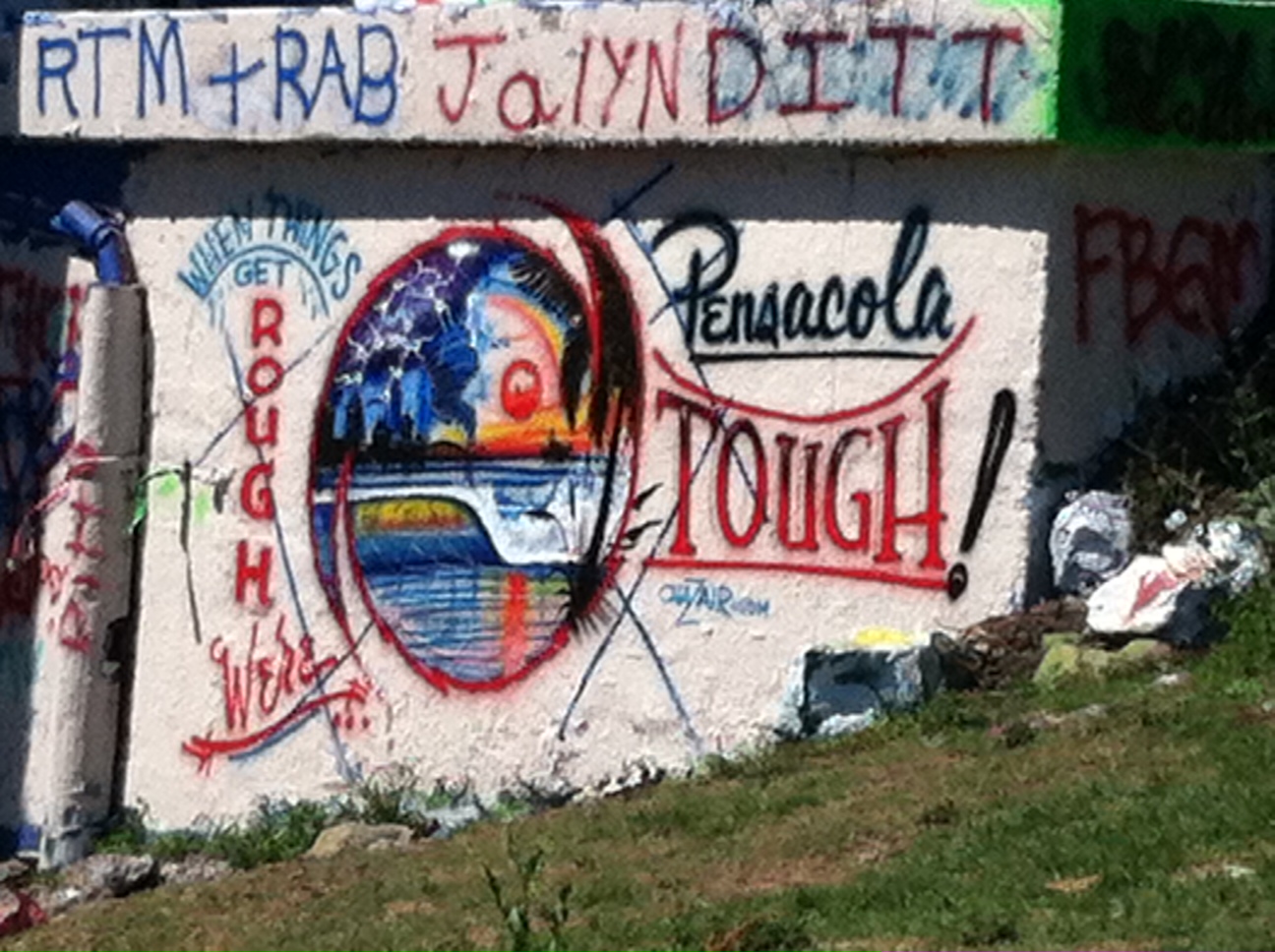
As I drove past today, I saw a lightning storm, well done, I couldn’t imagine how they had captured what it was like seeing so many strikes at once, and then I saw “Pensacola Tough.” By that time, I was through the bridge, so I had to circle and go back. I had to park, and take a closer look. And then I had to photograph it, and post it here.
Pensacola Tough. Pensacola got an award as the Toughest City in the USA, based on a criteria that measured percentage of felons in the population (it’s OK, it keeps us humble), sports heros, the number of military personnel, violent crime statistics, etc. It isn’t an award cities run for.
And yet, as the raging water abates, tales of heroism and helpfulness abound. While there have been bands of looters at an apartment complex housing the low-income workers in Pensacola, there have also been bands of volunteers scouring the county, helping clean out houses, pull out sodden carpeting, moving soaked furniture to the curbs for pickup, pulling out drywall and ceilings to prevent black mold. In today’s Pensacola News Journal, there is a story of a man who worked just above where the Escambia County Jail exploded and fell through the floor, breaking legs, ribs and assorted bones. He was paralyzed. His co-worker, also hurt, saw him with his head under water and pulled his head out, and held his head out for over an hour while waiting for help to arrive. She got tired, but the alternative was letting him die. She didn’t let go.
Pensacola Tough.
“When Things Get Rough . . . We’re Pensacola Tough.
This file photo provided by the National Institute for Allergy and Infectious Diseases shows a colorized transmission of the MERS coronavirus that emerged in 2012. Health officials on Friday, May 2, 2014 said the deadly virus from the Middle East has turned up for the first time in the U.S. (AP Photo/National Institute for Allergy and Infectious Diseases via The Canadian Press, File)
By MIKE STOBBENEW YORK (AP) — Health officials on Friday confirmed the first case of an American infected with a mysterious Middle East virus. The man fell ill after arriving in the U.S. about a week ago from Saudi Arabia where he is a health care worker.
The man is hospitalized in Indiana with Middle East respiratory syndrome, or MERS, according to the Centers for Disease Control and Prevention, which is investigating the case along with Indiana health officials.
Saudi Arabia has been the center of an outbreak of MERS that began about two years ago. At least 400 people have had the respiratory illness, and more than 100 people have died. All had ties to the Middle East or to people who traveled there. Infections have been previously reported among health care workers.
MERS belongs to the coronavirus family that includes the common cold and SARS, or severe acute respiratory syndrome, which caused some 800 deaths globally in 2003.
The MERS virus has been found in camels, but officials don’t know how it is spreading to humans. It can spread from person to person, but officials believe that happens only after close contact. Not all those exposed to the virus become ill.
But it appears to be unusually lethal – by some estimates, it has killed nearly a third of the people it sickened. That’s a far higher percentage than seasonal flu or other routine infections. But it is not as contagious as flu, measles or other diseases. There is no vaccine or cure for MERS.
The CDC on Friday released only limited information about the U.S. case: The man flew to the United States about a week ago, with a stop in London. He landed in Chicago and took a bus to the neighboring state of Indiana. He didn’t become sick until arriving in Indiana, the CDC said. Symptoms include fever, cough, breathing problems, which can lead to pneumonia and kidney failure.
CDC officials say they are sending a team to investigate the man’s illness, his travel history and to track down people he may have been in close contact with.
Saudi Arabia health officials have recently reported a surge in MERS illnesses; cases have tended to increase in the spring. Experts think the uptick may party be due to more and better surveillance. Researchers at Columbia University have an additional theory – there may be more virus circulating in the spring, when camels are born.
U.S. health officials have been bracing for the arrival of one or more cases, likely among travelers. Isolated cases of MERS have been carried outside the Middle East. Previously, 163 suspected cases were tested in the U.S. but none confirmed.
This is what I love about New Yorker magazine: they print stories no one prints, they follow stories that need following. They lead, and they do their job, alerting us to issues that matter. My heart goes out to the families, Christian and Muslim, of these girls who were abducted because they were being educated. Boko Haram believes educating women goes against Islam. Someone should read them a Quran.
“I thought it was the end of my life,” Deborah Sanya told me by phone on Monday from Chibok, a tiny town of farmers in northeastern Nigeria. “There were many, many of them.” Boko Haram, an Islamist terrorist group, kidnapped Sanya and at least two hundred of her classmates from a girls’ secondary school in Chibok more than two weeks ago. Sanya, along with two friends, escaped. So did forty others. The rest have vanished, and their families have not heard any word of them since.
Sanya is eighteen years old and was taking her final exams before graduation. Many of the schools in towns around Chibok, in the state of Borno, had been shuttered. Boko Haram attacks at other schools—like a recent massacre of fifty-nine schoolboys in neighboring Yobe state—had prompted the mass closure. But local education officials decided to briefly reopen the Chibok school for exams. On the night of the abduction, militants showed up at the boarding school dressed in Nigerian military uniforms. They told the girls that they were there to take them to safety. “They said, ‘Don’t worry. Nothing will happen to you,’ ” Sanya told me. The men took food and other supplies from the school and then set the building on fire. They herded the girls into trucks and onto motorcycles. At first, the girls, while alarmed and nervous, believed that they were in safe hands. When the men started shooting their guns into the air and shouting “Allahu Akbar,” Sanya told me, she realized that the men were not who they said they were. She started begging God for help; she watched several girls jump out of the truck that they were in.
It was noon when her group reached the terrorists’ camp. She had been taken not far from Chibok, a couple of remote villages away in the bush. The militants forced her classmates to cook; Sanya couldn’t eat. Two hours later, she pulled two friends close and told them that they should run. One of them hesitated, and said that they should wait to escape at night. Sanya insisted, and they fled behind some trees. The guards spotted them and called out for them to return, but the girls kept running. They reached a village late at night, slept at a friendly stranger’s home, and, the next day, called their families.
Sanya could not tell me more after that. She is not well. Her cousins and her close friends are still missing, and she is trying to understand how she is alive and back home. All she can do now, she said, is pray and fast, then pray and fast again.
The day after the abduction, the Nigerian military claimed that it had rescued nearly all of the girls. A day later, the military retracted its claim; it had not actually rescued any of the girls. And the number that the government said was missing, just over a hundred, was less than half the number that parents and school officials counted: according to their tally, two hundred and thirty-four girls were taken.
In the wake of the military’s failure, parents banded together and raised money to send several of their number into the forest to search for the girls. The group came across villagers who persuaded the parents to turn back. They told the parents that they had seen the girls nearby, but the insurgents were too well armed. Many of the parents had just bows and arrows.
***
The circumstances of the kidnapping, and the military’s deception, especially, have exposed a deeply troubling aspect of Nigeria’s leadership: when it comes to Boko Haram, the government cannot be trusted. Children have been killed, along with their families, in numerous Boko Haram bombings and massacres over the past five years. (More than fifteen hundred people have been killed so far this year.) State schools and remote villages in the north have borne the brunt of Boko Haram’s violence this year. The group is believed to be at least partly waging a campaign against secular values. The kidnapped girls were both Christian and Muslim; their only offense, it seems, was attending school.
Last June, I visited Maiduguri, the capital of Borno state and the birthplace of Boko Haram, to report on the insurgency and the Nigerian government’s counteroffensive, a security operation that placed three northeastern states, including Borno and Yobe, under a state of emergency as troops launched attacks on terrorist hideouts and camps. The military cut phone lines and Internet access, and, while residents were glad for the intervention, there was a sense of living in the dark. Gunshots, a bomb blast: was it Boko Haram or a military attack? Were the hundreds of men disappeared by the military actually terrorists—even the young boys? And was the government, as it claimed, really winning the war?
The military has restored phone lines in Borno. But the sole airline that flew to Maiduguri cancelled the route at the end of last year. The road to Chibok is so hazardous that Borno’s governor visited the town with a heavy military escort. Much of the northeast is now physically isolated. What is happening there that we cannot see?
Nigerians in the rest of the country had, until recently, been able to ignore the deaths. The general mood has been one of weary apathy—from a government waging a heavy-handed crackdown on northerners to civilians far removed from the chaos. That mood may finally change.
***
Sanya’s father, a primary-school teacher named Ishaya Sanya, is struggling with conflicting emotions: gratitude that his daughter has returned to him; guilt that the daughters of his siblings, friends, and neighbors are still somewhere in the bush; and an angry frustration that there seemed to be no effort to rescue the girls.
“We don’t know where they are up until now, and we have not heard anything from the government,” he told me. “Every house in Chibok has been affected by the kidnapping.” The only information that the families had been able to gather about the kidnapped girls, he went on, was from the girls who had escaped.
He remembers the exact time that Deborah appeared in front of him after her escape—4:30P.M.—and how he felt: “very happy.” But his despair soon returned. “Our area has been affected very seriously,” he told me. Parents had fallen physically ill, and some were “going mad.”
The military’s current plans are unclear; the Chibok parents hope that it is acting swiftly and cautiously. There is worry, too, that a rescue operation could result in the deaths of many of the girls; this happened during a previous attempted rescue, of two Western engineers kidnapped by Boko Haram. Last week, a military spokesman, Brigadier-General Chris Olukolade, said only that the search for the girls had “intensified.”
In the meantime, as in so many other ways in Nigeria, each community has to fend for itself. For a while after the abduction, girls trickled back into town—some rolled off trucks, some snuck away while fetching water. That trickle has stopped. “Nobody rescued them,” a government official in Chibok said of the girls who made it back. “I want you to stress this point. Nobody rescued them. They escaped on their accord. This is painful.”
A pastor in Chibok whose daughter is missing told me that he set out with friends on the morning after the abduction to find the girls. “I was forced to come home empty-handed,” he told me by phone. “I just don’t know what the federal government is doing about it. And there is no security here that will defend us. You have to do what you can do to escape for your life.”
I asked the pastor about rumors that Boko Haram has taken the girls outside of Nigeria’s borders, into Cameroon and Chad, and forcibly married them. He paused, and then said, “How will I be happy? How will I be happy?”
Four students walk in Chibok following their escape from Boko Haram. Photograph by Haruna Umar/AP.
Move 30 times? Check. Manage finances? Check. Buy or sell a house? Check. Buy a car? Check. It’s not that hard. You figure it out, you do it.
Every now and then you have a crisis that’s outside your comfort zone. This week we ran into one of those.
We’ve had a microwave, a wonderful huge microwave, with a platter that runs back and forth, instead of a circular revolving plate. About a year ago, it started stopping in mid-cook and the display would show “F9”, not a big deal, with a little jiggling, a little work around, we could get it working again and it worked most of the time.
We bit the bullet. OK, just time to get a new microwave, go somewhere where we can buy it and have it installed, because installing is outside of what we can do well.
We get to the store and discover that 36″ microwaves are very special. So special that the only one carried runs in the over $1000 range. We go to another store, same story. Evidently 36″ was to go over a 36″ range, which we have, but is no longer so trendy. Oh aarrgh. We decide to go home and do some online research, only to learn that the 36″ version for over $1000 has very poor ratings and the same problem that we currently have, made by the same manufacturer. Double aarrgh, and double aarrgh again because while AdventureMan and I are good problem solvers, we are out of our pay grade when it comes to kitchen design and installation, but we know enough to know that it has to look right.
(Does it seem to you like American appliances don’t last as long as they used to? Some old appliances I have had run forever, but I feel like I am constantly replacing or having repaired the newer appliances)
When we bought our house, we bought it from a man who has a lot of fun redesigning and remodeling and updating houses. The kitchen is small, but beautifully high end. Fortunately, he is local and I have his number so I called him and asked for his design input. He gave me several good ideas, and even better, we had a great, wonderful chat and I was able to tell him how much we enjoy the little touches he put in the house to make it special. By the time I finished, I had a plan, and it dovetails with some other work we have scheduled, to have a tankless water system put in.
Years ago, a friend gave me a book mark I still have, a quote from Bishop Sheen that says “All worry is atheism, because it is a want of trust in God” and while I believe that is true, and have greatly banished worry from my daily life, every now I find myself that squirrel running on that wheel of anxiety, knowing I am worrying for nothing, but unable, in my own strength, to get off the wheel. Thanks be to God, in his mercy, for leading me off that fruitless path!
“What will you be doing today?” asks AdventureMan as he heads out the door to the Extension Office gardens to work, helping get everything ready for the Great Spring Sale coming up the first weekend in May.
“Not much!” I grin in return.
I have always loved Thursdays, even when I was young. Thursday was always the day before Friday, a day to anticipate without feeling rushed. I am a planner. Planning takes time. You can’t plan well when you are rushed, you need quiet, uninterrupted TIME. (Have you noticed how precious time is, and we spend it like nothing?)
This week was a normal week – full. Monday we kept the grandkids because their school was closed;
Tuesday I volunteer, Wednesday I have a bible study . . . Fridays I have water aerobics and a trip to the commissary or whatever I need to do to prepare for the weekend, which tomorrow means commissary because we have guests again on Sunday. Dinners require planning, more so now that I don’t have people who help me get it all on the table, off the table, coffee and dessert served, leftovers into the refrigerator and dishes into the dishwasher or washed up. It used to be so easy. (sigh)
But today is my day. I can catch up, I can upload those photos, I can print them off for my upcoming visit to see my Mom for Mother’s Day, I can plan the menu for Sunday, check the pantry and freezer to see what I will need to pick up. I can catalog some photos, I can finish quilting one of the charity quilts. Today is sheer luxury, time!
It’s me who can’t stop. I read everything Chimamanda Ngozi Adichie writes. I only started reading her by accident, when I was facilitating the Kuwait Book Club I never intended to belong to, and found myself reading so many books by authors I had never heard of. We were reading Half Of a Yellow Sun and all of a sudden, I WAS Nigerian. She can do that. She uses the senses, she uses the thoughts in our head. We are really not so alien, us and the Nigerians I start to think. I have Nigerian friends, from the church. We all get along. We have a good time together.
“Not so fast!” Chimamanda tells me in Americanah, her newest book, which I put off buying until I could find it in paperback. “You are very different! You think differently! And growing up in a country where there are black and white, race becomes an issue that it is not when you are black, and everyone is black, and you are growing up in Nigeria.”
Hmmm. OK. That makes sense. I mean, I thought I was Nigerian because in Half of a Yellow Sun, I was Igbo, living in an academic community in Nigeria, and hmmmm. You’re right, Chimamanda, there were no white people around. Just us Nigerians.
Chimamanda, with her sharp, all-seeing eyes, her sharp ears and her sharp tongue make me cringe as she comes to the USA and comes up against assumptions many have about Africa. Do you even know where, exactly, Nigeria is? Do you know where Ghana is? Most Americans can find Egypt on a map of Africa, and MAYBE South Africa, but the rest is . . . mostly guesswork. Because we send clothing and food aid to African countries, we have the idea that all Africans are poor, but that is not so, and is insulting to the middle-class and upper class Africans who travel elsewhere for leisure – and education.
I don’t know how much of Chimamanda Ngozi Adichie’s book is autobiographical and how much is fiction. I know that her observations are acute, she nails expat friendships, she spotlights our blind spots and hypocricies, and she holds you in her grip because she is no less harsh with herself – if, indeed, her Ifemelu, the main character in Americanah, is reflecting Chimamanda’s own experience. The experiences, coming here, the overwhelming differences in manners and customs, even volume of voice and width of hand expression, are so immediate, so compelling, so well described that they have to have been experiences she herself had, and had the eyes to see. She must have taken notes, because she totally nails the expat experience.
Book ads and book reviews focus on Americanah as a book about being black in America, and it truly is that – as seen from the eyes of a non-American black, as she often reminds us.
She is hard on herself, returning to Nigeria, and quick to note that much of the change is in herself and her changed perspective. While I love the romantic storyline, I was disappointed by the fantasy ending, given how self-disciplined Adichie is at keeping it real in every other facet of the novel. On the other hand, I am still trying to think of an ending that would work for me, and I can’t. While her ending wraps it all up neatly, it’s the one part of the book where her sharpness dulls.
One of the things I liked best about the book was going behind the scenes, being Nigerian, going to school, having coffee, working, going to parties with other Nigerians, chatting with my girlfriends. We’ve done things with nationals of different countries before, but you know as soon as you walk in that your presence changes things. Chimamanda Ngozi Adichie takes me with her and no one knows I am there, observing, learning, figuring out how things are done when it’s “just us” Nigerians.
Here’s why I am a Chimamanda Ngozi Adichie addict. She keeps it real. She has eyes that see, and ears that hear, and a gift for capturing what she sees and hears and a gift for writing it down. She has insight, into herself, into others, into character and motivations. She is sophisticated and unpretentious, she admires and she mocks, but when she mocks, it is as likely to be self-mockery as mockery of another person, class, ethnicity or nation. Reading Adichie, I understand our similarities – and our differences. I believe she would be a prickly friend to have, but I would chose her as a friend.
Awards
● Winner of the 2013 National Book Critics Circle Award for Fiction
● One of The New York Times’s Ten Best Books of the Year
● Winner of the The Chicago Tribune 2013 Heartland Prize for Fiction
● An NPR “Great Reads” Book, a Washington Post Notable Book, a Seattle
Times Best Book, an Entertainment Weekly Top Fiction Book, a Newsday Top 10 Book, and a Goodreads Best of the Year pick.
There really are everyday heros, if you have the eyes to see. This man is bringing dignity to the poor, who have no place to pee and poop privately. He left a fine job in the United States to start a campaign to provide private toilets for the countless poor in India who live without any toilets at all, and are forced to perform their daily functions in public.
Swapnil Chaturvedi’s life had all the trappings of the American dream — a college degree, prestigious engineer job, wife and daughter.
But when he returned home to India in 2007 after four years of living comfortably in the U.S., he was horrified by the country’s lack of basic sanitation, and decided to leave his cushy life behind to help, Mental Floss reported.
Fifty-three percent of Indian households defecate in the open, because they don’t have access to working toilets — a practice that leads to malnutrition, stunted growth, poor cognition, disease and other hampering conditions, according to the World Bank.
Even when there are toilets available, many locals decline to use them because they’re not vented properly. Women and girls often choose to defecate outside because the communal restrooms aren’t secure — leaving users vulnerable to getting harassed and attacked by onlookers.
“Men often gather around toilets and if we ignore them they try to touch and feel us,” Afsana, a young resident of Bawana, told CNN-IBN.
Women like Afsana are the reason that Chaturvedi has committed to his work.
“If somebody asked me why I started this business, there is only one reason: for women’s dignity,” Chaturvedi said in an interview about his company.
In 2011, he launched Samagra Sanitation –- a program based in Pune that works with existing communal restrooms and incentivizes locals to change their hygiene habits.
The company improves ventilation, accessibility and cleanliness in communal bathrooms. It also turns locations into community centers that offer rewards program for users, among other perks, to inspire people to take advantage of the facility, according to the company’s website.
Samagra, which is a Gates Foundation grantee, dubbed its program the “LooRewards Model.” It has already gotten involved in three slums in Pune, providing services to more than 3,300 people daily.
But Chaturvedi says he’s just getting started. He wants to see his program expand to help more than 50,000 people daily, which is why he launched an IndieGoGo campaign in the hopes of raising $50,000 to achieve his goal.
“We can live without Facebook, we can live without smartphones,” he said. “But we cannot live without relieving ourselves.”







 “I thought it was the end of my life,” Deborah Sanya told me by phone on Monday from Chibok, a tiny town of farmers in northeastern Nigeria. “There were many, many of them.” Boko Haram, an Islamist terrorist group, kidnapped Sanya and at least two hundred of her classmates from a girls’ secondary school in Chibok more than two weeks ago. Sanya, along with two friends, escaped. So did forty others. The rest have vanished, and their families have not heard any word of them since.