“How Have You Managed . . . ?”
“What do you mean?” I asked the elegant grinning lady who was asking me the question. Three former military wives, one Army, one Air Force and one Navy, and we had been talking about our world-wide lives and adventures.
“How are you doing? You haven’t been here long. Are you managing to settle in?” asked with enormous sympathy.
She caught me off guard.
Yes, I am happy. I’ve settled in. I have friends. I’m connected.
But her question caught me off guard, and all of a sudden I couldn’t answer.
“I’m doing OK” I managed to start. “But it’s like this church. I love this church, and at the same time, there are times I walk in and oh, how I miss our churches in the Middle East, where I would walk in and think ‘this is what heaven must look like’ especially at Christmas, with all the Indian families in their saris and finery, and the Africans in their brocades and elaborate head-dresses, and the people from all over the world. The music was simpler, and at the Christmas Eve service, we sang ‘Silent Night’ in every language in the church . . . I miss that.”
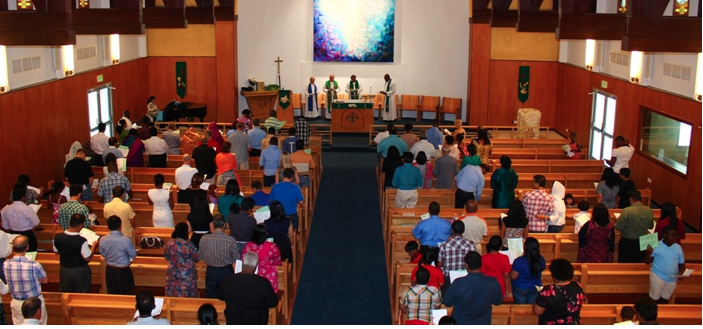
There are times the memories catch me unaware, and leave me breathless.
AdventueMan and I went grocery shopping today and when the cashier told me the total, AdventureMan almost gasped. I just laughed and told him that’s why I never took him grocery shopping with me in Kuwait – the sticker shock would have killed him.
Life here is definitely easier.
On the other hand, we have had to revise our ideas about Kuwait drivers. At first, we just thought there were a lot of Kuwaitis living in Pensacola; now we have realized that there are people who just drive as they please. Some of them are stoned out of their minds. I witnessed an accident last week where when I checked the driver of the car that was hit, she grinned at me loopily – and then disappeared. It was bizarre, and I wonder how many people are on the roads as impaired as she was. She went right through a stop sign as if it weren’t even there, and if the car had hit 6 inches more forward, she would have been dead. She didn’t have a scratch. And she was not at all concerned, just that loopy grin. “Elegantly wasted” said the driver of the car who hit her.
We both have a lot going on. With connection comes commitment and obligation. We try to coordinate our schedules at the beginning of the week so we can help one another out. The highlight is that each afternoon I am taking care of our new little granddaughter. AdventureMan/Baba often comes by and naps in the peaceful environment just to be with us. She is a sweet, laughing little baby, never very fussy. He offers me a day off, which occasionally I take, or he takes a time when I have a meeting or an appointment. We have both discovered how very much we like the ‘work’ of grandparenting. 🙂
We’re managing. 🙂
“if You Can’t Prevent Rape, You Enjoy It”: Ranjit Sinha
The Chief of India’s Central Bureau of Investigation said this! Was he snorting cocaine in a drunken stupor? Of course he is apologizing, but his careless remark demonstrates the sentiments buried deep in his culture’s heart – it’s only women. Not worth much, not like us men. Outrageous.
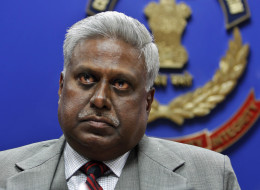
NEW DELHI (AP) — India’s top police official apologized Wednesday for saying, “If you can’t prevent rape, you enjoy it,” a remark that has outraged women across the country.
Central Bureau of Investigation chief Ranjit Sinha made the remark Tuesday during a conference about illegal sports betting and the need to legalize gambling. The CBI, the country’s premier investigative agency, is India’s equivalent of the FBI.
Sinha said at the conference that if the state could not stop gambling, it could at least make some revenue by legalizing it.
“If you cannot enforce the ban on betting, it is like saying, ‘If you can’t prevent rape, you enjoy it,'” he said.
The remarks have caused outrage across India, which in the past year has been roiled by widespread protests following the fatal gang rape of a 23-year-old woman on a bus in New Delhi.
On Wednesday, Sinha said that his comments had been taken out of context and misinterpreted, and that he was sorry if he had caused hurt.
Angry activists, however, called for his resignation.
Communist Party of India (Marxist) leader Brinda Karat said Sinha’s comments were offensive to women everywhere.
“It is sickening that a man who is in charge of several rape investigations should use such an analogy,” Karat told reporters. “He should be prosecuted for degrading and insulting women.”
The New Delhi attack on the young woman last December caused nationwide outrage and forced the government to change rape laws and create fast-track courts for rape cases. New laws introduced after the attack make stalking, voyeurism and sexual harassment a crime. They also provide for the death penalty for repeat offenders or for rape attacks that lead to the victim’s death.
Where is Umzimvubu, South Africa?
Today we pray for the Diocese of Umzimvubu, in South Africa:

Matthew 5: 44-46
|
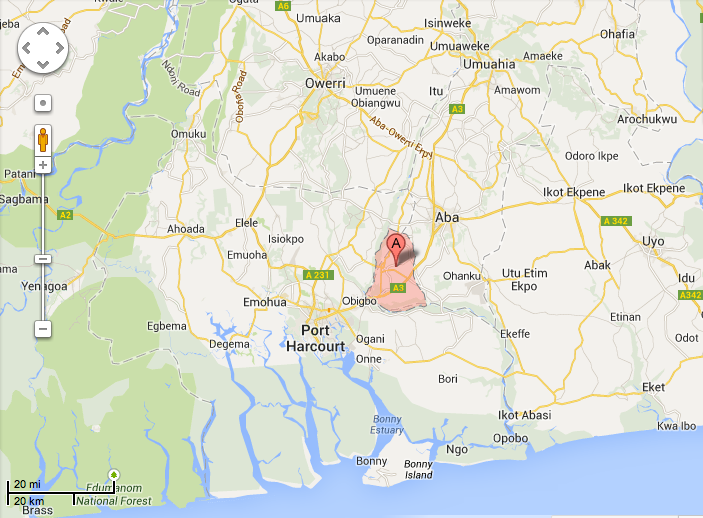
Where Are Dioceses of Ukwa and Umuahia (Aba, Nigeria)?
Every day our church prays for a different part of the world. Today it is Ukwa and Umuahia in Aba, Nigeria. I had to look it up:
Happy Islamic New Year
My good friend and commenter, Daggero, left this comment for us yesterday announcing the new Islamic year:
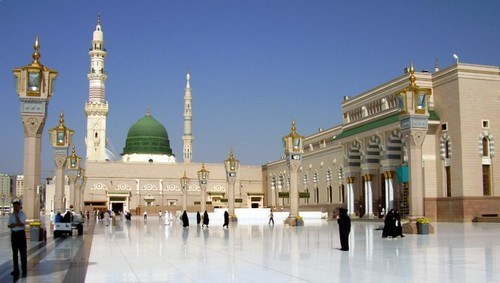
For your information yesterday we entered the Islamic year 1435 Hijri ( hijri = immigration ) which marks the year the prophet Muhammad peace be upon him, emigrated after 13 years of calling people to Islam from Mecca to Medina, ( where he is burried in his Mosque , Masjid an Nabawi, the second holliest mosque in Islam after the Mecca )
So total Islam time from begining to now is 1448 years, and on this auspicious occasion i wish you , AdventureMan and your family and the little ones a happy and a blessed New Islamic year.
We wish you the same, Daggero, and I smiled as I read that you discussed the topic we were discussing with your daughter on the drive to school in the morning. I remember those days so well, as young people begin to draw off into their own lives and the time we spend with them in cars can be so precious. Happy New Year to you and your family.
We had a friend from Libya whose family name meant “from Madina;” before we had ever lived in any Middle East country, he had told us a little about Madina, and what a beautiful city it is. The mosque is very beautiful. I think the tradition is that green was the prophet Mohammed’s favorite color?
Happy New Year, too, to all our Moslem friends.
Saudi Women Drive, No Problem
For your delight of the day, please go to YouTube and watch this hilarious Saudi video, No Woman, No Drive! Click on the blue type above 🙂

From The Guardian:
Dozens of Saudi Arabian women drive cars on day
of protest against ban
-
Staff and agencies
- theguardian.com, Saturday 26 October 2013 12.03 EDT
Activists say at least 60 joined call to allow female drivers – making it country’s biggest ever demonstration against the ban
More than 60 Saudi women got behind the wheels of their cars as part of a protest against a ban on women driving in the kingdom, activists have claimed.
A Saudi professor and campaigner, Aziza Youssef, said the activists have received 13 videos and another 50 phone messages from women showing or claiming they had driven, the Associated Press reported.
She said it had not been not possible to verify all of the messages. But, if the numbers are accurate, they would make Saturday’s demonstration the biggest the country has ever seen against the ban.
Despite warnings by police and ultraconservatives in Saudi Arabia, there have been no reports from those who claimed to have driven of being arrested or ticketed by police.
A video clip of a protest by May al-Sawyan, a 32-year-old economics researcher and mother of two, was uploaded on the YouTube channel of the October 26 driving for women group, along with several other videos of women purportedly driving in defiance of the ban in Riyadh, al-Ahsa and Jeddah. It was not possible to verify when they were filmed. Another video to feature on YouTube was the spoof No Woman, No Drive.
“I am very happy and proud that there was no reaction against me,” she told AP. “There were some cars that drove by. They were surprised, but it was just a glance. It is fine. They are not used to seeing women driving here.”
Sawyan said she had obtained a driver’s licence from abroad. She said she was prepared for the risk of detention if caught but added that she was far enough from a police car that she was not spotted.
“I just took a small loop. I didn’t drive for a long way, but it was fine. I went to the grocery store,” she said.
Her husband and family waited at home and called her when she arrived at the shop to check on her, she said. She drove with a local female television reporter in the car. They were both without male relatives in the vehicle.
“I know of several women who drove earlier today. We will post videos later,” one of the campaign organisers told Reuters.
The Associated Press reported that a security official said authorities did not arrest or fine any female drivers on Saturday.
Youssef said she and four other prominent women activists received phone calls this week from a top official with close links to Interior Minister Prince Mohammed bin Nayef, warning them not to drive on Saturday, the day the campaign set for women’s driving.
She also said that “two suspicious cars” have been following her everywhere all day. “I don’t know from which party they are from. They are not in a government car,” she said.
Activists said they have 16,600 signatures on an online petition calling for change. Efforts to publicise the issue have been described as the best-organised social campaign ever seen in Saudi Arabia, where Twitter has millions of users and is used to circulate information about the monarchy and official corruption.
Previous attempts to promote change fizzled out in arrests for public order offences and demoralisation. In 2011, the activist Manal al-Sharif made a YouTube video urging women to drive their own cars, and was imprisoned for more than a week. But the signs are far more positive now.
Three female members of the shura (advisory) council – among 30 appointed by the 90-year-old King Abdullah – recommended this month that the ban be rescinded, though no debate has yet taken place.
Latifa al-Shaalan, Haya al-Mani and Muna al-Mashit urged the council to “recognise the rights of women to drive a car in accordance with the principles of sharia and traffic laws”.
The three – praised by supporters for “stirring the stagnant water” – framed their argument with careful references to religious edicts banning women from being in the company of an unrelated male driver. Other ideas designed to reassure critics are appointing female traffic police and driving instructors. Cost is another big factor, with families having to employ chauffeurs, as is convenience.
Though no specific Saudi law bans women from driving, women are not issued licenses. They mostly rely on drivers or male relatives to move around.
Powerful clerics who hold far-reaching influence over the monarchy enforce the driving ban, warning that breaking it will spread “licentiousness.” A prominent cleric caused a stir when he said last month that medical studies show that driving a car harms a woman’s ovaries.
God-With-A-Sense-of-Humor at King O Felafel in Orlando
After driving seven and a half hours to get to the convention hotel, AdventureMan and I needed dinner! We settled in to our hotel and took a quick look at the menu – nope. We needed something comforting, something familiar. And there it was, just one minute, I am not kidding, from our hotel, the King O Felafel.
God-with-a-sense-of-humor had plopped us splat down in a hotel in the middle of Middle-Eastern-Land. Minutes from Disney, minutes from all the shoddy tackiness of Orlando, we find ourselves “home.”
The King O Felafel’s shop was full of regulars, including one very large family taking up about five tables all put together, and having a wonderful time. The King himself makes his own felafels, using that little felafel making tool, he was so quick. The was clean clean clean, and service was quick.
We started with lentil soup, and I ordered the Vegetarian Platter (which was like a mezze) and AdventureMan ordered a Felafel Sandwich.
Oh, how we have been yearning for the simple joy of a felafel sandwich done right. The King O Felafel was heaven for us.

Thank goodness I remembered to take a picture before we demolished the entire platter!

So simple, so good. A homemade felafel. Perfection.

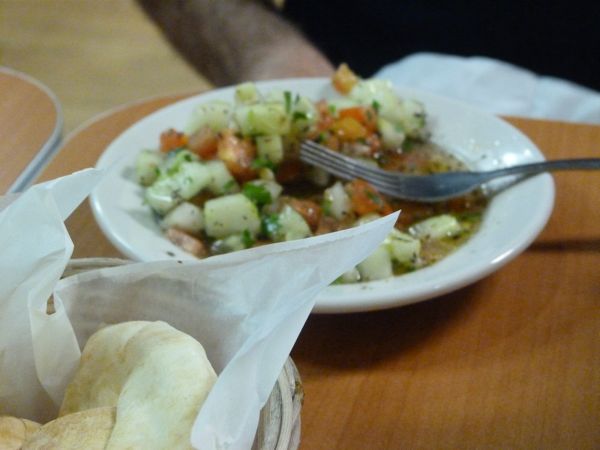
This shop is not undiscovered. He has a large clientele of all kinds of people who appreciate superb food, beautifully and tastily prepared.
Across the street from the King O Felafel is a mosque which also has a gym and a meeting hall. There are several other ‘Mediterranean’ restaurants nearby, and several hookah lounges. There are so many shops in this little area of Kissimmee with ‘halal’ foods and even groceries selling halal meats. Wow.
Mosque – my photo was blurry, so I grabbed this from Google Maps. I guess it used to be a computer shop; now it has arabic writing on it and a sign that says it is the AMYL Center (Masjid Shadi)


Taliban Says Malala ‘Has Done Nothing To Earn Prize’
Mr. Taliban, did you see Jon Stewarts interview with Malala? (See below) All she wants is an education. She wants an education for herself, but also for all children in Pakistan. Your children, too! She wants them to have that opportunity, that’s all. And she has paid the price for her courage speaking out, and she bravely continues to state the obvious – there is nothing in Islam against educating women.
MIRANSHAH, Pakistan: The Pakistani Taliban Thursday said teenage activist Malala Yousafzai had done “nothing” to deserve a prestigious EU rights award and vowed to try again to kill her.
The European Parliament awarded the Sakharov human rights prize to the 16-year-old, who has become a global ambassador for the right of all children to go to school since surviving a Taliban murder attempt.
Malala survived being shot in the head by a TTP gumnan on October 9 last year and is seen as a leading contender for the Nobel Peace prize, to be announced on Friday.
“She has done nothing. The enemies of Islam are awarding her because she has left Islam and has became secular,” Tehreek-e-Taliban Pakistan (TTP) spokesman Shahidullah Shahid told AFP by telephone from an undisclosed location.
“She is getting awards because she is working against Islam. Her struggle against Islam is the main reason of getting these awards.”
He repeated the TTP’s threat – made numerous times in recent months -try again to kill Malala, “even in America or the UK”.
Malala and moved to Britain in the wake of the shooting for treatment and to continue her education in safety.
Feted by world leaders and celebrities for her courage, Malala has addressed the UN, this week published an autobiography, and could become the youngest ever Nobel Peace Prize laureate on Friday.
Her autobiography “I am Malala”, written with journalist Christina Lamb, has gone on sale in Pakistan and Shahid warned the Taliban would target bookshops stocking it.
“Malala is the enemy of Islam and Taliban and she wrote this book against Islam and Taliban,” he said. (AFP)
The Alaska State Museum in Juneau
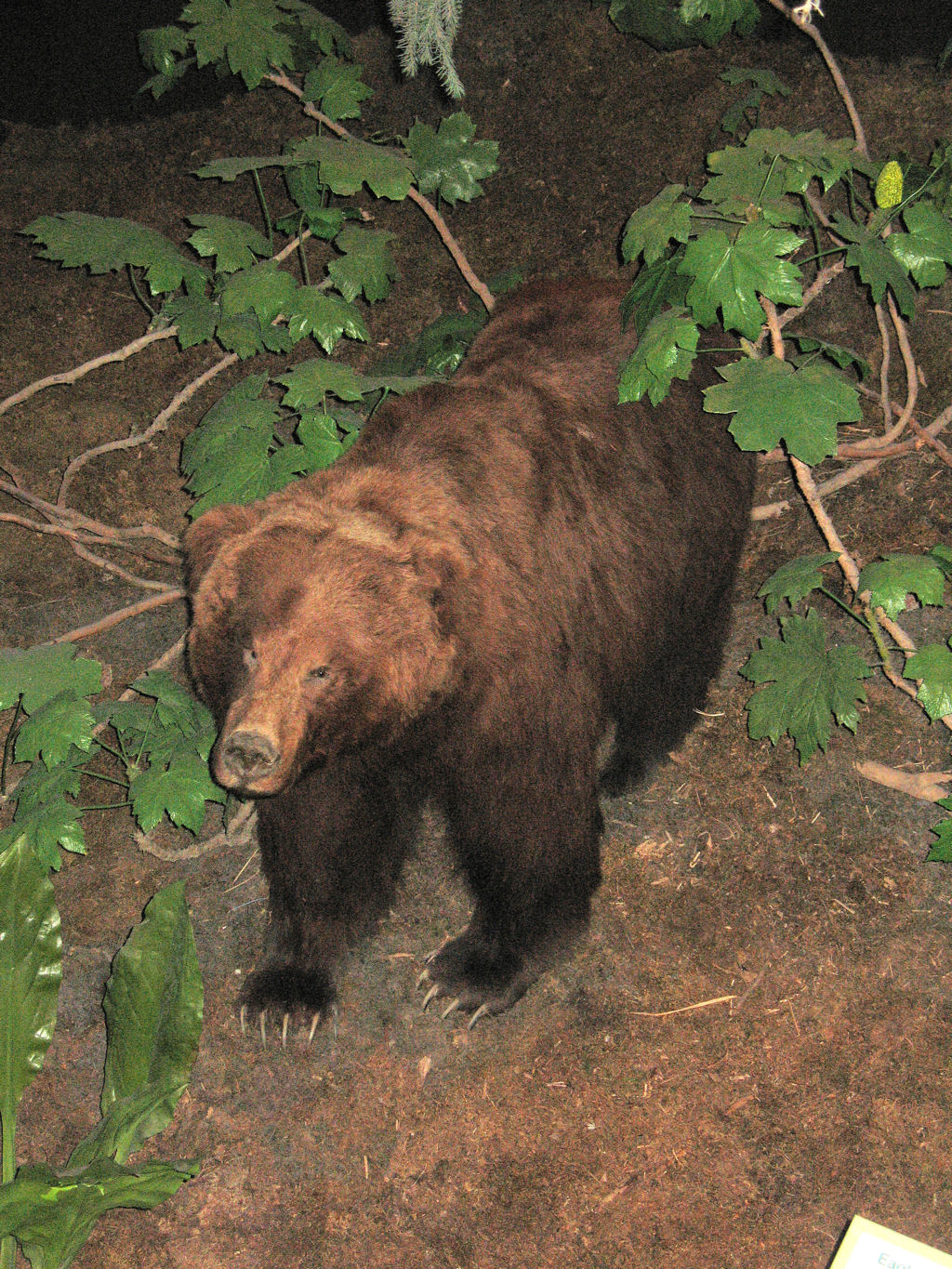
“Oh,” the docent laughed, “everyone asks about that old bear. He hasn’t been around for years. He got all patchy because all the kids touched him and his hair fell off.”
LOL. I know one of those kids. There was a big sign that said “Do Not Touch the Bear” but he was a snowy white polar bear and . . . irresistible. My Dad worked in the same building as this museum, in its old location, and I would meet him there for a ride home after going to the library.
I loved this museum.
This time, it was one of the highlights of the entire trip. This museum is rich in well-curated pieces, and they are beautifully arranged. A new museum is going up; I can only hope that when it opens, it is at least as well done as this one is. Both AdventureMan and I could spend a lot more time in this museum.
Carving at the entrance:


Bent wood box

Painted chest
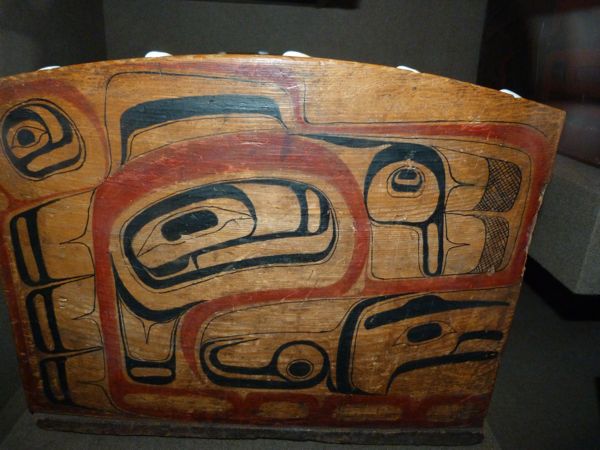
Ceremonial robe
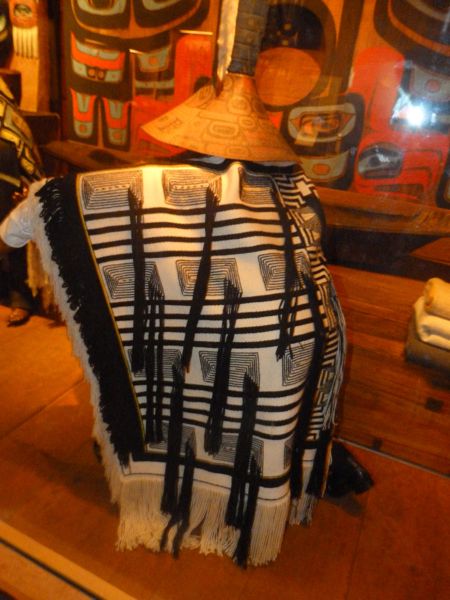
Everyday clothing
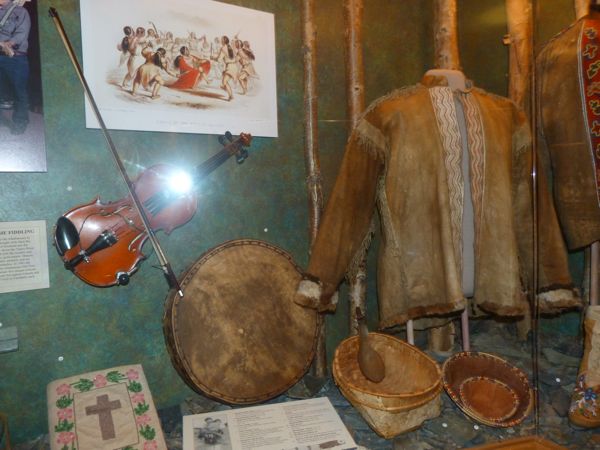
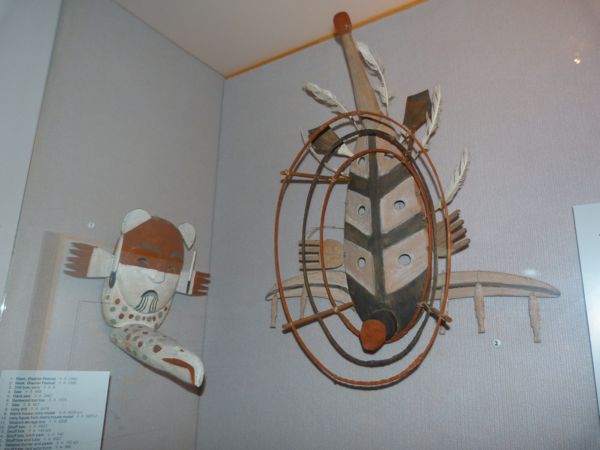
Upiq masks
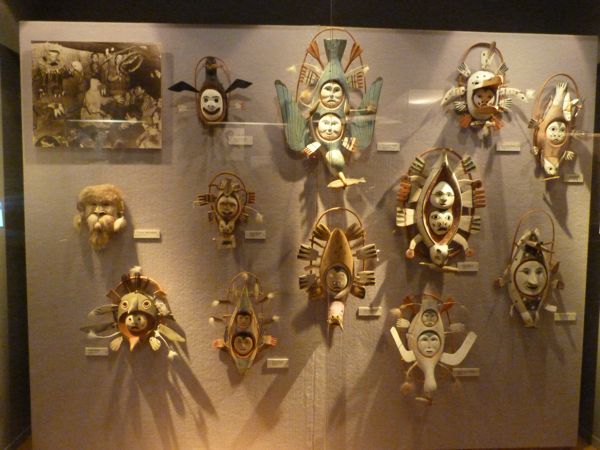
Close up Upiq masks
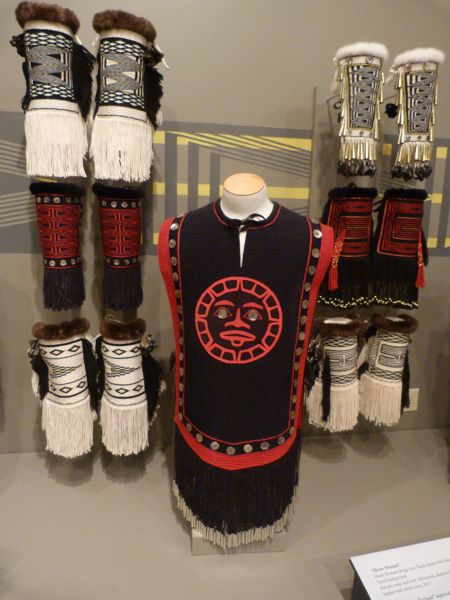
Sun motif ceremonial outfit – look at the leg pieces – don’t they look like Sadu weaving to you?

Moon motif ceremonial outfit
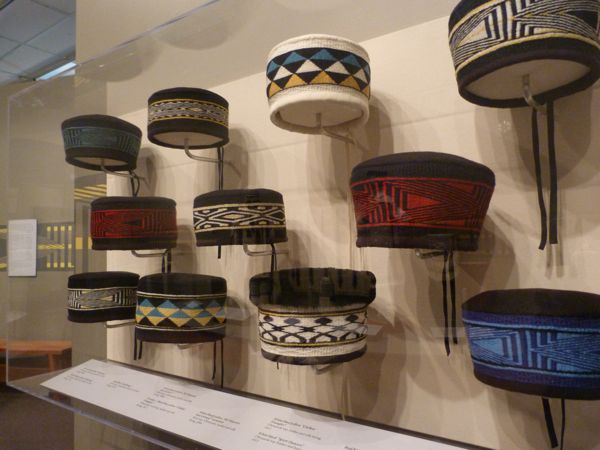
Hand made hats. I was so surprised; these are like prayer caps in Oman and in Pakistan and I think in Indonesia. That they would be so similar in shape and geometric embroidery was amazing to me.
Eagle’s nest display, with eagle sounds. I love this! There is also a bear, but positioned so you really cannot touch . . . 😦

Corner pillars of Alaskan native houses used to look like this, not exactly totemic but with carved spirits:

There is so much more. I focused on the Alaskan Native inhabitants, but there are also exhibits of the coming of the Russians, the gold rush, the transition to territory and statehood . . . I can only take in so much at one time! Good thing we are going back 🙂
ALASKA STATE MUSEUM
395 Whittier Street
Juneau, AK 99811-1718
Tel: 907.465.2901
Fax: 907.465.2976
Recent Comments
intlxpatr on Shampoo Ginger tigerbutterya0c5ff1d… on Shampoo Ginger intlxpatr on British Soldier Kidnapped, Esc… John on British Soldier Kidnapped, Esc… intlxpatr on British Soldier Kidnapped, Esc… Wikipedia Donate Button

Amazina


Early Voting in Florida


