It’s All ‘Insh’allah’
(Forgive me if I ramble a little bit; New Year’s Eve day is always something of a day of reflection for me. It’s not something I plan, it’s something I just find myself compelled to do; I do it whether I want to or not.)
I joke with my friends that the Lord kept sending me back to the Middle East until I learned that it was less my mission to share, than to learn. Once I shut up and watched and listened, I began learning, and what I learned contradicted many of my ignorant prejudices. In learning about my friends in the countries of the Middle East, I learned a lot about our Christian culture, and about myself.
When Westerners first get to the Middle East, the phrase ‘Insh’allah’ (God willing, or ‘if God wills it’) makes them want to tear their hair out. When your heat breaks down in the midst of a cold winter (and yes, there are very cold patches in many Middle Eastern countries) and the heat people tell you ‘Insh’allah’ they will be there ‘in the afternoon’ but won’t give you an exact time, it makes us want to slam the phone down. When you make plans to meet up with a friend for coffee, set a time, and then she says she will see us ‘insh’allah’, we don’t know whether she is going to show up or not.
It was only after many many years in the Middle East that we relaxed and accepted ‘insh’allah.’ Now, living back in the USA, we laugh, because life here is insh’allah, too, it’s just that people don’t know it. We’ve had several things done with our house, and whether or not the workers show up – it’s all insh’allah. When making plans with our family, a lot depends on when the baby is awake or sleeping, insh’allah. How much money our investments are worth? It’s all insh’allah. The same factor is there, it’s just cultural as to whether you acknowledge it or not.
Today’s New Testament reading from The Lectionary is all about insh’allah:
James 4:13-17, 5:7-11
13 Come now, you who say, ‘Today or tomorrow we will go to such and such a town and spend a year there, doing business and making money.’ 14Yet you do not even know what tomorrow will bring. What is your life? For you are a mist that appears for a little while and then vanishes. 15Instead you ought to say, ‘If the Lord wishes, we will live and do this or that.’ 16As it is, you boast in your arrogance; all such boasting is evil. 17Anyone, then, who knows the right thing to do and fails to do it, commits sin.
7 Be patient, therefore, beloved,* until the coming of the Lord. The farmer waits for the precious crop from the earth, being patient with it until it receives the early and the late rains. 8You also must be patient. Strengthen your hearts, for the coming of the Lord is near.* 9Beloved,* do not grumble against one another, so that you may not be judged. See, the Judge is standing at the doors! 10As an example of suffering and patience, beloved,* take the prophets who spoke in the name of the Lord. 11Indeed we call blessed those who showed endurance. You have heard of the endurance of Job, and you have seen the purpose of the Lord, how the Lord is compassionate and merciful.
And I think my New Year’s resolution is clear: Not to grumble against one another. 🙂
Deb Roy: The Birth of a Word
Come back when you have some time – you’ll need about twenty minutes to watch this TED video about communication. I love this – but then you know I am a word nerd, and I love the way concepts are born and grow.
Computers have aided language analysis and taken it to lengths that were previously inconceivable. First, Deb Roy shows – with videos, graphs and cloud analysis – how his son learned to speak his first word.
He goes from there to what I would call “buzz analysis”, taking program content from cable television and correlating it to comments on public media – blogs, FaceBook, all kinds of public forums. The results are astonishing, and a great tool to understand the national psyche and how we think and process. This is amazing stuff.
Your Smart Phone Monitoring Your Every Move?
A new video out by Trevor Eckhardt documents how Carrier IQ transmits your activities to your mobile phone carrier:
You can read the entire (fascinating) article on this Huffington Post article.
I Wish I’d Hugged Her
The phone rang, late for most of my friends. We rarely talk after nine. It was one of my quilting sisters, calling to tell me one of our members had collapsed and died.
I sat down. Why would my friend say such a thing? On the other hand, when I saw her – just three days ago – she wasn’t looking too good, had one of those allergies or things we all get during this time when the temperatures may be in the 40’s or in the high 70’s. But she did make it to the meeting, and we all have bad days, don’t we?
My friend said she would let me know as soon as she knew the arrangements. I think I was a little dazed, a little in shock. I remember when I got the call my Dad had died, it’s like I can’t integrate things all at once, it takes me a while for things to sink in.
I wish I’d hugged her. She’s a lady I really like, talented, wry, funny. We talked, briefly at the meeting, but then the meeting went into full swing and I didn’t really talk with her again. I wish I’d hugged her.
Law and Order SVU: How Did They Know and When Did They Know It?
What a tragedy. Joe Paterno, fired in disgrace. Joe Paterno, the much admired, the Penn State football coach who embodied integrity, fired, disgraced. “What did he know and when did he know it?” people ask.
What astonishes me is that the situation almost exactly parallels a recent episode of Law and Order SVU about which I recently blogged, in September.
In that episode, a much-admired football coach is reported to be preying on young men in his foundation, young men for whom he gave an opportunity to ‘be someone;’ he trained them, gave them motivation and the possibility of a lot of money, fame and good things for their very poor families. His victims were burdened by a debt of gratitude, combined with the shame of male-on-male sex, which they did not want to become public knowledge. The combination of gratitude and shame kept them silent, until one spoke out. It took a lot of courage, but finally, a big star who had come through this depraved coach’s program went public, appeared before the grand jury, and set the example.
The similarities are eerie. In Law and Order, however, the coach who had preyed on young players in the showers and locker rooms did not bring down a highly regarded top-ranking program director, and a university president.
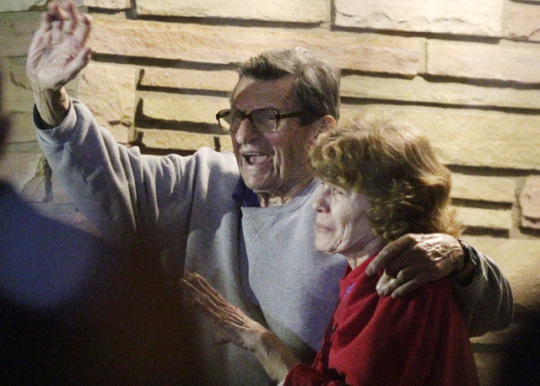
Joe, we are so sorry this has happened to you, and we hope that posterity will recognize that one poor decision is counter-balanced by a lifetime of integrity. We pray that young men victimized by Defensive Coach Jerry Sandusky will come forward, have their voices heard, and be able to move on with their lives, knowing that Sandusky will be punished. We pray for their families, who had no idea what was happening in their sons’ lives. It’s a sad time all the way around.
And thanks be to God, we live in a society where the trustees made the right decision, they fired the men who looked the other way as Sandusky victimized his young men. Thank God, this dirty laundry was not buried away to be forgotten, but brought forward, the perpetrator arrested and shamed publicly. There are times, in this world, when in the interest of the God of football, or the respect of position, when a scandal victimizing the poor and voiceless is shoved under the table, ignored, the victims sent the message that they don’t matter. As bitter as this pill is, I thank God for it, and for the increasing transparency in our society which begins to equalize justice for rich and poor.
Not-So-Real Housewives
Over Thai food, I confessed my guilty secret – I can’t help it, I watch the Real Housewives of Beverly Hills and the Real Housewives of New York. I expected a horrified response from my sweet smart niece, Professor Little Diamond, but she just laughed.

“Oh we all watch them,” she reassured me, “It’s like watching a train wreck, you are appalled, but you can’t look away.”
What makes me really, really nervous about these ‘real’ housewives is that I think that the Bravo station is carried in Qatar and Kuwait and Saudi Arabia. While the more educated have travelled, and know that these ‘real’ housewives are not the norm, there may be many who think that this is the life of the American female.

I remember when I shocked my Qatari friends as I told them I was going home to take care of my Dad while my Mom had a knee replacement and spent a few weeks in rehab. They didn’t know we take care of our parents; they thought we just put them in grim warehouse like nursing homes. How did they know? From television, of course.
So you can understand I have a major concern that these women are representing us normal people in the homes of our friends in the Middle East. These women spend a lot of money on scanty clothing, these women have people who come in and do their make-up before a dinner party, these people have nannies taking care of their children (many of whom are really bratty) and they all seem to be designing handbags or creating make-up lines or (oh-no!) cutting records to try to get a singing career started.
Ask yourself this – who do you know in your own circles who would agree to have camera crews follow them around in their lives, filming their most intimate conversations? Who do you know in your circle who creates drama and conflict? Who do you know who needs the affirmation of an audience to believe her life is worth living? Who in your circle is addicted to plastic surgery or throws charity events to get attention? Those are the women they are filming.
You never see these women go to church. You rarely see them cooking up a normal dinner for their family. You don’t see any of them heading off to an 8 – 5 job. You don’t see them doing all the normal things we normal American housewives do (a lot like our sisters do in every country of the world) like laundry, running the kids to school, doctors appointments, soccer matches, paying the bills, scrubbing the floor, making appointments at the veterinarian, getting the car serviced, buying groceries, going to PTA, or doing their volunteer work. You don’t see them running over to their children’s house to babysit, or going to their exercise classes.
But then again, if they were doing all these things that us REAL housewives do, who would watch, LLLLOOOOOLLLLLLL! I understand there may be some sister Real wives series coming up from foreign countries. It will be interesting to see how their lives look.
Anne Enright: The Gathering
What is it with my problem with Man Booker Award winners? The last one I remember is White Tiger, which we read in our Kuwait book group, and I hated. Actually, it was the main character I hated . . . and possibly that is what is happening with me and The Gathering, now that I think about it.

We meet Veronica, Irish, from a large Irish family, as she learns of the death of her brother Liam. Through claiming the body, preparing for the funeral, the funeral and the aftermath, we are there with Veronica as she whines and complains, as she disparages her family members while ignoring her own husband and family, and she drinks too much. She gets up at noon, and stays up all night, avoiding her husband. Her language is frightful, and her sexual episodes are crude and explicit . . . offensive, but maybe it is the utter distraught nature of a woman in the throes of the deepest grief?
Slowly, slowly, the story unfolds. For me, I was never sure what was truth and what was imagination, in terms of the story. Were the children abused, molested, neglected? Or are these the creative imaginings of a troubled woman? There seems to be a thread of insanity in the family – can we trust that she is a reliable narrator?
As little as I liked the main character – hmmmm, that seems to be a problem I am having a lot right now, or at least I’ve had a run of main characters I don’t like very well – I finished this book. I’m glad I read it so that I can talk about it if it comes up in a discussion, but it did not inspire or elevate me in any way, and I didn’t even feel a lot of compassion for the narrator.
Sobering Reading on Wealth
It’s a long weekend, Labor Day weekend, and Pensacola awakes to rain-sodden streets and forecasts of a rain soggy three day weekend (bad for hotels and restaurants at the beach who hope for a sell-out Labor Day) and high surf from off-shore storms.
The reading for today from James is equally gloomy. I always think of “Insh’allah” when I read it, because it probably has an equivalent somewhere in the Quran, and my Muslim friends say “Insh’allah” (As God wills, or If God wills it) when they state a planned event.
While we are not rich, we have a large homeless population in Pensacola, sleeping out under the skies in hidden camps, scrounging for food, often with a dog, seeking handouts, seeking scraps. They are a constant reminder, to me, of how comfortable we are, and how comfort wars with the religious spirit. When we are too comfortable, we often fail to keep our focus on God, and are distracted by our toys and interests.
(I told you this would be gloomy.)
On the other hand, I wonder how spiritual I would be if I were hungry, worried about getting enough to eat, worried about my safety sleeping out in one of the camps. I wonder if their community looks after one another, or if it is a brutal and chaotic life. I wonder how you can keep your mind on things of the spirit when the search for basic necessities takes up a large part of your life.
James 4:13-5:6
13 Come now, you who say, ‘Today or tomorrow we will go to such and such a town and spend a year there, doing business and making money.’ 14Yet you do not even know what tomorrow will bring. What is your life? For you are a mist that appears for a little while and then vanishes. 15Instead you ought to say, ‘If the Lord wishes, we will live and do this or that.’ 16As it is, you boast in your arrogance; all such boasting is evil. 17Anyone, then, who knows the right thing to do and fails to do it, commits sin.
5Come now, you rich people, weep and wail for the miseries that are coming to you. 2Your riches have rotted, and your clothes are moth-eaten. 3Your gold and silver have rusted, and their rust will be evidence against you, and it will eat your flesh like fire. You have laid up treasure* for the last days. 4Listen! The wages of the labourers who mowed your fields, which you kept back by fraud, cry out, and the cries of the harvesters have reached the ears of the Lord of hosts.
5You have lived on the earth in luxury and in pleasure; you have fattened your hearts on a day of slaughter. 6You have condemned and murdered the righteous one, who does not resist you.
What Tiny Qatar Stands To Gain In Libya
Another fascinating discussion on National Public Radio, which covers subjects not covered by major national news sources.
Of course, anything having to do with Qatar is of interest to us, as we lived there for four years during a time of breathtaking and exhilarating change. It is astounding, and wonderful, to us, that Qatar defies the lethargy and inertia of the Gulf Countries, and has transformed itself into a major influence, in spite of its smaller size, and even smaller population of native Qataris. They have taken the huge influx of cash that came with the discovery of natural gas, and leveraged it into massive modernization, transformation, and influence on the international scene. It’s an amazing accomplishment.

ROBERT SIEGEL, host: The Libyan rebels received decisive air support from NATO. But there was another, less publicized, smaller-scale but equally remarkable foreign involvement in support of the uprising, the involvement of Qatar, Q-A-T-A-R.
Qatar is a peninsula, a little smaller than Connecticut. It juts north into the Persian Gulf. On the south, it borders Saudi Arabia. It is rich in oil and natural gas. Its population is only about 900,000. And while it is an Arab country, a monarchy ruled by the al-Thani family, the majority of its residents are non-Arabs, non-citizens from India and Pakistan. Qatar is also home to the TV channel Al Jazeera. It will host soccer’s World Cup and it was an important player in Libya.
Ibrahim Sharqieh is deputy director of the Brookings Doha Center. Doha is the capital of Qatar. And, Ibrahim, first, what did the Qataris do in support of the Libyan rebels?
Dr. IBRAHIM SHARQIEH: That Qataris’ support to the Libyan rebels has been politically, diplomatically and militarily. We had about five Qatari fighter jets. In Qatar, we had about the training of Libyan rebels. And Qatar also played an important role in developing an Arab League support through the military intervention in Libya, which this Arab League support actually has provided the umbrella for the NATO intervention and for the military intervention and provided the legitimacy that, for example, was missing in Iraq.
SIEGEL: Why? What are the motives behind Qatar’s involvement in Libya and some of its broader ambitions in the region?
SHARQIEH: Oh, there are many theories. The one that makes the most sense in my view is that Qatar is supporting the revolution for humanitarian reasons. And in addition to this, Qatar is working and supporting the revolution is they’re strictly with its vision for its role in the region and in the world.
SIEGEL: One thing we should note, though, in this year of the Arab Spring, one thing Qatar isn’t is it isn’t a democracy. It isn’t an elected parliamentary republic.
SHARQIEH: Well, there is very high level satisfaction of the people here in the country, of the political system and of its leadership. So there haven’t been – we haven’t seen any cause for change or any protests or any different types of complaints. So the system seems to work and we seem to have a stable country. That distance itself very far away from the protests that are happening in the region.
SIEGEL: How would you describe U.S.-Qatar relations?
SHARQIEH: We know it’s a strong relationship. Qatar hosts a military base, the largest in the region here, in Al Udeid. And this has been a sophisticated policy where Qatar managed to have a good relationship between the United States and other rivals in the region, like Iran. In order to protect yourself as a small, wealthy country, some sort of striking a balance is needed and Qatar has been more influential in this crisis and other regions in Benghazi.
Going back to Libya, when you go outside the offices of the National Transition Council, you see the American flag. You see the French flag. You see the British flag, and you see also the Qatari flag.
SIEGEL: Yes. Here’s a country that aspires to a very high profile in regional affairs, but it consists of fewer than a million people. And of them only about 350,000 I read are citizens. That doesn’t sound like a country that can really be a world player, you know? It just sounds too tiny.
SHARQIEH: Well, it is too tiny but, hey, we are living in an international system that you have the means to play it right and become an important player. Qatar has invested in the right political market by mediation. Qatar was successful in the mediating an agreement between the Yemeni government and the Houthi rebels. Prevented a civil war almost in Lebanon, brokered peace agreements between the Palestinians, Fatah and Hamas, and also intervened in the fall in Sudan.
So, Qatar has proved to me an important, major emerging power in the region and to play it right and position itself very well in the international scene.
SIEGEL: Well, Ibrahim Sharqieh, thank you very much for talking with us about Qatar.
SHARQIEH: My pleasure. Thank you for having me, Robert.
SIEGEL: Ibrahim Sharqieh is deputy director of the Brookings Doha Center. Doha is the capital city of Qatar.

Neighbors Key to Survival
“Americans don’t know their neighbors” my dinner guest said, in response to my asking him what surprises him most in his visit to this country. “In my country, we all know our neighbors. It’s important to know your neighbors.”
I agreed, and quoted him this article supporting his view that I heard on National Public Radio, one of those ideas I hear so often on NPR because they cover news other news sources ignore.
Below is just a portion of the story, which you can read in whole by clicking on this blue type. Even better, if you want, you can listed to the story yourself by clicking on the “Listen to the Story: All things Considered” button on this same page.

When Hurricane Katrina struck in 2005, one victim was political scientist Daniel Aldrich. He had just moved to New Orleans. Late one August night, there was a knock on the door.
“It was a neighbor who knew that we had no idea of the realities of the Gulf Coast life,” said Aldrich, who is now a political scientist at Purdue University in Indiana. He “knocked on our door very late at night, around midnight on Saturday night, and said, ‘Look, you’ve got small kids — you should really leave.’ ”
The knock on the door was to prove prophetic. It changed the course of Aldrich’s research and, in turn, is changing the way many experts now think about disaster preparedness.
Officials in New Orleans that Saturday night had not yet ordered an evacuation, but Aldrich trusted the neighbor who knocked on his door. He bundled his family into a car and drove to Houston.
“Without that information we never would’ve left,” Aldrich said. I think we would’ve been trapped.”
In fact, by the time people were told to leave, it was too late and thousands of people got stuck.
Because of his own experience in Katrina, Aldrich started thinking about how neighbors help one another during disasters. He decided to visit disaster sites around the world, looking for data.
Aldrich’s findings show that ambulances and firetrucks and government aid are not the principal ways most people survive during — and recover after — a disaster. His data suggest that while official help is useful — in clearing the water and getting the power back on in a place such as New Orleans after Katrina, for example — government interventions cannot bring neighborhoods back, and most emergency responders take far too long to get to the scene of a disaster to save many lives. Rather, it is the personal ties among members of a community that determine survival during a disaster, and recovery in its aftermath.
When Aldrich visited villages in India hit by the giant 2004 tsunami, he found that villagers who fared best after the disaster weren’t those with the most money, or the most power. They were people who knew lots of other people — the most socially connected individuals. In other words, if you want to predict who will do well after a disaster, you look for faces that keep showing up at all the weddings and funerals.
“Those individuals who had been more involved in local festivals, funerals and weddings, those were individuals who were tied into the community, they knew who to go to, they knew how to find someone who could help them get aid,” Aldrich says.
My visiting guest was from Lebanon, where neighbors have relied on one another for years as civil unrest rocks the country.
“I am guessing we move more often than your family and friends,” I ventured. “You are right, it is harder to establish long-lasting neighborly relations here where people come and go more often.”
Actually, we have settled in a fairly established neighborhood, where many people around us have lived for years and years, some all their lives. But we have only been here a year, and it takes time to build strong neighborly relations. But we are aware that connecting with our neighbors and staying connected is important in a part of the country vulnerable to life-threatening hurricanes and other natural emergencies.
You can listen to the entire report in 6 minutes and 3 seconds here.
Recent Comments
ExpatAlien on What Country am I Living … intlxpatr on Yellowstone: Old Faithful to C… Michelle on Yellowstone: Old Faithful to C… Cathy on No Grown-Ups in Charge intlxpatr on Waiting for Snow Wikipedia Donate Button

Amazina


Early Voting in Florida


 Here There and Everywhere