“Never for Acclaim, Always for Country”
This weekend the CIA also honors fallen warriors, and in a new level of transparency, shares some of those names. It’s devastating to lose a loved one in the military, and I cannot imagine what it was like to lose a loved one and not to even be able to tell people your loved one was lost in service to his or her country. Heartfelt thanks to all those who have served silently and anonymously and sacrificed identity and history for our nation. You know who you are. 🙂
From ABC News:

Out of the shadows in death: The CIA honors its fallen
By Suzanne Kelly CNN – When you’re a spy, you have to accept the fact that everything you do will go unnoticed by most people during your life. Sometimes that secrecy even follows you in death, with a simple star carved into a marble wall at Langley being the only memorial to your service.
Sometimes though, in death, the names come out, along with just enough information to piece together a glimpse of what life — and death — have been like for CIA spies over the past three decades.
This past Monday, 15 names were added to what’s known by insiders as the “Book of Honor.” When a name is inscribed in the book, it allows family and friends of the fallen to publicly acknowledge in general terms, how their loved ones spent their lives, and how they died.
The names and brief stories shared with a crowd said to number in the hundreds gathered in the CIA lobby, told a story of an Agency spread far and wide; the story of an Agency not only consumed with tracking down terrorists, but sometimes becoming victims of the hunted.
Jeffrey R. Patneau, described by CIA Director David Petraeus as a “young can-do officer,” was killed in Yemen in September 2008. Yemen has become a hotbed of al Qaeda activity and is where a recent al Qaeda in the Arabian Pensinsula (AQAP) plot to bring down an airliner with a difficult-to-detect new explosive material, was recently foiled by undercover operatives.
Five of those honored this year died on April 18, 1983, when terrorists targeted the U.S. Embassy in Beirut, killing 63 people. Phyliss Nancy Faraci had also been one of the last four Americans evacuated from the Mekong Delta when Saigon fell, according to an Agency spokesman. She died in Beirut along with Deborah M. Hixson, Frank J. Johnston, and a married couple, James F. and Monique N. Lewis. Petraeus noted the Embassy bombing as the place where the Agency “first caught sight of the adversary we face today.”

To get a sense of just how widespread the CIA presence has been over the years, Matthew K. Gannon was killed in the December 1988 bombing of Pan Am Flight 103 over Lockerbie, Scotland; Molly N. Hardy was killed in the 1998 suicide bombing of the U.S. Embassy in Nairobi; Leslianne Shedd died when hijackers downed the plane she was on over the Indian Ocean in November 1996; Jacqueline K. Van Landingham was killed in Pakistan in March 1995; Barry S. Castiglione died during the ocean rescue of a colleague in 1992 in the waters off El Salvador; Lawrence N. Freedman was killed in Somalia in December 1992; Thomas M. Jennings, Jr. died in Bosnia in 1997; Freddie R. Woodruff was killed in Georgia in 1993; and Robert W. Woods died in a plane crash during a humanitarian mission to Ethiopia in 1989.
Petraeus told the group of gathered mourners and friends that the officers who have died for the mission “all heard the same call to duty and answered it without hesitation — never for acclaim, always for country.”
One more star has been carved into that wall so far this year, bringing the number of stars representing fallen officers to 103. We don’t know who the latest person was, or how they died, but maybe someday, we will.
Copyright 2012 Scripps Media, Inc. All rights reserved. This material may not be published, broadcast, rewritten, or redistributed.
Speaking Truth to our Neighbor
Oh aaarrgh. I do my morning readings, and then I go to Forward Day by Day for a short meditation and to find out what part of the world we are praying for today. Today, the commentary hits on our neighbor . . . my weak point. We are to love God and to love one another. Even in traffic, even in lines in the bank. We are to love that obnoxious woman talking loudly about her personal life on her cell phone, and the aggressive guy who barges in front of you as if he were entitled. Oh aarrgh.
Thursday, may 24
Ephesians 4:17-32. Let all of us speak the truth to our neighbors, for we are members of one another.
How well do you know your neighbors? Do you know their names, their heritage, or anything more than what they drive and a vague awareness of their schedule?
Our busy schedules and desire for privacy often keep us from getting to know the people who live close to us. And why not speak the truth to them? We are neighbors after all.
We might want to expand our definition of neighbor to include those driving next to us on the road, anyone sitting next to us on the bus or train, the person standing next to us in line at the bank. How do we speak the truth to them? Do we tell them the truth, or do we tell them something else? For instance, if you are in a hurry and someone seems to be taking a long time at the teller’s window, would you say, “What is taking you so long?” or would you say, “I am really in a hurry and feeling really impatient at this moment. Would you mind if I go ahead of you?”
When we speak the truth in love to someone, we gain respect and grow closer to being one with each other.
PRAY for the Diocese of Chotanagpur (North India) http://www.anglicancommunion.org/tour/diocese.cfm?Idind=425
The Lord Looks on the Heart
From today’s Lectionary reading:
It’s a common failing, when we study scriptures, to believe we get it right. The more you study, the more surprises you get, and the less sure you become about dogma, i.e. what your tribe believes is true. One of the things that comforts me is that the Lord loved Moses, who murdered a man on an uncontrolled impulse, and David, who had another man killed in battle so he could marry his wife, carrying his illegitimate child.
The Lord sees things differently.
We make things more complicated than they need to be. Jesus told us to believe simply, as a child. Jesus told us to love God with all our being, and to love our neighbor. He did not say love your fellow Christian and hate the Moslem, or love those who love you and don’t worry about the others. He pretty much said that we are to love – and serve – those with whom we come into contact.
To me, the good news is that the Lord loves sinners, even though we grieve him. If we confess, if we are truly sorry, if we ask for his forgiveness, he gives it to us. The great gift of grace – it’s a comfort to me.
1 Samuel 16:1-13
16The Lord said to Samuel, ‘How long will you grieve over Saul? I have rejected him from being king over Israel. Fill your horn with oil and set out; I will send you to Jesse the Bethlehemite, for I have provided for myself a king among his sons.’ 2Samuel said, ‘How can I go? If Saul hears of it, he will kill me.’ And the Lord said, ‘Take a heifer with you, and say, “I have come to sacrifice to the Lord.” 3Invite Jesse to the sacrifice, and I will show you what you shall do; and you shall anoint for me the one whom I name to you.’ 4Samuel did what the Lord commanded, and came to Bethlehem. The elders of the city came to meet him trembling, and said, ‘Do you come peaceably?’ 5He said, ‘Peaceably; I have come to sacrifice to the Lord; sanctify yourselves and come with me to the sacrifice.’ And he sanctified Jesse and his sons and invited them to the sacrifice.
6 When they came, he looked on Eliab and thought, ‘Surely the Lord’s anointed is now before the Lord.’* 7But the Lord said to Samuel, ‘Do not look on his appearance or on the height of his stature, because I have rejected him; for the Lord does not see as mortals see; they look on the outward appearance, but the Lord looks on the heart.’ 8Then Jesse called Abinadab, and made him pass before Samuel. He said, ‘Neither has the Lord chosen this one.’ 9Then Jesse made Shammah pass by. And he said, ‘Neither has the Lord chosen this one.’ 10Jesse made seven of his sons pass before Samuel, and Samuel said to Jesse, ‘The Lord has not chosen any of these.’ 11Samuel said to Jesse, ‘Are all your sons here?’ And he said, ‘There remains yet the youngest, but he is keeping the sheep.’ And Samuel said to Jesse, ‘Send and bring him; for we will not sit down until he comes here.’ 12He sent and brought him in. Now he was ruddy, and had beautiful eyes, and was handsome. The Lord said, ‘Rise and anoint him; for this is the one.’ 13Then Samuel took the horn of oil, and anointed him in the presence of his brothers; and the spirit of the Lord came mightily upon David from that day forward. Samuel then set out and went to Ramah.
Tribal Affiliations

When we first got to Qatar, and started attending church there, we had a wonderful priest, T. Ian Young, whose Friday morning services (Friday was the Qatari Sunday) were exactly 60 minutes long, and the music was always uplifting. I learned some great children’s songs from him, and he always gave a children’s sermon before sending them out for children’s Sunday School while he gave an adult level sermon to the older attendees, like us.

During the service, Father Ian would pray, including the phrase “from whom every tribe in heaven and earth get their name” (from Ephesians 3:15) and it got my attention, it was my first awareness thinking of myself as from a tribe. I had always heard it as “from whom every family on heaven and earth . . . ” but living in Qatar, where family and tribe were the same, it made sense. It’s just one of those situations where we think of “tribes” as THOSE people, not as us. When you include yourself as a tribal member, things start to look a little different. (Thank you, Father Ian)

So recently AdventureMan has been pointing out local tribal affiliations on people’s cars. People have specialized license plates that tell us of their concern for Florida’s environment, or schools, or support of the arts, etc. People have stickers that show they are from the Auburn tribe, or the Seminole Tribe, or Gator people, or graduated from such-and-such university. They might be from this neighborhood, so says the sticker on their bumper, or they might support the orchestra, or the ballet, or they might belong to this Krewe or that. Once we become aware that we, too, are tribal, and have tribal affiliations, there is no going back.
Diversity: No Holding Back the Tide
From today’s AOL News/ Huffpost:
So here’s the thing. In the USA, as in many countries, people study their ancestry, their bloodlines. Some people want those bloodlines to make them special, but anyone who has read history in any big-picture kind of way understands that most of history is people coming and going, waves of migration, immigration and emmigration, mostly depending on food supply, but often, too, depending on employment opportunities. Bottom line, most of it is about survival.
Now, blood. When we go to the hospital, or are taken there after an accident, do we ask whose blood it is that we receive when we need a transfusion? Blood is blood. The match to your antibodies and needs may be from another, despised race. Do we really know who our fathers are? Do women raped always admit to being raped? Do women admit to having a relationship outside of marriage? Many a child is born whose parenthood is not what it is claimed to be.
National DNA testing is controversial. Kuwait has been trying to do DNA testing to construct a profile for who is or is not Kuwaiti. 🙂 Do you really want to know?

Minority Birth Rate Now Surpasses Whites In US, Census Shows
By HOPE YEN 05/17/12 03:16 AM ET
WASHINGTON — For the first time, racial and ethnic minorities make up more than half the children born in the U.S., capping decades of heady immigration growth that is now slowing.
New 2011 census estimates highlight sweeping changes in the nation’s racial makeup and the prolonged impact of a weak economy, which is now resulting in fewer Hispanics entering the U.S.
“This is an important landmark,” said Roderick Harrison, a former chief of racial statistics at the Census Bureau who is now a sociologist at Howard University. “This generation is growing up much more accustomed to diversity than its elders.”
The report comes as the Supreme Court prepares to rule on the legality of Arizona’s strict immigration law, with many states weighing similar get-tough measures.
“We remain in a dangerous period where those appealing to anti-immigration elements are fueling a divisiveness and hostility that might take decades to overcome,” Harrison said.
As a whole, the nation’s minority population continues to rise, following a higher-than-expected Hispanic count in the 2010 census. Minorities increased 1.9 percent to 114.1 million, or 36.6 percent of the total U.S. population, lifted by prior waves of immigration that brought in young families and boosted the number of Hispanic women in their prime childbearing years.
But a recent slowdown in the growth of the Hispanic and Asian populations is shifting notions on when the tipping point in U.S. diversity will come – the time when non-Hispanic whites become a minority. After 2010 census results suggested a crossover as early as 2040, demographers now believe the pivotal moment may be pushed back several years when new projections are released in December.
The annual growth rates for Hispanics and Asians fell sharply last year to just over 2 percent, roughly half the rates in 2000 and the lowest in more than a decade. The black growth rate stayed flat at 1 percent.
The immigrants staying put in the U.S. for now include Narcisa Marcelino, 34, a single mother who lives with her two daughters, ages 10 and 5, in Martinsburg, W.Va. After crossing into the U.S. from Mexico in 2000, she followed her brother to the eastern part of the state just outside the Baltimore-Washington region. The Martinsburg area is known for hiring hundreds of migrants annually to work in fruit orchards. Its Hispanic growth climbed from 14 percent to 18 percent between 2000 and 2005 before shrinking last year to 3.3 percent, still above the national average.
Marcelino says she sells food from her home to make ends meet for her family and continues to hope that one day she will get a hearing with immigration officials to stay legally in the U.S. She aspires to open a restaurant and is learning English at a community college so she can help other Spanish-language speakers.
If she is eventually deported, “it wouldn’t be that tragic,” Marcelino said. “But because the children have been born here, this is their country. And there are more opportunities for them here.”
Of the 30 large metropolitan areas showing the fastest Hispanic growth in the previous decade, all showed slower growth in 2011 than in the peak Hispanic growth years of 2005-2006, when the construction boom attracted new migrants to low-wage work. They include Lakeland, Fla.; Charlotte, N.C.; Atlanta; Provo, Utah; Las Vegas; and Phoenix. All but two – Fort Myers, Fla., and Dallas-Fort Worth – also grew more slowly last year than in 2010, hurt by the jobs slump.
Pointing to a longer-term decline in immigration, demographers believe the Hispanic population boom may have peaked.
“The Latino population is very young, which means they will continue to have a lot of births relative to the general population,” said Mark Mather, associate vice president of the Population Reference Bureau. “But we’re seeing a slowdown that is likely the result of multiple factors: declining Latina birth rates combined with lower immigration levels. If both of these trends continue, they will lead to big changes down the road.”
William H. Frey, a demographer at the Brookings Institution who analyzed the census data, noted that government debates over immigration enforcement may now be less pressing, given slowing growth. “The current congressional and Supreme Court interest in reducing immigration – and the concerns especially about low-skilled and undocumented Hispanic immigration – represent issues that could well be behind us,” he said.
Minorities made up roughly 2.02 million, or 50.4 percent of U.S. births in the 12-month period ending July 2011. That compares with 37 percent in 1990.
In all, 348 of the nation’s 3,143 counties, or 1 in 9, have minority populations across all age groups that total more than 50 percent. In a sign of future U.S. race and ethnic change, the number of counties reaching the tipping point increases to more than 690, or nearly 1 in 4, when looking only at the under age 5 population.
The counties in transition include Maricopa (Phoenix), Ariz.; King (Seattle), Wash.; Travis (Austin), Texas; and Palm Beach, Fla., where recent Hispanic births are driving the increased diversity among children. Also high on the list are suburban counties such as Fairfax, Va., just outside the nation’s capital, and Westchester, N.Y., near New York City, where more open spaces are a draw for young families who are increasingly minority.
According to the latest data, the percentage growth of Hispanics slowed from 4.2 percent in 2001 to 2.5 percent last year. Their population growth would have been even lower if it weren’t for their relatively high fertility rates – seven births for every death. The median age of U.S. Hispanics is 27.6 years.
Births actually have been declining for both whites and minorities as many women postponed having children during the economic slump. But the drop since 2008 has been larger for whites, who have a median age of 42. The number of white births fell by 11.4 percent, compared with 3.2 percent for minorities, according to Kenneth Johnson, a sociologist at the University of New Hampshire.
Asian population increases also slowed, from 4.5 percent in 2001 to about 2.2 percent. Hispanics and Asians still are the two fastest-growing minority groups, making up about 16.7 percent and 4.8 percent of the U.S. population, respectively.
Blacks, who comprise about 12.3 percent of the population, have increased at a rate of about 1 percent each year. Whites have increased very little in recent years.
Other findings:
_The migration of black Americans back to the South is slowing. New destinations in the South, including Atlanta, Charlotte, N.C., Raleigh, N.C., and Orlando, Fla., saw sharp drop-offs in black population growth as the prolonged housing bust kept African-Americans locked in place in traditional big cities. Metro areas including New York, Chicago, Los Angeles and San Francisco had reduced declines or gains.
_Nine U.S. counties in five states saw their minority populations across all age groups surpass 50 percent last year. They were Sutter and Yolo in California; Quitman in Georgia; Cumberland in New Jersey; Colfax in New Mexico; and Lynn, Mitchell, Schleicher and Swisher in Texas.
_Maverick County, Texas, had the largest share of minorities at 96.8 percent, followed by Webb County, Texas, and Wade Hampton, Alaska, both at 96 percent.
_Four states – Hawaii, California, New Mexico and Texas – as well as the District of Columbia have minority populations that exceed 50 percent.
The census estimates used local records of births and deaths, tax records of people moving within the U.S., and census statistics on immigrants. The figures for “white” refer to those whites who are not of Hispanic ethnicity.
___
Associated Press writer John Raby in Charleston, W.Va., contributed to this report.
Jesmyn Ward and Salvage the Bones

You are fifteen, poor, black, and motherless as this book opens. Dad drinks, and isn’t around much. You are the only girl in a family of brothers. Having sex is no big deal, and there is one guy you really like, Manny.
Your oldest brother’s pit bull is having puppies, and you are having trouble with throwing up most of what you eat, especially every morning. Dad says a hurricane is coming, but he’s said that before, no big deal.
As this book opens, it has the feel of a myth of the nightmare kind. We know, because we have the benefit of hindsight, that the impending storm, Katrina, will be catastrophic. The Batiste family has already suffered a catastrophic storm with the death of their Mama, just after the birth of her last child. Throughout the book, we watch these children suffer the daily absence of their mother, raising one another, squabbling, but tenderly looking after one another.
If someone had told me about this book, I don’t think I would have wanted to read it. Amazon.com kept telling me I needed to read it, so finally, I did. From the opening page, I was in a world utterly alien from my own, and yet a world I could understand and inhabit. There are worse things than being poor, and one of them is heartless. This family has heart; they are loyal to one another, they look after one another and they sacrifice for one another. For all the violence – and there is a lot of violence – there is also beauty.
There is the familial love, and there is the love between Skeet, the oldest brother, and his dog, China. There is friendship, and good people who give you refuge in the aftermath of the storm. There is the stunning numbness of surviving the worst hurricane ever.
Jesmyn West has a deft touch, with the language, with the interweaving of the Medea myth, with non-verbal communication, with the complexities of families and love. This is a book worth reading.
Brrrrr! That Can’t be Right!
When I travel, I check with Weather Underground so I will know what to pack. While I barely had time to unpack and do mammoth piles of laundry to repack for the next trip, I did have time to check the weather. Lovely weather, highs in the high 50’s and 60’s, going up to 80 on Mother’s Day this coming Sunday.
So when we landed, and the pilot said “Welcome to Seattle, it is 47° out, my only possible response was “That can’t be right.” But as soon as I stepped out of the plane, I knew it was. I was wearing a little sleeveless silk and linen weave, with a lightweight cotton jacket over it. Not enough!
Arriving in Seattle mid-day is perfectl; traffic going north is calm and – for Seattle – light. I’m in an SUV; when I got to the rental pick up it’s all he had – that, or a Tundra or Yukon, which are just WAAYY too big for me. The car is a Captiva, not a large SUV, but one drive from the airport to Edmonds and I am down about an eighth of a tank, a far cry from my modest little Rav4. On our tip across the US, that sweet little car averaged 30.3 miles per gallon. In Seattle, where the gas prices are substantially higher, I am driving a gas hog. Aargh.
I am staying with my best friend from college. I’ve stayed in this house before, but it has been entirely renovated since then, and it is like staying in a boutique hotel – entirely lovely.
Here is the view just before dark from her house:

My friend has always been an inspirational gardener, and plants these gorgeous big pots:


When I arrive, she is struggling with a connectivity problem, which gives me some time to gather myself from my early rising to my long flights. Every time, I still thank God it is only two timezones and half a day, as opposed to two long flights and about 24 hours travel time from Kuwait and Qatar.
We run out to buy a new wireless modem, and look for a spot for dinner. This is what I love about my old friend, she’s always up for something new. I spot a restaurant I read a review for a long time ago, and she is game to try it.

The prices were unbelievable. This is Seattle. How can you have a simple and serenely lovely interior, full of quietly and happily dining customers, and still charge these low prices? For dinner? I had the Tic Tac combo rice vermicelli dish, and my friend had a different combo. It was delicious! They are on Aurora / Highway 99, and have a steady stream of customers, families, couples, singles, take-out – there are a lot of people love this restaurant, including us. Sorry there are no photos of the meal, but old friends always have so much to talk about, and it never even crossed my mind. Sorry!
This is my lovely ‘hotel’ room, where I quickly fell into bed and was soon fast asleep 🙂

Thank You, AdventureMan
This is a shakedown trip for the new iPad. I love the way it travels, and that it is bigger than an iPhone for picking up e-mail, and I have a keyboard, so I can write.
It is a lot harder to blog. It is harder to crop and manipulate photos, it is harder to integrate the photos into my blog entries. It was so much more difficult that I just didn’t do it. I had a lot of ideas and a lot of photos, but not enough time (you know how it is when you are traveling) to figure out how to get the job done.
AdventureMan very generously offered to let me use his computer to upload my photos and integrate them into blog entries. Thank you, AdventureMan!
Old Dog, New Tricks or I Greet New Technologies
About a year ago, I finally bought an iPhone. It could do so many things, it scared me, but when my little (then) 18 month old grandson fearlessly showed me how to play Tozzle, and Zombies in the Garden, and Angry Birds, I knew it was time for me to step up my game.
I don’t want my identity stolen, I don’t want Google tracking my searches, I don’t want targeted advertising, so I’ve been really careful about what I do. And then I though about the CIA. The CIA and NSA (aka No Such Agency) and several other highly technical services find themselves inundated with so much information these days that they have a harder time sorting it and then determining what is important and what is not. That gives me hope. I’m just not that important. Who would want to track me?
So, after a year, I finally synched my iPhone with my computer for the first time. Very scary. Then, when it didn’t work, I don’t know why, I restored the original settings, losing what little I had stored on the phone, but it wasn’t much.
Mostly, I like ringtones. I like for the people who call me regularly to have identifiable ring tones, and I have been really happy with the ones I have except for my daughter-in-law, I wanted an Edith Piaf song for her, and I never could find it.
Today, I girded my loins and bought a ring tone from a non-iTunes provider. Yes. Scary. And I thought it would magically go straight to my phone, but no, I had to download it, save it into iTunes, then synch my phone.
Earlier, I had taken another giant step and subscribed to “the Cloud” so, I thought, my computer, iPad and iPhone would all have the same music, but as it turns out, not everything goes to the cloud, like ringtones that you don’t buy from iTunes. So I had to risk everything and Synch again. It warned me that I could lose everything! I hesitated, then asked “what would I do if I were 11?” and pressed Synch. Woooo HOOOO, oh, the exhilaration!
There are some things I don’t want my devices to share, like financial information, etc. I don’t really want something like my iPhone, which gets carried everywhere and has the highest probability to get lost or stolen (although I have activated the Find My iPhone program, too). It’s a good think it’s not all-or-nothing, but it takes a longer time when you want some things but not others.
Now, I am all synched-up, and oh, I feel so dramatically technological, as I jump into last years technology. I know that my problem is over-thinking; the secret is to just jump in, just do it. I am just so thankful I have a son and a grandson to help me make the technology leaps.
“You Brought the Sunshine!”
When I arrived in Seattle, my best friend from University said “You brought the sunshine!”

(This week’s weather in Seattle)
Now, when I fly back to Seattle, it takes a mere half day, not a day and a half. When I leave early enough, I can arrive mid-day, and beat the rush hour traffic. You’d think after driving in Kuwait and Qatar that I would find Seattle traffic tame, but Germany, with it’s wide-laned autobahn, and Pensacola, with it’s laid back version of going-home traffic have spoiled me.
Seattle is beautiful, although my trip is one of those more stressful ones, with things to be done to manage changing circumstances. My Mom may – or may not – have had a stroke. What is verifiable is that she has been very very sick, too sick to live on her own any longer, sick enough to need hospitalization, and professional monitoring from now on. The sisters have handled mountains of work and desperate calls for assistance, and now it is my turn to do what I can.
I stayed in Mom’s condo, but it was a little soulless, all her favorite pieces of furniture moved to her new place, her plants languishing, the stuff and detritus of life waiting to be cleared out.
Thank God for my best friend, and for the sunshine.
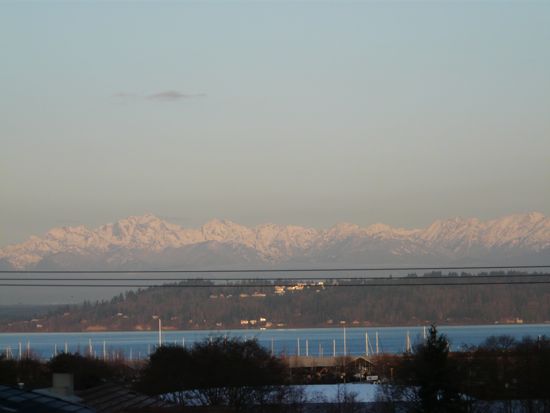
The sun just beginning to color the mountains as it rises off in the east.
The sisters had a full day of business, money, finances, and Mom’s recovery plan. We get a little goofy after a while; it’s a family culture. Our way of handling the worst, worst of times is laughter, and there were several times we were almost breathless from laughing. Yeh, I guess some would find it inappropriate, but for us, for our family, I think it is how we survive.
My second day there, we had a joyful family wedding. It was one of the sweetest events I have attended in a long time, and I loved the way the bride and the groom looked at each other, that they enjoyed their own wedding, smiling, laughing, dancing. Their signature was over everything; the colors (Purples!) and the food and the music and the ceremony, it was all perfectly thought through and delightful.

Sun setting in the west over the Olympic mountains
The rest of the trip was just hard work. And now, back in Pensacola, I have flights booked already for my next trip back. All part of life’s circle, I guess.
Through all this, we have met with kind, helpful people, who have made all the sorting out easier. Thanks be to God.
Recent Comments
Kitchen on Isiais: Winding Down intlxpatr on Shampoo Ginger tigerbutterya0c5ff1d… on Shampoo Ginger intlxpatr on British Soldier Kidnapped, Esc… John on British Soldier Kidnapped, Esc… Wikipedia Donate Button

Amazina


Early Voting in Florida


