Arian or Athanasian?
Remigius, today’s saint written up in The Lectionary, has so many interesting facets. Kiefer starts out explaining that the common Cajun name Remi is short for the French saint Remigius, who converted Clovis, one of the earliest kings of France, to Christianity. Not just to Christianity, however, but to Athanasian Christianity, the branch that believes Christ is of the same substance with God, and is one with God, as opposed to Arianism, a predominant belief at the time, which proposed Jesus was not the same as God.
REMIGIUS OF RHEIMS
BISHOP, APOSTLE OF THE FRANKS (1 OCTOBER 530)
by James Kiefer

(This photo cracks me up because one of the demons looks a lot like Ronald Reagan. I don’t know where it is, but it may be the Cathedral in Strassbourg)
St. Remi (or Remigius)
A 1987 motion picture, “The Big Easy” (a nickname for the city of New Orleans), and a current (1996) television series of the same name based on it, have as the male lead a Cajun police detective named Remy McSwaine. In the first episode of the series (I am not sure of the film) we are informed that “Remy” is short for “Remington.” I fear that this shows that the scriptwriters have not troubled to research Cajun culture. Remi is one of the three great national saints of France (the others are Denis (Dionysius) of Paris and Joan of Arc, or Joan the Maid (Jeanne la Pucelle)), and it is thoroughly natural for a Cajun to be named Remi. How is that for a topical introduction?
Remi (Latin Remigius) was born about 438 and became bishop of Rheims about 460, at the remarkably young age of 22. (Both he and the city were named for his tribe, the Remi.) In his time, the Roman Empire and the Christian church were jointly faced with a serious practical problem — the barbarian invasions. A series of droughts in central Asia had driven its inhabitants out in all directions in search of more livable territory. This brought the Goths, for example, across the Danube in the early 300’s.
Now the Emperor Constantine had died in 337, and during his lifetime the Church had debated the question of whether the Logos, the Word who was made flesh for our salvation in the person of Jesus of Nazareth, was (as Arius taught) the first and greatest of the beings created by God, but nevertheless not eternal, and not God; or was (as Athanasius taught) fully God, co-eternal and co-equal with the Father. At the Council of Nicea in 325, the Athanasian position had been endorsed by an overwhelming majority of the bishops assembled from throughout the Christian world. But the Arians refused to accept the decision, and there were attempts to re-negotiate and find a compromise that would make everyone happy.
Then Constantine died, and his Empire was divided among his sons, with Constantius Emperor of the East, and eventually of the whole Empire. And Constantius was an Arian, and made a serious attempt to stamp out the Athanasian position by banishing its leaders and pressuring churches into electing or accepting Arian bishops. During his reign, missionaries, led by one Bishop Ulfilas, were sent to convert the Goths. And naturally, Ulfilas was an Arian. He preached with great vigor and eloquence among the Goths, and translated the Bible into their language (omitting, we are told, the wars of the Hebrews, on the grounds that the Goths were quite warlike enough without further encouragement). In fact, the portions of his translation that have survived are the only material we have in the Gothic language, and as such are highly valued by students of the history of languages. So the Goths became Arian Christians, and so did the Vandals. And these two highly warlike peoples were most of the time either making war on the settled peoples of the Empire or hiring out as mercenaries to defend the borders of the Empire from the next wave of invaders.
You may remember that Ambrose, bishop of Milan (died 397, remembered 7 December), was commanded by the Empress Mother to hand over a church for the use of her soldiers, who were Goths and Arians, and that Ambrose refused, and filled the church with members of his congregation, who sang hymns composed by Ambrose for the occasion, and the soldiers did not attack. You may also remember that when Augustine lay on his deathbed in his town of Hippo in North Africa (near Carthage or modern Tunis), the city was under attack by Vandal troops, who had come into Africa out of Spain, and who captured and vandalized (that is where we get the term) the cities of North Africa, and Sicily and Sardinia and Corsica (which they made into bases for piracy) and the southern part of Italy. Long after Arianism had died out elsewhere, it was the religion of the Goths and Vandals and related peoples, and being an Arian was the mark of a good Army man.
Now a new people appeared on the scene, a pagan warrior tribe called the Franks. In the late 400’s, they were led by a chief called Clovis, a pagan but married to a Christian wife, Clotilda. His wife and Bishop Remi (remember him?) spoke to him about the Christian faith, but he showed no particular signs of interest until one day when he was fighting a battle against the Alemanni, and was badly outnumbered and apparently about to lose the battle. He took a vow that if he won, he would turn Christian. The tide of battle turned, and he won. Two years later, he kept his vow and was baptized by Remi at Rheims on Christmas Day, 496, together with about 3000 of his followers. (Rheims became the traditional and “proper” place for a French king to be crowned, as we learn from the story of Joan of Arc. It remained so until the French Revolution.)
Now Clovis was converted to the Athanasian (or orthodox, or catholic) faith rather than the Arian, and this fact changed the religious history of Europe. The clergy he brought to his court were catholic, and when the Franks as a whole became Christians, which did not happen overnight, they became catholic Christians, meaning in this context that they were Athanasian rather than Arian, and accepted the belief that it was God himself, and not a particularly prominent angel, who came down from heaven and suffered for our salvation.
During the preceding century, the Arians had had a near-monopoly on military power, and now this was no longer true. The conversion of the Franks brought about the conversion of the Visigoths, and eventually (about 300 years later) the empire of Charlemagne and the beginning of the recovery of Western Europe from the earlier collapse of government and of city life under the impact of plague, lead poisoning, currency inflation, confiscatory taxation, multiple invasions, and the assorted troubles of the Dark Ages.
As noted above, Clot(h)ilda, a Christian princess of Burgundy, married the pagan Clovis, King of the Franks, thus preparing the way for his baptism by Remi in 496, and for the conversion of the Franks. Their great-grandaughter, Bertha, married the pagan Ethelbert, King of Kent, thus preparing the way for his baptism by Augustine of Canterbury in 601, and for the eventual conversion of southeast England. Bertha and Ethelbert’s daughter, Ethelburga, married the pagan Edwin, King of Northumbria, thereby preparing the way for his baptism by Paulinus in 627, and for the eventual conversion of many in the North of England.
Iran to Isolate Iranians from the Internet?
Engaget publishes the information that Iran intends to isolate Iranians in Iran from the global ‘net. Makes sense to me . . . if I am running a country where I don’t want my people exposed to what is happening in the rest of the world, when I want to create my own perceptions of reality, if I don’t want people adopting ways contrary to my own beliefs AND I have the power to enforce it . . . But does anyone in the world truly have the power to isolate a population?
It seems to me that the quickest way to encourage people to find a new way to do something is to try to make it impossible for them to do it. Forbidding access incites clever minds to find work-arounds . . .
So what kind of “Spring” happens in a country where strict fundamentalists have already taken over . . . ?
Iran announces plans to create isolated local internet system, fate of global access unknown
By Sean Buckley posted Sep 23rd 2012 6:07PM
Iranians have been having trouble accessing YouTube, Gmail and other Google services for some time now, but their digital world may be growing even smaller — Iran announced today that it plans to shuffle citizens onto its own domestic version of the web. Reuters reports that officials plan to connect citizens to the national information network that’s currently in use at government agencies. Iran hopes to complete the transition by March of next year, and is already taking steps to isolate its population from certain international services. “Google and Gmail will be filtered throughout the country until further notice,” an Iranian official added, noting that the ban would commence in “a few hours.”
Some locals, such as the Iranian Students’ News Agency, are attributing the ban to recent protests sparked by a trailer for an anti-Islamic film on YouTube called Innocence of Muslims, but the government has made no official comment on the reason behind the ban. The state isn’t clear on the fate of the global internet in Iran, either — although it has talked about creating an isolated national network before. Here’s hoping the new network will be a compliment to the Persian web, and not a substitute.
“I Want to See How they Handle the Israel Problem.”
AdventureMan zipped left across three lanes of traffic and into a parking lot.
“What are you doing?” I hollered, hanging on for dear life.
“Jordan Valley restaurant has a new sign up, a big map of the Middle East, and I want to see how they handle the Israel problem,” he answered.
That explains everything. No, really, it does. We’ve been married for a long time, I know what he means.
“Very clever,” we both agreed.

Libyans Say “Sorry” In Counter-Protests
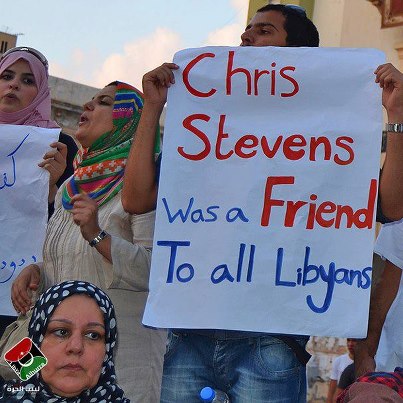
I was living in Qatar, and the Libyan ambassador’s wife had invited me, along with several other women, to morning coffee. It’s what people did. I was sitting between one of my Libyan friends and my good Iranian friend, and I started laughing. I said “Oh, what is this good little American girl doing sitting between a Libyan and an Iranian?” and then we all laughed. We weren’t Libyan, or American, or Iranian, we were just women who liked each other; we got along.
We were all religious women. Not the same religion, but all believers in the Abrahamic tradition. I felt more comfortable with them than I felt around non-religious women. We had a lot of fun together, and we liked each other.

It breaks my heart when bad things happen, and I know how good these people are, and that the people on the attack have their own agenda which has nothing to do with Islam, or Christianity, and everything to do with power. If they prevail, I fear for my good friends.

This article from USA Today made me cry this morning. Ambassador Stevens was loved, and these brave people are risking their futures to tell us so.

Libyans express sorrow over killing of Americans
by Donna Leinwand Leger, USA TODAY
Hours after learning of Ambassador Chris Stevens’ death, the Libyan Youth Movement transformed its Facebook page into a tribute to the slain diplomat. It changed its cover photo from “Free Libya” graffiti sprayed on a Tripoli wall to a somber photo of Stevens with the tag “RIP Christopher Stevens1960-2012.”
“As North America wakes up, dread washes over me. What a rough night. I’m sorry for the horrible day the world is about to face,” the administrator of the Shabab Libya page wrote. “We are sorry.”
As anti-American protests swept across North Africa and the Persian Gulf, a counter-protest of apology emerged. Photos of Libyans carrying hand-lettered signs condemning the violence and expressing contrition for their countrymen appeared on Facebook. “Sorry” became the trending mantra of Libyans on Twitter.
At one counter-protest, an unidentified man carried a crude sign phonetically written in English with blue marker on lined notebook paper, “Sorry People of America this not the Pehavior of our ISLAM and Profit.”
Another sign in red, white and blue read: “Chris Stevens wasa friend to all Libyans.”
On Facebook, one group formed The Sorry Project, designed to collect thousands of personal, written apologies from Libyans. Its profile photo is a man holding a sign, “USA. We are sorry. We are sad.”
“We Are Sorry,” the group wrote on the page created Sept.11. “We would like show that as Libyans we do not support on the actions committed by these criminals. USA, we are sorry and we will say it one thousand times over. Our apologies will never be enough, but the Libyan people will always be grateful for you since you were the first to stand by us in our fight for freedom and hopefully you will continue supporting us.”
One commenter, Hajer Sharief, vowed to avenge Stevens’ death by rebuilding a “new civilized democratic Libya.”
“We promise, we will not tire, we will not falter, and we will not fail,” Sharief wrote. “This is the way real Libyans will pay you back Mr. Ambassador Chris Stevens.”
At the ceremony Friday outside Washington to repatriate the remains of the four American victims, President Obama acknowledged Libya’s internal conflict.
“I know that this awful loss, the terrible images of recent days, the pictures we’re seeing again today, have caused some to question this work. And there is no doubt these are difficult days. In moments such as this — so much anger and violence — even the most hopeful among us must wonder,” Obama said. “But amid all of the images of this week, I also think of the Libyans who took to the streets with homemade signs expressing their gratitude to an American who believed in what we could achieve together. I think of the man in Benghazi with his sign in English, a message he wanted all of us to hear that said, ‘Chris Stevens was a friend to all Libyans.’ “
Psalm 55; Old Wisdom for Today
I’ve always liked this Psalm, from today’s readings in the Lectionary. It captures the worst betrayal, that of a friend, with whom you have shared meals and confidences. It captures the dichotomy of diplomacy, when one speaks with words ‘soft as butter’ which are, in truth, as steely as drawn swords. It captures the curse of the violent, those who cause strife and bloodshed and who die young.
Psalm 55
To the leader: with stringed instruments. A Maskil of David.
1 Give ear to my prayer, O God;
do not hide yourself from my supplication.
2 Attend to me, and answer me;
I am troubled in my complaint.
I am distraught 3by the noise of the enemy,
because of the clamour of the wicked.
For they bring* trouble upon me,
and in anger they cherish enmity against me.
4 My heart is in anguish within me,
the terrors of death have fallen upon me.
5 Fear and trembling come upon me,
and horror overwhelms me.
6 And I say, ‘O that I had wings like a dove!
I would fly away and be at rest;
7 truly, I would flee far away;
I would lodge in the wilderness;
Selah
8 I would hurry to find a shelter for myself
from the raging wind and tempest.’
9 Confuse, O Lord, confound their speech;
for I see violence and strife in the city.
10 Day and night they go around it
on its walls,
and iniquity and trouble are within it;
11 ruin is in its midst;
oppression and fraud
do not depart from its market-place.
12 It is not enemies who taunt me—
I could bear that;
it is not adversaries who deal insolently with me—
I could hide from them.
13 But it is you, my equal,
my companion, my familiar friend,
14 with whom I kept pleasant company;
we walked in the house of God with the throng.
15 Let death come upon them;
let them go down alive to Sheol;
for evil is in their homes and in their hearts.
16 But I call upon God,
and the Lord will save me.
17 Evening and morning and at noon
I utter my complaint and moan,
and he will hear my voice.
18 He will redeem me unharmed
from the battle that I wage,
for many are arrayed against me.
19 God, who is enthroned from of old,
Selah
will hear, and will humble them—
because they do not change,
and do not fear God.
20 My companion laid hands on a friend
and violated a covenant with me*
21 with speech smoother than butter,
but with a heart set on war;
with words that were softer than oil,
but in fact were drawn swords.
22 Cast your burden* on the Lord,
and he will sustain you;
he will never permit
the righteous to be moved.
23 But you, O God, will cast them down
into the lowest pit;
the bloodthirsty and treacherous
shall not live out half their days.
But I will trust in you.
Ten Shot While Kuwaiti Youngsters Are ‘Just Having Fun’
As AdventureMan and I read the Pensacola News Journal, we often wonder if we knew what we were getting into. Shootings in Pensacola are frequent. Killings, by gun, by beating, by knife – are equally frequent. Pensacola has one of the highest violent death rates per capita in the nation. Just this week a 72 year old man shot a preacher at his church because he thought the preacher was having an affair with his 69 year old wife. He then tried to enter the child care center where she was caring for small children, still with his loaded weapon. The paper quotes his wife as saying he has mental health issues.
What are people with mental health issues doing with loaded guns???
My Southern friends ask me if we more strictly regulate guns, how will they protect themselves, that the ‘bad guys’ will still have guns. Right now, they can protect themselves, they also have the right to shoot to defend their property? I can’t answer. All I know for sure is that the more people who carry guns, the more likely guns are to be used when the instinct strikes, whether it is a real threat or a perceived threat.
And then – there are these Kuwaiti teens, shooting passers-by, and when arrested, still carrying the shotgun used, say that they were ‘just having fun.’
KUWAIT: Jahra detectives, in cooperation with criminal investigation detectives, have arrested two Kuwaiti 17-year-old juveniles on charges of misuse of a hunting gun, which resulted in the shooting and wounding of 10 people in Jahra area. Police received several reports of pedestrians being wounded after they were shot by unknown assailants. Following an investigation, the juveniles were arrested with the gun still in their possession. They confessed to the shootings, claiming they were only having a good time. The teens were sent to concerned authorities. Later, Ministry of Interior officials called upon citizens and expatriates to watch their children and prevent them from behaving in ways that might cause harm to others, as the parents could be held liable for their children’s acts.
By Hanan Al-Saadoun, Staff Writer
Kuwait Times
The link refers to ‘hunting gun misuse.’ Because they are Kuwaiti, and because they are young, they are unlikely to have any severe punishment. They are likely to be released into the custody of their parents. Where were these parents when their children wounded ten innocent people? What lesson do these young men, 17 years old, learn if they can shoot ten people and be charged with ‘misuse’ of a weapon?
The only good thing I can think of in this case is that these youngsters had so little self-discipline that they never learned to shoot straight, thus no one was killed. They weren’t just lacking in any compassion for their fellow human beings, they were also bad shots. (I’m from a hunting culture. That’s an insult.)
The Night Circus by Erin Morgenstern

Every now and then a book comes along that engages me so thoroughly that I don’t even want to read another book for a while after finishing it. The Night Circus was that book for me; one of the most memorable and unique books I have read in a long time. From its much quoted opening line to the very end, I was enchanted. I loved living inside this book.
And then I got a surprise. Have you heard of Good Reads? I was introduced to Good Reads by an acquaintance, a friend-of-a-friend (whose reading I still follow on Good Reads because she introduced me to a book, An Unquiet Mind: A Memoir of Moods and Madness which was one of those books that come just at a time you need them; I had another friend who was off her meds, and struggling with the highs and lows of bipolar disorder. I didn’t know how to help her. The book helped me understand what she was going through and why she would go off her meds.)
So when my friend invited me to join Good Reads I did. I had started notebook after notebook, trying to keep track of books I’ve read so I could look them up when I needed to recommend them to someone, and here was this wonderful spot where I could record the books I read and keep track of them. Even better, they send me little notes and recommend books they think I will like based on books I have rated – and their recommendations are GOOD!
So when I went to Good Reads to record The Night Circus, I ended up reading other reviews, and discovered that this is a book few are neutral about. Many people love it. There is also a strong contingent who heartily dislike it.
The people who love it, love it for the same reasons that the people who dislike it dislike it. That’s always a shock to me, no matter how experienced I become, no matter how long I live – what? Other people see through different eyes and have different opinions???
To me, The Night Circus is a very sensual book. It has layers and layers of things going on, and, as in real life, you catch glimpses, especially at the beginning, but you don’t really know how these glimpses connect. As you read through the book, the scenes and events you read about earlier start to form a more complete picture, the puzzle pieces start to come together, but you never really know how this puzzle is going to look when it is finished.
For me, each glimpse was a jewel. The Night Circus tackles the nature of existence, what is real, what is a trick of distraction, a manipulation of the laws of the universe or pure deception. It features a contest between two talented men who pit their student against one another in a very long contest.
Each page of the book has layers of textures, scents, flavors, sounds and visions, woven together with the eye of an artist. I love the aromas integrated into the circus, cinnamon caramel apples, hot spiced punch, buttery popcorn, all with elusive and intriguing undertones, scents that you can almost – but not quite – identify. I love the descriptions of the clothing, of the circus tent constructions (there were many) and the sharp discipline of a circus all done in black and white. I loved the music, and the feats of engineering that constructed some of the circus wonders. I loved the artistry of the clock, and the winter garden. I loved the magic of the breathtaking acts, and the humanity of the characters.
Some complain on Good Reads that the descriptions in The Night Circus overshadow the plot. OK. Maybe. The descriptions nourished my imagination, took me on circular routes, just as this novel does. As I read the complaints, I could see a sharp divide between those who want to accomplish, and those who are happy to enjoy the journey. The Night Circus is a journey, in the old tradition of “there is no frigate like a book,” a journey that will take you places you have never been before. Just as I feel when I return from many of our travel adventures, I miss this great exploration of the landscape put forth in The Night Circus.
Barnes and Nobles: Paradise
We’d had guests, people we really like and admire, and now I was about to take them shopping. This kind of shopping is special. It is people-on-limited-budget shopping by people-who-may-never-visit-the-United-States-again and who have a lot of people hoping they will bring something back for them. We know this feeling – we’ve been those people on a limited budget who want to delight our family and friends with some exotic treasure.
I had a plan. Truthfully, I should know by now how it is going to work out, but I always plan bigger, just in case. This time, we started at TJ Maxx and The Dollar Store.
We park in a highly visible place. I know it sounds rude, but I escort them in, explain a few little things, then I go back to the car. I have a book with me, and Sudoku; they get to shop at their own pace without feeling like they are inconveniencing me. They have my phone number, and they know where the car is parked. Some groups come back and forth, many times, they bring packages, drop them, and head back again. This time, I didn’t see them, so after two hours, I went in and found them and told them this was their “one hour warning.” I had promised to have them back at their hotel by seven.
Almost on the minute one hour later, they came out, entered the car, and were so excited. One said she had finished all her shopping; she had something just right for everyone. The other said “Look! My friend wanted Bicycle cards! They had Bicycle cards!” They had found special gifts for all their friends and family, but the price was high. They had wanted to go to the Barnes and Noble store, but we had run out of time.
Deep sighs.
“It’s totally worth it,” the older one said, “I really really needed to have the peace of knowing my shopping was done. But . . . I’ve never seen the Barnes and Noble, only heard about it. Maybe I’ll have another chance at our next city . . . ”

I couldn’t bear it.
“The Barnes and Noble is only a short distance away,” I gave in, “I will take responsibility for getting you back late IF you promise me to only go in and look, just take a quick look, and come back out to the car.”
“Yes! Yes!” they both promised enthusiastically.
They were gone for twenty minutes. When they came back out, their faces were stunned. They got in the car, so silent I was afraid there was a problem.
The youngest leaned over, buried her head in her hands. She looked like she was going to be sick.
“What’s the matter?” I asked, alarmed.
“I almost feel sick,” she said. “So many books! We walked everywhere, but I stayed most of the time in the Business Management section; they had EVERYTHING. They had Who Moved My Cheese. Oh! They had so many good books, not the blah-blah-blah you get in textbooks, but the way they teach in parables, it’s so easy to understand their point. I can’t carry all the books I wanted to buy. I’m feeling shocked. All those books, right there where anyone can buy them! I want them all and I can’t have them.”
“You could order them, have them sent,” the older girl offered, and then remembered that no, she couldn’t have things sent in her country. She would never get them.
All the way to the hotel we had a great conversation about the flow of ideas, about censorship and the internet and cable television and Twitter, and how ideas flow more freely everywhere in the world, in spite of those who would try to restrict what their citizens might access. We also talked about freedom to travel – or the lack of freedom. We talked about families, caring for the elderly, and family responsibilities. We talked about what we’ve learned from one another, the truths travel teaches you about your prejudices and opinions, about others, and about yourself.
As I dropped them off, we all hugged, sadly realizing that we may never see one another again. Nonetheless, no regrets. Just the time I had with these two impressive young women was a great gift, and seeing the Barnes and Noble through their eyes – I will never again take a book shop for granted.
She Cried

“I wanted to thank you,” I said to my son’s sixth grade teacher “I can’t imagine how hard it was to get 30 sixth graders to go through the paper-writing process, but I know my son learned from it and he will use the skills you taught him for many years to come. One day he will thank you in his heart, but I wanted to thank you now.”
It was one of those small expat military communities, where your child’s teacher also goes to the same church you go to and shops in the same commissary. We were at a church benefit, chatting before dinner.
She started crying.
She told me that every year, she teaches the sixth graders to write papers, and they hate it. She started with library research, making bibliography cards on little index cards, formal writing, footnotes and a formal bibliography at the end with a formal title page at the beginning.
I was the first one who had ever thanked her. She believed in what she was doing, but it was so hard, and she never got any positive feedback.
Imagine. Do you remember what sixth graders are like? This lady had courage, and persistence. She gave these students (in spite of themselves) a skill which would take them through the rest of high school and into college. They learned to do it right, so they never had to embarrass themselves by turning in an inferior, poorly-done paper. It was a great gift she gave these students – and no one thanked her.
Well, it would be a rare, very rare sixth grader who has the maturity to understand that while it was a difficult and demanding section in their school year, it was a tool in their tool box of life, a gift that just kept on giving.
Thank you. Thank you, all the teachers out there who knock themselves out to give our children (and grandchildren) the tools they need to be good students and good citizens.
Jet Lag, iPads and Small Things
The first leg(s) of our travel are completed; today we head for our destination, the Robin Pope Camps in the upper Luangwa in the eastern part of Zambia. We took the relatively new Delta flight 200 from Atlanta to Johannesburg, leaving out of the new airport terminal in Atlanta for international flights. More on that later when I am back to my computer and can more easily insert photos the size I want them.
Fifteen hours is a long flight. There are a couple ways of doing long travel; one is to break up the journey, like go through Paris and spend a couple days, then fly on to your African destination. I say Paris, because it would be our destination of choice, but you can as easily connect through London or Frankfurt, and a few other places. Many people like doing that, and one of these days, we might, too.
During our years in the Gulf, we developed a pattern of just gutting it through, getting on a very long flight and just getting there, dealing with all the consequences once we reached our destination. For me, going west, it is a piece of cake. For some reason, when I fly east, my body rhythms are jangly for two or three weeks, my sleep patterns erratic, and all you can do is gut it through. We have learned that getting on schedule at your arrival destination helps, getting sunshine and exercise helps, but nothing keeps you from those long lonely hours awake in the middle of the night.
It has hit each one of us differently. I got almost no sleep for two nights, then got a good eight hours (broken) last night. AdventureMan is getting lots of sleep and having very little trouble adjusting.
I am getting used to using the iPad. Just before leaving, I discovered a Sudoko program, and very shortly learned a couple things – electronic Sudoku is just different from paper Sudoku, it is harder to quit. You also can find you’ve lost hours to playing and it gives you a splitting headache – unlike paper Sudoku. It also eats up your time, and although the battery is supposed to have ten hours, either it runs out faster when you are playing Sudoko, or it FEELS like it runs out faster because the time passes so quickly. All I know is that I suddenly became aware that ten hours is not all that much, and I am constantly looking for re-charging places; it has become a priority.
At the last minute, I also pitched my books, and downloaded books to the iPad. I find I am enjoying reading on the iPad (I never thought I would), but once again I am constantly concerned with how fast the time is going (it doesn’t seem to use as much battery time when I am reading) and when and where will I be able to recharge? I am wondering if the camps in the bush have made allowances for their customers increased reliance on electronics – iPads, cameras that have batteries that need recharging, etc.) and I am also wishing I had brought a book with me – it’s just easier.
On the other hand, I have also discovered that on the iPad I have a little program called “notes” where I can make . . . notes! I can do it on a daily basis and it keeps them separate, and it is much faster than writing notes in a little notebook.
The internet at the Taj Pamodzi in Lusaka is much more reliable and much faster than the last time I was here. I hope it is also more secure.
Small things. We are hearing a voice singing outside, we heard the call to prayer from the mosque this morning and felt oh, so nostalgic for our times living near the mosques of Qatar and Kuwait. The singing voices are coming from a nearby school; we can’t understand the words, but it sounds joyful. We have a newspaper, it is much wider and thicker than our Pensacola News Journal, and I think I remember our newspapers also were wider and thicker once. The first few pages were full of people being arrested for corruption, and it makes me happy for Zambia, not happy that they have corruption, but happy that their police are free to arrest highly placed corrupt officials who are stealing from the Zambian people and their heritage, and also that they are free to name the names.
I have lived in countries where offenders are not named, so as not to bring shame on the innocent families, but I believe that when the offender is named, it is a deterrent to corruption. And for what? Is a shiny Mercedes worth the shame, and the jail time? Even though corrupt people in high places steal on an unimaginable scale, the things they buy with them are . . . just things. When you place your value in things, you lead an unsatisfied life. No thing can fill the void that lack of integrity leaves.
Recent Comments
Kitchen on Isiais: Winding Down intlxpatr on Shampoo Ginger tigerbutterya0c5ff1d… on Shampoo Ginger intlxpatr on British Soldier Kidnapped, Esc… John on British Soldier Kidnapped, Esc… Wikipedia Donate Button

Amazina


Early Voting in Florida


