Onion Soup of the Pfalz region of Germany
I am printing this just as I found it. The thrill to me is that I can read it and follow it! It is from a blog called ‘Grandmother’s Best Recipes in the Pfalz’ and today I am making Pfalzerzuppe! (It is a onion soup made with creme and a little caraway seed; I often used to eat it at Neuleiningen Castle, in the Bergschanke restaurant.Zwiebelsuppe
“Zwiwwelsupp”
Zwiebelsuppe ist nicht gleich Zwiebelsuppe. Oder auf pfälzisch: Zwiwwelsupp is net wie Zwiwwelsupp. Die nach diesem Rezept ist jedenfalls sehr delikat und würzig.
Zutaten:
- 10 mittlere Zwiebeln (onions, middle sized)
- 500 ml Sahne (cream)
- 1 l Hühnerbrühe (chicken stock)
- Pfeffer, Salz, Kümmel (pepper, salt, caraway seed)
- Butter
- 2-3 EL Mehl (flour)
- 1/5 l Weißwein (aber bitte Pfälzer Wein!) (white wine, Pfalzer white wine, PLEASE!)
Zubereitung:
Geschälte Zwiebeln kleinschneiden und in Butter nur ganz leicht anbräunen. Mit dem Weißwein ablöschen und zur Hälfte einkochen lassen. Das Mehl darüber streuen. Die Brühe und die Sahne hinzugeben und ca. 20 Minuten köcheln lassen, dann abschmecken.
Tipp:
Am Ende des Kochens noch drei Eigelbe mit etwas Sahne verrühren und unter die Suppe ziehen, dann aber nicht mehr aufkochen, sondern gleich servieren.
1001 Inventions: Muslim Inventions That Changed the World
A fabulous new exhibition, 1001 Inventions has opened, and will be coming to this country in December of this year. The exhibit details our Muslim heritage in the arts and sciences.
1001 Inventions – Discover The Muslim Heritage In Our World

From coffee to cheques and the three-course meal, the Muslim world has given us many innovations that we take for granted in daily life. As a new exhibition opens, Paul Vallely nominates 20 of the most influential- and identifies the men of genius behind them
Saturday, 11 March 2006

1 The story goes that an Arab named Khalid was tending his goats in the Kaffa region of southern Ethiopia, when he noticed his animals became livelier after eating a certain berry. He boiled the berries to make the first coffee. Certainly the first record of the drink is of beans exported from Ethiopia to Yemen where Sufis drank it to stay awake all night to pray on special occasions. By the late 15th century it had arrived in Mecca and Turkey from where it made its way to Venice in 1645. It was brought to England in 1650 by a Turk named Pasqua Rosee who opened the first coffee house in Lombard Street in the City of London. The Arabic qahwa became the Turkish kahve then the Italian caffé and then English coffee.
2 The ancient Greeks thought our eyes emitted rays, like a laser, which enabled us to see. The first person to realise that light enters the eye, rather than leaving it, was the 10th-century Muslim mathematician, astronomer and physicist Ibn al-Haitham. He invented the first pin-hole camera after noticing the way light came through a hole in window shutters. The smaller the hole, the better the picture, he worked out, and set up the first Camera Obscura (from the Arab word qamara for a dark or private room). He is also credited with being the first man to shift physics from a philosophical activity to an experimental one.
3 A form of chess was played in ancient India but the game was developed into the form we know it today in Persia. From there it spread westward to Europe – where it was introduced by the Moors in Spain in the 10th century – and eastward as far as Japan. The word rook comes from the Persian rukh, which means chariot.
4 A thousand years before the Wright brothers a Muslim poet, astronomer, musician and engineer named Abbas ibn Firnas made several attempts to construct a flying machine. In 852 he jumped from the minaret of the Grand Mosque in Cordoba using a loose cloak stiffened with wooden struts. He hoped to glide like a bird. He didn’t. But the cloak slowed his fall, creating what is thought to be the first parachute, and leaving him with only minor injuries. In 875, aged 70, having perfected a machine of silk and eagles’ feathers he tried again, jumping from a mountain. He flew to a significant height and stayed aloft for ten minutes but crashed on landing – concluding, correctly, that it was because he had not given his device a tail so it would stall on landing. Baghdad international airport and a crater on the Moon are named after him.
5 Washing and bathing are religious requirements for Muslims, which is perhaps why they perfected the recipe for soap which we still use today. The ancient Egyptians had soap of a kind, as did the Romans who used it more as a pomade. But it was the Arabs who combined vegetable oils with sodium hydroxide and aromatics such as thyme oil. One of the Crusaders’ most striking characteristics, to Arab nostrils, was that they did not wash. Shampoo was introduced to England by a Muslim who opened Mahomed’s Indian Vapour Baths on Brighton seafront in 1759 and was appointed Shampooing Surgeon to Kings George IV and William IV.
6 Distillation, the means of separating liquids through differences in their boiling points, was invented around the year 800 by Islam’s foremost scientist, Jabir ibn Hayyan, who transformed alchemy into chemistry, inventing many of the basic processes and apparatus still in use today – liquefaction, crystallisation, distillation, purification, oxidisation, evaporation and filtration. As well as discovering sulphuric and nitric acid, he invented the alembic still, giving the world intense rosewater and other perfumes and alcoholic spirits (although drinking them is haram, or forbidden, in Islam). Ibn Hayyan emphasised systematic experimentation and was the founder of modern chemistry.
7 The crank-shaft is a device which translates rotary into linear motion and is central to much of the machinery in the modern world, not least the internal combustion engine. One of the most important mechanical inventions in the history of humankind, it was created by an ingenious Muslim engineer called al-Jazari to raise water for irrigation. His 1206 Book of Knowledge of Ingenious Mechanical Devices shows he also invented or refined the use of valves and pistons, devised some of the first mechanical clocks driven by water and weights, and was the father of robotics. Among his 50 other inventions was the combination lock.
8 Quilting is a method of sewing or tying two layers of cloth with a layer of insulating material in between. It is not clear whether it was invented in the Muslim world or whether it was imported there from India or China. But it certainly came to the West via the Crusaders. They saw it used by Saracen warriors, who wore straw-filled quilted canvas shirts instead of armour. As well as a form of protection, it proved an effective guard against the chafing of the Crusaders’ metal armour and was an effective form of insulation – so much so that it became a cottage industry back home in colder climates such as Britain and Holland.
9 The pointed arch so characteristic of Europe’s Gothic cathedrals was an invention borrowed from Islamic architecture. It was much stronger than the rounded arch used by the Romans and Normans, thus allowing the building of bigger, higher, more complex and grander buildings. Other borrowings from Muslim genius included ribbed vaulting, rose windows and dome-building techniques. Europe’s castles were also adapted to copy the Islamic world’s – with arrow slits, battlements, a barbican and parapets. Square towers and keeps gave way to more easily defended round ones. Henry V’s castle architect was a Muslim.
10 Many modern surgical instruments are of exactly the same design as those devised in the 10th century by a Muslim surgeon called al-Zahrawi. His scalpels, bone saws, forceps, fine scissors for eye surgery and many of the 200 instruments he devised are recognisable to a modern surgeon. It was he who discovered that catgut used for internal stitches dissolves away naturally (a discovery he made when his monkey ate his lute strings) and that it can be also used to make medicine capsules. In the 13th century, another Muslim medic named Ibn Nafis described the circulation of the blood, 300 years before William Harvey discovered it. Muslims doctors also invented anaesthetics of opium and alcohol mixes and developed hollow needles to suck cataracts from eyes in a technique still used today.
11 The windmill was invented in 634 for a Persian caliph and was used to grind corn and draw up water for irrigation. In the vast deserts of Arabia, when the seasonal streams ran dry, the only source of power was the wind which blew steadily from one direction for months. Mills had six or 12 sails covered in fabric or palm leaves. It was 500 years before the first windmill was seen in Europe.
12 The technique of inoculation was not invented by Jenner and Pasteur but was devised in the Muslim world and brought to Europe from Turkey by the wife of the English ambassador to Istanbul in 1724. Children in Turkey were vaccinated with cowpox to fight the deadly smallpox at least 50 years before the West discovered it.
13 The fountain pen was invented for the Sultan of Egypt in 953 after he demanded a pen which would not stain his hands or clothes. It held ink in a reservoir and, as with modern pens, fed ink to the nib by a combination of gravity and capillary action.
14 The system of numbering in use all round the world is probably Indian in origin but the style of the numerals is Arabic and first appears in print in the work of the Muslim mathematicians al-Khwarizmi and al-Kindi around 825. Algebra was named after al-Khwarizmi’s book, Al-Jabr wa-al-Muqabilah, much of whose contents are still in use. The work of Muslim maths scholars was imported into Europe 300 years later by the Italian mathematician Fibonacci. Algorithms and much of the theory of trigonometry came from the Muslim world. And Al-Kindi’s discovery of frequency analysis rendered all the codes of the ancient world soluble and created the basis of modern cryptology.
15 Ali ibn Nafi, known by his nickname of Ziryab (Blackbird) came from Iraq to Cordoba in the 9th century and brought with him the concept of the three-course meal – soup, followed by fish or meat, then fruit and nuts. He also introduced crystal glasses (which had been invented after experiments with rock crystal by Abbas ibn Firnas – see No 4).
16 Carpets were regarded as part of Paradise by medieval Muslims, thanks to their advanced weaving techniques, new tinctures from Islamic chemistry and highly developed sense of pattern and arabesque which were the basis of Islam’s non-representational art. In contrast, Europe’s floors were distinctly earthly, not to say earthy, until Arabian and Persian carpets were introduced. In England, as Erasmus recorded, floors were “covered in rushes, occasionally renewed, but so imperfectly that the bottom layer is left undisturbed, sometimes for 20 years, harbouring expectoration, vomiting, the leakage of dogs and men, ale droppings, scraps of fish, and other abominations not fit to be mentioned”. Carpets, unsurprisingly, caught on quickly.
17 The modern cheque comes from the Arabic saqq, a written vow to pay for goods when they were delivered, to avoid money having to be transported across dangerous terrain. In the 9th century, a Muslim businessman could cash a cheque in China drawn on his bank in Baghdad.
18 By the 9th century, many Muslim scholars took it for granted that the Earth was a sphere. The proof, said astronomer Ibn Hazm, “is that the Sun is always vertical to a particular spot on Earth”. It was 500 years before that realisation dawned on Galileo. The calculations of Muslim astronomers were so accurate that in the 9th century they reckoned the Earth’s circumference to be 40,253.4km – less than 200km out. The scholar al-Idrisi took a globe depicting the world to the court of King Roger of Sicily in 1139.
19 Though the Chinese invented saltpetre gunpowder, and used it in their fireworks, it was the Arabs who worked out that it could be purified using potassium nitrate for military use. Muslim incendiary devices terrified the Crusaders. By the 15th century they had invented both a rocket, which they called a “self-moving and combusting egg”, and a torpedo – a self-propelled pear-shaped bomb with a spear at the front which impaled itself in enemy ships and then blew up.
20 Medieval Europe had kitchen and herb gardens, but it was the Arabs who developed the idea of the garden as a place of beauty and meditation. The first royal pleasure gardens in Europe were opened in 11th-century Muslim Spain. Flowers which originated in Muslim gardens include the carnation and the tulip.
“1001 Inventions: Discover the Muslim Heritage in Our World” is a new exhibition which began a nationwide tour this week. It is currently at the Science Museum in Manchester. For more information, go to www.1001inventions.com.
So Much Hatred . . .
Today I saw a story about US soldiers in Afghanistan, killing for fun. It follows hard on the heels of the story of Reverend Terry Jones who has ‘prayerfully’ decided to burn a copy of the Quran on the anniversary, today, of 9-11. These stories are like wounds in my heart, and I begin to wonder if there is any hope for ‘peace on earth, good will toward men.’
Sometimes I get discouraged.
9-11 wounded us badly, wounded that fountain of optimism that believes we can all be friends, that we can overcome, that ‘Yes, we can.’
We’ve recovered.
Acts of hate are acts of hate, whether they originate from Americans, from Moslems, from Hindus, from Mongolians, from Krakens . . . We each have it within us to make the right choice, to choose NOT to act in hate against our fellow man. It’s not a one-time choice. It’s a choice we each, individually, make over and over again, every day.
Pat Conroy and South of Broad
I don’t know where to start, telling you how much I like this book. I couldn’t wait for reading time to read it. It never flagged, every page kept me glued. I want you to read it, I want to be able to talk about it with you, but there is so much in this book that I don’t want to spoil it for you.
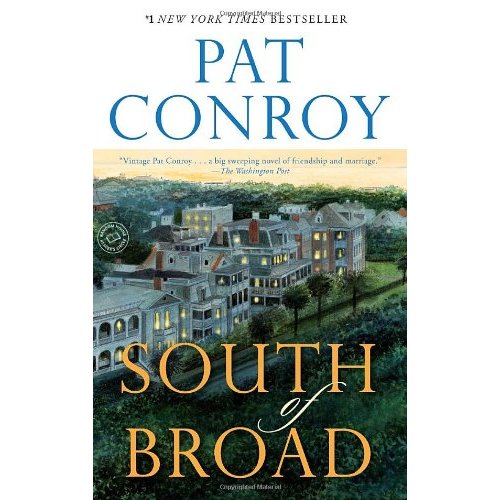
There are huge themes. There are some very bad people. There are some very good people. Sometimes the very good people can do very bad things, and sometimes the bad people can have some redeeming moments.
We meet the main character as he is about to begin his senior year in college. On the day we meet him, his life changes. Several new people come into his life. Two orphans. A beautiful sister and equally beautiful brother. A black football coach and his son. Three rich kids kicked out of the best private school in town for doing dope.
There are two ‘characters’ who are not people. One is the city of Charleston, SC, and there are entire paragraphs in this book which will make you fall in love, through Pat Conroy’s eyes, with this complicated, beautiful city. Another is Hurricane Hugo, which is as destructive as Charleston is beautiful.
South of Broad covers a time of tumult and change, and you see it through the eyes of of Conroy’s endearing characters. Times changes, society changes and change comes hard for those who stand to lose the most. Conroy deals with segregation, integration, child abuse, suicide, gay sex, economic discrimination, and psychiatric illness, a psycopathic criminal, who happens to be the father of two of this friends, and a hurricane.
For me, what was most engrossing was the complicated question of who is righteous? It’s what I want to talk about with you. Who is most like Jesus? (LOL, give examples) Which characters would you expect think themselves closest to God? Do you think they are? (Be prepared to defend your opinion.) What is a good parent? In this book, who do you think was the best parent?
If you decide to buy this book, please buy a copy with the Reader’s Guide in the back – an interview with Pat Conroy and questions that help you think about the book. I’d like to share with you a segment of the interview which I found so brightly illuminating:
. . . . I found the Parisians rarified, vigilant, hypercritical and fabulous. They had made themselves worthy of the great city they lived in. They oozed style and they ate like kings. . . . The Parisians seem special to both the world and themselves. Then it hit me: My God, they are like Charlestonians.
As I see it, you can take out Charlestonians and substitute Kuwaitis. Or New Yorkers. Or Romans. In fact, just about every society I have visited have their elite, who consider themselves rarified and special, and fight to keep themselves so.
So not only is the book dealing with spiritual righteousness, but also with themes of entitlement and deprivation, bullies and the bullied, parenting, self-fulfillment, and the very real and over-arching theme of friendship and the power of a close circle of friends.
I don’t want to tell you too much. I loved this book. I’m still thinking about it. I hope you’ll read it and think about it, too, and then come back and tell me what you’re thinking. 🙂
Five Theories on Why the Housing Market is Still Falling
This is from AOL News Opinion Round-Up and not one of them mentions my favorite theory, which is – the big huge bulge of baby boomers is now retiring and downsizing, there is a glut of housing on the market because there is not the same market for houses that existed when this big bulge of population was mating and bearing children. I think the ‘problem’ is greatly a natural phenomena related to the demographics. Experts disagree. 🙂
Why Is the Housing Market Plummeting? 5 Theories
Max Fisher
The Atlantic Wire
(Aug. 24) — Sales of existing homes dropped 27.2 percent in July, accelerating the recent decline in the already frail housing market. This brings the number of existing houses sold to an annual rate of only 3.83 million units, the lowest figure since 1999. The number of single-family home sales hit its lowest level since 1995. Some economists even fear that this signals the end of housing as an investment. How bad is this and what does it mean?
The Role of Expiring Tax Credits: Dow Jones Newswires’ Meena Thiruvengadam and Sarah Lynch explain, “The steep decline in sales in July reflects both a souring in the U.S. economic recovery and the expiration of a government tax credit program that has been supporting the housing market for more than a year. The tax credits offered certain buyers up to $8,000 to sign a contract by April 30. Deals originally needed to close by June 30, but lawmakers pushed that deadline to Sept. 30. Still, the tax credit’s expiration drove pending home sales down 30 percent in May and caused a double-digit dive in mortgage application volumes even as interest rates hovered near their lowest levels in generations. July’s existing home sales data reflects the May plunge in pending sales, which typically become existing sales within a couple of months.”
Tax Credits Caused ‘Collapse’: The Atlantic’s Megan McArdle writes of the homebuyer tax credits, “This housing collapse is the aftermath of that mania. The depth of the collapse suggests that in fact, the housing tax credit was not generating new demand as much as moving demand forward a few months. That means that we’re going to have to work out the aftermath in months of low home sales. … This only reinforces my belief that housing is no longer a good way to generate wealth. The government can’t fix this market, which needs to find a new, lower level. It can only very temporarily distort it.”
Market Fears Double-Dip Housing Recession: The Los Angeles Times’ Alejandro Lazo reports, “The big drop, which was worse than what many analysts had expected, sent stock markets tumbling Tuesday morning as investors feared a double dip in housing. The blue-chip Dow Jones industrial average fell more than 1%, as did the S&P 500, a broader measure of stocks. … The July plunge was the third consecutive monthly decline following the April 30 expiration of the tax credit, which offered up to $8,000 for certain buyers.”
Ballooning Supply Worsens Problem: The Atlantic’s Daniel Indiviglio explains, “This is the second highest inventory in a year. The number of months it would take to sell the current supply of homes also swelled in July to 12.5, which was a huge jump compared to June’s rate of 8.9. It’s also nearly double November’s rate of 6.5. Given the low rate of sales this summer and consistently high foreclosure rate, inventory will likely continue to grow. This is a really, really bad report. The awfulness of July’s sales were a little exaggerated due to all of the demand having been pulled forward form the buyer credit. But it’s unclear how many months of demand were captured early by the credit, so it’s hard to know when its effect will wear off.”
Entire Housing Market Is Stalled: Reuters’ Felix Salmon warns this report “means that despite record-low mortgage rates, people aren’t able to buy houses: essentially all the benefit from those low rates is going to people who already own their homes and are taking the opportunity to refinance. The news also means that there’s a big gap between buyers and sellers: the market isn’t clearing. Sellers are convinced that their homes are worth lots of money, or will rise in price if they just hold out a bit longer; buyers are happily renting, waiting for prices to come down. And entrepreneurial types, whom one would expect to arbitrage the two by buying houses with super-cheap mortgages and renting them out at a profit, don’t seem to have found those opportunities yet. Houses are rarely a liquid asset; they were, briefly, during the housing boom, but now they’re more illiquid than ever.”
Why People Give
An urgent message came out today asking us to help the homeless people in Pensacola – and there are a lot of them, thanks to the warm climate. With all the rain recently, sleeping rough has been doubly rough, and it has been made worse by a sudden humidity-moisture related surge in the mosquito population.
As I talked with AdventureMan about our donation, he laughed. I was in fund-raising for a while, and was unexpectedly good at it. One thing I learned, there are a lot of ways to persuade people to donate, and then again, sometimes people will donate and you haven’t a clue as to why they felt this urge to be generous.
AdventureMan laughed; he totally got it. I used to work with a homeless, a long time ago, so I have a soft spot where they are concerned. Mosquitos also love me, and I get these horrid great but huge itchy bumps any time I am anywhere near a mosquito, AdventureMan always says he keeps me nearby because they head straight for me and ignore him.

Of course we donated. Wet homeless people and mosquitos, it was a golden combination. If you would like to donate, too, you can, through the EscaRosa Coalition on the Homeless (Working to Eliminate Homelessness). They will hold an Annual Fundraiser on Saturday September 11th from 7pm – 11pm at The Garden Center.
HIV Increases Significantly in People over 50
Today, on BBC Health News experts say you are likely at risk if you have had sex without condoms, multiple sex partners, or sex in countries with high HIV rates:
HIV rate rises among over-50s
There has been a big increase in the number of people aged 50 and over catching HIV, latest figures show.
The over-50s infection rate in England, Wales and Northern Ireland more than doubled in under a decade – from 299 new cases in 2000 to 710 in 2007.
In 2008 there were 7,382 new diagnoses – 8% of these were in the over-50s, says the Health Protection Agency.
Experts say the figures are a stark reminder of the importance of practising safe sex, whatever your age.
This highlights the importance of HIV testing – whatever your age”
Other sexually transmitted infections have shown a similar doubling in under a decade among the same age group, and have been rising at a faster rate than in the young.
Promiscuity
Ruth Smith, who led the HPA research, said: “We estimate that nearly half of older adults diagnosed between 2000 and 2007 were infected at age 50 or over. This highlights the importance of HIV testing – whatever your age.
“We must continually reinforce the safe sex message – using a condom with all new or casual partners is the surest way to ensure people do not become infected with a serious sexually transmitted infection such as HIV.”
Woe to You!
We had a priest in Germany, a priest we dearly loved. He told us about how growing up, he would go to church with his Mom and after the sermon, she would say “I hope all those sinners were listening this morning!” AdventureMan and I sometimes say that after church, knowing full well that ‘those sinners’ is us.
It’s hard to read the scriptures for this morning, because Jesus is talking to religious people, and telling us that often the better we think we are, the farther we have to go.
Lord, clean us from the inside!
Matthew 23:13-26
13 ‘But woe to you, scribes and Pharisees, hypocrites! For you lock people out of the kingdom of heaven. For you do not go in yourselves, and when others are going in, you stop them.* 15Woe to you, scribes and Pharisees, hypocrites! For you cross sea and land to make a single convert, and you make the new convert twice as much a child of hell* as yourselves.
16 ‘Woe to you, blind guides, who say, “Whoever swears by the sanctuary is bound by nothing, but whoever swears by the gold of the sanctuary is bound by the oath.” 17You blind fools! For which is greater, the gold or the sanctuary that has made the gold sacred? 18And you say, “Whoever swears by the altar is bound by nothing, but whoever swears by the gift that is on the altar is bound by the oath.” 19How blind you are! For which is greater, the gift or the altar that makes the gift sacred? 20So whoever swears by the altar, swears by it and by everything on it; 21and whoever swears by the sanctuary, swears by it and by the one who dwells in it; 22and whoever swears by heaven, swears by the throne of God and by the one who is seated upon it.
23 ‘Woe to you, scribes and Pharisees, hypocrites! For you tithe mint, dill, and cummin, and have neglected the weightier matters of the law: justice and mercy and faith. It is these you ought to have practised without neglecting the others. 24You blind guides! You strain out a gnat but swallow a camel!
25 ‘Woe to you, scribes and Pharisees, hypocrites! For you clean the outside of the cup and of the plate, but inside they are full of greed and self-indulgence. 26You blind Pharisee! First clean the inside of the cup,* so that the outside also may become clean.
It’s Easy To Tell a Spy
This story interests me because I grew up in Cold War America, and when I was going to high school in Germany, we were surrounded by propaganda urging us always to be careful about anything we said, in public or even in private.
“It’s easy to tell a spy” the public service announcements would go, and show someone in a cafe, or in line waiting for a bus, or in the library giving out information on where her husband or father was deployed or when such and such a unit was going to the border, and a nefarious person writing it down to send back to their leaders, always the dreaded Russians.
They’re back. Did they ever go away?

NEW YORK -Nine people charged with operating as Russian spies entrenched in American suburbia were making long-shot bids to be released from jail pending trial Thursday, even as authorities scoured a Mediterranean island for an alleged co-conspirator who disappeared after he was granted bail.
Hearings were set for federal courts in Boston, New York and Alexandria, Va., for all but one of the 10 people arrested over the weekend by federal authorities in the United States.
Police searched airports, ports and yacht marinas Thursday to find an 11th person who was arrested in Cyprus but disappeared after a judge there freed him on $32,500 bail. The man, who had gone by the name Christopher Metsos, failed to show up Wednesday for a required meeting with police.
Authorities also examined surveillance video from crossing points on the war-divided island, fearing the suspect might have slipped into the breakaway north, a diplomatic no-man’s-land that’s recognized only by Turkey and has no extradition treaties.
In the U.S., Donald Heathfield and Tracey Foley, of Cambridge, Mass., were scheduled to appear Thursday at a federal court in Boston. Mikhail Semenko, Michael Zottoli and Patricia Mills, all of Arlington, Va., were set for a hearing before Magistrate Judge Theresa Buchanan in U.S. District Court in Alexandria. Defendants Richard Murphy, Cynthia Murphy, Juan Lazaro and Vicky Pelaez were to go before a judge in New York.
All have been charged with being foreign agents. Officials said the suspects will all eventually be transferred to New York, where the charges were filed.
Not due in court Thursday was Russian beauty Anna Chapman, the alleged spy whose heavy presence on the Internet and New York party scene has made her a tabloid sensation. She was previously ordered held without bail.
Eight of the suspects were accused by prosectuors of being foreign-born, husband-and-wife teams who were supposed to be Americanizing themselves and gradually developing ties to policymaking circles in the U.S.
Most were living under assumed identities, according to the FBI. Their true names and citizenship remain unknown, but several are suspected of being Russians by birth.
Heathfield claimed to be a Canadian but was using a birth certificate of a deceased Canadian boy, agents said in a court filing. His wife, Tracey Foley, purported to be from Canada, too, but investigators said they searched a family safe deposit box found photographs taken of her when she was in her 20s that had been developed by a Soviet film company.
Juan Lazaro had said he was born in Uraguay and was a citizen of Peru; he was secretly recorded by the FBI talking about a childhood in Siberia, according to court documents.
Two, Chapman and Mikhail Semenko, were Russians who didn’t attempt to hide their national origin, FBI agents said, but they had a similar mission: blend in, network and learn what they could.
Britain’s Foreign Secretary William Hague said the U.K. was investigating whether Foley might have used a forged British passport. The British spy agency MI5 is also investigating the extent to which Foley and Chapman had links to London, and will likely seek to find out whether either attempted to recruit British officials as informants.
There is evidence that at least some of the alleged agents had success cultivating contacts in the business, academic and political worlds.
The criminal complaint alleges that either Heathfield or Foley sent messages to Moscow talking about turnover at the CIA that was supposedly “received in private conversation” with a former congressional aide. Other messages described Heathfield establishing contact with a former high ranking U.S. national security official, and with a U.S. researcher who worked on bunker-busting nuclear warheads.
Moscow thanked Cynthia Murphy for having passed along “very useful” information about the global gold market and instructed her to strengthen ties with students and professors at Columbia University’s business school, where she was getting a degree, according to the FBI.
Among other things, the Russians wanted “detailed personal data and character traits w. preliminary conclusions about their potential to be recruited by Service,” according to one intercepted message.
Clare Lopez, senior fellow at the Center for Security Policy and a professor at the Centre for Counterintelligence and Security and a former operations officer for the CIA, said the alleged plotters might have someday been able to produce valuable information, if left in place long enough.
“Their value is not just in acquiring classified information,” she said. “There’s a lot that goes on that’s not simply stealing secrets and sending them back to Moscow.”
Metsos was charged with supplying funds to the other members of the ring.
Cypriot Justice Minister Loucas Louca on Thursday admitted that a judge’s decision to release him on bail “may have been mistaken” and said authorities were examining leads on his possible whereabouts.
“We have some information and we hope that we will arrest him soon,” Louca told reporters, without elaborating.
Cyprus has for decades been a hotbed of espionage intrigue as spies converge on the eastern Mediterranean island at the crossroads of Europe, Africa and Asia.
More recently, former CIA agent Harold Nicholson, in prison for espionage, recruited his 24-year-old son Nathaniel to meet with Russian agents in cities around the world from 2006 to 2008 to collect money owed by his former handlers. One of those cities was the Cypriot capital, Nicosia.
Good Enough
This is from Rick Warren’s Daily Hope send out for today, and for me, it really hits home. So many times I hesitate to step up to the plate, waiting until I am sure my skills are what is needed, when what is really needed is just for someone to have the courage to step up, to speak out.
The best ‘Christian’ person I know, who follows this Christian principle, was born Muslim. She is always the first to serve, and the last to take anything. She is the first to give and the first to start cleaning up after an event. She is never afraid to get her hands dirty, or to defend the dignity of ‘the least of these.’
Real servants do their best with what they have. Servants don’t make excuses, procrastinate, or wait for better circumstances. Servants never say, “One of these days” or “When the time is right.” They just do what needs to be done.
The Bible says, “If you wait for perfect conditions, you will never get anything done” (Ecclesiastes 11:4 NLT).
God expects you to do what you can, with what you have, wherever you are. Less-than-perfect service is always better than the best intention.
One reason many people never serve is that they fear they are not good enough to serve. They have believed the lie that serving God is only for superstars. Some churches have fostered this myth by making “excellence” an idol, which makes people of average talent hesitant to get involved.
You may have heard it said, “If it can’t be done with excellence, don’t do it.” Well, Jesus never said that! The truth is, almost everything we do is done poorly when we first start doing it — that’s how we learn.
At Saddleback Church, we practice the “good enough” principle: It doesn’t have to be perfect for God to use and bless it. We would rather involve thousands of regular folks in ministry than have a perfect church run by a few elites.
Recent Comments
ExpatAlien on What Country am I Living … intlxpatr on Yellowstone: Old Faithful to C… Michelle on Yellowstone: Old Faithful to C… Cathy on No Grown-Ups in Charge intlxpatr on Waiting for Snow Wikipedia Donate Button

Amazina


Early Voting in Florida


 Here There and Everywhere