Checking Out Pensacola Beach
After our water aerobics class this morning, AdventureMan and I drove out to the beautiful sugar-white sandy beaches of Pensacola to check the damage. The clean up crews have been busy, and the beaches look gorgeous. People are sunning, swimming, and sharing the beaches with the clean up crews.
A big huge electronic sign announces that the road to the beach will be closed all day tomorrow. How can you close a major road? Is this Kuwait, or Qatar, where the will of the Amir says “Make it so!” and it is so? Oh. Wait. President Obama is coming, so the road will be his and his alone to go out to the beaches and see what we saw today.
The huge, gigantic glob of oil has only sent tendrils, so far, to the pristine white beaches, but doom impends as storms and winds blow the thick oily sludge toward the shores. God willing, President Obama will find a way to encourage British Petroleum to work with a little more conviction and energy to find a long term solution to this unthinkable TWO MONTHS and hundreds of thousands of gallons spewing into the Gulf.
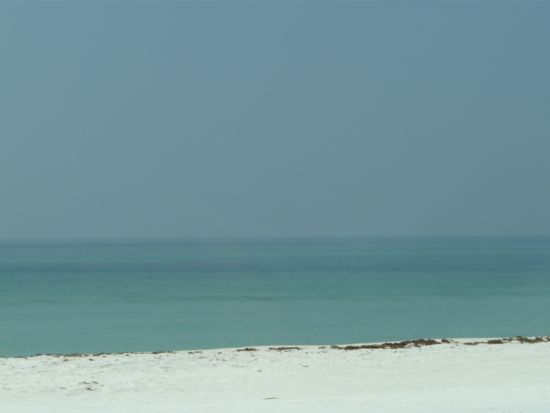


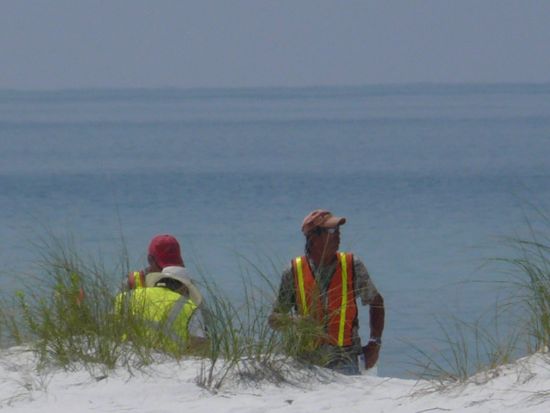
Kuwait or Qatar or Pensacola?
Showering after my water-aerobics class, I could hear voices discussing a local political-social situation. A benefits agency has groups of families working in it, and they know all the tricks. They know how to insure more of their own family members hired, and they know how to help all their family members (and friends) take advantage of all the entitlements.
Expats abroad call it nepotism, and scorn it as a third-world corruption. In truth, it happens everywhere.
There is an ongoing schism taking place in Qatar and Kuwait, countries that have been gracious and welcoming to me. The nationals of Kuwait and Qatar control citizenship carefully. The citizen base is about 20% of the population, on a good day. The rest of the population are people who are in Kuwait and Qatar to work. Most there to work can never hope for citizenship. For many, the poverty in their home country is so brutal that no matter how hard the working conditions, at least it is a salary, and they can send something home so that, literally, their families can eat. They dream – like we do – of educating their children so that they will have a better, more secure life.
Here is the problem. When 80% of the population is NON-Kuwaiti, or NON-Qatari, your country starts to change. One way in which things have changes is that in a very short time, the highways have gone from very quiet to gridlock, due to a dramatic increase in drivers and cars. In Qatar, the situation is made worse by nationalization of the taxi service, resulting in so few taxis that hotels now use private limo services, because finding a taxi at peak times is near to impossible.
That’s one issue. The second issue is language. Imagine your elderly parents going into shops to buy something – in their own country – and the clerks don’t speak their language. As they are stumbling and bewildered, some noisy “workers” walk in, state their needs, are understood, conduct their business and exit before you even get served. This is happening in Kuwait and in Qatar; everyone is speaking English. In a country where the workers are Indian, Nepalese, Philipino, Saudi, Yemani, Omani, Lebanese, Syrian, French, Dutch, English, Australian, South African, American (and about thirty or forty others) the common language has evolved to be English, not Arabic.
How do you think you would feel if it were happening here? If the great majority of cars on the road were not “us” but “guests” in our country? If the clerks in stores couldn’t understand what you want, because although they are in your country, they don’t speak your language?
Another problem is what to do with the huge, disproportionate number of geographically single males brought in to work as builders, cleaners, heavy equipment operators, dishwashers, drivers, security guards and other fairly low-paid positions? In Kuwait and in Qatar, non-married sex is strictly forbidden, even holding hands in public is considered an affront to morality. These men are banned from malls where families might gather, and from other public places. Their existence is grim, and they often find themselves unpaid, or paid far less than they were promised for their labor.
Last, but not least, this very modest Gulf culture has people – foreign guest workers – parading themselves on their streets in various states of undress. Think about it – that’s how we look to them. We have no shame. We bare our faces. We flaunt the glory of our uncovered hair. Sometimes a shawl might drop and a glimpse of bare arm or even a hint of cleavage might shock the modest eyes of a believer.
In Pensacola, there are also fundamentalists who wear long skirts, long sleeves, and determinedly modest clothing. I wonder what these believers think about the skimpy clothing on the beaches, or in the malls?
Coming home has been a real eye opener. It was easy for me to be critical of things I saw in Qatar and in Kuwait. Coming home, we joke all the time about “Kuwaiti drivers” here in the US, but the real joke is – they sure look a lot like us.
Last week, we saw a man here make a U-turn right in the middle of the road, and rock as he tried to regain control of his truck, and almost blast right through a red light he didn’t see. The back of his truck was down, and items loose in the truck bed were heading toward the highway – fortunately he figured that out, and last we saw, he had stopped to fix his rear door. Maybe he wasn’t sober. Maybe he had had an argument with his wife or boss or someone and was not paying close attention to his driving. All I know is that we have seen a goodly number of inattentive drivers here, too.
When a bureaucracy gets corrupted, when the rules are not applied equally to all, when select groups get favored treatment – here in Pensacola, at the immigration department in Kuwait or in the traffic department in Qatar – everyone suffers. It’s a political problem, a social problem, and a systemic problem. God willing, if we are truly evolving as a species, we will find a way to create truly fair and transparent systems which will work as they are ideally intended to work.
It’s on us. We have to make it happen. We have to want it badly enough to make it happen, even making sacrifices for the greater good.
I don’t have any answers. I don’t know how to make us better people that we are, how to make ourselves make the right choices. I do know this – whether it is a tiny village in Germany, or an eagle’s aerie in Kuwait, or the lush life of Doha – we are all more alike, and share more similarities and problems, than we are different. If we could only learn to see through one another’s eyes, maybe we could find ways to resolve our differences and learn to cooperate.
Garden Gate Nurseries
We’re new, but new-with-a-difference, as we have had so many good people to help us with all the decisions that come with settling in. Today, we spent most of our day exploring health care options. We are so lucky to have a military health plan that will cover most of our needs, but it is a bureaucracy, and our daughter-in-law’s step-father helped guide us through the channels, and introduced us to people who could help explain the benefits and rules. Today we searched out doctors who might work with us. At one point, I told AdventureMan, “the problem is, if they are available, I wonder why? Like maybe all the really good ones are taken?”
Our therapy is thinking about gardens, working on our gardens, and exploring ideas for how our yard should look in the future. Again, our daughter-in-law knew just the right person to help us out, and introduced us to Garden Gate Nurseries, a little piece of heaven on earth.
Garden Gate Nurseries specializes in educating clients as to what grows well in the Pensacola / Gulf Coast Climate, how to enrich the soil, which plants are particularly drought resistant, salt resistant, which attract butterflies, or hummingbirds, etc. You don’t just plonk things in the garden, you make a plan, and work little by little to accomplish that plan.
A visit to Garden Gate Nurseries is like a foretaste of Paradise:
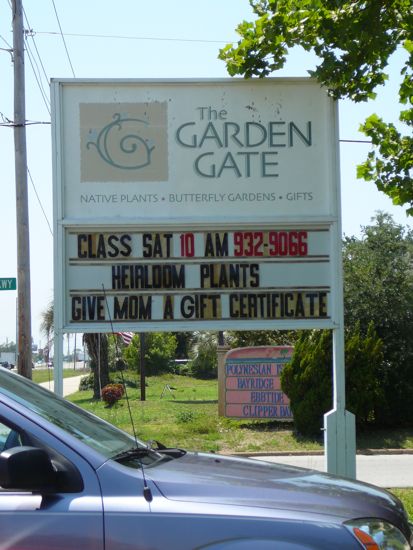
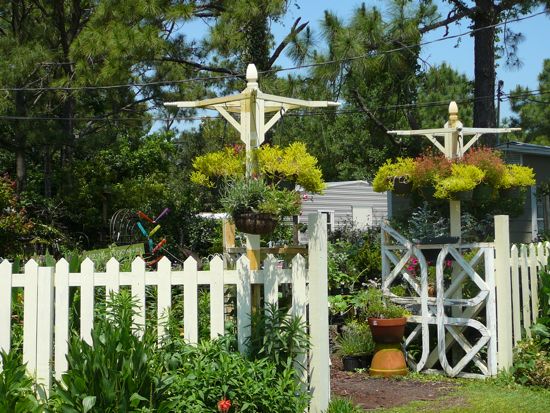


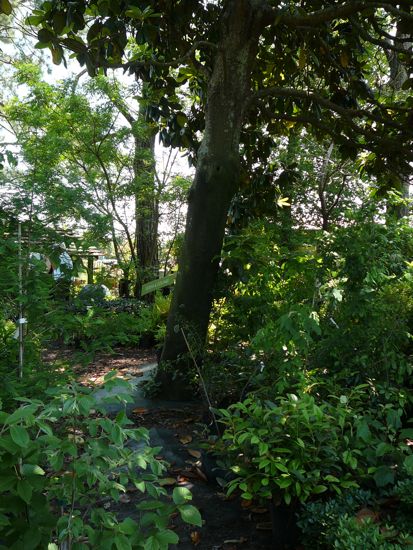
They have herbs and vegetables, plants that love the sun and plants that love the shade, and trees, fruit trees, flowering trees, and some wonderful and unique hand crafted gifts and garden-friendly items in their gift shop.
Best of all, they have a landscape designer, Carole Simpson, who loves gardening, gets her thrills from incorporating your dreams into her designs, is thoroughly knowledgeable about growing things in this climate, and on top of all that, is gracious and kind and generous with her time.
Garden Gate Nurseries / Carole Simpson Landscape Design
3268 Fordham Parkway
Gulf Breeze, FL
850-932-9066
Pocket Park with a View
As we were winding our way home from lunch, we came across a tiny parking area – two cars worth – and a pocket park with a view to die for.
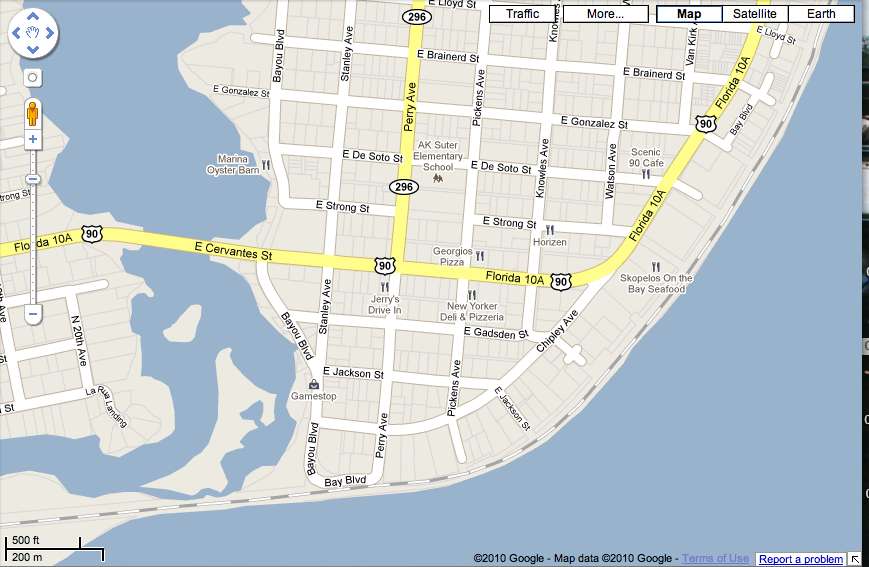
The park is about where it says Chipley Avenue, and has a view of the Garcon Point bridge; a perfect place to watch the sun rise, if you are a sunrise person, which . . .I am!


The park was donated by a gift from a woman who is memorialized in a tiny plaque in the park:
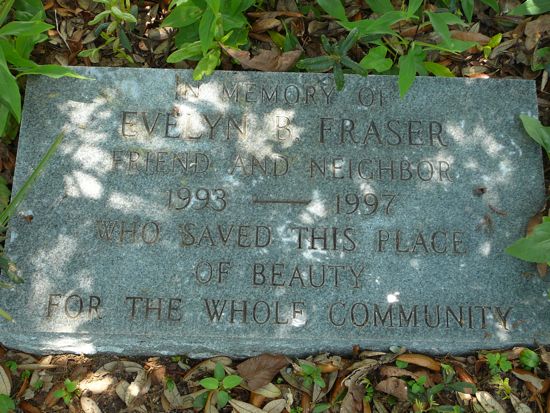
Isn’t that a beautiful legacy to leave behind when you depart this world?
Stamping Our Hunger
We are still getting used to a lot of things about living once again in our own country, but one thing we know we love is the open hearted spirit of giving in the USA. Every week people are raising funds to help those in need, or to raise awareness of a health issue, etc.
This week, on Saturday, the mail carriers sponsored a food drive for the local food pantry. Early in the week, they delivered flyers and a sack to each house on their route, asking us for donations of food to be placed on the doorsteps on Saturday. They even mentioned foods and items most needed, so it was easy.
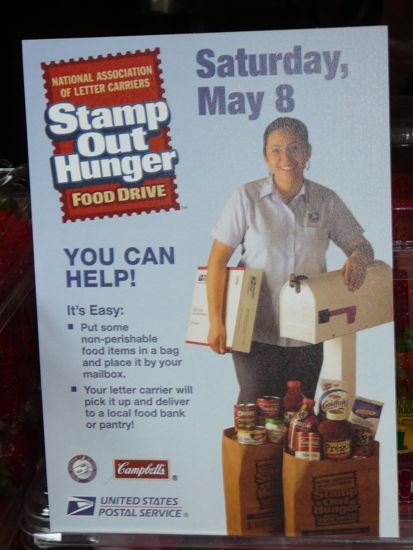
What I cannot imagine is how they got all the donations into one mail truck. I can imagine it was enormously successful. When I worked in fund raising, the first thing I learned is that people will give generously if you make it easy for them – that’s why when you get a request for donations, you get a form, a self-addressed envelope, and sometimes it even has a stamp on it.
So how much easier does it get than having a bag provided and just filling it? Putting it outside your own door, knowing it will be collected? God bless the men and women who had to trundle all those sacks out to the trucks, and then from the trucks to the food pantry! God bless the work of their hands!
By the way, when you are asked to give, here are some things that people who use food pantries often need:
rice
peanut butter
tuna fish
canned or powdered milk
disposable diapers
canned meats
And something most people don’t think of: dog food, cat food for the family pet
Rogation Days
AdventureMan and I love sleeping in a little on Tuesdays. This whole retirement thing is like being on vacation every day. No one says we HAVE to go to AquaAerobics, but it is such a great class, we want to go. This morning, however, it dawned grey and cloudy, not quite so cool . . . warmer, and more humid. I have my cup of coffee in my quilt room study, and AdventureMan is next door, in his office/study. It’s one reason we bought this house; we can have our own spaces and still be close enough to call back and forth.
As I am reading my morning devotions, I notice this is a “rogation” day. I have seen the term every now and then on the church calendar, but I haven’t a clue what it is, and today (!) I have the leisure to look it up. It is absolutely fascinating. This is from a website on church liturgies, traditions and prayers :
Rogation Days are an old religious custom which is now seldom observed in the Catholic Church, and many Catholics haven’t even heard of them. Episcopal parishes sometimes still observe them, and many people have them on a personal liturgical calendar.
Ok – so what are they?
The word “rogation” come from the Latin rogare, which means “to ask,” and the Rogation Days are four days set apart to bless the fields, and ask for God’s mercy on all of creation. April 25 (coincidentally the Feast of St. Mark) is called the Major Rogation; the three days preceding Ascension Thursday are called the Minor Rogations. On these days, the congregation used to march the boundaries of the parish, blessing every tree and stone, while chanting or reciting a Litany of Mercy, usually a Litany of the Saints. A few still do.
The Rogation Days were first instituted in the 5th Century by Mamertus, bishop of Vienne in France from 461 to 475. During his episcopate, France was in an almost continuous state of near-disaster. The Goths invaded Gaul. There was an enormous amount of disease; there were fires; there were earthquakes; there were attacks of wild animals. As a result, Mamertus spent a great deal of time in prayer, beseeching God to help the stricken community.
One night, when the village was overwhelmed with a fire, he conceived the idea of instituting a annual procession and litany in which the entire community would pray for God’s blessing and protection. He is reported to have said: “We shall pray to God that He will turn away the plagues from us, and preserve us from all ill, from hail and drought, fire and pestilence, and from the fury of our enemies; to give us favorable seasons, that our land may be fertile, good weather and good health, and that we may have peace and tranquility, and obtain pardon for our sins.”
Thus the custom of processing around the entire length of the parish while invoking a Litany of the Saints began. Over the centuries, it became the custom to also use the procession to “beat the bounds” – to mark and establish the boundaries of the parish – while also blessing the trees, stones and fields. In modern times, the actual purpose of “beating the bounds” – to impress the boundaries of the village on everyone’s mind – has ceased to be necessary due to modern surveying techniques, and the practice is largely ceremonial.
The standard practice in the Episcopal Church is to pray for fruitful seasons on Monday, commerce and industry on Tuesday, and stewardship of creation on Wednesday. When currently observed, the practice frequently has an environmental bent.
– Carl Fortunato
Don’t you love the idea of of “beating the bounds?” I think of the Emirs of Qatar and Kuwait, one day a year, followed by a procession of their countrymen and women, blessing every tree and stone and calling on God/Allah to protect their countries. I think how wonderful it would be in our own USA to have these four days a year (there is a major rogation in April to bless the crops, and then three days preceeding Ascension Day for “beating the bounds,” i.e. blessing the country. Imagine if we were all to pray blessings on our country at least three days a year. Uh Oh. Did I mention it is also a time of fasting?
Oil Spill Moving Towards Land
You can follow the oil spill movement on this interactive map from usatoday.com

There are lots of meetings. The answer to most questions is the same “I don’t know.” “We don’t know.” Fishing has been banned in the Gulf areas where the oil spill may have effect.
Missing Dottie
My Mom sent an e-mail today about an old friend, she’s not doing well. She lived next door to us in Alaska, and would take care of me and my sister when Mom needed to leave us with someone. She was older, so we weren’t really friends then, but we became friends as adults, years later, when AdventureMan and I moved to the Tampa Bay area and my friend and her husband lived just blocks away.
I’ve been missing my old friend; twice when I moved, she was there, the big-sister-I-never-had, helping me to move in while AdventureMan was far away. The first time, she loaned us her truck for several weeks while we settled and searched for another car. When I moved back to Seattle, she cleared out my overgrown garden, and then unpacked all the china and crystal and washed it and put it away in the cabinet. She was so much fun.
Through the years, she loved life and lived it to it’s fullest. She loved her time living in Egypt, and in Ramallah, and she travelled and sailed just about everywhere in the world. She exercised and watched her weight. She passed all the best books along to me, and kept up with the news. She was fit and active, and engaged with the world around her.
Statistically, and in all probability, she would never have seemed a risk for Alzheimer’s. I’m still angry about it. This should never have happened to her. It isn’t fair. She should be laughing, enjoying her grandchildren, dancing, swimming, sailing, running, biking, cooking, entertaining – all the things she loved. She DESERVES better. And I guess I am angry because I am selfish, and I want her to be around for ME. And I know that all this is stupid and childish, I should just accept and be calm, but it’s just so unfair and it makes me so angry. She is still in this world, although we don’t know for how long, but then again, she isn’t, not really, she is not a part of this world any longer, she just exists. It’s not right and it’s not fair and Alzheimer’s is a robber and a thief.
Music Banned in Somalia
We are in our own world these days, boxes needing unpacking, deliveries interrupting tasks, and no connection – no TV, no internet, no land line phone. We do have a cell phone, and Friday night our son called to ask us if we have heard about the weather.
Nope.
Heavy rains, strong winds, possibility of tornados. It was lively!
I hadn’t heard about Somalia, either.
This is really scary to me. This is the kind of thing I worry about in my own country – who makes the rules? Who gets to say what music I listen to, what movies I watch? Who gets to restrict my access to information?
Who gets to tell me that as a woman, I can’t have a checking account in my name? Or that I have to wear a burqa? Or that I am not allowed to wear a niqab (if that’s what I want?)
Somalia Radicals Declare Music ‘Un-Islamic,’ and Radio Goes Tuneless
POSTED: 04/25/10
If, as my colleague Sarah Wildman reports, the Francophonic world is intent on curbing expressions of fundamentalist Islam belief, then the radical Muslim world is taking no prisoners with the West, either. Last week, the Somalian fundamentalist Islamic group Hizbul Islam announced that music of any kind is “un-Islamic,” warning of “serious consequences” for those who dare to violate their decree. In response, radio stations all over the country, including those run by the moderate Muslim transitional government, cut all music from their broadcasts. Even intro music for news reports was scrapped. In its place? “We are using sounds such as gunfire, the noise of vehicles and the sound of birds to link up our programmes and news,” said one Somalian head of radio programming.
Get the new
PD toolbar!
Somalia has been wracked with inter-tribal violence for nearly two decades. In the last few years, increasingly radical Muslim militants, including the dominant Shabab group, have taken over large parts of the country and become closely affiliated with al-Qaeda. A moderate Muslim transitional government, helmed by a former teacher named Sheik Sharif Sheik Ahmed, controls a small part of the country. His government is largely propped up by African Union peacekeepers, with United Nations’ and U.S. support.
In the meantime, Islamic radicals like Shabab have gone on a campaign the New York Times described as “a quest to turn Somalia into a seventh century style Islamic state.”
The music decree follows a string of fundamentalist decrees, including prohibitions on wearing bras (also “un-Islamic”), the banning of modern movies and news channels, including the BBC and Voice of America.
As evidence of a power struggle between the moderate Muslim government and the hard-line radicals who control many parts of the country, Sheik Ahmed’s government responded last Sunday by saying any radio stations that stopped playing music would face closure. In the government’s eyes, those radio stations that complied with the ban were colluding with the radicals.
In the meantime, the radio stations have been caught between a rock and a hard place. “The order and counter-order are very destructive,” radio director Abukar Hassan Kadaf said in the Times article. “Each group are issuing orders against us and we are the victims.”
In the escalating tug-of-war between Western and Islamic powers over freedom of expression, what remains to be seen is how much of a causal relationship exists between the two. Is a proposed burqa ban in Quebec a result of the shuttering of a radio station in Somalia? Does a call for prohibition of headscarves in Paris force a bra-burning in Mogadishu?
If Islamic decrees do, in fact, fuel the fire for legal actions in the West (and vice versa), then continued and increased prohibition seems inevitable. But if radical Islam and a skeptical West are destined to one-up each other in a battle of bans, the powers that be might remember the men and women caught in the crossfire. That is, the women in the West who wear niqabs by choice, or the men and women in Somalia who just want to listen to music. What is perhaps most strikingly absent in all the brouhaha surrounding sharia vs. Western law are the voices of the moderate Muslims themselves. In the end, perhaps the gulf between the two sides will prove too great to be bridged, but for the immediate future, we would do well to remember the ground we share in common. Before there’s nothing left to ban.
Recent Comments
ExpatAlien on What Country am I Living … intlxpatr on Yellowstone: Old Faithful to C… Michelle on Yellowstone: Old Faithful to C… Cathy on No Grown-Ups in Charge intlxpatr on Waiting for Snow Wikipedia Donate Button

Amazina


Early Voting in Florida


 Here There and Everywhere