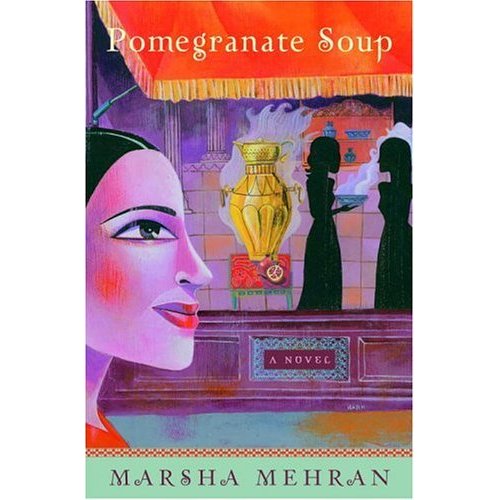
Pomegranate Soup by Marsha Mehran
I saw a mention of this book in an Amazon.com referral as a book I might like, and was almost set to order it when something said “go check the stack of books Little Diamond left for you” and sure enough, I already had the book.
I use books as an incentive to get me through life’s inevitable tasks I don’t like – like “if I finish this project on time, I get to read this book as a reward.” It works for me.
When I first started reading Marsha Mehran’s book about three Persian sisters starting up a cafe in a small Irish town after fleeing Iran, I found it sour. The author has a critical point of view, and generally speaking, I don’t like hanging around with people who criticize others and judge them harshly. At the beginning of the book, Mehran introduces a lot of people, many of whom we are not meant to like.
Even the sisters are not all that sympathetic – at the beginning. But also, near the beginning, she discusses Persian cooking, the idea of balance in a meal, hot and cold, spicy and bland, so you kind of get the idea that if there is sour, then there will also be sweet. In addition, at the end of each chapter there is a wonderful recipe, a wonderful, fairly easy-to-follow recipe, and she included one, Fesanjan, that is my all-time favorite Iranian dish and now, I know how to make it, Wooo HOOOO!
Three sisters, orphaned by fate, held together by love and duty, start a cafe, which, against all odds, becomes a raging success. Raging success does not heal all the old wounds, however, nor the hearts that bear them, and we learn through the book what the sisters have borne and overcome.
It turns out to be a sweet book, one well worth reading. And oh! the recipes! In each chapter, there are also hints that make them even better, so you can’t just copy out the recipes and use them, you really have to read the book. 🙂
It’s a pity that two of the most wonderful countries in the world – Syria and Iran – are off limits. We’ve been back to Syria, and it was everything we remembered (see the Walking Old Damascus blog entries) but oh, how we would love to explore Iran. Sigh. The world turns, and we can only hope to be able to get there in our lifetime. Stranger things have happened.
Iranian Joke
Sent to me by my good friend – it’s an Iranian joke:
What’s the difference between the USA and Iran ?
In the USA , they have Obama, Stevie Wonder, Bob Hope, Johnny Cash…
In Iran , we have Ahmadinejad, no wonder, no hope, no cash…
In Xanadu: A Quest by William Dalrymple
This book was on my (huge) “Read Me” stack, and I picked it up for a change of pace. As I started reading, I wondered “how did this get there?” My first instinct was it was a recommendation from Little Diamond. As I was reading, however, I came across a segment that was what our priest had read in church around the Feast of the Epiphany about the birthplace of the wise men who came seeking the Christ Child after his birth. I wrote down the title and ordered it from amazon.com (which has some copies used from 72 cents).

William Dalrymple wrote this book when he was a mere 22 years old. He and a travelling companion took off to trace Marco Polo’s journey from Jerusalem to Xanadu, where he was taking oil from the sanctuary lamp to Kubla Khan.
In a world where we have all been taught to be so careful, they take incredible risks. They travel on the cheap – staying in fleabag hotels, sometimes sleeping “rough”, i.e. out in the open. They travel any way they can – an occasional train, but more often a truck, a bus, whatever is going their way. One very long segment they travelled on top of a pile of coal.
They travel from Jerusalem up through Syria and into Turkey, then turn east and cross Iran, Pakistan and Afghanistan to China. They have some amazing adventures, see some astounding scenery and because of their mode of travel, have a lot of time to talk with their travelling companions or people in the cities where they are staying.
I am blown away that an unmarried couple would cross Iran, Pakistan and Afghanistan. I guess they told people they were married to share a room (they were on a budget) and they were only friends, not a couple, but what a risk. I am astonished that they were never asked to produce a marriage license or any proof of marriage when they stayed in hotels. I am astonished at the girls (one left in Lahore and another joined him, but these are girls who are friends, not anything more) would travel on the backs of trucks full of men, and never blink an eye.
The book is occasionally hilarious. Most of the hilarity results from foods they have to eat – sometimes it is the only food available – or from misunderstandings because of lack of a common language, or due to their frequent bouts of diarrhea, what I really liked about the author was that he was rarely pompous, and when he is funny, it is usually about some conversation he has had, or some mistake he has made.
One of my favorite parts of the book happens in Iran:
As we sat waiting for the bus to Tabriz, the next town on Marco Polo’s itinerary, we watched the mullahs speeding past in their sporty Renault 5s. Iran was proving far more complex than we had expected. A religious revolution in the twentieth century was a unique occurence, resulting in the first theocracy since the fall of the Dalai Lama in Tibet. Yet this revolution took place not in a poor banana republic, but in the richest and most sophisticated country in Asia. A group of clerics was trying to graft a mediaeval system of government and a pre-medieval way of thinking upon a country with a prosperous modern economy and a large and highly educated middle class. The posters in the bus station seemed to embody these contradictions. A frieze over the back wall of the shelter spoke out, in the name of Allah, against littering. On another wall two monumental pictures of the Ayatollah were capped with the inscriptions in both Persian and English:
BEING HYGENIC IS DIRECTLY RELATED ON THE MAN’S PERSONALITY
and:
ALLAH COMMANDS THE RE-USE OF RENEWABLE RESOURCES.
We had expected anything of the Ayatollah. But hardly that he would turn out to be an enthusiastic ecologist.
The challenge of this journey is to follow as closely as possible the path Marco Polo took, but two segments of the journey go through off-limits areas. They find a way into one, to discover later it is an atomic testing area, and the second, at the very end, around Xanadu, they find receptive Chinese officers who take them to have a brief glimpse of the ruins of Xanadu while booting them out of the area. As they stand in Xanadu, they repeat a poem that every American child grows up with in English Literature:
In Zanadu did Kubla Khan
A stately pleasure-dome decree:
Where Alph, the sacred river, ran
Through caverns measureless to man
Down to a sunless sea.
So twice five miles of gertile ground
With walls and twoers were girdled round:
And there were gardens bright with sinuous rills.
Where blossom’d many an incense-bearing tree:
And here were forests ancient as the hills,
Enfolding sunny spots of greenery.
(Coleridge)
I liked this book. Dalrymple is a history major, and often quotes from historical – even obscure – texts to illuminate what he observes. I think I may look at a couple more he has written since.
The Doha Museum of Islamic Arts – first visit
It’s Friday afternoon, and I can hardly believe it. We are here. Now THIS is my idea of a romantic getaway – please! Keep your chocolates (although I do love chocolate!) and your roses, keep your long lingering dinners and fabulous wine, but take me someplace where I have really wanted to go, and I will be your slave forever. You da man, AdventureMan. You know how to win my heart. 🙂
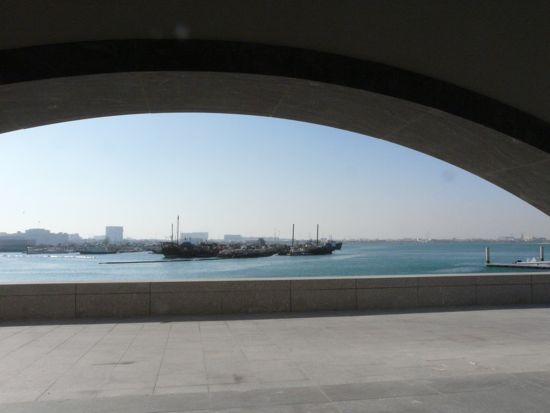

It is a glorious day and the museum has just opened. There is a huge parking lot and little carts ferrying the older people and women with small children to the entrance, but it is a nice walk, not a hard walk. Families are streaming in, and (gasp!) admission is FREE! You have to go get a ticket; I guess maybe that is how they keep track of admission statistics, but this beautiful museum, floating out over the gulf, all white and clean and gorgeous, filled with priceless objects of art, it’s free? Amazing.
We decide to start with the Beyond Borders exhibit, a special collection of art that integrates Jewish, Christian and Islamic traditions in an art collection. There are so many pieces that make me gasp in awe. I see one, and I can’t resist, the camera is out of my bag, I see others snapping photos with cell phones, but I know the rules . . . hmmm. But there is nothing posted here saying “no photos!” I ask the guard if I am allowed to take photos and he tells me “You are welcome, madame, all through the museum, you may take photos.”
I am in total shock. All through the museum? I can take photos?
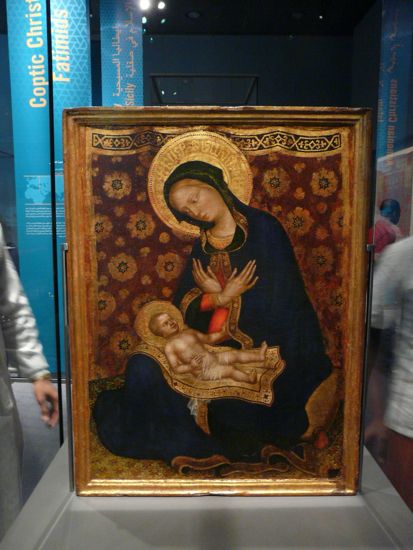
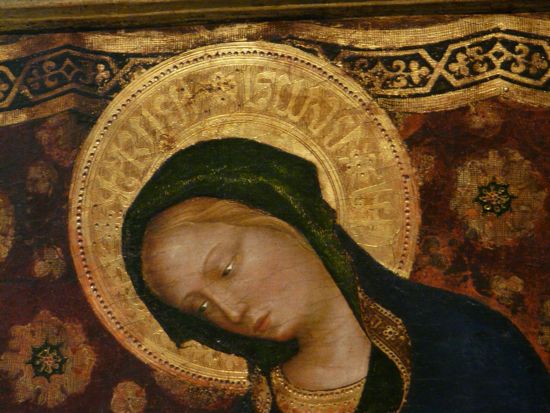
Here is the piece that moved me so much that I gathered up the courage to ask. It is a Madonna, painted in Aleppo, Syria, I believe, and it has an Quranic sura written in her halo:
The museum is my oyster, and my battery is dead. I didn’t bring another. Some things happen for the best, and I tuck my camera back in my purse and AdventureMan and I try to absorb what the Doha Museum of Islamic Art has to offer.
It is an impossible task. There is SO much. Not everything is well documented, and then there are sections which are amazing. There is so much to learn, and so much beauty in this museum.
If I had to choose my favorite thing of all, it would be some tiles from Kashan. In an earlier post, commenter Daggero mentioned that the word for tile used in Kuwait is “kashi” and now I know that it comes from these tiles, made in Kashan around the 1300’s (Gregorian calendar) which were famed for their intricacy, their interlocking designs, and their high quality. There are also Iznik tiles in the museum, which are thought to be greatly influenced by these tiles from Kashan.
I had no idea, but the tiles just blow me away. I would love to create some tiled rooms back in my Seattle house, with reproductions of some of these amazing star shaped tiles. For me, that was the highlight of this trip. I know there will have to be many more – this museum is filled with treasures. Free – for all the people. And yes – the gift shop is awesome!
Wise Men Still Seek Him
“Oh! You’re putting your Christmas things away!” I noticed, as I was picking up my friend.
“No, no, not until after Epiphany!” she said. “Our tradition is to take down the tree when Epiphany is over.”
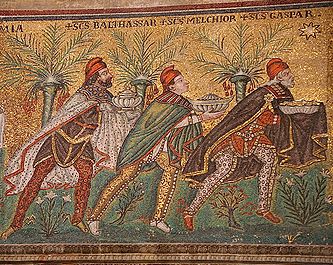
Tomorrow, January 6, is The Feast of Holy Epiphany and in celebration, I will post two more works of art I found to celebrate the wise men seeking the child by following a mysterious star. Many people are still looking for a scientific foundation for the Star of Wonder and if you click on the blue Star of Wonder it will take you to a very good discussion of some of the possibilities from BBC News.
I like this one because the Wise Men have on clothing that really looks Persian:
Here, in a painting by Murillo, they look, not surprisingly, Spanish/European, except for the African!

I wonder if in their travels, these wise men came through Kuwait?
An Eye for an Eye – Does Revenge Change Anything?
I have been following my own post with interest. The truth is, there is a huge part of me that agrees with you, agrees with Ameneh, who wants her attacker to suffer as she has suffered, to pay for the life he has stolen from her.
I used to be a lot more idealistic than I am now. I can remember the two times in my life I came face-to-face with who I am, viscerally, in my gut.
The first time, I was living in Jordan, and I awoke in the middle of the night. I heard gunfire. My husband was out of town – that happened a lot. Things like cars breaking down, heaters going out in the dead of winter, ants attacking (don’t even ask), those things always waited for my husband to be out of town. Now gunfire.
I finally called my British neighbors, who called their Security office, who said it was probably just the police shooting packs of dogs who attacked the sheep at night.
I knew, though, that night, that if I had a gun in the house, I would shoot anyone who came through the front door to protect my son. I had never thought of myself that way. I had never considered myself a killer. And I knew I could kill, without a second thought, to protect my son.
We all have times when we find out who we are, what we are made of. Men who go off to war and kill for a living have to live with their actions for the rest of their lives. Many, many live with regrets.
People who lived through the Invasion of Kuwait endured and suffered unimaginable horrors. Many won’t even talk about the things they saw or had to do.
Here is my problem with revenge – you have to live with the consequences.
If I had shot an intruder, even thinking it was a criminal, I would have to live with that the rest of my life. Even NOT shooting an intruder, I have to live with the thought that I would have, that I was fully prepared to kill. It still haunts me, even though I didn’t do anything, even though I just thought about it.
I like what This Lady said. I want this man punished, but if we choose to inflict the same punishment on him, don’t we lower ourselves to his level? I think life imprisonment would be worse. On another blog, dealing with the same topic, one Iranian woman wrote that if this man is blinded, some female in his family will be chosen to take care of him for the rest of his life, feeding him, preparing his meals. She, too, will be sacrificed, lose her own life to the obligation of taking care of this blinded villain for the rest of his life. Wouldn’t we all be better off if he were locked away, never to be free again?
I published the photo with the original article because I was shocked and intrigued by it. In spite of her blindness and disfigurement, this woman is laughing, and her mother is hugging her. In many ways, her life is blessed. Because God works in amazing and wonderful ways, we know that he can use this terrible act to do great things in her life, bring her peace, bring her new understanding . . . we don’t know what he can do, but we can trust that her life is not over, that he can still use her to fulfill his purpose in this world.
Reading your comments, trying to find my own response has been a challenge. As I said – if it were me, if it were my sister, God forbid – I know I would want revenge. I know that fiery outrage lives in all our hearts; the desire to take an eye for an eye. I know that dragon in my own heart.
And yet . . . I am left with this very uneasy feeling that revenge and retribution are neither deterrent, nor satisfying. I trust that if this sentence is carried out, God can even do great things with this violent assailant, that he can work in his heart and give him a new way of seeing, he can bring him to repentance, he can do great works, even in the heart of this sinner.
My greatest, gravest concern is for Ameneh. She seems to be a very stable, courageous woman. I fear that revenge can act as a poison in her soul, that the punishment, if inflicted, will eat away at all the goodness of her life. I fear for any of us who become obsessed with revenge at the cost of who we were created to be.
You have been very forceful in your expression of belief that the sentence should be imposed. Don’t you harbor any misgivings about this, no matter how small?
An Eye for an Eye in Iran – Penalty for Acid Disfigurement?
I found this today in the Washington Post
Woman Blinded by Spurned Man Invokes Islamic Retribution
By Thomas Erdbrink
Washington Post Foreign Service
Sunday, December 14, 2008; Page A01
TEHRAN — Ameneh Bahrami once enjoyed photography and mountain vistas. Her work for a medical equipment company gave her financial independence. Several men had asked for her hand in marriage, but the hazel-eyed electrical technician had refused them all. “I wanted to get married, but only to the man I really loved,” she said.
Four years ago, a spurned suitor poured a bucket of sulfuric acid over her head, leaving her blind and disfigured.
Late last month, an Iranian court ordered that five drops of the same chemical be placed in each of her attacker’s eyes, acceding to Bahrami’s demand that he be punished according to a principle in Islamic jurisprudence that allows a victim to seek retribution for a crime. The sentence has not yet been carried out.
You can read the rest of the article Here.

You may think you know how I feel about this. The man stole from this woman. He violated her very life. He stole her ability to see, her ability to support herself, he disfigured her for life and stole the likelihood of the love match she was holding out for. He treated her like property – if he can’t have her, then he will have revenge.
She fought – and won – for him to be blinded with the same acid she has been blinded with. She doesn’t ask that he be disfigured, only blinded. The court in Iran agreed. The sentence has not yet been carried out.
I’m interested in what YOU think. I feel sympathy for the woman, Ahmena Bahrami. I love the way she went after her attacker in the courts. I love it that she didn’t just collapse and be a victim.
On the other hand, I wish she had gone after something different. The thought of purposely blinding someone is SO repugnant to me, I can’t support it. I wish she had gone after his money, forcing him to support her at the level she was earning, for the rest of her life – and his. I find myself thinking – what good does it do to blind him?
He committed a heinous act. Hideous, unthinkable. And yet I find the punishment equally hideous, and unthinkable. I worry that in the future, she will regret having enforced this upon her assailant. I think that revenge, getting revenge, can extract it’s own price from our character. Do you think she will feel better? Do you think she will be happier knowing he was blinded in retrubution? I kinda sorta doubt it.
What do you think?
NY Cover Giggle
I can’t help it, this just gave me such a giggle.

From The New Yorker
The cartoon refers both to an American senator, Larry Craig, caught playing footsie with the cop in the next stall in the Minneapolis airport and Ahmadinajad playing footsie with nuclear power.
YouTubers had a field day with Craig’s guilty plea, and then reversal. Here is one:
Levantine/Gulf/Persian Warrior Women?
I’m still reading Sarum, by Edward Rutherford, although I am nearing the end. I am still thinking back to a fictional character – I think she is fictional because when I Google’d her name, I got the name of an English queen, but not this particular Aelfgifu.
In Sarum, Aelfgifu is a warrior woman. As a young girl, she hangs out with all the guys, rides with them, hunts with them, and is accepted by them. When the Vikings raid, she fights them. The Vikings are astounded, and more than a little angry, to be fought – successfully – by a woman. Later, her father reluctantly allows her to ride with the men to counter another Viking raid – they need all the “men” they can get, and she is one of the best.
I am intrigued. History shows that these exceptional women pop up now and then, and usually just at the right time. Joan of Arc for the French, the Amazons, Apache women warriors in Native American lore, Chinese Tang dynasty warrior women, Masai warrior women in Africa. We have women in the US Army, and I often hear their commanders say “some of my best men are women.”
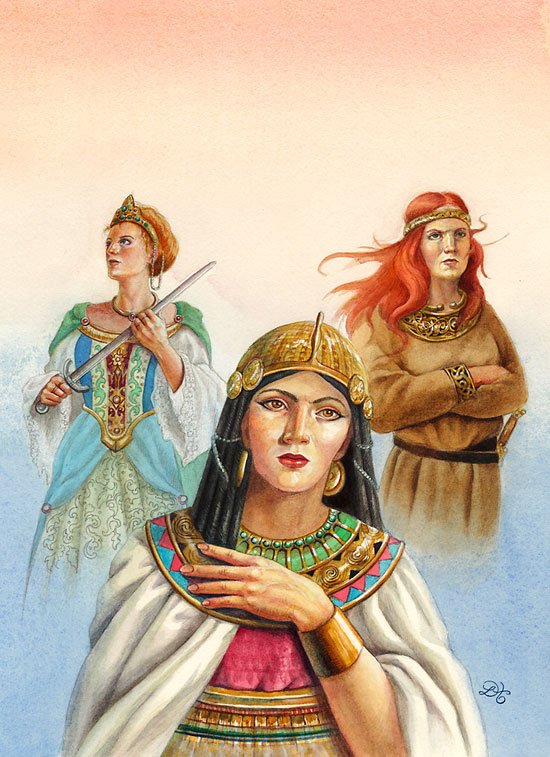
It was hard to find a good warrior women illustration which had women with their clothes on. Most of the illustrator, I guess, being men, they protray women warriors in scanty attire, and most of them have exaggerated breasts and hips, and tiny little wasp waists, and legs about twice as long as a normal woman. Sort of Barbie-doll in warrior women attire. *she snorts in disgust* Leaves a fighter a little vulnerable, don’t you think, fighting in a metal bra and tiny little loincloth? That metal would get uncomfortable in no time, and man, how can you ride a horse for very long without chafing your legs? But then reality wouldn’t sell the drawing, would it?
OK, OK, back to the real question – Warrior women pop up in all cultures. I think that is true, but when I think of the Arabian Gulf, or Persia, or the Levant, no one comes to mind, other than Sheherezad, but she triumphed by her wits, not her brawn, not her fighting skills. I remember hearing that nomadic women could be fierce; are there not legends of Bedouin women?
Is there a woman / are there women who were legendary fighters in Middle East culture? Are there women in Persian culture who fought, or held a castle, or were otherwise brave in the face of danger? Speak now!
NYT Article on “Shiitization of Syria”
My neice, Little Diamond wrote this morning referring to an excellent piece entitled Catalytic Conversion about persistent rumors of “Shiitization” in Syria. The article, by Andrew Tabler, is from today’s New York Times Sunday Magazine section, begins here:
The Middle East is abuzz with talk of “Shiitization.” Since the war in Lebanon last summer, newspapers, TV news channels and Web sites in Egypt, Saudi Arabia and elsewhere have reported that Sunnis, taken with Hezbollah’s charismatic Shiite leader Hassan Nasrallah and his group’s “resistance” to Israel, were converting to Shiite Islam. When I recently visited the semi-arid plains of eastern Syria, known as the Jazeera, Sunni tribal leaders whispered stories of Iranians roaming the Syrian countryside handing out bags of cash and macaroni to convert families and even entire villages to Shiite Islam.
You can read the original article from the New York Times Sunday Magazine section HERE.
Recent Comments
ExpatAlien on What Country am I Living … intlxpatr on Yellowstone: Old Faithful to C… Michelle on Yellowstone: Old Faithful to C… Cathy on No Grown-Ups in Charge intlxpatr on Waiting for Snow Wikipedia Donate Button

Amazina


Early Voting in Florida


 Here There and Everywhere