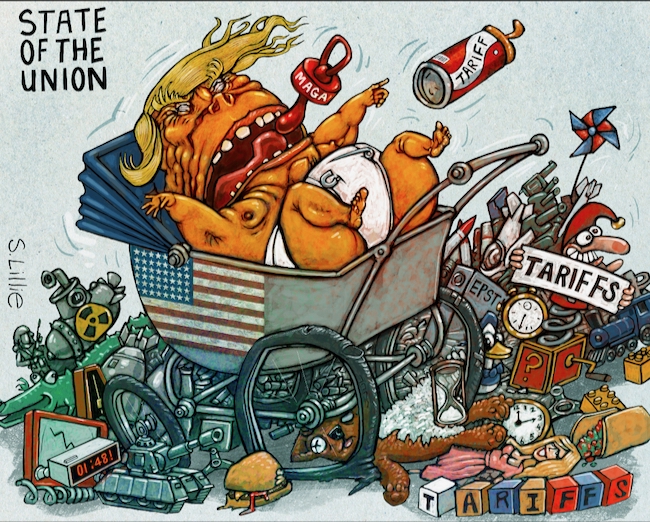
This is not the world I grew up in. This is not the country I served. These are not the values we were taught as children, in a United States full of post WWII optimism, as we allied with other nations for the greater good.
I am a blessed woman. I have what I need, and my son married a woman with deeply perceptive insights. An environmental specialist, she taught me the concept of Unanticipated Consequences. We are witnessing a host of unanticipated consequence unrolling by the minute, consequences which will have reverberations far into the future – not forseeable consequences but lasting.
Our current Administration is whacko. They command the mightiest military on earth, and they hold the keys to nuclear weapons. I have a friend who says “We’re Doomed,” only he uses a stronger, vulgar word I don’t want to use here.
I don’t think I ever met an Iranian woman I didn’t like.
The Iranian women I met – it seemed to me – were all gorgeous. They were educated, and they liked to read books and if you ever want to have a great conversation, look for the Iranian woman. I survived many a stuffy reception, finding intelligent women and talking books, or customs, or history.
So I shudder as I see our forces gathering for a potential strike on Iran.
I get it. Iranian men are smart too, I used to run into them in college, always talking engineering, as in huge national engineering projects, and, way above my head, nuclear physics. They are smart, creative, and great problem solvers.
Here is what makes me laugh. I don’t think the Iranian nuclear threat is the problem. I think Iran is too much like the USA.
Iran has a strong, unpopular leader who is particularly tough on uppity women (do you see where this is going?) and has an economy which is slowly tanking. Iran wants the population to be COMPLIANT and does not like civil protest. Iran is hard on student protestors, but especially hard on non-compliant women.
Our equally unpopular leader, equally chaotic, arbitrary, and cruel, envies the Ayatollah’s theocratic autonomy. Theocracy in Iran has all the power; they can jail people with impunity. They kill protestors with impunity. Not only are they the LAW, but they are above the law.
So how is that working out for Iran? Not so great. It hasn’t worked out so great since the overthrow of the Shah. When people don’t have a voice in how the country are run, they aren’t happy, and unhappy people have ways of resisting, and sabotaging the oppressive regime.
I think that all this massing of power and threatening to invade Iran is a distraction from our own orange leader’s problems with leading. After one year of his leadership, jobs are declining, people cannot afford health care, colleges are afraid to teach critical thinking skills, and we have poorly trained goons and thugs with carte blanche to invade people’s houses, shove demonstrators around, and to kill with impunity. Or at least that is how I see it. I have seen no accountability for the killing of Renee Good or Jonathan Pretti in Minneapolis, nor for the homicides in the “detention centers” which are like huge cattle corrals.
And to what point? As long as the Iranians are increasingly unhappy with their own leader, their leadership has big problems. When the leadership can point their finger at an impending danger caused by an encroaching bully, it rallies the people to the national cause.
Oh, but the power and the might makes the heart beat faster, and what a perfect opportunity to play with all our ships and planes and the great glory of it all, you know, like what happened in Iraq and Afghanistan.
Oh wait! Another similarity! Our leader uses emergency powers because of an ALIEN INVASION! The Rule of Law no longer applies! We are overrun by our roofers! Our gardeners and landscapers! Our waiters! Our housekeepers! Our fruit and vegetable pickers! Our meat packers! Our teacher assistants! Our janitors! Our nursing home care-givers! Our teachers and professors! Our potential citizens, tempest-tossed, waiting by the Golden Door (posted on our Statue of Liberty, welcoming our fore-fathers to this country).
These are not the criminals and rapists our toddler-in-chief tells us he is saving us from; over 90% of those violently arrested and detained are NOT criminals, just people who will work hard to try to provide their family with a living wage and a roof over their heads, and enough food. Many are documented, going through the system. The system is failing them, and failing us, as a country. We are a nation of immigrants.
Like the Ayatollah, our leader seeks total control, including “protecting” our elections – protecting us from voting against him and his politics of hatred, inequality, and humiliation.
Do you think there is a long-term strategy in all this? Do you believe in the Board of Peace as a functional institute? Do you see anything here that is truly in the national interest of the citizens of the United States of America? All I see is a dance of chaos, self-enrichment, self-aggrandizement, vanity, and a grab for all the power.
First, God bless America, where every and any citizen is free to criticize our President. Second, this man is not the “real face of America.” He became president by a statistical sleight-of-hand, winning the electoral college, but losing the popular vote by THREE MILLION votes.
Many people who voted for him have voters remorse – the Americans happy with his performance is 36%.
(CNN)President Donald Trump enters office facing low job approval ratings and skepticism from voters, according to a new Quinnipiac University poll released Thursday.
The survey found that 36% of American voters approve of Trump’s handling of his job after his first week, while 44% say they disapprove. By comparison, former President Barack Obama received a 59%-25% approval rating in the first Quinnipiac poll taken after his inauguration in 2009.
Mr. Trump, as is his habit, calls all news which is not flattering “fake news.” His staff makes things up all the time, and seem unembarrassed when caught – no wonder they see the world a making things up. When it’s what you do, that’s what you think others are doing.
There is a majority of good hearted Americans who do not see “radical Islamic terrorism” in the face of every refugee. There are Americans demonstrating for people they don’t even know, for their right to immigrate to this great nation of immigrants. There are Americans sending money to the American Civil Liberties Union, to fight the battles through the judicial system, to Planned Parenthood, to make sure our abortion rate continues to fall because unwanted children are neither conceived nor born, the International Rescue Committee, to help settle the refugee families and keep our borders open to the flows which have given us the strength of diversity.
No, Mr. Trump is not the face of America, not the America I grew up in. He has to move fast, because he knows he doesn’t have long before the next election, when his mis-deeds come home to roost.
I believe he is a smart man, in the way con-men are often smart – clever. He doesn’t do his homework, he doesn’t understand the complexities of domestic nor international politics, he offends everywhere he goes with his bad manners and bluster. He has some very outdated ideas about women. He is fascinated with celebrity. Perhaps, if there were any indication he was taking this job seriously, he would be effective, but he is lazy, and arrogant, and thinks the laws don’t apply to him because he is in some way special. Like the bully on the playground, he is fragile, insecure and vulnerable to flattery, and will go crying home when the people call “The Emperor Has No Clothes!”
No, Ayatollah Khamenei, this man Trump does not show the real face of America.
We have had a choice of Old Testament readings this week in the Lectionary readings, either Esther or Judith, (Judith is in the Apocrypha). I like both stories 🙂 Judith is a tale to curl your hair, a tale not for children, but an amazing story within that culture, and telling. Meanwhile, I wondered, where is Susa?
As it turned out, I lived almost next door to Susa. So close I could spit across the Gulf. I wonder if I will ever have a chance to visit Iran? As hopeless as the current situation(s) in the Middle East look, I have seen amazing and wondrous things in my life – the fall of the Berlin Wall and the unification of South Africa sans apartheid – and I believe, by God’s grace, anything is possible.
The New Yorker is an expensive subscription and worth every penny. This article takes an enormously complex situation, breaks it down into components and summarizes the options and their drawbacks. No wonder President Obama is having a problem finding a strategy – there aren’t a lot of winning options out there, and we don’t need to get stuck with another tar baby.
Wars cost money. There is an election coming up. The economy is just now moving past the downswing, and we still have wounded from Iraq and Afghanistan to take care of. Can anything we do make a difference? Will that difference be appreciated or will it add to our reputation as a world bully? All these are factors when formulating a strategy.
At the end of the eighth century, Harun al-Rashid, a caliph of the Abbasid dynasty, built a palace in Raqqa, on the Euphrates River, in what is now Syria. His empire stretched from modern Tunisia to Pakistan. It was an age of Islamic discovery in science, music, and art; Rashid’s court of viziers inspired stories in “One Thousand and One Nights.”
In June, the Islamic State in Iraq and al-Sham (ISIS) declared Raqqa the seat of a new caliphate, presided over by Abu Bakr al-Baghdadi, a fierce preacher who was once an American prisoner in Iraq, and is now in hiding. The city has lost its splendor. Public executions are “a common spectacle” on Fridays in El Naim Square or at the Al Sa’a roundabout, a United Nations human-rights commission reported last month. ISIS fighters mount the dead on crucifixes, “as a warning to local residents.”
ISIS emerged a decade ago as a small Iraqi affiliate of Al Qaeda, one that specialized in suicide bombings and inciting Iraq’s Sunni Muslim minority against the country’s Shiite majority. The network regenerated after 2011 amidst Iraq’s growing violence and the depravities of Syria’s civil war. This year,ISIS has conquered cities, oil fields, and swaths of territory in both Syria and Iraq. The movement draws its strength from Sunni Arab communities bitterly opposed to the Shiite-led government in Baghdad and the Alawite-dominated regime in Damascus, led by Bashar al-Assad.
Defense Secretary Chuck Hagel has called ISIS “as sophisticated and well funded as any group that we have seen . . . beyond anything we have seen.” The group has former military officers who can fly helicopters, spot artillery, and maneuver in battle. ISIS is increasingly a hybrid organization, on the model of Hezbollah—part terrorist network, part guerrilla army, part proto-state.
President Obama has decided that the United States must now attack ISIS, if only from the air. The President vacationed on Martha’s Vineyard, and golfed conspicuously, as his initial aerial campaign in Iraq unfolded. He has been less than forthright about why, after pledging to end America’s costly war in Iraq, he believed a return to battle there was necessary. But in interviews and other forums Obama has offered a casus belli, in three parts.
ISIS has massacred religious minorities, including Christians and Yazidis, and American air strikes can prevent more wanton killing, the President has said. A second imperative is the defense of the Kurdistan Regional Government, a semi-autonomous, oil-endowed American ally in northern Iraq, which a few weeks ago was teetering under pressure from ISIS but has since recovered, with the aid of American air power. The third, and most resonant, reason that the President has given is self-defense: to disrupt ISIS before it tries to attack Americans in the region or inside the United States.
ISIS has beheaded one American journalist, James Foley, and threatened to execute a second. Yet some terrorism specialists point out that ISIS is consumed by the sectarian wars in Syria and Iraq, and has shown no intent to launch attacks in the West, or any ability to do so. Still, ISIS has attracted five hundred British volunteers, many scores of other European passport holders, and even some Americans to its fight; they might eventually turn toward London, Berlin, or New York. Last week, British authorities announced that the threat of a terrorist attack on its home soil was “severe,” given the rising number of British jihadis now among the militants in Iraq and Syria.
The question about President Obama’s resumption of war in Iraq is not whether it can be justified but where it will lead. Air strikes against a well-resourced guerrilla army will do little if they are not accompanied by action on the ground. It would be a catastrophic error for the United States to take on that role. But what other professional force will dislodge the self-proclaimedISIS caliphate and then control the population? American policy assumes that Iraq’s squabbling politicians will rally a Shiite-led army to fight ISIS in the country’s Sunni heartland. On recent evidence, this assessment looks unrealistic.
In Syria, the options are worse. Obama has said repeatedly that he does not believe that Syria’s moderate rebels have the capacity to overthrow Assad or defeat jihadists. Yet the alternatives would allow Syria’s violence to fester at the cost of tens of thousands more civilian lives or would tacitly condone an alliance with the brutal Assad, who has been implicated in war crimes.
Obama and his advisers have at times taken refuge in a self-absolving logic: We can’t force people in other countries to unite around our agenda, so, if they don’t, whatever calamity unfolds is their responsibility. As a retreat from American hubris, this form of realism has appeal. As a contribution to a stable Middle East, it has failed utterly.
It is not yet clear that ISIS will endure as a menace. Fast-moving extremist conquerors sometimes have trouble holding their ground. ISIS has promised to govern as effectively as it intimidates, but its talent lies in extortion and ethnic cleansing, not in sanitation and job creation. It is vulnerable to revolt from within.
The group’s lightning rise is a symptom, however, of deeper instability; a cause of that instability is failed international policy in Iraq and Syria. If the United States is returning to war in the region, one might wish for a more considered vision than Whack-a-Mole against jihadists.
The restoration of human rights in the region first requires a renewed search for a tolerable—and, where possible, tolerant—path to stability. ISIS feasts above all on the suffering of Syria, and that appears to be unending. The war is in its fourth year, with almost two hundred thousand dead and nine million displaced, inside the country and out. The caliphate now seated in Raqqa is the sort of dark fantasy that can spring to life when people feel they are bereft of other plausible sources of security and justice.
“We don’t have a strategy yet,” the President remarked last week, infelicitously, about Syria. He does have a coalition of allies in the region that are willing to challenge ISIS’s ambition, including Jordan, Turkey, Saudi Arabia, and the United Arab Emirates. These countries patronize disenfranchised Sunnis in Iraq and Syria, and some of their support certainly reaches jihadists, includingISIS. Yet they share an interest in reducing Syria’s violence and in promoting regional and local Sunni self-governance that is less threatening and more sustainable than what ISIS has created. Ultimately, Sunnis will need the kind of autonomy that Kurds presently enjoy.
Leading a coalition of this character is hard, uncertain work. George H. W. Bush, the President whose foreign policy Obama seems to admire most, did it successfully in the runup to the Gulf War of 1991, by intensive personal engagement. Obama has more than two years left in the White House. To defeat ISIS, but also to reduce its source of strength, will require the President to risk his credibility on more than just air strikes.
Steve Coll, a staff writer, is the dean of the Graduate School of Journalism at Columbia University, and reports on issues of intelligence and national security in the United States and abroad.
TEHRAN: The arrest of six Iranian youths for dancing to US singer Pharrell Williams’ hit “Happy” in a video that went viral highlights the rift between conservatives and youths fascinated by the West. Recorded on a smartphone and uploaded multiple times on YouTube, the clip shows three girls dancing and singing along to the song in a room, on rooftops and in secluded alleys with three young men. For the youths, the homemade video now watched one million times was merely an “excuse to be happy”, but for the Iranian authorities it was “vulgar” breach of the Islamic republic’s values. Originally posted online in April, the clip gradually spread online before it led to the arrest of the dancers and their director on Tuesday for having “hurt” the country’s strict moral codes, according to Tehran police chief Hossein Sajedinia.
The youths appeared on state television repenting for appearing in the clip, after the girls failed to properly observe hijab, a series of rules that oblige women in Iran to cover their hair and much of their body when outside.
Their arrest sparked international fury and criticism in the media and online, with many Iranians expressing shock and some observers questioning whether it was a “crime to be happy in Iran”. Supporting the young Iranians, Williams himself chimed in and hit out at their treatment, saying on Twitter and Facebook: “It’s beyond sad these kids were arrested for trying to spread happiness.” Reports emerged Wednesday night that the dancers were released on bail, with one of the arrested girls, Tehranbased fashion photographer Reihane Taravati, saying on Instagram: “Hi I’m back.” The arrests came after President Hassan Rouhani-a selfdeclared moderate who claims to be for more social freedomsreiterated in a weekend speech his calls for a relaxation of Internet censorship. Rouhani’s statements have irked the conservatives, who have long imposed limitations on the Internet, blocking millions of websites particularly social media platforms, including Facebook and Twitter, as well as YouTube. — AFP
January was always the best month to visit the fish souk in Kuwait; cooler weather = less smell. One of my best memories is my friend who was living in Teheran going through with her camera, taking photos of every fish to show her husband – they didn’t get a lot of fresh seafood, and they missed it so much. It was January, it was cold – but so much less fish-y smelling than in July 🙂
This is from AOL News:
A shark species previously thought to have been extinct was reportedly found in a fish market in the Middle East.
This is the smoothtooth blacktip shark, and the last time anyone ever reported seeing one was was in 1902 in Yemen. Scientists eventually labeled it extinct, or vulnerable to extinction in the 1980’s.
Then in 2008, the Shark Conservation Society took a trip to a fish market in Kuwait. They were looking at sharks and noticed one looked ‘very similar, but different, to a couple of other species.’ So of course they decided to investigate.
Further analysis confirmed it was in fact the smoothtooth blacktip shark.
But there’s more: Recent studies of Middle Eastern fish markets also counted as many as 47 more have been spotted.
Now this doesn’t mean the species is necessarily thriving, but it does mean scientists have a greater chances at learning more about the shark and possibly even ways to save the species.
Most people I know these days are trying to eat less meat. In the readings for today, we start the story of Daniel, a story every Christian child learns in Sunday School, but when you read as an adult, you see different things. This morning, doing the readings from the Lectionary, I smiled to see that Daniel and his companions wanted only vegetables; they were working very hard not to violate their food laws.
I also wonder if not eating meat was helpful in the den of lions; maybe they smelled less interesting as vegetarians? Then again, lions eat impalas, wildebeest, all sorts of vegetarians, so that probably was not a factor . . . 🙂
Daniel 1:1-21
1In the third year of the reign of King Jehoiakim of Judah, King Nebuchadnezzar of Babylon came to Jerusalem and besieged it. 2The Lord let King Jehoiakim of Judah fall into his power, as well as some of the vessels of the house of God. These he brought to the land of Shinar,* and placed the vessels in the treasury of his gods.
3 Then the king commanded his palace master Ashpenaz to bring some of the Israelites of the royal family and of the nobility, 4young men without physical defect and handsome, versed in every branch of wisdom, endowed with knowledge and insight, and competent to serve in the king’s palace; they were to be taught the literature and language of the Chaldeans. 5The king assigned them a daily portion of the royal rations of food and wine. They were to be educated for three years, so that at the end of that time they could be stationed in the king’s court. 6Among them were Daniel, Hananiah, Mishael, and Azariah, from the tribe of Judah. 7The palace master gave them other names: Daniel he called Belteshazzar, Hananiah he called Shadrach, Mishael he called Meshach, and Azariah he called Abednego.
8 But Daniel resolved that he would not defile himself with the royal rations of food and wine; so he asked the palace master to allow him not to defile himself. 9Now God allowed Daniel to receive favour and compassion from the palace master. 10The palace master said to Daniel, ‘I am afraid of my lord the king; he has appointed your food and your drink. If he should see you in poorer condition than the other young men of your own age, you would endanger my head with the king.’
11Then Daniel asked the guard whom the palace master had appointed over Daniel, Hananiah, Mishael, and Azariah: 12‘Please test your servants for ten days. Let us be given vegetables to eat and water to drink. 13You can then compare our appearance with the appearance of the young men who eat the royal rations, and deal with your servants according to what you observe.’ 14So he agreed to this proposal and tested them for ten days. 15At the end of ten days it was observed that they appeared better and fatter than all the young men who had been eating the royal rations. 16So the guard continued to withdraw their royal rations and the wine they were to drink, and gave them vegetables. 17To these four young men God gave knowledge and skill in every aspect of literature and wisdom; Daniel also had insight into all visions and dreams.
18 At the end of the time that the king had set for them to be brought in, the palace master brought them into the presence of Nebuchadnezzar, 19and the king spoke with them. And among them all, no one was found to compare with Daniel, Hananiah, Mishael, and Azariah; therefore they were stationed in the king’s court. 20In every matter of wisdom and understanding concerning which the king inquired of them, he found them ten times better than all the magicians and enchanters in his whole kingdom. 21And Daniel continued there until the first year of King Cyrus.
DOHA, Qatar — An amount of freshwater almost the size of the Dead Sea has been lost in parts of the Middle East due to poor management, increased demands for groundwater and the effects of a 2007 drought, according to a NASA study.
The study, to be published Friday in Water Resources Research, a journal of the American Geophysical Union, examined data over seven years from 2003 from a pair of gravity-measuring satellites which is part of NASA’s Gravity Recovery and Climate Experiment or GRACE. Researchers found freshwater reserves in parts of Turkey, Syria, Iraq and Iran along the Tigris and Euphrates river basins had lost 117 million acre feet (144 cubic kilometers) of its total stored freshwater, the second fastest loss of groundwater storage loss after India.
About 60 percent of the loss resulted from pumping underground reservoirs for ground water, including 1,000 wells in Iraq, and another fifth was due to impacts of the drought including declining snow packs and soil drying up. Loss of surface water from lakes and reservoirs accounted for about another fifth of the decline, the study found.
“This rate of water loss is among the largest liquid freshwater losses on the continents,” the authors wrote in the study, noting the declines were most obvious after a drought.
The study is the latest evidence of a worsening water crisis in the Middle East, where demands from growing populations, war and the worsening effects of climate change are raising the prospect that some countries could face sever water shortages in the decades to come. Some like impoverished Yemen blame their water woes on the semi-arid conditions and the grinding poverty while the oil-rich Gulf faces water shortages mostly due to the economic boom that has created glistening cities out of the desert.
In a report released during the U.N. climate talks in Qatar, the World Bank concluded among the most critical problems in the Middle East and North Africa will be worsening water shortages. The region already has the lowest amount of freshwater in the world. With climate change, droughts in the region are expected to turn more extreme, water runoff is expected to decline 10 percent by 2050 while demand for water is expected to increase 60 percent by 2045.
One of the biggest challenges to improving water conservation is often competing demands which has worsened the problem in the Tigris and Euphrates river basins.
Turkey controls the Tigris and Euphrates headwaters, as well as the reservoirs and infrastructure of Turkey’s Greater Anatolia Project, which dictates how much water flows downstream into Syria and Iraq, the researchers said. With no coordinated water management between the three countries, tensions have intensified since the 2007 drought because Turkey continues to divert water to irrigate farmland.
“That decline in stream flow put a lot of pressure on northern Iraq,” Kate Voss, lead author of the study and a water policy fellow with the University of California’s Center for Hydrological Modeling in Irvine, said. “Both the UN and anecdotal reports from area residents note that once stream flow declined, this northern region of Iraq had to switch to groundwater. In an already fragile social, economic and political environment, this did not help the situation.”
Jay Famiglietti, principle investigator of the new study and a hydrologist and UC Irvine professor of Earth System Science, plans to visit the region later this month, along with Voss and two other UC Irvine colleagues, to discuss their findings and raise awareness of the problem and the need for a regional approach to solve the problem.
“They just do not have that much water to begin with, and they’re in a part of the world that will be experiencing less rainfall with climate change,” Famiglietti said. “Those dry areas are getting dryer. They and everyone else in the world’s arid regions need to manage their available water resources as best they can.”
Engaget publishes the information that Iran intends to isolate Iranians in Iran from the global ‘net. Makes sense to me . . . if I am running a country where I don’t want my people exposed to what is happening in the rest of the world, when I want to create my own perceptions of reality, if I don’t want people adopting ways contrary to my own beliefs AND I have the power to enforce it . . . But does anyone in the world truly have the power to isolate a population?
It seems to me that the quickest way to encourage people to find a new way to do something is to try to make it impossible for them to do it. Forbidding access incites clever minds to find work-arounds . . .
So what kind of “Spring” happens in a country where strict fundamentalists have already taken over . . . ?
Iran announces plans to create isolated local internet system, fate of global access unknown
By Sean Buckley posted Sep 23rd 2012 6:07PM
Iranians have been having trouble accessing YouTube, Gmail and other Google services for some time now, but their digital world may be growing even smaller — Iran announced today that it plans to shuffle citizens onto its own domestic version of the web. Reuters reports that officials plan to connect citizens to the national information network that’s currently in use at government agencies. Iran hopes to complete the transition by March of next year, and is already taking steps to isolate its population from certain international services. “Google and Gmail will be filtered throughout the country until further notice,” an Iranian official added, noting that the ban would commence in “a few hours.”
Some locals, such as the Iranian Students’ News Agency, are attributing the ban to recent protests sparked by a trailer for an anti-Islamic film on YouTube called Innocence of Muslims, but the government has made no official comment on the reason behind the ban. The state isn’t clear on the fate of the global internet in Iran, either — although it has talked about creating an isolated national network before. Here’s hoping the new network will be a compliment to the Persian web, and not a substitute.