Prohibited For Travel in Kuwait
LOL, the have you been to the web page of all the items that are banned for traveling in and out of Kuwait? It’s all in Arabic, but you can understand the photos.
My last move to Kuwait, I was allowed several hundred pounds to take on the airplane. I packed an entire set of flatware, and all my good kitchen knives, and lots of scissors. . . like, who can live without scissors???
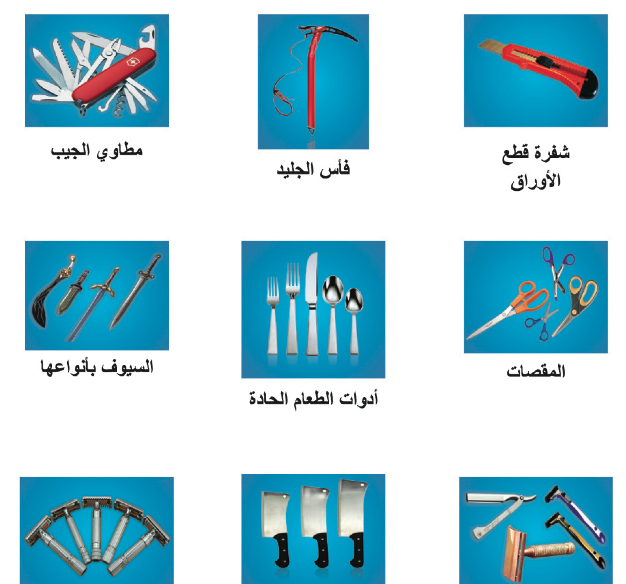
Honest Judge, so sorry, I had NO idea! No one asked me if I was carrying dangerous flatware in my baggage!
What Are Kuwait Traffic Laws?
You all know me – I am a law and order kind of gal. I like order, I like laws, especially those voted on by the people. I like laws which can be enforced, and are enforced, equally, for all people equally in the country. Oh? I did? I said EQUALLY twice?
We are all equal before the law.
Now here is the tricky part. Have you ever seen a listing of traffic laws in Kuwait? Can you find a listing of laws, violations, and their charges? When we apply for driver’s licenses in almost any country, we get a little booklet to memorize, with the laws written inside it. The laws are clear. Clear laws are enforceable.
I’ve looked at the MOI website. I see something that looks like it might be a traffic code in Arabic. I have looked everywhere; I cannot find one in English. I find no reference to any handbooks for people applying for their driver’s license.
How can you enforce a law if the law is not published? Is there a code somewhere listing violations and fines? I published one many years ago, something that all the expats were sending around as ‘the new Kuwait traffic rules’ but IF it was, there was never anything in the paper about it to confirm its validity.

If you are going to have a major campaign to enforce traffic codes, you might want to publish the laws . . . in all major languages use today in Kuwait.
From the Kuwait Times:
Ali vows to rid traffic ‘disease’
Interior Ministry Assistant Undersecretary Maj Gen Abdulfattah Al-Ali
KUWAIT: Interior Ministry Assistant Undersecretary Maj Gen Abdulfattah Al-Ali stressed that all traffic violation-related deportations are in accordance with the law. Speaking at a press conference at the Kuwait Journalists Association (KJA) headquarters, Ali said that deporting people for traffic violations was also adopted by the US and other countries worldwide. “The problem is that we were very tolerant with violators and this does not mean that law violation is a right for motorists,” he underlined, urging all human rights organizations who have criticized Kuwait’s traffic police to examine human rights in their respective countries before talking about Kuwait.
“We have filed over 70,000 traffic citations including 43,000 serious ones such as running red lights, driving under the influence of alcohol, driving on the wrong side and many others,” he elaborated, pointing out that those already deported did not want to respect the traffic laws they had repeatedly violated. Ali added that the results of studies of traffic problems revealed many and that once one problem was solved, another emerged immediately.
“We have various problems… including the fact that motorists speak many languages and dialects which requires a large number of specialists to develop their traffic awareness,” he explained, noting that the traffic remedy strategy started by diagnosing the “disease” by studying random “specimens” at different times of the day at places with heavy traffic flows such as Jleeb Al-Shuyoukh, Shuwaikh Industrial Area, Amman Street, Bnaid Al-Gar, Khaitan, Farwaniya and Fahaheel.
“The specimens showed some major problems such as domestic drivers using private vehicles as taxis, taxi and large vehicle drivers who do not hold general driver’s licenses and people driving without licenses at all,” he said, adding that this called for strict law enforcement.
“Traffic in Kuwait is like an old sick man who once treated for one aliment develops another,” he noted, adding that 18 traffic inspection teams dressed in civilian clothes had been formed and deployed in various places. “Fortunately, traffic police only file 100 daily citations in Jleeb compared to 1,000-1,500 in the past”, he concluded.
Ramadan in Kuwait Starts July 9


Ramadan on July 9
KUWAIT: The fasting month of Ramadan is forecast to begin on July 9 on the basis of astronomical calculations, said astronomer Adel Al-Saadoun yesterday. Saadoun told KUNA the crescent will be visible on July 8 at 10:14 am and disappear some four minutes after sunset.
He added the sighting of the crescent would not be possible at any spot throughout the Muslim world, but would be seen through telescope in southern America. However on July 9, it would be visible in some countries including Kuwait.
Ramadan is a yearly month of fasting observed by millions of Muslims throughout the world. Kuwaitis observe and celebrate its advent and Eid Al-Fitr marking its end. People fast from dawn to dusk, and public eating, drinking or smoking is punishable by law.
My very first year blogging, I wrote a post which has become one of my all time statistical highlights, Ramadan for Non-Muslims. It was a rich time for blogging in Kuwait, lots of interchange of ideas. If you want to know more about Ramadan, be sure to read the comments by clicking on ‘comments’ at the end of the article.
“I Will Wipe out the word WASTA from the Traffic Dictionary”
Wooo HOOOO on You, Major General Abdulfattah Al-Ali!
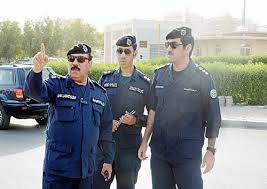
Sometimes, when you are reading a newspaper looking for content, the most significant articles can be little small ones:
Major Al-Ali vows to redraw traffic map
KUWAIT: “I have orders from higher authorities to organize the traffic and the law will be implemented strictly, Assistant Interior Ministry Under Secretary for Traffic Affairs Major General Abdelfattah Al-Ali said. “I will change the traffic map within six months and wipe out the word wasta from the traffic dictionary ,” he added. “I have strict orders from higher authorities to organize traffic and the law will be implemented very strictly,” Major Ali said.
The Kuwait Times got his title wrong; it is Major GENERAL, not Major, LOL, that’s a big difference. It appears he has the clout – and the backing – to make a brave and steadfast stand:
“WIPE OUT THE WORD WASTA FROM THE TRAFFIC DICTIONARY”
I can hardly believe my eyes. This is going to be very painful for young Kuwait men, who have learned – from prior experience – that the rules do not apply to them. IF Major General Abdulfattah Al-Ali can maintain his strong position, there may be more young Kuwait men who live to be grown-up men, there may be fewer heart-wrenching funerals, far fewer trips to the emergency room (did you know that some of the best head-trauma physicians in the world are in the ER’s in Qatar, Kuwait, and the UAE? There’s a reason for that.) The days of seeing babies on their daddy’s laps in traffic may be over. People may actually start wearing seatbelts!
Wooo HOOO on You, Major General Abdulfattah Al-Ali. You are a brave and courageous man, with a vision for a safer future for Kuwait.
11,800 Deported: Kuwait Deportations Continue “Without an End Date”
I still have a large contingent of loyal readers from Kuwait, but by early this morning, I could see something was up:
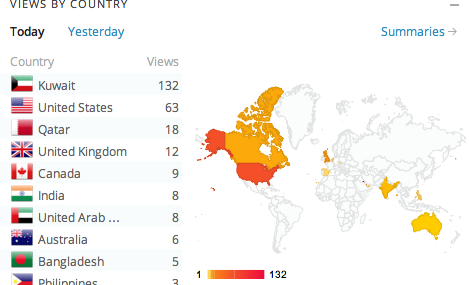
It’s not often that I have 132 Kuwait hits before noon.
So I checked the Kuwait Times:
Expat deportations will continue: Traffic chief – 11,800 deported in two-and-a-half months
KUWAIT: Major General Abdulfattah Al-Ali’s name has become synonymous with extensive traffic campaigns, aimed at enforcing the law at all costs, including implementation of mass deportations. The senior Interior Ministry official, who takes pride in deporting 11,800 people and impounding 3,000 vehicles during his tenure as head of the Ahmadi Security Department over the past two and a half years, told a local daily that deporting expatriates for serious violations will continue without an end date. “Administrative deportation of violating expatriates is not going to stop, especially of those carrying passengers illegally, in which case a person would be in violation of traffic and labor regulations,” Maj Gen Al-Ali, the Interior Ministry’s Assistant Undersecretary for Traffic Affairs, told Al-Rai on Friday.
He added that any ticket can be disputed “by a request to refer the case for traffic department investigations”. In the series of crackdowns that started late April, at least 2,000 traffic violations were registered, including 1,000 tickets issued directly on the street, while thousands of people were reportedly deported. Moreover, Maj Gen Al-Ali revealed that the ministry collected KD4 million, out of the KD24 million owed in traffic fines, during the same period. In that regard, the senior official pointed out that only KD8 million worth of fines are registered against individuals, while the rest are against companies and state departments. Out of the KD8 million, KD6 million is registered against expatriates, Maj Gen Al-Ali said. “Cases are soon to be filed with the traffic court in order to issue travel ban orders against people with more than KD80 in fines owed to the ministry,” he added.
Al-Rai published Maj Gen Al-Ali’s statement yesterday, along with a transcript of an interview with Al- Watan TV during which he defended the ongoing campaigns. “Our procedures are necessary to save lives, with average statistics indicating that 450 people are killed and 3,000 are injured annually due to traffic accidents,” he explained. During the interview, Maj Gen Al-Ali insisted that all drivers are equal when it comes to implementation of the law. “There have been doctors among the people deported, including a surgeon caught driving without a license for three years,” he said, before confirming news reports that he had taken a decision to impound a vehicle owned by Minister of Cabinet Affairs Sheikh Mohammad Al-Abdullah Al-Sabah on grounds of repeated violations committed by his personal driver. Meanwhile, the senior official urged any person who had obtained a license through illegal means to dispose of it “because once caught, they are going to be charged with forgery”. —Al-Rai, Al-Watan
Continued Efforts to Deal with Expats in Kuwait
93,000 illegals in Kuwait?
Minimum wage KD500 for Dependency Visa?
Forced retirements?
During my years in Kuwait, I saw many sorry situations. It doesn’t matter where you are on the social scale, if you are not Kuwaiti, you are expat labor. When management, for whatever reason, wants you to go, you go. People who have lived in Kuwait 50 years, who are elderly, sent home, and sent home quickly, barely time to sell what you can’t take with you, people who have had a health setback and can’t work anymore, handed their papers and told their visas will no longer be valid in 30 days.
There is no point in romanticizing your position. You’re hired help. You think you have friends, but your friends are not going to help you live out your days and die in Kuwait. When your usefulness is over, they want you gone.
We often had to get special permission to bring in professional workers for critical jobs who were over – or even approaching – 60 years old. Long-in-the-tooth is not a highly valued characteristic for imported labor.
Have an exit strategy.

The Kuwait Times title for this photo is “Illegals”
Embassies push for deportees’ rights – KD500 minimum wage proposed for dependency visa
From 30 May 2013 Kuwait Times:
KUWAIT: Two Asian embassies complained to Kuwaiti officials about the “arbitrary actions” taken during the deportation of illegal residents and lawbreakers, who were arrested in a series of crackdowns over the past few weeks across the country, a local daily reported yesterday, quoting sources with knowledge of the case.
Nearly 1,260 people of Arab and Asian nationalities have been deported since Kuwait launched crackdowns on traffic violators late last month. The General Traffic Department stated that deportation was enforced in cases of repeat offenders.
Thousands of others have been detained in simultaneous crackdowns targeting people with expired visas or those working in violation of labor regulations. But according to a report published yesterday by Al-Qabas daily, the Ministry of Interior received complaints from the embassies of India and Bangladesh, regarding the swift deportation of a large number of their nationals without them getting the opportunity to receive what they were owed from their employers.
The sources, who spoke to Al-Qabas on the condition of anonymity, said many of the deportees were sent back home through the use of travel documents released by their respective embassies, instead of their original passports that, in most cases, are kept by their sponsors. “The Indian and Bangladeshi embassies are currently taking legal recourse to secure the rights of the deported nationals, including their original passports”, the sources said.
Many expatriates arrested during the recent traffic crackdowns reportedly remain in custody, as their respective embassies refuse to grant authorities travel documents on the grounds that their visas are still valid. In that regard, the sources revealed the ministry had been trying to reach the employers in order to retrieve the passports of the soon-to-be-deported expatriates.
Meanwhile, a senior Interior Ministry official defended Kuwait’s right to deport illegal residents or foreigners who break the law. “It is the right of every country to deport expatriates who violate its residency laws or its laws in general, or take legal action against them, in order to maintain safety and security, in line with human rights principles,” Assistant Director of the ministry’s General Training Department, Brigadier General Adel Al-Saadoun, was quoted by Al-Jarida yesterday. He made these comments at a workshop on Tuesday, organized by the International Organization for Migration office in Kuwait.
In other news, Undersecretary Assistant for Citizenship and Passports Affairs, Major General Sheikh Faisal Al-Nawaf Al-Sabah, during a meeting with directors of migration departments in Kuwait, called for “tougher procedures” with regard to the issuance of visitor visas, so marginal labourers would not be able to gain access into the country.
He made the demand amid a discussion on efforts to address Kuwait’s demographic imbalance, which senior ministry officials described as “a main duty” for his department. “Maj Gen Al-Sabah told the directors that labor forces in countries having internal struggles should not be able to move to Kuwait, and that Kuwait should not become a shelter for them and their problems,” said sources quoted in an Al-Rai report yesterday.
Nationals of Syria, Iraq, Iran, Pakistan, Afghanistan, and Yemen are currently banned from obtaining visas to work in or visit Kuwait. In that regard, Maj Gen Al-Sabah said the lifting of the ban on them in the future must be coupled with controls to regulate their entrance and prevent the country’s demographic imbalance from getting worse, said the sources, who spoke to Al-Rai on the condition of anonymity.
The meeting also discussed other suggestions aimed at reducing the number of expatriate workers in Kuwait, including Maj Gen Al-Sabah’s intentions to “prepare a memorandum about the benefits of raising the minimum cap for foreigners applying for dependency visas for relatives”. Currently, such visas can be obtained as long as a supporter earns a minimum of KD250 a month, but the Undersecretary Assistant reportedly suggested during the meeting that the cap be raised to KD500.
“Maj Gen Al-Sabah questioned the capability of a man who receives KD250 a month to meet the educational, health and living requirements of a family with children,” the sources explained. They added that the senior official also plans to refer a letter to the Ministry of Social Affairs and Labor, recommending that it suspend issuing work visas to holders of commercial visit visas.
Minister of Social Affairs and Labor Thekra Al-Rashidi announced two months ago a plan to deport 100,000 foreigners every year, as part of a strategy to reduce the number of expatriates in the Gulf state by one million over a period of 10 years. Criticism sparked by the lack of details about the proposed plan prompted the minister to later clarify that the plan targeted illegal residents, whose numbers have reached 93,000, as per official statistics released last year. Kuwait is home to 2.6 million expatriates who account for 68 percent of the country’s total population of 3.8 million.
Meanwhile, minister Al-Rashidi released an order – with effect from July 1, 2013 – to terminate the services of expatriate employees who have worked for at least 30 years in the Social Affairs and Labor Ministry. According to sources familiar with the issue, the ministry has already started the process to end the services of nearly 70 foreigners by the beginning of July. The decision is in accordance with a government plan that requires forcing Kuwaitis who have held government posts for 30 years, including senior officials, into retirement. According to official statistics, published by Al-Qabas yesterday, 138 senior officials, including 11 women, will be subjected to this regulation. – Al-Qabas, Al-Jarida & Al-Rai
In a related article, measures are gaining support for withdrawing Kuwait citizenship from naturalized citizens for different reasons; below another article from the 30 May 2013 Kuwait Times Foreign spouses married to Kuwaitis watch these developments with trepidation.
MPs want citizenship revoked for breaching security – Long-time employees won’t be forced out
KUWAIT: A number of MPs yesterday proposed that Kuwaiti nationality should be withdrawn from naturalized Kuwaitis who abuse the country’s internal security or insult the country’s figures. The lawmakers also proposed that all benefits given to the naturalized person proven to have breached national security should be withdrawn and this measure should include withdrawing the citizenship of other people who gained the citizenship as a result of naturalizing that person. The proposal also suggests that people who applied for Kuwaiti citizenships and carried out similar offenses should have their applications rejected even if they fulfilled all the conditions for nationality.
To become effective, the proposal must be adopted by the concerned Assembly committees, mainly the legal and legislative and the interior and defense committees and then passed by the National Assembly and eventually accepted by the government. The proposal comes amid protests by opposition activists and former MPs and a crackdown on opposition tweeters – several of whom have received jail terms on charges of insulting the Amir. Meanwhile, MP Faisal Al-Duwaisan yesterday asked Justice Minister Sharida Al-Meosharji about implementing a law passed a few months ago to establish the Anti-Corruption Authority. Besides the corruption authority, the legislation also calls for wealth disclosure of ministers, MPs and top government officials. Duwaisan asked the minister about the steps that have been taken to implement the law and the obstacles facing it.
MP Yacoub Al-Sane said yesterday that he was informed by Prime Minister Sheikh Jaber Al-Mubarak Al- Sabah that top bureaucrats who served 30 years and above will not be forced to resign as has been published. The lawmaker said he told the premier that forcing such top officials to step down is “unconstitutional” and the prime minister replied that the government will not force them to resign but will grant them incentives and benefits to encourage them to resign. In the meantime, MP Saud Al- Huraiji questioned Finance Minister Mustafa Al-Shamali about the charges collected from expatriates for the health insurance scheme and other charges since applying the law in 1999. Huraiji said that he learned that KD522 million have been collected since that year but the ministry of finance has failed to utilize the funds in proper channels. He asked the minister if the ministry has any plan to spend the funds in the right way.
By B Izzak, Staff Writer
‘Hundreds’ deported for traffic offences
KUWAIT: Kuwait has deported hundreds of expats for traffic offences in the past month, a report said yesterday, drawing condemnation from a human rights group.
The Al-Anbaa newspaper cited a senior interior ministry official as saying that as many as 1,258 foreigners have been deported for traffic violations since a crackdown began about a month ago.
Foreign residents caught driving without a licence, using their cars to carry paying passengers, jumping a red light for a second time, or breaking the speed limit by more than 40 km per hour, can be deported without a court order. The Kuwait Society for Human Rights called on the government to halt the deportations describing them as “oppressive”. “The oppressive measure against expatriates… violates the basic principles of human rights,” it said.
The group warned that the measure could tarnish the state’s image abroad at a time when its human rights record is under scrutiny. Kuwait is home to 2.6 million expatriates who form 68 percent of the country’s 3.8 million population.
Kuwaiti nationals who commit similar offences have their vehicles seized and can be sent to court. Last month, Minister of Social Affairs and Labour Thekra Al-Rasheedi said the state plans to deport around 100,000 expatriates every year for the next decade to reduce the number of foreigners living in the Gulf state by one million. She did not say what measures she would adopt to carry out the plan.
Foreigners need to hold a university degree, earn KD 400 a month and have lived in Kuwait for at least two years to be eligible to apply for a driver’s licence, under a decision issued nearly a decade ago. —AFP
Making Idols
A confluence of events happened at a period in my life when I was paying attention, and those things coming together have influenced me enormously. The first was participation in a bible study conducted in a branch of Christianity not my own, whose dogma is occasionally repellant and repugnant to me, but whose study of the chapter in the bible is thorough. The second was my move back to the Islamic world, and my choice to study Arabic at the Qatar Center for the Presentation of Islam.
In both cases, what I learned is that we have more in common than we have differences. I also learned that if we focus on the differences, it can be devastating.
Both groups know the Bible. My Moslem sisters knew the bible better than I did, and when discussing such issues as covering hair and wearing abaya, could quote me verses from my own book which re-inforced their argument. It was mortifying – and edifying.
My Baptist friends also surprise me. For every one who rails against gay marriage or ordination of women, there was another who would laugh and quote scripture saying “did you notice the same penalty for a woman who cuts her hair? or wears pants in public?” I learned a lot about my own religion, my own beliefs, and the goodness of others by my interactions with both these groups.

One of the differences in the Moslem world was that many houses I went into (I was honored to be invited into their homes) were very plain. The furniture might be basic or elaborate, but often, the walls were bare. Maybe there might be a calligraphy with a Quranic verse on the wall – that was it. No paintings, especially no human figures – no idols, no images.
In my house, I am surrounded by images, photos, paintings, weavings – they give me joy, but I do not worship them. They are not idols, they are merely art or family – things that make me smile. I distinguish between idols and gods. Yesterday’s reading from Deuteronomy sticks with me, however, and I can hear my sweet teachers at QCPI saying to me “But doesn’t it say in Deuteronomy 4 that you are to have no idols?”
Deuteronomy 4:25-31
25 When you have had children and children’s children, and become complacent in the land, if you act corruptly by making an idol in the form of anything, thus doing what is evil in the sight of the Lord your God, and provoking him to anger, 26I call heaven and earth to witness against you today that you will soon utterly perish from the land that you are crossing the Jordan to occupy; you will not live long on it, but will be utterly destroyed.
27The Lord will scatter you among the peoples; only a few of you will be left among the nations where the Lord will lead you. 28There you will serve other gods made by human hands, objects of wood and stone that neither see, nor hear, nor eat, nor smell. 29From there you will seek the Lord your God, and you will find him if you search after him with all your heart and soul. 30In your distress, when all these things have happened to you in time to come, you will return to the Lord your God and heed him. 31Because the Lord your God is a merciful God, he will neither abandon you nor destroy you; he will not forget the covenant with your ancestors that he swore to them.
The Little Blue Pill
I’m not a person who feels a lot of pain. I hardly ever get a headache, rarely get even a paper cut. At one point in my life, when my biliary duct blocked, the doctor gave me pictures and looked at me sternly and said “You could have died, politely waiting out there in the waiting room. When this happens, come in immediately, show the ER people these photos and tell them you need this blockage cleared immediately.”
That one really did hurt, but I’m not much for groaning and writhing in pain, so I didn’t.
Today was a confluence of events. Yesterday, when the air conditioning people were at our house, all day, configuring and installing the new air conditioning system, the terrified and disoriented Qatari Cat spent the day in the large laundry room, with his cat bed and his food and water, and his litter box. It was a long day, and he was alone, and he could hear loud bumps and thuds, and he could smell strange smells, and hear strange voices. Therefore, when let out, he needed to snuggle, closely, to the one he thinks is his mother, i.e. me.
He curled into my arm and purred and cried about his long day and how scared he had been. He was still snuggling, closer and closer, during the night, as I was trying to sleep. He is a good sleeper, doesn’t move around a lot, but when he is snuggled up against me, it is hard to move. Now and then he will snore, or go into kitty-dream state, legs thrumming along and sub-vocal snarling, which can wake me.
Our normal water aerobics instructor was out, and the substitute was wonderful, but we did more repetitions of high kicks, jacks-crunches, and more high kicks; it was a great workout, different from what we are used to.
We really needed to clean our floors after the air conditioning crew, so AdventureMan took all the carpets outside for a good vacuum front and back while I tackled the tile floors throughout the main level of the house. Some of the grime was ground in, this wasn’t one of those quick swish washes but a lot of stoop and scrape, or hands and knees and scrub kind of jobs. While down close, I also noticed the base boards needed a swab, more bending and stooping.
I still had one appointment to go before I could kick back, and while waiting, I noticed my back was a little uncomfortable. By a little uncomfortable, I mean it had my attention, I couldn’t get comfortable. By the time I got home, it had my undivided attention. I know what works for me, back when I had a reaction to a root canal, I discovered Aleve, so I had some on hand.

When I went to take one, I saw this great big capsule. I remembered tiny little blue tablets, sort of ovoid, but I guess I had just grabbed whatever I saw and it happened to be a capsule. Swallowed the capsule.

There is a reason I don’t like taking medicines, and that reason is that because I don’t take a lot of medications, when I do, I can tell. It takes the edge off. I feel slow. I feel a little loopy. I feel tired. And then, by the grace of God, in an hour or so, I feel no pain in my back.
It wasn’t a bad day, just a day with some unexpected conditions. Scrubbing floors is not my favorite thing. In Kuwait and in Doha I had wonderful women who kept my floors sand-free, and sparkling clean. As I clean my floors, I found myself remembering them fondly.
AdventureMan popped his head in the door to tell me how much he likes vacuuming the carpets outdoors, where he can see the intricacies of the patterns. He can see I am grumpy. “I don’t really like cleaning floors!” I grump.
“Let’s hire someone to do it for us!” he responds, and my day suddenly looks a lot brighter. 🙂
Miracle Birth in Kuwait
Found the following on AOL News / What to Expect:
Clinically Dead Woman Is Revived After C-Section Birth

A pregnant woman in her ninth month was admitted to a hospital in Kuwait with an acute blood pressure condition, suffered cardiac arrest, and was pronounced dead. Doctors rushed to deliver her unborn child. The cesarean section was performed without anesthesia since the mother was presumed dead, and a healthy 6.8 lb baby boy was delivered. Then with one last attempt to revive the 36-year-old Filipina woman, doctors were astonished when she started breathing again.
“This is a scientific miracle at all levels,” hospital manager Dr. Hmoud Al-Zobi told theKuwait Times. Three days later the 36-year-old Filipina (or Pinay) woman named Zuraida remains unconscious at Al-Farwaniya Hospital, but doctors say she is in stable condition and are hopeful that she will return to health.
Zuraida’s husband, Verdadero, remains by her side. “When I visited her today, tears were rolling down her eyes. I felt she could hear me, she could feel my presence and was trying her best to communicate. ”
Said Verdadero, “I brought her to the hospital because she experienced blood and the water discharged at that time. Of course, I knew that she was already in pain and it was about time for her to deliver our second child. I was very happy. But my happiness changed to uncertainty when I heard that she was vomiting blood and was in danger and only a miracle could save her. I prayed hard for her to survive.”
Verdadero is a truck driver who is often away for days in Iraq and elsewhere. He feels lucky that he happened to be in Kuwait when his wife was ready to deliver their baby. “At least I was with her when it all happened and I really pray that she will be okay.”
During pregnancy, it is recommended that women and their doctors keep a close eye onblood pressure. There are many reasons for occasional spikes in blood pressure and most are nothing to worry about (in fact, worry only contributes to elevated levels). But chronic high blood pressure during pregnancy is something that should be monitored and treated to ensure that mother and baby are as healthy as can be.
Recent Comments
intlxpatr on Shampoo Ginger tigerbutterya0c5ff1d… on Shampoo Ginger intlxpatr on British Soldier Kidnapped, Esc… John on British Soldier Kidnapped, Esc… intlxpatr on British Soldier Kidnapped, Esc… Wikipedia Donate Button

Amazina


Early Voting in Florida


