Today in Kuwait
Oh! I am green with envy! I would love to be at these events!

Imagine what the release of falcons is going to look like!
Star Wars Paradise
One of my bible study friends and I were talking about our study, and she asked me “What is it they are saying when all the people drop everything and go pray in those countries?”
The expat dilemma – most people don’t want too much explanation. And you never know who is a rabid anti-Islamist, and I don’t want to argue. But this time I took a chance.
“They are saying different things depending on the time of day, like first thing in the early morning they say ‘come pray! come pray! It is better to pray than to sleep!’ and then they say ‘God is Great! God is Great! I testify that there is only one God, and Mohammed is his prophet.'”
I sort of held my breath, as she thought about this, and then she said “Well, I guess that’s all right.”
Then she asked me if I ever thought about heaven. I told her about our churches in Qatar and Kuwait. I especially miss them at this time of the year. I told her I thought Paradise would look like our churches there, all peoples from all parts of the globe. I told her how on Christmas, all the Indian women wore their most beautiful saris, and the African women wore their dresses and fancy headpieces, and we westerners wore our nicest winter clothes, and we all worshipped together in peace, and to me, that was just a tiny slice of what I think paradise will look like.
My friend is fourth generation Pensacolian, and has never travelled. She proceeded to blow me away.
“Did you ever see Star Wars?” she asked me. I nodded. “Do you remember the bar scene?” I nodded again. Who could forget? But where is this discussion going?
“When we think of heaven, we think of what we know, but there is so much out there we don’t know, and God is creator of all the universe.” she said. “We can’t limit God to what we know; he is so much more! I think it’s going to be like that bar in Star Wars, that we will be with creatures we cannot even imagine, and that we can have celestial homes wherever we want, like a cabin in Alaska, or a hut beside the Ganges or maybe we can be here for a few thousand years and then on another planet, whatever we want.”

Her vision is huge. It took my breath away. The more she talked, the more blown away I became. I was shocked at my own smallness, my lack of imagination, and thrilled with her vision and the possibilities. She’s right, you know. We can’t begin to imagine what our heavenly home will look like, but her idea gave me food for speculation for months – maybe years – to come.
US Embassy Warden Message for Kuwait
Kuwait City, Kuwait
December 16, 2010
MEMORANDUM
To: All American Wardens
From: Consular Section
Subject: Warden Notice 2010 – 1
Please circulate the following message without additions or omissions
immediately to all American citizens within your area of responsibility.
Thursday, December 16, 2010, is Ashoura and marks the end of the 10 days of
ritual mourning observed by most Shi’a Muslims. Observances in Kuwait are
generally peaceful although the mourning rituals can be emotional and public.
As a security precaution, we recommend that U.S. citizens avoid areas where
there are public gatherings and crowds observing Ashoura. In particular, the
following neighborhoods have concentrations of Shi’a mosques and gathering halls
where crowds may congregate:
Bneid Al-Qar
Mansouriya
Al-Daeya
Al-Dasma
Rumaithiya
Maidan Hawali
A standard good security practice is to avoid any large gatherings or crowds.
Even demonstrations that are meant to be peaceful can become violent and
unpredictable. You should avoid them if at all possible. Be alert and aware of
your surroundings and pay attention to local news media.
It is illegal in Kuwait for foreigners to participate in demonstrations. If you
take part in one, you may be arrested.
You can stay in touch and get Embassy updates by checking the Embassy website,
found here at U.S. Embassy Kuwait , and by enrolling in the State Department’s
Smart Traveler Enrollment Program (STEP). You can also get global upates at the
U.S. Department of State’s, Bureau of Consular Affairs website where you can
find the current Worldwide Caution, Travel Warnings, Travel Alerts, and Country
Specific Information. If you don’t have internet access, we have a call center
for updates–1-888-407-4747 toll-free in the United States and Canada, or
outside the United States and Canada on a regular toll line at 1-202-501-4444.
The American Citizens Services Unit is located in the Consular Section of the
American Embassy in Bayan, Block 6, on Masjed Al-Aqsa Street.
Telephone: [965] 2259-1001 or 2259-1002
Emergency after-hours telephone: [965] 2538-2097
Facsimile: [965] 2259-1438 or 2538-0282
The U.S. Embassy is open Sunday through Thursday, except U.S. federal and most
local holidays.
Ancient Civilizations Hidden in The Persian Gulf?
I found this first thing this morning on AOL Science News
Theory Points to Civilization Under Persian Gulf
Hugh Collins
Contributor

(Dec. 11) — The waters of the Persian Gulf may be hiding a lost civilization that could change our understanding of human history, according to new research.
This huge fertile stretch of land may have been home to humans from about 74,000 years ago until about 8,000 years ago, according to Discovery News.
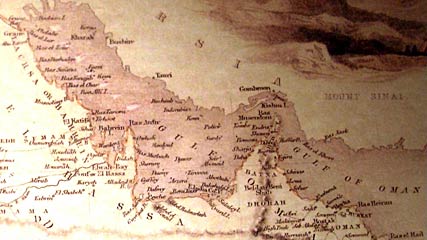
When the waters around them began to rise, these early humans may have migrated to what is now the gulf shoreline, founding new settlements there, according to a paper published in the December issue of Current Anthropology.
Wikipedia
New research suggests the waters of the Persian Gulf, depicted here in an historical map of the region, may be hiding a lost civilization that could change our understanding of human history.
Over the past several years, archaeologists have uncovered new evidence of those shoreline settlements.
“Where before there had been but a handful of scattered hunting camps, suddenly, over 60 new archaeological sites appear virtually overnight,” Jeffrey Rose of the University of Birmingham said, according to LiveScience.
“These settlements boast well-built, permanent stone houses, long-distance trade networks, elaborately decorated pottery, domesticated animals, and even evidence for one of the oldest boats in the world,” Rose said.
Rose says such sophisticated settlements couldn’t have developed so quickly, which is why he believes even older settlements lie beneath gulf waters. If true, Rose’s hypothesis could offer a clue as to how and when human beings first departed Africa and settled in the Middle East.
This has long been a topic for debate, with some scientists saying that humans made the migration 125,000 years ago, while others put it closer to 60,000 years ago, LiveScience said.
The now-submerged slice of land would have been about the size of Great Britain, Rose said.
Since it would have received water from the rivers Tigris, Euphrates, Karun and Wadi Baton, it would have offered a fertile refuge from the nearby harsh deserts.
“I think Jeff’s theory is bold and imaginative, and hopefully will shake things up,” Oxford Brookes University’s Robert Carter told LiveScience.
“It would completely rewrite our understanding of the out-of-Africa migration. It is far from proven, but Jeff and others will be developing research programs to test the theory,” Carter said.
Rose admits that much work remains be done. So far, he has focused on archaeological sites on dry land and studies of geological history.
Finding some physical evidence beneath the waves of the ocean would be a major advance in proving that his theory is correct.
“We would need to find a submerged site, and excavate it underwater,” Rose said, according to LiveScience. “This would likely only happen as the culmination of years of survey in carefully selected areas.”
The waters of the Persian Gulf rose 8,000 years ago, perhaps because of the collapse of a huge glacial dam in Canada, according to Postmedia News.
This event caused water levels to rise across the world. This catastrophic event may have forced humans out of the Gulf basin and given rise to ancient stories such as that of Noah’s Ark.
“Certainly, I think there is compelling evidence to suggest that both the flood and Eden myths may be rooted in these events around the Gulf basin,” Rose said, according to Discovery News.
Amer Al Hilal on Kuwait’s Ban on DSLR Cameras
Woooooo Hooooo Amer Al-Hilal, a man I am proud to call my friend. It takes such great courage to speak out when something is going terribly wrong, and Amer knows how to do it articulately, rationally, and as the gentleman he is.
From his article in the Arab Times:
Camera ban regressive idea
‘Don’t stifle home-grown talent’
For a country that possesses a Constitution which safeguards civil liberties and freedom of speech, Kuwait sporadically sure likes toying with those liberties such as tentatively banning the Blackberry service, shutting down You Tube, impeding public gatherings and marches, banning and censoring books, literature, films and magazines which are available elsewhere in the Gulf.
This week according to media reports, and highlighted extensively in local Weblogs and Twitter, a palpable growing outcry is directed at the tentative plans by The Ministry of Information, Ministry of Social Affairs and Ministry of Finance to outlaw public photography and relegate it to journalism purposes only. This has allegedly resulted in the ban of Digital Single Lens Reflex Cameras (DSLRs) in public places. If this charade is true, then it bodes ill for this country, another regressive move into the annals of ignorance.
During the 1980s video cameras and photographic equipment were also shunned by the authorities. I remember visiting Failaka in 1985 and being confronted by a military officer who demanded I hand in my bulky video camera until I left the island. These types of infringements in the name of security were insignificant — we still had an attempt on HH the Amir, explosions at Foreign Embassies in Kuwait and an actual invasion.
Why does this country always attempt to stifle home-grown talent? Banning cameras in public places is demoralizing to all the passionate, talented young Kuwait men and women who have excelled in this field and love their hobby, not to mention visitors who attempt to document their travels here. Moreover, banning DSLR cameras is irrational and counterproductive if you think about it; in this day and age of iPhones, Blackberries, 5 MP plus camera phones, Google Earth and the like, anyone can take photograph of anything, quietly, without fanfare, which makes the potential DSLR ban even more preposterous.
I have just returned from a trip to Dubai where I witnessed dozens of tourists proudly using their cameras to document Burg Khalifa and the other picturesque locations. No one stopped them, impeded them or asked them what they were doing and you know why, because they respect people’s rights and are intent on making their country more appealing. UAE is able to manage security matters confidently because they have proper security and ID processes in place: eye scanners at airports and entry points, proper electronic government, high fines for breaking the law, a brilliant CCTV system in place in every street corner (not the shoddy black and white choppy, streaming-like quality of the limited equipment we have here) — they truly invest in their infrastructure, maintain it and upgrade it.
If Kuwait is serious about its security then it should invest in the same caliber of CCTV and not the bargain basement tenders that usually go towards ineffective systems (i.e. Highway signs with the useless ‘no mobile’ plasma screen) belonging to members of the matching ministry who want a ‘piece of the action’. The sad reality is the government sector here would rather ban something than actually strive to improve it through sheer hard work and effective processes. It’s just easier to ban; a question of laziness and neglect.
Needless to say, Kuwait seems unfazed when foreign jets infiltrate our airspace and take aerial shots of our oil refineries and military installations, or when agents and their local conspirators are found to possess blueprints and photographs of said installations, but no, lets go after the ‘little guy’, the amateur photographer or tourist on the street taking pictures. It’s a hypocritical, spineless action by the authorities.
Moreover, I suspect the issue is not just relegated to security, a myriad of reasons could have led to the support of this ban, fundamentalists who felt cameras and pictures are a ‘Tool of the Devil,’ government officials and ministries disgraced at seeing shots of Kuwait’s dilapidated infrastructure, environment and mismanagement on weblogs, internet forums and magazines. You cannot conceal the squalid side of Kuwait; it is there for everyone to see.
Furthermore, this law against public photography will not be enforced, just as seatbelt, no mobile while driving, no litter, no smoking areas, and other ‘laws’ cannot be enforced in this Land of Confusion.
Amer Al-Hilal is webmaster of http://www.hilaliya.com and can be reached at amer@hilaliya.com.
Kuwait Ministries Ban Photography?
I am in total shock.
Thank you, Bit Jockey, for sending this to me, an article from the Kuwait Times.
We had so much fun! We had photo challenges, Kuwait sunsets, National Day Celebration photos, so much fun. And now, you can get arrested for taking photos? Not of military or political or sensitive buildings, not for reasons of national security, but . . . just because?

Most photographers in Kuwait are careful not to photograph women, or any citizens without their permission. Why on earth was this ban created?
How on earth will they enforce it? What are the penalties?
KUWAIT: After the ban three ministries placed on photography, most Kuwaiti youth are a bit confused about what to do with their cameras if they can’t use them in public and why such laws were implemented in the first place. The Ministry of Information, Ministry of Social Affairs and Ministry of Finance recently came to the conclusion that photography should be used for journalism purposes only. This has resulted in the ban of Digital Single Lens Reflex Cameras (DSLRs) in public, on the streets and in malls
.
What most Kuwaiti photographers have come to wonder is how such a decision could be reached by authorities, especially considering that digital cameras and cell phone cameras have the same abilities. What most people think of photography as a hobby has become a bit misguided due to the fact that the country has so little exposure to art. While using a DSLR, passersby may wonder if the camera is being used for the wrong reasons.
Mohammed Al-Eisa, who picked up photography as a hobby more than 10 years ago, said that he has decided to take photos of animals or still life due to the fact that these subjects don’t mind having their picture taken and don’t make a scene. “I started facing problems the very first day I bought my camera,” Mohammed added.
What often happens is that a big black camera tends to worry people. Taking a picture of a stranger would seem like much less of an issue if you were using a more discreet camera or even a cell phone. Mariam Al-Fodiry said that she has faced similar problems with her hobby and that being a girl doesn’t help at all. She said that in some cases it makes the problem even worse. “Switching to abstract and landscape photography was one the options I considered after getting into enough trouble,” Mariam said.
Majed Al-Saqer said that sometimes people stop him while he is in his car with his camera, as if he were planning to kill someone with it. He said that he isn’t sure what the real problem is, whether it is people taking photos of each other or the size of the camera.
Gulf Coast Citizen Diplomacy Council
I have a friend from church; she is a woman I admire greatly. Older than I am, though not much, she participates in the Spartacus Program at the “Y”, she is good at running things, she is good at making phone calls and even sounds like she enjoys them, she enjoys social life and she sparkles.
She is always thinking.
“I think I know just the group for you!” she exclaimed as we were working on a project. “Have you heard about the Gulf Coast Citizen Diplomacy Council?”
No, no, I hadn’t heard about that. Having lived here six months now, there is a lot I don’t know.
She told me all about it and she was right. It is right up my alley. The Gulf Coast Citizen Diplomacy Council greets foreign visitors and performs a variety of services, escorting them to appointments, showing them the area, even taking them shopping or inviting them for a dinner in your private home, all in the name of hospitality and showing the best side of this beautiful part of the United States.
The Gulf Coast Citizen Diplomacy Council is a non-partisan, non-profit organization whose mission is to create and encourage collaboration between like-minded community stakeholders who value sharing the Central Gulf Coast with the rest of the world by:
° Facilitating professional and personal interaction for international leaders during official visits to the Central Gulf Coast
° Enhancing respect and communication through international exchanges and alliances
Forging cultural, educational, and business relationships with the global community through citizen diplomacy
° Promoting greater understanding of global affairs in our community through a balance of public events, educational activities, and the International Visitor Leadership Program
° Promoting the Central Gulf Coast as an important center of commerce, culture, and tourism
How cool is that? Even AdventureMan is excited about joining this club; we are so grateful for all the wonderful hospitality shown us through many years of adventures abroad. We feel grateful for an opportunity to be hosts in turn.
In this club I am not so alien. The club members are people who have a broad world view. I met other people who have lived or visited in Qatar or Kuwait, and other parts of the world where I have never been. Oh, what fun.
Many of the members are former military, and I found myself listening to a discussion of an upcoming meeting. As this is a community that parties hearty during Mardi Gras, I assumed it must be the name of a Krewe, a Mardi Gras social club, all these high-testosterone men were discussing camellias, must be a code word for some secret society, right?
Wrong. As it turns out, many people here, men and women, are passionate about gardening, and there is a club devoted to turning out perfect camellias, and they are having a show coming up in December. I learn new things ever day. 🙂
The Gulf Coast Citizen Diplomacy Council was only founded a short couple years ago, and has already won awards for its programs and hospitality. A truly impressive group. 🙂
Tabbouli Dance (Thank You, Daggero)
I’m in my office trying to write a blog entry and AdventureMan is next door, and it’s been a long time since I have heard him laugh so hard. He is laughing and Holy Smokes, he is almost dying laughing, and it’s all Daggero’s fault, my friend Daggero, my mysterious friend who has commented for so many years now on my blog that I think of him like a brother, although none of us have ever met.
Here is what was making him laugh so hard. Once I started watching, I was laughing, too. It is a total hoot, not just the song but all the fun they had making this, and the utter decorum with which he ‘shakes his booty,’ LLLLOOOOOOLLLLLL!
Notice also, his home has some very nice art pieces. 🙂
When Bureaucracies Function Well
This week AdventureMan and I explored something new in our lives – Early Voting. We had heard about it from our friends. It’s not like absentee voting, where you are mailed a ballot and you mail it back in after you have filled in your votes. With early voting, you can actually go to a voting place and vote.

We went after lunch, and we didn’t know where it was, but once we got near, we started seeing signs. Great signage.
When we entered the door, there was a lady there to tell us where to go – and more signs, too.
When we got to the right floor, there were signs with arrows and “Vote Here” on them.
When we got to the voting office, there were lots of people to help us get our ballot. When I messed up my first ballot (I hadn’t read an amendment carefully), they quickly did all the necessary paperwork and got me voting again. The second time, the machine accepted my ballot. 🙂
All in all, a fabulous experience. And – they gave me a sticker! We were so impressed with the careful attention to detail that had gone into getting us to the right place and getting our vote accomplished.
Later in the week, I had a mammogram. Being new, I am not in the system, so I have to go through admitting procedures every time I go to a new doctor or a new institution. At the West Florida Hospital, as soon as I got to the right room, I could see a sign telling me where to wait my turn. The receptionist was welcoming AND efficient. There were a lot of people waiting, and one by one we were taken in to have our paperwork done. No need for a pen; you sign on a machine, like you do for credit card purchases in many stores. Then you sit in a small hallway until someone calls your name and you become a human train as a guide leads you to your stop. That part was half hilarious and half annoying. If I knew where it was, I might have gotten there faster on my own, but . . . I didn’t know where it was. As far as systems go – it worked. It kept people orderly. It got a lot of people in and out efficiently, and fairly. No one can break into the lines, claiming to be more important. I am guessing if there is a patient whose malady is serious enough to take precedence, they have procedures they can follow separate from the normal intake procedures.
I have to stop and admire when bureaucracies function as intended, to help us more efficiently accomplish our business. It is when they become a stomping ground for nepotism and inefficiency that they earn my ire.
When I arrived in Qatar, my bank had a Women’s branch which was convenient for me and I loved going there. I was often the only customer, and the women taking care of me were always charming, helpful and friendly. When the same bank broke into another section and became an Islamic bank, instead of a normal bank working with Islamic customs, I was no longer able to use the women’s bank, but I’ve always remembered their personal customer service.
On the other hand, banking in Qatar could be totally tortuous, if you had to use the normal bank where Mr. Important would walk right in front of you as if you didn’t exist, or certainly, as if you were far less important than he was. In Kuwait, at my bank branch, you took a number, and it appeared to me that most of the time the number system was honored, unless it was a personal friend, LOL. Personal friends, or friends of the family, or a friend of a friend of the family always get to go first.
I suspect there are similar exceptions in Pensacola, but less transparent. Mr. Important has his own banker he can go to without waiting, probably in a private office, and it is invisible to the rest of us. Ms. Important, on the other hand, probably has to wait in the waiting room with the rest of us for her mammogram.
Recent Comments
ExpatAlien on What Country am I Living … intlxpatr on Yellowstone: Old Faithful to C… Michelle on Yellowstone: Old Faithful to C… Cathy on No Grown-Ups in Charge intlxpatr on Waiting for Snow Wikipedia Donate Button

Amazina


Early Voting in Florida


 Here There and Everywhere