Amazing Day
Yesterday turned out to be one of those days that surprise you. I didn’t have a lot of hope for the day, I started off feeling negative and thinking about cancelling appointments. My head has been a little stuffy, I have a mild cough, altogether, I am not in peak form.
I decided to keep my appointments, which required preparation, and the prep turned out better than I had expected. In fact, the entire day was full of unexpected blessings.
First – I know not all of Kuwait experienced it, but the storm! Lightning! Rain! Rain in late late April! Whoda thunk?
Then, the light – drama drama drama – dark dark clouds, but sunlight on the white-capped water, bringing out all the shades from turquoise through jade and lapiz into deep purple – oh, what joy! Last but not least, the wonderful breeze that kept everything from being hot and sticky – what a day! What I might have missed!

Rola Dashti Tackles Sensitive Issues
“Why are you looking so sad?” AdventureMan asked me as we sat down to dinner.
(Sigh) “There are people in Kuwait who don’t believe change is possible, and there is a movement afoot to WITHHOLD their votes as a protest.”
“Why do you care? It’s not your country?”
We call it “falling on your sword,” when a person does something fatal to self, to career, to family or to country, choosing an issue and staking everything on it. Rarely does it pay. The world moves on, life goes on and you are left behind bleeding on your sword.
Withholding your vote gives more power to those who are good at stirring up the rabble with irrational and selfish issues. Those who get the votes are those who make grandiose – and general – promises, those who refuse to be held accountable.
If you are a person who cares deeply about Kuwait – Please, do not withhold your vote. Do the hard work of listening to the candidates, and exploring their reputations for truthfulness and accountability. Think beyond your own needs, think of the greater good of Kuwait.
This is from today’s Al Watan; a candidate tackling some very sensitive issues, bringing them out in the open.
Ghenwah Jabouri
Staff Writer Al Watan
KUWAIT: In pursuit of winning enough ballots to secure a seat in the National Assembly, Dr. Rola Dashti, who is believed to be a potential woman candidate, delivered an emotive speech Monday evening to announce her parliamentary agenda if elected.
Dashti touched on sensitive and delicate issues which aroused the emotions of the audience, resulting in heated engagements later on in the evening.
Dashti mainly focused on family related issues, germane to women issues.
In an attempt to recoup the cynicism manifested by citizens toward parliament, Dashti urged the audience to not ponder on who is wrong or right.
“We need to move on; seeking to blame parliament, government, MPs, etc., is not going to serve us justice. We need to focus on developing Kuwait, rather then pointing our fingers at the wrongdoers, ” Dashti said.
She stressed that whether it was the parliament, the government, or the citizenship who committed the mistakes is not important; “what is important is that we learn from such mistakes.
“Individuals who have the cultural habituate of blaming, attacking and are cynical, do not want to move toward the future; rather, they want to travel back in time. Allow me to give you an example: last year, thirty percent of citizens in my constituency did not cast their ballot. These people are like you and me: their heart is burning for Kuwait, and they observed nothing positive, and they are in immense suffering.
“They gave up on hope and decided to ultimately not vote. Had half of them voted (nine thousand), ten people who would have succeeded in the Third Constituency elections would have determined a better fate for those that abstained from voting.” She further lamented that society should consider first and foremost Kuwait, and that the children, the youth and coming generations “deserve this.”
Dashti, further illustrating her point, noted: “For example, if soـandـsoـperson does not vote, who is going to protect their rights and so forth?”
Dashti stressed that Kuwait is experiencing “tumultuous times” and that the country is on the verge of a major collapse.
“Kuwait cannot afford political arguments and political confrontations and commotions. It is in our hands to save Kuwait. If we take responsibility, vote and call on those who did not vote to cast their ballot, change might have a chance of survival.
“Hundreds of people did not cast their votes because they lost their confidence in parliament. However, many families are suffering, and so, it is pivotal to acquire each and every vote; we need to give back what Kuwait bestowed us with.
“We need to give a little back to those who lost their lives to protect Kuwait during the Iraqi invasion in 1990; many people lost their lives during the invasion who fought for our liberty. Women were raped and families were torn apart. We need to give back a little, we need to continue to believe, and fight for our children and future generations,” Dashti added.
“Does Kuwait not deserve for us to stand in the cue for fifteen minutes to cast our votes?”
Talking more about women”s issues, Dashti noted that there are many things that need to be considered where women’s issues are concerned.
“Women have many burdens that they shoulder; the divorced, the widowed, the one who is married to an expatriate, and housing for women, all are issues the Kuwaiti woman suffers from.”
She pointed out that not every family is living happily, “although this is something I would love to achieve.
“Today, the Kuwaiti family has to wait fifteen years for (government) housing. Where will the divorced woman go during this lengthy period?
“This woman could be my sister, my mother, or our daughter; where does she go?”
Dashti noted that the law stipulates that a woman who is over forty years of age and both of whose father and mother are deceased and is unassisted by a guardian “is entitled to receive a housing allowance.”
“However,” Dashti said challenging the law, “what about other women in a somewhat parallel situation where the father is deceased but is not receiving allowance from her guardian ـ what can she do? Shall the woman take her guardian to court to sue him?
“Why does the law in pursuit of helping women insist on punishing them, even insulting her?
“This law is one of many that are flawed and need to be amended,” Dashti stressed.
She further said that “neither Kuwait or the people of Kuwait can tolerate empty words and useless slogans. Today we need to put many things on the table and take action in tackling them.
“Let”s now have a look at the children of some Kuwaiti women who are married to expatriates: we need to look at their educational, health, and employment and social needs and treat them with justice, like other children are treated who have Kuwaiti fathers.
“This is their country, why are we abusing them? These are our cousins, our brothers and sisters, and have to be treated with equality when their mother is a citizen of the country.”
She further added that citizens have been “fooled” enough; “vote for someone who knows what they can do, someone who can save us from the financial burden.” Touching on an issue that has become central in campaigns, Dashti noted, “We should not allow people who do not understand finance to tamper with the budget.
“Nor should we allow individuals who are responsible in dealing with the financial budget to use the financial budget for personal gains.”
“Why should we follow those who damage our financial budget, and steal the money of the public? There is another option: choose someone who will protect the public financial budget and enhance the budget!”
Dashti further stated that there is an “internal bleeding” in the country and that she is not going to offer an “aspirin to silence your pain to only kill you” as a member of parliament.
“I will opt for a long term alternative and choose to cure you.”
During the question and answer session following her address, particularly passionate but enraged voices emerged, where some expressed their frustration with the old faces of parliament.
One woman said she was “fed up with the old faces and that it is about time new faces took over.”
She further said, “We have been deceived, fooled and cheated by the old MPs,” and stressed, “We are suffering and are in desperate need of MPs who will promote social and financial justice.
“Kuwait has hit a plateau and something”s got to give,” she noted.
Another woman made a remark about Dashti”s strong foreign accent.
She noted: “Society often criticizes you (Dashti) for speaking in a Lebanese accent.
“I don”t understand why you come under scrutiny for such a reason. After all, people have television at home and typically watch the satellite channels, all of which speak in foreign accents.”
The woman”s comment was understood to be a positive comment, where she welcomed Dashti”s candidacy and believes that the candidate will be a forceful vehicle towards righteous deeds toward society.
Another frustrated woman spoke about property and about people whose houses was taken from them by the banks. She said that she read an article in Al Watan newspaper that there are many withdrawn properties and houses for sale.
“The inheritors are crying blood and are traumatic, because their houses are being taken from them. Other citizens are staying in small apartments after they used to occupy villas,” she said.
Another woman who was virtually in tears pled to the people “to opt for change and choose new faces, even if the new members of parliament will do nothing.
“The former parliament has tormented and killed me; please, give your votes to new faces, in the name of God, please, vote for change.”
Shimmering Sunrise
It’s not yet eight in the morning, and the temperature is almost 90°F / 32°C . . . this is the beginning of hot hot hot:

There was a group of fishermen in the water this morning, just before sunrise, using old fashioned nets; the water must be very warm now. The sun had to battle a thick layer of low lying clouds, and won the battle.

I don’t know if it shows up in this photo at all, but to the left, there is a bright spot with just a tiny slice of rainbow peeking through. 🙂 A good omen! Have a great day, Kuwait.
Forecast: Hot and Crabby
It isn’t my fault. I was born in the cold winter months in Alaska, and to this day, I thrive in cooler weather. When October comes to Kuwait and I can feel an occasional cool breeze on my face, I am in heaven for the next six months. When the rains come, I dance for joy.
So, alternatively, when I open the door to take a photo of the sunrise from my balcony, and it is as warm outside as it is inside, my heart sinks.
The sunrise this morning was awesome – lights and darks and sparkles all over the place:

What is not to love?
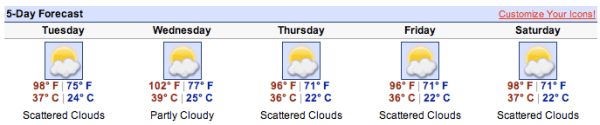
I’m trying not to be grumpy. I’m trying to think cool thoughts, and to be cool-headed. Keep me in your prayers, please, for sweetness of spirit, and for peace of spirit, and for super organizational skills.
Sunrise 26 April 2009
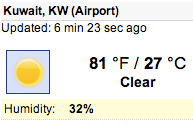
Last night, out for dinner, the air was not cool and refreshing. It was warm. The outdoor seating was thronged; for many, the temperatures are wonderful; for me, it is a little stale. Just the night before, we were outside and it was wonderful, still a tiny cool breeze now and then. Overnight, you can feel the inevitable approach of the scorching summer. It’s coming. It’s almost here.
Sunrise this morning was silvery. There are some fleecy little clouds up in the sky, but no, it doesn’t look like rain, only a little tease.

At 0700, it is already hot.
The pace is picking up, lists of things to do growing instead of shrinking . . . the pressure is on.
Amer al-Hilal on Global Voices
Kuwait Community blogger Amer Al-Hilal has accepted the invitation to be one of the Kuwait desk editors at Global Voices, an aggregator followed by many who want to keep up with the blogging scene all over the world. An active and passionate blogging community member himself, Amer will be trolling the Kuwait blogs for interesting bits to compile.
Amer is a former Kuwait diplomat and a frequent columnist in the Arab Times. He has his own business – and a family – and still makes time to keep the blogging scene relevant and engaging. Alf Mabruk (a thousand congratulations!) on your selection, Amer, and many many thanks for accepting the responsibilitiies of promoting the Kuwait blogging community. 🙂
Sunrise on the Sparkling Water
I broke my own rules this morning. The Qatteri Cat started walking around and saying “Miooooow” around first-call-to-prayer time, and AdventureMan, who has a sweet soft heart sometimes gets up to feed him.
“If you get up to feed him,” I scold in my mean-mommy voice, “he learns that if he comes mioooowing at oh-dark-thirty that someone is going to get up and feed him! You have to ignore him!”
AdventureMan just looks at me sadly, that I could be so mean and cruel. He is a lucky man; he can get up, feed the cat and get back to sleep in like zero seconds flat. Once I am awake, I am awake.
So this morning, I ignored QC two or three times as he came in and said he was hungry, and then, around five, I took pity on him and got up to check his bowl, which was empty to the last grain of cat food. (Have you ever noticed how FOUL cat food smells??)
And since I was up anyway, I went to get a cup of coffee and saw – oh, I could see all the way to the horizon! Not a speck of dust, not a speck of haze! And the sun is coming up and there is a sparkle all across the Gulf!

I couldn’t resist the sparkle on the water:

So the Qatteri Cat gets a few extra snuggles today for getting me up to see this wonderful sunrise. It is a sweet morning, and I hope you have a wonderful day. 🙂
Warden Notice 2009-5
In the coming days, expect to see political rallies occurring in the evening hours at locations around Kuwait. The rallies are typically peaceful events, but vehicle and pedestrian traffic in and around these venues will be highly congested. Consequently, it would be wise to avoid these areas and never attempt to enter or push through a crowd.
Residents and visitors should expect to see an increase in Ministry of Interior law enforcement operations aimed at ensuring the integrity of the political process. These operations will likely entail the use of helicopters to monitor parts of the city. However, the most visible manifestation of this police presence will likely be an increase in traffic checkpoints. Americans are reminded to cooperate with police and carry their Kuwait Civil Identification or U.S. passport with the visa sheet at all times while in Kuwait.
Kuwait Parliament is Male Territory?
Ghenwah Jabouri
Staff Writer (from today’s Al Watan: you can read the entire article by clicking here)
KUWAIT: Citizens have dynamically noted that they are cynical about women becoming Members of Parliament, stressing that “Parliament is territorial to the male candidate.” Moreover, various opinions state that women are far from ready to steer Kuwait to higher places. However, will the next Parliament, witness women figures finally taking the oath, in spite of the fact that people still do not trust women? After all, the National Assembly in Kuwait, has been male dominant since its establishment in 1962, and has always been subject to scrutiny, enquiry and has been dissolved several times constitutionally and unconstitutionally. Moreover, the rage, bickering and lack of communication between members of Parliament and government officials is becoming more and more frequent, ultimately, infusing citizens with melancholy toward their government.
Will women succeed where men have failed is a question that is highly anticipated, but time can only prove if women are able to persuade voters that they can make that change.
A New Day, a New Dawn
Good morning, Kuwait! Yes, yes, don’t ask me why, I don’t know, but when I got out of bed I could see the big red sun just rising above the horizon and I thought “just in time! I am awake just in time!” Even the Qatteri Cat was still drowsy and looking at me like I was crazy, but I love watching the sun come over the horizon, even if it means being up around 5 ayem.

The air is warmer today. This week is going to be WAYYY warmer. Aargh:

It is just psychological, but anything over 90°F is just HOT to me. Fortunately, I have lots of things I can do inside this week. 🙂
Recent Comments
intlxpatr on Shampoo Ginger tigerbutterya0c5ff1d… on Shampoo Ginger intlxpatr on British Soldier Kidnapped, Esc… John on British Soldier Kidnapped, Esc… intlxpatr on British Soldier Kidnapped, Esc… Wikipedia Donate Button

Amazina


Early Voting in Florida


