Kuwait Citizens Cite ‘Wasta’ (Undue Influence) as Problem for Crime Prevention
From todays Arab Times Kuwait:
‘Wasta’ Major Setback In Battle Against Crime; Some Police Not Keen To Tackle Issues
In this week’s online poll, the Arab Times probed the factors that are blunting the efforts to fight crime in Kuwait. A majority of the voters felt that Wasta is a major setback to the fight against crime. About 56% of the voters felt this way.
Speaking to the Arab Times, respondents said criminals use Wasta to escape the long arm of the law. “I know a citizen who routinely cuts red lights. He pats his back and says that he has Wasta to dodge penalties. This is a traffic offence, and may not be considered a crime. However, if this is possible in the case of traffic offences, it should be possible in major crimes too.” Another respondent shared a personal experience when one of his neighbors had a conflict with the landlord.
The neighbor decided to go to the court, and he was asked to pay the rent there. However, the person in charge of collecting the rent in the court gave lame excuses and avoiding collecting the amount in time. The landlord used this as a pretext to procure an ejection notice from the court. “It looks like some authorities in the court were in cahoots with the landlord to deny justice to my neighbor.”
About 13% of the voters felt that law keepers themselves become law breakers, and that’s why it becomes hard to fight crimes. Respondents cited the example of the recent case that made headlines when cops raped a woman in her flat, entering her flat under the pretext of looking for residence violators. “This is an example of policemen stooping to the lowest level, becoming worse than criminals.” Others brought up a report that Arab Times had published some time back about the ‘Trolley Mafia” in the airport. “The workers in the airport literally extort money from the passengers forcing the trolley service on them for a charge of 500 fils.
They do not let us take the trolley.” Respondents said it’s highly improbable for this mafia to work in this fashion without the knowledge and blessings of the concerned authorities in the airport, especially after the report coming in the newspapers several times. One of the respondents said that he had an altercation with one of the workers in the airport over the trolley. “I used an expletive in the course of the heated exchange, and the worker complained to a policeman in duty.
The cop came over to me to inquire if I had used the bad word, but as he didn’t speak our language I told him that it was only an impolite word, and not a bad word. The officer went to the extent of calling another passenger, who spoke our language, to verify if what I was saying was true. To my good luck, the passenger concurred with me.
The officer let me go, but then I complained to him about the worker who was trying to extort money from me. The officer walked away as if he couldn’t care less.” The trolley mafia is continuing to operate without any hassles, and people suspect the tacit support of the authorities.
About 16% of the voters said that the police are not very keen on solving crimes, and that is encouraging criminals. Other reasons for the increase in crime in the society, according to the poll, included unemployed youth wanting to make quick money, corrupt politicians and crime getting accepted as a part of life. However, these only won very small percentage of votes. A very tiny fraction of voters felt that criminals are getting smarter.
By: Valiya S Sajjad Arab Times Staff
Only in Kuwait: The Original
Sigh. These are, sadly, true. I have seen them myself. I used to make people mad; I always carried a camera, and when I would see able bodied young men park in the handicapped spots, I would take their photos. They would get really mad. I knew I might be risking my life, so I tried to be careful, but I was also hoping they would feel shame, and stop doing it.

Talal Al-Ghannam is a very brave Kuwaiti for printing these “Only in Kuwait . . . ” columns.
Only In Kuwait
These are the things you won’t find in other modern countries or even ones that are poorer, but only in Kuwait.
1. Only in Kuwait people APPEAL to the government to apply the law.
2. Only in Kuwait handicapped parking places are seized by ordinary people.
3. Only in Kuwait many people like to park on the pavement and on green landscapes.
4. Only in Kuwait you could get killed for a parking space.
5. Only in Kuwait you could get beaten if you did not let a maniac driving behind you to pass.
6. Only in Kuwait policemen are beaten by mobs.
7. Only in Kuwait many policemen play with their smart phones rather than monitor the roads.
8 .Only in Kuwait many police stations have only one policeman.
9. Only in Kuwait you need a fancy car on the road to be respected.
10. Only in Kuwait you need three months to get an appointment in a hospital unless you are really sick.
11. Only in Kuwait the majority of Kuwaitis travel out of town when there is a two-day holiday.
12. Only in Kuwait the majority of employees get sick suddenly when there is a holiday coming up.
13. Only in Kuwait we see people spitting or urinating in the streets.
14. Only in Kuwait we see maniacs driving on the shoulder of the road, throwing up gravel to break your car’s windshield.
15. Only in Kuwait some Kuwaitis say ‘kaifi ana Kuwaiti’, meaning I am a Kuwait, I can do whatever I want.
16. Only in Kuwait you see many Kuwaitis able to deport expatriates. I will rest my pen for now until the next article.
By Talal Al-Ghannam
local@kuwaittimes.net
Only in Kuwait 2
This is what I love about reading Kuwait newspapers. It is a society full of contradictions, and a population not afraid to point out and comment on those contradictions. I remember the first time AdventureMan yelled at me for stopping at a stop sign; he was not being abusive, he was afraid someone would hit me from behind because NO ONE stops at the stop sign. It was LaLa Land driving:
Only in Kuwait – 2
 This is the second episode of the things you see happening in Kuwait even though our country is considered a “modern state”.
Maybe the honorable reader thinks I am being pessimistic, of course when I compare Kuwait with other countries in the region.
1- Only in Kuwait you could be run over when you cross the road on the pedestrian crossing. Always wait till there are no cars because they don’t care.
2- Only in Kuwait please, please don’t stare at anyone even if you admire him or her otherwise you could put yourself in trouble and end up in a fight.
3- Only in Kuwait the stop sign means GO. If you stop you could be hit from behind or encounter angry faces from maniacs who do not respect the law.
4- Only in Kuwait you see public bus drivers race and compete on the roads and they may not stop for you.
5- Only in Kuwait when many people see a sign saying ‘do not enter’, they do the opposite.
6- Only in Kuwait doctors are beaten just because they want to organize the queue.
7- Only in Kuwait you see people who had been fighting outside continue their contest inside the hospital.
8- Only in Kuwait policemen guard hospitals.
9- Only in Kuwait housemaids get kidnapped when they go out to throw the garbage.
10- Only in Kuwait teachers who don’t help students pass get their cars damaged by paint, punctures or even fire.
11- Only in Kuwait when you approach the traffic light you must be extra careful if your side of the light is green because some maniacs run the red light from the other corner.
12- Only in Kuwait our soaps are full of crying and beatings in order to prove it is real drama.
13- Only in Kuwait public bus passengers have to wait under the searing sun for their bus ride without having a decent shade or bus stop.
14- Only in Kuwait many Kuwaiti plays and soaps put down other nationalities and make fun of them, not knowing that people from those countries possess nuclear weapons and we only use what other nations invent for us.
15- Only in Kuwait we call the tea boy sharekah, meaning company, without even respecting his name. I have seen this a lot in police stations and at various state institutions.
16- Only in Kuwait drivers ride their cars close to 200 km per hour thinking this speed will take them to heaven fast.
17- Only in Kuwait we build apartment buildings without adequate parking.
18- Only in Kuwait we enjoy parking on the yellow/black zone and occupy the bus stop area.
19- Only in Kuwait a 400 sq m empty land is worth KD 300,000 while in Khafji in Saudi Arabia, it’s KD 20,000 only for a 500 sq m piece of land.
20- Only in Kuwait contractors do projects inefficiently and once these are done, they find out that something is missing and have to do it all over again
By Talal Al-Ghannam
local@kuwaittimes.net
500,000 in Kuwait Banned from Travel
From the Kuwait Times:
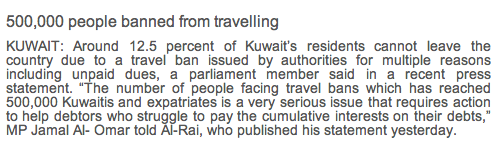
Mostly for people who have not paid interest on their loans? The banks have that much power, that they can put a travel ban on their customers?
MERS Virus Found to be Widespread
Thank you, John Mueller, for this fascinating article from Science NOW:
Middle Eastern Virus More Widespread Than Thought
 Bernard Gagnon/Wikimedia CommonsTrail of infection. Scientists have found MERS virus in camels from Sudan and Ethiopia, suggesting the virus is more widespread than previously thought.
It’s called Middle East respiratory syndrome, or MERS, after the region where almost all the patients have been reported. But the name may turn out to be a misnomer. A new study has found the virus in camels from Sudan and Ethiopia, suggesting that Africa, too, harbors the pathogen. That means MERS may sicken more humans than previously thought—and perhaps be more likely to trigger a pandemic.
MERS has sickened 183 people and killed 80, most of them in Saudi Arabia. A couple of cases have occurred in countries outside the region, such as France and the United Kingdom, but those clusters all started with a patient who had traveled to the Middle East before falling ill.
Scientists have uncovered more and more evidence implicating camels in the spread of the disease. They found that a large percentage of camels in the Middle East have antibodies against MERS in their blood, while other animals, such as goats and sheep, do not. Researchers have also isolated MERS virus RNA from nose swabs of camels in Qatar, and earlier this week, they showed that the virus has circulated in Saudi Arabian camels for at least 2 decades.
Malik Peiris, an infectious disease researcher at the University of Hong Kong, and colleagues expanded the search to Africa. In a paper published last year, they showed that camels in Egypt carried antibodies against MERS. For the new study, they took samples from four abattoirs around Egypt; again they found antibodies against MERS in the blood of 48 out of 52 camels they tested. But the most interesting results came from taking nose swabs from 110 camels: They found MERS RNA in four animals that had been shipped in from Sudan and Ethiopia.
Peiris cautions that it is unclear whether the infected camels picked up the virus in Sudan and Ethiopia or on their final journey in Egypt. Abattoirs could help spread MERS just like live poultry markets do for influenza, he says. “You cannot point the finger exactly at where those viruses came from,” he says. “But I would be very surprised if you do not find the virus in large parts of Africa.”
If so, that changes the picture of MERS considerably. No human MERS cases have been reported from Egypt or anywhere else in Africa, but if camels are infected, they may well occur, says Marion Koopmans, an infectious disease researcher at Erasmus MC in Rotterdam, the Netherlands. “It would be important to look systematically into that,” she writes in an e-mail. “Health authorities really need to test patients with severe pneumonia all across Africa for MERS,” Peiris says.
The researchers were able to sequence the virus of one of the camels almost completely, and it is more than 99% identical with viruses found in people. “I would be very surprised if this virus cannot infect humans,” says Christian Drosten, a virologist at the University of Bonn in Germany. But the virus also shows a few intriguing differences from known camel samples, he says. “We have to analyze this carefully in the next few days, but it looks like this sequence broadens the viral repertoire found in camels,” he says. If the viruses found in camels show more genetic variation than those isolated from humans, that is further strong evidence that camels are infecting humans and not the other way around.
Anthony Mounts, the point person for MERS at the World Health Organization in Geneva, Switzerland, says that it is very likely that human MERS cases occur in Africa. “Wherever we find [infected] camels, there is a good chance we’ll find [human] cases if we look closely,” he says. And humans may be exposed to camels in Africa much more often than in the Middle East: There were about 260,000 camels in Saudi Arabia in 2012, but almost a million in Ethiopia and 4.8 million in Sudan, according to the U.N. Food and Agriculture Organization. The more human cases there are, the higher the risk that the virus will one day learn how to become easily transmissible between people, which could set off a pandemic.
The researchers also looked at the blood of 179 people working at the camel abattoirs for antibodies against MERS virus, but found none. That shows that the virus is only rarely successful in infecting human beings, Peiris says. “What we need to find out now is the reason for these rare transmissions.”
Happy National Day Kuwait

Happy Liberation Day and Happy National Day to all my friends in Kuwait. Party hearty 🙂
Almost twenty-five years since the Invasion of Kuwait. Imagine. There are young Kuwaitis graduating from college who weren’t even alive when Iraq invaded.
A Stalwart Falls

“Are you catching colds?” our friend asked as the funeral ended.
“No, no, I said, funerals just find us very vulnerable, and we have to deal with losses, past, present . . . and future. We have an ongoing fight over who is going to bury whom.”
We did not know the man well who had died, but we knew him as a stalwart. He was a greeter and usher at our service, and he was only rarely ever not there. He served the church. He was always there. I had asked his wife to help me with tickets, and she had laughed and said “of course, I’ll be there because my husband will be there, and if you need me just holler.”
They weren’t there. It made me uneasy, it nagged at me. I didn’t need her, but I missed her, and as I said – they are ALWAYS there. Sometimes it’s what is missing that catches your attention. It caught mine.
When I learned her husband had died, suddenly and unexpectedly, just as the Antique Fair was starting, it came almost as a physical blow. It’s not that I knew him that well. It’s that his presence at the church was something we took for granted, he was stalwart. You could count on him. We attended out of respect, respect for him, support for his wife.
And I know that the two of them spend (spent) as much time together as AdventureMan and I do. I don’t like to think that it could happen to me, that I could be suddenly left. AdventureMan was a military man, he would often leave, all these years, and he might tell me where he was going but I never knew for sure where he was going. We had a code to use if he was lying, but although he never used the code, I know there are times he lied, all for that bitch, national security. Yes, yes, I know, strong language from Intlxpatr, but strong times call for strong language. We both knew that there were times when there was a risk he wouldn’t come back.
We didn’t have to deal with death a lot in our life abroad. Of course, in the military, everyone is young. In all the countries where we worked in the Gulf, there were upper age limits – people retired and people left; you can’t live out your years in Qatar or Kuwait, there are laws against it. You can’t even be buried there without special permission. We learned to deal with the losses of people coming into our lives and leaving, but we didn’t have to deal with the great finality of death. We’re learning.
AdventureMan insists he is going to go first. I am tough in a lot of ways, but I don’t know that I am tough enough to go through his funeral. The very thought of it makes me sick to my stomach.
He tells me not to worry. He wants a Viking funeral; he wants to be sent out in a kerosene soaked ship and for archers to set it on fire as it sails off, disintegrating in flames. Isn’t going to happen, AdventureMan, but if it did, I might give some thought to pitching myself on the ship as it departs . . . otherwise, I’m afraid I might live the rest of my life as the one of the walking wounded.
‘Putin’ On The Ritz in Moscow, LLOOOLLL
Oh Hayfa, this is one of the best flash-mobs ever! I wanted to be there!
I always thought Kuwait was ripe for a flash mob at the junction where the Fintas Expressway joined 6th Ring road. Never had the courage; even though you’d have to wait 6 – 9 light changes to get through. Figured the morality police would have me up on charges, LOL.
Best Best eveh!
“Extinct” Shark Found in Kuwait Fish Market
January was always the best month to visit the fish souk in Kuwait; cooler weather = less smell. One of my best memories is my friend who was living in Teheran going through with her camera, taking photos of every fish to show her husband – they didn’t get a lot of fresh seafood, and they missed it so much. It was January, it was cold – but so much less fish-y smelling than in July 🙂
This is from AOL News:

A shark species previously thought to have been extinct was reportedly found in a fish market in the Middle East.
This is the smoothtooth blacktip shark, and the last time anyone ever reported seeing one was was in 1902 in Yemen. Scientists eventually labeled it extinct, or vulnerable to extinction in the 1980’s.
Then in 2008, the Shark Conservation Society took a trip to a fish market in Kuwait. They were looking at sharks and noticed one looked ‘very similar, but different, to a couple of other species.’ So of course they decided to investigate.
Further analysis confirmed it was in fact the smoothtooth blacktip shark.
But there’s more: Recent studies of Middle Eastern fish markets also counted as many as 47 more have been spotted.
Now this doesn’t mean the species is necessarily thriving, but it does mean scientists have a greater chances at learning more about the shark and possibly even ways to save the species.
Recent Comments
intlxpatr on Shampoo Ginger tigerbutterya0c5ff1d… on Shampoo Ginger intlxpatr on British Soldier Kidnapped, Esc… John on British Soldier Kidnapped, Esc… intlxpatr on British Soldier Kidnapped, Esc… Wikipedia Donate Button

Amazina


Early Voting in Florida


