The Sunshine Vitamin
This is from The Washington Post and you can read the entire article by clicking on the blue type.
Vitamin D deficiency is, ironically, a serious issue for Middle Eastern women who stay out of the sun and who cover – wear abaya, hijab and niqab. The body makes Vitamin D from sunshine – which we have here in the Gulf in great abundance. Even exposing your skin for ten minutes a day in a secluded sunny spot will help your body create the Vitamin D it needs to build your bones and your system.
Some Seek Guidelines to Reflect Vitamin D’s Benefits
By Rob Stein
Washington Post Staff Writer
Friday, July 4, 2008; Page A01
A flurry of recent research indicating that Vitamin D may have a dizzying array of health benefits has reignited an intense debate over whether federal guidelines for the “sunshine vitamin” are outdated, leaving millions unnecessarily vulnerable to cancer, heart disease, diabetes and other ailments.
The studies have produced evidence that low levels of Vitamin D make men more likely to have heart attacks, breast and colon cancer victims less likely to survive, kidney disease victims more likely to die, and children more likely to develop diabetes. Two other studies suggested that higher Vitamin D levels reduce the risk of dying prematurely from any cause.
In response to these and earlier findings, several medical societies are considering new recommendations for a minimum daily Vitamin D intake, the American Medical Association recently called for the government to update its guidelines, and federal officials are planning to launch that effort.
But many leading experts caution that it remains premature for people to start taking large doses of Vitamin D. While the new research is provocative, experts argue that the benefits remain far from proven. Vitamin D can be toxic at high doses, and some studies suggest it could increase the risk for some health problems, experts say. No one knows what consequences might emerge from exposing millions of people to megadoses of the vitamin for long periods.
“The data are intriguing and serve as, no pun intended, food for further fruitful research,” said Mary Frances Picciano, at the Office of Dietary Supplements of the National Institutes of Health. “But beyond that, the data are just not solid enough to make any new recommendations. We have to be cautious.”
The current clash is the latest in a long, often unusually bitter debate. Some skeptics question whether funding by the tanning, milk and vitamin industries is biasing some advocates. Frustrated proponents accuse skeptics of clinging to outdated medical dogma.
“It feels kind of ridiculous working in this field sometimes,” said Reinhold Vieth, a professor of nutritional sciences and pathobiology at the University of Toronto. “Every week, I get interviewed about the next important publication about Vitamin D. But this field remains mired in the muck.”
Vieth is one of a small but vocal cadre of researchers pushing doctors and patients to stop waiting for new official guidelines. Physicians should routinely test their patients for Vitamin D deficiencies, and more people — especially African Americans — should take supplements and increase their exposure to the sun, they say.
“The bottom line is we now recognize that Vitamin D is important for health for both children and adults and may help prevent many serious chronic diseases,” said Michael F. Holick, a professor of medicine, physiology and biophysics at Boston University.
Scientists have long known that Vitamin D is a vital nutrient the skin produces when hit by ultraviolet light from sunlight and other sources. The amount of Vitamin D produced varies, depending on where the person lives, skin pigment, age and other factors. African Americans and other dark-skinned people, and anyone living in northern latitudes, make far less than other groups.
With people spending more time indoors surfing the Web, watching television, working at desk jobs, and covering up and using sunblock when they do venture outdoors, the amount of Vitamin D that people create in their bodies has been falling. Milk and a few other foods are fortified with Vitamin D, and it occurs naturally in others, such as fatty fish, but most people get very little through their diets.
“Humans evolved in equatorial Africa wearing no clothes,” said Robert P. Heaney, a leading Vitamin D researcher at Creighton University in Omaha. “Now we get much less direct sunlight, and so we don’t make nearly as much Vitamin D.”
How Hot is It?
Here is a photo of what it looks like this morning, not quite 7 in the ay-em:

It’s hot. It is so hot that I will need to run to the grocery store any minute now, before it gets too hot. It is so hot, I don’t even sweat, the sweat evaporates right off my body. It is so hot that a crayon left lying on the ground will spontaneously dissolve:
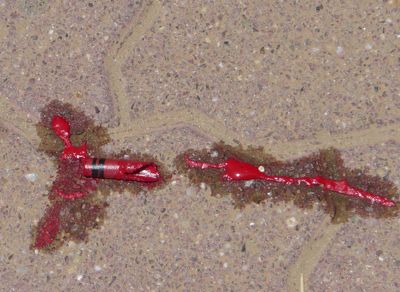
At 0730, it is 97°F / 36°C.
Hot as . . .

Night before last, for the first time, I saw my husband’s temperature gizmo in the car register 50°C – and that was at 8 PM.
In Kuwait, if the temperature registers 50°C, work is supposed to cease. The official temperature gauges on buildings downtown never go above 49°C. But if the temperature outside is still 50°C at 8 at night, wouldn’t you think it would be higher during mid-day?
He had visitors in town the other day, visitors who were so fascinated with the heat that they took photos of his dashboard temperature gauge.
It is unbelievably hot.
Electricity Bills Certificate?
Back in May, we saw the following in the Kuwait Times:
“the Ministry of Electricity and Water (MEW) has decided to ask all expatriates before exiting the country – whether on holiday or permanently – to obtain a certificate of clearance from the ministry. The certificate is only valid for one month. If the expat doesn’t have it, he will be returning from the airport the same day . . . “
School is out, people have fled the heat in droves, even with the atrocious airline prices. Has anyone heard of this policy being implemented? I haven’t heard of anyone being halted from travelling because of an unpaid bill, nor did anyone look us up when we were departing on holiday.
Disturbing Change
Late yesterday, I was online on AOL checking my e-mails. I often do, Law and Order Man comes online around that time in Pensacola and we can grab a quick chat.
Only Instant Messaging didn’t show up on my screen. I took care of business, and went on to other things. We don’t chat every day, just when we can.
Today, I noticed again – I don’t have AIM. I have a couple other ways to check in online, so I tried them. No AIM. Finally, I tried iChat, which also logs into AIM. It showed me logged in, it also showed no contacts.
My other AOL entry route didn’t show the Buddy Screen, even when I asked it to repeatedly.
I am hoping this is a little AOL glitch, temporary.
You don’t think Instant Messaging is being blocked in Kuwait, do you?
Sacred Spaces in Kuwait
As I was on my way home from picking up milk and vegetables, I passed another local mosque undergoing renovation. Or at least, that is my best guess; it has been gutted and partially destroyed. I am guessing it is about to be reconstructed, but I don’t know for sure. I am only guessing because I have seen it happen to other mosques since we arrived.
And it got me thinking, and I am going to ask a question, but I will tell you before I ask it, that if you asked me the same question about Christian spaces, I would have to ask an expert; it is not a question I can answer about my own culture.
Do Moslems have sacred spaces? How are they made sacred? Is there a ceremony? If you are going to destroy parts of a building on a sacred space, does it have to be de-consecrated (made no-longer-sacred) while it is undergoing renovation? If a mosque is destroyed/no longer used is there a ceremony that makes it no longer a holy spot?
I know that in my religion, churches are consecrated, made officially holy, and that there is a ceremony. I know that in some places, churches that are no longer needed are deconsecrated, not made UNholy, but made not a sacred place of worship any more, and they become restaurants, housing, etc.
In my specific branch of Christianity, which is Episcopalian, there is a service for blessing a new house, which I love, and it is called a House Blessing. The priest comes, usually at dusk, you can have friends there, you carry candles and he blesses every room in the house. When we buy and move into a new house, we always have it blessed. The priest tells me that it is really a mis-nomer, it is not the house being blessed, but those who live within in. To me, that is a distinction that hardly matters, all I know is that I feel more secure in a house that has been blessed.
And no, there is no un-blessing ceremony when we leave a house. The blessing does not create a holy space, a place of worship, a sacred place, but only blesses a humble dwelling.
No, I don’t understand exactly how this all works.
I remember travelling in Syria with an archaeology group one time, and we went to see the site of St. Simeon the Stylite. In my cynical heart, I was not wild about the visit – a saint who sat atop a huge rock for several years to show his devotion to God? When I got there, however, my heart changed – it felt like a holy place. It felt like Saint Simeon had done a holy act, demonstrating his faith so . . . faithfully. If you know Syria, you know how bitterly cold it can be in winter, and how bone-breakingly hot it can be in summer. The pure grit and devotion it took to stay atop the pillar of stone was an amazingly faithful act. It felt like a sacred place, a holy place, to me.
So my question is not just for the Moslem readers, but also for Christian readers – what makes a space holy? Does it need a ceremony to be holy? Does it need a ceremony if it will no longer be used for sacred purposes?
Jackknife
The Kuwait Times crime editor has come across a new term, and now he is using it every chance he gets. It is driving me crazy.
See if you can pick it out:
Policeman Injured
A policeman was injured after his patrol vehicle jackknifed when he lost control of the steering with the car coming to a rest upside down in the road. The officer managed to use the car’s radio to call for assistance and emergency services were quickly rushed to the scene, rushing the injured policeman to hospital.
Unless the police officer was driving a sectioned vehical; a car towing a trailer, a truck carrying a connected load – something that can be BENT, FOLDED, like a jackknife –

– then it is NOT a jackknifed vehicle. Most police vehicles are sedans. A sedan cannot jackknife.
This is the explanation from Wikipedia:
Jackknifing means the accidental folding of an articulated vehicle (i.e. one towing a trailer) such that it resembles the acute angle of a folding pocket knife. If a vehicle towing a trailer skids, the trailer can push it from behind until it spins round and faces backwards. This may be caused by equipment failure, improper braking, or adverse road conditions such as an icy road surface.
Jackknifing is not very common and usually only happens to an empty vehicle. Most truck drivers are skillful enough to correct a skid before it becomes a jackknife. It would be an exaggeration to claim that jackknifing accounts for a large number of tractor-semitrailer accidents since in many cases it is the collision that would have caused the vehicle to jackknife and not vice versa. Radio stations often report jackknifed trucks because people phone to tell them, but more often than not, the truck has not technically jackknifed; it may be stuck in the snow or damaged in a crash.
The Qatteri Cat’s Five Under Five
As told to me by the Qatteri Cat:
1. The sound of Dad’s key in the door when he comes home.
2. Tuna water
3. Sleeping on my back in the last remaining spot of sunshine
4. Cat mint! Cat grass! Catnip!
5. Snuggling up to Mom on a cold winter day.

Crown Relocation Marketing
I found this on my doorstep, as a neighbor is moving out:

And this is on the flip side:

I totally love it. Brilliant marketing.
First, it purports to be an apology for any inconvenience. How thoughtful, right? What great customer service, innoculating against negative perceptions by apologizing humbly in advance.
And, what a brilliant way to get attention and drum up customers. Wouldn’t you want a company who is so polite? So caring? After all, they start by apologizing for any inconvenience, before you turn the page over to read about the services they offer.
Last – no misspellings, uses good English, uses economical language and lots of white space. Well done, no annoyances, and leaves a positive impression.
I love it. Well done, Crown Relocation Services.
AIDS and Africa
Listening to BBC yesterday, I learned that in Ghana, men forbid their wives to get HIV testing. If the wife tests positive, it makes public his own shame, carrying HIV, and they don’t want people to know they are infected. They will even resist being treated rather than confess to having HIV.
Recently a Ghanian man divorced his wife for testing positive, even denied he was infected. She states he is the only man she has ever been with. He said she is bringing shame on him, going public.
What tragedy. What folly. Life enhancing, life prolonging drug treatments are available. First, you have to acknowledge you are infected. And, of course, if the women do not get tested, the dreaded disease passes along to the babies.
The newspaper recently published an article that 129 Kuwaitis are HIV positive. I imagine the problems here are similar, that people would prefer it all be kept very private. Is that possible? Is confidentiality respected? Do couples have blood tests before getting married?
Recent Comments
Kitchen on Isiais: Winding Down intlxpatr on Shampoo Ginger tigerbutterya0c5ff1d… on Shampoo Ginger intlxpatr on British Soldier Kidnapped, Esc… John on British Soldier Kidnapped, Esc… Wikipedia Donate Button

Amazina


Early Voting in Florida


