A Love of Colors
A friend who shares a love of both colors and words sent this quiz to me this morning, challenging me to match them up WITHOUT using a dictionary to see how many I got right. I thought I only missed two, but I missed four. This is challenging even for native English speakers. I know some of you will know at least one, because when I looked it up, it was a Persian word! Have fun, and let us know how you did. And which work do you like best?

A Case of Two Cities with Inspector Chen: Qiu Xiaolong
When my sister Sparkle recommends a book, I have learned to listen. I think I ordered this book about six months ago, but never cared enough to actually read it. After reading a recent Donna Leon (like dessert, I use it as a reward for reading something more challenging) I decided it was time to tackle Qiu Xiaolong.
I believe A Case of Two Cities is the first in the series; I tried very hard to make sure it was. When I first started reading it, it was difficult, but it didn’t take long to adjust. When you read a detective story written in a foreign culture, you have to park your old way of thinking, and quickly adapt to a new way of thinking. First, you have to learn what that new way of thinking is. They don’t just tell you at the beginning of the book “Here are the differences in values – you will notice . . .” no, but Qiu Xiaolong is courteous enough to take us by the hand and lead us gently into the Chinese way of thinking, the Chinese way of getting things done, and the technicalities of Chinese detective work.
As we meet Inspector Chen, a published poet, and a detective, ten pages into the book, a new anti-corruption campaign is starting in Shanghai, and Inspector Chen has been given a special assignment – a qinchai dacheng – as “Emperor’s Special Envoy with an Imperial Sword.” Even though imperial days are long gone, this warrant gives him emergency powers to search and arrest without reporting to anyone – and without a warrant. He is to seek and find Xing, a corrupt businessman who has caused huge loss to the national economy and is in danger of tarnishing the Chinese national image, and Xing’s associates.
Just as in the Donna Leon books about Commissario Guido Brunetti, and the Bowen books about Gabriel duPre, and James Lee Burke’s books about New Orleans, and Cara Black’s books about Aimee LeDuc, the detectives and investigators have to walk a fine line between going after the criminal and overstepping their warrant – stepping on the toes of those also engaged in corruption so entrenched that it has become a way of life. Each of these detectives has to maneuver that treacherously fine line – who determines when corruption has become too much? It usually puts their own lives in danger at some point, as those manipulating the system and making a fortune out of it do not want to be caught, do not want to be exposed, and will go to great lengths to protect their ill-gotten gains.
And just as in the above books, the book is more about the actual process than the crime itself. Inspector Chen must go about his task indirectly, having chats here and there, gathering threads of information with which he tries to weave a plausible tapestry of events.
As I was reading A Case of Two Cities, I kept making AdventureMan take me out for Chinese food! The meetings are often held over food, and the descriptions are mouth-watering.



Best of all, when you read these books, you get a tiny little glimpse into another way of thinking, another way of doing business. We are all human, we all have the same needs, and we differ in how we go about getting those needs met. We differ in the way we think. It helps to enter another way of living, another way of thinking, it helps to visit through these books so that we can increase our own understanding that our way of doing things is not the only way, maybe (gasp!) not even the “right” way! Maybe (crunching those brain cells really hard to output this thought) there is more than one “right” way?
“Whirling Chaff”
From Psalm 83
Verse 13
O my God, make them like whirling dust,*
like chaff before the wind.
Reading the Lectionary readings for today I came across this verse in the very first reading. It brought a grin to my face.
Lent continues. The Lord sends me out in my car almost daily, in spite of my best laid plans. I struggle to keep my resolution not to call – not to even THINK – bad names at the fools on the road who cause disruption, chaos and pain. It helps to have a substitute in mind, so I have something I CAN say instead of just struggling NOT to say the words that immediately come to mind.
The above verse will do nicely – don’t you think?
Founder or Flounder?
“Ummm, errrr. . . .is her campaign foundering or floundering?” I asked my very-intelligent-almost-a-doctor friend and she matter of factly and crisply said that it could be either, her campaign may be gasping and dying like a fish out of water, or approaching failure.
Don’t you wish you knew all those things? I do. I have to look them up all the time.
Founder has a lot of meanings. The one I was looking for is in bold type:
founder
n 1: inflammation of the laminated tissue that attaches the hoof
to the foot of a horse [syn: {laminitis}]
2: a person who founds or establishes some institution; “George
Washington is the father of his country” [syn: {beginner},
{founding father}, {father}]
3: a worker who makes metal castings
v 1: fail utterly; collapse; “The project foundered” [syn: {fall through}, {fall flat}, {flop}]
2: sink below the surface
3: break down, literally or metaphorically; “The wall
collapsed”; “The business collapsed”; “The dam broke”;
“The roof collapsed”; “The wall gave in”; “The roof
finally gave under the weight of the ice” [syn: {collapse},
{fall in}, {cave in}, {give}, {give way}, {break}]
4: stumble and nearly fall; “the horses foundered”
Flounder also has a lot of meanings:
A fish with a flattened body adapted for life on the seafloor.
http://www.reefed.edu.au/glossary/f.html
i) A small edible flatfish, ii)any small flatfish of the family Pleuronectidae or Bothidaes.
http://www.mi.mun.ca/mi-net/terms/nautical.htm
from flounce and founder
encyclopedia.kids.net.au/page/li/List_of_portmanteaus
a flat, bony saltwater fish which lives in bays and coastal waters. They are carnivores eating shrimp, small fish and crabs and are eaten by larger fish. Flounder is considered a popular food fish for people. …
http://www.lakeland.k12.in.us/limabrighton/nctrip07/glossary.html
stagger: walk with great difficulty; “He staggered along in the heavy snow”
any of various European and non-European marine flatfish
behave awkwardly; have difficulties; “She is floundering in college”
wordnet.princeton.edu/perl/webwn
Flounder are flatfish that live in ocean waters ie., Northern Atlantic and waters along the east coast of the United States and Canada, and the Pacific Ocean, as well. The name “flounder” refers to several geographically and taxonomically distinct species. …
en.wikipedia.org/wiki/Flounder
Flounder is an Disney character that appeared in Disney’s The Little Mermaid. He is Ariel’s best friend. Ironically, he is not a flounder, but is more similar in appearance to a Regal Tang or similar fish.
en.wikipedia.org/wiki/Flounder (The Little Mermaid)
I guess I can use either floundering or foundering, but now that I think of it, floundering will always remind me of a big flat fish, so I think I will try to think of founder.
Keystone Cops
As you all have seen from US Crime tapes, this news story could happen anywhere, but it happened in Kuwait. I would love to see a video of this!
Kuwait Times, 21 Feb 2008
Drunken Man
The operations room received an anonymous call reporting that a drunken man had been dancing in the streets of Fehaheel and terrifying passersby. A police patrol rushed to the scene and managed to arrest the suspect, who initially resisted arrest.
However, after being cuffed and forced into the patrol vehicle for just a couple of seconds, he managed to step out and ran for dear life while police were busy putting some gear into the vehicle’s trunk. A wild goose chase ensued with police hot on his trail, while the man returned to the spot where the vehicle was parked, got in, stepped on the gas and sped to his freedom again. Police later tracked the vehicle that was dumped in a deserted area in Jleeb. A manhunt has been launched to arrest this man.
I commend the writer on the correct use of the plural “passersby.” Bravo.
Your challenge: how many cliche’s did this staff writer use to write this article?
Phase Me
AdventureMan and I were having one of those conversations we love so much – why we say what we do. This time, it was on the word phrase “phase”. We have a collection of words you use one way but not the other, and we are adding to it all the time.
Like with “phase” – we never say “Oh, man, I was so totally phased.” We never say “that phased me.”
We MIGHT say “I sort of phased out when he started talking about molecular electronics and phased back in as he summed it up,” but that is a phrase – phased-out / phased-in. I’m not sure they are related.
No.
We say:
That didn’t phase me.
I wasn’t the least bit phased.
We got throught he entire procedure unfazed. (It’s the same word.)
I’ve been searching the internet for any kind of explanation as to why we use this almost exclusively in the negative, and I can’t find much.
I did find a website, Urban Dictionary which asks for audience participation to define what words and phrases mean. Very interesting:
1. phase
(Votes) 132 up, 17 down
(Verb) To disturb, perturb, deter or intimidate. Usually used in the negative.
“They swore at me, but hey, I’m not phased.”
“You can’t phase me by talking while playing chess.”
This entry brought to you by Mrm who used the phrase in a recent comment and it was just too much of a co-incidence, so I had to write about it.
Update:
I just couldn’t let it go. Finally I discovered the problem. Me and Mark Twain have the same problem, thinking phase and faze are related. They are not. From Wiktionary:
English
Pronunciation
fāz, /feɪz/, /feIz/
Homophones: phase
Rhymes: -eɪz
Verb: to faze
third-person singular simple present: fazes,
present participle: fazing,
simple past: fazed,
past participle: fazed
To frighten or cause hesitation; to daunt, put off (usually used in the negative)
Jumping out of an airplane does not faze him, yet he is afraid to ride a roller coaster.
Related terms
unfazed
Translations
to frighten or cause hesitation; to daunt
Usage notes
Citations for faze in the OED start in 1830; usage was established by 1890.
The word phase is sometimes used incorrectly for faze; such notables as the New York Times and Mark Twain have made this error. This sometimes leads to the supposition that faze is an uneducated spelling of phase; they are distinct terms.
Sunrise 19 Feb 2008
“Not with a bang, but a whimper. . . ”
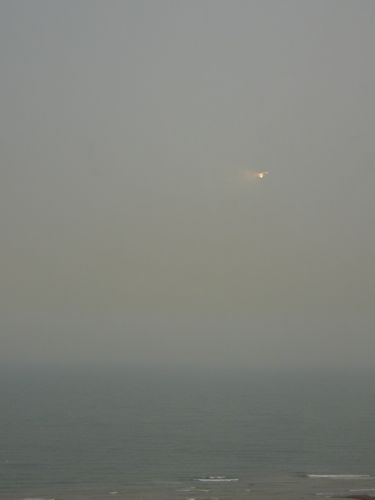
That tiny tiny bright speck you see is the sun fighting to shine through the clouds. It was only there for one brief moment – then gone! Maybe we will have rain today?
The gasp of brightness brought to mind T.S. Eliot’s poem, The Hollow Men (by clicking on the blue hypertext, you can go to a great website where it explains all the references in the poem.) Although it was written in 1925 – almost a century ago – it has a very modern feel to it. Your challenge for today – read the poem. Those with more time or interest – go to the website and read the references.:
The Hollow Men
I
We are the hollow men
We are the stuffed men
Leaning together
Headpiece filled with straw. Alas!
Our dried voices, when
We whisper together
Are quiet and meaningless
As wind in dry grass
Or rats’ feet over broken glass
In our dry cellar
Shape without form, shade without colour,
Paralysed force, gesture without motion;
Those who have crossed
With direct eyes, to death’s other Kingdom
Remember us – if at all – not as lost
Violent souls, but only
As the hollow men
The stuffed men.
II
Eyes I dare not meet in dreams
In death’s dream kingdom
These do not appear:
There, the eyes are
Sunlight on a broken column
There, is a tree swinging
And voices are
In the wind’s singing
More distant and more solemn
Than a fading star.
Let me be no nearer
In death’s dream kingdom
Let me also wear
Such deliberate disguises
Rat’s coat, crowskin, crossed staves
In a field
Behaving as the wind behaves
No nearer –
Not that final meeting
In the twilight kingdom
III
This is the dead land
This is cactus land
Here the stone images
Are raised, here they receive
The supplication of a dead man’s hand
Under the twinkle of a fading star.
Is it like this
In death’s other kingdom
Waking alone
At the hour when we are
Trembling with tenderness
Lips that would kiss
Form prayers to broken stone.
IV
The eyes are not here
There are no eyes here
In this valley of dying stars
In this hollow valley
This broken jaw of our lost kingdoms
In this last of meeting places
We grope together
And avoid speech
Gathered on this beach of the tumid river
Sightless, unless
The eyes reappear
As the perpetual star
Multifoliate rose
Of death’s twilight kingdom
The hope only
Of empty men.
V
Here we go round the prickly pear
Prickly pear prickly pear
Here we go round the prickly pear
At five o’clock in the morning.
Between the idea
And the reality
Between the motion
And the act
Falls the Shadow
For Thine is the Kingdom
Between the conception
And the creation
Between the emotion
And the response
Falls the Shadow
Life is very long
Between the desire
And the spasm
Between the potency
And the existence
Between the essence
And the descent
Falls the Shadow
For Thine is the Kingdom
For Thine is
Life is
For Thine is the
This is the way the world ends
This is the way the world ends
This is the way the world ends
Not with a bang but a whimper.
Just Bad English
I am adding a new catagory today called Just Bad English.
No, I am not going to troll your blogs looking for grammar mistakes or misspellings or unusual use of English. I have noticed that I am blogging in English, and that many of the Kuwaiti bloggers are blogging in their second language – that is tough enough without the Language Police lurking in the background, and that’s not my point, nor my interest.
If, however, you are writing for a newspaper, you are held to a higher standard, even if English is not your native tongue.
So tell me, in this article from the Arab Times Kuwait Crime News, how many people were arrested? What were they arrested for?
Meanwhile, a team of securitymen has launched a surprise inspection campaign in Ahmadi resulting in the arrest of two Kuwaitis wanted by law for various criminal charges and 105 jobless expatriates. The arrested individuals were referred to the concerned authorities.
I have another complaint. In the Kuwait Times, we often read of the police “suspecting” a car and pulling it over, or
“suspecting” some individuals and chasing them.
We don’t use “suspecting” that way.
There is suspicious behavior. People are suspected OF something – you can’t just look at a car and “suspect” it, you have to suspect it OF something – erratic driving? What made the police suspicious?
examples of good usage:
Police suspected him of being under the influence of drugs, and pulled him over.
He looked nervous, and police suspected him of being an illegal resident, so they asked to see his papers.
Police received a tip that a brothel was operating in Farwaniya, and based on that suspicion, raided the apartment, breaking down two iron doors in the process which gave the occupants enough time to escape through a hidden hatch in the back of the apartment.
A sharp eyes policeman spotted the car, which appeared to be one stolen a few nights previously. Suspicious that the driver was not the legal owner, they stopped him and interrogated him, and demanded to see his registration and residency papers.
(I made up all the above. Any resemblance to a case you may know is purely coincidental.)
I have also noticed that almost every suspect gives up his drug accomplices, pimp, fellow thieves, smugglers and drug stash after interrogation. I suspect Kuwait police have some extensive experience in encouraging these confessions. Most of these confessions seem to result in other valid arrests. Sometimes, I can believe, these confessions are made by people who are very very afraid. On the other hand, sometimes a confession elicited by fear of a lot of pain might be totally false.
How do you know the difference? What if someone experiences a lot of pain and confesses to a crime they did NOT commit? This means that an innocent man suffers and the one who committed the crime skates. This happens in every country in the world. (That is just a rant, not a language criticism, just a general question in my mind; how do we protect the innocent?)
But / And
Several years ago I was working for a charismatic leader. He was amazing, he built something out of nothing, and changed countless lives. I felt very privileged to be a part of his team.
I managed a particular program for him, and I raised money for college scholarships so that poor kids, who were smart but had very small chance of going on to university without outside help, would have the promise of a full-tuition paid scholarship if they kept their grades up, stayed drug free, attended cultural events for which we provided free tickets, donated by our very generous sponsors (museums! baseball games! fishing trips! opera! symphony! our sponsors were SO generous!)
From this leader I learned many things, and one sticks with me in my daily life – using “and” instead of “but.”
Here is what he explained to me – when you reply with “but”, you are negating what the previous speaker – or even you, yourself – said. When you use “and” instead of “but”, you open up the possibility of two different things co-existing.
I challenge you to try it.
It will change your life.
Eliminate “but” from your vocabulary. Replace it with “and.” It opens an amazing new world.
Here is an example:
“She wants to go to the mall, but I want to go to the movies.” (Implies that these things are mutually exclusive)
“She wants to go to the mall, and I want to go to the movies.” (Implies we can do both!)
“And” gives room for negotiation, for finding a bigger frame that includes all the wants and needs, with a little co-operation.
I challenge YOU to give it a try. Give it a try for just one day – see how it works. Come back here and tell us how it worked for you.
“Marionette . . . or Moron?”
This was sent by a good friend, 8 minutes by Keith Olbermann, ending with “Mr. Bush, you are a bold-faced liar.” This is from his December 6th broadcast.
Recent Comments
ExpatAlien on What Country am I Living … intlxpatr on Yellowstone: Old Faithful to C… Michelle on Yellowstone: Old Faithful to C… Cathy on No Grown-Ups in Charge intlxpatr on Waiting for Snow Wikipedia Donate Button

Amazina


Early Voting in Florida


 Here There and Everywhere