Pensacola: Fiesta of Five Flag Parade
I’ve never lived anywhere with so many parades, and as Pensacola cools down a little and an offshore breeze blows away the heat of the day, a parade sounds like fun. Tonight is the Fiesta of Five Flags Parade. I can’t think of a parade since Lent, so maybe this is the kick off of the new season. Pensacola has an active and lively social scene, with all these Mardi Gras Krewes, and the older our grandson gets, the more of the parade we get to see! I think we got through three quarters of the parade tonight, and oh what fun.
The people on the floats are having a great time. They have these great alter-egos, get to wear elaborate costumes, and there may be some alcohol involved, LOL. The people on the ground are having a great time, you can really get into the waving and trying to catch the beads. Some of the beads are prettier than others, but as AdventureMan says, it’s all plastic. Having said that, you should see him scramble! He is good at catching beads.
And oh my, they are so good to the kids, with stuffed toys, beads, ice cream bars, frisbees, trinkets, including pieces of eight!
Honestly, there are some things in life I will never get tired of – parades and fireworks. I feel so blessed to live in Pensacola.
These photos are not in the right order because I just did a group dump into the photo gallery, and it scrambled them when they were inserted into the blog entry.
The parade always starts with the Pensacola motorcycle police, with flashing lights and roaring engines!

I love that they decorate the horses tails:

And then AdventureMan pointed out they also rubbed glitter into the horses haunches to make them pretty 🙂

So many beads! We got to the parade a mere ten minutes before it began, but it was more lightly attended, and we were able to be right up front. Our little grandson had a great view, and people were so kind giving him beads, throwing him beads, toys, etc.


Look at all those beads they plan to throw! There was a throne on this float with King Tut!




These ladies were having a grand time!


The Mayoki Indians seemed to be the Krewe having the best time of all, with two floats loaded with beads, and more ‘foot Indians’ handing and throwing beads into the crowds:





The flame throwing baton twirler got lots of applause:








We saw our little grandson rubbing his eyes and asked if he was ready to go home, and he was. One of these days he will be old enough we will see an entire parade. I had a minor concern that Tropical Storm Andrea would blow in bad weather and make the parade unlikely, but nothing of the sort, we had great weather, a lovely evening and a wonderful time making good memories with our little grandson.
Your Calls – Every One – Reported to the Government
I found this on AOL News/Tech Crunch this morning. Post 9/11, did we know that the Homeland Security legislation would give the government so much power? To gather so much information on individual citizens who are not remotely suspected of committing a crime against the United States seems excessive to me.

Report: NSA Secretly Collecting Phone Records Of All U.S. Verizon Calls
Gregory Ferenstein
The National Security Administration is secretly collecting phone record information for all U.S. calls on the Verizon network. “Under the terms of the blanket order, the numbers of both parties on a call are handed over, as is location data, call duration, unique identifiers, and the time and duration of all calls,” reports The Guardian, which broke the story of the top-secret project after it obtained record of a court order mandating Verizon hand over the information.
The contents of the call are not recorded and it is also not known whether Verizon is the only cell-phone carrier complying with the massive spying project. The court order concerns all calls to, from, and within the United States.
With this so-called “metadata,” the government knows “the identity of every person with whom an individual communicates electronically, how long they spoke, and their location at the time of the communication,” explains the Guardian.
The Senate’s tech-savviest member, Ron Wyden (CrunchGov Grade: A), has been discretely warning citizens of these kinds of secretive government projects. “There is now a significant gap between what most Americans think the law allows and what the government secretly claims the law allows,” wrote Wyden and Senator Mark Udall to embattled Attorney Eric Holder.
The order apparently draws from a 2001 Bush-era provision in the Patriot Act (50 USC section 1861). The revelation dovetails similar exposes on massive government spying projects, including one project to combine federal datasets and look for patterns on anything which could be related to terrorism.
“Aggressive driving and speeding are common on Doha’s roads now”
From Gulf Times (Qatar); a new proposal to lower speeds on some roads to try to meet the goal of reducing accidents and fatalities rates. It notes they are also putting in more cameras and radars. All that is good. The question will be: How equitably will the law be enforced? When you look at percentages of accidents and fatalities as a proportion of population, are Qataris over represented? How do you encourage the nationals to drive respectfully?
Qatar’s Public Works Authority (Ashghal) is seeking to lower the speed limits set for several roads in Qatar in a new initiative to bring down the number of accidents. This is a sensible move. Aggressive driving and speeding are common on Doha’s roads now. Strict regulations are needed to counter this trend. Qatar already has one of the highest rates of road accidents in the world.
During a presentation at the Qatar Transport Conference in Doha this week, Ashghal official, Yousef Abdulrahman al-Emadi, blamed speeding for most fatalities in road accidents. Speaking on “Road safety in Qatar: improving safety for all road users”, al-Emadi said Ashghal had recommended reduction in the current speed limits to the government.
Ashghal is also calling for the installation of additional radars and cameras at key locations in Doha as part of its initiative.
But rules and regulations alone are not enough to bring about a safety culture on our roads. Programmes to raise safety awareness among motorists should be a regular feature of all initiatives. That is why the “One Second” campaign , launched by the Traffic Department in association with Maersk this week, is important.
A Qatar National Road Safety Strategy (2013-2022), released in January 2013, aims to save 800 lives and prevent 2,000 serious injuries over the next 10 years. This is an achievable target if the government acts on the Ashghal suggestion and organises regular campaigns like “One Second”.
The Lord Laughs at the Wicked
When I start to fret about those in high places who oppress the poor and the workers, whose lives are so far from worrying about a roof over their head and food to eat that they will pass still laws further oppressing the poor and homeless, I take consolation in this psalm.

The Pensacola City Council is passing a draconian measure against the homeless. I’ve been so proud of Pensacola, and the citizen response to the homeless, the beds Pensacola provides, the meals the citizens, through a variety of church and social agencies, hand out. Their response is humane, and compassionate.
The homeless are attracted by the moderate climate; they are here in droves. They panhandle at the intersections, they approach you at downtown attractions. They often have dogs. For the most part, they greet people cheerfully or respectfully, and they aren’t aggressive.

They are, in truth, a kind of plague on Pensacola, but as a traveler, I have brushed my teeth in many a restroom, changed my clothes, even had to rise out a coffee stained outfit before my next flight once – these are things for which the homeless will be charged with an offense against the law. If I were without a place for the night, I might look for a safe public restroom in which to sleep, especially if I had a child with me, as so many women did when I worked with homeless women.
I understand the problem.
But I also understand the desperation of those who have little, and that very little – a public restroom, a safe place to sleep outdoors – are being taken away from them by this statute. It’s heartless, and if there is truly an accounting at the end of our lives, and an afterlife, I fear for those who put additional burdens on the poorest of the poor.
Psalm 37
Of David.
1 Do not fret because of the wicked;
do not be envious of wrongdoers,
2 for they will soon fade like the grass,
and wither like the green herb.
3 Trust in the Lord, and do good;
so you will live in the land, and enjoy security.
4 Take delight in the Lord,
and he will give you the desires of your heart.
5 Commit your way to the Lord;
trust in him, and he will act.
6 He will make your vindication shine like the light,
and the justice of your cause like the noonday.
7 Be still before the Lord, and wait patiently for him;
do not fret over those who prosper in their way,
over those who carry out evil devices.
8 Refrain from anger, and forsake wrath.
Do not fret—it leads only to evil.
9 For the wicked shall be cut off,
but those who wait for the Lord shall inherit the land.
10 Yet a little while, and the wicked will be no more;
though you look diligently for their place, they will not be there.
11 But the meek shall inherit the land,
and delight in abundant prosperity.
12 The wicked plot against the righteous,
and gnash their teeth at them;
13 but the Lord laughs at the wicked,
for he sees that their day is coming.
14 The wicked draw the sword and bend their bows
to bring down the poor and needy,
to kill those who walk uprightly;
15 their sword shall enter their own heart,
and their bows shall be broken.
16 Better is a little that the righteous person has
than the abundance of many wicked.
17 For the arms of the wicked shall be broken,
but the Lord upholds the righteous.
18 The Lord knows the days of the blameless,
and their heritage will abide for ever;
19 they are not put to shame in evil times,
in the days of famine they have abundance.
20 But the wicked perish,
and the enemies of the Lord are like the glory of the pastures;
they vanish—like smoke they vanish away.
21 The wicked borrow, and do not pay back,
but the righteous are generous and keep giving;
22 for those blessed by the Lord shall inherit the land,
but those cursed by him shall be cut off.
23 Our steps* are made firm by the Lord,
when he delights in our* way;
24 though we stumble,* we* shall not fall headlong,
for the Lord holds us* by the hand.
25 I have been young, and now am old,
yet I have not seen the righteous forsaken
or their children begging bread.
26 They are ever giving liberally and lending,
and their children become a blessing.
27 Depart from evil, and do good;
so you shall abide for ever.
28 For the Lord loves justice;
he will not forsake his faithful ones.
The righteous shall be kept safe for ever,
but the children of the wicked shall be cut off.
29 The righteous shall inherit the land,
and live in it for ever.
30 The mouths of the righteous utter wisdom,
and their tongues speak justice.
31 The law of their God is in their hearts;
their steps do not slip.
32 The wicked watch for the righteous,
and seek to kill them.
33 The Lord will not abandon them to their power,
or let them be condemned when they are brought to trial.
34 Wait for the Lord, and keep to his way,
and he will exalt you to inherit the land;
you will look on the destruction of the wicked.
35 I have seen the wicked oppressing,
and towering like a cedar of Lebanon.*
36 Again I* passed by, and they were no more;
though I sought them, they could not be found.
37 Mark the blameless, and behold the upright,
for there is posterity for the peaceable.
38 But transgressors shall be altogether destroyed;
the posterity of the wicked shall be cut off.
39 The salvation of the righteous is from the Lord;
he is their refuge in the time of trouble.
40 The Lord helps them and rescues them;
he rescues them from the wicked, and saves them,
because they take refuge in him.
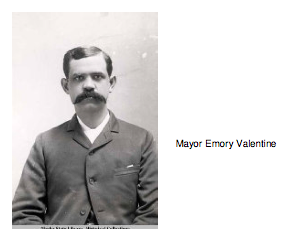
Mayor Emory Valentine Doesn’t Get His Way

It all started with a conversation with my Mom, during which, in a hushed voice, she told me about a neighbor “who had gotten a blue card.” A blue card? I had never heard of a blue card.
“It meant she had to leave the state!” Mom said.
Such a small thing, and such a journey it has led me on, trying to find out about the blue card and how it functioned. It led me to The History of the Juneau Alaska Police Department, and reading through that led to an hour of hilarity reading through the struggles of a small frontier town trying to bring order out of chaos and fight the battles of sewers, garbage, untethered horses, bawdy houses, and law enforcement.
Here are some examples of early actions:
1904
September, 1904 – George Kyrage (“George the Greek”) was elected to the Council and served with Mayor George Forrest, Councilmen Henry Shattuck, John Reck, Louis Lund, J.P. Jorgenson, and Henry States. Kyrage was named chairman of the Police Committee and found himself squarely between those who wanted prosperity through a wide open town, and those who demanded strict enforcement of a new ordinance prohibiting women loitering in saloons.
1910
January 7, 1910 – The conduct of a man named Al Graham was discussed and the Council ordered that he be given a “Blue Ticket”.
April 15, 1910 – The applicants for City Marshal were as follows: Charles Biernoth, W.G. Harris, Charles Meline, Mike McKenna, William Steinbeck, John Sweeney, Fred LaMarche Holmberg, and J.T. Martin. Charles Biernoth received the majority of the votes and was elected.
May 6, 1910 – City Marshal Charles Biernoth was asked to resign.
1913
April 18, 1913 – Mr. Nolan appeared before the Council and protested that the women of ill fame were allowed to live in the vicinity of the saw-mill outside of the restricted district, and the matter was referred to the Police Committee and the Chief of Police.
1914
January 2, 1914 – The City Attorney was instructed to prepare an ordinance against expectorating on the sidewalks of the City of Juneau.
-An ordinance was passed that provided punishment for pimps and moques to be set at not more than one hundred dollars.
City refuses to clean up red light district
February 6, 1914 – Councilman H.J. Raymond said that the last Grand Jury: wanted the City of Juneau to do something about cleaning up the red light district in the City. It was moved that the Chief of Police be ordered to close up every bawdy house in the City; but the motion died for lack of a second. It was then moved that the Chief of Police be instructed to stop the sale of liquor in all houses of prostitution in the City of Juneau; and again the motion died for lack of a second. It was then moved and seconded that a letter be forwarded to John Rustgard, US District Attorney, First Division of Alaska, stating that the City authorities of Juneau will be glad to lend all the aid they can in the enforcement of the law in the sale of liquor in houses of prostitution in the City of Juneau.
May 14, 1914 – A day’s labor in the Municipality of Juneau was set at eight (8) hours, common laborers were paid 35 cents per hour, and could work any number of additional hours at the same rate per hour.
1915
January 27, 1915 – A special meeting was called to hear charges of misconduct in office that have been made against Chief of Police William McBride. The Council requested that witnesses give their testimony. Harry Grove was duly sworn and testified and Charles Freegrove, Helen, and J.H. Gilpatrick were called and questioned by different councilmen. The hearing was then continued to a subsequent meeting of the Council.
January 29, 1915 – The Clerk read the resignation of William McBride from the office of the Chief of Police of the City of Juneau which took effect on February 1, 1915.
-A proposed ordinance was presented entitled “An ordinance requiring horses to be tied”.
July 7, 1916 – S.A. Judd protested that the Chief of Police had ordered him to leave town.
It makes for fascinating reading. Then I came across this sequence of reports, but for all my Googling, I cannot find out what the charges were against Chief of Police W.S. Harding:
1917
April 11, 1917 – Mayor Valentine declared that grave and serious charges have been made against W.S. Harding, Chief of Police, and that proofs are now in his possession. He further declared that an emergency existed, ordered that the office of Chief of Police be declared vacant, and stated that he will in due time appoint an emergency Chief of Police.
Councilman King asked Mayor Valentine the nature of the charges, to which Mayor Valentine replied that Mr. Harding would be given an opportunity to answer them, and that he would call a special meeting for that purpose.
April 12, 1917 – It was moved and seconded that W.S. Harding be elected to the position of Chief of Police for the coming year, to which Mayor Valentine declared out of order and stated that Mr. Harding had been suspended under the rules. Councilman Blomgren called for a vote on the adoption of the motion, and all six councilmen vote aye.
April 20, 1917 – The Clerk read the following demand: To Emory Valentine, Mayor and Common Council of the City of Juneau:
Whereas, Emory Valentine Mayor of the City of Juneau did at a public meeting held in the City of Juneau on the night of the 19th day of April, 1917, read certain affidavits purporting to contain certain charges against me as Chief of Police of Juneau, and that Emory Valentine publicly announced on the streets and public places of the Town of Juneau that he had other charges against me, I hereby demand that affidavits and all charges made against me as a public official and against my conduct, if committed and filed with the Common Council of the City of Juneau, or the Clerk of the City, and that a hearing be had immediately. Respectfully submitted, dated Juneau, Alaska, April 20, 1917. (signed) W.S. Harding
-An Executive Session was scheduled for Monday, April 23, 1917, at the hour of eight o’clock p.m. for the purpose of having the charges against W.S. Harding formally filed or presented.
-The Mayor called for the election of a person to fill the position of Chief of Police for the coming year. The Clerk read the following names as persons who had filed their applications: W.S. Harding, W.D. McMillan, E.J. Sliter, and Capt. E. Harrigan. W.S. Harding received six votes and the other applicants received none. The Mayor declared a veto on the election of W.S. Harding as Chief of Police.
-Harding appointed Dan Harrington, W.D. McMillan, and Emil Mullenbeck, to serve as police officers under him and asked for approval of the Council which was given. The Mayor declared a veto to the action of the Council.
April 27, 1917 – The Common Council of the City of Juneau, Alaska, convened in the Council Chambers of City Hall at the hour of eight o’clock p.m. on Friday, April 27, 1917, for the purpose of trying the charges against W.S. Harding, Chief of Police.
-The trial of the charges was to be heard by affidavit, and W.S. Harding was given until Monday night to file his answering affidavits, with the trial continued to Thursday, May 3, 1917 at the hour of eight o’clock p.m.
May 3, 1917 – The Common Council of the Town of Juneau, Territory of Alaska, convened in the Council Chambers of the City at the hour of eight o’clock p.m. on Thursday, May 3, 1917 – Mayor Valentine presiding. A resolution calling for the reading of the charges against W.S. Harding, Chief of Police accusing him of misconduct in office and the answering affidavits from the Chief was read.
-Affidavits of Walter Johnson, Frank Morrison, Jack Ivey, Fred Alexander, Mrytle Mercer, J.W. Felix, D. DeBlaser, F.J. Breezee, L.N. Ritter, and E. Valentine supported the charges.
-Affidavits of W.S. Harding, Emil Mullenbeck, Louise Dejonghe, E.W. Pettit, L.O. Sloane, C.O. Lindsey, Carl R. Brophy, W.D. MacMillan, A.C. Williams Jr., Frank E. Sargent, Glen C. Bartlett, H.H. Post, D.J. Harrington, George C. Burford, Edith Johnson, John B. Marshal, Harry Ellingen, and E.A. Naud were read in answer to the charges.
-The Council took a ten minute recess to consider the charges, and Mayor Valentine left the meeting.
-Following the recess, the following resolution was read: Be it resolved that W.S. Harding, Chief of Police of the City of Juneau, whom certain charges have been filed against, has been exonerated and it is the wish of the Council that he continue as Chief of Police.
May 4, 1917 – The electric light at the end of the garbage dump was out, causing trouble for boats navigating up and down the channel.
-Mayor Valentine objected to the claim of Chief Harding for his full monthly salary, saying that he was only entitled to pay for the first eleven days in April, because Harding was relieved from office on that date.
-The Clerk read Mayor Valentine’s veto message to the action of the Council electing W.S. Harding as Chief of Police on April 20, 1917, and to the action of the Council confirming the appointments of W.S. Harding, Patrolman Harrington and Mullenbeck. The following resolution was then read: Be it resolved that the veto of Mayor Valentine to the action of the Council in electing W.S. Harding, Chief of Police of the City of Juneau, Alaska on April 20, 1917, be overruled and held for naught. And be it further resolved that the veto of Mayor Valentine to the action of the Council in confirming the appointment of Patrolman Harrington and Mullenbeck on April 20, 1917, be overruled and held for naught.
Mayor Valentine served as Mayor for six terms, according to Wikipedia, and organized the volunteer fire department and designed the city’s first water system. For some reason, he really didn’t like the Chief of Police, but Harding and a lot of support among the council members, and retained his position. Fascinating stuff; brings history to life.
And you thought history was dull?
Afghanistan: Such Laws Give Women Ideas . . .
Law Protecting Afghanistan Women Blocked By Conservatives
By KAY JOHNSON 05/18/13 08:03 AM ET EDT 
KABUL, Afghanistan — Conservative religious lawmakers in Afghanistan blocked a law on Saturday that aims to protect women’s freedoms, with some arguing that parts of it violate Islamic principles or encourage women to have sex outside of marriage.
The failure highlights how tenuous women’s rights remain a dozen years after the ouster of the hard-line Taliban regime, whose strict interpretation of Islam kept Afghan women virtual prisoners in their homes.
Khalil Ahmad Shaheedzada, a conservative lawmaker for Herat province, said the legislation was withdrawn shortly after being introduced in parliament because of fierce opposition from religious parties who said parts of the law are un-Islamic.
“Whatever is against Islamic law, we don’t even need to speak about it,” Shaheedzada said.
The Law on Elimination of Violence Against Women has actually been in effect since 2009 by presidential decree. It is being brought before parliament now because lawmaker Fawzia Kofi, a women’s rights activist, wants to cement it with a parliamentary vote to prevent its reversal by any future president who might be tempted to repeal it to satisfy hard-line religious parties.
Among the law’s provisions are criminalizing child marriage and banning “baad,” the traditional practice of selling and buying women to settle disputes. It also criminalizes domestic violence and specifies that rape victims should not face criminal charges for fornication or adultery.
“We want to change this decree as a law and get the vote of parliamentarian for this law,” said Kofi, who is herself running for president in next year’s elections. “Unfortunately, there were some conservative elements who are opposing this law. What I am disappointed at is because there were also women who were opposing this law.”
Afghanistan’s parliament has more than 60 female lawmakers, mostly due to constitutional provisions reserving certain seats for women.
The child marriage ban and the idea of protecting female rape victims from prosecution were particularly heated subjects in Saturday’s parliamentary debate, said Nasirullah Sadiqizada Neli, a conservative lawmaker from Daykundi province.
Neli suggested that removing the custom – common in Afghanistan – of prosecuting raped women for adultery would lead to social chaos, with women freely engaging in extramarital sex safe in the knowledge they could claim rape if caught.
Lawmaker Shaheedzada also claimed that the law might encourage promiscuity among girls and women, saying it reflected Western values not applicable in Afghanistan.
“Even now in Afghanistan, women are running from their husbands. Girls are running from home,” Shaheedzada said. “Such laws give them these ideas.”
Freedoms for women are one of the most visible – and symbolic – changes in Afghanistan since 2001 U.S.-led campaign that toppled the Taliban regime. Aside from their support for al-Qaida leaders, the Taliban are probably most notorious for their harsh treatment of women under their severe interpretation of Islamic law.
For five years, the regime banned women from working and going to school, or even leaving home without a male relative. In public, all women were forced wear a head-to-toe burqa veil, which covers even the face with a mesh panel. Violators were publicly flogged or executed. Freeing women from such draconian laws lent a moral air to the Afghan war.
Since then, women’s freedoms have improved vastly, but Afghanistan remains a deeply conservative culture, especially in rural areas.
___
Associated Press writer Rahim Faiez contributed in Kabul.
Bloggers Create Freedom Friday in Oppressed Eritrea
I heard whispers of this on National Public Radio, and found this write up on The International Business Times website. The message is simple – in a country where even a glance can be interpreted as treason, express your non-support of the government by STAYING AT HOME ON FRIDAY, the day Ethiopians usually go out and visit with friends, gather together and mingle. Ghandi would smile; this is civil expression at it’s most civil 🙂
Let the empty streets speak for you. LOL @ a tyrant making staying at home a crime against the government!
Eritrean bloggers outside of Ethiopia started it, smuggling an old Eritrean phone book out of the country and making calls to acquaintances – and strangers – in Eritrea. People didn’t even have to respond. they could just listen . . . then they developed a robo-call to help them enlarge the number they could reach.
Eritrea is considered one of the continent’s most opaque countries. National elections have not been held in the Horn of Africa country since it gained independence in 1993. Torture, arbitrary detention and severe restrictions on freedom of expression remain routine.
President Isaias Afwerki does not tolerate any independent media, the internet is strictly controlled and Reporters without Borders recently named it 179th out of 179 countries for freedom of expression.
It is illegal to criticise the government, prompting the Eritrean diaspora to set up a campaign to reverse the Arab-style call to take to the streets every Friday by emptying the streets in protest.

“We made phone calls from diaspora to Eritrea,” Meron Estefanos toldIBTimes UK. “We have a phone catalogue and called random numbers every Friday, telling them to stay at home and think about problems in our country.”
The phone calls “give them [Eritreans within the country] an opportunity to protest without risking too much”, according to Freedom Friday’s coordinator in the UK Selam Kidane.
The activists turned to a computerised auto-dialer called robocall to spread hundreds of thousands of taped messages to Eritrean phones. “It is time to restore our liberty and dignity” messages were sent automatically.
In another message, the mother of renowned political prisoner Aster Yohannes recalls the fate of her daughter, who was arrested in 2003 and has disappeared.
After two years, the movement is finally gaining momentum inside the country.
“Now they trust us inside the country, we have our team in Eritrea that puts out posters and leaflets late at night,” Estefanos said.
“The plan now that we have their trust is asking them to go out and demonstrate.”
About 1,500 Eritreans leave their country every month, according to the United Nations, paying up to 30,000 euros ($39,500) each to seek a new life free of grinding poverty and repression.
Earlier this year, Amnesty International put the spotlight on Eritrean asylum-seekers who are kidnapped from Sudanese refugee camps by the local Rashaida tribe, sold to Bedouin criminals in Egypt’s Sinai peninsula and severely abused while they are held for ransom.
One thousand refugees are held captive in the Sinai, according to reports. About 7,000 people in total may have been tortured and 4,000 may have died as a result of the people-trafficking in humans from 2009 to October 2012, according to recent data. A total of 3,000 people disappeared from 2007-11.
Maldives President Urges Patience in Lashing Sentence of Rape Victim
Little drops of water, little grains of sand, make the mighty ocean and the beauteous land . . .
Little drops of water, in the form of expressions of international outrage against the sentence of 100 lashings for a 15 year old girl, impregnated by her stepfather, who bore his still-born babe, and was ordered punished by the court system for immorality. A call to express outrage by boycotting travel to the Maldives seems to have gotten the attention of the government. It appears they will try to find a way to avoid this grueling punishment . . . thanks to the attention being paid.
From the English edition of Haveeru Online:
President Dr Mohamed Waheed Hassan Manik on Tuesday urged patience from the international community in the case of the 15 year old alleged rape victim who received a flogging after being convicted of adultery in a separate incident.
The conviction had sparked an international outcry and condemnation from rights groups such as Amnesty International. While an online petition condemning the Maldives over the sentencing has received over two million signatures. The petition, started by New York-based campaign group avaaz.org, calls on President Waheed to intervene and has been signed by over two million users.
“We appreciate the international compassion for this young woman and ask for your patience as this case moves through the judicial system,” President Waheed said in a statement.
“Currently the case is being appealed and I have urged the judiciary to resolve this matter as quickly as possible.”
“This case should never have been presented in the courts and we are working to ensure that cases like this are never brought to the courts again.”
In the statement, President Waheed also assured that the young woman remains under the care of the Gender Ministry and is receiving the appropriate physical and psychological counseling at this time.
“As both the President and as a father, I am fully committed to protecting and advancing the rights of women and girls in the Maldives and throughout the world and share your deep concern about this young victim.”
In its attempt to pressure the Maldives government to overturn the sentence, Avaaz had called for tourism to be boycotted.
“Tourism is the big earner for the Maldives elite, including government ministers. Let’s build a million-strong petition to President Waheed this week, then threaten the islands’ reputation through hard-hitting ads in travel magazines and online until he steps in to save her and abolish this outrageous law,” Avaaz said on its website.
In that regard, President noted that the Maldives is a young democracy working to balance religious faith with new democratic values and asked the international community to support as partners as the country works through this challenge.
“A boycott on tourism will only serve as a setback to the economic opportunities and rights we are all striving to uphold for women, girls and the hardworking Maldivian people in general,” Waheed stressed.
The 15 year old girl who gave birth and buried the baby in Shaviyani Atoll Feydhoo had been sentenced to eight months under house arrest and 100 lashes after the Juvenile Court found her guilty of pre marital sex.
Prosecutors have maintained that the 15 year old was charged with adultery over another case which came to light during the investigation of the buried baby.
The baby born last June was found buried in the bath house of the girl’s home. The child delivered out of wedlock was dead at the time of discovery. Charges have been filed against the 15 year old’s mother and step-father over the deliberate murder of the baby.
Expats in Kuwait: A Burden on the State?
From today’s Kuwait Times . . . .

KUWAIT: The government has sent a draft law to the parliament stipulating an increase in fees collected from expatriate residents for using public services in Kuwait, a senior state official said in statements reported yesterday by the local press.
Minister of Cabinet Affairs Sheikh Mohammad Al-Abdullah Al-Sabah further indicated that the proposal is currently under review primarily to ensure it was in keeping with the constitution. “The state pays KD6 billion to subsidize public services, including electricity and water, while only KD2 billion of it is the average share of Kuwaitis,” he told a gathering of third constituency women voters at MP Ahmad Al-Mulaifi’s dewaniya on Monday night.
He also termed the remaining KD4 billion, a cost which supposedly the government bears for services used by expatriates, “a burden on the state.” Al-Sabah, who is also the State Minister for Municipality Affairs, added that similar steps have been adopted in the rest of the Gulf Cooperation Council states to increase the state revenue from expatriates. “Unfortunately, Kuwait’s law prohibits the government from increasing the fees unilaterally,” he said, referring to regulations which stipulate that such decisions must be passed by the parliament before becoming effective.
The minister’s statement is the latest turn in the government’s efforts seen targeted at the country’s expatriate community which comprises two thirds of the population, including a Ministry of Social Affairs and Labor announcement to deport 100,000 foreigners annually as part of a ‘demographic balance restoration plan’; the details of which are yet to be announced.
Meanwhile, Undersecretary Assistant for Traffic Affairs in the Interior Ministry, Major General Abdulfattah Al-Ali, announced that 213 expats were deported in the past few days for committing ‘grave’ traffic violations. In this regard, Al-Ali told Al-Rai on Tuesday that deportations only happen in cases where people have a record of repeated violations. “An expatriate who commits the same violation over and over again must be deported in the public interest,” he said, calling a person in this case as “abnormal” and “untreatable.” According to the ministry, the violations warranting deportation include driving without a driver’s license, jumping the red traffic light for a second time, using private vehicles to carry passengers and exceeding speed limits by 40 km. Al-Ali refuted the notion that the recent deportations were connected to the MSAL’s plan mentioned above.
Minister of Social Affairs and Labor Thekra Al-Rashidi had indicated that the annual deportation plan, through which the government hopes to deport a million foreigners in ten years, is chiefly going to target ‘marginal labor forces’ or workers who usually accept menial jobs and often live without valid visas.
Such workers are often the victim of visa traffickers who exploit loopholes in the ministry’s system to release work permits in the name of fake companies or nonexistent job openings, and then sell them to unskilled labor forces looking for a chance to work in the oil-rich Gulf region. The system is based on the kafala (sponsorship of foreign workers) program which is often criticized by international organizations for human right violations recorded in Kuwait and the entire region.
On a related note, Al-Rai reported yesterday that the social affairs and interior ministries are studying the possibility of creating an ‘amnesty period’ during the summer to allow illegal residents to leave Kuwait or obtain a new visa without paying the cumulative fines.
Anonymous sources were quoted in the report as saying that the project depends on the two ministries’ ability to “plug some loopholes” which could make violators irresponsive to it. “For example, we cannot expect Bangladeshi nationals staying illegally in Kuwait to leave when they know that they will be banned by law in this case from ever returning to Kuwait,” one source explained. “There are violators who become stuck in Kuwait due to circumstances in their home countries combined with regulations that prevent them from issuing a residency in Kuwait.
Legal obstacles in similar cases need to be removed before an amnesty period is announced,” the source added.
Recent Comments
intlxpatr on Yellowstone: Old Faithful to C… Michelle on Yellowstone: Old Faithful to C… Cathy on No Grown-Ups in Charge intlxpatr on Waiting for Snow intlxpatr on Waiting for Snow Wikipedia Donate Button

Amazina


Early Voting in Florida


 Here There and Everywhere