Woman Hits Four Cars, One at a Time, in Pensacola
We love driving in Pensacola. Most of the time, traffic is laid back and courteous. Exceptions like this are rare – no license, no insurance, fleeing the scene of an accident, all her children suffering head injuries in the FOUR separate hits – this woman should not be on the road.. From today’s PNJ Online:
A woman’s alleged attempt at a hit-and-run backfired when she hit three other cars while trying to flee, said eyewitnesses Friday.
About 2:30 p.m., authorities responded to a four-car accident with injuries at Fairfield Drive and Palafox Street, but the number of people injured and the severity of those injuries has not been released.
The incident began at the turning lane at Davis Highway and Fairfield Drive when a woman in a minivan containing three small children bumped an Orkin Man’s truck, witnesses said.
The man, Scott Stricker, said the woman took a look at the truck, said it looked untouched and that she was going to leave. Stricker told her that his company has a policy to pull over and call in any kind of traffic incident.
He said the woman told him that she would pull over just a little ahead, but as he pulled over, she skirted around him and turned down Fairfield.
“She jetted around me,” Stricker said.
While driving down Fairfield, the woman ended up hitting three other cars.
“I heard a hit, I heard another hit and I heard a third hit, and I came flying out of the office,” said Jan Prentice, who works at an advertising agency on Fairfield Drive.
Prentice said the woman told her that she was afraid of going to jail because she wasn’t driving with a valid driver’s license, and she didn’t have insurance.
Prentice said the woman had injuries and that her three small children in the van appeared to have head injuries and were taken to a hospital. It is not clear how many people were injured in the accidents.
Trooper St. Clair of the Florida Highway Patrol said that the incident was a four-car pileup, but that more information will be confirmed by a release that should be sent out later today.
Canadian Family Found Guilt of Honor Killing
From today’s AOL / Huffington Post: World:
KINGSTON, Ontario — A jury on Sunday found an Afghan father, his wife and their son guilty of killing three teenage sisters and a co-wife in what the judge described as “cold-blooded, shameful murders” resulting from a “twisted concept of honor.”
The jury took 15 hours to find Mohammad Shafia, 58; his wife Tooba Yahya, 42; and their son Hamed, 21, each guilty of four counts of first-degree murder in a case that shocked and riveted Canadians from coast to coast. First-degree murder carries an automatic life sentence with no chance of parole for 25 years.
After the verdict was read, the three defendants again declared their innocence in the killings of sisters Zainab, 19, Sahar 17, and Geeti, 13, as well as Rona Amir Mohammad, 52, Shafia’s childless first wife in a polygamous marriage.
Their bodies were found June 30, 2009, in a car submerged in a canal in Kingston, Ontario, where the family had stopped for the night on their way home to Montreal from Niagara Falls, Ontario.
Prosecutors said the defendants allegedly killed the three teenage sisters because they dishonored the family by defying its disciplinarian rules on dress, dating, socializing and going online. Shafia’s first wife was living with him and his second wife. The polygamous relationship, if revealed, could have resulted in their deportation.
The prosecution alleged it was a case of premeditated murder, staged to look like an accident after it was carried out. Prosecutors said the defendants drowned their victims elsewhere on the site, placed their bodies in the car and pushed it into the canal.
Defense lawyers said the deaths were accidental. They said the Nissan car accidentally plunged into the canal after the eldest daughter, Zainab, took it for a joy ride with her sisters and her father’s first wife. Hamed said he watched the accident, although he didn’t call police from the scene.
After the jury returned the verdicts, Mohammad Shafia, speaking through a translator, said, “We are not criminal, we are not murderer, we didn’t commit the murder and this is unjust.”
His weeping wife, Tooba, also declared the verdict unjust, saying, “I am not a murderer, and I am a mother, a mother.”
Their son, Hamed, speaking in English said, “I did not drown my sisters anywhere.”
But Judge Robert Maranger was unmoved, saying the evidence clearly supported their conviction for “the planned and deliberate murder of four members of your family.”
“It is difficult to conceive of a more despicable, more heinous crime … the apparent reason behind these cold-blooded, shameful murders was that the four completely innocent victims offended your completely twisted concept of honor … that has absolutely no place in any civilized society.”
Hamed’s lawyer, Patrick McCann, said he was disappointed with the verdict, but said his client will appeal and he believes the other two defendants will as well.
But prosecutor Gerard Laarhuis welcomed the verdict.
“This jury found that four strong, vivacious and freedom-loving women were murdered by their own family in the most troubling of circumstances,” Laarhuis said outside court.
“This verdict sends a very clear message about our Canadian values and the core principles in a free and democratic society that all Canadians enjoy and even visitors to Canada enjoy,” he said to cheers of approval from onlookers.
The family had left Afghanistan in 1992 and lived in Pakistan, Australia and Dubai before settling in Canada in 2007. Shafia, a wealthy businessman, married Yahya because his first wife could not have children.
The prosecution painted a picture of a household controlled by a domineering Shafia, with Hamed keeping his sisters in line and doling out discipline when his father was away on frequent business trips to Dubai.
The months leading up to the deaths were not happy ones in the Shafia household, according to evidence presented at trial. Zainab, the oldest daughter, was forbidden to attend school for a year because she had a young Pakistani-Canadian boyfriend, and she fled to a shelter, terrified of her father, the court was told.
The prosecution said her parents found condoms in Sahar’s room as well as photos of her wearing short skirts and hugging her Christian boyfriend, a relationship she had kept secret. Geeti was becoming almost impossible to control: skipping school, failing classes, being sent home for wearing revealing clothes and stealing, while declaring to authority figures that she wanted to be placed in foster care, according to the prosecution.
Shafia’s first wife wrote in a diary that her husband beat her and “made life a torture,” while his second wife called her a servant.
The prosecution presented wire taps and cell phone records from the Shafia family in court to support their honor killing theory. The wiretaps, which capture Shafia spewing vitriol about his dead daughters, calling them treacherous and whores and invoking the devil to defecate on their graves, were a focal point of the trial.
“There can be no betrayal, no treachery, no violation more than this,” Shafia said on one recording. “Even if they hoist me up onto the gallows … nothing is more dear to me than my honor.”
Defense lawyers argued that at no point in the intercepts do the accused say they drowned the victims.
Shafia’s lawyer, Peter Kemp, said after the verdicts that he believes the comments his client made on the wiretaps may have weighed more heavily on the jury’s minds than the physical evidence in the case.
“He wasn’t convicted for what he did,” Kemp said. “He was convicted for what he said.”
US Navy Rescues Iranian Fishermen from Somali Pirates
I love this story. I found it on AOL News / Huffington Post; it’s an Associated Press Story.:
WASHINGTON — The political tensions between the U.S. and Iran over transit in and around the Persian Gulf gave way Friday to photos of rescued Iranian fisherman happily wearing American Navy ball caps.
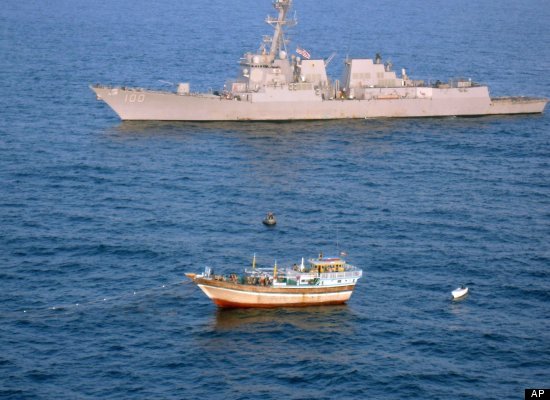
The fishermen were rescued by a U.S. Navy destroyer Thursday, more than 40 days after their boat was commandeered by suspected Somali pirates in the northern Arabian Sea. The rescue came just days after Tehran warned the U.S. to keep its warships out of the Persian Gulf – an irony not lost on U.S. officials who trumpeted the news on Friday.
“We think it’s very doubtful that the Iranians or the pirates were aware of recent events of the last couple days,” Rear Adm. Craig S. Faller, commander of the U.S. Navy Carrier Strike Group involved in the rescue, told reporters by phone Friday. “Once we released them (the fishermen) today they went on their way very happily, I might add, waving to us wearing USS Kidd Navy ball caps.”
Faller, speaking from the aircraft carrier USS John C. Stennis in the Arabian Sea, said the fishermen, who had been living off the fish they could catch, expressed their thanks and are believed to be headed back to their homeport in Iran.
The rescue was carried out by American forces flying off the guided-missile destroyer USS Kidd, after crew on the Iranian fishing vessel, the Al Molai, made it clear they were in trouble.
The USS Kidd, part of the Stennis carrier group, was sailing in the Arabian Sea, after leaving the Persian Gulf, when it came to the sailors’ aid. It was alerted to the hostage situation when the captain of the fishing boat spoke by radio to the Americans in Urdu – a Pakistani dialect that he hoped the pirates near him would not understand – and managed to convey that he needed help.
A U.S. Navy team helicoptered to the ship, boarded it without any resistance, and detained 15 suspected Somali pirates. They had been holding the 13-member Iranian crew hostage and were using the boat as a “mother ship” for pirating operations in the Persian Gulf.
“They were scared,” U.S. Navy Cmdr. Jennifer L. Ellinger, commander of the USS Kidd, said of the Iranians. “They pleaded with us to come over and board their vessel, invited us to come over. And we reassured them that we would be on our way.”
Amid escalating tensions with Tehran, the Obama administration reveled in delivering the news.
“This is an incredible story. This is a great story,” State Department spokeswoman Victoria Nuland said, explaining that the very same American ships the Islamic republic protested for recently traveling through the Strait of Hormuz were responsible for the Iranian vessel’s recovery.
“They were obviously very grateful to be rescued from these pirates,” Nuland said.
The episode occurred after a week of hostile rhetoric from Iranian leaders, including a statement by Iran’s Army chief that American vessels are no longer welcome in the Gulf. Iran also warned it could block the Strait of Hormuz, the strategic waterway that carries to market much of the oil pumped in the Middle East.
The Iranian threats, which were brushed aside by the Obama administration, were in response to strong economic sanctions against Iran over its disputed nuclear enrichment program. Last week, President Barack Obama signed into law new sanctions targeting Iran’s Central Bank and its ability to sell petroleum abroad.
According to Faller and Ellinger, the incident began Thursday morning when the Navy got a distress call from a Bahamian-flagged ship, and saw six individuals in a small boat next to it, throwing what appeared to be weapons into the water. They checked but found no evidence of piracy, so they released the small boat, but followed it by helicopter.
The small boat headed back to the Iranian-flagged ship, where U.S. Navy officials said it looked like there were both Middle Eastern and Somali on board.
The radio conversation with the Iranian captain made it clear his crew was under duress, so the USS Kidd launched a Navy search and seizure team. The suspected pirates hid on the ship, but the Iranian crew told the team where they were, Ellinger said, adding that the pirates surrendered quickly.
“The Al Molai had been taken over by pirates for roughly the last 40-45 days,” said Josh Schminsky, a Navy Criminal Investigative Service agent aboard the Kidd. “They were held hostage, with limited rations, and we believe were forced against their will to assist the pirates with other piracy operations.”
Schminsky said the Iranian boat’s captain thanked the U.S. for assistance. “He was afraid that without our help, they could have been there for months,” Schminsky said in a prepared release.
The U.S. team gave the crew food, water and medical care, and on Friday morning they moved the captured pirates to the Stennis. They will remain there while the U.S. considers options for prosecution and consults with other nations that have joined forces against piracy.
“Sadly, this is not a new thing,” Nuland told reporters, citing more than 1,000 pirates picked up at sea who are under prosecution in some 20 countries. “So this is always a question of where to send them and who will do the prosecution.”
Asked if the rescue mission could provide a chance for a thaw in relations with Iran, Nuland declined to comment. She said the Navy had made a “humanitarian gesture” to take the Iranians onboard, feed them and ensure they were in good health before setting them off. She said the U.S. and Iranian governments have had no direct contact over the incident.
Defense Secretary Leon Panetta called Faller on Friday to congratulate him on the rescue, adding that, “When we get a distress signal, we’re going to respond. That’s the nature of what our country is all about.”
Excitement at the Apple Market
“This is what happens when you live in a state where every other person is carrying a handgun,” AdventureMan grumbled as we left the Apple Market.
We had been to see the new Sherlock Holmes Movie, Game of Shadows, (really action packed, by the way, and entertaining) when we remembered we needed milk. The Publix parking lot, shared with Toys R Us, is totally gridlocked on this Wednesday night before Christmas, and we figure the Winn Dixie, shared with Target, Michaels, etc. will be another gridlock. Although the Apple is out of the way, we always love to stop at the Apple Market.
As we are heading into a light, we hear sirens. We pull over (it’s the LAW) and two police cars go wailing past.
“I hope it’s not the Apple Market,” I say.
The fog is thick as pea soup, and we drive a lot more slowly than usual. As we near the Apple market, we can see lots of lights – but they are at the CVS next door, four squad cars with their lights twinkling blue.
“Think it’s OK to go into the Apple Market?” I ask AdventureMan.
“Yeh – I see customers going in and out; I think it must be OK.”
We go in, make our purchases. As we are checking out, we overhear one customer telling another that “someone saw a guy breaking into a car and started yelling at him to stop. He got into his car and tried to run down the other guy but the guy SHOT at him!”
At this point, I don’t know who shot at whom. I don’t know if the situation was under control. There was a part of me that wished we weren’t at the Apple Market, because if there are people shooting guns (and did I mention it is really foggy?) some innocent bystander-customer could get hurt . . .

First Flash Mob in Doha, Qatar
Thank you, my friend Hayfa, for sending this flash mob from City Center Mall; very nice;
But this one dates from May 2011, and I love the energy!
And one more, this time at Villagio! Wooo HOOOO, Qatar!
I’m eager to see one done at the Souk al Waqif!
I think Qatar’s National Day is December 18th, and the Qataris know how to party. It would be lovely to see a Qatari flash mob.
Christmas Time in Pensacola
Christmas in Pensacola starts just after Thanksgiving, for most people. I saw a very few decorations go up around Veteran’s Day (11 November) but very few. Most started going up around Thanksgiving. Because we are having some work continuing on our house, I couldn’t do the same decorations I did last year, so I did something new; my goal in the week before I left was to get SOME Christmas up, inside and out.
This year, AdventureMan is here, too, and it makes all the difference. Last year, he left for Kuwait just before Christmas, and I was so sad that it was hard to put a lot of effort into decorating. I did it, mostly because I am too proud not to. (No. I will not let adversity get me down!) But mostly, it takes a lot of energy to fight depression, so this year, I am appreciating just how good it is to have a ‘normal’ Christmas, i.e. my husband is on the same continent as me, in the same country, even the same state, same city, and same residence. It’s all good. 🙂
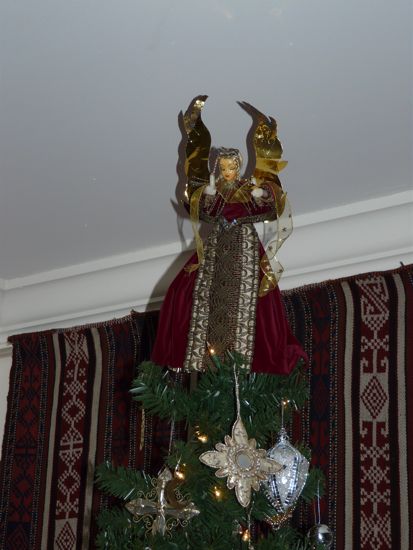
Our tree this year is smaller – and higher – that other years, and all the ornaments on it are unbreakable. Yes. Happy Baby, now Happy Toddler, will be coming by and I want to protect him – and the tree. Over the years we have collected so many wonderful ornaments that I have a lot to work with, and still manage to have a nice tree; the angel on the top is a traditional angel from Nurnberg, and we bought it the first year we were married. It’s nice to have her high on the top of the tree once more.

Under the tree, covering the table, is a special wool sefsari we bought when we lived in Tunisia, bright red with bands of gold trim. These were everywhere when we lived there, especially in the cold winters, but when we visited, I no longer saw them in any stores. Covering the tree stand, I have one of my smaller Damascus tablecloths; I treasure these coverings, and beads, Pensacola parade beads.

“Beads!” we shouted to Happy Toddler as we put them over his head.
“Beads!” the crowd shouted as the floats went by at the Pensacola Christmas Parade last night.
Last year, even as a Happy Baby, the parade was an enthralling event. What baby wouldn’t love a parade that starts with flashing lights, and motorcycles, and a loudly wailing, lights fashing FIRE TRUCK?? What Happy Toddler wouldn’t love the bands with the throbbing drums, and trumpets, and tubas, and trombones? And the dancing girls, and oh yes – the BEADS! Life is sweet at the Pensacola Christmas Parade.
The parade starts at 5:15 and we get there about 5:14. Here is what I love about Pensacola; you can get there at 5:14 and get a place to park only about 1/2 a block from the parade and be there when the spectacle begins. It is a laid back kind of parade, still a community parade, you see your friends there. It is sort of a Christmas parade, you see some Santas, and some reindeer, and snowmen, and there is usually at least one float with angels, but it is also sort of Mardi Gras, with all the Krewes (local social groups focused on Mardi Gras) on floats with their buds throwing beads, coins, toys and candy out into the waiting, dancing crowd.
Technically, I know this isn’t a great photo because you can’t even really tell what it is, but it is the beginning of the parade, and I love the motion of it all:
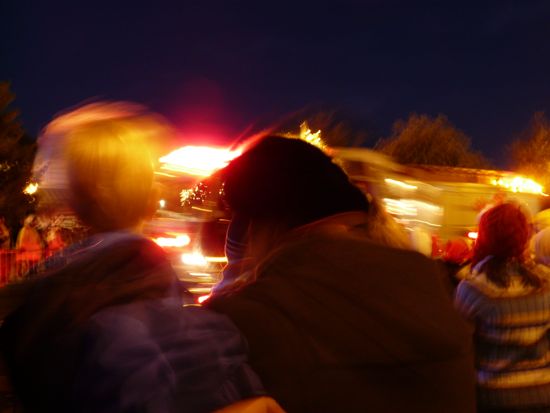

As it turned out, we were in a pretty good spot for catching beads, and we loaded down the Happy Toddler, put a few on each of us, and shared the bounty with some of the babies standing behind us. There were some people in front of us who caught a LOT of beads, and as soon as they caught them, they stashed them in a bag; they caught LOTS. Maybe they sell them back or something.
Last week, we took Happy Toddler to Boats on the Bayou, where boats decorated with Christmas lights gather near the bridge and then come parading to the park, and people gathered there sing Christmas Carols. Happy Toddler loves going to the park; the boats were interesting for about five seconds, and then he got to swing and play on the playground, which mattered a whole lot more to him:

It was just a really fun, community thing, and it was pretty, too.
Lunch at the Fish House, always a treat, and their tree is BLUE!

The Pensacola Christmas Parade attracts around 50,000 people every year. Imagine! It is so much fun. What I love about it is that there are so many floats, so many bands, so many civic heroes – you know how I feel about giving back to your community. These people are doing it. On one of the coldest nights of the year, they are on the Krewe floats throwing beads, they are patrolling behind the dog clubs, cleaning up, they are making sure the floats make the turn at Wright and Palafox, they are marching with bare legs in the cold, windy night – and it is so much fun.
Who would think that 50,000 people gathered in one place, competing for beads, would keep it all so civil? There is no place for ‘special people;’ we are all Pensacola citizens, there to enjoy a family evening, and it is just that, it is a great Pensacola evening, one of my favorite of the year.
Best of all was watching the Happy Toddler take it all in. The lights! The sirens! The beads, and the scrambling to catch them! The loud music, the pounding drums! It was all so much fun, and that fun was doubled watching him try to figure it all out. I can hardly wait ’till next year. 🙂
Law and Order SVU: How Did They Know and When Did They Know It?
What a tragedy. Joe Paterno, fired in disgrace. Joe Paterno, the much admired, the Penn State football coach who embodied integrity, fired, disgraced. “What did he know and when did he know it?” people ask.
What astonishes me is that the situation almost exactly parallels a recent episode of Law and Order SVU about which I recently blogged, in September.
In that episode, a much-admired football coach is reported to be preying on young men in his foundation, young men for whom he gave an opportunity to ‘be someone;’ he trained them, gave them motivation and the possibility of a lot of money, fame and good things for their very poor families. His victims were burdened by a debt of gratitude, combined with the shame of male-on-male sex, which they did not want to become public knowledge. The combination of gratitude and shame kept them silent, until one spoke out. It took a lot of courage, but finally, a big star who had come through this depraved coach’s program went public, appeared before the grand jury, and set the example.
The similarities are eerie. In Law and Order, however, the coach who had preyed on young players in the showers and locker rooms did not bring down a highly regarded top-ranking program director, and a university president.
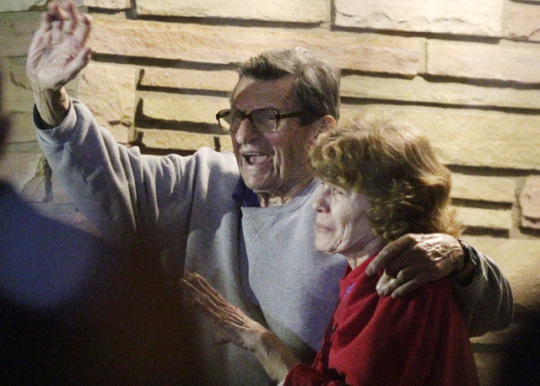
Joe, we are so sorry this has happened to you, and we hope that posterity will recognize that one poor decision is counter-balanced by a lifetime of integrity. We pray that young men victimized by Defensive Coach Jerry Sandusky will come forward, have their voices heard, and be able to move on with their lives, knowing that Sandusky will be punished. We pray for their families, who had no idea what was happening in their sons’ lives. It’s a sad time all the way around.
And thanks be to God, we live in a society where the trustees made the right decision, they fired the men who looked the other way as Sandusky victimized his young men. Thank God, this dirty laundry was not buried away to be forgotten, but brought forward, the perpetrator arrested and shamed publicly. There are times, in this world, when in the interest of the God of football, or the respect of position, when a scandal victimizing the poor and voiceless is shoved under the table, ignored, the victims sent the message that they don’t matter. As bitter as this pill is, I thank God for it, and for the increasing transparency in our society which begins to equalize justice for rich and poor.
Emergency Message for U.S. Citizens 2011-17 (Kuwait)
Kuwait City, Kuwait
October 13, 2011
To: All American Citizens
From: U.S. Embassy Kuwait-Consular Section
Subject: Emergency Message for U.S. Citizens 2011-17
Worldwide Travel Alert
U.S. Department of State
The Department of State alerts U.S. citizens of the potential for anti-U.S.
actions following the disruption of a plot, linked to Iran, to commit a
significant terrorist act in the United States. This Travel Alert expires on
January 11, 2012.
An Iranian-born U.S. citizen, working on behalf of the Iranian Islamic
Revolutionary Guard Corps Qods Force -designated by the Treasury Department in
2007 for its support of terrorism – is suspected of conspiring to assassinate
the Saudi Arabian Ambassador to the United States. The U.S. government assesses
that this Iranian-backed plan to assassinate the Saudi Ambassador may indicate a
more aggressive focus by the Iranian Government on terrorist activity against
diplomats from certain countries, to include possible attacks in the United
States.
U.S. citizens residing and traveling abroad should review the Department’s
Worldwide Caution and other travel information when making decisions concerning
their travel plans and activities while abroad. U.S. citizens are encouraged to
enroll in the Smart Traveler Enrollment Program
(STEP). U.S. citizens without internet access may enroll directly at the
nearest U.S. Embassy or U.S. Consulate. By enrolling, U.S. citizens make it
easier for the embassy/consulates to contact them in case of emergency.
Up-to-date information on security can also be obtained by calling
1-888-407-4747 toll-free in the United States and Canada or, for callers outside
the United States and Canada, on a regular toll line at 1-202-501-4444. These
numbers are available from 8:00 a.m. to 8:00 p.m. Eastern Daylight Time, Monday
through Friday (except U.S. federal holidays).
Stay up to date by bookmarking our Bureau of Consular Affairs website, which
contains the current Travel Warnings and Travel Alerts as well as the Worldwide
Caution. Follow us
on Twitter and the Bureau of Consular Affairs page on Facebook as well.
The U.S. Embassy Kuwait is located at Al-Masjid Al-Aqsa Street, Block 6, Plot
14, Bayan, Kuwait. If you are a U.S. citizen in need of emergency assistance in
Kuwait, you may reach the U.S. Embassy by calling +965-2259-1001 and requesting
the duty officer.
American citizens in Kuwait who would like to receive future Warden Messages
from the Embassy directly by e-mail may sign up for this service by sending an
e-mail to the following address: join-wardenmessagekuwait@mh.databack.com
This message may be accessed on the Embassy website, http://kuwait.usembassy.gov
Please note that the Consular Section is closed for U.S. and most local
holidays. The current holiday schedule for 2011 is posted on
http://kuwait.usembassy.gov/holidays.html.
Why I Love Reading James Lee Burke
For James Lee Burke, I make an exception to the paperback only rule. (Paperbacks are lighter, so if you fall asleep, they don’t hurt you when they fall over. They travel well on airplanes, and you can leave them behind when you finish them, and not feel bad. Yes, I have heard about Kindle. No, I don’t think it meets my needs. I like to pass books along.)
I was on the “mail it to me the day it comes out” list at Amazon for his newest book, a Hackberry Holland mystery set in the wilds of Texas. I hit page 2 and came across this:
“The sheriff had arrived at an age when he no longer speculated on the validity of a madman’s visions or, in general, the foibles of human behavior. Instead, Hackberry Holland’s greatest fear was his fellow man’s propensity to act collectively, in militaristic lockstep, under the banner of God and country. Mobs did not rush across town to do good deeds, and in Hackberry’s view, there was no more odious taint on any social or political endeavor than universal approval. . . “
His books transcend the banality of modern mysteries.
This book is Feast Day of Fools, and I’ll tell you more about it when I’ve finished.
Male on Male Sexual Abuse on Law and Order
AdventureMan teases me about my loyalty to the Law and Order Series . . . “Ripped from the headlines!” he will taunt me, when I flip the channel. We often watch separate TV’s when he wants to watch one of his droning military history channels and I want to watch Law and Order re-runs. But tonight’s L&O will tackle a topic no-one talks about – male on male rape and abuse.
I was so naive. I thought it only happened in prisons. While I was living in Qatar, I started hearing horrific stories about young men abducted and taken to the desert, often gang raped. Most of them lived, but had to deal with the aftermath of the violence and humiliation. In Kuwait, it was reported almost weekly in the papers, it was so common. I had a friend whose son was abducted, and walked with her through the horrors of the aftermath. Her greatest fear was that her son would commit suicide. He overcame his abduction, and is happy now, but the path was long, and full of perils along the way.
Male on male rape, like male on female rape, or any kind of rape, is not about sex. It’s about power. It’s about humiliation. It’s bullying taken to the extreme. It’s just wrong.
From AOL TV:
The second episode of ‘Law & Order: SVU’ Season 13 is one for the TV history books. Not only does it feature guest stars Dan Lauria, Mechad Brooks, Carmelo Anthony and Chris Bosh, but it’ll also tackle the taboo issue of male-on-male sexual violence.
In ‘Personal Fouls,’ a basketball coach known as a trusted mentor and figure in the community comes under suspicion of molesting a number of his players.
“This script was very exciting and I think the cast felt honored and excited to be able to talk about this issue because obviously sexual violence is something people are scared to talk about,” series star Mariska Hargitay said at a recent press event on the ‘SVU’ set.
Hargitay’s The Joyful Heart Foundation, Wolf Films, NBC, 1in6 and A Call to Men are partnering in an effort to raise awareness about male-on-male sexual abuse.
“It takes so much courage to come forward and male-on-male sexual violence is even more swept under the carpet,” she said. “The statistics are frightening.”
According to statistics from 1in6, an organization that seeks to help male sexual abuse survivors, 19 million men in the United States are victims of sexual abuse.
“It’s exciting to do a show about it because obviously when things are on TV somehow they’re made OK to talk about and that’s been exciting.”
The partnerships between the organizations hope to spread awareness about the subject. Hargitay said one of the objectives is to “let male survivors know they’re not alone and there are so many people that want to help them.”
“It’s not a shameful secret that you should keep to yourself, that the blame belongs with the perpetrator, not the survivor,” she said.
Recent Comments
intlxpatr on Shampoo Ginger tigerbutterya0c5ff1d… on Shampoo Ginger intlxpatr on British Soldier Kidnapped, Esc… John on British Soldier Kidnapped, Esc… intlxpatr on British Soldier Kidnapped, Esc… Wikipedia Donate Button

Amazina


Early Voting in Florida


