Your Vote – The Power of We (Blog Action Day 2012)
This year, in the United States we are going through a vicious process, that of choosing one candidate over another for political office. Many people are so put-off by the mechanics of the process that they opt out of the choosing altogether. Others are just too busy to vote, beset by the needs of family, job, car pool, church, social activities, etc. in spite of the ease with which one can ask for and receive an absentee ballot.
You need only live in a country where people have no meaningful vote to quickly learn the value of your vote. Your vote may be just one, but in a democracy, where just one vote can turn an election – your vote counts. Together, with other voters of your persuasion, your vote counts.
There has never been a country where women have the vote and men don’t. Sadly, the opposite is true; there are still countries where women are not considered fully qualified to vote. Less than 100 years ago, our own country was one of them. Yes, it’s true, we didn’t get the vote until 1920. I reprint the following from a post I wrote several years ago, a post I have never forgotten, because it was so shocking to me when I read the price these women paid that I might freely vote today.
“The doctor admonished the men: ‘Courage in women is often
mistaken for insanity.’”
We may have different preferences for who gets elected; that doesn’t matter to me. What matters to me is the power of we – that we care enough about our country and its policies to exercise our right as citizens, to get out there and vote.
This is reblogged from July 17, 2008:
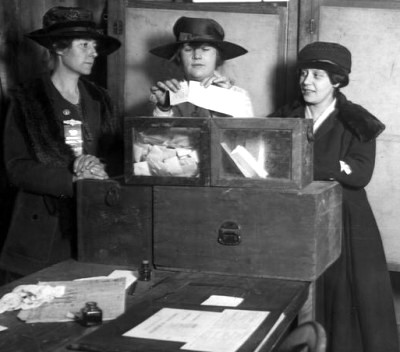
WHY EVERY WOMAN SHOULD VOTE
This is the story of our Grandmothers, and Great-grandmothers, as they
lived only 90 years ago. It was not until 1920 that women were granted
the right to go to the polls and vote.
Thus unfolded the ‘Night of Terror’ on Nov. 15, 1917, when the warden at
the Occoquan Workhouse in Virginia ordered his guards to teach a lesson
to the suffragists imprisoned there because they dared to picket Woodrow
Wilson’s White House for the right to vote. The women were innocent and
defenseless. And by the end of the night they were barely alive. Forty
prison guards wielding clubs and their warden’s blessing went on a
rampage against the 33 women wrongly convicted of ‘obstructing sidewalk
traffic.’
They beat Lucy Burn, chained her hands to the cell bars above her head
and left her hanging for the night, bleeding and gasping for air. They
hurled Dora Lewis into a dark cell, smashed her head against an iron bed
and knocked her out cold. Her cell mate, Alice Cosu, thought Lewis was
dead and suffered a heart attack. Additional affidavits describe the
guards grabbing, dragging, beating, choking, slamming, pinching,
twisting and kicking the women.
For weeks, the women’s only water came from an open pail. Their
food–all of it colorless slop–was infested with worms. When one of the
leaders, Alice Paul, embarked on a hunger strike, they tied her to a
chair, forced a tube down her throat and poured liquid into her until
she vomited. She was tortured like this for weeks until word was
smuggled out to the press.
So, refresh my memory. Some women won’t vote this year because–why,
exactly? We have carpool duties? We have to get to work? Our vote
doesn’t matter? It’s raining?
Last week, I went to a sparsely attended screening of HBO’s new movie
‘Iron Jawed Angels.’ It is a graphic depiction of the battle these women
waged so that I could pull the curtain at the polling booth and have my
say. I am ashamed to say I needed the reminder.
All these years later, voter registration is still my passion. But the
actual act of voting had become less personal for me, more rote.
Frankly, voting often felt more like an obligation than a privilege.
Sometimes it was inconvenient.
My friend Wendy, who is my age and studied women’s history, saw the HBO
movie , too. When she stopped by my desk to talk about it, she looked
angry. She was–with herself. ‘One thought kept coming back to me as I
watched that movie,’ she said. ‘What would those women think of the way
I use–or don’t use–my right to vote? All of us take it for granted
now, not just younger women, but those of us who did seek to learn.’ The
right to vote, she said, had become valuable to her ‘all over again.’
HBO released the movie on video and DVD. I wish all history, social
studies and government teachers would include the movie in their
curriculum. I want it shown on Bunco night, too, and anywhere else women
gather. I realize this isn’t our usual idea of socializing, but we are
not voting in the numbers that we should be, and I think a little shock
therapy is in order.
It is jarring to watch Woodrow Wilson and his cronies try to persuade a
psychiatrist to declare Alice Paul insane so that she could be
permanently institutionalized. And it is inspiring to watch the doctor
refuse. Alice Paul was strong, he said, and brave. That didn’t make her
crazy. The doctor admonished the men: ‘Courage in women is often
mistaken for insanity.’
Please, if you are so inclined, pass this on to all the women you know.
We need to get out and vote and use this right that was fought so hard
for by these very courageous women. Whether you vote democratic,
republican or independent party – remember to vote.
History is being made.
The War We are Losing: Assault of American Servicewomen
Shocking, and sad. What can be worse than serving your country and to be assaulted by a member of your own team? To double that shock and betrayal, to have the team captains bury your injury for the sake of the team?? I thank God for the gals that are taking their cases to civil court and making a stink. Sometimes, that is what it takes to make people pay attention.
I have a friend, a friend in her sixties. She has served in Iraq and Afghanistan as a civilian, and she has had senior officers stalk and attack her. She is disgusted that senior leaders could feel so entitled, and so free from constraints.
I can’t print this whole article here, but it is fascinating. You can read the entire article from Huffpost: HERE.
Active-duty female personnel make up roughly 14.5 percent — or 207,308 members — of the more than 1.4 million Armed Forces, according to the Department of Defense.
One in three military women has been sexually assaulted, compared to one in six civilian women, according to Defense. According to calculations by The Huffington Post, a servicewoman was nearly 180 times more likely to have become a victim of military sexual assault (MSA) in the past year than to have died while deployed during the last 11 years of combat in Iraq and Afghanistan.
According to the most recent report by the Pentagon’s Sexual Assault Prevention and Response Office, 3,192 sexual assaults were reported out of an estimated 19,000 — roughly 52 a day — between Oct. 1, 2010, to Sept. 31, 2011. The department estimates that only roughly 14 percent of the assaults were reported. The majority of sexual assaults each year are committed against service members by service members, SAPRO reports. While MSA does not affect only women, the office characterizes the “vast majority” of victims as female junior enlists under the age of 25, and the “vast majority” of perpetrators as male, older (under the age of 35) and generally higher-ranking.
Last Tuesday, Defense Secretary Leon Panetta ordered a sweeping review of all initial military training across the services: Army, Navy, Air Force, Marine Corps and Coast Guard. The move resulted in part from mounting pressure at Lackland Air Force Base in Texas, where at least 43 women have recently come forward as victims of sexual assault. Every aspect of training, from the selection of instructors who directly supervise trainees to the number of female instructors, is under consideration. And a day after Panetta issued the directives, Defense officials revealed that Jeffrey A. Sinclair — a brigadier general with five combat tours behind him — is facing possible courts martial on charges ranging from inappropriate relationships with female subordinates to forcible sodomy.
On Friday, Panetta called the military’s record on prosecuting MSA an “outrage.”
Panetta’s refrain for years has been heartening: “One sexual assault is too many.”
To which Havrilla responds, “This whole concept of ‘zero tolerance,’ it’s just words and no action.”
“You can’t leave. You can’t quit. You can’t walk away.”
We were in the military when the first women were sent to serve with formerly all-male battalions. There was a lot of controversy, and a lot of chagrin among the men. I think those first women were some of the bravest women ever. Almost forty years later, the battle is still being fought. Militaries attract the guys with high testosterone, the guys who don’t think the rules, laws and boundaries apply to them – and slowly, slowly, they have to be brought to understand that yes, the rules apply to them, and that forcible sex with another woman – or man – is OFF LIMITS. Bravo to those brave women who go public and create awareness and disgust for this problem. Evil whens men get away with this despicable crime.
Wil Saudi Arabia Curb the Morals Police?
This is a tiny little article in the Qatar Gulf Times:
New curbs on Saudi moral police: reports
AFP/Riyadh
Saudi Arabia will curb the powers of its religious police, a newspaper report said yesterday.
“The new system will set a mechanism for the field work of the committee’s men which hands over some of their specialisations to other state bodies, such as arrests and interrogations,” Al Hayat daily quoted religious police chief Sheikh Abdullatiff Abdel Aziz al-Sheikh as saying.
Agents of the body known as the Commission for the Promotion of Virtue and Prevention of Vice will also be banned from carrying out “searches without prior approval from the governor”, he said.
Okaz daily also reported that the religious police agents will be prohibited from “standing at the entrances of shopping malls to prevent the entry of any person”, referring to attempts by agents to ban women who do not comply with the Islamic dress code and unmarried couples from entering malls.
Sheikh was appointed in January as the new chief of the religious police. Two weeks into his post, he banned volunteers from serving in the commission which enforces the kingdom’s Islamic rules.
In April he went further, prohibiting the religious police from “harassing people” and threatening “decisive measures against violators”.
In June, Sheikh came out strongly against one of his men who ordered a woman to leave a mall because she was wearing nail polish.
The woman had defied the orders as she filmed her argument with the policeman and posted it on YouTube.
Donna Leon and Beastly Things Made Me Cry

I can always count on Donna Leon. She gives me a good read, a solid mystery, a social issue, the louche damp atmosphere of Venice and the Venetian aristocracy, and my good friend Guido Brunetti, police commissario, with his lovely wife and dear children and great Italian meals.
This time, she fooled me.
A barrel chested man is found floating in the canals with no identification. When identified, he is found to be a veterinarian, separated from his angry and hostile and broken-hearted wife.
Then Donna Leon pulls me way out of my comfort zone – TWICE. First, there are parts of the book I can scarcely read, as she talks about the meat industry. I’m reading this book, dealing with the meat industry, and I’ve just watched the movie GreY posted on the devastation meat eating causes in your metabolism and blood; the passages in Beastly Things sealed the deal – I don’t think I can eat red meat again. I’m not sure I can even be around red meat. Leon is fearless; she spotlights issues few dare to tackle. There are issues here that are not for the faint-hearted. Read at your own risk.
It’s a tricky mystery, and at the end, Leon catches me by surprise again, as she describes the funeral of the veterinarian, a very unusual funeral, where his patients are also in attendance. It was hard to read. My eyes were blurring. If you like mysteries, if you have pets you adore, this is the sweetest literary funeral you will ever attend.
Big Brother Exploring Crowd Control

I find this terrifying, on the lines of those loud, destructive aliens in that Tom Cruise movie about an invasion from outer space. Have you ever heard a noise so loud you couldn’t think? Couldn’t hear? Now imagine that noise in your mind! The potential applications for this technology whether for crowd control or warfare are appalling.
Microwave Ray Gun
Under a research contract from the U.S. Navy, microwave ray guns are being developed by Sierra Nevada Corp. that are designed to beam sounds directly into people’s heads at a distance of up to several hundred yards away. The device—dubbed MEDUSA (Mob Excess Deterrent Using Silent Audio)—exploits the microwave audio effect, in which short microwave pulses rapidly heat tissue causing a sound effect “loud” enough to cause discomfort or even incapacitation. While
supposedly intended for non-lethal use in crowd control, future military uses for this type of technology are sure to arouse the imagination.
Ten Shot While Kuwaiti Youngsters Are ‘Just Having Fun’
As AdventureMan and I read the Pensacola News Journal, we often wonder if we knew what we were getting into. Shootings in Pensacola are frequent. Killings, by gun, by beating, by knife – are equally frequent. Pensacola has one of the highest violent death rates per capita in the nation. Just this week a 72 year old man shot a preacher at his church because he thought the preacher was having an affair with his 69 year old wife. He then tried to enter the child care center where she was caring for small children, still with his loaded weapon. The paper quotes his wife as saying he has mental health issues.
What are people with mental health issues doing with loaded guns???
My Southern friends ask me if we more strictly regulate guns, how will they protect themselves, that the ‘bad guys’ will still have guns. Right now, they can protect themselves, they also have the right to shoot to defend their property? I can’t answer. All I know for sure is that the more people who carry guns, the more likely guns are to be used when the instinct strikes, whether it is a real threat or a perceived threat.
And then – there are these Kuwaiti teens, shooting passers-by, and when arrested, still carrying the shotgun used, say that they were ‘just having fun.’
KUWAIT: Jahra detectives, in cooperation with criminal investigation detectives, have arrested two Kuwaiti 17-year-old juveniles on charges of misuse of a hunting gun, which resulted in the shooting and wounding of 10 people in Jahra area. Police received several reports of pedestrians being wounded after they were shot by unknown assailants. Following an investigation, the juveniles were arrested with the gun still in their possession. They confessed to the shootings, claiming they were only having a good time. The teens were sent to concerned authorities. Later, Ministry of Interior officials called upon citizens and expatriates to watch their children and prevent them from behaving in ways that might cause harm to others, as the parents could be held liable for their children’s acts.
By Hanan Al-Saadoun, Staff Writer
Kuwait Times
The link refers to ‘hunting gun misuse.’ Because they are Kuwaiti, and because they are young, they are unlikely to have any severe punishment. They are likely to be released into the custody of their parents. Where were these parents when their children wounded ten innocent people? What lesson do these young men, 17 years old, learn if they can shoot ten people and be charged with ‘misuse’ of a weapon?
The only good thing I can think of in this case is that these youngsters had so little self-discipline that they never learned to shoot straight, thus no one was killed. They weren’t just lacking in any compassion for their fellow human beings, they were also bad shots. (I’m from a hunting culture. That’s an insult.)
James Lee Burke and the Creole Belle
James Lee Burke is number one on my guilty-pleasures list.

I first met his main character Dave Robicheaux in A Morning For Flamingos, a book I picked up in a military library at Lindsay Air Station, a post that doesn’t even exist any more. In the cold dark endless winter in Wiesbaden, Germany, James Lee Burke lit up my life. I had thought I was picking up just another escapist mystery novel, but when James Lee Burke puts words together to describe the way a storm moves in over the bayou, prose becomes poetry.
There is a downside. Whether it is his character Dave Robicheaux, the former New Orleans cop, now head homicide investigator in New Iberia, Louisiana, or his Hackberry Holland series set in West Texas, James Lee Burke’s books are filled with extreme violence and disturbing images that live in your head for a long time.
I’ve recommended James Lee Burke to friends, some of whom have said “Why do you read this trash??? It is HORRIBLE! It is full of over-the-top violence!”
And then again . . . he is writing about some really really bad people. They are out there. There are people who exist who inflict cruelty. I don’t understand it, I can’t begin to fathom where the urge would come from, but I’ve seen it. It’s out there. James Lee Burke pulls up that rock and exposes the dark happenings underneath.
On one level, as I started reading Creole Belle, I thought “Oh James Lee Burke, stop! Stop! It’s the same old formula! A downtrodden victim (often a beautiful woman) cries for help. You and Clete start looking for information and end up beating people up and then they retaliate by threatening your family! There is a rich, beautiful woman who seems vulnerable and who you kind of like, but she is complicated. There are rich amoral people who keep their hands clean, but who are calling the shots and never go to jail! Stop! Stop!”
Well, I should say that, and maybe I should stop. Then he starts talking about the smoke from the sugar cane fields and the bridge over the Bayou Teche, and the big Evangeline oak in St. Martinsville, and I am a goner. I’m sucked in, I’m hooked.
I detest the violence and the images. I keep coming back because James Lee Burke has some important things to say.
I’d love to have him to dinner. I’d love for him and our son to have a chance to talk about Law Enforcement. Here is what James Lee Burke has to say in Creole Bell:
There are three essential truths about law enforcement: Most crimes are not punished; most crimes are not solved through the use of forensic evidence; and informants product the lion’s share of information that puts the bad guys in a cage.
My son hates shows like CSI, and Law and Order, where the evidence convicts the criminals. He says it raises unreal expectations in juries, and makes it harder to get a conviction.
We watched a Violation of Parole hearing, or actually a series of hearings, where the judge asked each individual whose parole was about to be revoked what had happened when he or she was re-arrested. In each case, the parolee had done something stupid; drove a car with an expired license, drove to another state, was arrested driving drunk, etc. EVERY time. The judge made his point, I believe.
From Creole Belle:
But if Caruso was the pro Clete thought she was, she would avoid the mistakes and geographical settings common to the army of miscreants and dysfunctional individuals who constitute the criminal subculture of the United States. Few perpetrators are arrested during the commission of their crimes. They get pulled over for DWI, an expired license tag, or throwing litter on the street. They get busted in barroom beefs, prostitution stings, or fighting with a minimum-wage employee at a roach motel. Their addictions and compulsions govern their lives and place them in predictable circumstances and situations over and over, because they are incapable of changing who and what they are. Their level of stupidity is a source of humor at every stationhouse in the country. Unfortunately, the pros – high end safecrackers and jewel thieves and mobbed-up button men and second story creeps – are usually intelligent, pathological, skilled in what they do, middle class in their tastes and little different in dress and speech and behavior from the rest of us.
And then there are paragraphs like this that discuss the human experience, and have a far wider application than the book:
No one likes to be afraid. Fear is the enemy of love and faith and robs us of all serenity. It steals both our sleep and our sunrise and makes us treacherous and venal and dishonorble. It fills our glands with toxins and effaces our identity and gives flight to any vestige of self-respect. If you have ever been afraid, truly afraid, in a way that makes your hair soggy with sweat and turns your skin gray and fouls your blood and spiritually eviscerates you to the point where you cannot pray lest your prayers be a concesion to your conviction that you’re about to die, you know what I am talking about. This kind of fear has no remedy except motion, no matter what kind. Every person who has experienced war or natural ctastrophe or man-made calamity knows this. The adrenaline surge is so great that you can pick up an automobile with your bare hands, plunge through glass windows in flaming buildings, or attack an enemy whose numbers and weaponry are far superior to yours. No fear of self-injury is as great as the fear that turns your insides to gelatin and shrivels your soul to the size of an amoeba.
Last, but not least, this is what keeps me coming back to James Lee Burke, so much so that I buy the book almost as soon as it is released. James Lee Burke isn’t afraid to take on the big guys. He “gives voice to those who have no voices.” (Proverbs 31:8) His focus is always on the dignity of the common man, the dignity of hard work, done well, and on the dignity of doing unexpected kindnesses to those who have no expectation of kindness.
. . . All was not right with the world. Giant tentacles of oil that had the color and sheen of feces had spread all the way to Florida, and the argument that biodegradation would take care of the problem would be a hard sell with the locals. The photographs of pelicans and egrets and seagulls encased in sludge, their eyes barely visible, wounded the heart and caused parents to shield their children’s eyes. The testimony before congressional committees by Louisiana fisher-people whose way of life was being destroyed did not help matters, either. The oil company responsible for the blowout had spent an estimated $50 million trying to wipe their fingerprints off Louisiana’s wetlands. They hired black people and whites with hush-puppy accents to be their spokesmen on television. The company’s CEO’s tried their best to look ernest and humanitarian, even though the company’s safety record was the worst of any extractive industry doing business in the United States. They also had a way of chartering their offshore enterprises under the flag of countries like Panama. Their record of geopolitical intrigue went all the way back to the installation of the shah of Iran in the 1950’s. Their even bigger problem was an inability to shut their mouths.
They gave misleading information to the media and the government about the volume of oil escaping from the blown well, and made statements on worldwide television about wanting their lives back and the modest impact that millions of gallons of crude would have on the Gulf Coast. For the media, their tone-deafnessness was a gift from a divine hand. Central casting couild not have provided a more inept bunch of villains.
James Lee Burke has a voice, and he uses it. He could just cash in on his reputation as an Edgar Award winning author, but he uses his voice to speak out against injustice and corruption. He is a champion of the people. I’ve written several book reviews, and taken some trips just because I wanted to see James Lee Burke country; if you are interested in those, you can read them here.
I have a concern about this series, in that this book ended differently than all the others. So differently it made me seriously question whether Burke intends to continue writing about Dave Robicheaux or if Dave is about to hang up his shield and call it a day. He’s a guilty pleasure I am not yet ready to give up.
Confiscated Liquor in Kuwait Came in Under US Army Guise
From today’s Kuwait Times
Concerns About Liquor Smuggling
After stopping two containers loaded more than 1500 cartons of alcohol on June 12, 2012 by customs authorities and drug enforcement officials, it was learned that those containers were consigned to the US army. I have started researching that case and collected information with one question in my head, how smuggling happened through goods consigned to the US army and are there parties in the army involved in this smuggling or had this been a case of good intentions by the official who signed the order?
I collected too much information using official documents and am publishing this with the hope that officials in the US Army or Ministry of Interior stop this smuggling, which might harm the American army or our state. Today, the American Army seems to be penetrated, to some extent.
When the American army forces were in Iraq, they contracted with many local and international companies for logistics and transportation of its equipment and personnel and to provide basic services and foodstuff for the army.
In the beginning, the US army used to monitor every small thing happening, but after withdrawing from Iraq, and keeping their forces in Kuwait, things have changed. The army’s main concern is to guard its equipment and personnel, which arrives in Kuwait from outside and is brought to its camps in convoys. Similar concerns apply when they export this equipment from their camps to Kuwaiti ports. Up until loading equipment aboard vessels, the cargo remains under guard.
Regarding food supplies, this was assigned to local and international companies, and have deployed officers from the American army whose role was only to stamp the order papers, as those contracting companies brought whatever they wanted, claiming it was for the American army.
According to the information I received, about 1,000 containers are shipped daily from Kuwaiti ports to the American army, including 700 containers through Shuwaikh Shuaiba port, and these containers are loaded with whatever the American army needs.
Looking at carton declarations, I found large number of containers loaded with oil, battery water, and coolant water for radiators for the American army vehicles, though most of the vehicles do not move and have stopped in their place. These were the same cargo containers found to be loaded with liquor.
We do not know if other containers were smuggled before, although the information supports that theory. Also, there are several containers still in the port awaiting completion of customs formalities. The contents of the trailers stopped by Kuwaiti officials had been unknown, though they were monitored by drug enforcement officials beginning immediately after leaving the port of Shuwaikh and heading to Arifjan camp, along with a convoy of trailers.
When the trailer deviated from the convoy and headed to the Subhan area, it was stopped and the driver was arrested, along with the person who brought the shipment and another container was stopped after the completion of the formalities. When transporting containers to the American army, some contracting companies or persons might bring in whatever they want, under the guise that it is cargo for the American army and cannot be inspected, as per agreement with the two countries.
If the American army is careless in protecting itself, and the army knows very well that war is not only a showdown between two armies, but also of how an army can be harmed through keeping poisonous materials in their food or through chemicals in their equipment, even if those materials were not important.
We thank the ministry of interior for stopping the two containers, yet the ministry is requested to take necessary precautions to apprehend those containers which might be loaded with arms or explosives and can cause harm to the security of our state. The American army can monitor those containers loaded on trailers through convoys traveling to their camps and know the number of containers that left the port and the number that arrive at the camps. – Al-Anba
By Hamad Al Sarie
“Nobody wins. We’ve all lost.”
Guilty. A fitting end to a sorry story. A man who used his position to prey on the most vulnerable, poor children. He brought down one of America’s heroes, Joe Paterno, and cast a stain on a stellar football school. Although he is convicted, as one victim’s mother states, there are no winners here – the kids will have to live with his betrayal for the rest of their lives. My guess is he still believes he did nothing wrong. These guys tell themselves that their victims are willing. Put the man away.
BELLEFONTE, Pa.—Jerry Sandusky was convicted Friday of sexually assaulting 10 boys over 15 years, a swift and emphatic end to a case that shattered Penn State University’s Happy Valley image and brought down Hall of Fame football coach Joe Paterno.
Sandusky, a 68-year-old retired defensive coach who was once Paterno’s heir apparent, was found guilty of 45 of 48 counts and is almost certain to spend the rest of his life in prison.
The jury of seven women and five men, including nine with ties to Penn State, deliberated more than 20 hours over two days.
Sandusky showed little emotion as the verdict was read. Judge John Cleland revoked his bail and ordered him taken to the county jail to await sentencing in about three months. Many of the charges carry mandatory minimum sentences.
Sandusky half-waved toward his family in the courtroom as the sheriff led him away. Outside, he calmly walked to a sheriff’s car with his hands cuffed in front of him.
The accuser known in court papers as Victim 6 broke down in tears upon hearing the verdicts, and a prosecutor embraced him and said, “Did I ever lie to you?”
The man, now 25, testified that Sandusky called himself the “tickle monster” in a shower assault. He declined to comment to a reporter afterward, but his mother said: “Nobody wins. We’ve all lost.”
Almost immediately after the judge adjourned the case, loud cheers could be heard from a couple hundred people gathered outside the courthouse as word quickly spread that Sandusky had been convicted. The crowd included victim’s advocates and local residents with their children.
As Sandusky was placed in the cruiser to be taken to jail, someone yelled at him to “rot in hell.” Others hurled insults and he shook his head no in response.
Lead defense attorney Joe Amendola was interrupted by cheers from the crowd on courthouse steps when he said, “The sentence that Jerry will receive will be a life sentence.”
Eight young men testified in a central Pennsylvania courtroom about a range of abuse, from kissing and massages to groping, oral sex and anal rape. For two other alleged victims, prosecutors relied on testimony from a university janitor and then-graduate assistant Mike McQueary, whose account of a sexual encounter between Sandusky and a boy of about 10 ultimately led to Paterno’s firing and the university president’s ouster.
Sandusky did not take the stand in his own defense, which Amendola said was a last-minute strategy change.
Defense attorney Karl Rominger said it was “a tough case” with a lot of charges and that an appeal was certain. He said the defense team “didn’t exactly have a lot of time to prepare.”
Amendola praised the prosecution, the judge and the jury and added: “Jerry indicated he was disappointed with the verdict, but obviously he has to live with it.” He said he would appeal.
Pennsylvania Attorney General Linda Kelly thanked the accusers who testified, calling them “brave men.”
She said she hoped the verdict “helps these victims heal … and helps other victims of abuse to come forward.”
Jerry Sandusky faces up to 442 years in prison. (AP Photo)
“One of the recurring themes in this case was: Who would believe a kid?” she said. “The answer is: We here in Bellefonte, Pa., would believe a kid.”
Sandusky repeatedly denied the allegations, and his defense suggested that his accusers had a financial motive to make up stories, years after the fact. His attorney also painted Sandusky as the victim of overzealous police investigators who coached the alleged victims into giving accusatory statements.
But jurors believed the testimony that, in the words of lead prosecutor Joseph McGettigan III, Sandusky was a “predatory pedophile.”
One accuser testified that Sandusky molested him in the locker-room showers and in hotels while trying to ensure his silence with gifts and trips to bowl games. He also said Sandusky had sent him “creepy love letters.”
Another spoke of forced oral sex and instances of rape in the basement of Sandusky’s home, including abuse that left him bleeding. He said he once tried to scream for help, knowing that Sandusky’s wife was upstairs, but figured the basement must be soundproof.
Another, a foster child, said Sandusky warned that he would never see his family again if he ever told anyone what happened.
And just hours after the case went to jurors, lawyers for one of Sandusky’s six adopted children, Matt, said he had told authorities that his father abused him.
Matt Sandusky had been prepared to testify on behalf of prosecutors, the statement said. The lawyers said they arranged for Matt Sandusky to meet with law enforcement officials but did not explain why he didn’t testify.
Amendola said Sandusky reluctantly agreed not to testify in his own behalf because the son would have been called by the prosecution as a rebuttal witness and the defense feared that would destroy any chance of acquittal.
Defense witnesses, including Jerry Sandusky’s wife, Dottie, described his philanthropic work with children over the years, and many spoke in positive terms about his reputation in the community. Prosecutors had portrayed those efforts as an effective means by which Sandusky could camouflage his molestation as he targeted boys who were the same age as participants in The Second Mile, a charity he founded in the 1970s for at-risk youth.
Sandusky’s arrest in November led the Penn State trustees to fire Paterno as head coach, saying he exhibited a lack of leadership after fielding a report from McQueary. The scandal also led to the ouster of university president Graham Spanier, and criminal charges against two university administrators for failing to properly report suspected child abuse and perjury.
The two administrators, athletic director Tim Curley and now-retired vice president Gary Schultz, are fighting the allegations and await trial.
The family of Paterno, who died exactly five months before Sandusky’s conviction, released a statement saying: “Although we understand the task of healing is just beginning, today’s verdict is an important milestone. The community owes a measure of gratitude to the jurors for their diligent service. Our thoughts and prayers continue to be with the victims and their families.”
In a statement, Penn State praised the accusers who testified and said that it planned to invite the victims of Sandusky’s abuse to participate in a private program to address their concerns and compensate them for claims related to the school.
Sandusky had initially faced 52 counts of sex abuse. The judge dropped four counts during the trial, saying two were unproven, one was brought under a statute that didn’t apply and another was duplicative.
Upcoming Execution in Iran?
Thank you, John Mueller 🙂
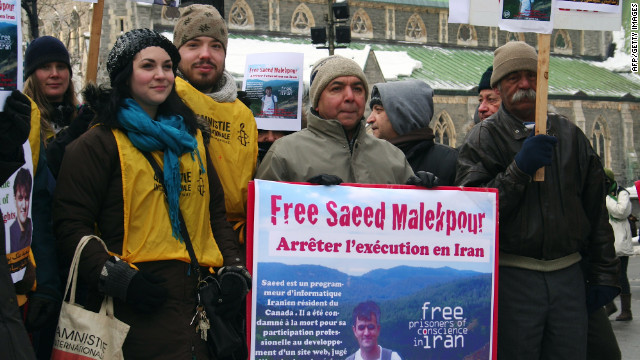
Supporters demonstrate in January for the release of Saeed Malekpour in Montreal, Quebec.
(CNN) — A computer programmer from Canada faces imminent execution in Iran for the actions of another person, which he had no control over, a human rights group says.
Saeed Malekpour wrote a program to upload photos to the Internet, an accomplishment that could cost him his life, Amnesty International reported Friday. Authorities in the Islamic Republic claimed his program was used by someone else to upload pornography and charged him with “insulting and desecrating Islam.”
Malekpour, who is a Toronto resident, was arrested in October 2008 while visiting relatives in Iran. He was convicted in a short trial and was sentenced to death in October 2011, according to Amnesty International.
Iran’s Supreme Court confirmed the sentence on January 17. Malekpour’s lawyers have been unable to ascertain the whereabouts of his court files since Tuesday and fear this could be an indicator that an executioner could carry out the sentence soon, Amnesty said. A court official suggested to the lawyers that the file had been sent to the Office for the Implementation of Sentences, according to Amnesty.
Malekpour sent a letter from prison detailing beatings and other mistreatment at the hands of Iranian prison officials to obtain a confession, said Hadi Ghaemi, executive director of the International Campaign for Human Rights in Iran.
“A large portion of my confession was extracted under pressure, physical and psychological torture, threats to myself and my family, and false promises of immediate release upon giving a false confession to whatever the interrogators dictated,” the letter says.
Malekpour’s supporters have created Facebook pages and websites in his support dating to at least 2009.
Amnesty International has requested on its website that concerned individuals write Iranian authorities inside and outside the country to demand that Malekpour not be executed.
Recent Comments
intlxpatr on Shampoo Ginger tigerbutterya0c5ff1d… on Shampoo Ginger intlxpatr on British Soldier Kidnapped, Esc… John on British Soldier Kidnapped, Esc… intlxpatr on British Soldier Kidnapped, Esc… Wikipedia Donate Button

Amazina


Early Voting in Florida


