What’s Really Hood: A Collection of Tales from the Streets by Wahida Clark, et al
Sometimes do you pick up a book and you don’t really know why you did? I saw this book in Target, and picked it up on an impulse. I read the cover and thought “you know, this is way out of my culture and out of my comfort zone” but then I thought hey – it’s a sub-culture in my own country, and like isn’t it hypocritical to be so interested in other cultures and then to ignore this sub-culture in my own country? Plus, I had a friend called Wahida, . . . well, it doesn’t have to make sense. It’s just the way it was.

I read the whole book. Some of what I read was frankly repellant. Some of the sex was so implausible that I can’t tell if my ideas are just way out of step with the changing times (and there are clues that this may be the problem) or that this sub-culture just has constant, earth-shaking sex.
The book contains five very different stories, but there are threads of similarity that appear in all five. Drugs are rampant, and destructive to individuals, couples, families, children, friendships, marriages, and the social context. Parenting skills are often fragile or non-existent. The male-female relationships are mostly exploitive.
And they all dream of a better life.
I think that’s what kept me reading. The stories are raw. You might not even like them at all, you might wish you had never heard of this book, but there is an honesty in the rawness, and a yearning to escape. The goal of all the easy money in the drug trade is mostly to GET OUT, to run away to some place safe, to live in a place where gunshots aren’t heard, and where kids can safely go to school.
I learned a lot from reading this book, but it was not an easy read. It is gritty, and characters you find yourself liking get killed off. It’s also stuck with me; I find myself thinking about things it brought to my attention. I’d love for you to read it too, and tell me what you think.
“So I Shot HIm . . . “
In Pensacola, people talk all the time about “carrying.” People have lots of weapons; even my tiniest little friend has a small revolver in her handbag when she goes out.
This old guy makes life a lot easier for the rest of us. Sometimes young guys get bad ideas, and these guys evidently thought they would hit and rob the old people. Guess they got quite a surprise. Guess they will think twice before doing another home invasion – once they get out of prison, which will probably be quite a while from now.
Resident shoots 2 teens in home invasion
Resident, 72, fends off 3 attackers; 1 suspect in hospital, 2 in jail
Two teenagers were shot Saturday night by a 72-year-old man they allegedly beat with a baseball bat during a home-invasion robbery in Ferry Pass.
About 8:45 p.m., three teenage males knocked on the door of a home in the 3300 block of Raines Street, Pensacola Police Department officials said.
When resident Jack Crawford, 72, answered the door, one of the teens hit him in the head with an aluminum bat and tried to force his way into the home.

“I opened it up, and he hit me right off. … Wham! Split my head open,” Crawford said.
“So I shot him and another guy,” Crawford said, chuckling as he told the story to a News Journal reporter Sunday evening. “I could have shot the third one, but I would have had to shoot him in the back as he ran away.”
The attackers fled the scene on foot, and Crawford’s 70-year-old sister, who also lives at the home, called the police, he said.
Earl Benard, 15, Nathaniel Nichols, 17, and Curtis Crenshaw, 18, all of Pensacola, have been charged with home-invasion robbery and aggravated battery in connection with the case, police said.
Crenshaw and Nichols were arrested at a local hospital after being dropped off for treatment with gunshot wounds to their torsos. Benard later was arrested at a nearby rental home.
Nichols remained hospitalized Sunday afternoon, police said. Crenshaw was treated and released and was being held Sunday evening at Escambia County Jail on $300,000 bond.
State Attorney Bill Eddins said he plans to try all three suspects as adults.
Crawford said he grabbed his handgun as a precaution and was holding it at his side when he opened the door Saturday night.
“At 9 o’clock at night, I never take any chances,” Crawford said.
The three teens had “hoods on and scarves around their faces,” Crawford said, and they hit him with the bat before anyone had a chance to speak.
Crawford stumbled back a step from the blow but didn’t fall, and he started shooting as the first attacker was coming through the door, he said.
“I didn’t go down, and I think it shocked him,” Crawford said.
Following the attack, Crawford was transported by ambulance to West Florida Hospital for treatment of injuries to his head. He said doctors stapled his scalp back together, and he was back at home and feeling fine Sunday evening.
“Yeah I’m fine. I’ve got a hard head,” Crawford said.
Police did not release any information Sunday about possible connections between Crawford and the teens. Crawford said he’s lived in the neighborhood about 12 years, and he suspects the attackers were acquaintances with a neighborhood boy who used to do odd jobs around his home.
Crawford said he wasn’t too rattled by the attack, and he still felt comfortable staying in the home.
He said he’s had a rough-and-tumble past that’s left him with a cool head in similar situations.
“I’m not that big of a boy, but I had a reputation,” Crawford said.
I live next door to a cop. His car isn’t marked, but it is a big dark Crown Vic with that cage thing that separates the front from the back seats. Not that criminals are very smart, but you would have to be REALLY stupid to invade my house.
This story is from today’s Pensacola News Journal.
Al Jazeera (English) Covers Egypt
If you are in the USA, the best coverage I have been able to find has been on Al Jazeera live. They have English language coverage. Unlike Egypt, which has closed down all access to the internet, you can stream Al Jazeera live by clicking on the blue type below.
Their coverage is – from what I can tell – fair and balanced.

It’s in the mid 70’s Fahrenheit, in Cairo in the daytime, getting down to the 50’s – 60’s at night – perfect weather for a protest. Looks like Paris in the late 60’s.
The Glass Rainbow by James Lee Burke
“Here’s the book,” Sparkle said, sliding into the restaurant seat as we all poured over the menu, wafts of garlic, white wine and butter drifting our way. “I’m getting kind of tired of Dave and Clete.”
“What, you mean not just bending the envelope but tearing right through it?” I asked “Or all the gratuitous violence?”
“Mostly the scorn for official procedures,” she started, two little lines between her eyes as she took in all the delicious possibilities, “How about some of that Montepulciano?”
She passed the book along to me. I was in the middle of another book, but oh, the temptation to drop it and get on with a new James Lee Burke.

The book opens with Dave Robicheaux, our recovering alcoholic detective, meeting up with a convict on a work crew whose sister has disappeared and who was found murdered. Bernadette Latiolais’s remains are thought to be the work of a serial killer working the area who targets prostitutes, but Bernadette was an honor student, graduating with a full scholarship promised to a Louisiana university. She was also an heiress, in a small way, to some property at the edge of a swamp. She doesn’t fit the profile, and her brother wants justice – not for himself, he’s doing his time, but for his sister, who never did anything to anyone, and who wanted to create a conservation area to preserve bears.
Right off the top, Robicheaux is outside of his parish, investigating a case nobody cares about in an area out of his jurisdiction.
OK, OK, my sister is right, this is pretty much another formulaic James Lee Burke. There are the corrupt rich families, the amoral women, the voiceless victims. Instead of the old Italian organized crime families, this time there are hired mercenaries, equally creative in killing, but way more efficient in cleaning up afterwards.
I’m just a sucker for James Lee Burke’s writing. Here’s one sample, from his interview with a very rich old man who goes a long way back with Robicheaux’s family:
“Don’t get old, Mr. Robicheaux. Age is an insatiable thief. It steals the pleasures of your youth, then locks you inside your own body with your desires still glowing. Worse, it makes you dependent upon people who are half a century younger than you. Dont’ let anyone tell you that it brings you peace, either, because that’s the biggest lie of all.”
Burke’s Dave Robicheaux and his private-investigator friend Clete are flawed men, prone to violence, but I cut them a lot of slack because in each novel they are bright shining avengers of all the wrongs done to the weak and helpless. They are Quixotic. They fight the rich and powerful for the rights of the common man. They know the risks they take, and they are too old to think they are going to survive every bad guy they go after. It’s a good thing the law of averages doesn’t hold true in novels; they should have been dead a long time ago.
What keeps me coming back are the lyrical descriptions of life along the Atchafalaya Bayou, community life in New Iberia, Louisiana, and Robicheaux’s family life, wife Molly, daughter Alifair (now grown to young womanhood) and Snuggs their cat and Tripod their raccoon, as well as the knowledge that at the end of the book, in spite of every evidence to the contrary, Dave and Clete will emerge alive, if damaged, and their indirect and violent path will have achieved some semblance of justice.

(I ordered the spaghetti with a white-wine mussel sauce, and Sparkle ordered the chicken marsala. Mom had seafood diablo.)
Aftermath: Americans at War in the Muslim World
I guess it is no surprise to you that I love National Public Radio / BBC, etc. I learn things I never even knew I didn’t know. As I sat down to write a very different blog entry, I heard the following interview with journalist Nir Rosen, who talks about Americans and our outdated views of the Middle East and Muslim world.
You may be able to listen to the entire interview live by going to NPR Programs and clicking on The US At War in the Muslim World by Nir Rosen.
The US At War In The Muslim World: ‘Aftermath’ With Nir Rosen
Steve Scher
01/04/2011 at 9:00 a.m.
The US invaded Iraq nearly seven years ago. What have been the consequences of going to war in a Muslim country? Have the US invasions of Iraq and Afghanistan created more militancy among the Muslim population there? Have the radical Islamists gained a stronger following as a result of our presence there?
Journalist Nir Rosen has been asking these questions in his reporting from outside the green zones in Iraq and Afghanistan. His new book “Aftermath” tells a side of the story we rarely hear.
Amer Al Hilal on Kuwait’s Ban on DSLR Cameras
Woooooo Hooooo Amer Al-Hilal, a man I am proud to call my friend. It takes such great courage to speak out when something is going terribly wrong, and Amer knows how to do it articulately, rationally, and as the gentleman he is.

From his article in the Arab Times:
Camera ban regressive idea
‘Don’t stifle home-grown talent’
For a country that possesses a Constitution which safeguards civil liberties and freedom of speech, Kuwait sporadically sure likes toying with those liberties such as tentatively banning the Blackberry service, shutting down You Tube, impeding public gatherings and marches, banning and censoring books, literature, films and magazines which are available elsewhere in the Gulf.
This week according to media reports, and highlighted extensively in local Weblogs and Twitter, a palpable growing outcry is directed at the tentative plans by The Ministry of Information, Ministry of Social Affairs and Ministry of Finance to outlaw public photography and relegate it to journalism purposes only. This has allegedly resulted in the ban of Digital Single Lens Reflex Cameras (DSLRs) in public places. If this charade is true, then it bodes ill for this country, another regressive move into the annals of ignorance.
During the 1980s video cameras and photographic equipment were also shunned by the authorities. I remember visiting Failaka in 1985 and being confronted by a military officer who demanded I hand in my bulky video camera until I left the island. These types of infringements in the name of security were insignificant — we still had an attempt on HH the Amir, explosions at Foreign Embassies in Kuwait and an actual invasion.
Why does this country always attempt to stifle home-grown talent? Banning cameras in public places is demoralizing to all the passionate, talented young Kuwait men and women who have excelled in this field and love their hobby, not to mention visitors who attempt to document their travels here. Moreover, banning DSLR cameras is irrational and counterproductive if you think about it; in this day and age of iPhones, Blackberries, 5 MP plus camera phones, Google Earth and the like, anyone can take photograph of anything, quietly, without fanfare, which makes the potential DSLR ban even more preposterous.
I have just returned from a trip to Dubai where I witnessed dozens of tourists proudly using their cameras to document Burg Khalifa and the other picturesque locations. No one stopped them, impeded them or asked them what they were doing and you know why, because they respect people’s rights and are intent on making their country more appealing. UAE is able to manage security matters confidently because they have proper security and ID processes in place: eye scanners at airports and entry points, proper electronic government, high fines for breaking the law, a brilliant CCTV system in place in every street corner (not the shoddy black and white choppy, streaming-like quality of the limited equipment we have here) — they truly invest in their infrastructure, maintain it and upgrade it.
If Kuwait is serious about its security then it should invest in the same caliber of CCTV and not the bargain basement tenders that usually go towards ineffective systems (i.e. Highway signs with the useless ‘no mobile’ plasma screen) belonging to members of the matching ministry who want a ‘piece of the action’. The sad reality is the government sector here would rather ban something than actually strive to improve it through sheer hard work and effective processes. It’s just easier to ban; a question of laziness and neglect.
Needless to say, Kuwait seems unfazed when foreign jets infiltrate our airspace and take aerial shots of our oil refineries and military installations, or when agents and their local conspirators are found to possess blueprints and photographs of said installations, but no, lets go after the ‘little guy’, the amateur photographer or tourist on the street taking pictures. It’s a hypocritical, spineless action by the authorities.
Moreover, I suspect the issue is not just relegated to security, a myriad of reasons could have led to the support of this ban, fundamentalists who felt cameras and pictures are a ‘Tool of the Devil,’ government officials and ministries disgraced at seeing shots of Kuwait’s dilapidated infrastructure, environment and mismanagement on weblogs, internet forums and magazines. You cannot conceal the squalid side of Kuwait; it is there for everyone to see.
Furthermore, this law against public photography will not be enforced, just as seatbelt, no mobile while driving, no litter, no smoking areas, and other ‘laws’ cannot be enforced in this Land of Confusion.
Amer Al-Hilal is webmaster of http://www.hilaliya.com and can be reached at amer@hilaliya.com.
A Little TSA Humor
Thank you, KitKat 🙂



Kuwait Ministries Ban Photography?
I am in total shock.
Thank you, Bit Jockey, for sending this to me, an article from the Kuwait Times.
We had so much fun! We had photo challenges, Kuwait sunsets, National Day Celebration photos, so much fun. And now, you can get arrested for taking photos? Not of military or political or sensitive buildings, not for reasons of national security, but . . . just because?

Most photographers in Kuwait are careful not to photograph women, or any citizens without their permission. Why on earth was this ban created?
How on earth will they enforce it? What are the penalties?
KUWAIT: After the ban three ministries placed on photography, most Kuwaiti youth are a bit confused about what to do with their cameras if they can’t use them in public and why such laws were implemented in the first place. The Ministry of Information, Ministry of Social Affairs and Ministry of Finance recently came to the conclusion that photography should be used for journalism purposes only. This has resulted in the ban of Digital Single Lens Reflex Cameras (DSLRs) in public, on the streets and in malls
.
What most Kuwaiti photographers have come to wonder is how such a decision could be reached by authorities, especially considering that digital cameras and cell phone cameras have the same abilities. What most people think of photography as a hobby has become a bit misguided due to the fact that the country has so little exposure to art. While using a DSLR, passersby may wonder if the camera is being used for the wrong reasons.
Mohammed Al-Eisa, who picked up photography as a hobby more than 10 years ago, said that he has decided to take photos of animals or still life due to the fact that these subjects don’t mind having their picture taken and don’t make a scene. “I started facing problems the very first day I bought my camera,” Mohammed added.
What often happens is that a big black camera tends to worry people. Taking a picture of a stranger would seem like much less of an issue if you were using a more discreet camera or even a cell phone. Mariam Al-Fodiry said that she has faced similar problems with her hobby and that being a girl doesn’t help at all. She said that in some cases it makes the problem even worse. “Switching to abstract and landscape photography was one the options I considered after getting into enough trouble,” Mariam said.
Majed Al-Saqer said that sometimes people stop him while he is in his car with his camera, as if he were planning to kill someone with it. He said that he isn’t sure what the real problem is, whether it is people taking photos of each other or the size of the camera.
Chase Ends with Suspect Trying to Drown Police and Police Dog
I loved reading the papers in Kuwait. What criminals could be so incredibly STUPID, I would wonder. (Here is my all time favorite Kuwait story.)
This morning, AdventureMan asked “Have you read the paper? Some guy had a high speed chase, then he tried to drown the policeman AND the policeman’s dog!”
No, I hadn’t read it. It is almost to stupid to be believed. What I do love is that the idiot is named in the Pensacola News Journal story and, of course, that his mother says he couldn’t have done it, LOL.
Chase Ends With Officer Fighting To Save His Life
Gulf Breeze Police Department Sgt. Stef Neff knows things can go bad in just a few seconds in his line of work.
That’s what happened in Gulf Breeze early Saturday morning when a traffic stop ended with Neff fighting for his life with a suspect in Hoffman Bayou.
“There is no lonelier feeling than that,” said Neff, a 15-year veteran who survived the fight without serious injuries. “I didn’t have any way to call anybody else. It was me and him.”
The suspect — Kyle Estes, 21, of Navarre — was eventually captured but it took more than an hour as he struggled in the water with two other officers and a police dog.
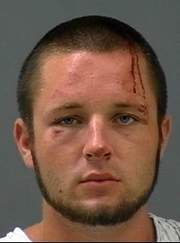
Estes remains in Santa Rosa County Jail today under $111,000 bond. He is facing a long list of charges related to Saturday’s fracas:
• Fleeing and eluding law enforcement officers.
• Obstruction of police.
• Aggravated battery.
• Resisting an officer.
• Driving while license is suspended or revoked.
• Hit and run.
• DUI with property damage.
The suspect’s mother hasn’t talked to him since the early morning battle, but she insists he is not violent by nature.
“It was totally out of character for Kyle to get violent like that,” Michelle Estes said today. “It was a very desperate and extreme attempt to get away from the police. I just think he didn’t want to get in trouble.”
The incident began when Gulf Breeze Police Officer Greg Baker tried to stop Estes at about 2 a.m. after seeing him speeding south on the Pensacola Bay bridge at about 95 mph, Neff said.
Baker followed Estes to Chanteclaire Circle, where Estes lost control of his vehicle and hit a cement wall, a mailbox and a tree, Neff said.
Estes jumped out the vehicle and ran. Neff and Gulf Breeze police officer Daylyn Wilson went to help Baker.
As Neff drove on Chanteclaire Circle, Estes ran by. Neff said he jumped out his vehicle, ran between some houses and pursued Estes to Hoffman Bayou.
Estes fell into the bayou from a rock embankment. Neff said Estes pulled him into the water.
“He tried to push me under the water,” Neff said. “He tried to drown me.”
Neff had no way to tell anyone where he was because his radio was disabled after being dunked in the water.
The Pensacola Police Department and Santa Rosa County Sheriff’s Office dispatched officers to help look for Neff.
Neff said he hit Estes in the head a few times with his flashlight as the two struggled in the water. He said Estes let him go after he hit him and started to swim across the bayou toward Laura Lane.
As Neff was coming out of the water, Wilson arrived. Neff told Wilson to head toward Laura Lane.
At first, Estes couldn’t be found after he swam away.
“He kind of hunkered down in some saw grass,” Neff said. “He just tried to wait us out.”
When Pensacola Police Officer Shawn Thompson made it to the area, he let his dog, Bandit, off his leash to search for Estes.
The dog found Estes hiding in the saw grass. Estes grabbed Bandit.
“Then he tried to drown the dog,” Neff said. “He was pulling the dog out into the bayou, holding him under the water.”
Thompson and Wilson jumped in to save Bandit. Estes started to swim away after taking some hits to the head with a flashlight, Neff said.
It wasn’t long before Estes was spotted under a pier. Neff and Santa Rosa County Sheriff’s Office Sgt. Judd White went into water and pulled Estes onto the pier.
None of the officers involved in the incident suffered serious injuries.
Estes was taken to Gulf Breeze Hospital, where he was treated for his injuries, and transported to jail.
Bandit was taken to a veterinarian.
“I think he’s doing fine now,” Pensacola Police Chief Chip Simmons said.
This story illustrates why police and fire crews and teachers and emergency room personnel are, to me, everyday heroes. Every day, they never know what might be out there to bite them.
Recent Comments
ExpatAlien on What Country am I Living … intlxpatr on Yellowstone: Old Faithful to C… Michelle on Yellowstone: Old Faithful to C… Cathy on No Grown-Ups in Charge intlxpatr on Waiting for Snow Wikipedia Donate Button

Amazina


Early Voting in Florida


 Here There and Everywhere