British Mom Continues Qatar Court Battle for Abducted Son
Ayb! Ayb! (Shame! Shame!) Tricking a young woman by having her sign papers purporting to be inheritance papers but signing over custody of her son to his grandmother. Now he sits, idle, bored, confused and lonely, in his grandmother’s house, yearning to be with his mother, friends and classmates, and leading a normal life. She sounds like a reasonable young woman; coming to visit the “sick” grandmother, agreeable that he should visit with his father’s family. Why did they need to high-handedly take it to this level? What were they thinking?
He wants to come with me, says mom in custody battle
from today’s Gulf Times
A British mother, who has been fighting a custody battle for her son with her late husband’s Qatari family, was on Monday briefly reunited with the boy for the second time, Bahrain’s Gulf Daily News yesterday said.
Rebecca Jones claims her son Adam has been “kidnapped” by the Qatari relatives. She saw him for the first time last Thursday, after the Cassation Court in Doha agreed to let her visit him.
“It was a bit better tonight, still very upsetting. I brought Adam some presents and he seemed happy with that,” Bahrain resident Jones told the GDN.
“He keeps telling me he wants to come home with me so it’s really terrible. It’s difficult to leave him, he was very tearful tonight when I left but I get to see him twice a week now. I will be back to see him in two days. I think that has made it easier for both of us.
“I told Adam I’d bring some movies next time and we can just pretend we are back in Bahrain, just the two of us.
“He spoke to his friends tonight. He hasn’t spoken to them since he left Bahrain. Some of them were upset. He also spoke to his grandmother and Barrie (stepfather) and Alex (younger sister),” Jones said.
“I’m desperate to see my son. I wouldn’t care if it was even for one hour at this stage. He said he’s very bored and has got nothing to do during the day, he just plays the Playstation from morning to night. He said he can’t sleep at all,” GDN quoted her as saying.
“He knows I love him and he knows I’m not going to leave him until we can go back to Bahrain together and get back to our lives.
“I’m going to keep going until I can go to a judge and get my son back. I’m waiting for the day when they have to let him go.”
Jones claims Adam was abducted on October 3 after she was “duped into travelling with him to visit his sick Qatari grandmother.”
Meanwhile, Bahrain Human Rights Watch Society secretary-general Faisal Fulad, who has been central to the campaign to bring Adam home, is in London to meet British
non-governmental organisations.
“I have been making contacts with Amnesty International, Save the Children and the children’s rights committee in British Parliament. I hope to meet them for discussions tomorrow,” he told the GDN.
“I am also trying to get a hold of people in BBC, Sky News and some big British newspapers because we need to generate more awareness, more media coverage and more support for Adam’s campaign.”
A Facebook group demanding Adam be reunited with his family in Bahrain, meanwhile, has attracted more than 7,000 members in almost four weeks.
Those who set up the group has organised a sponsored swim at St Christopher’s Senior School in Isa Town, and raised about BD1,000 for the campaign.
Divorced from Rebecca Jones for a number of years, Adam’s Qatari father, Jamal al-Madhaiki, died in 2005. Adam had remained in Bahrain with his mother, stepfather and younger sister until he and his mother travelled to Qatar.
Jones claims that in Qatar, her late ex-husband’s family requested her to sign some documents relating to what they said was Adam’s inheritance.
According to Jones, the papers in Arabic turned out to be custody documents in the name of Adam’s grandmother.
Since the alleged “abduction”, Jones has remained in Qatar to win back Adam’s custody, which was granted to his 77-year-old grandmother by a Qatari court almost three weeks ago.
“You’re Such a Good Driver”
Twice in the last two weeks, friends riding with me have said “You’re such a good driver.” You’d think I would be flattered, but instead, it makes me aware of how much I have adapted to driving conditions in Doha. The truth is, I am pretty good. The truth is, that’s not a good thing.
Doha is smaller than Kuwait. The trick in Doha is to know which roads are closed, (that is usually in the newspaper,) and to have two or three routes to get to the same place. The trick is to know where the lanes are going to go wonky with all the people needing to make a left turn, and at the same time, how to avoid the mandatory left turn lane that can catch you by surprise.
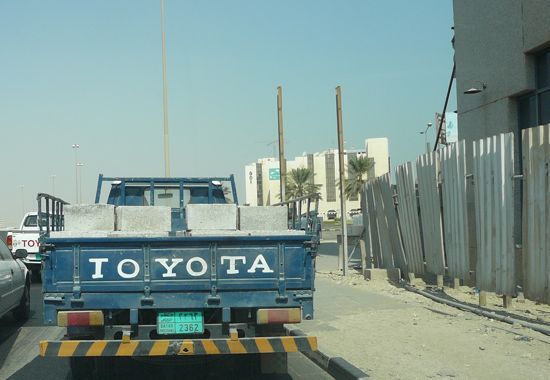
The trick is to yield to the bigger vehicle, especially if he is a cement truck, crane, or similar very heavy vehicle, unless you think you can quickly get ahead of them so you won’t have to go 15 km/hr for the next thirty miles. The trick is to avoid being behind a truck loaded with not-secured concrete blocks. The trick is to know that new cameras are going up all the time – have you noticed? Even the locals are slowing down, so I am guessing that the fines here are being imposed across the board.
Last week, I even saw a policeman pull a truck over for an illegal left turn – he turned from the lane next to the legal turn lane – he got pulled over. I don’t know if he got a citation, but he got a talking to. He seemed to be listening respectfully. I was shocked. There are times you will see three lanes turn left, only one of which is the legal left turn lane. It’s so common, you take it for granted. But things seem to be changing.
I have also caught myself doing some things I would never ever think of doing in the US. I needed to use a cash machine, and all the parking spaces were filled. I gave it 5 seconds thought, parked my car behind two cars right by the cash machine, and prayed no one would need to move while I was getting my money. Unfortunately – no one did. My bad behavior was positively reinforced.
The other night, picking up food on the way home, I begged some workers to let me park in a marked “no parking” spot so I could pick up my food.
“Bas hamsa deqiqa” I smiled as I ran to pick up my food, which, fortunately was ready and I paid, ran back out, tipped a little for the spot and drove off.
These are things I would never never never do in the United States. I do it here because it makes my life easier and because . . . everybody else does it.
I can still hear my Mother’s voice saying “and if everyone were jumping off a bridge, would you do that?” That’s what mother’s say. I probably said it myself. And here I am, knowing I shouldn’t do it, and doing it.
When I first got here, a woman was taking me shopping and as we got to the roundabouts, she said “You’ve just got to commit!” and she would whirl through the roundabout with seconds to spare. An Iranian friend got us from the airport to the Diplomatic Club once in 17 minutes in peak night-time traffic. It was easier for me to watch the clock than to watch her drive; she didn’t even look left when she entered the roundabouts. And she got us across town in 17 minutes. I still wonder at that accomplishment, and feel myself, at the same time, quaking in my boots at her confidence.
So I wonder if my admiring friends feel the same way, if I have become so used to local driving that I am adapting dare-devil tactics in my driving as well as in my parking?
I shudder at the re-education I will have to undergo when I return to the US for good.
Breakfast in the Souks
“I need a hundred camel spoons,” my friend said, and since we all sort of think on the same track, no one looked at me like I was crazy when I said “let’s all meet for breakfast, shop when the souks open and leave.”
In fact, they didn’t look at me like I was crazy for two reasons. One was that we really sort of think alike, and meeting for breakfast is just the kind of thing we don’t do often, but it is a good time to grab some time together in lives that get very busy later in the day.
The second reason is that we are all introverts, and three of us were doing most of this arranging by e-mail. We’re not really phone chatters, although every now and then we will dial, but it tends to be the exception rather than the rule.
The weather is perfect. You would be amazed how lovely and peaceful the souks are early in the morning. There are customers in the restaurants, but it is a very laid back time of the day.
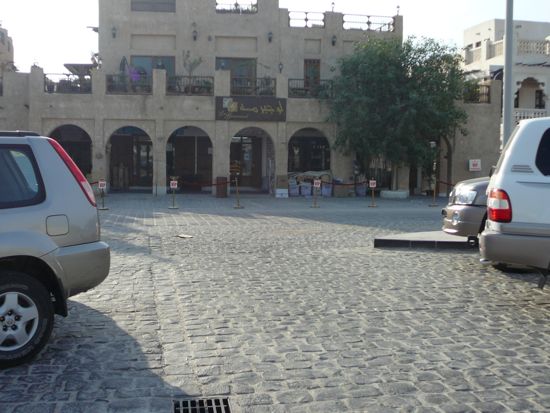
For a significant sum – I can’t remember how much, but I think I remember like 80 QR – you can park in VIP parking. Me, I was there an hour, and paid QR4 (just a little over a dollar) I just wanted you to see the difference from plain old everyday common folk parking and the VIP parking (above.) (Those signs in front of the stores straight ahead say VIP Parking, and at night they are roped off with red velvet ropes)
We find a shady table and order breakfast, across the street guys are into their early morning hubbly bubbly, there are people sweeping up to be sure everything is Disney-tidy, and it really is. As we are sipping at our coffee, the mounted police come by. Their horses are gorgeous, with high bushy tails and beautiful dressings in Qatar’s blood red and white colors.
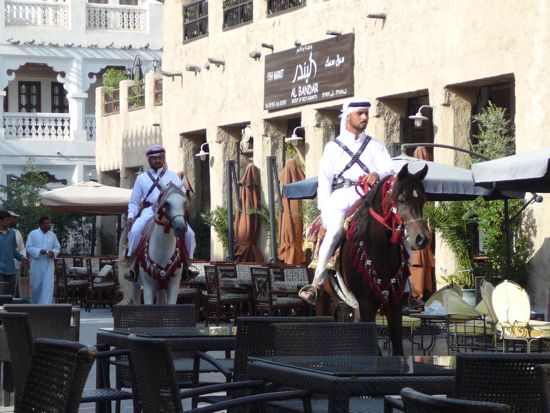
What I like even better is the police-riders. They are handsomely dressed, and they ride like cowboys – look at that posture, the way real horsemen ride, with that cowboy slump and the weight firm in the saddle. The horses aren’t big horses, but they have beautiful bones. I wonder where they stable these horses in the souqs?
On to find the Yemeni Honey Man, relocated from Karabaa / Electricity Street. The police help us find him, hidden back next to a metal kitchen crafter, and we see he has other old customers who have also found him. His new shop is shiny and clean, with great shelves for displaying his beautiful baskets from the Asir.

“Big troubles” he says, and I know he is right, many people are being evacuated from that area while the Saudis and Yemenis have problems near the border. One of his customers communicates to us with gestures that in our new baskets, we must pack our jewelry in the bottom, then our abayas, and then food, oud or honey on top, so people won’t know where we are hiding our jewelry.
My Kuwaiti friend told me that in his memory, before oil, people kept all their clothes in baskets like this, folded neatly. They didn’t have a lot of clothes, he told me, and then there were other baskets specially woven to hold food stuffs, and to keep the insects off the food. Those baskets are not the same as these sturdy baskets, the more local Kuwait and Qatteri baskets are woven from palm fronds, I believe, and you can still find them in the more traditional stores at the Souq al Waqef, behind where the Bedouin women sell foods on Thursday night and sometimes on Fridays.
Qatari Police Balloon?
I thought this was so cute when I passed it on B-ring today:
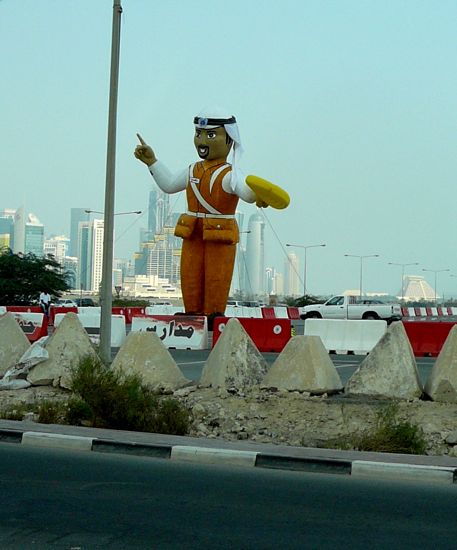
I don’t know what it’s all about, but I like it that he has on bright clothing and a reflector vest to help him be safe while he is directing traffic. 🙂
“It Was a Mistake!” The Fall of the Wall
BBC News reports today that while the ease in travel restrictions was planned, the way it happened – was a mistake!
When the Berlin Wall opened on 9 November 1989 Brian Hanrahan was the BBC News reporter on the ground. This year he’s been back to talk to some of those whose decisions made this key moment in 20th Century history possible.
From the safe distance of 20 years, the opening of the Berlin Wall can be seen as inevitable – the natural consequence of changes that were reshaping Europe. But for most of 1989 it was unthinkable.
And the decision itself was an accident – intended neither to happen the way it did nor to spark off the tumultuous changes that followed.
I heard the inside story of what started this extraordinary rush of events from one of those who made the decision in the East German Politburo – the communist party’s ruling body.
With hindsight, it’s the border guards we must thank
Politburo reformer Hans Modrow
Hans Modrow was a communist reformer in the Gorbachev mould. He had only just been given a place on the Politburo as East Germany’s leaders tried to head off the demands for change that were sweeping the country. But as a new boy his opinions counted for little.
He remembers an agitated discussion about the travel restrictions – the laws which banned most East Germans from leaving the country and which had sparked off the popular discontent.
At the end of it the party leader, Egon Krenz, suddenly produced a new set of regulations. From now on it would be much easier for East Germans to travel.
What annoyed Mr Modrow was the autocratic way in which the Communist Party still did business. “We couldn’t change anything, he says, We sat there like stupid little boys. We just had to do what we were told.”
‘Blurted out’
But now came a blunder that would bring down the Berlin Wall and the East German state with it.
The intention was to announce the changes overnight and phase in the new rules the next morning. Instead one of the Politburo members, Guenter Schabowski, blurted out the plans during a televised press conference – and compounded his error by adding the new rules would come into force “immediately”.
Live press conferences were a novelty in communist days, and Mr Schabowski was becoming something of a celebrity through his appearances. Mr Modrow is still scathing about Mr Schabowski’s preening in front of the media.
The Politburo announce the decision to allow people to cross the border
“The order wasn’t to be published until 0400 in the morning. But Mr Schabowski didn’t notice. He went into an international press conference. And he was so arrogant and full of himself. We had no idea this was happening.”
Mr Schabowski’s announcement was complicated and bureaucratic, and like many others that evening I puzzled over it before concluding that it signalled free travel. If this was true it would mean the end of the Berlin Wall because the whole fearsome structure with its watchtowers, barbed wire and guard dogs had become redundant.
East Berliners were rather quicker off the mark. Tens of thousands of them started turning up at the border demanding to be let across.
But the guards hadn’t been told anything – their standing orders were to stop anyone crossing. Until recently they’d been instructed to shoot to kill anyone who tried.
This night they tried to turn people back – but after a generation being pushed about Berliners turned belligerent and refused to go.
Stunned guards
The standoff between the armed guards and the angry crowds soon grew tense and dangerous.
The guards asked their headquarters for orders but the government ministries in charge of security told them nothing. Mr Modrow and the other Politburo members had gone home unaware of what was going on.
With radio and TV reports bringing more people on to the streets, Mr Modrow says it was the border guards themselves who decided what to do.
“With hindsight it’s the border guards we must thank, not any of us in the Politburo. The guards on the ground – at the time – made the critical decision. They ignored their standing orders. They said, ‘Open the border.'”
I arrived at the main border post just in time to see the barriers swing open as the guards gave up any attempt to regulate the crossing. They looked stunned at the mass of people streaming past them. Their whole world was collapsing about them.
But if East Germany’s leaders were ignorant of what was happening, the rest of the world was already watching on television.
In Washington, James Baker was at lunch with the President of the Philippines, Cory Aquino, when he was told the news. A short while later, hearing that people were taking sledgehammers to the wall, he abandoned the table and hastened over to the White House.
Changed world
There he and President Bush were taken aback at what they saw. They’d had no warning. “It was happening before our eyes. Maybe the Soviet leadership saw it coming but I don’t think anyone in allied capitals anticipated it happening with that speed.”
And Mr Baker admitted candidly that he was daunted by the scale of the task ahead in reshaping world alliances. As the West’s chief diplomat he would have to do most of it. “The world as I had known it all my adult life changed that day, and it changed fundamentally. I had grown up with the Cold War. Everyone in my generation had.”
In the Kremlin the man most responsible for the change slept through it. The Soviet leader had been tipped off a few days earlier about the way the East Germans were thinking.
Mr Gorbachev chuckled as he remembered the rush to tell him what had happened. “They reported to me quite early in the morning. They were in a hurry to let me know. We had been expecting it to happen. It could have happened at any time.”
And he was matter-of-fact about the consequences. “I took note of the report. It moved us on to a new phase. Not that I was enthusiastic about it, but I accepted it as something that had to happen. We understood that the time was coming for the German problem to be addressed.”
In London Douglas Hurd had been foreign secretary for just 15 days. He noted the news from Berlin in his diary. “The regime and now the wall are crumbling fast,” he wrote. But he was already wondering how he could persuade the Prime Minister, Margaret Thatcher, to consider the idea of a united Germany.
Berliners were only just opening the bottles of sparkling Sekt at the beginning of a street party that would last for days. Many were still uncertain what exactly was happening.
But in a few short hours they had changed the contours of world politics and there could be no going back. The inevitable, unthinkable accident had happened.
Somalia Returns to Stoning
What gets me about this article I found on BBC News is buried way down is a detail that a 13 year old girl was recently stoned for adultery. What does a 13 year old know? Some say she was raped. What kind of protection is this, for a little girl, to be stoned for something over which she had no control. Oh? She was just so tempting, she must be punished?
Somali adulterer stoned to death
Islamists in southern Somalia have stoned a man to death for adultery but spared his pregnant girlfriend until she gives birth.
Abas Hussein Abdirahman, 33, was killed in front of a crowd of some 300 people in the port town of Merka.
An official from the al-Shabab group said the woman would be killed after she has had her baby.
Islamist groups run much of southern Somalia, while the UN-backed government only control parts of the capital.
This is the third time Islamists have stoned a person to death for adultery in the past year.
Al-Shabab official Sheikh Suldan Aala Mohamed said Mr Abdirahman had confessed to adultery before an Islamic court.
“He was screaming and blood was pouring from his head during the stoning. After seven minutes he stopped moving,” an eyewitness told the BBC.
The BBC’s Mohammed Olad Hassan in Mogadishu says that if the woman is also killed, her baby would be given to relatives to look after.
Meanwhile, President Sheikh Sharif Sheikh Ahmed has accused al-Shabab of spoiling the image of Islam by killing people and harassing women.
“Their actions have nothing to do with Islam,” said the moderate Islamist during a ceremony at which he nominated a new administration for the capital, Mogadishu.
“They are forcing women to wear very heavy clothes, saying they want them to properly cover their bodies but we know they have economic interests behind – they sell these kinds of clothes and want to force people to buy them.”
Last month, two men were stoned to death in the same town after being accused of spying.
A 13-year-old girl was stoned to death for adultery in the southern town of Kismayo last year.
Human rights groups said she had been raped.
Another man has also been punished in this way in the Lower Shabelle region.
Mr Sharif, a former rebel leader, was sworn in as president after UN-brokered peace talks in January.
Although he says he also wants to implement Sharia, al-Shabab says his version of Islamic law would be too lenient.
The country has not had a functioning national government for 18 years.
Changes in Qatar Rent Laws
From today’s Gulf Times Qatar
New rent law seen a victory for tenants
By Sarmad Qazi
In a major victory for tenants, rent disputes can now be taken up with the Rental Dispute Resolving Committee (RDRC) regardless of whether the contract was registered or not, a senior official said yesterday.
This follows amendments in the rental law.
Law number 20 of 2009 sees changes to some provisions of the previous law number 4 of 2008 issued by HH the Emir Sheikh Hamad bin Khalifa al-Thani on October 25, the official said adding it further protected the rights of tenants in Qatar.
“There are two things in the new rule: you can come here, whether or not your contract is registered and speak to a judge, and secondly the landlord must now give at least six months notice of eviction,” the official said.
The law number 4 of 2008 was aimed at regulating the market by making registration of rental contracts mandatory and by establishing the RDRC with its own jurisdiction to take up grievances at a time of near-record inflation in the country.
“But we know the law missed out on rental contracts made prior to the 2008 law or based on goodwill and word only. In these cases we weren’t able to address any complaint,” the official at the RDRC’s headquarters in Muntazah (now Rawdat al-Khail) said.
“This amendment changes all that,” he added.
However, according to him, with the rents showing declining trends, the number of disputes is also falling; currently only 15 new cases are being filed at the RDRC every day.
The nature of cases varies from landlords wanting to hike the rent despite a two-year freeze since 2008, to non-payment claims and eviction notices.
A year ago the RDRC was registering 1,500 cases a month.
The official also dismissed questions about the effectiveness of RDRC saying so far this year its five committees have addressed and closed 1,205 cases. Only “600 or so are ongoing,” he said.
The committees have three members and one judge each.
“Yes it is true that 50% of RDRC decisions are later challenged in the appeal court (in Dafna), but 90% of the time the judge there upholds the rulings,” the official said.
Veteran lawyer Ala’a Hamad, a partner at the Arab Law Forum, yesterday said every new law requires takes time to prove its effectiveness.
“This was a new law and the more it’s practiced, it will prove its effectiveness.
“The tweaking is an ongoing process just as with foreign investment and other laws,” Hamad said.
The More Things Change
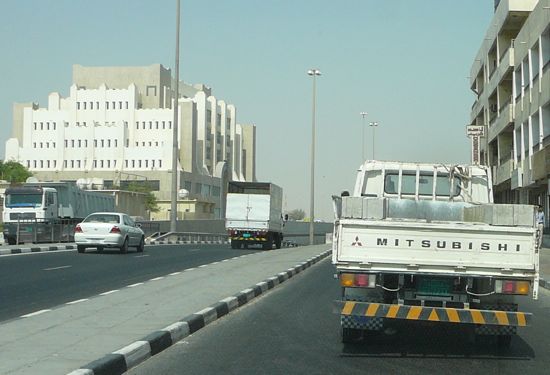
“. . . When we first came to Doha,” I laughed to my friend, “the first thing my husband warned me was never never to get behind a truck carrying concrete blocks. They weren’t tied down, and now and then a bump or a lumpy corner would send concrete blocks all over the roads. They don’t do that any more. They have rules now.”
Spoken too soon.
The very next week, I saw three trucks in a row, laden with concrete bricks, moving slowly down B-ring; one red, one white, one blue. I got stuck, first behind one, then behind the second.
No one was endangered as I took these photos. Traffic was at a standstill.
The Social Contract
Without accountability, does the social contract exist?
Wikipedia on the Social Contract:
Social contract describes a broad class of theories that try to explain the ways in which people form states and/or maintain social order. The notion of the social contract implies that the people give up some rights to a government or other authority in order to receive or maintain social order through the rule of law. It can also be thought of as an agreement by the governed on a set of rules by which they are governed.
Social contract theory formed a central pillar in the historically important notion that legitimate state authority must be derived from the consent of the governed. The starting point for most of these theories is a heuristic examination of the human condition absent from any structured social order, usually termed the “state of nature”. In this condition, an individual’s actions are bound only by his or her personal power, constrained by conscience. From this common starting point, the various proponents of social contract theory attempt to explain, in different ways, why it is in an individual’s rational self-interest to voluntarily give up the freedom one has in the state of nature in order to obtain the benefits of political order.
He’s on the Roads Again
This also from today’s Gulf Times. This 25 year old was convicted of killing an Asian driver, due to his reckless driving, and the court fined him the equivalent of $1370. He also had to pay the family of the man he killed about $41,000. Oh. Wait. He “and his insurance company” will pay the fine.
And they didn’t take his driver’s license away, they suspended it. Oh. His jail sentence is also suspended.
Do you think because his license is suspended, that he isn’t driving?
What do you think he has learned about the value of a human life?
What do you think he has learned about equality before the law?
What do you think he has learned about accountability?
Do you believe he will be a better driver now that he has learned the consequences of reckless driving?
You will note that I did not use the tags “Doha” or “Qatar” on this post. That is because these are not situations unique to Qatar, unique to the Gulf countries, unique to the Middle East . . . in every country, including my own, there are pockets where justice depends on who is on trial. I would venture a guess that no country is exempt, that it is always a question of degree. So the question for us, as parent,s is how do we raise children who respect the value of life? Who respect the law? Who see themselves as equal to every other person before God and before the law?
Jail term suspended
A Doha appeals court has suspended the three-month imprisonment given by a lower court to a local motorist for reckless driving that caused the death of an Asian driver on June 27, 2007.
According to sources, the fatal accident took place in Shahaniya soon after midnight, “when the accused swerved left suddenly, for unknown reasons, colliding with a pickup driven by the deceased in the opposite direction.”
According to the court papers, there was no median separating the two lanes that ran in the opposite directions and the pickup was damaged in the crash.
The Qatari motorist was 25 at the time of the incident.
The appeals court ordered him to pay, jointly with the insurance company, QR150,000 as blood money to the family of the Bangladeshi victim (32).
The Doha court of first instance ordered to cancel the driving licence of the convict, but the upper court suspended it. A fine of QR5000 was upheld.
Recent Comments
intlxpatr on Shampoo Ginger tigerbutterya0c5ff1d… on Shampoo Ginger intlxpatr on British Soldier Kidnapped, Esc… John on British Soldier Kidnapped, Esc… intlxpatr on British Soldier Kidnapped, Esc… Wikipedia Donate Button

Amazina


Early Voting in Florida


