100 Lashes Each for Illicit Relationships in Qatar
COURT ROUNDUP
100 lashes for illicit relations
By Nour Abuzant in today’s Gulf Times
Two Asians – a man and a woman – have been sentenced to 100 lashes each and subsequent deportation for maintaining illicit relations.
The father of the woman told the interrogators that he saw his 21-year-old daughter leaving the house in the morning of April 15, 2009 and boarding the car of her 26-year old lover.
The father also said he opposed their marriage and that he had planned his daughter’s marriage with another compatriot man.
The Doha court of first instance heard that the father found three mobile phones, belonging to her lover, in his daughter’s possession.
The accused Pakistani nationals confessed in the court that they were in love. The court said that the 100-lash penalty came in line with the Sharia rules, as both the accused were Muslims and unmarried.
That’s some angry father – turning in his own daughter to be jailed, humiliated in court and then subjected to the additional humiliation and pain of 100 lashes. Cannot imagine what that will do to her marriage prospects “with another compatriot man.”
Some people ask why I run these articles about expats. The truth, as I see it, is that any one of us who is not Qatari falls under these laws. We are ALL expats. The laws can be applied to any one of us at any time.
3 Months for Killing, One Year for Stealing
These articles are in today’s Gulf Times, under Court Roundup.
Jail term, fine for death crash
A local motorist has been sentenced to three-month’s imprisonment for reckless driving that led to the death of a 56-year-Pakistani pedestrian.
The Doha court of first instance imposed on the 26-year-old motorist a fine of QR20,000.
The fatal accident took place in the Old Airport area on September 27, 2008. According to the traffic report, “the accident occurred because the motorist was speeding.”
A traffic official told the court that the motorist was driving at 80kmph on a busy street.
Family members of the deceased can claim blood money in a civil court.
Man sentenced for stealing
A Sri Lankan driver has been sentenced to a year-imprisonment for stealing items including two gas cylinders and a vacuum cleaner from the labour camp of a private company. Four of the co-accused were sentenced in absentia to five years in jail.
The theft took place on July 21, 2008 in New Rayan area, the charge-sheet said.
Two Egyptians, who witnessed the incident, testified that they saw five men loading the items, estimated to cost QR4,000, on to a pickup from a store inside the camp.
The Egyptians said they captured three of the workers while the others drove away in the pick-up.
The police arrested all the accused and four of them were deported on an administrative order before the commencement of the trial.
Community Police Graduate
Community policing is necessary when we neglect to police ourselves. . . if, for example, we find ourselves throwing a tissue out of our car window as we drive along, littering the pristine streets of Doha. If we bully someone because we want that parking spot he is driving into, if we disrupt the peace and quality of life of others by our behavior.
I notice, in this story from the Gulf Times, that women are a part of this program, and that they are wearing uniforms, and hijab, and that those uniforms are very modest and also that they are wearing pants. Please see the previous article.
I commend Qatar for this visionary program, helping the community police itself, and for including women from the very first class.
46 take part in community policing basic course
Graduates with officials at the convocation ceremony

The Police Training Institute (PTI) recently held a ceremony to mark the graduation of participants in the first batch of the Community Policing Basic Course, under the auspices of Minister of State for Interior Affairs HE Sheikh Abdullah bin Nasser bin Khalifa al-Thani.
Some 46 students from various security departments took part in the course, which lasted seven weeks, said a spokesperson.
The ceremony was attended by the chairman on the Central Municipal Council, HE Nasser al-Kaabi; director of the PTI, Brigadier Mohamed Hassan Youssef al-Saei as well as other ministry officials.
Brigadier al-Saei explained that the course has been conducted to “enhance the role and mechanisms of community policing,” as well as helping to create partnerships with various social institutions to help with national security.
The PTI director added that the graduates of this course will be able to translate the Ministry of Interior’s aims and strategies to encourage understanding between various communities and to help the police to be able to prevent crimes before they are committed.
Brigadier Rashid Shaheen al-Atheeque, chairman of the steering committee of community policing, said: “The graduation of the first course of community policing is one of the stages of qualifying the national cadres at the Ministry of Interior to work in the national project.”
“Qatar is currently witnessing progress in all aspects of development in economic and social fields – this increases the role of all sectors in the country to face all kinds of challenges brought with this development,” he said, adding: “These factors require the improvement of capabilities to keep pace with development.”
Brigadier al-Atheeq explained that the ministry had pursued the initiative of community policing to help reduce crime throughout all institutions, and said that they had pursued the objective with the co-operation of the Supreme Council for Family Affairs as well as other ministries and companies, working towards the National Vision 2030.
He explained that the concept will initially be employed in the North Security Department from April 2010, with plans to apply it across the board from 2011.
Representing the director of the Ummul Qura Independent School for Boys, teacher Areezah al-Yami described the noticeable benefits of introducing the community policing programme in the school over the past year.
LLOOLL, Dumb and Dumber in Florida News
I found this hilarious article in The Pensacola News Journal
Bizarre news much the norm in Florida
BRENDAN FARRINGTON • ASSOCIATED PRESS • DECEMBER 30, 2009
TALLAHASSEE — You know you’re living in a weird state when the governor promotes a pay-per-minute sex chat line.
Or when a congressman asks the House speaker to move a day’s worth of votes so he can watch a college football game.
Or when employees at not just one, not two, but three state prisons use stun guns on their kids as part of “Take Our Daughters and Sons to Work Day.”
That’s Florida, once again making people snicker at its dumb criminals, strange animals and all-around oddness.
Gov. Charlie Crist was embarrassed when an on-hold recording he made transposed two numbers for an uninsured child helpline and callers instead were led to “horny” girls willing to talk about anything for just $2.99 a minute.
It wasn’t the only odd moment in politics. Rep. Cliff Stearns asked Speaker Nancy Pelosi to basically shut down Congress early so he and some of the Florida and Oklahoma House guys could go watch their teams in the national championship game. She said no.
Candidates for local offices were also embarrassed in 2009. A Miami Beach mayoral candidate was disqualified from the race after his qualifying check bounced, and a minister running for Belle Glade City Commission was charged with swinging a bat at a woman outside a polling place. He lost the election.
Two 8-year-old Alachua County boys made better use of their baseball bats — they successfully fought off a man armed with a gun who was threatening to kill the mother of one of the boys.
Booze A Factor
Alcohol seems to lead to a lot of Florida’s oddest stories.
Tampa police arrested a man who let his 12-year-old son drive his SUV so he could drink in the passenger seat.
A Marion County man was charged with driving under the influence after crashing a stolen riding lawnmower into a school bus.
A 22-year-old South Florida man climbed aboard a locomotive with a friend and took it seven miles down the tracks for a joy ride. They came up with the idea while heading to a local bar.
A Clearwater man was charged with drunken driving after police pulled him over for driving a car with only three tires.
Pasco County deputies arrested two men they said were fighting over $3 in gas money on the way home from a strip club. The weapons involved: a fish tank and a beer bottle.
In other random stories:
• A Lakeland eighth-grader was suspended from riding the school bus after farting to make other students laugh and badly stinking up the bus.
• A Melbourne-area woman changed diapers for a man who was faking disabilities. The man, whom she met through Craigslist, paid her $600 a week for the services. It took her three months to figure out he wasn’t disabled.
• The University of Florida’s disaster recovery plan included a section on dealing with zombies.
• DeLand authorities said a man strangled a pet rat after accusing his wife of taking his last cigarette and a Jensen Beach man was arrested after drenching his wife with a hose for smoking in the house.
• A woman sitting on a toilet in a Tampa restroom dropped her gun, which discharged and shot a woman sitting in another stall.
• Bank of America in Tampa refused to cash a check for a man born without arms because he couldn’t provide a thumbprint.
And finally, some readers might recall that a costumed Tigger was acquitted of charges he groped women at Disney World a few years ago. This year a 60-year-old man was convicted of groping Minnie Mouse at the same theme park.
Ahh, Florida, a whole new way of thinking . . . LLOOLLL!
I am dying laughing, what a way to end an old year and start a new one. I hope your celebrations are full of laughter and you keep your sense of humor through the coming New Year. 🙂
New Qatar Traffic Violations and Fines
Update: LLOOLL, I went to QatarLiving.com and discovered that these “new” laws came out in 2007. These are great laws, deterrents to bad driving and aggressive driving, but the laws mean nothing without enforcement. Do I still see many many children sitting in the front seat? Are people driving while talking on their mobile phones? And not a word about one of the worst offenses these days – texting.
A recent study showed texting is even more dangerous while driving than talking on a mobile phone:
The crash risk attributable to texting is substantial. One possible explanation is that drivers who text tend to decrease their minimum following distance and also experience delayed reaction time. For example, in the Drews et al. study, drivers’ median reaction time increased by 30% when they were texting and 9% when they talked on the phone, compared with their performance in a driving-only condition.
Notwithstanding the safety risk of texting while driving, previous research by Drews and colleagues at the University of Utah — not to mention crash data and widespread legislation — makes clear that using a phone while driving is dangerous.
(To check my source, just click on the blue type, above)
We were talking about people who were saying “Qatar is the most dangerous place to drive in the world” and wondering where this is coming from? Most of us have driven in more dangerous places, but this is the new quote floating around, with no foundation, no statistics, no studies, at least not any I can find with a simple Google.
The topic of new laws came up next over Christmas dinner. New laws? New fines?
“I never saw a word about this in the paper,” I said, peevishly.
“Oh, didn’t I tell you?” said AdventureMan.
People who have been married a long time will understand the urge to kill . . .
Someone else jumped in,
“I think the different companies are passing it around. The Education Foundation has it. Some of the universities have it. That’s the way it is in Qatar, news of new laws filters out.”
LLLOOOLLL. News of new laws “filters out?”
I found it online HERE, at Team BPH and it looks exactly like the copy AdventureMan brought home yesterday, but there is no attribution. Who put this out? There is no kind of official marking on it at all.
IF ENFORCED, these laws would have a serious effect on Qatar traffic.
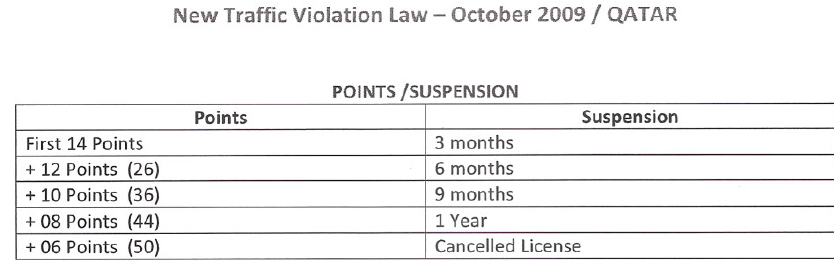

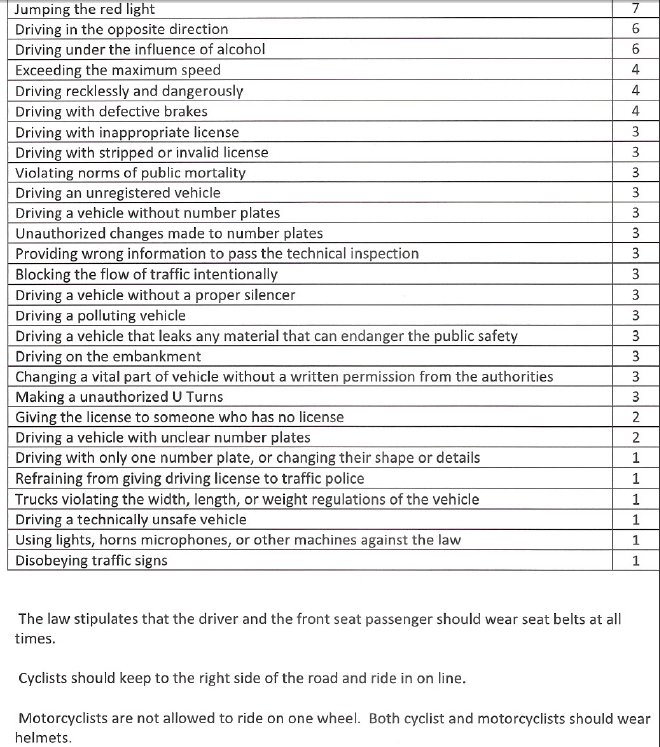
In theory, these went into effect in November 2009, just last month. Who issued these? Has there been any coverage in the newspapers? TV? How can people be held accountable for violating laws of which they are not aware? Or is this something one of the companies printed up, anticipating new laws?
Me and the FBI
Got this e-mail today from the FBI (yeh, right.)
Federal Bureau of Investigation (FBI)
Anti-Terrorist And Monitory Crime Division.
Federal Bureau Of Investigation.
J.Edgar.Hoover Building Washington Dc
http://www.fbi.gov/libref/directors/directmain.htm
Attn: Beneficiary,
This is to Officially inform you that it has come to our notice and we have
thoroughly Investigated with the help of our Intelligence Monitoring Network
System that you are having an illegal Transaction with Impostors claiming to be
Prof. Charles C. Soludo of the Central Bank Of Nigeria, Mr. Patrick Aziza, Mr
Frank Nweke, Dr. Philip Mogan, none officials of Oceanic Bank, Zenith Banks,
Barr. Derrick Smith, kelvin Young of HSBC, Ben of FedEx, Ibrahim Sule,Larry
Christopher, Dr. Usman Shamsuddeen, Dr. Philip Mogan, Paul Adim, Puppy Scammers are impostors claiming to be the Federal Bureau Of Investigation. During our Investigation, we noticed that the reason why you have not received your payment is because you have not fulfilled your Financial Obligation given to you in
respect of your Contract/Inheritance Payment.
Therefore, we have contacted the Federal Ministry Of Finance on your behalf and
they have brought a solution to your problem by coordinating your payment in
total USD$11,000.000.00 in an ATM CARD which you can use to withdraw money from any ATM MACHINE CENTER anywhere in the world with a maximum of $4000 to $5000 United States Dollars daily. You now have the lawful right to claim your fund in an ATM CARD.
Since the Federal Bureau of Investigation is involved in this transaction, you
have to be rest assured for this is 100% risk free it is our duty to protect the
American Citizens. All I want you to do is to contact the ATM CARD CENTER via
email for their requirements to proceed and procure your Approval Slip on your
behalf which will cost you $110.00 only and note that your Approval Slip which
contains details of the agent who will process your transaction.
CONTACT INFORMATION
NAME: Mr. Kelvin Williams
EMAIL: williamskelvin22@yahoo.cn
Telephone: +2348191213677
Do contact Mr Mr. Kelvin Williams of the ATM PAYMENT CENTER with your details:
FULL NAME:
HOME ADDRESS:
TELL:
CELL:
CURRENT OCCUPATION:
BANK NAME:
AGE:
So your files would be updated after which he will send the payment
information’s which you’ll use in making payment of $110.00 via Western Union
Money Transfer or Money Gram Transfer for the procurement of your Approval Slip
after which the delivery of your ATM CARD will be effected to your designated
home address without any further delay.We order you get back to this office
after you have contacted the ATM SWIFT CARD CENTER and we do await your response so we can move on with our Investigation and make sure your ATM SWIFT CARD gets to you.
Thanks and hope to read from you soon.
ROBERT S. MUELLER, III
DIRECTOR, FEDERAL BUREAU OF INVESTIGATION
UNITED STATES DEPARTMENT OF JUSTICE
WASHINGTON, D.C. 20535
http://www.fbi.gov/libref/directors/directmain.htm
Note: Do disregard any email you get from any impostors or offices claiming to
be in possession of your ATM CARD, you are hereby advice only to be in contact
with Mr. Kelvin Williams of the ATM CARD CENTER who is the rightful person to
deal with in regards to your ATM CARD PAYMENT and forward any emails you get
from impostors to this office so we could act upon and commence investigation.
LLLOOOOOLLLLLL!
Bad grammar, bad word choices, gives you away every time, scammers!
Defense: It’s The Cops Fault; He Was Chasing Me!
Court asks motorcycle rider to pay blood money
Web posted at: 12/19/2009 2:30:29
Source ::: THE PENINSULA
DOHA: A young man who rode a motorcycle and killed a pedestrian in a bizarre crash has been asked by the court to pay QR200,000 as blood money to the family of the deceased.
The court fined the convict QR10,000 for violating traffic law. But how the man was caught by the law-enforcement agencies is quite interesting.
It so happened that the Police Patrol saw two men riding motorbikes with tremendous speed. They gave the duo a chase but in vain. They vanished in think air. But soon the police was informed that a pedestrian was hit by a speeding motorbike.
When a police party reached the spot of the crash it saw a motorbike lying near the body of the victim.
The cops were quick to realize that this was one of the two motorbikes they had given a chase sometime ago.
With help from its registration plate they zeroed in on the culprit and referred the matter to the court after investigation.
The defense lawyer argued in the court that the crash occurred because they motorbike was chased by the cops. The court, however, did not buy the argument and convicted the man.
QR 200,000 sounds like a fortune, but it is $55,000 for taking a man’s life. For a young man who was running from the cops and then tries to claim their chasing him as a defense! This case sounds like a perfect opportunity to give a community service penalty in addition to the blood money; expose this young man to the consequences of motorcycle accidents, and accident victims, allow him to see with his own eyes, and serve, the victims. It could change his life, and change his callous attitude.
Round 2, Why You Should Always Carry Your Camera in Doha
“HOLY COW!” I shouted at AdventureMan, as I am already digging for my camera. He hates it when I do that, he things maybe I have spotted some danger or something and it gets his adrenaline going. I couldn’t help it. I was shocked, and I said “There’s a CHEETAH in that car!”
We love cheetah. Anyone who has ever seen a cheetah in the wild knows the awesome measure of God’s creativity and wonder. The cheetah is a speed machine, a glorious hunter, born to run. The cheetah is a glorious creation.
AdventureMan didn’t believe me, not for two or three full seconds and then – he saw it, too:


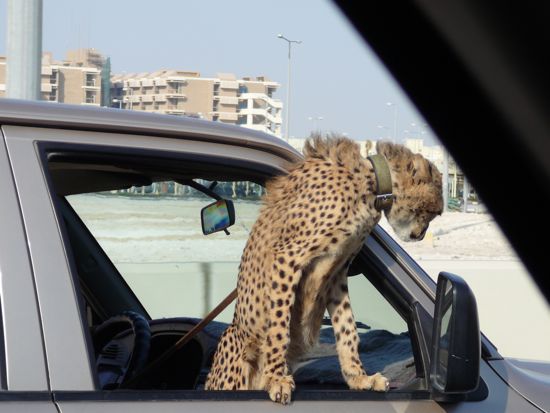
The man with the very young cheetah on a leash under very loose control was having a ball. The cheetah looked very happy to be out in the car with him, even on a leash.
It is a shame, and it should be a crime.
A cheetah, even when snatched away from his mother early in life, is not a toy, not an accessory. A cheetah can eat your innocent babies. A cheetah can bite you or scratch you badly, and think it is just playing. Taking a cheetah out of the wild is probably not a really good thing for the cheetah. How long with this man find him novel and fun and pay attention to him? And then what?
This is what a cheetah is meant to do, and this is how a cheetah is meant to live:
My friends, if you love wildlife, no matter how rich you are, leave the wildlife in the wild. Please.
Qatar Population on Monday is 1,580,050
This gave me a grin – as of a certain date, Qatar has a number, not an approximate number, a fairly fixed number – for its population.
You know what? I believe it. I have seen the way the computers here operate; they seem to have some inter-operability, and quick ways of accessing information back and forth between departments. I can believe they are tallying people leaving, people coming, people being born, people dying, as fast as the data can be entered.
I wouldn’t have believed it six years ago. I believe they have this capability now. They must have made a significant investment in this infrastructure, and it’s continuous upgrade.
From today’s Peninsula
Doha: The population of Qatar till Monday is 1,580,050, according to statistics released by Qatar Statistics Authority (QSA) yesterday. These data represent the number of individuals of all ages (Qataris and non-Qataris) within the state on Monday, excluding Qataris and residents who were outside the borders of the State at the time of the statement monitoring. The total number of males according to these data, is 1, 225,487 compared to 354,563 females.
These figures indicate a decline in population within the state with 86,803 people compared to last October, which recorded the highest rise in population during the year. It is noteworthy that QSA started presenting data on its website showing total population at the end of each month since October last year.
Recent Comments
intlxpatr on Shampoo Ginger tigerbutterya0c5ff1d… on Shampoo Ginger intlxpatr on British Soldier Kidnapped, Esc… John on British Soldier Kidnapped, Esc… intlxpatr on British Soldier Kidnapped, Esc… Wikipedia Donate Button

Amazina


Early Voting in Florida


