GoogleEarth Map of Speed Cameras in Kuwait
From this morning’s mail, a most valuable tool for money-saving:

AdventureMan tells me in Doha, Qatar, there are now speed cameras everywhere, and the fines are HUGE. Like $2000 for speeding, and they have the picture to prove it. He also tells me the law is applied against everyone, from the highest to the lowest, so that there is a lot less speeding and weaving than we see in Kuwait. I wonder how it is going to work here?
I read in yesterday’s paper, in Jahra, a driver deliberately hit one of the cameras with his car! I wonder if the camera was able to capture the incident before its demise? (It said the culprit was arrested, I think.)
We were out in the Wild West last night (Fehaheel) and a police car was trying to get to a huge traffic snarl. He blurped and burbled, he shouted in his loudspeaker, and nobody let him in. There was no respect for the traffic police, no fear. People just looked after their own interests. Fortunately, it was all at a very low speed, as traffic was jammed tight. There WAS room to let the police car in, but nobody did. I wonder how it would have worked if he had a camera? Or started giving tickets?
Doesn’t Kuwait need a call-in, or e-mail in place where you can take photos of traffic things happening and report violators, like those guys who think they own the emergency lanes when traffic is backed up, or who think the handicapped spots are for them (one told me “but when there is no one parking there, anyone can use it!”) to use – it would be so nice to be able to take a photo and send it in to the authorities and to believe that something would be done about it.
Kuwaiti Girl Raped and Abandoned in Desert
From the Arab Times
If YOU know anything about this, please tell someone. The young men who committed this crime must be stopped. What they did is unthinkable. They robbed a young woman of her privacy, and they robbed her of a future where she had never been raped.
Who could so such a thing? Who is not paying attention to what their sons are up to? Abducting women off the streets, even in front of their own homes – who brings up young men who would do this? Why so many at this time of the year?
Young Kuwaiti girl left in desert after gang rape, 10 men queried
KUWAIT CITY : In a shocking incident, a Kuwaiti girl in her 20s was raped and left unconscious in a desert area in Al-Jedaliyat near Doha.
Sources say a Kuwaiti man noticed the girl and called Operations Room which promptly dispatched securitymen and paramedics to the scene. She was then rushed to Intensive Care Unit of Sabah Hospital where doctors confirmed that she was raped.
Investigations revealed that the girl was a resident of Sabah Al-Salem area and a missing persons report was filed on her.
Securitymen combed the camping area where she was found and arrested tens of youths for investigation.
Sources suspect that the culprits are still out there. “Since no mobile phone was found near the girl and she is still unconscious, police don’t have any clue about the culprits,” they add.
Securitymen are keeping a watch in the area where she was found.
Rape, Abduction and Sorcery
I’ve always loved reading the newspaper, but even more so in other countries, where things are seen differently. These two items are from the Arab Times
11 out of 30 youths held in rape of 2 Asian women
KUWAIT CITY : Police have arrested 11 Bedoun youths out of the thirty who had kidnapped two Asian women near a commercial complex in Jahra and sexually assaulted them for four days in a camp in Mutla’a area.
It was reported that the two victims managed to escape after the four-day ordeal and reported the incident to a night patrol team who informed the Jahra police.
The police then raided the camp and arrested the eleven suspects and referred them to North Jahra Police Station. A case was registered.
Sorceress held: Police have arrested an unidentified Iraqi sorceress and referred her to the concerned authorities, reports Al-Dar daily.
The arrest came following a complaint filed by an unidentified Kuwaiti man who told police the woman had cheated by selling him a magic charm for KD 230. He also told police he had been wearing the charm for three months and failed to get what he aspired for.
Acting on this information police set a trap for the sorceress and caught her in the act while selling a charm worth KD 300 to a police agent. Armed with a search and arrest warrant, police then raided the apartment and confiscated various kinds of tools used by the suspect in black magic.
During interrogations she admitted to the charge and said her clientele includes well-known personalities and female university students. She also said she has until now ‘earned’ KD 85,000 from her ‘work’.
It has also been reported many people, particularly those who believe in her power, intervened in vain to secure her release.
By Mezyad Al-Saeedi
Special to the Arab Times
First, I cannot imagine the horror of being abducted, held in a remote location, and raped by up to 30 different men. The worst fear, of course, is whether you will live through it. Some victims don’t. Wouldn’t you think the names of these young rapists would be published so that women could be protected from marrying them? Imagine, being married to a man who rapes women . . . it would be a little bit of hell on earth.
Secondly – the first guy spent over $800 on a charm and then waited three months for it to work. In the interest of full disclosure, I sure would like to know what the charm was supposed to do? The police officer who entrapped the sorceress was going to pay over $1000 for her magic. That she claims she has earned 85,000 KD per year – that is around $325,000, that’s some serious income for some sorcery.
They are very good at obtaining confessions in Kuwait.
I can’t remember the last time I heard of someone being arrested for sorcery in my home town. There are similar sorts, people who con the elderly, people who prey on the deepest fears and hopes of others, but rarely are they accused of anything but fraud and theft.
Regional Crime
I know it is “crime” but this small article in today’s Al Watan made me smile. It is such a far cry from drugs, overdoses, knifings, rapes and abductions – smuggling nightingales. I don’t know why, it just makes me smile:
KUWAIT: Customs officers foiled an attempt that was made to smuggle 6 hawks and 55 nightingales coming from Iran in a wooden boat. Inspection supervisor, Khalid AlـFailakawi said: “The birds were hidden in a secret compartment, and owner of the boat confessed that he tried to smuggle the birds in order to sell them in Kuwait. And he also does not have any legal or health documents regarding his concealed shipment.” The necessary legal actions are being taken against the man who attempted the smuggling.
I Stand 100% with 86% of Kuwaitis
This is from today’s Kuwait Times, but it wasn’t online, it was a tiny little article at the bottom of page 2 in today’s paper:
Kuwaitis Oppose Morality Police
Kuwait: According to a recent questionnaire, 82% of Kuwaitis opposed calls to establish a group similar to the Saudi authourity that calls on individuals to commit good deeds while avoiding vices. The survey also discovered that 86% of participants thought such a group would trespass on the authority of the state.
Meanwhile, a government official recently said that some radical individuals and MP’s have attempted to support certain officials in the Criminal Intelligence Department and other authorities to create the foundations for a religious group that promoted virtue and condemned vices under an official cover, Al-Qabbas reports.
There is already a problem with the perception of the police force being “not-us”, not-educated, and not impartial in Kuwait. If radical individuals and MP’s are further subverting the forces of law and order, trying to get like-minded people in positions with real authority, this is not a good sign for Kuwait.
A Little Slow
No sunrise this morning – I missed it! When it is cold like this, we end up reading in bed, and before we know it, the book is falling over, and we give up and turn off the lights. Thanks to a little coffee late in the day and going to bed early – I was awake in the middle of the night for about an hour, then when the alarm went off this morning, no, I just didn’t want to get up.
Once up, Qatteri Cat and I just huddle together her on the couch. It feels warmer, but . . . not warm! I have projects lined up, and a thousand things to do . . . and I just can’t seem to get started. I DO love this weather, at least I love it once I am outside and warm and toasty in the sun.
I am also having a problem staying home these days – are you? Most of the year I happily stay inside except for maybe early early in the morning for swimming or an early run for groceries. Now? Any excuse will do. I love NOT using the air conditioning, having windows open in my car, being so comfortable. And I am not getting anything done in the house.
I know these times are fleeting, and not to worry, just to go with it and enjoy it . . . I am feeling so LAZY!
Kuwait Times on Morality Police
Wooo HOOOO on you, Jamie Etheridge; you bring grammar, tone and content to the Kuwait Times
Kuwait’s illegal morality police
Published Date: January 02, 2009
By Jamie Etheridge
Two female students were attacked by two youths this past week in Hawally, reportedly for not wearing the hijab. The girls were standing outside their school when two bearded young men jumped from an SUV, whacked them with a stick and then jumped back into their truck and took off. The incident sparked outrage and triggered discussions across Kuwait about the self-proclaimed morality police encouraged by a radical Islamist cleric Mubarak Al-Bathali.
In late December, Al-Bathali announced that he had established a voluntary committee for the “Promotion of Virtue and the Prevention of Vice” along the lines of the dreaded Saudi mutaween. The mutaween are a sort of religious police that patrol the streets in the villages and cities of Saudi Arabia, ensuring that women are covered from head to toe, that men go to the mosque to pray and that unmarried men and women do not mix in public. They also enforce other important moral strictures, like no mixed dancing or playing rock and roll music.
Al-Bathali said that his ‘vice’ squad will patrol the Sulaibikhat area first and then slowly spread out to other areas. It’s not clear who was behind the attacks in Hawally. Some have argued that it might have been just a couple of youths having fun and playing a trick on the girls by whacking them like the mutaween in Saudi do.
Let’s hope it was a bad joke by bored teens. God help us if random groups of men suddenly start forming ‘morality’ patrols and beating women on the streets of Kuwait. A Kuwaiti mutaween would create a host of problems.
First, the morality police would be trying to enforce a brand of radical Islam and ideology many in Kuwait – both citizens and expats – do not follow. Many Muslim women in this country do not wear hijab and there are no laws that require them to do so – despite the best efforts of the fundamentalists in parliament.
Second, Kuwaitis are highly protective of their female family members and few are likely to accept strange men whacking their mothers, sisters, daughters, wives and aunts in public areas. Following the 1990-1991 Iraqi invasion and occupation, some radical Islamists tried to establish a religious police and had begun even stationing ‘officers’ outside the Co-ops in Jabriya, Surra and elsewhere.
These mullahs carried short sticks and would strike women coming out of the Co-ops who they deemed to be dressed inappropriately. The women, of course, immediately called their male relatives who then rushed to the Co-ops and attacked the mullahs for attacking the women. The resulting chaos led to the banning of the self proclaimed morality cops.
Third, an ad hoc security force running loose around the country poses a real and present danger to the forces of the Interior Minister and by extension, the stability and security of Kuwait as a whole.
Nearly 20 years later, the radicals have reemerged and wider popularity – as evidenced by the fundamentalists victory in parliamentary polls – has encouraged them to reassert their plans for greater social control.
Success for the mullahs will mean failure for Kuwait’s experiment with democracy. Unlike the rest of the Gulf Arab states, Kuwait isn’t just beginning this experiment. For nearly half a century, this diminutive Muslim country has balanced tribal mores and religious identity with the Islamic and democratic ideals of freedom, dignity and self respect. Allowing roving bands of self appointed religious police to patrol the streets of Kuwait will undermine all of the country’s efforts toward balancing tradition
and modernity.
What We’re Watching – Briefly
We could hardly wait to recover enough from jet lag to sit down and watch the final season of The Wire Season 5, generously loaned to us by our son. This season focused on newspaper coverage, how they choose what to run, how newspapers are changing and how they influence city management and police work.
It was a hoot.
McNulty, in the face of huge budget cuts, damaging Baltimore city police morale, creates a “serial killer” using bodies which actually died a natural death. From the beginning, you find yourself saying “No! McNulty, No!” it is just so blatantly self-destructive, so destined for exposure, but, as many con-jobs do, it succeeds brilliantly for a short while, with unexpected assistance from a journalist who builds his own coverage on a fictional phone call he claims to receive from the serial killer. Meanwhile, we follow the familiar faces on the streets, and think often of what our son has said – in law enforcement, the good guys aren’t always that good and the bad guys aren’t always that bad.

At the end of the last episode, they tie things together and show us a glimpse of where the characters we have grown to love end up with their lives. It is a brilliant series, one of the best we have ever watched. If you have never followed The Wire, we suggest you start with Season 1 and work your way to Season 5, so you get the fullest picture.
This weekend, we watched four movies:
Twilight
Burn After Reading
The Day the Earth Stood Still
Charlie Wilson’s War
I was really looking for Valkyrie and Australia, but the DVD guy says he hasn’t gotten good copies yet.
Twilight – based on a series of book very popular with readers about vampires, at first we thought the movie was pretty bad, but camp. We watched the whole thing. There were moments of good writing, but overall – if you have ever seen True Blood, which has the same Romeo & Juliet premise, breeching the moral barrier between human and vampire, how can two so unalike find true love, etc. . . True Blood is funnier, has better writing. Twilight is interesting, though, and ties in other interesting legends, American Indian, etc.
Burn After Reading – We really like many of the Coen brother’s films, especially Fargo, but we found this one had few of those golden moments and a lot of boring boring boring. Oh well.
The Day the Earth Stood Still – I have always loved science fiction, the way it takes the long view, so I was interested to see how this re-make would do. It was ok – good. We enjoyed the movie, which had some great moments, and makes it’s point – when pushed to the precipice, we CAN change. It had a lot of drama.
Charlie Wilson’s War – Tom Hanks and Julia Roberts, golden combination, in how the US got involved supporting mujeheddin against the Russians in Afghanistan. It was an interesting movie. Had many funny moments, so funny you know it probably had an element of real life, as the ridiculous pops up so often – or it does in my life (how about yours?) I was left wondering, though, if anyone ever really succeeds in Afghanistan, and if we haven’t overstayed our usefullness to the Afghanis.
Not a really great movie in the bunch. It’s a good thing we have good books to read. 🙂
Uncle Jay Explains the News (US) from 2008
Tongue-in-cheek funny . . . This came out mid-December, or I am sure there would also be a shot at more recent events . . .
Jailed for Headscarf?
It’s a good think I read this article all the way through before I published it. I thought it was about a woman getting arrested for wearing hijab. She was not arrested for wearing hijab. Read the last sentence in the article. She was turned away from the courtroom for wearing hijab – that’s bad enough. She was arrested when she swore at the bailiff (an officer of the court who preserves a dignified atmosphere in the courtroom, or tries to.)
I suspect this policy is more a gang thing – prohibiting headgear that would cause an outbreak of violence in the court – but that it was enforced in ignorance and protest against this Muslim-American woman. They released her quickly once threatened with investigation.
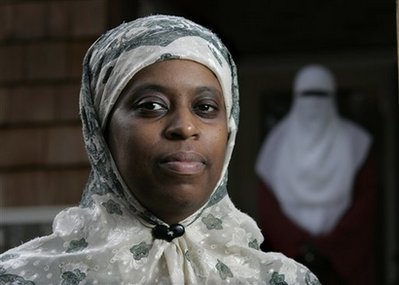
Sikhs won the right to wear their headgear while serving in the US military, as a religious right. I am betting Muslim women can win the right to wear hijab – it just needs to be tested in the courts. I do not think they can win the right to wear niqab, or other face coverings into the court – it isn’t a religious requirement, and the safety of the court can’t be protected if you don’t know who you are letting into the courtroom.
ATLANTA (Dec. 17) – A Muslim woman arrested for refusing to take off her head scarf at a courthouse security checkpoint said Wednesday that she felt her human and civil rights were violated.
‘Stripped of My … Human Rights’
A Georgia judge ordered Lisa Valentine, above at her home in Douglasville, to serve 10 days in jail for refusing to take her head scarf off in court Tuesday. The Muslim, who had violated a policy that prohibits any headgear, was released Wednesday after an advocacy group called for a federal probe into the matter.
A judge ordered Lisa Valentine, 40, to serve 10 days in jail for contempt of court, said police in Douglasville, a city of about 20,000 people on Atlanta’s west suburban outskirts.
Valentine violated a court policy that prohibits people from wearing any headgear in court, police said after they arrested her Tuesday.
Kelley Jackson, a spokeswoman for Georgia Attorney General Thurbert Baker, said state law doesn’t permit or prohibit head scarfs.
“It’s at the discretion of the judge and the sheriffs and is up to the security officers in the court house to enforce their decision,” she said.
Valentine, who recently moved to Georgia from New Haven, Conn., said the incident reminded her of stories she’d heard of the civil rights-era South.
“I just felt stripped of my civil, my human rights,” she said Wednesday from her home. She said she was unexpectedly released after the Washington-based Council on American-Islamic Relations urged federal authorities to investigate the incident as well as others in Georgia.
The group cited a report that the same judge removed a woman and her 14-year-old daughter from the courtroom last week because they were wearing Muslim head scarves.
Jail officials declined to say why she was freed and municipal Court Judge Keith Rollins said that “it would not be appropriate” for him to comment on the case.
Last year, a judge in Valdosta in southern Georgia barred a Muslim woman from entering a courtroom because she would not remove her head scarf. There have been similar cases in other states, including Michigan, where a Muslim woman in Detroit filed a federal lawsuit in February 2007 after a judge dismissed her small-claims court case when she refused to remove a head and face veil.
Valentine’s husband, Omar Hall, said his wife was accompanying her nephew to a traffic citation hearing when officials stopped her at the metal detector and told her she would not be allowed in the courtroom with the head scarf, known as a hijab.
Hall said Valentine, an insurance underwriter, told the bailiff that she had been in courtrooms before with the scarf on and that removing it would be a religious violation. When she turned to leave and uttered an expletive, Hall said a bailiff handcuffed her and took her before the judge.
Associated Press writer Kate Brumback in Atlanta contributed to this report.
Recent Comments
ExpatAlien on What Country am I Living … intlxpatr on Yellowstone: Old Faithful to C… Michelle on Yellowstone: Old Faithful to C… Cathy on No Grown-Ups in Charge intlxpatr on Waiting for Snow Wikipedia Donate Button

Amazina


Early Voting in Florida


 Here There and Everywhere