56,660 Kuwait Car Accidents: 2008
This is a totally breathtaking statistic. Kuwait just isn’t that big. That is more than one thousand car accidents, every week, in Kuwait.
We had three accidents in front of my house this morning. One included a school bus. Thank God, there were no children on board.
I would love to see a statistical breakdown on age groups, nationality, whether speed was involved, and whether the person was using a mobilephone while driving when the accident occurred.
One of my readers reported she had been in a car accident shortly after her arrival in country. A car going too fast rear-ended them. In almost every country in the world, if someone hits you from behind, they are charged, immediately, with following too closely and inattentive driving. You are supposed to be driving carefully enough to anticipate the car in front of you slowing down. Here, after six months, and several trips to the police station, it was determined that her husband was at fault. Unbelievable.
She adds that thanks be to God, no harm came to the infant traveling in the front seat of the car that hit them, on his mother’s lap, or they would have been liable for that, too. Unbelievable.
56,660 car accidents in 2008 alone
Staff Writer Al Watan
KUWAIT: Head of the Traffic Safety Department Bader AlـMatar has warned that the number of annual traffic accidents is on the rise. An estimated 56,660 car accidents and 410 cases of accident related fatalities occurred in 2008. AlـMatar added that the United Nations reports that car accidents claim more than 1,300,000 fatalities around the world each year, most of whom are young men.
Dumbest Thief of the Month
from today’s BBC News. I don’t think anyone will ever beat the Kuwait idiot who ended up in the bed next to the cop who had been chasing him, and told him he broke his leg running from a cop! That still makes me laugh every time I think about it.
‘Dumb’ thief picks police summit
A man in the US state of Pennsylvania accused of a robbery at a narcotics police convention has been described as probably the state’s dumbest criminal.
Retired police chief John Comparetto was attending the meeting of 300 officers when he was allegedly held up at gunpoint in the men’s toilets.
He handed over money and a phone but then he and some colleagues gave chase as the suspect tried to flee in a taxi.
They arrested a 19-year-old man over the incident near Harrisburg.
‘Retired police chief John Comparetto says he was held up at gunpoint
Mr Comparetto was wearing an ankle holster with a gun, and when told to drop his trousers, he managed to conceal his weapon.
He described the suspect as “probably the dumbest criminal in Pennsylvania”.
The Associated Press news agency reported that when a journalist asked the suspect for comment as he was led from court, he said: “I’m smooth.”
Female Police Given Ranks Equal to Men
The Police Academy attracted 16 women with university degrees – HOOOO-AHHH! I imagine these women are going to shake things up a little – in a good way – around police headquarters. Mabruk, mabruk, Kuwait.
Women officers given rank equally to men
Staff Writer – from Al Watan
KUWAIT: An Amiri decree was issued requiring female police officers to be put on equal footing with their male counterparts in terms of rank. Accordingly, Minister of Interior Sheikh Jaber AlـKhaled AlـSabah issued an executive order to rank women police officers according to the same requirements as given to male officers.
The first batch of women police now includes 16 Lieutenants, all of which have university degrees, eight Warrant Officers, all holding technical diplomas, and three Sergeants who have secondary school certificates.
Last updated on Friday 27/3/2009
Driver – and His Father – Obstruct Police
Don’t you wonder what happens next? Do they ever find out who the people are who are blocking them? I can see the whole thing happening in my mind – blocking the police!!
Driver arrested after obstructing onـduty police
Staff Writer Al Watan
KUWAIT: While police were organizing traffic at the second crossـsection in Jahra, they spotted two juveniles joyـriding nearby. They reported the incident to another police patrol which went to investigate the case. The two cars, upon being flagged down by the police patrol, immediately drove off and a police chase ensued.
The police patrol initially found it difficult to corner them due to wedding party, but as they were closing in a car of a German make impeded them.
Police repeatedly instructed him to clear from the route but the driver persistently blocked them. The officers approached the man to investigate the matter, but he refused to cooperate. Police asked for his identification, but the driver and the passenger, who was the driver”s father, refused to present identification. The two were arrested in place of the joyـriders and taken into police custody.
Record Traffic Violations Recorded
Cameras capture record traffic violations
Staff Writer – From today’s Al Watan
Wooo HOOOO! Cameras are impartial; they catch the violators, no matter who. I love it.
KUWAIT: The relocation of radar cameras on major roads has led to a sharp increase in the number of violations registered during an entire month. According to security sources; they reported that around 2,000 cars have been photographed by the relocated cameras during last January as compared to 900 cars prior to the relocation.
Earlier on, the Assistant Undersecretary for Traffic Affairs Major General Mahmoud AlـDousari had recommended the relocation of the radar cameras, particularly since motorists had become too familiar with the previous locations. Drivers who have been involved in violations have been contacted through official channels to either pay their fines or get referred to the concerned authorities. It has been gathered that fines have been already collected from 400 errant motorists.
Last updated on Friday 27/3/2009
Here is an extra one for you, General Al-Dousari, one of those special kind of people who travel in the emergency lane while the rest of us obey the rules and crawl along the freeway. I could not resist this particular photo – with the sign right there.

PS – We were not moving. I wasn’t driving when I took the photo. 🙂
First Kuwaiti Policewomen Graduate
Wooo HOOO on you, Kuwaiti policewomen! It is always hard to be in the vanguard, you take the criticisms, you take the disbelieving stares, and you handle questions, even from your own families. It’s always tough to be out front – to be a leader.
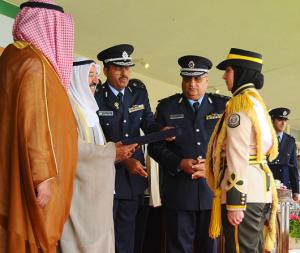
First group of policewomen graduate
From today’s Al Watan
KUWAIT: His Highness the Amir and Supreme Commander of the Armed Forces Sheikh Sabah AlـAhmad AlـSabah has attended on Wednesday the graduation ceremony of the 35th batch of military cadets, the 20th batch of specialized officers and the first batch of female cadets at the Support Authority Institute of the Saad AlـAbdullah Academy for Security Sciences.
The ceremony witnessed the graduation of the first batch of policewomen in the country. His Highness the Amir who arrived at the academy at 10:30 a.m. was warmly received by the Minister of Interior Lieutenant General Sheikh Jaber AlـKhalid AlـSabah, as well as other senior police officers.
The ceremony was also attended by His Highness the Crown Prince Sheikh Nawaf AlـAhmad AlـSabah, Vice President of the National Guards Corps Sheikh Mishaal
AlـAhmad AlـSabah, His Highness the Prime Minister Sheikh Nasser AlـMohammed AlـSabah, First Deputy Prime Minister and Minister of State for Defense Sheikh Jaber AlـMubarak AlـSabah, as well as other members of the ruling family, senior statesmen and members of the families of the graduating cadets.
Representatives of the 35th batch of military cadets then handed over the national flag to the representatives of the 36th batch. The Assistant Director General of the Academy for Education and Training Affairs Brigadier Dr. Waleed Khalaf BinـSalama read the ministerial decrees before inducting the new male and female police officers into the police force.
His Highness the Amir handed the graduates awards and certificates in appreciation for their efforts and then received the shield of the academy, that is dedicated to him, from Major General Yousef Mubarak AlـMedhahka. ـKUNA
Last updated on Thursday 26/3/2009
Another Martyr For Olde Ireland
Thanks be to God, the brutal, ceaseless battles in Ireland have ended and peace prevails. So many innocent were lost – and for what? The recent bombing is thought to be a hiccup left over from those desperate, sad days. We can only hope that is true, and that peace can also break out in places like Gaza, like Dharfur, where entire peoples are oppressed and dealt with brutally by those in power.
For blogger Mathai; one of the songs the Irish sing in the pubs on St. Patrick’s day – and others. Whenever the beer is flowing, you’ll hear Kevin Barry. They know all the words.
This is the version I used to hear; the one above has slightly different words.
In Mountjoy jail one Monday morning
High upon the gallows tree,
Kevin Barry gave his young life
For the cause of liberty.
But a lad of eighteen summers,
Still there’s no one can deny,
As he walked to death that morning,
He proudly held his head on high.
2. Just before he faced the hangman,
In his dreary prison cell,
The Black and Tans tortured Barry,
Just because he wouldn’t tell.
The names of his brave comrades,
And other things they wished to know.
“Turn informer and we’ll free you”
Kevin Barry answered, “no”.
3. “Shoot me like a soldier.
Do not hang me like a dog,
For I fought to free old Ireland
On that still September morn.
“All around the little bakery
Where we fought them hand to hand,
Shoot me like a brave soldier,
For I fought for Ireland.”
4. “Kevin Barry, do not leave us,
On the scaffold you must die!”
Cried his broken-hearted mother
As she bade her son good-bye.
Kevin turned to her in silence
Saying, “Mother, do not weep,
For it’s all for dear old Ireland
And it’s all for freedom’s sake.”
5. Calmly standing to attention
While he bade his last farewell
To his broken hearted mother
Whose grief no one can tell.
For the cause he proudly cherished
This sad parting had to be
Then to death walked softly smiling
That old Ireland might be free.
6. Another martyr for old Ireland;
Another murder for the crown,
Whose brutal laws to crush the Irish,
Could not keep their spirit down.
Lads like Barry are no cowards.
From the foe they will not fly.
Lads like Barry will free Ireland,
For her sake they’ll live and die.
Don’t Call, Text, or Sign on to Internet . . .
until you arrive”

From today’s Kuwait Times
‘Avoid cell talk, SMS, life you save maybe your own’
KUWAIT, March 15, (KUNA): Ninety percent of road accidents are coupled with lack of attention while driving, Assistant Undersecretary for Traffic Affairs at the Ministry of Interior Major General Mahmoud Al-Dousari said Sunday.
His remarks came on the occasion of hoisting flags of Gulf Cooperation Council (GCC) countries, announcing the commencement of the unified GCC traffic week; themed “Don’t Call Until You Arrive”. The ceremony was attended by traffic directors and their deputies of all six governorates, as well as a host of senior officials in Kuwait and the Gulf. This year’s theme aim at conveying an awareness message, cautioning from the use of mobile phones while driving, and depending on other means such as hands’ free and Bluetooth in order to stay focused on road and steer clear of accidents, Al-Dousari noted, pointing out that more studies had proven the theory suggesting the association of lack of attention with using mobile phones while driving.
The issue was not limited to speaking on phone, it went beyond that to include text messaging, or even logging on to the Internet while driving; which would turn them into major distracters, Al-Dousari said, adding that consequences of such behavior would eventually lead to tragic endings.
Al-Dousari advised that the best way to remain focused on road was to divert all incoming calls to voice mail, as well as receiving and sending SMS messages after pulling off the road. Some 18,773 violations were registered since the law that prohibited the use of mobile phones while driving was implemented last year, he noted.
“The Traffic Week aims to raise awareness, as it includes a host of various educational programs. It is not a week of firmness, stake out and issuing tickets like some might think,” Al-Dousari said, pointing out that injuries resulting from accidents had significantly decreased in the past two years. There are strict orders to deport any expatriate who commits serious traffic violations such as reckless driving, driving on the wrong side of the road, speeding, violating the red signal and assaulting security men, Al-Dousari concluded.

General al-Dousari, how many expatriates have you exported for serious traffic violations?
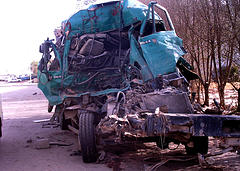
If you want to see fewer people on mobile phones, texting, signing on the the internet, running red lights, weaving while overspeeding, and assaulting security men, enforce your laws, enforce them all the time, and enforce them equally against every offender. If you enforce your laws, equally, against all offenders, traffic violations will decrease, traffic deaths will decrease, and all our lives, and those of our children, will be much safer.
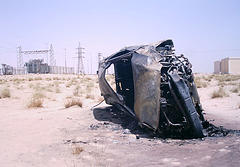
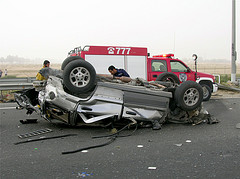
These photos are from a Flikr search for car wreck/Kuwait and, unfortunately, it is just a random selection among many. many. many.
Citizens?
Here is what I don’t understand. Sometimes, it is very clear who did what to whom, and sometimes it is not. In the first paragraph, they talk about a serious car accident with six injured citizens, two Sudanese parents and their son and an Iranian female. OK, that’s four people. Who are the other two citizens? A citizen lost control? Which citizen?
I thought a citizen was one who had citizenship, and all the rest of us are Sudanese, Iranian, British, Irish, American, etc. etc. etc. These accident and crime reports are ambiguous, at best. Why so oblique?
From today’s Al Watan:
KUWAIT: Due to a serious car accident which occurred on the Fifth Ring Road heading to Jahra near the Surra area, six citizens, two Sudanese parents and their son, as well as an Iranian female, sustained serious injuries. It was reported that a citizen lost control of his speeding car and hit another other car which overturned. The injured were rushed to Mubarak Hospital by ambulance to seek medical assistance.
Meanwhile, in a separate incident, a citizen suffered serious injuries after his car overturned near a roundabout located in the Abdullah AlـMubarak area. After the operation room received a phone call informing them that a citizen had a car accident and was trapped within his vehicle, police officers and fire brigades rushed to the scene. Firefighters from the Jleeb AlـShuyoukh Fire Station, lead by First Lieutenants Mishari AlـTourah and Bader AlـKandari, managed to rescue the man from the wreckage. The man was taken to Farwaniya Hospital by paramedics to seek medical assistance.
General Traffic Department: Don’t Call Till You Reach Your Destination
God Bless ’em. GCC Traffic week will start on March 14 and they have chosen for their theme: Don’t Call Until You Reach Your Destination.
From today’s Arab Times:
GTD completes all preparations for GCC Traffic Week
KUWAIT CITY, March 6: The General Traffic Department (GTD) has completed all the necessary preparations for the GCC Traffic Week, which will be hosted by Kuwait on March 14 under the slogan “Don’t call until you reach your destination”, GTD General Manager General Mohmoud Al-Dousari said in a press release recently. Al-Dousari pointed out “mobile phones are vital communications gadgets, considering the additional services such as the Internet and camera, but there are also disadvantages.”
He said using the mobile phone by hand while driving is one of the major causes of road accidents in the country. Drivers might get distracted while talking over the phone, endangering not only their lives but also that of other road users, he added.
Minister of Interior Sheikh Jaber Al-Khalid Al-Sabah had earlier issued a decision banning the use of mobile phone by hand while driving to protect the lives of motorists, which was implemented since last year, said Al-Dousari. The GCC Traffic Week is aimed at conveying a clear message to the public on the dangers of using mobile phones by hand while driving, as well as encourage the use of other technologies like earphones and Bluetooth.
Al-Dousari revealed the department issued 18,773 citations for using mobile phone while driving. He added Kuwait is one of the most developed countries in the world in terms of traffic regulations, but some drivers are disregarding these rules. Al-Dousari warned the GTD will not tolerate those violating the traffic regulations and advised the public to drive safely and strictly comply with the traffic laws.
I admire General Al-Dousari. God bless him; he gallantly fights a battle for traffic safety in Kuwait. No kidding some drivers are disregarding these rules. Some policemen are disregarding these rules. Some policemen aren’t enforcing these rules. I wonder when the majority of those citations were issued? My bet would be that around 18,000 were issued more than six months ago. Until there is enforcement, this is a losing battle.
Recent Comments
intlxpatr on Shampoo Ginger tigerbutterya0c5ff1d… on Shampoo Ginger intlxpatr on British Soldier Kidnapped, Esc… John on British Soldier Kidnapped, Esc… intlxpatr on British Soldier Kidnapped, Esc… Wikipedia Donate Button

Amazina


Early Voting in Florida


