The Appeal by John Grisham
One of the things I like about John Grisham is that he really likes the underdog. In his books, the person often the least likely to prevail does so, usually because he has a smart attorney, one who is paying attention and taking good care of the client. Warning – this book review contains a spoiler, so don’t go any further if you don’t want to know too much about the plot and resolution.

The Appeal is the exception. No one wins, not even the apparent winner, who sails off in the end with his empty, unsatisfying life. He schemes, he exploits, he lies, he buys elections, and he makes a fortune – and he isn’t satisfied. He is married to a woman who sounds more like a greyhound, all skin and bones and self-absorption.
The subject matter is a case where a chemical company has dumped toxic wastes into the ground in Mississippi, it has penetrated into the groundwater, and polluted the entire water system of a small fictional town. Two lawyers, married to one another, sacrifice everything and face bankruptcy to win a case for their client who has lost both husband and son to cancer caused by the toxic chemicals dumped. They win.
There is an appeal.
What this book is about isn’t just about groundwater contamination, or even about buying elections in Mississippi – it is an indictment of every state that elects judges. The core of the novel is about how big money, big corporations, pick candidates and fund them, legally and illegally, and insure that they win. They pack the courts with judges who are opposed to large settlements.
God bless John Grisham. With all his great legal thrillers, he has made a bundle and can take risks like writing a book like The Appeal, which should be an eye opener, and should be read by every caring citizen.
Judges should not be elected. When the judiciary are elected, they have to think about their next election, with every legal decision. It taints objectivity. It corrupts objectivity. It eliminates objectivity. Without an objective judiciary – why bother? They will always rule on the side whose interests are the most powerful and profitable.
Here are a couple quotes that tell you where the novel is going. My Kuwaiti friends are going to love this – I have taken so many shots at Kuwait corruption – so here it is, my friends, exposure of the institutionalized corruption in my country:
Barry laughed and crossed his legs. “We do campaigns. Have a look.” He picked up a remote and pushed the button, and a large white screen dropped from the ceiling and covered most of the wall, then the entire nation appeared. Most of the states were in green, the rest were in a soft yellow. “Thirty-one states are in the green. The yellow ones have the good sense to appoint their courts. We make our living in the green ones.”
“Judicial elections.”
“Yes. That’s all we do, and we do it very quietly. When our clients need help, we target a supreme court justice who is not particularly friendly, and we take him, or her, out of the picture.”
“Just like that.”
“Just like that.”
“Who are your clients?”
“I can’t give you the names, but they’re all on your side of the street. Big companies in energy, insurance, pharmaceuticals, chemicals, timber, all types of manufacturers, plus doctors, hospitals, nursing homes, banks. We raise tons of money and hire the people on the ground to run aggressive campaigns.”
* * * * * * * *
The Senator did not know who owned the jet, not had he ever met Mr. Trudeau, which in most cultures would seem odd since Rudd had taken so much money from the man. But in Washington, money arrives through a myriad of strange and nebulous conduits. Often those taking it have only a vague idea of where it’s coming from; often they have no clue. In most democracies, the transference of so much cash would be considered outright corruption, but in Washington the corruption has been legalized. Senator Rudd didn’t know and didn’t care that he was owned by other people. He had over $11 million in the bank, money he could eventually keep if not forced to waste it on some frivolous campaign. In return for such an investment, Rudd had a perfect voting record on all matters dealing with pharmaceuticals, chemicals, oil, energy, insurance, banks and on and on.
I like almost every book I read by John Grisham. He is a man with a conscience, and he is trying to raise our awareness of corruptive factors before our system goes entirely under. I couldn’t put this book down, and I can hardly wait to read the next one.
The Doha Anglican Church
Back in Doha, church at the same time as always but for once, we are late because we didn’t realize the traffic pattern had changed, and we got lost, briefly, making us walk in after the service had started. As we walked in, we were greeted by a man we knew well when we used to attend, and he was so happy to see us! The congregation is about double the size as when we used to attend, may familiar faces, even after all these years, and there are our old friends, and they have saved two seats for us. 🙂
The service was a happy combination – familiar service sheet, familiar – and much loved – music, but some new things, too, more people serving, a little more formal service, and a priest-policeman who gave a powerful testimony. Soon, we understand, we will be able to start meeting on the new compound, where the big church will be built, and many congregations will share the same buildings, as they do at the Kuwait NEC.
Later, talking with my friend, we were talking about the policeman-preist’s testimony.
“I’m a little confused,” my friend started, “I got the impression testimony was an emotional story about how people get born-again, and he used those words, but it wasn’t like in the evangelical churches.”
“Yeh,” I responded, “being ‘born again’ encompasses a wide variety of experiences. You get the impression it has to come like a mighty wind, blowing you away, but this guy talks about listening to the gentle nudge, that is also the work of the holy spirit.”
“It was so gradual!” she exclaimed. “I thought it had to be like one great emotionally moving experience.”
“So what happens if you are born in the church, you are baptized and you believe from the time you are a little child?” I asked her. “And what happens if after being ‘born again’ you make some huge mistake, do you get ‘born again born again’?”
It’s all a question of style, how the holy spirit comes to each individual, how we believe. It isn’t right or wrong; it is how the spirit speaks to you. One of the things Jesus said over and over was to concern ourselves with our own relationship to God, and not with our neighbor’s short-comings. He said we each had enough of our own short-comings to keep us busy for an entire life. When he wants us to be involved with our neighbors – and we know who our neighbors are – it is with an open and helping hand, not a pointing finger.
The essence, in my mind, is the belief, and the listening, in your heart, for the whispers of the holy spirit. I pray to hear it, when it whispers. There are enough gales in my life – like moving, for example – I don’t need a mind-blowing, scales falling from my eyes experience, although the spirit has used one or two in my life to get my attention. I mostly just need to listen better.
Kuwait Paper Dump Badge
I admit it. When I saw Ansam on her new blog had a Kuwait Paper Dump certificate, I was green with envy! I knew I didn’t deserve one – I have only contributed once, and even my contribution wasn’t truly acceptable because I don’t have a fax, so I took photos and sent them to Abaid.
Yesterday, when I opened my e-mail, I almost cried. He sent me a badge for my support and positive mentions. Honestly, it is the best badge I have ever sported on Here, There and Everywhere.
I’m from Seattle, remember, where recycle cans are issued, and sorting and recycling is mandatory. I’m also from the hippie generation, the back-to-the-earth movement that springs up every now and then, you know, make your own paper, make your own soap, grow your own tomatoes and basil. That my son, his wife, my sisters and my nieces and nephews and this new generation of Kuwaitis are all into saving the environment – it is just icing on my cake. And the candle on my cake is the new badge. You can see it here, and you can see it for the rest of the life of the blog under Kuwait Paper Dump in the Blogroll.

For those of you not familiar with the website, 3baid gathers up paper from around Kuwait from restaurants, service providers, Kuwait resources, events, etc. and publishes them all in one place, eliminating our need to keep track of all those papers. When you want to know what the possibilities are from a particular restaurant, you will find the menu there. When you want to know who has mushroom pizzas, you can click on “mushroom pizzas” and find out which places have them. It is an amazing public service they provide at Paper Dump, and they do it entirely as volunteers, serving the community.
I am so totally honored. Thank you for the badge. Thank you, too, for your quiet, persistent leadership in the Kuwait environmental/Green movement.
Investment in Africa
This was in the morning’s e-mail. Unlike the e-mails I post inviting me to get lots and lots of free money, this one seems to have some interesting information. Here is one excerpt from their opening page, The Conversation Behind Closed Doors:
To make itself more attractive for US investment, Africa should:
Invest in education , health and infrastructure
Ensure the rule of law and a business-friendly climate for all investing companies
Show it is serious about attracting foreign investment
Market itself as aggressively as other regions of the world
Demonstrate opportunity cost of not investing
I would have to say there is nothing I disagree with there. I have not explored the whole site, but it looks legitimate, and interesting, if you, like me, are interested in Africa, and future solutions.
Hi
I’m reaching out to you because I thought you and the readers of here there and Everywhere would be fascinated by what my firm has recently uncovered about the attitudes toward corporate investment in Africa among leading U.S. corporations — according to senior officers of 30 American Fortune 100 corporations we interviewed. Why has Africa not attracted more interest from the U.S. business community? We have collected all of the answers and case studies into a news release introducing a study that launched yesterday commissioned by the US Chamber of Commerce:
http://www.usafricainvestment.com
We’re very excited about the revelations in this paper and would love it if you could let your readers know about what we’ve uncovered through a post or a tweet. If you are able to post please let me know so that I can share it with the team. If you have any questions or would like to speak to the partners who wrote this paper, let me know and I will set it up.
Thank you so much,
Fabiane
—
Fabiane Dal-Ri
fabiane@usafricainvestment.com
Joy in Kuwait
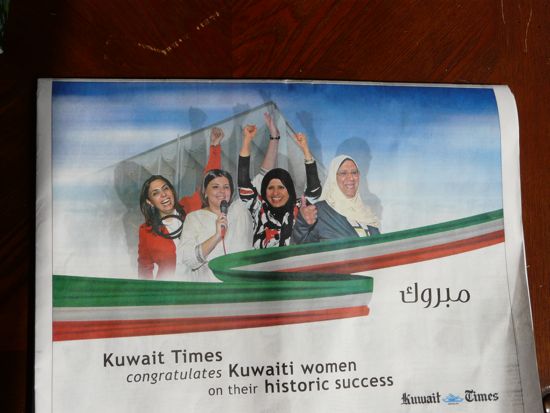
You might think it is the inner feminist in me that is rejoicing, and you would be only half right. The Kuwait elections brought me a lot of joy, for many reasons. First, as an equal opportunity woman, you need to know that I believe women are every bit as capable of veniality and stupidity as men, and that not being in power has only meant not having equal opportunity to abuse that power. And then – you take a look at the women who were elected – smart women. Capable women! Not-your-shy-shrinking-violet kind of women! Women who know how to organize, how to delegate, and how to discuss and resolve differences.
FOUR women! Four highly educated women, who inspired droves of supporters not only to vote – but also to campaign.
Across the board, it struck me as a very sober election. It was as if people thought this might be their last chance, and they took their vote very very seriously. In the fifth district, voters crossed tribal lines, broke with rigid alliances.
Here are three conversations that caused me to rejoice.
On election day, my good Kuwaiti friend, a guy about the same age as AdventureMan and I, leaned over and said “My dear, today I voted for a Shiite woman! This is Kuwait! This is the REAL Kuwait, where no-one ever cared, Shiite or Sunni, no-one ever asked, we all worked together. I voted for her because I thought she was the best candidate.”
He’s been educating me on Kuwait ever since we got here. He grew up about a block from the big food court down at Mubarakiyya. I was just glad to know he had voted – he had seemed so dejected, so hopeless after the last election, I wasn’t sure he would even give it one more try. Something inspired him. Something gave him the courage to hope just one more time.
I talked with a young friend who was active in the campaign of a winning candidate. Well, really mostly SHE talked, and I just listened with a big grin on my face. It doesn’t even matter who she campaigned for, this woman was PUMPED! She had committed, she had engaged, she was on the phones and on the campaign lines and her candidate won! I could hear the transformation in her voice – this is the Kuwait of tomorrow.
At an earlier time, she had told me that the decisions were all made by “elderly” people (meaning people over 40, I think, people like me!) and that young people were getting discouraged, waiting for their turn. All that was gone, as I listened to her voice. She knows she can make a difference NOW in Kuwait. I could not stop grinning. I think she is one of the leaders of tomorrow. 🙂
My third Kuwaiti friend said to me “so many of the winners were from good families, but not the big, rich families! This is the first time!” and she said it with sheer amazement. She said “I think we may be on our way to a true democracy!” I was shocked. I never thought I would hear those words, not after the cynicism and discouragement apparent during the last legislature, when many Kuwaits awoke with a shock to the fact that their legislature had been hijacked, their voices stolen. “This is not the real Kuwait” they kept assuring me after the last election, as they watched in shock and horror as the newly elected MP’s postured and promised and promised “grillings” but did nothing for the population who had elected them in terms of basics – housing, roads, electricity/energy, or groundwork for future development.
My joy is in the renewal of their spirit. It’s not my election. But oh, I dance with joy for your joy, Kuwait, and I celebrate your commitment to the future.
PS For our non-Kuwaiti readers – early in the election campaigns, one party announced a religious fatwa (edict) saying that it was forbidden to vote for women. I think it outraged people badly enough to create a huge backlash.
Eliot Pattison: Prayer of the Dragon
As you can see, I am into some serious reading. Not heavy reading, but books like carrots – I am the donkey, plodding way, packing my boxes, sorting, weeding, throwing out – it is time consuming, and it is pitiless work. I need the promise of a great excape at the end of my day to keep me going.
Prayer of the Dragon was a GREAT carrot. I like all of Eliot Pattison’s Inspector Shan Tao Yun series, set in Tibet. In his very first book, we meet Shan as he is still in the Tibetan prison camp, imprisoned for exposing corrupt officials in China. He learns a huge appreciation, in prison, for a different way of thinking, and his treasured companions become the Bhuddist monks with whom he is imprisoned. If you want to read this series, you can read any book as a stand-alone, but it helps to read them in order, starting with The Skull Mantra. The Chinese eventually free Shan; they find him useful – as long as he is not exposing corruption in the Chinese bureaucracy. He is free on parole; he lives with the sword over his head. At any time, if he crosses an important person, he can be sent back to the merciless gulag.

In The Prayer of the Dragon Inspector Shan finds himself involved in a series of murders on the mountainside, in a small mining village. The village headman has a great scam going, skimming the miners take, charging passage on the mountain trails, and keeping his village hidden from the Chinese bureaucracy.
Here is what I learned that surprised me. There appears to be a connection between the American Navaho nation and the native Tibetans. They share some body-prototype similarities, and they share many symbols and earliest legends. An first-nation Navaho and his niece are exploring similarities, and commonalities, when two members of their party are murdered while sleeping. The Navaho is charged, by the headman, with the death, because he survived although he is covered in blood. It doesn’t make sense, but it doesn’t have to. The headman needs a scapegoat, and he chooses the Navaho.
It is a fascinating read. Here is an excerpt from a conversation Inspector Shan has with the local director of Public Security:
“I know your type so well, Shan, ” Bing said. “God, how well I know you. I was responsible for ten barracks of prisoners, like you – pathetic, morose creatures with no vision, only bitterness about the past. They would sit in reeducation classes and copy out slogans from the little red books like robots, praising the Chairman, reading aloud apologies printed in other books, using someone else’s words. Never a one among them with the balls to stand up and say Fuck the Chairman, screw the Party secretaries, and screw the limo drivers who brought them to town.”
“I tried at first,” Shan replied in a weary voice. “They sent me to a special hospital for the criminally insane.”
“Unfortunately,” Bing said soberly, “you are the sanest person I have ever met.”
AdventureMan knows I love these books. “Do you want to go to Tibet?” he asks me, and I say “No, if I went I would want to hang around with Inspector Shan and his gang of monks, not do tourist things allowed by the Chinese.” These are great reads, Pattison is doing a great job of bringing the plight of the Tibetans to the conscience of his readers, depicting, in graphic, horrorific detail how the Chinese are systematically crushing and obliterating every shred of Tibetan culture, while claiming they are not. I think one of the very worst things they have done is taking over the Tibetan monastery system and corrupting it into something it was never meant to be, a cruel, ugly deformity.
I can hardly wait for the next book to come out. I am on the waiting list for The Lord of Death, yet another book about Chinese bureaucratic corruption and the adventures Inspector Shan has in Tibet confronting and evading all its manifestations.
Old Fashioned Piracy Goes High Tech
Thanks to blogger BitJockey, and news service Reuters for this update on the Somali pirates:
MADRID (Reuters) – Somali pirates are planning attacks on shipping using detailed information telephoned through by contacts in London, according to an intelligence report cited by Spanish radio on Monday.
The pirates have built up a network of informants in London with access to sensitive data from shipping companies about vessels, routes and cargoes, according to a European military intelligence report that Cadena Ser radio said it had seen.
The pirates receive their information by satellite phone and use sophisticated equipment to locate their targets, Cadena Ser said.
The intelligence report also said that the pirates seem to avoid attacks on ships of some nationalities, including British ships.
It listed several attacks in which the pirates had surprised crew with detailed information of their prey, including the nationalities of those on board.
Cadena Ser did not provide any more details about where the report originated, identifying it only as “European.”
Western nations have sent warships to try to stop the pirates, who have made millions of dollars from ransoming ships and their crews in strategic shipping lanes off the Horn of Africa that connect Europe to Asia.
They are currently holding about 20 vessels with nearly 300 hostages, according to monitoring groups.
Efforts to fight the pirates have been hindered by the gaps in international maritime law, which have sometimes left it unclear who, if anyone, can put them on trial.
Spanish authorities have disagreed among themselves over what to do with 14 Somalis caught last week by a Spanish warship. A judge tried to bring some of them to Spain while the government argued they should be sent to a court in Kenya.
(Reporting by Jason Webb; Editing by Kevin Liffey)
Wise Sayings about Governments – LOL for today
Thanks to Kim for a great contribution – my friends, I think you will like these. They sure gave me a grin:
Wise Sayings on Government
1. In my many years I have come to a conclusion that one useless man is a shame, two is a law firm, and three or more is a Congress. — John Adams
2. If you don’t read the newspaper, you are uninformed; if you do read the newspaper, you are misinformed. — Mark Twain
3. Suppose you were an idiot. And suppose you were a member of Congress. But then I repeat myself. — Mark Twain
4. I contend that for a nation to try to tax itself into prosperity is like a man standing in a bucket and trying to lift himself up by the handle. — Winston Churchill
5. A government which robs Peter to pay Paul can always depend on the support of Paul. — George Bernard Shaw
6. A liberal is someone who feels a great debt to his fellow man, which debt he proposes to pay off with your money. – G. Gordon Liddy
7. Democracy must be something more than two wolves and a sheep voting on what to have for dinner. — James Bovard
8. Foreign aid might be defined as a transfer of money from poor people in rich countries to rich people in poor countries. — Douglas Casey
9. Giving money and power to government is like giving whiskey and car keys to teenage boys. — P.J. O’Rourke
10. Government is the great fiction, through which everybody endeavors to live at the expense of everybody else. – Frederic Bastiat
11. Government’s view of the economy could be summed up in a few short phrases: If it moves, tax it. If it keeps moving, regulate it. And if it stops moving, subsidize it. — Ronald Reagan
12. I don’t make jokes. I just watch the government and report the facts. — Will Rogers
13. If you think health care is expensive now, wait until you see what it costs when it’s free. — P.J. O’Rourke
14. In general, the art of government consists of taking as much money as possible from one party of the citizens to give to the other. — Voltaire
15. Just because you do not take an interest in politics doesn’t mean politics won’t take an interest in you. – Pericles (430 B.C.)
16. No man’s life, liberty, or property is safe while the legislature is in session. — Mark Twain
17. Talk is cheap… except when Congress does it. – Anonymous
18. The government is like a baby’s alimentary canal, with a happy appetite at one end and no responsibility at the other. — Ronald Reagan
19. The inherent vice of capitalism is the unequal sharing of the blessings. The inherent blessing of socialism is the equal sharing of misery. — Winston Churchill
20. The only difference between a tax man and a taxidermist is that the taxidermist leaves the skin. — Mark Twain
21. The ultimate result of shielding men from the effects of folly is to fill the world with fools. — Herbert Spencer
22. There is no distinctly native American criminal class…save Congress. — Mark Twain
23. A government big enough to give you everything you want, is strong enough to take everything you have. — Gerald Ford
Rola Dashti Tackles Sensitive Issues
“Why are you looking so sad?” AdventureMan asked me as we sat down to dinner.
(Sigh) “There are people in Kuwait who don’t believe change is possible, and there is a movement afoot to WITHHOLD their votes as a protest.”
“Why do you care? It’s not your country?”
We call it “falling on your sword,” when a person does something fatal to self, to career, to family or to country, choosing an issue and staking everything on it. Rarely does it pay. The world moves on, life goes on and you are left behind bleeding on your sword.
Withholding your vote gives more power to those who are good at stirring up the rabble with irrational and selfish issues. Those who get the votes are those who make grandiose – and general – promises, those who refuse to be held accountable.
If you are a person who cares deeply about Kuwait – Please, do not withhold your vote. Do the hard work of listening to the candidates, and exploring their reputations for truthfulness and accountability. Think beyond your own needs, think of the greater good of Kuwait.
This is from today’s Al Watan; a candidate tackling some very sensitive issues, bringing them out in the open.
Ghenwah Jabouri
Staff Writer Al Watan
KUWAIT: In pursuit of winning enough ballots to secure a seat in the National Assembly, Dr. Rola Dashti, who is believed to be a potential woman candidate, delivered an emotive speech Monday evening to announce her parliamentary agenda if elected.
Dashti touched on sensitive and delicate issues which aroused the emotions of the audience, resulting in heated engagements later on in the evening.
Dashti mainly focused on family related issues, germane to women issues.
In an attempt to recoup the cynicism manifested by citizens toward parliament, Dashti urged the audience to not ponder on who is wrong or right.
“We need to move on; seeking to blame parliament, government, MPs, etc., is not going to serve us justice. We need to focus on developing Kuwait, rather then pointing our fingers at the wrongdoers, ” Dashti said.
She stressed that whether it was the parliament, the government, or the citizenship who committed the mistakes is not important; “what is important is that we learn from such mistakes.
“Individuals who have the cultural habituate of blaming, attacking and are cynical, do not want to move toward the future; rather, they want to travel back in time. Allow me to give you an example: last year, thirty percent of citizens in my constituency did not cast their ballot. These people are like you and me: their heart is burning for Kuwait, and they observed nothing positive, and they are in immense suffering.
“They gave up on hope and decided to ultimately not vote. Had half of them voted (nine thousand), ten people who would have succeeded in the Third Constituency elections would have determined a better fate for those that abstained from voting.” She further lamented that society should consider first and foremost Kuwait, and that the children, the youth and coming generations “deserve this.”
Dashti, further illustrating her point, noted: “For example, if soـandـsoـperson does not vote, who is going to protect their rights and so forth?”
Dashti stressed that Kuwait is experiencing “tumultuous times” and that the country is on the verge of a major collapse.
“Kuwait cannot afford political arguments and political confrontations and commotions. It is in our hands to save Kuwait. If we take responsibility, vote and call on those who did not vote to cast their ballot, change might have a chance of survival.
“Hundreds of people did not cast their votes because they lost their confidence in parliament. However, many families are suffering, and so, it is pivotal to acquire each and every vote; we need to give back what Kuwait bestowed us with.
“We need to give a little back to those who lost their lives to protect Kuwait during the Iraqi invasion in 1990; many people lost their lives during the invasion who fought for our liberty. Women were raped and families were torn apart. We need to give back a little, we need to continue to believe, and fight for our children and future generations,” Dashti added.
“Does Kuwait not deserve for us to stand in the cue for fifteen minutes to cast our votes?”
Talking more about women”s issues, Dashti noted that there are many things that need to be considered where women’s issues are concerned.
“Women have many burdens that they shoulder; the divorced, the widowed, the one who is married to an expatriate, and housing for women, all are issues the Kuwaiti woman suffers from.”
She pointed out that not every family is living happily, “although this is something I would love to achieve.
“Today, the Kuwaiti family has to wait fifteen years for (government) housing. Where will the divorced woman go during this lengthy period?
“This woman could be my sister, my mother, or our daughter; where does she go?”
Dashti noted that the law stipulates that a woman who is over forty years of age and both of whose father and mother are deceased and is unassisted by a guardian “is entitled to receive a housing allowance.”
“However,” Dashti said challenging the law, “what about other women in a somewhat parallel situation where the father is deceased but is not receiving allowance from her guardian ـ what can she do? Shall the woman take her guardian to court to sue him?
“Why does the law in pursuit of helping women insist on punishing them, even insulting her?
“This law is one of many that are flawed and need to be amended,” Dashti stressed.
She further said that “neither Kuwait or the people of Kuwait can tolerate empty words and useless slogans. Today we need to put many things on the table and take action in tackling them.
“Let”s now have a look at the children of some Kuwaiti women who are married to expatriates: we need to look at their educational, health, and employment and social needs and treat them with justice, like other children are treated who have Kuwaiti fathers.
“This is their country, why are we abusing them? These are our cousins, our brothers and sisters, and have to be treated with equality when their mother is a citizen of the country.”
She further added that citizens have been “fooled” enough; “vote for someone who knows what they can do, someone who can save us from the financial burden.” Touching on an issue that has become central in campaigns, Dashti noted, “We should not allow people who do not understand finance to tamper with the budget.
“Nor should we allow individuals who are responsible in dealing with the financial budget to use the financial budget for personal gains.”
“Why should we follow those who damage our financial budget, and steal the money of the public? There is another option: choose someone who will protect the public financial budget and enhance the budget!”
Dashti further stated that there is an “internal bleeding” in the country and that she is not going to offer an “aspirin to silence your pain to only kill you” as a member of parliament.
“I will opt for a long term alternative and choose to cure you.”
During the question and answer session following her address, particularly passionate but enraged voices emerged, where some expressed their frustration with the old faces of parliament.
One woman said she was “fed up with the old faces and that it is about time new faces took over.”
She further said, “We have been deceived, fooled and cheated by the old MPs,” and stressed, “We are suffering and are in desperate need of MPs who will promote social and financial justice.
“Kuwait has hit a plateau and something”s got to give,” she noted.
Another woman made a remark about Dashti”s strong foreign accent.
She noted: “Society often criticizes you (Dashti) for speaking in a Lebanese accent.
“I don”t understand why you come under scrutiny for such a reason. After all, people have television at home and typically watch the satellite channels, all of which speak in foreign accents.”
The woman”s comment was understood to be a positive comment, where she welcomed Dashti”s candidacy and believes that the candidate will be a forceful vehicle towards righteous deeds toward society.
Another frustrated woman spoke about property and about people whose houses was taken from them by the banks. She said that she read an article in Al Watan newspaper that there are many withdrawn properties and houses for sale.
“The inheritors are crying blood and are traumatic, because their houses are being taken from them. Other citizens are staying in small apartments after they used to occupy villas,” she said.
Another woman who was virtually in tears pled to the people “to opt for change and choose new faces, even if the new members of parliament will do nothing.
“The former parliament has tormented and killed me; please, give your votes to new faces, in the name of God, please, vote for change.”
Free Speech in Fiji
It was prime drive time in Kuwait, and I almost laughed so hard that I might have been a danger on the road. A brief news article on BBC News featured the national leader in Fiji saying “free speech is nothing but trouble.” The news reporter was saying that the only real news in Fiji right now is from the bloggers. Here is a fragment of an article on BBC April 15th:
Free speech ‘trouble’
In an interview with Radio New Zealand, Mr Bainimarama said he was determined to carry out what he described as reforms.
He defended the introduction of emergency regulations that include an edict that the local Fijian media publishes only positive news, saying Fiji does not need free and open public discussion about current issues.
“That was how we ended up with what we came up with in the last couple of days,” he told Radio New Zealand.
“The circumstances have changed. We [the government] now decide what needs to be done for our country, for the reforms that need to be put in place for us to have a better Fiji,” he said.
Fiji’s Court of Appeal ruled last Thursday that the Bainimarama regime, in power since staging a 2006 coup, was illegal under the country’s 1997 constitution.
In response, the country’s ailing President Josefa Iloilo sacked the judges, dissolved the constitution and reappointed Mr Bainimarama, who then said there would be no democratic elections until 2014.
Recent Comments
ExpatAlien on What Country am I Living … intlxpatr on Yellowstone: Old Faithful to C… Michelle on Yellowstone: Old Faithful to C… Cathy on No Grown-Ups in Charge intlxpatr on Waiting for Snow Wikipedia Donate Button

Amazina


Early Voting in Florida


 Here There and Everywhere