NYT: In Democracy Kuwait Trusts, but Not Much
The New York Times had a full length article on the upcoming Kuwait election yesterday:
KUWAIT — In a vast, high-ceilinged tent, Ali al-Rashed sounded an anguished note as he delivered the first speech of his campaign for Parliament.
“Kuwait used to be No. 1 in the economy, in politics, in sports, in culture, in everything,” he said, his voice floating out in the warm evening air to hundreds of potential voters seated on white damask-lined chairs. “What happened?”
It is a question many people are asking as this tiny, oil-rich nation of 2.6 million people approaches its latest round of elections. And the unlikely answer being whispered around, both here and in neighboring countries on the Persian Gulf: too much democracy.
In a region where autocracy is the rule, Kuwait is a remarkable exception, with a powerful and truculent elected Parliament that sets the emir’s salary and is the nation’s sole source of legislation. Women gained the right to vote and run for office two years ago, and a popular movement won further electoral changes.
Despite those gains, Kuwait has been overshadowed by its dynamic neighbors — Dubai, Abu Dhabi and Qatar — where economies are booming under absolute monarchies. Efforts to overhaul Kuwait’s sclerotic welfare state have stalled in its fractious and divided Parliament, and scandals led the emir to dissolve the chamber last month for the second time in less than two years, forcing new elections.
All this has left many Kuwaitis deeply disenchanted with their 50-member elected legislature. The collapse of the Bush administration’s efforts to promote democracy in the region and the continuing chaos in Iraq, just to the north — once heralded as the birthplace of a new democratic model — have also contributed to a popular suspicion that democracy itself is one Western import that has not lived up to its advertising.
“People say democracy is just slowing us down, and that we’d be better off if we were more like Dubai,” said Waleed al-Sager, 24, who is advising his father’s campaign for Parliament.
Like many Kuwaitis, Mr. Sager quickly distanced himself from that view. But as the May 17 parliamentary elections approach, with near-constant coverage in a dozen new newspapers and on satellite television stations, candidates refer again and again to a “halat ihbaat” — state of frustration. His father, Mohammed al-Sager, a longtime member of Parliament, delivered his own opening campaign speech shortly after Mr. Rashed two weeks ago, and spent much of it urgently reminding his listeners of the need for an elected assembly.
“Some people have called for a permanent dissolution of Parliament,” he said, his face telecast on an enormous screen to a thick overflow crowd outside the tent. “But everywhere in the world — in Africa, in Palestine, in the old Soviet Union — people have turned to elections to solve their problems, not away from them. Whatever problems we have in our Parliament, we must remember that it is much better than no Parliament at all.”
One source of frustration has been the failure to reform Kuwait’s state-controlled economy. After the 2006 elections, many Kuwaitis were hoping for changes to cumbersome government rules that allow land to be allocated for business projects. Instead, the effort was blocked in Parliament. The slow pace of efforts to privatize the national airline and parts of the oil sector has also caused disappointment.
Many Kuwaitis also complain about government neglect of public hospitals and schools. Problems with the power grid caused brownouts last summer.
Although parts of Kuwait City were rebuilt after the Iraqi invasion of 1990, much of it looks faded and tatty, a striking contrast with the gleaming hyper-modernity of Dubai, Abu Dhabi and Qatar.
The current political malaise is especially striking because most Kuwaitis take pride in their nation’s relatively democratic traditions. The ruling Sabah family acquired its position not through conquest, but with an agreement among the coastal traders of the region in the mid-18th century. After Kuwait gained independence from the British in 1961, the emir approved a written Constitution that sharply limited his power in relation to Parliament.
The article is long – you can read the rest HERE.
From the Animal Friends League Newsletter
These people do such amazing work with limited resources and limitless hearts. If you can help them out in any way, please give them a call.
ANIMAL FRIENDS LEAGUE OF KUWAIT
SHELTER NEWSLETTER
5 May, 2008
+965-700-1622 (Tel) info@animalfriendskuwait.org +965-244-3859(Fax)
http://www.animalfriendskuwait.org
SHELTER UPDATE
Well it is that time of year. People are leaving for
the summer and animals are getting dumped left,
right and center. Our intake is very high right now
with 15 dogs and 17 cats in just over the last two
days. With the holidays under way, it also means
our adoptions have come to a grinding halt. We will
be holding a few adoption fairs over the next
couple months in town to make it a little easier for
people to access us and our animals.
The good news is, things are still under control.
Although we are bursting at the seams, with the
hard work of our precious kennel staff and the
help of our volunteers and the coordination of our
shelter manager, Stephanie Wriede, every animal
continues to get the highest quality care both
physically and mentally.
If you have time over the summer and want to
volunteer, please contact us as we do lose a lot of
our volunteers over the summer.
GOLF COURSE DOG PARK
We were recently contacted by a gentleman that is
managing the construction of a golf course on the way to
Wafra. The desert camp-grounds dismantled and many
people left their dogs behind.
Now a large number of dogs have moved onto the golf course seeking out the
cool grass and refreshing lakes. We visited the site and
counted over thirty dogs in broad daylight. The Harris
says it rises to well over fifty at night and of course
there are puppies galore! Although the manager loves
dogs, the invasion has caused a lot of problems with the
construction and they need to be moved out. Due to the
fact that there is no animal control in Kuwait, we have
to take on yet another massive project that is well
above and beyond our means.
We have started the work and moved the first five dogs on Friday. We will continue
to move the dogs in small groups until we gain control of
the situation. If you would be willing to help us with this
effort please let us know as it is a big one!
Big Plans, No Action
Hmmm, let’s see . . . plans drawn up, billions allocated for renovation and restoration and blah blah blah and nothing happens. Good ol’ Kuwait? Nope! The tragic quagmire of post-Katrina New Orleans. You can read the entire article at The New York Times.
By ADAM NOSSITER
Published: April 1, 2008
NEW ORLEANS — In March 2007, city officials finally unveiled their plan to redevelop New Orleans and begin to move out of the post-Hurricane Katrina morass. It was billed as the plan to end all plans, with Paris-like streetscape renderings and promises of parks, playgrounds and “cranes on the skyline” within months.
But a year after a celebratory City Hall kickoff, there have been no cranes and no Parisian boulevards. A modest paved walking path behind a derelict old market building is held up as a marquee accomplishment of the yet-to-be-realized plan.
There has been nothing to signal a transformation in the sea of blight and abandonment that still defines much of the city. Weary and bewildered residents, forced to bring back the hard-hit city on their own, have searched the plan’s 17 “target recovery zones” for any sign that the city’s promises should not be consigned to the municipal filing cabinet, along with their predecessors. On their one-year anniversary, the designated “zones” have hardly budged.
“To my knowledge, I don’t think they’ve done anything to any of them,” said Cynthia Nolan, standing near a still-padlocked, derelict library in the once-flooded Broadmoor section, which is in the plan.
“I haven’t seen anything they’ve done to even initiate anything,” said Ms. Nolan, a manager in a state motor vehicles office who has painstakingly raised her house here nearly four feet. “It’s too long. A year later, and they still haven’t initiated anything they decided to do?”
The library still bears the cross-hatch markings made by emergency teams in the days immediately after Hurricane Katrina, to indicate whether any bodies were inside (there were none).
The city official in charge of the recovery effort, Edward J. Blakely, said the public’s frustration was understandable, but he suggested that bureaucratic hurdles had made moving faster impossible. Mr. Blakely said crucial federal money had only recently become available, the process of designing reconstruction projects within the 17 zones was time-consuming, and ethics constraints on free spending were acute, given a local history of corruption.
Election Fever
I have a very dear friend who will say “I don’t have a dog in that fight” and that is the way I feel about your upcoming elections. You (Kuwait, Kuwait leadership, Kuwait people) are in our prayers for a fair election, and that you elect good leadership. You know what a mess it has been; it would be nice to elect people who can work with the government to get things done.
So I don’t have a clue who those people would be, but I know YOU do.
Here is what tickles me, what I can’t resist commenting on from this morning’s Kuwait Times:
ELECTION FEVER GRIPS STATE
Tribes, groups move to chose candidates • Eligible voters rise to 361,000 including 200,000 women
Holy Smokes! Almost FORTY THOUSAND more women voters than men voters??? Woooo HOOOOOO, Kuwaiti women!
A Case of Two Cities with Inspector Chen: Qiu Xiaolong
When my sister Sparkle recommends a book, I have learned to listen. I think I ordered this book about six months ago, but never cared enough to actually read it. After reading a recent Donna Leon (like dessert, I use it as a reward for reading something more challenging) I decided it was time to tackle Qiu Xiaolong.
I believe A Case of Two Cities is the first in the series; I tried very hard to make sure it was. When I first started reading it, it was difficult, but it didn’t take long to adjust. When you read a detective story written in a foreign culture, you have to park your old way of thinking, and quickly adapt to a new way of thinking. First, you have to learn what that new way of thinking is. They don’t just tell you at the beginning of the book “Here are the differences in values – you will notice . . .” no, but Qiu Xiaolong is courteous enough to take us by the hand and lead us gently into the Chinese way of thinking, the Chinese way of getting things done, and the technicalities of Chinese detective work.
As we meet Inspector Chen, a published poet, and a detective, ten pages into the book, a new anti-corruption campaign is starting in Shanghai, and Inspector Chen has been given a special assignment – a qinchai dacheng – as “Emperor’s Special Envoy with an Imperial Sword.” Even though imperial days are long gone, this warrant gives him emergency powers to search and arrest without reporting to anyone – and without a warrant. He is to seek and find Xing, a corrupt businessman who has caused huge loss to the national economy and is in danger of tarnishing the Chinese national image, and Xing’s associates.
Just as in the Donna Leon books about Commissario Guido Brunetti, and the Bowen books about Gabriel duPre, and James Lee Burke’s books about New Orleans, and Cara Black’s books about Aimee LeDuc, the detectives and investigators have to walk a fine line between going after the criminal and overstepping their warrant – stepping on the toes of those also engaged in corruption so entrenched that it has become a way of life. Each of these detectives has to maneuver that treacherously fine line – who determines when corruption has become too much? It usually puts their own lives in danger at some point, as those manipulating the system and making a fortune out of it do not want to be caught, do not want to be exposed, and will go to great lengths to protect their ill-gotten gains.
And just as in the above books, the book is more about the actual process than the crime itself. Inspector Chen must go about his task indirectly, having chats here and there, gathering threads of information with which he tries to weave a plausible tapestry of events.
As I was reading A Case of Two Cities, I kept making AdventureMan take me out for Chinese food! The meetings are often held over food, and the descriptions are mouth-watering.
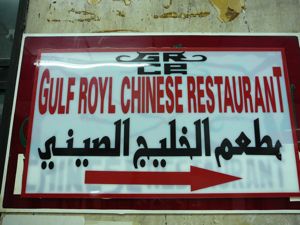


Best of all, when you read these books, you get a tiny little glimpse into another way of thinking, another way of doing business. We are all human, we all have the same needs, and we differ in how we go about getting those needs met. We differ in the way we think. It helps to enter another way of living, another way of thinking, it helps to visit through these books so that we can increase our own understanding that our way of doing things is not the only way, maybe (gasp!) not even the “right” way! Maybe (crunching those brain cells really hard to output this thought) there is more than one “right” way?
“So Many Christians!”
My Kuwaiti friend was shaking his head in disbelief. He had been to the old city to pay a condolence call on a Friday, and happened by the Lighthouse compound near the Sheraton circle on a Friday morning, just as some of the services were getting out.
“I had NO idea!” he looked at me in absolute amazement.
I just laughed. When we first got here, we attended church on that compound; our church moved off only months ago, when the road construction work got seriously under way and parking increasingly became a problem. It was the most amazing experience on earth – there were the Indian Men’s Catholic services and the Philipine Evangelical service and the rock-music evangelical service and the staid Anglican services and the family Philipine Catholic services and . . . well, you get the picture. There are an amazing number of expatriate Christians in Kuwait. At any one time on the compound, there are about twelve different services going on, and no sooner does one finish and the participants exit, than the new group is coming in.
Now, churches meet all over Kuwait. They met in villas, they meet in schools, they meet in every neighborhood. Today, in our church, we asked for blessings on Kuwait, on the Emir and his family, and those in leadership positions in Kuwait. We prayed for the leaders of all the countries in our congregation (English, Irish, Scottish, South African, Chinese, Indian, Nigerian, Kenyan, Dutch, Egyptian, Ethiopian, American, Australian {I have forgotten a few, I am sure} . . . lots and lots of blessings!) Most of all, we thank God for the freedom to worship in Kuwait.

(This is not our church in Kuwait. This is the Church of the Holy Sepulcher, in Jerusalem. I was looking for a church that looked more Middle Eastern than Western, and this is what I could find!)
Our pastor also has a blog, q8bridge about which he says “The purpose of this blog is to enable a bridge to be built between Christians and Muslims, especially those living in Kuwait. Through questions and dialogue we hope to promote deep friendships and mutual understanding.”
He examines the beliefs we have in common, and where we differ, and some of the reasons why we differ. I urge you to have a look.
Corrupt Officials Beware
I don’t usually type out the whole article from the Kuwait Times, but because this one is so small, and buried way down on the page, I am making an exception and typing in the whole thing:
Responding to recent stories published by Al-Rai concerning alleged violations and corruption cases committed by ministers and MPs, HH the Prime Minister Sheikh Nassar Al-Mohammed noted that HH the Amir had instructed them to enforce the law to everybody. “And you can start with enforcing it on me,” the prime minister added.
Sheikh Nassar pointed out that the law would be enforced on everybody, be them (sic) (they) senior or minor officials. He added that he had instructed all concerned law-enforcement authorities to treat everyone equally with no exceptions at all.
Comment: WOOOO HOOOOOOOOO, HH Prime Minister Sheikh Nassar Al-Mohammed and BIG WOOOO HOOOOOOOOOOO to HH the Emir! If I knew how to make red letters, this would be a big RED letter day! WOOOOO HOOOOO law enforcement!
Napoleon NOT Poisoned!
There is one person in my world who will really care about this article, and AdventureMan, this is for you. Happy Valentines Day, sweet man!
(You would not believe the places I have visited because of AdventureMan’s fascination with Napoleon – his room as a student, his room as a young soldier, countless small, obscure museums, any Napoleonic battlefield in France, Germany, Italy and Belgium!)

Scientists Say Napoleon Wasn’t Poisoned
By Robin Pomeroy, Reuters
Posted: 2008-02-12 19:18:08
Filed Under: Science News
ROME (Feb. 12) – Italian scientists say they have proved Napoleon was not poisoned, scotching the legend the French emperor was murdered by his British jailors.
Italian scientists said they have disproved a theory that Napoleon, here in an undated portrait, was fatally poisoned by his British jailors in 1821. The former French emperor’s captors were believed to have killed him with arsenic while he was in exile at Saint Helena, an island located in the South Atlantic.
Napoleon’s post-mortem said he died of stomach cancer aged 51, but the theory he was assassinated to prevent any return to power has gained credence in recent decades as some studies indicated his body contained a high level of the poison arsenic.
“It was not arsenic poisoning that killed Napoleon at Saint Helena,” said researchers at the National Institute of Nuclear Physics and the University of Pavia who tested the theory the British killed him while he was in exile on the South Atlantic island in 1821.
The Italian research — which studied hair samples from various moments in his life which are kept in museums in Italy and France — showed Napoleon’s body did have a high level of arsenic, but that he was already heavily contaminated as a boy.
The scientists used a nuclear reactor to irradiate the hairs to get an accurate measure of the levels of arsenic.
Looking at hairs from several of Napoleon’s contemporaries, including his wife and son, they found arsenic levels were generally much higher than is common today.
“The result? There was no poisoning in our opinion because Napoleon’s hairs contain the same amount of arsenic as his contemporaries,” the researchers said in a statement published on the university’s website.
The study found the samples taken from people living in the early 1800s contained 100 times as much arsenic than the current average. Glues and dyes commonly used at the time are blamed for high environmental levels of the toxic element.
AdventureMan, I know you will want to read the rest of the story. You can read the entire article at AOL News HERE.
New Kuwait Traffic Fines
A new e-mail flying around Kuwait gives the new traffic fines. At first, I thought this was a joke, but it looks pretty serious. Will someone please explain why a Jordanian car would get such a stiff fine?
And I remember a lot of discussion about penalties for talking on a mobile phone while driving, but when did the law pass? Was there any announcement? And babies in the front seat, not allowed, when did that change? All of this is amazing to me, I am still wondering if it is a hoax?

Do you think the police will really enforce these laws?
American Unipolarity
One of the top five articles e-mailed to others this week in the New York Times was this fascinating article called Waving Goodbye to Hegemony by PARAG KHANNA, published January 27.
It is 2016, and the Hillary Clinton or John McCain or Barack Obama administration is nearing the end of its second term. America has pulled out of Iraq but has about 20,000 troops in the independent state of Kurdistan, as well as warships anchored at Bahrain and an Air Force presence in Qatar. Afghanistan is stable; Iran is nuclear. China has absorbed Taiwan and is steadily increasing its naval presence around the Pacific Rim and, from the Pakistani port of Gwadar, on the Arabian Sea. The European Union has expanded to well over 30 members and has secure oil and gas flows from North Africa, Russia and the Caspian Sea, as well as substantial nuclear energy. America’s standing in the world remains in steady decline.
Why? Weren’t we supposed to reconnect with the United Nations and reaffirm to the world that America can, and should, lead it to collective security and prosperity? Indeed, improvements to America’s image may or may not occur, but either way, they mean little. Condoleezza Rice has said America has no “permanent enemies,” but it has no permanent friends either. Many saw the invasions of Afghanistan and Iraq as the symbols of a global American imperialism; in fact, they were signs of imperial overstretch. Every expenditure has weakened America’s armed forces, and each assertion of power has awakened resistance in the form of terrorist networks, insurgent groups and “asymmetric” weapons like suicide bombers. America’s unipolar moment has inspired diplomatic and financial countermovements to block American bullying and construct an alternate world order. That new global order has arrived, and there is precious little Clinton or McCain or Obama could do to resist its growth.
Its premise is that during the two terms of George Bush, American power has altered in ways he never anticipated. While he foresaw America leading the world into a peaceful place (like the Pax Romana), he never dreamed American power would unite friend and foe into powerful opposition. The author foresees a future – not that far off – where there are three major powers, the EEC, China, and the US in “a global, multicivilizational, multipolar battle.”
You can read the rest of this fascinating piece by clicking Here: Waving Goodbye to Hegemony
Recent Comments
ExpatAlien on What Country am I Living … intlxpatr on Yellowstone: Old Faithful to C… Michelle on Yellowstone: Old Faithful to C… Cathy on No Grown-Ups in Charge intlxpatr on Waiting for Snow Wikipedia Donate Button

Amazina


Early Voting in Florida


 Here There and Everywhere