General Traffic Department: Don’t Call Till You Reach Your Destination
God Bless ’em. GCC Traffic week will start on March 14 and they have chosen for their theme: Don’t Call Until You Reach Your Destination.
From today’s Arab Times:
GTD completes all preparations for GCC Traffic Week
KUWAIT CITY, March 6: The General Traffic Department (GTD) has completed all the necessary preparations for the GCC Traffic Week, which will be hosted by Kuwait on March 14 under the slogan “Don’t call until you reach your destination”, GTD General Manager General Mohmoud Al-Dousari said in a press release recently. Al-Dousari pointed out “mobile phones are vital communications gadgets, considering the additional services such as the Internet and camera, but there are also disadvantages.”
He said using the mobile phone by hand while driving is one of the major causes of road accidents in the country. Drivers might get distracted while talking over the phone, endangering not only their lives but also that of other road users, he added.
Minister of Interior Sheikh Jaber Al-Khalid Al-Sabah had earlier issued a decision banning the use of mobile phone by hand while driving to protect the lives of motorists, which was implemented since last year, said Al-Dousari. The GCC Traffic Week is aimed at conveying a clear message to the public on the dangers of using mobile phones by hand while driving, as well as encourage the use of other technologies like earphones and Bluetooth.
Al-Dousari revealed the department issued 18,773 citations for using mobile phone while driving. He added Kuwait is one of the most developed countries in the world in terms of traffic regulations, but some drivers are disregarding these rules. Al-Dousari warned the GTD will not tolerate those violating the traffic regulations and advised the public to drive safely and strictly comply with the traffic laws.
I admire General Al-Dousari. God bless him; he gallantly fights a battle for traffic safety in Kuwait. No kidding some drivers are disregarding these rules. Some policemen are disregarding these rules. Some policemen aren’t enforcing these rules. I wonder when the majority of those citations were issued? My bet would be that around 18,000 were issued more than six months ago. Until there is enforcement, this is a losing battle.
Kuwait Independence / Liberation Holiday Treat
My friends, run to the nearest newsstand and pick up a copy of today’s Arab Times. On page 3, one of Kuwait’s most eminent bloggers, Amer al Hilal, has a full page article; his diary as a soldier during the Liberation.
It is an awesome article. He brings the liberation period, with its thrills and challenges, to life. He is a very readable writer, and his story is compelling. Now! Right now! Go read the paper! Its YOUR history!
Kuwait Attorneys Defend Constitution
From today’s Al Watan:
Attorneys defend the Constitution
A group of young attorneys gather in front of the Palace of Justice on Tuesday to declare a new movement to defend the Constitution and its values. Nearly 100 female and male lawyers took part in the gathering. (Al Watan)
Last updated on Wednesday 18/2/2009
That’s it. That’s all there is. This photo, and the above two-sentence article:

It feels significant, but the significance is opaque to me. Can someone give me an idea why this group formed, and against what encroachments are they are defending the Kuwait Constitution?
Thoughtful Opposition to proposed new Labor Law
”Segregating between women, men against human values”
Ghenwah Jabouri
Staff Writer
KUWAIT: There have been recent debates about the new Labor Law that is expected to go into motion soon. One aspect of the law, which 43 MPs voted in favour of during its first session, will prevent women working between the hours of 10 p.m. till 7 a.m. Many experts and individuals are questioning this law and challenging it, arguing that such a law goes against basic human rights. This topic is a contentious one and is seen by many as a setـback to women rights in Kuwait. Imposing this law will be difficult and unfeasible, argued many experts.
Labeed Abdal, attorney at law, Constitutional expert, and Head of the International Committee at the Kuwait Bar Association, said that the new draft law was a result of the Parliament, which still included some members who were “against women’s rights and the prevention from working at night, was related to some cases against some clubs and cafes depended in their services on ladies at night. However, this restriction was not realistic, especially when there are many female doctors or journalists and other women professionals that need to do their job in any time of the day.”
The expert went on to explain reactions about the new amendments related to the draft law. “So far, the new draft has received criticism from the local unions, women’s societies and above all the International Labor Organization (ILO), especially on the areas of canceling the sponsorship system, protecting the low paid and house workers, unions for foreign workers and the need to allow group cases.”
In regard to women workers, the law was criticized because it imposed new restrictions on women working at night, where the new law prevented women from working from 10 p.m. till 7 a.m. excluding hospitals.
“This restriction historically, was related to some restaurants, entertainment clubs and shisha cafes, where they depended on some women workers in late hours to attract customers and there were few incidents of women abuse and harassment that took place and was brought to the local/international media and the Parliament discussions,” Abdal explained.
He further said the matter could be organized by administrative measures to regulate those shops and oblige them to make necessary changes; for example, requesting the commercial license to provide the needed security and protection for women workers during the night. And providing safe transportation and to make sure that work in that area of business came after the consent of the worker.
“There is no need to prevent women from working at night in general as there are many professions that requires women to work during the night. These jobs include the professions of: doctors, lawyers, journalists, etc. Any generalization in that case is considered against the principles of equality which were mentioned in the constitution of Kuwait and can be considered as sexual discrimination between men and women which were prevented by the international conventions of civil and human rights and Kuwait has already signed,” the lawyer pointed out.
Abdal added that the new draft came closer to the ILO requirements to protect the working women’s rights. Moreover, it added some benefits which were not previously mentioned especially the benefits and holidays after pregnancy that would elevate equality in the workplace. The new law included some new changes, after the old law which was issued in 1964. The new law was approved in the first debate in the Parliament and will be reـdiscussed by the Parliament in the coming session.
“The new law has some new benefits, like improving the minimum wage, fighting visa traders, and providing more benefits to the working women after pregnancy,” he added however.
“The new Labor Law was long been awaited by labor unions and even from expatriates, especially the minimum wage issue, and we can say that it amended 70 percent of the old law which was released in 1964.”
Maryam AlـKandari, a Political Science Professor at Kuwait University said: “We need to think beyond the law; one cannot practice it as it is. We need to go beyond how much it will affect women and not only the nonـKuwaiti women but also Kuwaiti women.”
“NonـKuwaiti women are living in this society and there is a lot of misbehaviour towards these women and we should care about these women whether or not she is a Kuwaiti or a nonـKuwaiti,” she explained.
The political scientist pointed out that first, people needed to understand whom are they applying this law on; the Kuwaitis or the expats and the reasons behind applying the law and most importantly, “how are you going to apply this law? It is not achievable,” the expert stated.
“I have heard comments from some of the women say that they do not want to work after 7:00 p.m. Unfortunately, the majority of women are very shortـsighted because they are looking for their own interests. This law may work for them but not our daughters. In other words, the law is not practical, and even if it were to go with today”s society it may not necessarily suit future generations,” the academic explained.
“Restricting women”s duties according to time is absurd, and we need to fight for our rights. What we need is some organisations to hold a seminar, and undertake research such as an NGO organisation, socioـeconomic society where not only women but men too will undertake study to determine how such a law will affect our lives in the future and now,” she pointed out.
“Women who practice law, women who are political professors such as myself need to look into this issue more thoroughly, by looking at the weakness of this law and have a conference whereby we make a symposium relevant to the law,” the academic lamented.
AlـKandari emphasised that she was a human being before being a woman. “When you view yourself as a human being before being a woman, you will become more neutral and objective rather than being subjective and shortـsighted.”
The academic further pointed out that society today was very fortunate because the Amir of the Kingdom of Saudi Arabia announced recently that he would appoint a woman as Deputy Minister at the Ministry of Higher Education. “That offers us a beautiful relief for us Kuwaitis. We used to be pressured by other societies, whereas now we have been given a wonderful opportunity to move forward; other societies are changing and so should we,” the academic pointed out.
“Ultimately, we need to debate this law through a wider perspective and the new media. We need to address the younger generation by publicising the issue on facebook and other mediums that the younger generation use and not only through television and newspapers. Finding ways to engage the younger generation on this issue is important, this law does not only concern experts and academics, rather it concerns a society at large and everyone should have their say in this topic,” AlـKandari noted strongly.
Thabet AlـHaroun, Head of the International Labor Organization (ILO) highlighted issues dealing with the new Labor Law, saying that issuing it in the private sector became an inevitable necessity after its delay for more than thirty years. “Therefore we are pushing towards its adoption in its final form, even though we have comments on it,” he said.
“In respect to women’s work, definitely the rights as enclosed in the new Labor Law are better than the current applied law, it also carries in its articles more rights for the working women that were missing, and it regulates the work of women at night.”
He added: “The work of women at night is subject to regulatory decisions from the concerned Minister, and I hope that it will not be an obstacle for women in the workforce.”
“Furthermore, the law came to achieve justice and equality and it is in favour of all parties (government, employers and workers). It is a qualitative step towards the application of international labor standards and conventions. Thus, all parties will benefit from issuing this new Labor Law, whereby Kuwait will be able to achieve a main component of sustainable development where women play an important part,” AlـHaroun pointed out.
AlـHaroun pointed out that under the current law, women were not being given their full rights, whereas the new Labor Law considered the fact that women play a significant role in the labor market. “Therefore urging women to engage in the private sector instead of depending on work in the public sector; the new proposed law ensures many rights that might not be flawless, but is an important development for women,” he added.
“In my opinion, and according to my reading of the law, it does not constitute any hindrance to women’s work and does not diminish women’s rights. Even though we have some comments on the new law, this does not call us or women to reject the adoption of this evolving law in comparison to the previous one.
Women could effectively participate in the workers” organizations and prove her ability to challenge and therefore emphasizes that she is an important partner in the social and economic development process. Rights are not granted but it is a right to be seized. No matter how many articles we put either for women or men, if they don”t prove their abilities and commitment in their work and face the challenges and difficulties that cross their paths, then they will not be able to reach their goals,” he explained.
“I would like here to refer to the role of the employers” and workers” organizations in engaging women in various activities and events and opening the way for women to prove their presence enable women to resist the campaigns aimed to distance her and diminish her role as an essential partner of the community,” the official stressed.
The expert further stressed that “real development cannot be attained if women are absent from decision making and taking.”
AlـHaroun further emphasized that the proposed law supported women”s rights and enhanced her presence to a large extent. He remarked: “Moreover, women have to benefit from this significant achievement, and not await any grants, but to work and persevere and strive side by side with the male figure.”
AlـHaroun explained that “The ILO”s theme for International Women”s Day this year is “Work and Family,” and we want a working woman productive and capable of effectively participating in the economic growth. But at the same time, we need women to surround their families, caring for them and be the core of the advanced society. She should be able to combine her responsibilities at work and her role in a happy successful family.”
Brian Katulis, an editor at Freedom House, a United Statesـbased international nonـgovernmental organization, stated in a study entitled “Women”s Rights In Focus: Kuwait, Findings From Focus Groups With Kuwaitis On Women”s Rights,” that the need to “control” women and their sexuality is a frequent part of Kuwaiti men”s discussions about societal change.
“It is at this complex nexus of societal change, with all of the pushes of modernity and globalisation and the tugs of religion and tribe, where much of the debate in Kuwait on women”s rights takes place.”
This article is the first in a two part series which examines a proposed amendment to the Labor Law which would restrict women working between 10 p.m. and 7 a.m. ـ Editor
Last updated on Wednesday 18/2/2009
Khaled Aljenfawi: Tolerance Begins at Home
An extraordinary article from today’s Arab Times:
Tolerance usually begins at home
By Khaled Aljenfawi
Verbally or physically abusing some domestic servants, stone pelting some expatriate passengers and drivers, lack of patience toward some expatriate doctors and teachers, by some individuals, certainly indicate that tolerance usually begins at home.
Already known for its tolerance toward strangers, foreigners and non-citizens, our Kuwaiti traditional society stands upon certain pillars of morality. These moral ideals usually advocate mercy, compassion and understanding toward others. As such, as Kuwaiti citizens, many of us already understand the importance of such moral ideals and many of us live by them. Therefore, we realize that we are integral parts of a larger human family; many of us in fact continue to refuse anti-social behavior directed toward some expatriates.
This being said yet certain individuals in our society continue to verbally or physically torment some helpless domestic servants. Some youngsters pelt expatriate passengers while they ride in public buses; perhaps just because they believe they can do so!
One can add to this the other negative phenomenon common these days of not being patient with some expatriate doctors and teachers and simply opting for the more reckless behavior: verbally and sometimes physically assaulting these expatriate professionals. Such behavior go against our national law and against the teachings of our national heritage. Such negative behavior in fact go against our Islamic tenets!
As a case in point, borrowing from already accepted international laws about human rights, and relying basically on our genuine Kuwaiti heritage of tolerance, officials in the Ministry of Education continue to update our national curriculum to adapt to a changing world. For example, primary, middle and secondary schooling emphasizes tolerance as a way of life in a modern society. Yet what the younger generations are learning at school about tolerance continues to be threatened by the behavior of some.
Intolerance actually goes against the basic teachings of our Islamic faith. As a Muslim society, Kuwait has been welcoming strangers, foreigners and expatriates for tens of years without apparent conflict. This tolerance toward those who are different springs from our Islamic faith, in addition, it originates from our national heritage. For example, one of the most enduring tenets of Islam is the equality among humans: in the Holy Quran, the Almighty say: “We have created you from male and female, and have made you nations and tribes that ye may know one another. Lo! the noblest of you, in the sight of Allah, is the best in conduct. Lo! Allah is Knower, Aware.” (Al-Hujraat-13).
One cannot instill by force tolerance in the mind of a child unless the whole family believes in the legitimacy of tolerance and its importance to its general wellbeing. If a young child learns about tolerance at school and then encounters daily situations of intolerance at home, he/she will find it hard to believe in tolerance. In other words, tolerance in addition to being a moral concept, which reflects the morality of a whole society, will take its roots if the ordinary family considers it as an accepted code of conduct. A Tolerant young person for example, will subsequently be a tolerant father or mother for these parents are already used to tolerance and will ultimately help shape the mentalities of their children.
A child who is already used to voicing his points freely in a safe family environment will find it much easier to accommodate tolerance and accept it as a way of life. Indeed, a child raised in a Tolerant family will eventually become a good neighbor, a good friend and certainly a Tolerant person toward those who are different from him.
khaledaljenfawi@yahoo.com
Wooo Hooo on you, Khaled Aljenfawi!
The Doha Museum of Islamic Arts – first visit
It’s Friday afternoon, and I can hardly believe it. We are here. Now THIS is my idea of a romantic getaway – please! Keep your chocolates (although I do love chocolate!) and your roses, keep your long lingering dinners and fabulous wine, but take me someplace where I have really wanted to go, and I will be your slave forever. You da man, AdventureMan. You know how to win my heart. 🙂


It is a glorious day and the museum has just opened. There is a huge parking lot and little carts ferrying the older people and women with small children to the entrance, but it is a nice walk, not a hard walk. Families are streaming in, and (gasp!) admission is FREE! You have to go get a ticket; I guess maybe that is how they keep track of admission statistics, but this beautiful museum, floating out over the gulf, all white and clean and gorgeous, filled with priceless objects of art, it’s free? Amazing.
We decide to start with the Beyond Borders exhibit, a special collection of art that integrates Jewish, Christian and Islamic traditions in an art collection. There are so many pieces that make me gasp in awe. I see one, and I can’t resist, the camera is out of my bag, I see others snapping photos with cell phones, but I know the rules . . . hmmm. But there is nothing posted here saying “no photos!” I ask the guard if I am allowed to take photos and he tells me “You are welcome, madame, all through the museum, you may take photos.”
I am in total shock. All through the museum? I can take photos?
Here is the piece that moved me so much that I gathered up the courage to ask. It is a Madonna, painted in Aleppo, Syria, I believe, and it has an Quranic sura written in her halo:
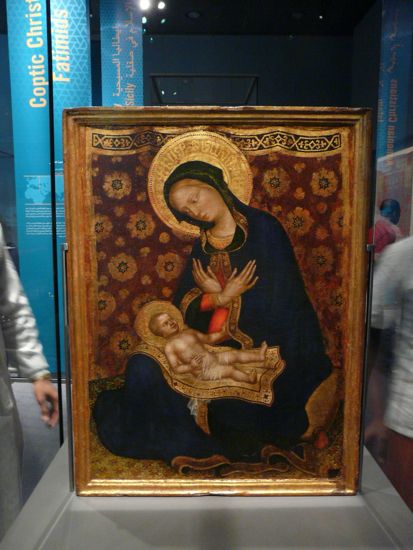

The museum is my oyster, and my battery is dead. I didn’t bring another. Some things happen for the best, and I tuck my camera back in my purse and AdventureMan and I try to absorb what the Doha Museum of Islamic Art has to offer.
It is an impossible task. There is SO much. Not everything is well documented, and then there are sections which are amazing. There is so much to learn, and so much beauty in this museum.
If I had to choose my favorite thing of all, it would be some tiles from Kashan. In an earlier post, commenter Daggero mentioned that the word for tile used in Kuwait is “kashi” and now I know that it comes from these tiles, made in Kashan around the 1300’s (Gregorian calendar) which were famed for their intricacy, their interlocking designs, and their high quality. There are also Iznik tiles in the museum, which are thought to be greatly influenced by these tiles from Kashan.
I had no idea, but the tiles just blow me away. I would love to create some tiled rooms back in my Seattle house, with reproductions of some of these amazing star shaped tiles. For me, that was the highlight of this trip. I know there will have to be many more – this museum is filled with treasures. Free – for all the people. And yes – the gift shop is awesome!
Prayers for Deliverance from Enemies
In today’s Lectionary, a timely prayer for deliverance from those wicked people who gleefully plan for the downfall of others:
Psalm 70
Prayer for Deliverance from Enemies
To the leader. Of David, for the memorial offering.
1 Be pleased, O God, to deliver me.
O Lord, make haste to help me!
2 Let those be put to shame and confusion
who seek my life.
Let those be turned back and brought to dishonour
who desire to hurt me.
3 Let those who say, ‘Aha, Aha!’
turn back because of their shame.
4 Let all who seek you
rejoice and be glad in you.
Let those who love your salvation
say evermore, ‘God is great!’
5 But I am poor and needy;
hasten to me, O God!
You are my help and my deliverer;
O Lord, do not delay!
Psalm 71
1 In you, O Lord, I take refuge;
let me never be put to shame.
2 In your righteousness deliver me and rescue me;
incline your ear to me and save me.
3 Be to me a rock of refuge,
a strong fortress,* to save me,
for you are my rock and my fortress.
4 Rescue me, O my God, from the hand of the wicked,
from the grasp of the unjust and cruel.
5 For you, O Lord, are my hope,
my trust, O Lord, from my youth.
6 Upon you I have leaned from my birth;
it was you who took me from my mother’s womb.
My praise is continually of you.
7 I have been like a portent to many,
but you are my strong refuge.
8 My mouth is filled with your praise,
and with your glory all day long.
9 Do not cast me off in the time of old age;
do not forsake me when my strength is spent.
10 For my enemies speak concerning me,
and those who watch for my life consult together.
11 They say, ‘Pursue and seize that person
whom God has forsaken,
for there is no one to deliver.’
12 O God, do not be far from me;
O my God, make haste to help me!
13 Let my accusers be put to shame and consumed;
let those who seek to hurt me
be covered with scorn and disgrace.
14 But I will hope continually,
and will praise you yet more and more.
15 My mouth will tell of your righteous acts,
of your deeds of salvation all day long,
though their number is past my knowledge.
16 I will come praising the mighty deeds of the Lord God,
I will praise your righteousness, yours alone.
17 O God, from my youth you have taught me,
and I still proclaim your wondrous deeds.
18 So even to old age and grey hairs,
O God, do not forsake me,
until I proclaim your might
to all the generations to come.*
Your power
19 and your righteousness, O God,
reach the high heavens.
You who have done great things,
O God, who is like you?
20 You who have made me see many troubles and calamities
will revive me again;
from the depths of the earth
you will bring me up again.
21 You will increase my honour,
and comfort me once again.
22 I will also praise you with the harp
for your faithfulness, O my God;
I will sing praises to you with the lyre,
O Holy One of Israel.
23 My lips will shout for joy
when I sing praises to you;
my soul also, which you have rescued.
24 All day long my tongue will talk of your righteous help,
for those who tried to do me harm
have been put to shame, and disgraced.
Nothing new under the sun. These are verses we share, Christian, Jew and Moslem alike. Interesting, huh?
“Ban Valentine’s Day Celebrations”
(Yawn)
I hate it when I can’t find the entry all typed up for me in one of the local online versions of the newspaper; it means I have to type the whole thing in by myself. I guess all the newspapers felt this was to ho-hum to put on the online edition.
Live from the Kuwait Times:
Ban Valentine’s Day Celebrations
KUWAIT: MPs have spung to action earlier than usual. They have urged the government to ban any form of Valentine’s Day celebrations on February 14. Lawmakers have asked the MInister of Commerce and Industry to see it that Kuwaiti traditions and values are fully observed, reported Al Watan. Speaking in this regard, MP Mohammed Hayef al-Mutairi urged the Commerce minister, Ahmed Baqer to ban the import of merchandise related to celebrating the “heathen occasion” (allusion to Valentine’s Day). He also warned local companies against displaying any of these goods for sale.
“This is against Islam and misleads our youth” he said. MP Abdullatif Al Omairi said that celebrating this day was a ‘blind imitation of the West.’ It is something that does not belong to us, something that is completely alien to our society, morals and traditions,” he warned. He urged the government to interfere and preserve Muslim values. “There are only two Eids in Islam. We should not celebrate Christians’ festivities because they do not celebrate ours,” he said.
As if celebrating Valentine’s Day could be stopped! As if a loving husband doesn’t invite his wife to dinner, or as if a loving wife doesn’t fix something special for her husband just because, just because. As if you won’t buy chocolates for your sweetheart, or flowers, whether or not there is a Valentine’s Day (February 14th) advertisement in a window. As if you can forbid the joyful celebration of a relationship. It’s not about a Christian holiday; this stopped being a religious holiday long ago, if it ever was, this holiday is purely about the joy of living. Not unlike Liberation Day, or a national day, neither of which are Islamic, and both of which are joyfully celebrated.
When will these lawmakers (and I include the lawmakers in all nations) learn that when you forbid something, you only make it more attractive?
In my country, we have some very serious national issues to tackle. I prefer that my lawmakers focus on national issues and not issues-of-choice to private individuals. (AdventureMan already knows where he is taking me on Valentine’s Day. 🙂 See you there!)
Why I Love A-Word-A-Day
This is today’s entry from Anu Garg’s A Word A Day.
Wordsmith.org The Magic of Words
This week’s theme
Words from Obama
This week’s words
cohere
with Anu Garg
Tomorrow Barack Obama will become president of the US, and not a moment too soon. This week we’ll feature words from Obama, words from his books, speeches, and interviews.
Unlike most politicians, who hire ghostwriters, Obama writes his own books. He’s a gifted writer. Reading his words you can see his thought process. He’s not one who sees the globe in black and white. He has lived outside the US and has been exposed to other cultures. He realizes that just because someone has a different set of beliefs, just because someone looks different, doesn’t mean he’s wrong — sometimes there can be two ways to do something and both can be right.
Obama is to be commended for his accomplishments. We’ve come a long way in this country. But we still have far to go before we can call ourselves truly unbiased. Real progress will be when any capable person can have a fair chance at winning the highest office, even someone who happens to be, say, a black gay vegan atheist woman.
Anything is possible… but don’t hold your breath.
cohere
PRONUNCIATION:
(ko-HEER)
MEANING:
verb intr.: To be united; to work or hold together.
ETYMOLOGY:
From Latin cohaerere, from co- (together) + haerere (to stick).
USAGE:
“I learned to slip back and forth between my black and white worlds, understanding that each possessed its own language and customs and structures of meaning, convinced that with a bit of translation on my part the two worlds would eventually cohere.”
Barack Obama; Dreams From My Father; Times Books; 1995.
A THOUGHT FOR TODAY:
I have a dream that my four little children will one day live in a nation where they will not be judged by the color of their skin but by the content of their character. -Martin Luther King, Jr., civil-rights leader (1929-1968)
Here is what Anu Garg isn’t saying, and my guess is he hasn’t thought twice about it. He is an American. He was not born in America, he immigrated to America – as most of us did, meaning our forefathers and mothers came from Europe, from Africa, from Asia and from India and the Middle East and – and – and. As an immigrant, as an American, he is free to say what he wants. Free to be happy Obama is president, and at the same time free to say that the system is not yet free enough.
I also totally love it that his quote for today is from Martin Luther King, who we are celebrating in America, on this national holiday.
We don’t have to agree. I love it that he is passionate about his beliefs, and that he provides A-Word-A-Day as a public service, entirely free, every day sending a new word, defined and used in context, to subscribers in every nation in the world. I admire people like him, like the Rajab family here in Kuwait, like Andrew Carnegie who started most of the small town libraries in the United States, people who use what they have been given to give back to the world-at-large.
You can see A Word A Day leads my blogroll. You can subscribe by clicking on the blue type above. 🙂
Ok To Marry 10 Year Old Girls – Saudi Arabia
This is just sad. I’m sorry, a ten year old girl is that – a girl. Any father knows that. She is precious and innocent, and still playing dolls and make believe. Few girls are even menstruating at 10. No girl, at 10, has the emotional and physical maturity to enter into a marriage. And this is the SENIOR Saudi Arabian cleric speaking? I’m sorry, this makes me sick to my stomach. It’s just wrong.
You don’t leave a ten year old alone – you get a babysitter. A ten year old belongs in school, a ten year old belongs with her mother.
This is from today’s Al Watan, right on the front page.
RIYADH: Saudi Arabia”s most senior cleric was quoted Wednesday as saying it is permissible for 10ـyearـold girls to marry and those who think they’re too young are doing the girls an injustice.
The mufti”s comments showed the conservative clergy’s opposition to a drive by Saudi rights groups, including government ones, to define the age of marriage and put an end to the phenomenon of child marriages.
“It is wrong to say it’s not permitted to marry off girls who are 15 and younger,” Sheik AbdulـAziz AlـSheikh, the country”s grand mufti, was quoted as saying.
“A female who is 10 or 12 is marriageable and those who think she’s too young are wrong and are being unfair to her,” he said during a Monday lecture, according to the panـArab AlـHayat newspaper.
AlـSheikh”s comments come at a time when Saudi human rights groups have been pushing the government to put an end to marriages involving the very young and to define a minimum age for marriage. In the past few months, Saudi newspapers have highlighted several cases in which young girls were married off to much older men or very young boys.
Though the mufti’s pronouncements are respected and provide guidance, the government is not legally bound by them.
On Sunday, the governmentـrun Human Rights Commission condemned marriages of minor girls, saying such marriages are an “inhumane violation” and rob children of their rights.
The commission’s statement followed a ruling by a court in Oneiza in central Saudi Arabia last month that dismissed a divorce petition by the mother of an eightـyearـold girl whose father married her off to a man in his 50s.
Newspaper reports said the court argued that the mother did not have the right to file such a case on behalf of her daughter and said that the petition should be filed by the girl when she reaches puberty.
Responding to a question about parents who force their underage daughters to marry, the mufti said: “We hear a lot about the marriage of underage girls in the media, and we should know that Islamic law has not brought injustice to women.”
The mufti said a good upbringing will make a girl capable of carrying out her duties as a wife and that those who say women should not marry before the age of 25 are following a “bad path.”
“Our mothers and before them, our grandmothers, married when they were barely 12,” said AlـSheikh, according to AlـHayat.
There are no statistics to show how many marriages involving children are performed in Saudi Arabia every year. And it’s also not clear whether these unions are on the rise or whether people are hearing about them more now because of the prevalence of media outlets and easy access to the Internet.
Activists say the girls are given away in return for hefty dowries or as a result of longـstanding custom in which a father promises his infant daughters and sons to cousins out of a belief that marriage will protect them from illicit relationships. ـAP
Last updated on Thursday 15/1/2009
I have a friend who says the mufti needs to come back in his next life as a young girl in Saudi Arabia. I think it might give his thought processes some clarity.
Recent Comments
intlxpatr on Shampoo Ginger tigerbutterya0c5ff1d… on Shampoo Ginger intlxpatr on British Soldier Kidnapped, Esc… John on British Soldier Kidnapped, Esc… intlxpatr on British Soldier Kidnapped, Esc… Wikipedia Donate Button

Amazina


Early Voting in Florida


