“Kuwait Will Work it Out”
Some ambassadors, in my humble opinion, are just weenies. They go to all the dinners, they shake hands with important people, they mouth polite phrases and the party line, and some barely connect with the country where they are assigned. No one can accuse the current American ambassador to Kuwait, Deborah Jones, of being a weenie. This woman is a lion. And you get the feeling she loves what she is doing, and that she is truly connected with issues and activities in Kuwait.
”Kuwait will work it out”, stresses U.S. ambassador
Dina AlـMallak
Al Watan; you can read the entire article by clicking on the blue type, here.
KUWAIT: “Kuwaiti people are wellـeducated and know themselves well enough …. They don”t need someone coming from outside to fix their machine. We look forward to the lively debate that is to come,” said U.S. Ambassador to Kuwait Deborah Jones on Wednesday.
In a roundtable open discussion with a group of journalists from the Kuwaiti media, U.S. Ambassador Jones underscored the U.S. relations and aims locally and in the region. She also discussed such topics as the local elections, President Barrack Obama”s goals, and the Kuwaiti detainees at Guantanamo Bay. Excerpts:
How does the U.S. administration view the recent political developments in Kuwait?
Jones: Obviously Kuwait is a sovereign country; we take that word, “sovereign,” very seriously. Kuwait is not one of the 50 states. On the other hand, I don”t think that it is a big secret in the world that the United States is a big believer in democracy ـ representative democracy ـ and participatory governance.
The best way to ensure peaceful transition and growth, as countries grow, because governments are organic and we think that democracy ـ representative democracy ـ is what helps countries to grow and develop, and avoid violent transitional episodes.
We have always supported Kuwait”s democratic traditions, which we believe are deeply embedded in your diwaniya tradition and others, such as participatory governance. We describe the process here as being vibrant and a little bit complicated. We support that, given the alternatives. Politics is about building capacity and ensuring that there is growth and access to resources.
When political gridlock leads to stagnation, no one benefits of course. So, democracy is about a couple of things ـ it”s about representative government. It”s also about respectful rule of law and respect for institutions.
We feel pretty confident that Kuwaitis are going to work (it) out. There is a lively debate and you all have an important role to play as a free press, in responsibly reporting on what you hear, and contributing to that democratic dialogue, which is often noisy. I was going to use the word cacophony, which means a clash of sounds. We are used to this in the United States; we are used to having a lot of noise that comes when the various branches of government interact.
You can read the entire article HERE
Clever Solution: When Men Refuse to Salute Women
That gives me a huge grin – for every subordinate who refuses to salute a female superior officer, she gets an extra KD50 in her paycheck! This is a very clever solution.
Kuwaiti policemen refusing to salute female officers
Published Date: April 02, 2009
KUWAIT: Only shortly after the graduation of the first batch of female police officers, a large number of their male colleagues have put the Ministry of Interior (MoI) in an awkward position by insisting that they will refuse to salute any female officer, no matter how superior her rank to their own. The male officers cited local social values, cultural norms and traditions to justify their stance, reported Al-Jarida.
The ministry must now decide whether to strictly implement the law and force these officers to perform their duties in a professional manner or to take the policemen’s concerns into account and accept their refusal. A recent fatwa issued by Dr Ajil Al-Nashmi which stated that saluting a woman is contrary to local and tribal traditions, is believed to have aggravated the situation, making the male officers’ determination to accept no compromise on the issue even stronger.
One MoI official said that the ministry is considering the options of paying female officers an additional KD 50 on top of their wages for every salute which male colleagues refuse to give them or imposing administrative penalties on the male police officers in question.
Female Police Given Ranks Equal to Men
The Police Academy attracted 16 women with university degrees – HOOOO-AHHH! I imagine these women are going to shake things up a little – in a good way – around police headquarters. Mabruk, mabruk, Kuwait.
Women officers given rank equally to men
Staff Writer – from Al Watan
KUWAIT: An Amiri decree was issued requiring female police officers to be put on equal footing with their male counterparts in terms of rank. Accordingly, Minister of Interior Sheikh Jaber AlـKhaled AlـSabah issued an executive order to rank women police officers according to the same requirements as given to male officers.
The first batch of women police now includes 16 Lieutenants, all of which have university degrees, eight Warrant Officers, all holding technical diplomas, and three Sergeants who have secondary school certificates.
Last updated on Friday 27/3/2009
Record Traffic Violations Recorded
Cameras capture record traffic violations
Staff Writer – From today’s Al Watan
Wooo HOOOO! Cameras are impartial; they catch the violators, no matter who. I love it.
KUWAIT: The relocation of radar cameras on major roads has led to a sharp increase in the number of violations registered during an entire month. According to security sources; they reported that around 2,000 cars have been photographed by the relocated cameras during last January as compared to 900 cars prior to the relocation.
Earlier on, the Assistant Undersecretary for Traffic Affairs Major General Mahmoud AlـDousari had recommended the relocation of the radar cameras, particularly since motorists had become too familiar with the previous locations. Drivers who have been involved in violations have been contacted through official channels to either pay their fines or get referred to the concerned authorities. It has been gathered that fines have been already collected from 400 errant motorists.
Last updated on Friday 27/3/2009
Here is an extra one for you, General Al-Dousari, one of those special kind of people who travel in the emergency lane while the rest of us obey the rules and crawl along the freeway. I could not resist this particular photo – with the sign right there.

PS – We were not moving. I wasn’t driving when I took the photo. 🙂
First Kuwaiti Policewomen Graduate
Wooo HOOO on you, Kuwaiti policewomen! It is always hard to be in the vanguard, you take the criticisms, you take the disbelieving stares, and you handle questions, even from your own families. It’s always tough to be out front – to be a leader.
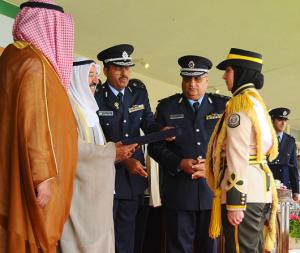
First group of policewomen graduate
From today’s Al Watan
KUWAIT: His Highness the Amir and Supreme Commander of the Armed Forces Sheikh Sabah AlـAhmad AlـSabah has attended on Wednesday the graduation ceremony of the 35th batch of military cadets, the 20th batch of specialized officers and the first batch of female cadets at the Support Authority Institute of the Saad AlـAbdullah Academy for Security Sciences.
The ceremony witnessed the graduation of the first batch of policewomen in the country. His Highness the Amir who arrived at the academy at 10:30 a.m. was warmly received by the Minister of Interior Lieutenant General Sheikh Jaber AlـKhalid AlـSabah, as well as other senior police officers.
The ceremony was also attended by His Highness the Crown Prince Sheikh Nawaf AlـAhmad AlـSabah, Vice President of the National Guards Corps Sheikh Mishaal
AlـAhmad AlـSabah, His Highness the Prime Minister Sheikh Nasser AlـMohammed AlـSabah, First Deputy Prime Minister and Minister of State for Defense Sheikh Jaber AlـMubarak AlـSabah, as well as other members of the ruling family, senior statesmen and members of the families of the graduating cadets.
Representatives of the 35th batch of military cadets then handed over the national flag to the representatives of the 36th batch. The Assistant Director General of the Academy for Education and Training Affairs Brigadier Dr. Waleed Khalaf BinـSalama read the ministerial decrees before inducting the new male and female police officers into the police force.
His Highness the Amir handed the graduates awards and certificates in appreciation for their efforts and then received the shield of the academy, that is dedicated to him, from Major General Yousef Mubarak AlـMedhahka. ـKUNA
Last updated on Thursday 26/3/2009
A Modern Parable
Thank you, Anita!
A MODERN PARABLE . .
A Japanese company ( Toyota ) and an American company (Ford) decided to have a canoe race on the Missouri River. Both teams practiced long and hard to reach their peak performance before the race.
On the big day, the Japanese won by a mile.
The Americans, very discouraged and depressed, decided to investigate the reason for the crushing defeat. A management team made up of senior management was formed to investigate and recommend appropriate action.
Their conclusion was the Japanese had 8 people rowing and 1 person steering, while the American team had 8 people steering and 1 person rowing.
Feeling a deeper study was in order, American management hired a consulting company and paid them a large amount of money for a second opinion.
They advised, of course, that too many people were steering the boat, while not enough people were rowing.
Not sure of how to utilize that information, but wanting to prevent another loss to the Japanese, the rowing team’s management structure was totally reorganized to 4 steering supervisors, 3 area steering superintendents, and 1 assistant superintendent steering manager.
They also implemented a new performance system that would give the 1 person rowing the boat greater incentive to work harder. It was called the ‘Rowing Team Quality First Program,’ with meetings, dinners, and free pens for the rower There was discussion of getting new paddles, canoes, and other equipment, extra vacation days for practices and bonuses.
The next year the Japanese won by two miles.
Humiliated, the American management laid off the rower for poor performance, halted development of a new canoe, sold the paddles, and cancelled all capital investments for new equipment. The money saved was distributed to the Senior Executives as bonuses and the next year’s racing team was out-sourced to India.
Sadly, The End.
Here’s something else to think about:
Ford has spent the last thirty years moving all its factories out of the US, claiming they can’t make money paying American wages.
TOYOTA has spent the last thirty years building more than a dozen plants inside the US. The last quarter’s results:
TOYOTA makes 4 billion in profits while Ford racked up 9 billion in losses.
Ford folks are still scratching their heads.
St. Oscar Romero
I didn’t even know we had a St. Oscar Romero, so when it came up on my screen, this morning as I was doing my daily lectionary readings I took a little time to read about him.
What an incredible man – and a modern day saint, too, a man for our times:
OSCAR ROMERO
ARCHBISHOP OF SAN SALVADOR, AND THE MARTYRS OF EL SALVADOR
(24 March 1980)
Óscar Arnulfo Romero y Galdámez (August 15, 1917 – March 24, 1980), commonly known as Monseñor Romero, was a priest of the Roman Catholic Church in El Salvador. He later became prelate archbishop of San Salvador.
As an archbishop, he witnessed numerous violations of human rights and began a ministry speaking out on behalf of the poor and victims of the country’s civil war. His brand of political activism was denounced by the hierarchy of the Roman Catholic Church and the government of El Salvador. In 1980, he was assassinated by gunshot while consecrating the Eucharist during mass. His death finally provoked international outcry for human rights reform in El Salvador.
In 1997, a cause for beatification and canonization into sainthood was opened for Romero and Pope John Paul II bestowed upon him the title of Servant of God. The process continues. He is considered the unofficial patron saint of the Americas and El Salvador and is often referred to as “San Romero” in El Salvador. Outside of Catholicism Romero is honored by other religious denominations of Christendom, like the Church of England through its Common Worship. He is one of the ten 20th-century martyrs from across the world who are depicted in statues above the Great West Door of Westminster Abbey, London.
You don’t have to be perfect to be a saint, in fact in the reading for today, St. Paul writes that “22 For I delight in the law of God in my inmost self, 23 but I see in my members another law at war with the law of my mind, making me captive to the law of sin that dwells in my members. 24 Wretched man that I am! Who will rescue me from this body of death? 25 Thanks be to God through Jesus Christ our Lord!
So then, with my mind I am a slave to the law of God, but with my flesh I am a slave to the law of sin.
We cannot, in our own strength do right all the time, even if we want to choose rightly. Oscar Romero may not have been perfect (because none of us are, it’s not like I know anything scandalous about him) but he dedicated himself to righting a major wrong he saw in society, and his persistence and dedication ended up causing his death.
Honored Guest
In every country where I have lived, we have felt like honored guests. This week, I have been truly honored, my blogging friend Hilaliya has asked me to be an occasional guest blogger on his revamped blog, now featuring a Kuwait Blogging Diwaniya. Pretty cool, huh? I have to admit it, I have a smile from ear to ear.
The revered blogger Don Veto led the way with an article yesterday, and I jumped in today.
In honor of my ear-to-ear smile, it’s called Smile for me Baby – Let Me See Your Grill but fair warning – it’s political polemic, about parliamentary gridlock, so you will see a grittier side of Intlxpatr.
Wild Blue Yonder
Today was the Kuwait show of military might. No sandstorm, thanks be to God. Somehow, I had thought yesterday was Wednesday and thought how sad it was it would have had to be cancelled. When I woke up today and realized it was Wednesday, I could hardly wait.
Just the sound of the roaring jets gives me a grin. I once lived near a huge airbase, and we lived with the sound day and night. It never bothered me. I always knew these were men and women who sacrificed their lives to serve their country in a profession that looks a lot more glamorous than it is. Flying can be exciting, but it can also be very tedious. You are away from your family for long hours. It gets old. They persevere.
The young men and women chosen to fly these fighter planes have to have superior physical condition and reflexes. Think about you and the car your daddy gave you – it may be expensive, but it didn’t cost billions. These planes do. It’s an amazing responsibility, a privilege and an honor to be selected.
Bu Yousef, tell your friend he was supposed to waggle his wings when he flew by so I would know which one he was! 😉
Macaholic, it was a little hazy, but the attack helicopters are for you. 🙂




“Praying on land not owned by the mosque is legally invalid”
From today’s Al Watan:
Furor over mosque demolition a ”political ploy”
Staff Writer
KUWAIT: The newest attempt to demolish a mosque located on stateـowned property gave raise to several concerns from the populace.
Prominent Shiite cleric in Kuwait Mohammed Baqir AlـMahri stated that praying on land not owned by the mosque is legally invalid.
He also condemned demands for the prosecution of the Chairman of the State Property Violation Committee, Mohammed AlـBader, who, he said, “must be honored for honoring the law and meeting the request of the Ministry of Awqaf for the removal of all mosques in violation.”
He went on to state that all the turmoil surrounding the removal of the mosque was “a ploy to gain votes,” in case of the dissolution of the council.
Member of the Municipal Council and the Chairman of the Development and Reform Commission Khalifa AlـKhorafi agreed with AlـMahri”s views and stated that Kuwait is suffering from a major crisis that reeks of a general lack of confidence and faith in most matters that concern the state.
He warned against hasty decisions and explained that the mosque was not a heritage monument and that it was mainly used as a storage space.
He pointed out that before the demolition of the mosque the council had ensured the availability of another mosque in the same area and that the permission of many preachers and scholars was taken long before the attempt to demolish the holy structure. He went on to state that all had agreed that it was illegal to pray in the mosque, a fact agreed to by Dr. Ajil AlـNashmi.
Meanwhile, lawyer Nawaf Sari praised the act of MPs against the demolition of the mosque and referred to it as a “glorious stand.” He said that there was no justification for the elimination of the mosque and that people should protect Islamic and religious beliefs whenever possible. He also demanded the persecution of Mohammed AlـBader and blamed him for the deterioration of the political system in the country.
I don’t understand. How can this be an issue? An old, run-down mosque was erected – illegally – on public property. Before the mosque was demolished, authorities informed and had consensus from the local clerics, and the mosque was only used for storage? What is furor about? Why is tearing down an old mosque an attack on Islamic beliefs? I see mosques torn down around Kuwait all the time – usually just before a newer, bigger mosque takes its place. In this case, they insured sufficient mosques were available before they demolished this one.
Recent Comments
intlxpatr on Shampoo Ginger tigerbutterya0c5ff1d… on Shampoo Ginger intlxpatr on British Soldier Kidnapped, Esc… John on British Soldier Kidnapped, Esc… intlxpatr on British Soldier Kidnapped, Esc… Wikipedia Donate Button

Amazina


Early Voting in Florida


