Oscar Romero, Patron Saint of The Americas and El Salvador
My friends, when you hear that the immigrants seeking a new life in our country are rapists, thieves, the mentally ill and very bad people, please think of Oscar Romero, and all those who have fought the evil forces of thuggery and dictatorship to find a life of freedom for themselves, and for their families, especially, hope for their children.
I urge you to read a much criticized book, American Dirt, by Jeanine Cummins. Here is what Wikipedia says. My experience was that the struggles exposed in American Dirt are very typical of people seeking to escape the violence of their societies.
American Dirt is a 2020 novel by American author Jeanine Cummins, published by Flatiron Books. The book is about a Mexican bookseller who is forced to flee as an undocumented immigrant to the United States, along with her son, after her journalist husband exposes a local drug kingpin.
ÓSCAR ROMERO
ARCHBISHOP OF SAN SALVADOR, AND THE MARTYRS OF EL SALVADOR
(24 March 1980)
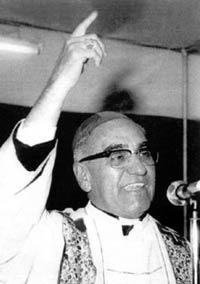
Óscar Arnulfo Romero y Galdámez (August 15, 1917 – March 24, 1980), commonly known as Monseñor Romero, was a priest of the Roman Catholic Church in El Salvador. He later became prelate archbishop of San Salvador.
As an archbishop, he witnessed numerous violations of human rights and began a ministry speaking out on behalf of the poor and victims of the country’s civil war. His brand of political activism was denounced by the hierarchy of the Roman Catholic Church and the government of El Salvador. In 1980, he was assassinated by gunshot while consecrating the Eucharist during mass. His death finally provoked international outcry for human rights reform in El Salvador.
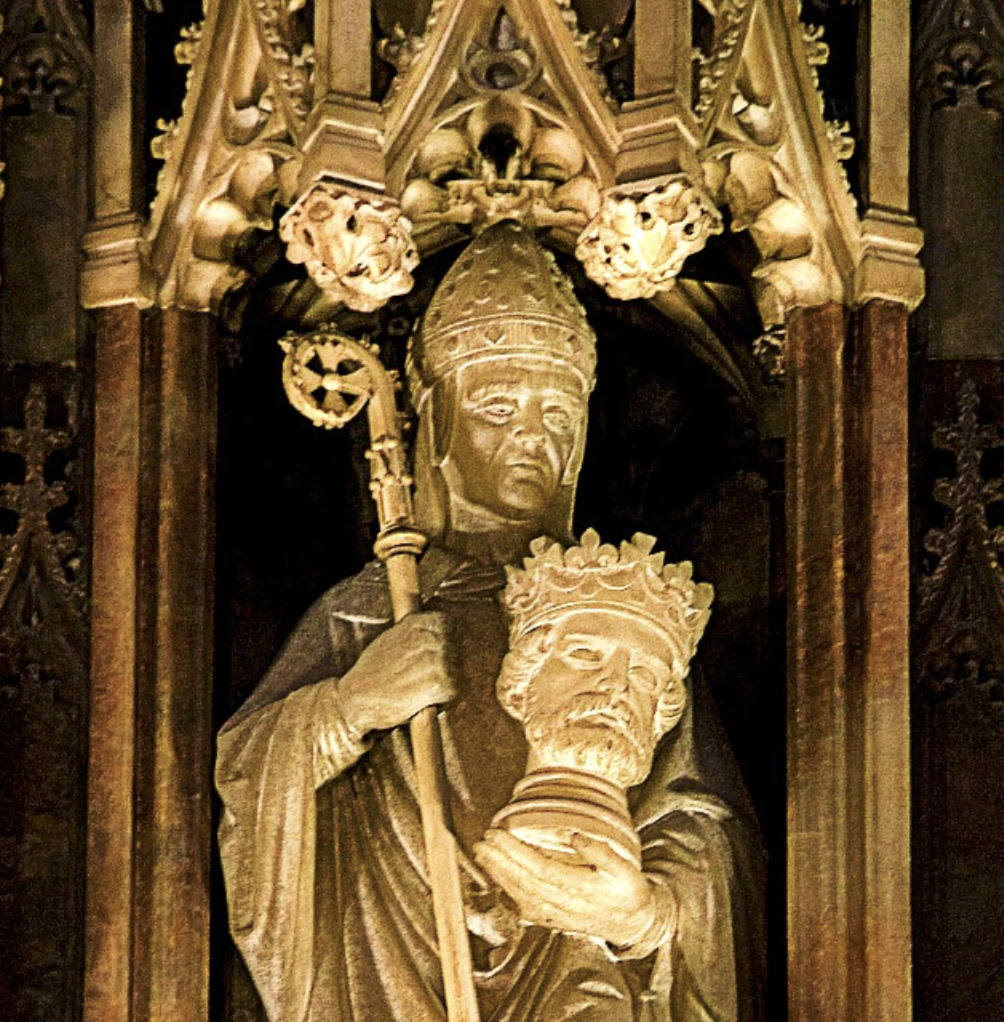
In 1997, a cause for beatification and canonization into sainthood was opened for Romero and Pope John Paul II bestowed upon him the title of Servant of God. Pope Francis canonized Romero as a saint on 14 October 2018. He is considered the unofficial patron saint of the Americas and El Salvador and is often referred to as “San Romero” in El Salvador. Outside of Catholicism Romero is honored by other religious denominations of Christendom, like the Church of England through its Common Worship. He is one of the ten 20th-century martyrs from across the world who are depicted in statues above the Great West Door of Westminster Abbey, London.
from Wikipedia
Also commemorated on this day are three Maryknoll nuns and a woman lay missionary killed by a Salvadoran army death squad on 2 Dec, 1980, and additionally six Jesuits, their housekeeper and her daughter, who were also murdered by the Salvadoran army on 16 Nov. 1989.
Prayer for the Feast Day of Saint Cuthbert
From today’s Lectionary readings:
Merciful God, who called Cuthbert from following the flock to be a shepherd of your people: Mercifully grant that we also may go without fear to dangerous and remote places, to seek the indifferent and the lost; through Jesus Christ our Lord, who lives and reigns with you and the Holy Spirit, one God, for ever and ever. Amen.
“I Have No Need of You”
From this morning’s Lectionary Readings:
1 Corinthians 12:12-26
12 For just as the body is one and has many members, and all the members of the body, though many, are one body, so it is with Christ.13For in the one Spirit we were all baptized into one body—Jews or Greeks, slaves or free—and we were all made to drink of one Spirit.
14 Indeed, the body does not consist of one member but of many. 15If the foot were to say, ‘Because I am not a hand, I do not belong to the body’, that would not make it any less a part of the body. 16And if the ear were to say, ‘Because I am not an eye, I do not belong to the body’, that would not make it any less a part of the body. 17If the whole body were an eye, where would the hearing be? If the whole body were hearing, where would the sense of smell be?
18But as it is, God arranged the members in the body, each one of them, as he chose. 19If all were a single member, where would the body be? 20As it is, there are many members, yet one body. 2
1The eye cannot say to the hand, ‘I have no need of you’, nor again the head to the feet, ‘I have no need of you.’ 22On the contrary, the members of the body that seem to be weaker are indispensable, 23and those members of the body that we think less honourable we clothe with greater honour, and our less respectable members are treated with greater respect; 24whereas our more respectable members do not need this. But God has so arranged the body, giving the greater honour to the inferior member, 25that there may be no dissension within the body, but the members may have the same care for one another. 26If one member suffers, all suffer together with it; if one member is honoured, all rejoice together with it.
No Grown-Ups in Charge
We thought we would change the world, my generation. How on earth did we end up with a President who has the self-control, self-restraint, self-discipline, and dignity of a two-year-old?
How did we end up with a President who supports COAL, flying in the face of science, and wants to roll back protections against climate change, air pollution, water pollution, vaccinations, human rights, and stewardship of earthly resources?
What happened to the dawning of the Age of Aquarius, where we worked on harmony and understanding, and the dignity of ALL human beings?
How did we get stuck with a government of morons, whose first move was to remove all the bureaucratics who knew what they were doing? How did we allow all the oversights to be abolished?
How do we continue to allow the oligarchs to forbid the completion of a bridge between Canada and Michigan because of a conflict with a rich man who owns a competing bridge? How do we allow a Presidency which makes private deals to enrich his sons and son-in-law with opaque deals outside the public view?
How do we accept a new army of MERCENARIES, attracted by a $50K bonus for signing on, who have paltry training, disobey standard policing standards and who act with disregard to our national constitution?
I may be old, but I am not blind, nor am I stupid. I see, to my horror. I witness, and I document. I am part of a large and growing crowd of witnesses, (dead and alive!) who will call this administration to account for their grave injustices.

Pam Bondi, who cannot answer questions, who is protecting her boss, mentioned over one million times in the Epstein files, pointing her finger.
This week I attended a school service at our church, and the Old Testament reading was from Isaiah. It heartened me; this is what we are teaching our children
ISAIAH 58: 6-10
“Is not this the kind of fasting I have chosen:
to loose the chains of injustice
and untie the cords of the yoke,
to set the oppressed free
and break every yoke?
7 Is it not to share your food with the hungry
and to provide the poor wanderer with shelter—
when you see the naked, to clothe them,
and not to turn away from your own flesh and blood?
8 Then your light will break forth like the dawn,
and your healing will quickly appear;
then your righteousness will go before you,
and the glory of the Lord will be your rear guard.
9 Then you will call, and the Lord will answer;
you will cry for help, and he will say: Here am I.
“If you do away with the yoke of oppression,
with the pointing finger and malicious talk,
10 and if you spend yourselves in behalf of the hungry
and satisfy the needs of the oppressed,
then your light will rise in the darkness,
and your night will become like the noonday.”
Let us shine. Let us seek to shine.
On Friends and Friendship
I love the Lectionary. I learn so much. Today’s is one that I feel like I have never read before. I must have, I’ve been reading the Lectionary for over 30 years, but it feels fresh and new:
Sirach 6:5-17
5 Pleasant speech multiplies friends,
and a gracious tongue multiplies courtesies.
6 Let those who are friendly with you be many,
but let your advisers be one in a thousand.
7 When you gain friends, gain them through testing,
and do not trust them hastily.
8 For there are friends who are such when it suits them,
but they will not stand by you in time of trouble.
9 And there are friends who change into enemies,
and tell of the quarrel to your disgrace.
10 And there are friends who sit at your table,
but they will not stand by you in time of trouble.
11 When you are prosperous, they become your second self,
and lord it over your servants;
12 but if you are brought low, they turn against you,
and hide themselves from you.
13 Keep away from your enemies,
and be on guard with your friends.
14 Faithful friends are a sturdy shelter:
whoever finds one has found a treasure.
15 Faithful friends are beyond price;
no amount can balance their worth.
16 Faithful friends are life-saving medicine;
and those who fear the Lord will find them.
17 Those who fear the Lord direct their friendship aright,
for as they are, so are their neighbours also.
The “Righteous Gentiles”
Today in our church Lectionary, we celebrate those who stood up to the Nazi policies and shielded and rescued thousands of Jewish people who might otherwise not have survived the torture, imprisonment and extermination, solely for being “the other.”
PRAYER (contemporary language)
Lord of the Exodus, who delivers your people with a strong hand and a mighty arm: Strengthen your Church with the examples of the Righteous Gentiles of World War II to defy oppression for the rescue of the innocent; through Jesus Christ our Lord, who lives and reigns with you and the Holy Spirit, one God, now and for ever. Amen.
“THE RIGHTEOUS GENTILES”
Although the phrase “Righteous Gentiles” has become a general term for any non-Jew who risked their life to save Jews during the Holocaust, it here appears to apply specifically to: Raoul Wallenberg [Swedish, d. 1947] Hiram Bingham IV [d. 1988, American]; Karl Lutz [d. 1975, Swiss]; C. Sujihara [d. 1986, Japanese]; and Andre Trocme [d. 1971, French].

Raoul Wallenberg (August 4, 1912 – July 17, 1947?) was a Swedish humanitarian who worked in Budapest, Hungary, during World War II to rescue Jews from the Holocaust. Between July and December 1944, he issued protective passports and housed Jews, saving tens of thousands of Jewish lives.
On January 17, 1945, he was arrested in Budapest by the Soviets after they wrested control of the city from the Germans, and was reported to have been executed while a prisoner at Lubyanka Prison, although this is not entirely certain.
Wallenberg has been honored numerous times. He is an honorary citizen of the United States, Canada, Hungary and Israel. Israel has also designated Wallenberg one of the Righteous among the Nations. Monuments have been dedicated to him, and streets have been named after him throughout the world.
— more at Wikipedia

Hiram “Harry” Bingham IV (July 17, 1903 – January 12, 1988) was an American diplomat. He served as a Vice-Consul in Marseille, France, during World War II, and helped over 2,500 Jews to flee from France as Nazi forces advanced.
In 1939, Bingham was posted to the US Consulate in Marseille, where he, together with another vice-consul named Myles Standish, was in charge of issuing entry visas to the USA.
On June 10, 1940, Adolf Hitler’s forces invaded France and the French government fell. Several influential Europeans tried to lobby the American government to issue visas so that German and Jewish refugees could freely leave France and escape persecution.
Anxious to limit immigration to the United States and to maintain good relations with the Vichy government, the State Department actively discouraged diplomats from helping refugees. However, Bingham cooperated in issuing visas and helping refugees escape France. Hiram Bingham gave about 2,000 visas, most of them to well-known personalities, speaking English, including Max Ernst, André Breton, Hannah Arendt, Marc Chagall, Lion Feuchtwanger and Nobel prize winner Otto Meyerhof.
— more at Wikipedia
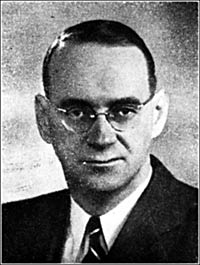
Carl Lutz (b. Walzenhausen, 30 March 1895; d. Berne, 12 February 1975) was the Swiss Vice-Consul in Budapest, Hungary from 1942 until the end of World War II. He helped save the lives of tens of thousands of Jews from deportation to Nazi Extermination camps during the Holocaust.
Lutz immigrated at the age of 18 to the United States, where he was to remain for more than 20 years. Lutz’s sojourn in the United States ended with his assignment as vice-consul to the Swiss Consulate General in Jaffa, in what was then Palestine.
Appointed in 1942 as Swiss vice-consul in Budapest, Hungary, Lutz soon began cooperating with the Jewish Agency for Palestine, issuing Swiss safe-conduct documents enabling Jewish children to emigrate.
Once the Nazis took over Budapest in 1944 and began deporting Jews to the death camps, Lutz negotiated a special deal with the Hungarian government and the Nazis: he had permission to issue protective letters to 8,000 Hungarian Jews for emigration to Palestine. Lutz then deliberately misinterpreted his permission for 8,000 as applying to families rather than individuals, and proceeded to issue tens of thousands of additional protective letters, all of them bearing a number between one and 8,000. He also set up some 76 safe houses around Budapest, declaring them annexes of the Swiss legation. Among the safe houses was the now well-known “Glass House” (Üvegház) at Vadász Street 29. About 3,000 Jews found refuge at the Glass House and in a neighboring building.
— more at Wikipedia
Chiune Sugihara (1 January 1900 – 31 July 1986) was a Japanese diplomat, serving as Vice Consul for the Japanese Empire in Lithuania. During World War II, he helped several thousand Jews leave the country by issuing transit visas to Jewish refugees so that they could travel to Japan. Most of the Jews who escaped were refugees from German-occupied Poland or residents of Lithuania. Sugihara wrote travel visas that facilitated the escape of more than 6,000 Jewish refugees to Japanese territory, risking his career and his family’s life.
When asked why he did it, he responded:
“You want to know about my motivation, don’t you? Well. It is the kind of sentiments anyone would have when he actually sees refugees face to face, begging with tears in their eyes. He just cannot help but sympathize with them. Among the refugees were the elderly and women. They were so desperate that they went so far as to kiss my shoes, Yes, I actually witnessed such scenes with my own eyes. Also, I felt at that time, that the Japanese government did not have any uniform opinion in Tokyo. Some Japanese military leaders were just scared because of the pressure from the Nazis; while other officials in the Home Ministry were simply ambivalent.
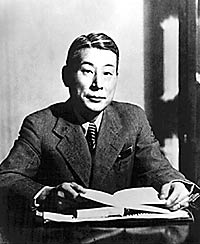
People in Tokyo were not united. I felt it silly to deal with them. So, I made up my mind not to wait for their reply. I knew that somebody would surely complain about me in the future. But, I myself thought this would be the right thing to do. There is nothing wrong in saving many people’s lives …. The spirit of humanity, philanthropy … neighborly friendship … with this spirit, I ventured to do what I did, confronting this most difficult situation —and because of this reason, I went ahead with redoubled courage. ”
When asked why he risked his career to save other people, he quoted an old samurai saying: “Even a hunter cannot kill a bird which flies to him for refuge.”
— more at Wikipedia
André Trocmé ( April 7, 1901 – June 5, 1971) and his wife Magda (née Grilli di Cortona, November 2, 1901, Florence, Italy – Oct. 10, 1996) are a couple of French Righteous Among the Nations. For 15 years, André served as a pastor in the town of Le Chambon-sur-Lignon on the Plateau Vivarais-Lignon in South-Central France. He had been sent to this rather remote parish because of his pacifist positions which were not well received by the French Protestant Church. In his preaching he spoke out against discrimination as the Nazis were gaining power in neighboring Germany and urged his Protestant Huguenot congregation to hide Jewish refugees from the Holocaust of the Second World War.

In 1938, André Trocmé and Reverend Edouard Theis founded the Collège Lycée International Cévenol in Le Chambon-sur-Lignon, France. Its initial purpose was to prepare local country youngsters to enter the university. When the refugees arrived, it also took in many Jewish young people wishing to continue their secondary education.
When France fell to Nazi Germany, the mission to resist the Nazis became increasingly important. Following the establishment of the Vichy France regime during the occupation, Trocmé and his church members helped their town develop ways of resisting the dominant evil they faced. Together they established first one, and then a number of “safe houses” where Jewish and other refugees seeking to escape the Nazis could hide. Many refugees were helped to escape to Switzerland following an underground railroad network. Between 1940 and 1944 when World War II ended in Europe, it is estimated that about 3500 Jewish refugees including many children were saved by the small village of Le Chambon and the communities on the surrounding plateau because the people refused to give in to what they considered to be the illegitimate legal, military, and police power of the Nazis.
— more at Wikipedia
I am thankful for Sawtucket, who has kept me up with my daily Lectionary readings for more than 22 years. I thank Sawtucket for today’s reading, reminding us that we are all of one blood, one humanity, no matter our skin color, our nationality, nor our religion. We are human beings, and our job is to watch over one another.
Take a Wife With You
Our church has daily readings, called The Lectionary, and the one I read also features Saints of the Church, people who have served in faithfulness. Today’s reading had an impact on me for several reasons. I was immediately caught by the fact he was assigned, and told to take a wife with him, at which point he immediately proposed to a woman he thought suitable who accepted. So interesting, and so different from the way “courtships” are conducted these days. (With more reading in Wikipedia, I discovered his education was funded by donors, he was trained as a blacksmith and he actually had a fiancee, and she was the one who married him and went with him to Moose Bay. She worked with the women.)
The union was fruitful. John Horden and his wife were able to accomplish great things among the Cree and Inuit, learning their language, preaching in their tongue. It sounds like more than the preaching, his life and his love of his parishoners attracted converts to the faith.

JOHN HORDEN
MISSIONARY BISHOP IN CANADA, 1893
John Horden (1828 – January 12, 1893) was the first Anglican Bishop of Moosonee, Canada.
On May 10, 1851, he received a letter from Church Missionary Society, informing him that the bishop of Rupert’s Land had made a request for a schoolmaster at Moose Factory, in northern Ontario, and that he had been appointed to fill the position. They also told him to prepare to leave within a month, and indicated that they desired he marry and take his wife out to assist him in his missionary work. Although he was less than enthused about the appointment, he immediately prepared for his new position. He contacted the woman of his choice, a young lady who herself had missionary inclinations, and she agreed to marry him. On June 8, 1851, they set sail for Canada. Horden spent much of his time on the trip by continuing his studies of the Greek Testament and beginning the study of the Cree language.
He went among the natives, writing down new words as he heard them and, after eight month’s effort, was able to preach to the natives without an interpreter. He was ordained a priest during this period. Soon Horden had prepared a prayer book, a hymnal, and translations of the Gospels in the Cree language.
Then in 1865, Horden and his family, which now included five children that he and his wife had had in Canada, sailed back to England so that his children could be educated. Upon Horden’s return to England, he found he was very well-known throughout the British Isles, and became a popular and sought-after speaker. In 1867, Horden returned with his wife to James’ Bay.
In the autumn of 1872, Horden received a message to return to England to be consecrated as a bishop, and on December 15, 1872, he and two others were ordained in a ceremony involving eight other bishops, including Bishop Anderson, who had first ordained Horden 20 years earlier.
He continued to serve as bishop of his huge territory, making pastoral visits to as many parts of his huge diocese as possible, despite his having a serious problem with rheumatism. In his later years, he also worked diligently to finish his translation of the Bible into the Cree language.
“This is the Best Christmas Ever!”

In today’s Lectionary readings, what Christmas is all about:
1 John 4:7-16
7 Beloved, let us love one another, because love is from God; everyone who loves is born of God and knows God. 8Whoever does not love does not know God, for God is love. 9God’s love was revealed among us in this way: God sent his only Son into the world so that we might live through him. 10In this is love, not that we loved God but that he loved us and sent his Son to be the atoning sacrifice for our sins. 11Beloved, since God loved us so much, we also ought to love one another. 12No one has ever seen God; if we love one another, God lives in us, and his love is perfected in us.
13 By this we know that we abide in him and he in us, because he has given us of his Spirit. 14And we have seen and do testify that the Father has sent his Son as the Saviour of the world. 15God abides in those who confess that Jesus is the Son of God, and they abide in God. 16So we have known and believe the love that God has for us.
God is love, and those who abide in love abide in God, and God abides in them.
Last night, our family arrived breathless and energetic after the Children’s Service at Christ Church (Episcopal) in Pensacola. My granddaughter was a reader at the service and had worked very hard to give a dignified delivery of the New Testament reading. We were all exhilarated at her success, and she was full of joy.
We did something different this year, a self-service buffet. AdventureMan put together two lavish charcuterie boards, We had salad makings and all sorts of garnishes, a cheese dip and chips, and many condiments. Ever-creative, our granddaughter asked if we had any salsa, and used that to dip her shrimp, rather than cocktail sauce or remoulade.
“This is the best Christmas dinner ever,” remarked our son, a rare and genuine compliment. We had agreed to simplify, and it was fun seeing how people chose, differently than we would have expected. It worked for us, for our family, giving people choices and creativity in what they ate.
As we ate, we played silly Christmas games. One was to take a phrase and go around the table with everyone taking the first letter of the next word and saying the first word which came to mind (assuming it was family-friendly). We ended up laughing so hard. It was then our grandson said “This is the best Christmas ever!” and my heart sang with joy, because there wasn’t a present in sight, this dinner was all about celebrating the great gift of a God arriving as an infant to show us what true love was all about, and that true love was flowing around the table. How often can we say “my heart is full?”
We will be rejoining them shortly, for the great gift-giving. For the first time, our grandchildren are excited about something they are giving us, something they know we will love. We haven’t a clue, but already we are feeling so blessed because they are thinking about the giving, rather than the getting. Thanks be to God! He is merciful, and he loves us more than we can ever comprehend.
St. Birgitta: As Many Books As They Pleased
From today’s Lectionary, because I am of Swedish descent and because I love that while embracing poverty, the nuns were allowed “as many books as they pleased.”

BIRGITTA OF SWEDEN
Mystic and Prophetic Witness, 1373
Brigitta (Bridget) of Sweden (1303 – 23 July 1373); born as Birgitta Birgersdotter, was a mystic and saint, and founder of the Bridgettines nuns and monks.
The most celebrated saint of Sweden was married at the age of 14 to Ulf Gudmarsson, to whom she bore eight children. In 1344 Ulf died, after wehich Birgitta devoted herself wholly to a life of prayer and caring for the poor and the sick. It was about this time that she developed the idea of establishing the religious community which was to become the Order of the Most Holy Saviour, or the Brigittines. One distinctive feature of the pre-Reformation houses of the Order was that they were double monasteries, with both men and women forming a joint community, though with separate cloisters. They were to live in poor convents and to give all surplus income to the poor. However, they were allowed to have as many books as they pleased.
At the age of ten, Bridget had a vision of Jesus hanging upon the cross. She was so impressed that from that moment the Passion of Christ became the center of her spiritual life. The revelations she had received since childhood became more frequent, and her records of these Revelationes coelestes (“Celestial revelations”) obtained a great vogue during the Middle Ages.These revelations made Bridget something of a celebrity to some and a controversial figure to others.
In 1350, a Jubilee Year, Birgitta braved a plague-stricken Europe to make a pilgrimage to Rome accompanied by her daughter, Catherine, and a small party of priests and disciples. This was done partly to obtain from the Pope the authorization of the new Order and partly in pursuance of her self-imposed mission to elevate the moral tone of the age. Birgitta made herself universally beloved in Rome by her kindness and good works. Save for occasional pilgrimages, including one to Jerusalem in 1373, she remained in Rome until her death on 23 July 1373, urging ecclesiastical reform and an end to the Avignon schism.
Florence Nightengale Made a Difference
Today, in addition to the readings from the Old Testament, New Testament and Gospels, the Lectionary celebrates Florence Nightingale. I had no idea how influential this woman-ahead-of-her-times was in making hospitals safer places in which to treat our wounded and sick. She observed, studied and documented sanitary practices and how changing small things – like changing the linens on beds between patients, clean latrines – could make a big difference. She brought order out of chaos, truly a Godly woman.
FLORENCE NIGHTINGALE
NURSE, RENEWER OF SOCIETY (12 AUGUST 1910)
 The commemoration of Florence Nightingale is controversial. On the one hand, she doubted or denied many of the central articles of the Creed. On the other hand, she believed in God and devoted her life to His service as she understood it.
She was born in Florence on 12 May 1820 of upper-class English parents travelling through Italy, and named for her native city. (“Florence” was not an accepted first name at the time. Her sister was born in Naples and named “Parthenope,” the Greek name for that city.) Florence was reared in the Unitarian Church, but later joined the Church of England.
In her diary, an entry shortly before her seventeenth birthday reads: “On February 7th, 1837, God spoke to me and called me to his service.” She did not know what the service would be, and therefore decided that she must remain single, so as to have no encumbrances and be ready for anything. With this in mind, she rejected a proposal of marriage from a young man whom she dearly loved. She suffered from “trances” or “dreaming” spells, in which she would lose consciousness for several minutes or longer, and be unaware when she recovered that time had passed. (Could this be a form of petit mal epilepsy? No biographer of hers that I have read uses the word.) She found the knowledge that she was subject to such spells terrifying, and feared that they meant that she was unworthy of her calling, particularly since she did not hear the voice of God again for many years. In the spring of 1844 she came to believe that her calling was to nurse the sick. In 1850 her family sent her on a tour of Egypt for her health. Some extracts from her diary follow:
March 7. God called me in the morning and asked me would I do good for Him, for Him alone without the reputation.
March 9. During half an hour I had by myself in my cabin, settled the question with God.
April 1. Not able to go out but wished God to have it all His own way. I like Him to do exactly as He likes without even telling me the reason.
May 12. Today I am thirty–the age Christ began his mission.
Now no more childish things. No more love. No more marriage. Now Lord let me think only of Thy Will, what Thou willest me to do. Oh Lord Thy Will, Thy Will.
June 10. The Lord spoke to me; he said, Give five minutes every hour to the thought of Me. Coudst thou but love Me as Lizzie loves her husband, how happy wouldst thou be.” But Lizzie does not give five minutes every hour to the thought of her husband, she thinks of him every minute, spontaneously.
Florence decided that she must train to be a nurse. Her family was horrified. In her day, nursing was done mostly by disabled army veterans or by women with no other means of support. It was common for nurses of either sex to be drunk on the job most of the time, and they had no training at all. It was common practice never to wash or change the sheets on a bed, not even when a patient died and his bed was given to a new patient. Florence was told to go to Kaiserswerth, Germany, to learn and train with the Lutheran order of Deaconesses who were running a hospital there. Back in England again, she used the influence of Sidney Herbert, a family friend and Member of Parliament, to be appointed supervisor of a sanatorium in London. Under her able guidance, it turned from a chamber of horrors into a model hospital. The innovations introduced by Miss Nightingale were, for their day, little short of revolutionary. She demanded, and got, a system of dumb-waiters that enabled food to be sent directly to every floor, so that nurses did not exhaust themselves carrying trays up numerous flights of stairs. She also invented and had installed a system of call bells by which a patient could ring from his bed and the bell would sound in the corridor, with a valve attached to the bell which opened when the bell rang, and remained open so that the nurse could see who had rung. “Without a system of this kind,” she wrote, “a nurse is converted to a pair of legs.”
While working in the poorer districts of London, Miss Nightingale encountered a Roman Catholic priest, Henry Edward Manning (later Cardinal Manning), who was working among the poor of London. She was impressed by the assistance he gave to many who had nowhere else to turn, and they became friends for life. She was greatly attracted by Roman Catholicism, but rejected much of its theology, and so reluctantly decided against joining it.
 Then war broke out in the Crimea (in Russia, on the north edge of the Black Sea), and Sir Sidney Herbert, now Secretary of War, obtained permission for Florence to lead a group of 38 nurses there. Of these, 10 were Roman Catholic nuns, 14 were Anglican nuns, and the remaining 14 were “of no particular religion, unless one counts the worship of Bacchus.” They found conditions appalling. Blankets were rotting in warehouses while the men did without, because no one had issued the proper forms for their distribution. The lavatories in the hospitals had no running water, and the latrines were tubs to be emptied by hand. But no one emptied them, since official regulations did not specify which department was responsible for doing so. The result was that the hospital had a foul stench that could be smelled for some distance outside its walls. Far more men were dying in hospitals of infection than of wounds. The chief concern of many of the Army doctors was that the nurses might usurp some of their authority. Florence gradually managed to win the doctors and other authorities over, and to reform hospital procedures, with spectacular results. Once the medical situation had ceased to be an acute problem, she turned her attention to other aspects of the soldiers’ welfare. For example, most of them squandered all their pay on drink. She noted that there was no trustworthy way for them to send money home to their families, and she set up facilities for them to do so. First, she undertook to send money home herself for any soldier in the hospital that wanted it sent, and the soldiers brought in about 1000 pounds a month. She asked the authorities to set up an official service to do this, and they refused. By appealing to Queen Victoria herself, she overcame opposition to the idea, and the men sent home 71,000 pounds sterling in less than six months. She established with her own money a reading-room with tables for writing letters, and the men used it enthusiastically. She imported four schoolmasters to give lectures, and the halls were filled to overflowing. All this was done despite opposition from officers who said, “The men are hopeless brutes. You cannot expect anything from them.”
At night, she would often patrol the wards, carrying a dim lamp, to make sure that all was well and no one was in need of help. She became famous as “the Lady with the Lamp.”
 In April 1856 the war was over, and by mid-July the hospital was emptied and her work in Crimea over. She returned to England a national hero, with a great welcome prepared for her; but she slipped into the country unnoticed and went to a convent that had supplied some of her nurses. There, she spent the day in prayer before coming out to face the public and beginning to lobby Parliament for suitable legislation. She wrote pamphlet after pamphlet, pointing out by pie charts, for example, that the major cause of deaths in the Army was not wounds caused by enemy action but disease caused by lack of proper sanitation. She is perhaps the first person to use pie charts and similar graphic devices to convey statistical information. She obtained the formation of an Army Medical Staff Corps and a Sanitary Commission to oversee military health conditions.
Throughout these efforts, she relied on the help of Sidney Herbert, insisting that he must work hard and long to get the legislation she needed through Parliament. When he protested that she was asking too much, she would not listen. His health broke, and he died in August 1861. Florence prayed God to raise him from the dead, explaining that she needed him for the job. When God failed to comply, her faith was badly shaken. She wrote a book called, Suggestions for Thought: An Address to the Artisans of England, in which she explained that God was less of a Person and more of a Cosmic Force than is generally supposed by Christians. (But note that she was working on this book before Sir Sidney died, and one cannot call it simply a response to his death.) Advance copies were given to a few friends, such as John Stuart Mill, who praised it highly. However, it was never published (I have not seen it, and neither the Library of Congress nor the National library of Medicine has a copy, nor any other library in the United States that I have been able to learn of), since Florence kept revising it — arguably, because her beliefs on the nature of God were simply not internally consistent. Eventually, it seems, God spoke to her again and said, “You are here to carry out my program. I am not here to carry out yours.” She wrote in her diary, “I must remember that God is not my private secretary.”
Before his death, Sir Sidney had gotten her involved in Indian affairs. She served on the Indian Sanitary Commission. In May 1859, she decided that there were insufficient data available in England on conditions in the Indian Army, and she wrote to 200 military stations there, asking for copies of all regulations and all documents relating to the health and sanitary administration of the army. The reports that came back filled two vans. She read them all and summarized them for the Report of the Commission. Her conclusion was that the death toll from disease in the Indian Army was appallingly high (69 out of 1000 annually), and that this was largely due, not to the climate, but to lack of sanitation, and that preventive measures included sanitation not just for army posts but for neighboring villages and, in the long run, for all of India.
She was a friend of General Charles George Gordon, who captured the British imagination when he and his troops were beseiged at Khartoum in the Sudan, and finally captured and killed. After his death, Florence wrote to a friend that suffering, disappointment, and lack of success are the tribute which it is the soul’s greatest privilege to present to God. In Gordon’s death, she wrote, we see “the triumph of failure, the triumph of the Cross. With him, all is well.”
She met the scholar Benjamin Jowett, who was translating Plato into English. They became fast friends, and she contributed to the translation. She also began an anthology of mystical writings, called “Notes from Devotional Authors of the Middle Ages, Collected, Chosen, and Freely Translated by Florence Nightingale.” It was her contention that mystical prayer is not just for monks and nuns, but should form a part of the every-day life of ordinary persons.
Under the strain of ceaseless overwork, her own health broke, and she was an invalid for the latter half of her life. On Christmas Day when she was sixty-five, she wrote: “Today, O Lord, let me dedicate this crumbling old woman to thee. Behold the handmaid of the Lord. I was thy handmaid as a girl. Since then, I have backslid.” She wrote a manual called Notes for Nurses, and a set of instructions for the matron in charge of training nurses, emphasizing the importance for a nurse of a schedule of daily prayer. A few years before her death, she was the first woman to receive the Order of Merit from the British government. She died at ninety, and, by her directions, her tombstone read simply, “F.N. 1820-1910”.
Florence Nightingale died on 13 August 1910, and is commemorated on this day on the Lutheran Calendar. The Episcopal calendar commemorates Jeremy Taylor on 13 August, and accordingly has shifted the commemoration of Nightingale to 18 May. I am not sure of the significance of this date, but it is the date (or nearly) of the opening of the Nightingale Training School for Nurses in 1860. [Note: the current date in the Episcopal Church for her commemoration is 12 Aug.]
by James Kiefer
Recent Comments
ExpatAlien on What Country am I Living … intlxpatr on Yellowstone: Old Faithful to C… Michelle on Yellowstone: Old Faithful to C… Cathy on No Grown-Ups in Charge intlxpatr on Waiting for Snow Wikipedia Donate Button

Amazina


Early Voting in Florida


 Here There and Everywhere