“In the beginning was the Word . . .”
He is risen!
In today’s Lectionary readings, Saint John explains the coming of the light (Jesus Christ) into the world. On this day, when we celebrate that he is risen from the dead, it is a most fitting and wonderful verse to read. Below is the tomb of John-the-Baptist (Yahyah,) in the Umayyad Mosque in Damascus, one of my favorite cities on earth. On this wonderful day of new beginnings, I pray for the peace and prosperity of Syria and all mankind, that we might set aside all the pettiness and grubbing for small things, and look to the larger and harder issues of how to love one another.
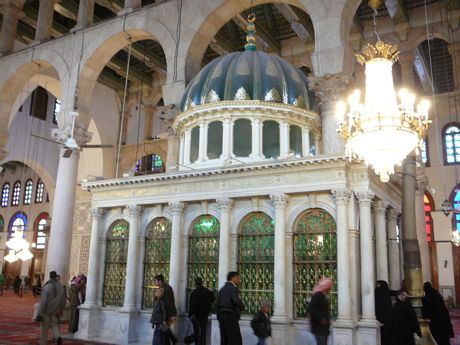
John 1:1-18
1In the beginning was the Word, and the Word was with God, and the Word was God. 2He was in the beginning with God. 3All things came into being through him, and without him not one thing came into being. What has come into being 4in him was life,* and the life was the light of all people. 5The light shines in the darkness, and the darkness did not overcome it.
6 There was a man sent from God, whose name was John. 7He came as a witness to testify to the light, so that all might believe through him. 8He himself was not the light, but he came to testify to the light. 9The true light, which enlightens everyone, was coming into the world.*
10 He was in the world, and the world came into being through him; yet the world did not know him. 11He came to what was his own,* and his own people did not accept him. 12But to all who received him, who believed in his name, he gave power to become children of God, 13who were born, not of blood or of the will of the flesh or of the will of man, but of God.
14 And the Word became flesh and lived among us, and we have seen his glory, the glory as of a father’s only son,* full of grace and truth. 15(John testified to him and cried out, ‘This was he of whom I said, “He who comes after me ranks ahead of me because he was before me.” ’) 16From his fullness we have all received, grace upon grace. 17The law indeed was given through Moses; grace and truth came through Jesus Christ. 18No one has ever seen God. It is God the only Son,* who is close to the Father’s heart,* who has made him known.
The Prophet Jeremiah Ponders the Ways of the Wicked
Today the prophet Jeremiah sounds like a modern man – asking why, when we know what is good and what is bad, that some choose bad, and seem to do just fine – even better than the rest of us?
From the Holy Week readings in The Lectionary:
Jeremiah 12:1-16
12You will be in the right, O Lord,
when I lay charges against you;
but let me put my case to you.
Why does the way of the guilty prosper?
Why do all who are treacherous thrive?
2 You plant them, and they take root;
they grow and bring forth fruit;
you are near in their mouths
yet far from their hearts.
3 But you, O Lord, know me;
You see me and test me—my heart is with you.
Pull them out like sheep for the slaughter,
and set them apart for the day of slaughter.
4 How long will the land mourn,
and the grass of every field wither?
For the wickedness of those who live in it
the animals and the birds are swept away,
and because people said, ‘He is blind to our ways.’*
The Church Remembers Saint Gregory The Illuminator
From today’s Forward Day by Day, information on St. Gregory the Illuminator
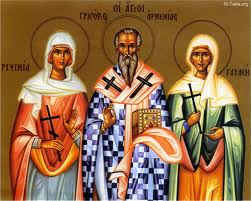
The Liturgical Calendar: The Church Remembers
Today the church remembers Gregory the Illuminator, Bishop and Missionary of Armenia, c. 332.
Armenia, the first Christian kingdom in history, was converted through the efforts of Gregory. This kingdom came to an unhappy end as an independent state in 430, yet some two and one-half million persons today are still culturally Armenians. They enjoy a racial, linguistic, and religious heritage which is one of the world’s oldest and richest. Their community has endured fifteen hundred years of dispersion, harassment, and often severe persecution.
The truly marvelous story of Christian Armenia began when the infant Gregory, who was a prince by birth, was exiled by enemies and reared by a compassionate Christian family in Cappadocia (modern central Turkey). As an adult and a Christian he returned to Armenia and converted the king, Tiridates, heir of Gregory’s old enemies. This was not done easily. Indeed, many legends have grown up around the tradition of Gregory’s great difficulties, hardships, and sufferings in effecting the conversion of the king and subsequently the kingdom. For this work he is called the “Illuminator.” Gregory was eventually consecrated Bishop of Echmiadzin and was the organizer of the Armenian Church.
The Episcopal Church has enjoyed a warm and friendly relationship with the Armenian Church for many years. Offer thanks for that friendship.
We thank you, O God, for the witness of Gregory the Illuminator and for the people of Armenia. Amen.
Almighty God, whose will it is to be glorified in all your saints, and who raised up your servant Gregory the Illuminator to be a light in the world, and to preach the Gospel to the people of Armenia: Shine, we pray, in our hearts, that we also in our generation may show forth your praise, who called us out of darkness into your marvelous light; through Jesus Christ our Lord, who lives and reigns with you and the Holy Spirit, one God, now and for ever. Amen.
The ExPat Verses from Jeremiah
In our Old Testament reading from the prophet Jeremiah this morning, in the Lectionary, I read these old familiar verses, and they bring a smile to my face. I always thought of these as my instructions, living in alien lands, to pray for the welfare of the land in which I was living, to be a blessing there, and to live my life fully, trusting I would one day be living once again in my own land.
Jeremiah 29:1,4-13
29These are the words of the letter that the prophet Jeremiah sent from Jerusalem to the remaining elders among the exiles, and to the priests, the prophets, and all the people, whom Nebuchadnezzar had taken into exile from Jerusalem to Babylon. 4Thus says the Lord of hosts, the God of Israel, to all the exiles whom I have sent into exile from Jerusalem to Babylon: 5Build houses and live in them; plant gardens and eat what they produce. 6Take wives and have sons and daughters; take wives for your sons, and give your daughters in marriage, that they may bear sons and daughters; multiply there, and do not decrease. 7But seek the welfare of the city where I have sent you into exile, and pray to the Lord on its behalf, for in its welfare you will find your welfare. 8For thus says the Lord of hosts, the God of Israel: Do not let the prophets and the diviners who are among you deceive you, and do not listen to the dreams that they dream,* 9for it is a lie that they are prophesying to you in my name; I did not send them, says the Lord.
10 For thus says the Lord: Only when Babylon’s seventy years are completed will I visit you, and I will fulfil to you my promise and bring you back to this place. 11For surely I know the plans I have for you, says the Lord, plans for your welfare and not for harm, to give you a future with hope. 12Then when you call upon me and come and pray to me, I will hear you. 13When you search for me, you will find me; if you seek me with all your heart,
A Thorny Sermon: The Prodigal Son
From today’s Lectionary reading, the Gospel:
GOSPEL: Luke 15: 1 – 3, 11b – 32 (RCL)
Luke 15: 1 – 3, 11 – 32 (Roman Catholic)
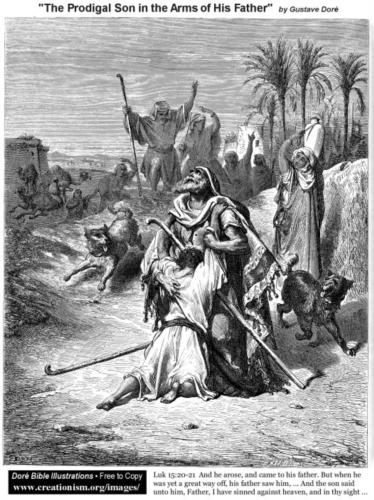
Gustave Dore: The Prodigal Son in the Arms of his Father
Luke 15:1 (NRSV) Now all the tax collectors and sinners were coming near to listen to him. 2 And the Phar’isees and the scribes were grumbling and saying, “This fellow welcomes sinners and eats with them.”
3 So he told them this parable:
11 Then Jesus said, “There was a man who had two sons. 12 The younger of them said to his father, “Father, give me the share of the property that will belong to me.’ So he divided his property between them. 13 A few days later the younger son gathered all he had and traveled to a distant country, and there he squandered his property in dissolute living.
14 When he had spent everything, a severe famine took place throughout that country, and he began to be in need. 15 So he went and hired himself out to one of the citizens of that country, who sent him to his fields to feed the pigs. 16 He would gladly have filled himself with the pods that the pigs were eating; and no one gave him anything.
17 But when he came to himself he said, “How many of my father’s hired hands have bread enough and to spare, but here I am dying of hunger! 18 I will get up and go to my father, and I will say to him, “Father, I have sinned against heaven and before you; 19 I am no longer worthy to be called your son; treat me like one of your hired hands.” ‘
20 So he set off and went to his father. But while he was still far off, his father saw him and was filled with compassion; he ran and put his arms around him and kissed him. 21 Then the son said to him, “Father, I have sinned against heaven and before you; I am no longer worthy to be called your son.’ 22 But the father said to his slaves, “Quickly, bring out a robe–the best one–and put it on him; put a ring on his finger and sandals on his feet. 23 And get the fatted calf and kill it, and let us eat and celebrate; 24 for this son of mine was dead and is alive again; he was lost and is found!’ And they began to celebrate.
25 “Now his elder son was in the field; and when he came and approached the house, he heard music and dancing. 26 He called one of the slaves and asked what was going on. 27 He replied, “Your brother has come, and your father has killed the fatted calf, because he has got him back safe and sound.’
28 Then he became angry and refused to go in. His father came out and began to plead with him. 29 But he answered his father, “Listen! For all these years I have been working like a slave for you, and I have never disobeyed your command; yet you have never given me even a young goat so that I might celebrate with my friends. 30 But when this son of yours came back, who has devoured your property with prostitutes, you killed the fatted calf for him!’
31 Then the father said to him, “Son, you are always with me, and all that is mine is yours. 32 But we had to celebrate and rejoice, because this brother of yours was dead and has come to life; he was lost and has been found.'”
Sometimes people will leave off the part about the elder son, and just concentrate on the return of the younger son, focusing on the father watching always, hoping for the return of the younger son, ready to forgive and welcome before the words can even get out of the younger son’s mouth.
It is wonderful, and reassuring, for those of us sinners.
Many, however – including me – can also identify with the oldest son who says “I’ve always done everything right and you’ve NEVER given me a tiny goat, much less a fatted calf, and you’re throwing this party for the son who blew his entire fortune on louche living???”
It doesn’t seem fair, does it? Isn’t that really the point of the story, that we can’t behave our way into heaven, it is sheer grace, the love of the heavenly creator, that allows us in? It’s not an easy concept to wrap my mind around, so today I struggle to take it in, and I give thanks for Father Neil who tackles the hard questions and doesn’t just sweep them under the carpet because they are inconvenient. (The sermon isn’t up yet, but when it is available, you will find it here)
All Who Exalt Themselves Will be Humbled . . .
Today’s Ash Wednesday reading the Lectionary is a great reading for a season of introspection and meditation:

Luke 18:9-14
9 He also told this parable to some who trusted in themselves that they were righteous and regarded others with contempt: 10‘Two men went up to the temple to pray, one a Pharisee and the other a tax-collector. 11The Pharisee, standing by himself, was praying thus, “God, I thank you that I am not like other people: thieves, rogues, adulterers, or even like this tax-collector. 12I fast twice a week; I give a tenth of all my income.” 13But the tax-collector, standing far off, would not even look up to heaven, but was beating his breast and saying, “God, be merciful to me, a sinner!” 14I tell you, this man went down to his home justified rather than the other; for all who exalt themselves will be humbled, but all who humble themselves will be exalted.’


Maladies of the Soul
Part of my morning meditation is that after I finish my readings from The Lectionary, I find the daily reading in Forward Day by Day. Today’s is particularly interesting, relating to Jesus healing the woman who touched the hem of his garment and was cured of her hemorrhagic disease. He lists some of the maladies of the soul, for which belief in Jesus is the best medicine:
MONDAY, January 28
Mark 5:21-43. [There was a woman] who had endured much under many physicians, and had spent all that she had; and she was no better, but rather grew worse.
Even the most talented and dedicated physician has an occasional patient who can identify with those words. Doctors, being human, are fallible, and some unhappy conditions have no human cure.
But then there is Jesus. Healing was a major part of Jesus’ earthly ministry. Often, as in this woman’s case, a physical malady is cured. This is true today as well. But many people, in Jesus’ day and ours, suffer from illnesses which are not cured, either by Jesus or a physician. What of them?
Three things: First, it is appropriate to pray for healing. Second, dying is integral to the world as God has created it. Generations are meant to come and go; no one should try to hang around here forever. Everyone’s body will wear out someday and a holy death is part of holy living. Third, the most important healing is not of the body but of the soul. Diseases of the soul include bitterness, anger, greed, seeking revenge, grasping for control, and condemning other people and groups of people. From these maladies, Jesus heals not some but all who follow in his way.
Feast Day of St. Anthony
In our Lectionary Readings for today, they list today as the Feast Day for St. Antony, one of the early monastics of the Christian Church.

ANTONY
ABBOT IN EGYPT (17 JAN 356)
Before the conversion of the Emperor Constantine in 312 AD, back in the days when Christianity was still a persecuted religion, the act of becoming a Christian involved turning one’s back on the pursuit of security, of fashionable prestige and popularity, of success as the term is widely understood. After the Emperor had changed Christianity from a persecuted religion into a fashionable one, many earnest Christians felt the need to make such a renunciation in the service of Christ, and did not see mere Church membership as any longer enough to constitute such a renunciation. Accordingly, many of them sought Christian commitment by fleeing from society into the desert, and becoming hermits, devoting themselves to solitude, fasting, and prayer. Although this trend was much accelerated and reinforced by the conversion of Constantine and attendant changes, it had already begun earlier. An outstanding early example is Antony of Egypt, often reckoned as the founder of Christian monasticism.
Antony of Egypt, the son of Christian parents, inherited a large estate. On his way to church one day, he found himself meditating on the text, “Sell all that you have, and give to the poor, and come follow me.” When he got to church, he heard the preacher speaking on that very text. He took this as a message for him, and, having provided for the care of his sister, he gave his land to the tenants who lived on it, and gave his other wealth to the poor, and became a hermit, living alone for twenty years, praying and reading, and doing manual labor.
In 305, he gave up his solitude to become the head of a group of monks, living in a cluster of huts or cells, devoting themselves to communal singing and worship, to prayer and study and manual labor under Antony’s direction. They did not simply renounce the world, but were diligent in prayer for their fellow Christians, worked with their hands to earn money that they might distribute it as alms, and preached and gave personal counseling to those who sought them out.
In 321, Christians in Alexandria were being persecuted by the Emperor Maximinus (the rule of Constantine was not yet universal), and Antony visited Alexandria to encourage those facing the possibility of martyrdom. He visited again in 335, when Arianism was strong in the city, and converted many, by his preaching and testimony, and by prayer and the working of miracles. His biography was written by Athanasius, who said of him: “Who ever met him grieving and failed to go away rejoicing?”
The Forward Day by Day website summarizes St. Antony just a little differently:
Today the church remembers Antony, Abbot in Egypt, 356.
Father of Christian Monasticism Many young men of the third-century world despaired of their decaying, materialistic, and licentious society. In Egypt many fled into the desert in protest and for their own souls’ health. Sometimes their behavior became almost as bizarre and unbalanced as the behavior of those from whom they fled. This was not true of Antony. Antony’s quiet and well-ordered life of devotion in the desert stood out in contrast both to the wickedness of the contemporary world and the eccentricities of some other hermits. He gave away all his possessions to the poor and thereby freed himself from the demands of property. Still, he found that he had to fight a seemingly endless battle against his personal passions and temptations. He helped fellow Christian hermits to organize their lives in meaningful patterns of prayer, work, and meditation. His own solitude was frequently interrupted by his concern for the secular church and by requests for counseling. He was a friend to Athanasius (see May 2) and his orthodoxy was unquestionable. It has been said that, “Alone in the desert, Antony stood in the midst of mankind.”
This is not the same St. Anthony who helps you find lost things; that is St. Anthony of Padua, but when I read about this St. Anthony, and his orderly life, I thought that beating back the forces of chaos keeps things from getting lost in the first place. 🙂
Living Waters
Here is what I love about reading the Bible every day; the sheer inane humanity of it all. Even many of the heroes are seriously flawed, murders, adulterers, liars, and the bible goes ahead and tells the whole story, not just the part of the story that makes them look good.
So here we have Jesus, talking about the rivers of living water – rivers that are supposed to be flowing out of US, the believers, if we are true believers, rivers of good works, good deeds, love for one another. It is a glorious – and challenging – image.
And here are those niggling, human, priests, who, in the face of this miraculous man, are denying he could be the Christ because he comes from Galilee.
How often do we do the same thing in our own lives, overlook the blindingly glorious to focus on the niggling detail which doesn’t even matter one iota in the greater scheme of things?

John 7:37-52
37 On the last day of the festival, the great day, while Jesus was standing there, he cried out, ‘Let anyone who is thirsty come to me, 38and let the one who believes in me drink. As* the scripture has said, “Out of the believer’s heart* shall flow rivers of living water.” ’ 39Now he said this about the Spirit, which believers in him were to receive; for as yet there was no Spirit,* because Jesus was not yet glorified.
40 When they heard these words, some in the crowd said, ‘This is really the prophet.’ 41Others said, ‘This is the Messiah.’* But some asked, ‘Surely the Messiah* does not come from Galilee, does he? 42Has not the scripture said that the Messiah* is descended from David and comes from Bethlehem, the village where David lived?’ 43So there was a division in the crowd because of him. 44Some of them wanted to arrest him, but no one laid hands on him.
45 Then the temple police went back to the chief priests and Pharisees, who asked them, ‘Why did you not arrest him?’ 46The police answered, ‘Never has anyone spoken like this!’ 47Then the Pharisees replied, ‘Surely you have not been deceived too, have you? 48Has any one of the authorities or of the Pharisees believed in him? 49But this crowd, which does not know the law—they are accursed.’ 50Nicodemus, who had gone to Jesus* before, and who was one of them, asked, 51‘Our law does not judge people without first giving them a hearing to find out what they are doing, does it?’ 52They replied, ‘Surely you are not also from Galilee, are you? Search and you will see that no prophet is to arise from Galilee.
Declare His Praise in the Coastlands!
The old testament reading for this morning continues in Isaiah, and I think he is talking to me! He mentions the coastlands several times, ending with “Let them give glory to the Lord,
and declare his praise in the coastlands.”
Isaiah 42:1-12
42Here is my servant, whom I uphold,
my chosen, in whom my soul delights;
I have put my spirit upon him;
he will bring forth justice to the nations.
2 He will not cry or lift up his voice,
or make it heard in the street;
3 a bruised reed he will not break,
and a dimly burning wick he will not quench;
he will faithfully bring forth justice.
4 He will not grow faint or be crushed
until he has established justice in the earth;
and the coastlands wait for his teaching.
5 Thus says God, the Lord,
who created the heavens and stretched them out,
who spread out the earth and what comes from it,
who gives breath to the people upon it
and spirit to those who walk in it:
6 I am the Lord, I have called you in righteousness,
I have taken you by the hand and kept you;
I have given you as a covenant to the people,*
a light to the nations,
7 to open the eyes that are blind,
to bring out the prisoners from the dungeon,
from the prison those who sit in darkness.
8 I am the Lord, that is my name;
my glory I give to no other,
nor my praise to idols.
9 See, the former things have come to pass,
and new things I now declare;
before they spring forth,
I tell you of them.
10 Sing to the Lord a new song,
his praise from the end of the earth!
Let the sea roar* and all that fills it,
the coastlands and their inhabitants.
11 Let the desert and its towns lift up their voice,
the villages that Kedar inhabits;
let the inhabitants of Sela sing for joy,
let them shout from the tops of the mountains.
12 Let them give glory to the Lord,
and declare his praise in the coastlands.
Recent Comments
ExpatAlien on What Country am I Living … intlxpatr on Yellowstone: Old Faithful to C… Michelle on Yellowstone: Old Faithful to C… Cathy on No Grown-Ups in Charge intlxpatr on Waiting for Snow Wikipedia Donate Button

Amazina


Early Voting in Florida


 Here There and Everywhere