Prince of Peace
Today, in our Lectionary readings, we have the powerful words of the prophet Isaiah, telling of the birth of the babe who will bring us endless peace, justice and righteousness . . .

Isaiah 9:1-7
9*But there will be no gloom for those who were in anguish. In the former time he brought into contempt the land of Zebulun and the land of Naphtali, but in the latter time he will make glorious the way of the sea, the land beyond the Jordan, Galilee of the nations.
2 *The people who walked in darkness
have seen a great light;
those who lived in a land of deep darkness—
on them light has shined.
3 You have multiplied the nation,
you have increased its joy;
they rejoice before you
as with joy at the harvest,
as people exult when dividing plunder.
4 For the yoke of their burden,
and the bar across their shoulders,
the rod of their oppressor,
you have broken as on the day of Midian.
5 For all the boots of the tramping warriors
and all the garments rolled in blood
shall be burned as fuel for the fire.
6 For a child has been born for us,
a son given to us;
authority rests upon his shoulders;
and he is named
Wonderful Counsellor, Mighty God,
Everlasting Father, Prince of Peace.
7 His authority shall grow continually,
and there shall be endless peace
for the throne of David and his kingdom.
He will establish and uphold it
with justice and with righteousness
from this time onwards and for evermore.
The zeal of the Lord of hosts will do this.
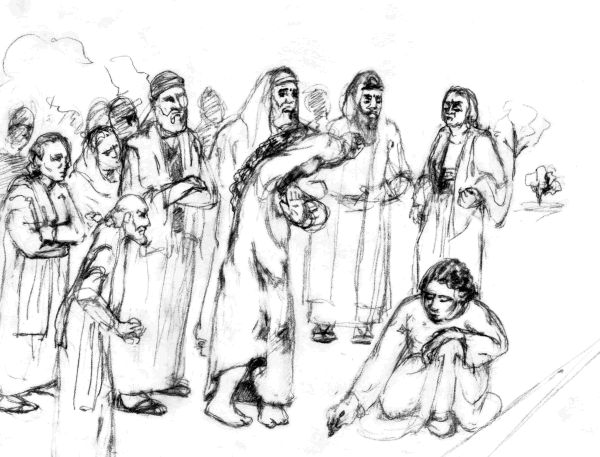
Jesus and the Woman to be Stoned for Adultery
I’ve always loved this passage, along with the woman at the well, and the woman who touched the hem of his garment to be healed from a bleeding disease – Jesus was kind to women, in a time and culture where a pious man would not speak to a woman.
Hilary Mantel captures the stunning experience in Eight Months on Ghazzah Street, where she asks a man at a counter for an item and he looks right past her. She repeats her request and he acts as if she isn’t there. Her husband walks up, asks, and receives an answer. Cultural biases most often do not favor women. In this regard, Jesus – and the prophet Mohammed – changed everything, and treated women as equal people. It’s amazing to me how many of the Jesus anecdotes featuring females survived; it must have been astonishing in his time to treat females – property – with such compassion and humanity.
Footnote to this passage from The Lectionary: The most ancient authorities lack 7.53—8.11; other authorities add the passage here or after 7.36 or after 21.25 or after Luke 21.38, with variations of text; some mark the passage as doubtful.
John 7:53-8:11
53Then each of them went home, 81while Jesus went to the Mount of Olives. 2Early in the morning he came again to the temple. All the people came to him and he sat down and began to teach them. 3The scribes and the Pharisees brought a woman who had been caught in adultery; and making her stand before all of them, 4they said to him, ‘Teacher, this woman was caught in the very act of committing adultery. 5Now in the law Moses commanded us to stone such women. Now what do you say?’ 6They said this to test him, so that they might have some charge to bring against him. Jesus bent down and wrote with his finger on the ground. 7When they kept on questioning him, he straightened up and said to them, ‘Let anyone among you who is without sin be the first to throw a stone at her.’ 8And once again he bent down and wrote on the ground.* 9When they heard it, they went away, one by one, beginning with the elders; and Jesus was left alone with the woman standing before him. 10Jesus straightened up and said to her, ‘Woman, where are they? Has no one condemned you?’ 11She said, ‘No one, sir.’* And Jesus said, ‘Neither do I condemn you. Go your way, and from now on do not sin again.’]]*
The Gift of Saint Nicholas
This is from today’s Lectionary reading on the saints, by James Kiefer; today is the feast of Saint Nicholas, and in many European countries, little children find their shoes filled with little gold coins (chocolate) or . . . sticks with coal (usually also candy, these days)
The true Saint Nicholas embodied the spirit of anonymous giving – a grace more rarely seen in these days of blogs and twitters and 15 seconds of news coverage.
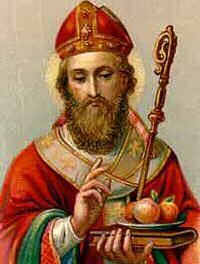
(of course I chose this image of Saint Nicholas because of the pomegranates 🙂 )
NICHOLAS OF MYRA
FRIEND OF CHILDREN, GIVER OF GIFTS, CLIMBER OF CHIMNEYS, ETC. (6 DEC 326)
The story of St. Nicholas offers a possible way of dealing with the “Santa Claus” problem, to parents who do not want to lie to their children, even in fun, but do not want to say simply: “Bah, humbug! There is no such thing as Santa. Forget about him.”
Nicholas was a native of the western part of what is now Asiatic Turkey. He became Bishop of Myra in the fourth century, and there are many stories of his love for God and for his neighbor.
The best-known story involves a man with three unmarried daughters, and not enough money to provide them with suitable dowries. This meant that they could not marry, and were likely to end up as prostitutes. Nicholas walked by the man’s house on three successive nights, and each time threw a bag of gold in through a window (or, when the story came to be told in colder climates, down the chimney). Thus, the daughters were saved from a life of shame, and all got married and lived happily ever after.
Because of this and similar stories, Nicholas became a symbol of anonymous gift-giving. Hence, if we give a gift to someone today without saying whom it is from, it can be called “a present from Saint Nicholas (or Santa Claus).” Some parents explain this to their children and invite the child to join them in wrapping a toy (either something purchased for that purpose, at least partly with the child’s allowance, or else a toy that the child has outgrown but that is still serviceable) or an outgrown but not shabby item of the child’s clothing, or a package of food, and then going along to donate it to a suitable shelter that will give it to someone who will welcome it. This gift is then called “a present from Santa,” so that the child understands that this is another name for an anonymous gift given to someone whom we do not know, but whom we love anyway because God does. (Presents within the family can be “From Santa” or “From Santa and…”)
Pictures of Nicholas often show three bags of gold next to him, and often these bags have become simply three disks or balls. Nicholas became the patron of an Italian city (I think Bari, which is where his body is now buried) that was a center of the pawnbroking business, and hence a pawnbroking shop traditionally advertises by displaying three gold balls over its front. It is thought that some persons looking at pictures of Nicholas confused the three round objects with human heads. Hence there is a story of a wicked innkeeper who murdered three boys and salted their bodies to serve to his guests, to save on the butcher’s bill. Nicholas visited the inn and confronted the innkeeper, who confessed his crime, whereupon Nicholas prayed over the brine-tub and the three boys leaped out unharmed. Other stories have him saving the lives of three innocent men who had been condemned to death. Still other stories have him coming to the rescue of drowning sailors (could this be related to the brine-tub incident?). Nicholas has always been popular with children, mariners, pawnbrokers, the Dutch, the Russians, and recently, the department-store owners. (American readers may remember the story of the brine-tub through reading it as children in the book The Dutch Twins, by Lucy Fitch Perkins, author of The Spanish Twins, The Italian Twins, and many similar books, all children’s favorites in the middle of this century. They may now be banned as politically incorrect — I have no idea. If your children know the brine-tub story, from this book or elsewhere, they may be interested to know how it may have originated.)
In many countries, Nicholas visits children on his feast day, 6 December, and brings them gifts then. In these countries, there is usually no exchange of Christmas presents, but there may be gifts again on January 6, the feast of the coming of the Wise Men, who brought gifts to the Holy Child of gold, frankincense, and myrrh. In America, it may be thought necessary to yield to outside pressure and let Nicholas distribute gifts on December 25.
If you want to show your children (or yourself) how Nicholas is remembered by Christians with a background different from your own (unless, of course, this IS your background), you might want to attend an East Orthodox service at this time. Many Eastern Orthodox congregations have services on the evening before 6 December that feature “visits from Saint Nicholas.” He appears as a bishop, with no red suit. The faithful leave their shoes outside the church door, and find in them afterwards gold coins (actually chocolate wrapped in gold foil) representing the gold dowries of the three daughters. To find a service and inquire what it is likely to be like, look up CHURCHES, ORTHODOX in the Yellow Pages. For an English-language service, “Orthodox Church in America” or “Antiochan Orthodox” parishes are likely choices, but do not overlook other possibilities.
We are told, but it is uncertain, that Nicholas was imprisoned for his faith before the accession of Constantine, and that he was present at the Council of Nicea in 325. We may note in passing that the picture of him as roly-poly is a late development. Early stories indicate that he was generous to others, but not given to self-indulgence. Indeed, even as an unweaned infant, he fasted regularly on Wednesdays and Fridays.
by James Kiefer
John of Damascus
This morning, as I read my Lectionary readings, I noticed I had skipped the Saint yesterday (I was trying to get a lot done) and it was John of Damascus. Checking the blog, I can see I printed this several years ago – 6 years! – but because it was new to me all over again, I am printing it again for you.
It is fascinating to me. John of Damascus defended the use of icons in worship. He distinguished between using an icon as an aide, and worshipping an icon. He was defended by his powerful position with a khalif, a Moslem who believes that images are forbidden. And we think WE live in interesting times . . . 🙂
JOHN OF DAMASCUS
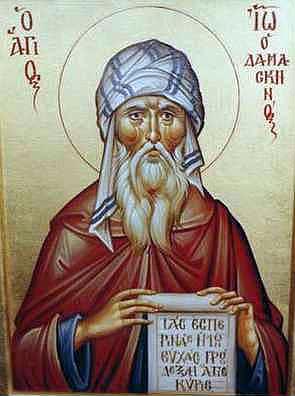
(I love this photo because he is wearing a gutra 🙂 )
HYMN-WRITER, DEFENDER OF ICONS (4 DEC 750)
John is generally accounted “the last of the Fathers”. He was the son of a Christian official at the court of the moslem khalif Abdul Malek, and succeeded to his father’s office.
In his time there was a dispute among Christians between the Iconoclasts (image-breakers) and the Iconodules (image-venerators or image-respectors). The Emperor, Leo III, was a vigorous upholder of the Iconoclast position. John wrote in favor of the Iconodules with great effectiveness. Ironically, he was able to do this chiefly because he had the protection of the moslem khalif (ironic because the moslems have a strong prohibition against the religious use of pictures or images).
John is also known as a hymn-writer. Two of his hymns are sung in English at Easter (“Come ye faithful, raise the strain” and “The Day of Resurrection! Earth, tell it out abroad!”). Many more are sung in the Eastern Church.
His major writing is The Fount of Knowledge, of which the third part, The Orthodox Faith, is a summary of Christian doctrine as expounded by the Greek Fathers.
The dispute about icons was not a dispute between East and West as such. Both the Greek and the Latin churches accepted the final decision.
The Iconoclasts maintained that the use of religious images was a violation of the Second Commandment (“Thou shalt not make a graven image… thou shalt not bow down to them”).
The Iconodules replied that the coming of Christ had radically changed the situation, and that the commandment must now be understood in a new way, just as the commandment to “Remember the Sabbath Day” must be understood in a new way since the Resurrection of Jesus on the first day of the week.
Before the Incarnation, it had indeed been improper to portray the invisible God in visible form; but God, by taking fleshly form in the person of Jesus Christ, had blessed the whole realm of matter and made it a fit instrument for manifesting the Divine Splendor. He had reclaimed everything in heaven and earth for His service, and had made water and oil, bread and wine, means of conveying His grace to men. He had made painting and sculpture and music and the spoken word, and indeed all our daily tasks and pleasures, the common round of everyday life, a means whereby man might glorify God and be made aware of Him. (NOTE: I always use “man” in the gender-inclusive sense unless the context plainly indicates otherwise.)
Obviously, the use of images and pictures in a religious context is open to abuse, and in the sixteenth century abuses had become so prevalent that some (not all) of the early Protestants reacted by denouncing the use of images altogether. Many years ago, I heard a sermon in my home parish (All Saints’ Church, East Lansing, Michigan) on the Commandment, “Thou shalt not make a graven image, nor the likeness of anything in the heavens above, nor in the earth beneath, nor in the waters under the earth — thou shalt not bow down to them, nor worship them.” (Exodus 20:4-5 and Deuteronomy 5:8-9) The preacher (Gordon Jones) pointed out that, even if we refrain completely from the use of statues and paintings in representing God, we will certainly use mental or verbal images, will think of God in terms of concepts that the human mind can grasp, since the alternative is not to think of Him at all.
(Here I digress to note that, if we reject the images offered in Holy Scripture of God as Father, Shepherd, King, Judge, on the grounds that they are not literally accurate, we will end up substituting other images — an endless, silent sea, a dome of white radiance, an infinitely attenuated ether permeating all space, an electromagnetic force field, or whatever, which is no more literally true than the image it replaces, and which leaves out the truths that the Scriptural images convey. (One of the best books I know on this subject is Edwyn Bevan’s Symbolism and Belief, Beacon Press, originally a Gifford Lectures series.[note – now out of print])
C S Lewis repeats what a woman of his acquaintance told him: that as a child she was taught to think of God as an infinite “perfect substance,” with the result that for years she envisioned Him as a kind of enormous tapioca pudding. To make matters worse, she disliked tapioca. Back to the sermon.) The sin of idolatry consists of giving to the image the devotion that properly belongs to God. No educated man today is in danger of confusing God with a painting or statue, but we may give to a particular concept of God the unconditional allegiance that properly belongs to God Himself. This does not, of course, mean that one concept of God is as good as another, or that it may not be our duty to reject something said about God as simply false. Images, concepts, of God matter, because it matters how we think about God. The danger is one of intellectual pride, of forgetting that the Good News is, not that we know God, but that He knows us (1 Corinthians 8:3), not that we love Him, but that He loves us (1 John 4:10).
(Incidentally, it was customary in my parish in those days for the preacher to preach a short “Children’s Sermon,” after which the children were dismissed for Sunday School, and the regular sermon and the rest of the service followed. What I have described above was the Children’s Sermon. I remained for the regular sermon, but found it a bit over my head — a salutary correction to my intellectual snobbery.)
In the East Orthodox tradition, three-dimensional representations are seldom used. The standard icon is a painting, highly stylized, and thought of as a window through which the worshipper is looking into Heaven. (Hence, the background of the picture is almost always gold leaf.) In an Eastern church, an iconostasis (icon screen) flanks the altar on each side, with images of angels and saints (including Old Testament persons) as a sign that the whole church in Heaven and earth is one body in Christ, and unites in one voice of praise and thanksgiving in the Holy Liturgy.
At one point in the service, the minister takes a censer and goes to each icon in turn, bows and swings the censer at the icon. He then does the same thing to the congregation — ideally, if time permits, to each worshipper separately, as a sign that every Christian is an icon, made in the image and likeness of God, an organ in the body of Christ, a window through whom the splendor of Heaven shines forth.
My prayer for us all for today is that we may each be that window through which the splendor of Heaven shines forth.
Bridle the Tongue
From today’s reading in the Lectionary . . . hmmmmm . . . . do you think blogging counts?
James 1:26-27
26 If any think they are religious, and do not bridle their tongues but deceive their hearts, their religion is worthless. 27Religion that is pure and undefiled before God, the Father, is this: to care for orphans and widows in their distress, and to keep oneself unstained by the world.
The End of Days
My good friend was visiting, and was late the first day of our visit, arriving breathless, and with her arms full of flowers.
“I am so sorry! I am late!” she apologized, “but I could not find a single florist!”
The truth is that she could arrive empty armed and I would love her as much. She doesn’t need to bring me anything, just her coming to see me is enough. It was a wonderful visit, full of laughter and shared moments, time with family and friends.
Florist shops have almost disappeared in Pensacola, and I suspect elsewhere, as hard times continue. Fresh cut flowers are such a luxury, and one of the first things to go when people start cutting back. Times are getting better, but slowly. Flowers are still a luxury. There are a couple shops I know still open, but not many.
Today’s reading is from Revelations, about the end of times, and set my mind adrift about the identity of Babylon (there are many ideas about this) and about God’s time. We may be in the end of times, I muse, but we don’t even know it because God’s time is so different from our earthly time. An instant can be a couple thousand years – we don’t know.
The author of Revelation uses symbolic language and can be a sort of Rohrshach test which tells more about the interpreter than the text interpreted.
Revelation 18:1-14
18After this I saw another angel coming down from heaven, having great authority; and the earth was made bright with his splendour.2He called out with a mighty voice,
‘Fallen, fallen is Babylon the great!
It has become a dwelling-place of demons,
a haunt of every foul spirit,
a haunt of every foul bird,
a haunt of every foul and hateful beast.*
3 For all the nations have drunk*
of the wine of the wrath of her fornication,
and the kings of the earth have committed fornication with her,
and the merchants of the earth have grown rich from the power* of her luxury.’
4 Then I heard another voice from heaven saying,
‘Come out of her, my people,
so that you do not take part in her sins,
and so that you do not share in her plagues;
5 for her sins are heaped high as heaven,
and God has remembered her iniquities.
6 Render to her as she herself has rendered,
and repay her double for her deeds;
mix a double draught for her in the cup she mixed.
7 As she glorified herself and lived luxuriously,
so give her a like measure of torment and grief.
Since in her heart she says,
“I rule as a queen;
I am no widow,
and I will never see grief”,
8 therefore her plagues will come in a single day—
pestilence and mourning and famine—
and she will be burned with fire;
for mighty is the Lord God who judges her.’
9 And the kings of the earth, who committed fornication and lived in luxury with her, will weep and wail over her when they see the smoke of her burning; 10they will stand far off, in fear of her torment, and say,
‘Alas, alas, the great city,
Babylon, the mighty city!
For in one hour your judgement has come.’
11 And the merchants of the earth weep and mourn for her, since no one buys their cargo any more, 12cargo of gold, silver, jewels and pearls, fine linen, purple, silk and scarlet, all kinds of scented wood, all articles of ivory, all articles of costly wood, bronze, iron, and marble, 13cinnamon, spice, incense, myrrh, frankincense, wine, olive oil, choice flour and wheat, cattle and sheep, horses and chariots, slaves—and human lives.*
14 ‘The fruit for which your soul longed
has gone from you,
and all your dainties and your splendour
are lost to you,
never to be found again!’
Slander
The first reading today in The Lectionary is from Ecclesiasticus, one of the Apocrypha, books which are used by Catholics, Episcopalians, Lutherans and a few other liturgical sects in addition to the books of the bible selected at the Council of Trent used by most Protestant Christians.
We don’t think like God. God used flawed men, murderers, Moses and David, to further his goals for his people. Jesus was gentle with the fornicators and taxmen, and reserved his greatest wrath for those who thought they were holy, but who washed the outside of the cup, and were unclean on the inside. In the Final Judgement, we really don’t know who will stand. We do know, if we read scripture, that lying and slander are considered heinous.
Sirach 28:14-26
14 Slander* has shaken many,
and scattered them from nation to nation;
it has destroyed strong cities,
and overturned the houses of the great.
15 Slander* has driven virtuous women from their homes,
and deprived them of the fruit of their toil.
16 Those who pay heed to slander* will not find rest,
nor will they settle down in peace.
17 The blow of a whip raises a welt,
but a blow of the tongue crushes the bones.
18 Many have fallen by the edge of the sword,
but not as many as have fallen because of the tongue.
19 Happy is one who is protected from it,
who has not been exposed to its anger,
who has not borne its yoke,
and has not been bound with its fetters.
20 For its yoke is a yoke of iron,
and its fetters are fetters of bronze;
21 its death is an evil death,
and Hades is preferable to it.
22 It has no power over the godly;
they will not be burned in its flame.
23 Those who forsake the Lord will fall into its power;
it will burn among them and will not be put out.
It will be sent out against them like a lion;
like a leopard it will mangle them.
24a As you fence in your property with thorns,
25b so make a door and a bolt for your mouth.
24b As you lock up your silver and gold,
25a so make balances and scales for your words.
26 Take care not to err with your tongue,*
and fall victim to one lying in wait.
Daily Readings on Gossip
I grew up in a culture that thrives on gossip and speculation. Today’s reading from The Lectionary reminds me to gurd my tongue; never to repeat a conversation, unless not to repeat it would be a sin, as in murder or abuse.
Sirach 19:4-17
4 One who trusts others too quickly has a shallow mind,
and one who sins does wrong to himself.
5 One who rejoices in wickedness* will be condemned,*
6 but one who hates gossip has less evil.
7 Never repeat a conversation,
and you will lose nothing at all.
8 With friend or foe do not report it,
and unless it would be a sin for you, do not reveal it;
9 for someone may have heard you and watched you,
and in time will hate you.
10 Have you heard something? Let it die with you.
Be brave, it will not make you burst!
11 Having heard something, the fool suffers birth-pangs
like a woman in labour with a child.
12 Like an arrow stuck in a person’s thigh,
so is gossip inside a fool.
13 Question a friend; perhaps he did not do it;
or if he did, so that he may not do it again.
14 Question a neighbour; perhaps he did not say it;
or if he said it, so that he may not repeat it.
15 Question a friend, for often it is slander;
so do not believe everything you hear.
16 A person may make a slip without intending it.
Who has not sinned with his tongue?
17 Question your neighbour before you threaten him;
and let the law of the Most High take its course.*
Words for Life
From The Lectionary readings for Friday, October 26:
Sirach 11:2-20
2 Do not praise individuals for their good looks,
or loathe anyone because of appearance alone.
3 The bee is small among flying creatures,
but what it produces is the best of sweet things.
4 Do not boast about wearing fine clothes,
and do not exalt yourself when you are honoured;
for the works of the Lord are wonderful,
and his works are concealed from humankind.
5 Many kings have had to sit on the ground,
but one who was never thought of has worn a crown.
6 Many rulers have been utterly disgraced,
and the honoured have been handed over to others.
7 Do not find fault before you investigate;
examine first, and then criticize.
8 Do not answer before you listen,
and do not interrupt when another is speaking.
9 Do not argue about a matter that does not concern you,
and do not sit with sinners when they judge a case.
10 My child, do not busy yourself with many matters;
if you multiply activities, you will not be held blameless.
If you pursue, you will not overtake,
and by fleeing you will not escape.
11 There are those who work and struggle and hurry,
but are so much the more in want.
12 There are others who are slow and need help,
who lack strength and abound in poverty;
but the eyes of the Lord look kindly upon them;
he lifts them out of their lowly condition
13 and raises up their heads
to the amazement of many.
14 Good things and bad, life and death,
poverty and wealth, come from the Lord.*
17 The Lord’s gift remains with the devout,
and his favour brings lasting success.
18 One becomes rich through diligence and self-denial,
and the reward allotted to him is this:
19 when he says, ‘I have found rest,
and now I shall feast on my goods!’
he does not know how long it will be
until he leaves them to others and dies.
20 Stand by your agreement and attend to it,
and grow old in your work
My Wealth and My Treasure . . .
Blessings abound when you have faithful friends! Blessings on my friends, and know I am thinking of you as I write this, each and every one-in-a-thousand 🙂 From today’s readings in The Lectionary:
Sirach 6:5-17
5 Pleasant speech multiplies friends,
and a gracious tongue multiplies courtesies.
6 Let those who are friendly with you be many,
but let your advisers be one in a thousand.
7 When you gain friends, gain them through testing,
and do not trust them hastily.
8 For there are friends who are such when it suits them,
but they will not stand by you in time of trouble.
9 And there are friends who change into enemies,
and tell of the quarrel to your disgrace.
10 And there are friends who sit at your table,
but they will not stand by you in time of trouble.
11 When you are prosperous, they become your second self,
and lord it over your servants;
12 but if you are brought low, they turn against you,
and hide themselves from you.
13 Keep away from your enemies,
and be on guard with your friends.
14 Faithful friends are a sturdy shelter:
whoever finds one has found a treasure.
15 Faithful friends are beyond price;
no amount can balance their worth.
16 Faithful friends are life-saving medicine;
and those who fear the Lord will find them.
17 Those who fear the Lord direct their friendship aright,
for as they are, so are their neighbours also.
Recent Comments
intlxpatr on Shampoo Ginger tigerbutterya0c5ff1d… on Shampoo Ginger intlxpatr on British Soldier Kidnapped, Esc… John on British Soldier Kidnapped, Esc… intlxpatr on British Soldier Kidnapped, Esc… Wikipedia Donate Button

Amazina


Early Voting in Florida


