The Widow’s Mite
Today’s meditation is on the Gospel reading from the Lectionary found in Forward Day by Day. I’ve always loved this image, this humble, poor woman who gives what little she has.

THURSDAY, June 20
Luke 20:41—21:4. Jesus looked up and saw rich people putting their gifts into the treasury; he also saw a poor widow put in two small copper coins. He said, “Truly I tell you, this poor widow has put in more than all of them; for all of them have contributed out of their abundance, but she out of her poverty has put in all she had to live on.”
There is something about generosity that is compelling. Jesus says that the poor widow has given out of her poverty, but in reality it is only she who has given out of her abundance—an inner abundance of the heart that allows her to behave almost recklessly, as if she had more than enough.
I was taught to save those pennies, to save them for a rainy day, and it can still keep me looking to the horizon for any sign of clouds. My spouse, admittedly, has a much better relationship to money: it’s not about having or not having, but about knowing the relative value of wealth; it is energy to be moved around, rather than bankable power or security. Above all, it is a potent way to extend and manifest generosity.
As we see in the widow’s mite, it’s not the amount, but the heart’s intention behind it that matters. That is where the real power lies.
The Festival of BERNARD MIZEKI
(Play the video of the Soweto Gospel Choir as you read this summary from today’s Lectionary Readings How I would love to be able to attend this festival!)
BERNARD MIZEKI
CATECHIST AND MARTYR IN AFRICA (18 JUNE 1896)
Bernard Mizeki was born in Portuguese East Africa (Mozambique) in about 1861. When he was twelve or a little older, he left his home and went to Capetown, South Africa, where for the next ten years he worked as a laborer, living in the slums of Capetown, but (perceiving the disastrous effects of drunkenness on many workers in the slums) firmly refusing to drink alcohol, and remaining largely uncorrupted by his surroundings. After his day’s work, he attended night classes at an Anglican school.
Under the influence of his teachers, from the Society of Saint John the Evangelist (SSJE, an Anglican religious order for men, popularly called the Cowley Fathers), he became a Christian and was baptized on 9 March 1886. Besides the fundamentals of European schooling, he mastered English, French, high Dutch, and at least eight local African languages. In time he would be an invaluable assistant when the Anglican church began translating its sacred texts into African languages.
After graduating from the school, he accompanied Bishop Knight-Bruce to Mashonaland, a tribal area in Southern Rhodesia (now Zimbabwe), to work there as a lay catechist. In 1891 the bishop assigned him to Nhowe, the village of paramount-chief Mangwende, and there he built a mission-complex. He prayed the Anglican hours each day, tended his subsistence garden, studied the local language (which he mastered better than any other foreigner in his day), and cultivated friendships with the villagers. He eventually opened a school, and won the hearts of many of the Mashona through his love for their children.
He moved his mission complex up onto a nearby plateau, next to a grove of trees sacred to the ancestral spirits of the Mashona. Although he had the chief’s permission, he angered the local religious leaders when he cut some of the trees down and carved crosses into others. Although he opposed some local traditional religious customs, Bernard was very attentive to the nuances of the Shona Spirit religion. He developed an approach that built on people’s already monotheistic faith in one God, Mwari, and on their sensitivity to spirit life, while at the same time he forthrightly proclaimed the Christ. Over the next five years (1891-1896), the mission at Nhowe produced an abundance of converts.
Many black African nationalists regarded all missionaries as working for the European colonial governments. During an uprising in 1896, Bernard was warned to flee. He refused, since he did not regard himself as working for anyone but Christ, and he would not desert his converts or his post.
On 18 June 1896, he was fatally speared outside his hut. His wife and a helper went to get food and blankets for him. They later reported that, from a distance, they saw a blinding light on the hillside where he had been lying, and heard a rushing sound, as though of many wings. When they returned to the spot his body had disappeared. The place of his death has become a focus of great devotion for Anglicans and other Christians, and one of the greatest of all Christian festivals in Africa takes place there every year around the feast day that marks the anniversary of his martyrdom, June 18.
A Question of Time
I’ve always loved this section of Revelations, the beautiful woman crowned with the diadem of stars and the terrifying dragon, waiting for her to give birth so he can eat her child, but the child is snatched away and the dragon – Satan – and his angels are thrown to earth. “He knows his time is short” Revelations tells us, but no matter what HE thinks, to us, here on earth, when evil walks, each second seems an infinity.
If you read biblical commentary, the woman is convincingly described as many different things – some say Mary, some say clearly she is the church, there are as many ideas as their are commenters. I prefer to think of it as Hagia Sophia, Logos, the Word, the second person in the Holy Trinity, who gives birth to the son, who is of one substance with the Father. I love the imagery. It’s all metaphor, trying to explain something grand and inexplicable to us, the simple minded.

Revelation 12:1-12
12A great portent appeared in heaven: a woman clothed with the sun, with the moon under her feet, and on her head a crown of twelve stars. 2She was pregnant and was crying out in birth pangs, in the agony of giving birth. 3Then another portent appeared in heaven: a great red dragon, with seven heads and ten horns, and seven diadems on his heads. 4His tail swept down a third of the stars of heaven and threw them to the earth. Then the dragon stood before the woman who was about to bear a child, so that he might devour her child as soon as it was born. 5And she gave birth to a son, a male child, who is to rule* all the nations with a rod of iron. But her child was snatched away and taken to God and to his throne; 6and the woman fled into the wilderness, where she has a place prepared by God, so that there she can be nourished for one thousand two hundred and sixty days.
7 And war broke out in heaven; Michael and his angels fought against the dragon. The dragon and his angels fought back, 8but they were defeated, and there was no longer any place for them in heaven. 9The great dragon was thrown down, that ancient serpent, who is called the Devil and Satan, the deceiver of the whole world—he was thrown down to the earth, and his angels were thrown down with him.
10 Then I heard a loud voice in heaven, proclaiming,
‘Now have come the salvation and the power
and the kingdom of our God
and the authority of his Messiah,*
for the accuser of our comrades* has been thrown down,
who accuses them day and night before our God.
11 But they have conquered him by the blood of the Lamb
and by the word of their testimony,
for they did not cling to life even in the face of death.
12 Rejoice then, you heavens
and those who dwell in them!
But woe to the earth and the sea,
for the devil has come down to you
with great wrath,
because he knows that his time is short!’
Making Idols
A confluence of events happened at a period in my life when I was paying attention, and those things coming together have influenced me enormously. The first was participation in a bible study conducted in a branch of Christianity not my own, whose dogma is occasionally repellant and repugnant to me, but whose study of the chapter in the bible is thorough. The second was my move back to the Islamic world, and my choice to study Arabic at the Qatar Center for the Presentation of Islam.
In both cases, what I learned is that we have more in common than we have differences. I also learned that if we focus on the differences, it can be devastating.
Both groups know the Bible. My Moslem sisters knew the bible better than I did, and when discussing such issues as covering hair and wearing abaya, could quote me verses from my own book which re-inforced their argument. It was mortifying – and edifying.
My Baptist friends also surprise me. For every one who rails against gay marriage or ordination of women, there was another who would laugh and quote scripture saying “did you notice the same penalty for a woman who cuts her hair? or wears pants in public?” I learned a lot about my own religion, my own beliefs, and the goodness of others by my interactions with both these groups.

One of the differences in the Moslem world was that many houses I went into (I was honored to be invited into their homes) were very plain. The furniture might be basic or elaborate, but often, the walls were bare. Maybe there might be a calligraphy with a Quranic verse on the wall – that was it. No paintings, especially no human figures – no idols, no images.
In my house, I am surrounded by images, photos, paintings, weavings – they give me joy, but I do not worship them. They are not idols, they are merely art or family – things that make me smile. I distinguish between idols and gods. Yesterday’s reading from Deuteronomy sticks with me, however, and I can hear my sweet teachers at QCPI saying to me “But doesn’t it say in Deuteronomy 4 that you are to have no idols?”
Deuteronomy 4:25-31
25 When you have had children and children’s children, and become complacent in the land, if you act corruptly by making an idol in the form of anything, thus doing what is evil in the sight of the Lord your God, and provoking him to anger, 26I call heaven and earth to witness against you today that you will soon utterly perish from the land that you are crossing the Jordan to occupy; you will not live long on it, but will be utterly destroyed.
27The Lord will scatter you among the peoples; only a few of you will be left among the nations where the Lord will lead you. 28There you will serve other gods made by human hands, objects of wood and stone that neither see, nor hear, nor eat, nor smell. 29From there you will seek the Lord your God, and you will find him if you search after him with all your heart and soul. 30In your distress, when all these things have happened to you in time to come, you will return to the Lord your God and heed him. 31Because the Lord your God is a merciful God, he will neither abandon you nor destroy you; he will not forget the covenant with your ancestors that he swore to them.
Luke 6 – The Hard Teachings
It just doesn’t make sense. It goes against everything we think we know. If someone hits you on the cheek, turn the other one to be hit, too? If someone robs you, don’t go looking for your stolen goods? If someone asks you for something, give it to them, and more?
And, for me, the one that convicts me –
30Give to everyone who begs from you;
We have always worked hard and saved hard for what we want. How to know who is conning when he begs, and who is genuinely in need? Jesus says it doesn’t matter – give.
Luke 6:27-38
27 ‘But I say to you that listen, Love your enemies, do good to those who hate you, 28bless those who curse you, pray for those who abuse you. 29If anyone strikes you on the cheek, offer the other also; and from anyone who takes away your coat do not withhold even your shirt. 30Give to everyone who begs from you; and if anyone takes away your goods, do not ask for them again. 31Do to others as you would have them do to you.
32 ‘If you love those who love you, what credit is that to you? For even sinners love those who love them. 33If you do good to those who do good to you, what credit is that to you? For even sinners do the same.34If you lend to those from whom you hope to receive, what credit is that to you? Even sinners lend to sinners, to receive as much again.35But love your enemies, do good, and lend, expecting nothing in return.* Your reward will be great, and you will be children of the Most High; for he is kind to the ungrateful and the wicked. 36Be merciful, just as your Father is merciful.
37 ‘Do not judge, and you will not be judged; do not condemn, and you will not be condemned. Forgive, and you will be forgiven; 38give, and it will be given to you. A good measure, pressed down, shaken together, running over, will be put into your lap; for the measure you give will be the measure you get back.’
Wisdom of Solomon
Our church tradition includes several books of the bible that the mainline Protestant churches do not. Wisdom of Solomon is one of my favorites (I think I like Judith the best) This is our reading for today from the Old Testament in our Lectionary Readings:
Wisdom 1:1-15
1Love righteousness, you rulers of the earth,
think of the Lord in goodness
and seek him with sincerity of heart;
2 because he is found by those who do not put him to the test,
and manifests himself to those who do not distrust him.
3 For perverse thoughts separate people from God,
and when his power is tested, it exposes the foolish;
4 because wisdom will not enter a deceitful soul,
or dwell in a body enslaved to sin.
5 For a holy and disciplined spirit will flee from deceit,
and will leave foolish thoughts behind,
and will be ashamed at the approach of unrighteousness.
6 For wisdom is a kindly spirit,
but will not free blasphemers from the guilt of their words;
because God is witness of their inmost feelings,
and a true observer of their hearts, and a hearer of their tongues.
7 Because the spirit of the Lord has filled the world,
and that which holds all things together knows what is said,
8 therefore those who utter unrighteous things will not escape notice,
and justice, when it punishes, will not pass them by.
9 For inquiry will be made into the counsels of the ungodly,
and a report of their words will come to the Lord,
to convict them of their lawless deeds;
10 because a jealous ear hears all things,
and the sound of grumbling does not go unheard.
11 Beware then of useless grumbling,
and keep your tongue from slander;
because no secret word is without result,*
and a lying mouth destroys the soul.
12 Do not invite death by the error of your life,
or bring on destruction by the works of your hands;
13 because God did not make death,
and he does not delight in the death of the living.
14 For he created all things so that they might exist;
the generative forces* of the world are wholesome,
and there is no destructive poison in them,
and the dominion* of Hades is not on earth.
15 For righteousness is immortal.
Shadrach, Meshach and Abednigo Survive the Test of Fire
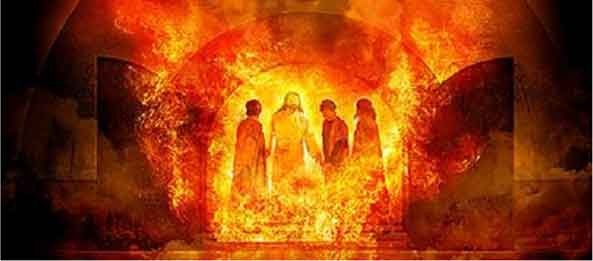
Some of the stories you come across in the Bible are so horrifying – and so human – that they still have a compelling immediacy. People do the most horrible things to one another, it mystifies me. This King, Nebuchadnezzar, is so incensed that his Jewish bureaucrats won’t bow down and worship his statue that he orders them cast into a furnace, which he heats seven times hotter than normal. That’s pretty angry!
Daniel 3:19-30
19 Then Nebuchadnezzar was so filled with rage against Shadrach, Meshach, and Abednego that his face was distorted. He ordered the furnace to be heated up seven times more than was customary, 20and ordered some of the strongest guards in his army to bind Shadrach, Meshach, and Abednego and to throw them into the furnace of blazing fire. 21So the men were bound, still wearing their tunics,* their trousers,* their hats, and their other garments, and they were thrown into the furnace of blazing fire.
22Because the king’s command was urgent and the furnace was so overheated, the raging flames killed the men who lifted Shadrach, Meshach, and Abednego. 23But the three men, Shadrach, Meshach, and Abednego, fell down, bound, into the furnace of blazing fire.
24 Then King Nebuchadnezzar was astonished and rose up quickly. He said to his counsellors, ‘Was it not three men that we threw bound into the fire?’ They answered the king, ‘True, O king.’
25He replied, ‘But I see four men unbound, walking in the middle of the fire, and they are not hurt; and the fourth has the appearance of a god.’* 26Nebuchadnezzar then approached the door of the furnace of blazing fire and said, ‘Shadrach, Meshach, and Abednego, servants of the Most High God, come out! Come here!’
So Shadrach, Meshach, and Abednego came out from the fire. 27And the satraps, the prefects, the governors, and the king’s counsellors gathered together and saw that the fire had not had any power over the bodies of those men; the hair of their heads was not singed, their tunics* were not harmed, and not even the smell of fire came from them.
28Nebuchadnezzar said, ‘Blessed be the God of Shadrach, Meshach, and Abednego, who has sent his angel and delivered his servants who trusted in him. They disobeyed the king’s command and yielded up their bodies rather than serve and worship any god except their own God. 29Therefore I make a decree: Any people, nation, or language that utters blasphemy against the God of Shadrach, Meshach, and Abednego shall be torn limb from limb, and their houses laid in ruins; for there is no other god who is able to deliver in this way.’ 30Then the king promoted Shadrach, Meshach, and Abednego in the province of Babylon.
When I read this, I think of the recent legislation proposed in Kuwait against insulting God or his prophets. Let men insult. Let them build their gods, their statures, let them pursue their little gods of vanity, power and wealth. The one true God laughs. He holds all the true power. He doesn’t need our protection; he is in charge.
In Florida, some friends complain about “the law that says our kids can’t pray in school.” There is no law that says kids can’t pray in school. Kids pray in school all the time! I did, specially when I had a really hard test I hadn’t prepared adequately for 🙂 What the law says is that no one can make all pray together, using the same words, as we did at one time. It’s not such a bad thing; even as Christians, we don’t all share the same beliefs. You might not want your children praying a prayer I might compose 🙂 because I might have a dogmatic belief a little different from your own. Our job is to teach our children to pray; the Holy Spirit will be with them, and put the words in their hearts.
Pierre Teilhard de Chardin
Today in our Lectionary, the church honors Pierre Tielhard do Chardin, a man who thought about God and the nature of the world and tried to figure out a logical explanation for the state of the world. He was condemned by the church for some of this thoughts, which were not in line with Catholic dogma. I’ve always thought that people who, like the Apostle Thomas, need to seek an explanation and need to see the evidence, are at pondering God and his ways, and in my mind, God must dance with joy – or with amusement – to be so pondered.
PRAYER
Eternal God, the whole cosmos sings of your glory, from the dividing of a single cell to the vast expanse of interstellar space: We bless you for your theologian and scientist Pierre Teilhard de Chardin, who perceived the divine in the evolving creation. Enable us to become faithful stewards of your divine works and heirs of your eternal kingdom; through Jesus Christ, the firstborn of all creation, who with you and the Holy Spirit lives and reigns, one God, for ever and ever. Amen.

PIERRE TEILHARD DE CHARDIN
SCIENTIST AND MILITARY CHAPLAIN, 1955
Pierre Teilhard de Chardin (May 1, 1881 – April 10, 1955) was a French philosopher and Jesuit priest who trained as a paleontologist and geologist and took part in the discovery of Peking Man. His theological and philosophical works came into conflict with the Catholic Church and several of his books were censured.
Pierre Teilhard de Chardin was born in Orcines, close to Clermont-Ferrand, in France on May 1, 1881. When he was 12, he went to the Jesuit college of Mongré, in Villefranche-sur-Saône, where he completed baccalaureates of philosophy and mathematics. Then, in 1899, he entered the Jesuit novitiate at Aix-en-Provence where he began a philosophical, theological and spiritual career. Teilhard studied theology in Hastings, in Sussex (UK), from 1908 to 1912. There he synthesized his scientific, philosophical and theological knowledge in the light of evolution. From 1912 to 1914, Teilhard worked in the paleontology laboratory of the Musée National d’Histoire Naturelle, in Paris, studying the mammals of the middle Tertiary period.
Mobilised in December 1914, Teilhard served in World War I as a stretcher-bearer in the 8th Moroccan Rifles. For his valour, he received several citations including the Médaille militaire and the Legion of Honour.
In 1923 he traveled to China with Father Emile Licent, who was in charge in Tianjin of a laboratory collaborating with the Natural History Museum in Paris. Licent carried out considerable basic work in connection with missionaries who accumulated observations of a scientific nature in their spare time. Teilhard would remain there more or less twenty years. From 1926 to 1935, Teilhard made five geological research expeditions in China. They enabled him to establish a first general geological map of China. He joined the ongoing excavations of the Peking Man Site at Zhoukoudian as an advisor in 1926 and continued in the role for the Cenozoic Research Laboratory of the Geological Survey of China following its founding in 1928. During this tima and after, he also made a great number of travels throughout the world, studying and lecturing.
Teilhard died on April 10, 1955 in New York City, where he was in residence at the Jesuit church of St Ignatius of Loyola. He is buried on what is now the grounds of the Culinary Institute of America, in Poughkeepsie, NY.
In 1925, Teilhard was ordered by the Jesuit Superior General Vladimir Ledochowski to leave his teaching position in France and to sign a statement withdrawing his controversial statements regarding the doctrine of original sin. Rather than leave the Jesuit order, Teilhard signed the statement and left for China. This was the first of a series of condemnations by certain ecclesiastical officials that would continue until long after Teilhard’s death. The climax of these condemnations was a 1962 monitum (reprimand) of the Holy Office denouncing his works. It states:
“The above-mentioned works abound in such ambiguities and indeed even serious errors, as to offend Catholic doctrine… For this reason, the most eminent and most revered Fathers of the Holy Office exhort all Ordinaries as well as the superiors of Religious institutes, rectors of seminaries and presidents of universities, effectively to protect the minds, particularly of the youth, against the dangers presented by the works of Fr. Teilhard de Chardin and of his followers.”.
Teilhard’s writings, though, continued to circulate — not publicly, as he and the Jesuits observed their commitments to obedience, but in mimeographs that were circulated only privately, within the Jesuits, among theologians and scholars for discussion, debate and criticism. As time passed, it seemed that the works of Teilhard were gradually becoming viewed more favourably within the Church. However, the 1962 statement remains official Church policy to this day.
In his posthumously published book, The Phenomenon of Man, Teilhard writes of the unfolding of the material cosmos, from primordial particles to the development of life, human beings and the noosphere, and finally to his vision of the Omega Point in the future, which is “pulling” all creation towards it. He was a leading proponent of orthogenesis, the idea that evolution occurs in a directional, goal driven way, argued in terms that today go under the banner of convergent evolution. Teilhard argued in Darwinian terms with respect to biology, and supported the synthetic model of evolution, but argued in Lamarckian terms for the development of culture, primarily through the vehicle of education.
Teilhard makes sense of the universe by its evolutionary process. He interprets complexity as the axis of evolution of matter into a geosphere, a biosphere, into consciousness (in man,) and then to supreme consciousness (the Omega Point.)
Teilhard himself claimed his work to be phenomenology. Teilhard studied what he called the rise of spirit, or evolution of consciousness, in the universe. He believed it to be observable and verifiable in a simple law he called the Law of Complexity / Consciousness. This law simply states that there is an inherent compulsion in matter to arrange itself in more complex groupings, exhibiting higher levels of consciousness. The more complex the matter, the more conscious it is. Teilhard proposed that this is a better way to describe the evolution of life on earth, rather than Herbert Spencer’s “survival of the fittest.” The universe, he argued, strives towards higher consciousness, and does so by arranging itself into more complex structures.
Teilhard here proposed another level of consciousness, to which human beings belong, because of their cognitive ability; i.e. their ability to ‘think’, and to set things to purpose. Human beings, Teilhard argued, represent the layer of consciousness which has “folded back in upon itself”, and has become self-conscious. So in addition to the geosphere and the biosphere, Teilhard posited another sphere, which is the realm of human beings, the realm of reflective thought: the noosphere. The noosphere has been compared to C. G. Jung’s theory of the collective unconscious.
Finally, the keystone to his phenomenology is that because Teilhard could not explain why the universe would move in the direction of more complex arrangements and higher consciousness, he postulated that there must exist ahead of the moving universe, and pulling it along, a higher pole of supreme consciousness, which he called Omega Point.
Teilhard re-interpreted many disciplines, including theology, sociology, metaphysics, around this understanding of the universe. A main focus of his was to re-assure the converging mass of humanity not to despair, but to trust the evolution of consciousness as it rises through them.
Daniel and the Vegetarian Diet
Most people I know these days are trying to eat less meat. In the readings for today, we start the story of Daniel, a story every Christian child learns in Sunday School, but when you read as an adult, you see different things. This morning, doing the readings from the Lectionary, I smiled to see that Daniel and his companions wanted only vegetables; they were working very hard not to violate their food laws.

I also wonder if not eating meat was helpful in the den of lions; maybe they smelled less interesting as vegetarians? Then again, lions eat impalas, wildebeest, all sorts of vegetarians, so that probably was not a factor . . . 🙂
Daniel 1:1-21
1In the third year of the reign of King Jehoiakim of Judah, King Nebuchadnezzar of Babylon came to Jerusalem and besieged it. 2The Lord let King Jehoiakim of Judah fall into his power, as well as some of the vessels of the house of God. These he brought to the land of Shinar,* and placed the vessels in the treasury of his gods.
3 Then the king commanded his palace master Ashpenaz to bring some of the Israelites of the royal family and of the nobility, 4young men without physical defect and handsome, versed in every branch of wisdom, endowed with knowledge and insight, and competent to serve in the king’s palace; they were to be taught the literature and language of the Chaldeans. 5The king assigned them a daily portion of the royal rations of food and wine. They were to be educated for three years, so that at the end of that time they could be stationed in the king’s court. 6Among them were Daniel, Hananiah, Mishael, and Azariah, from the tribe of Judah. 7The palace master gave them other names: Daniel he called Belteshazzar, Hananiah he called Shadrach, Mishael he called Meshach, and Azariah he called Abednego.
8 But Daniel resolved that he would not defile himself with the royal rations of food and wine; so he asked the palace master to allow him not to defile himself. 9Now God allowed Daniel to receive favour and compassion from the palace master. 10The palace master said to Daniel, ‘I am afraid of my lord the king; he has appointed your food and your drink. If he should see you in poorer condition than the other young men of your own age, you would endanger my head with the king.’
11Then Daniel asked the guard whom the palace master had appointed over Daniel, Hananiah, Mishael, and Azariah: 12‘Please test your servants for ten days. Let us be given vegetables to eat and water to drink. 13You can then compare our appearance with the appearance of the young men who eat the royal rations, and deal with your servants according to what you observe.’ 14So he agreed to this proposal and tested them for ten days. 15At the end of ten days it was observed that they appeared better and fatter than all the young men who had been eating the royal rations. 16So the guard continued to withdraw their royal rations and the wine they were to drink, and gave them vegetables. 17To these four young men God gave knowledge and skill in every aspect of literature and wisdom; Daniel also had insight into all visions and dreams.
18 At the end of the time that the king had set for them to be brought in, the palace master brought them into the presence of Nebuchadnezzar, 19and the king spoke with them. And among them all, no one was found to compare with Daniel, Hananiah, Mishael, and Azariah; therefore they were stationed in the king’s court. 20In every matter of wisdom and understanding concerning which the king inquired of them, he found them ten times better than all the magicians and enchanters in his whole kingdom. 21And Daniel continued there until the first year of King Cyrus.
Ezekiel Prophesies to Bare Bones in the Desert
When I read a segment like this in the daily Lectionary Readings, I wonder what happens next? What a great science fiction/fantasy story this would make, writing from the point of view of a newly raised newly re-fleshed person – like would they have their former memories? Would they remember their deaths? Or would they come into the world with the blank unfilled minds of babies, but in grown bodies? Did the Lord God just revive them and set them on their way? We know he was making a point to the prophet Ezekiel, but you have to wonder . . . what came next?

Ezekiel 37:1-14
37The hand of the Lord came upon me, and he brought me out by the spirit of the Lord and set me down in the middle of a valley; it was full of bones. 2He led me all round them; there were very many lying in the valley, and they were very dry. 3He said to me, ‘Mortal, can these bones live?’ I answered, ‘O Lord God, you know.’ 4Then he said to me, ‘Prophesy to these bones, and say to them: O dry bones, hear the word of the Lord. 5Thus says the Lord God to these bones: I will cause breath* to enter you, and you shall live. 6I will lay sinews on you, and will cause flesh to come upon you, and cover you with skin, and put breath* in you, and you shall live; and you shall know that I am the Lord.’
7 So I prophesied as I had been commanded; and as I prophesied, suddenly there was a noise, a rattling, and the bones came together, bone to its bone. 8I looked, and there were sinews on them, and flesh had come upon them, and skin had covered them; but there was no breath in them. 9Then he said to me, ‘Prophesy to the breath, prophesy, mortal, and say to the breath:* Thus says the Lord God: Come from the four winds, O breath,* and breathe upon these slain, that they may live.’ 10I prophesied as he commanded me, and the breath came into them, and they lived, and stood on their feet, a vast multitude.
11 Then he said to me, ‘Mortal, these bones are the whole house of Israel. They say, “Our bones are dried up, and our hope is lost; we are cut off completely.” 12Therefore prophesy, and say to them, Thus says the Lord God: I am going to open your graves, and bring you up from your graves, O my people; and I will bring you back to the land of Israel. 13And you shall know that I am the Lord, when I open your graves, and bring you up from your graves, O my people. 14I will put my spirit within you, and you shall live, and I will place you on your own soil; then you shall know that I, the Lord, have spoken and will act, says the Lord.’
Recent Comments
ExpatAlien on What Country am I Living … intlxpatr on Yellowstone: Old Faithful to C… Michelle on Yellowstone: Old Faithful to C… Cathy on No Grown-Ups in Charge intlxpatr on Waiting for Snow Wikipedia Donate Button

Amazina


Early Voting in Florida


 Here There and Everywhere