Day Two, Mostly Missouri
Day two started early in Arkansas, and I cajoled AdventureMan into telling me university stories as we drove into Missouri, where we stayed the entire day, driving north, driving west, and driving north again, the whole day. AdventureMan spent a lot of time in this area around Memphis while at university, and hung out at Beale Street with his other music and blues loving friends. The early morning highways were a delight:

Just outside St. Louis, we crossed the great Missouri:
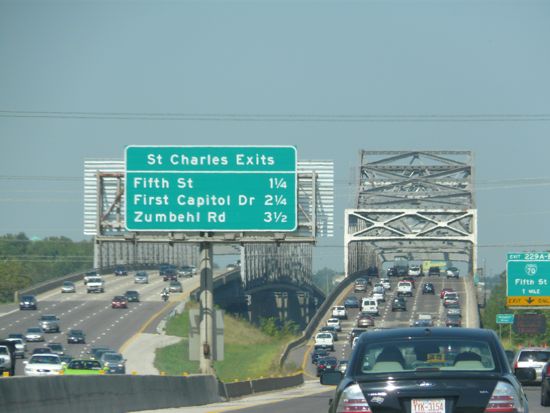
We like to stop at least every couple hours, buy a coffee, stretch our legs, take a rest stop. Around lunch time, AdventureMan saw a sign for 2 Dudes BBQ, and we couldn’t resist the name and the fact that it was only two blocks off the interstate. We found it without a problem:
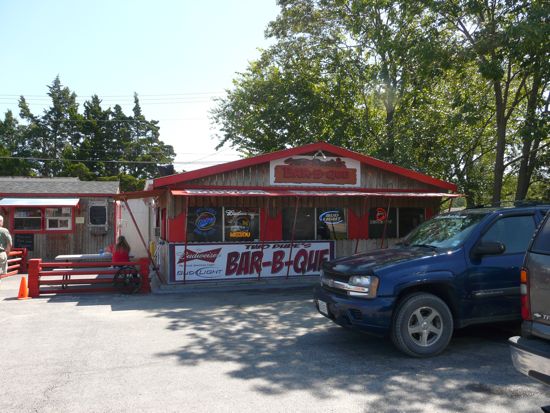
It had our kid of menu – simple, and the food was the same – simply GOOD.
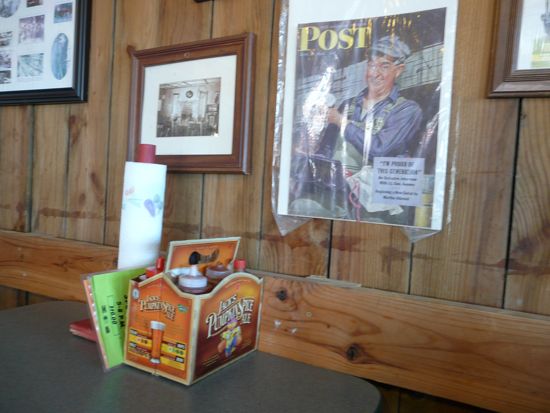

AdventureMan had the pulled pork sandwich with cole slaw and beans – ALL good:

I ordered the smoked half chicken (that was the smallest chicken they had) and it was smokey, cooked, and moist – it is really really hard to get all three. Plus, while I normally go for the really spicy sauce, the Two Dudes normal barbecue sauce was both vinegary-tangy and sweet, and knocked my socks off. (I didn’t eat the bread) and the cole slaw was apple-y tasting with poppy seeds – oh YUMMMM.

Outside, I caught one of the dudes grilling up some ribs, and he laughed when I asked if I could take his picture, and said “sure” and even arranged the ribs for me:
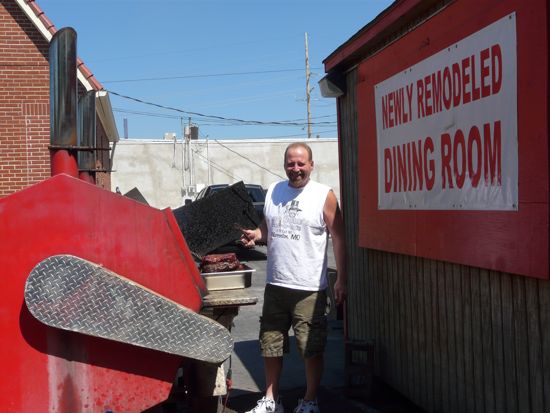

If you are driving on 1-70 between St. Louis and Kansas City, you will find the Two Dudes BarBQue at exit 193, in Warrenton, MO. You will see signs, follow those directions. 🙂
About an hour up the road, in Fulton, we saw the Visitor’s Center across from where we were buying gas, and AdventureMan had a burning question he needed answered: Was this where Winston Churchill had made his “iron curtain” speech, and was this why they had a museum devoted to Winston Churchill? The answer, from the delighted and helpful ladies, was ‘yes’.
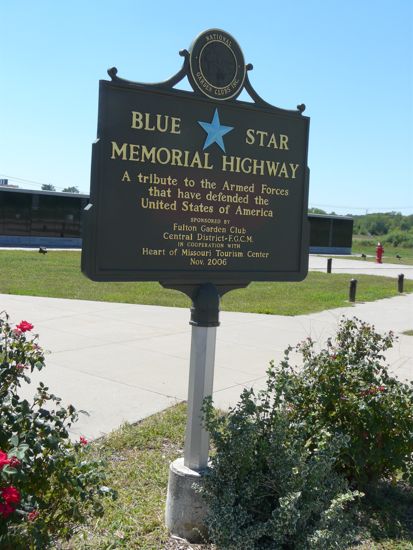
Fulton also has this moving and meaningful monument to fallen heroes – one of my weak spots.

We skirted Kansas City, zipped past Fort Leavenworth, where we had a wonderful year back a long time ago, and landed in St. Joseph, birthplace of Jesse James, where we found a hotel with a great pool so we could kick back and kick some laps, kicking out all those kinks and aches that driving all day can bring.
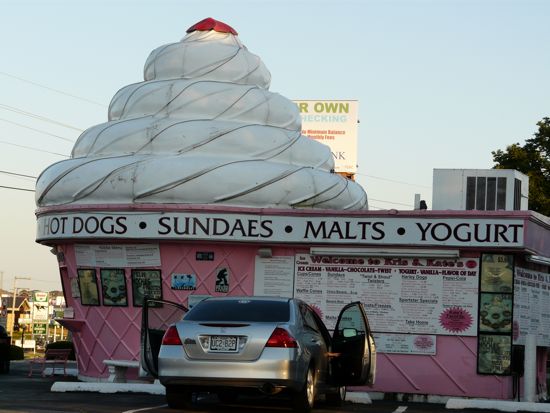
After dinner, mostly lettuce (LOL) AdventureMan helped me get a photo of this wonderful ice-cream vendor; I adore this old fashioned kind of commercial art:
And then we had a great adventure, trying to find the historical center of St. Joseph. We found the center, full of stately and gracious mansions and impressive and imposing old buildings, most in fairly good condition, and we found a lovely city park, down by the river, where the sun was setting . .. and you know me, and sun, and water . . .


Too soon, we had to leave, the mosquitos were eating me alive. I actually bought repellent today, but did I remember to put it in my purse???
Day One, Osceola, Arkansas
We start the day sadly, rushing around with last minute things and the Qatari Cat KNOWS what is going on and RUNS when I try to pick him up! He never does that. He is always such a good kitty, but when I caught him, he said “eh eh eh eh eh eh eh” to me; he told me clearly he does not want to go to the Kitty Hotel. When we got there, his suite was waiting, we put his special towel and his baby in the sleeping area and filled his dish with his food. Fresh water was already waiting. He was OK, a little miffed at us, but OK. The people at We Tuck ‘Em Inn were wonderful, and we know he will be spoiled rotten by the time we return.

Just as we hit Mobile, Alabama, Mobile was also hit with a huge rainstorm. Off to the right, we watched a truck on the freeway entry ramp skid and spin around, out of control. Just a minute later, we saw police and a wrecker trying to get another truck out of a deep ravine at the side of the freeway. It was a fearsome storm, and we were glad we were out of it.
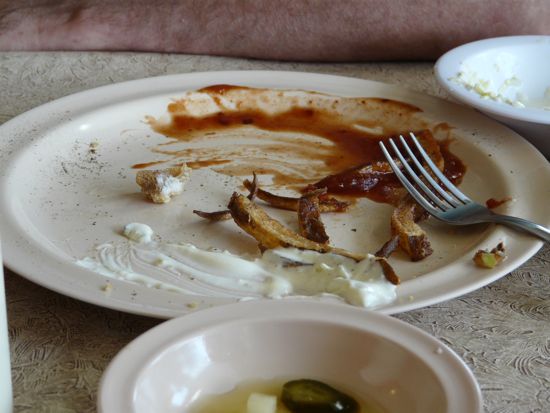
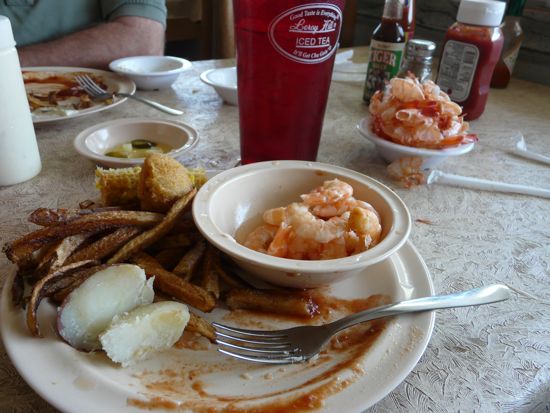
We toodled up through Mississippi, in fact it felt like we spent most of our day in Mississippi, because we did. We were on a not-quite-freeway that cuts catty-corner across the state to Jackson. Most of the way it was two lanes in each direction, fairly fast, but every now and then would be an intersection with stoplights. Around noon we stopped . . . somewhere . . . to have a healthy meal, but my healthy boiled shrimp was surrounded with deep fried french fries, hush puppies and a mayonnais-y cole slaw, and AdventureMan had fried catfish. It may be fish, but it was fried, along with fries and hushpuppies. You can see a remnant of my meal, but AdventureMan at ALL of his!


This road was fascinating. Lots of big black Tundras and Denalis and pick-ups of all kinds, lots of farm equipment, a lamb in someone’s back yard and a truck full of cattle . . . I told AdventureMan that Mississippi is a lot like Kuwait:

Just out of Jackson, Mississippi, we stopped for gas:


Driving toward Memphis, we spot a good German town – Gluckstadt means lucky city:
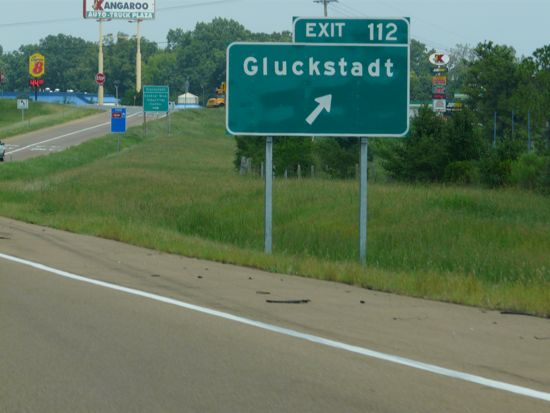
We get through Memphis without a hitch, way faster than we expected, and we settle in Osceola, Arkansas, where the entire downtown ‘historical Osceola’ is full of empty stores with broken windows, falling down houses, even a large stone church – or library? where pigeons are now living. We did find some spots of beauty down near the river:

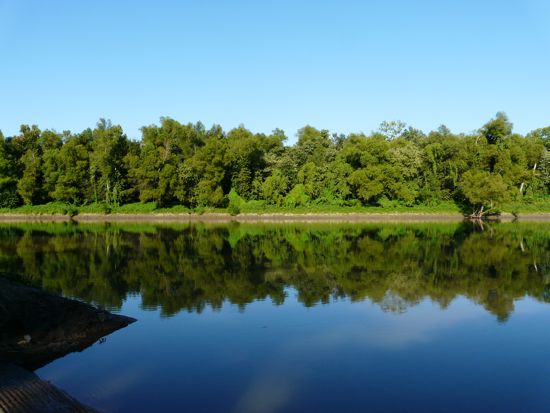
“Don’t open your door after dark!” our Indian hotel manager warned us and our eyes are big wondering if this is some kind of Stephen King thing and the harvest-corn-king roams around killing unwary tourists, but she followed it with “we have lots of mosquitos in these parts.” Indeed. I have several bites already to prove it.
Five Theories on Why the Housing Market is Still Falling
This is from AOL News Opinion Round-Up and not one of them mentions my favorite theory, which is – the big huge bulge of baby boomers is now retiring and downsizing, there is a glut of housing on the market because there is not the same market for houses that existed when this big bulge of population was mating and bearing children. I think the ‘problem’ is greatly a natural phenomena related to the demographics. Experts disagree. 🙂
Why Is the Housing Market Plummeting? 5 Theories
Max Fisher
The Atlantic Wire
(Aug. 24) — Sales of existing homes dropped 27.2 percent in July, accelerating the recent decline in the already frail housing market. This brings the number of existing houses sold to an annual rate of only 3.83 million units, the lowest figure since 1999. The number of single-family home sales hit its lowest level since 1995. Some economists even fear that this signals the end of housing as an investment. How bad is this and what does it mean?
The Role of Expiring Tax Credits: Dow Jones Newswires’ Meena Thiruvengadam and Sarah Lynch explain, “The steep decline in sales in July reflects both a souring in the U.S. economic recovery and the expiration of a government tax credit program that has been supporting the housing market for more than a year. The tax credits offered certain buyers up to $8,000 to sign a contract by April 30. Deals originally needed to close by June 30, but lawmakers pushed that deadline to Sept. 30. Still, the tax credit’s expiration drove pending home sales down 30 percent in May and caused a double-digit dive in mortgage application volumes even as interest rates hovered near their lowest levels in generations. July’s existing home sales data reflects the May plunge in pending sales, which typically become existing sales within a couple of months.”
Tax Credits Caused ‘Collapse’: The Atlantic’s Megan McArdle writes of the homebuyer tax credits, “This housing collapse is the aftermath of that mania. The depth of the collapse suggests that in fact, the housing tax credit was not generating new demand as much as moving demand forward a few months. That means that we’re going to have to work out the aftermath in months of low home sales. … This only reinforces my belief that housing is no longer a good way to generate wealth. The government can’t fix this market, which needs to find a new, lower level. It can only very temporarily distort it.”
Market Fears Double-Dip Housing Recession: The Los Angeles Times’ Alejandro Lazo reports, “The big drop, which was worse than what many analysts had expected, sent stock markets tumbling Tuesday morning as investors feared a double dip in housing. The blue-chip Dow Jones industrial average fell more than 1%, as did the S&P 500, a broader measure of stocks. … The July plunge was the third consecutive monthly decline following the April 30 expiration of the tax credit, which offered up to $8,000 for certain buyers.”
Ballooning Supply Worsens Problem: The Atlantic’s Daniel Indiviglio explains, “This is the second highest inventory in a year. The number of months it would take to sell the current supply of homes also swelled in July to 12.5, which was a huge jump compared to June’s rate of 8.9. It’s also nearly double November’s rate of 6.5. Given the low rate of sales this summer and consistently high foreclosure rate, inventory will likely continue to grow. This is a really, really bad report. The awfulness of July’s sales were a little exaggerated due to all of the demand having been pulled forward form the buyer credit. But it’s unclear how many months of demand were captured early by the credit, so it’s hard to know when its effect will wear off.”
Entire Housing Market Is Stalled: Reuters’ Felix Salmon warns this report “means that despite record-low mortgage rates, people aren’t able to buy houses: essentially all the benefit from those low rates is going to people who already own their homes and are taking the opportunity to refinance. The news also means that there’s a big gap between buyers and sellers: the market isn’t clearing. Sellers are convinced that their homes are worth lots of money, or will rise in price if they just hold out a bit longer; buyers are happily renting, waiting for prices to come down. And entrepreneurial types, whom one would expect to arbitrage the two by buying houses with super-cheap mortgages and renting them out at a profit, don’t seem to have found those opportunities yet. Houses are rarely a liquid asset; they were, briefly, during the housing boom, but now they’re more illiquid than ever.”
Why People Give
An urgent message came out today asking us to help the homeless people in Pensacola – and there are a lot of them, thanks to the warm climate. With all the rain recently, sleeping rough has been doubly rough, and it has been made worse by a sudden humidity-moisture related surge in the mosquito population.
As I talked with AdventureMan about our donation, he laughed. I was in fund-raising for a while, and was unexpectedly good at it. One thing I learned, there are a lot of ways to persuade people to donate, and then again, sometimes people will donate and you haven’t a clue as to why they felt this urge to be generous.
AdventureMan laughed; he totally got it. I used to work with a homeless, a long time ago, so I have a soft spot where they are concerned. Mosquitos also love me, and I get these horrid great but huge itchy bumps any time I am anywhere near a mosquito, AdventureMan always says he keeps me nearby because they head straight for me and ignore him.

Of course we donated. Wet homeless people and mosquitos, it was a golden combination. If you would like to donate, too, you can, through the EscaRosa Coalition on the Homeless (Working to Eliminate Homelessness). They will hold an Annual Fundraiser on Saturday September 11th from 7pm – 11pm at The Garden Center.
Welcome Home Dinner and Empress Rice Recipe
We had a dinner yesterday, to welcome AdventureMan home, and just to gather together friends and family in the area to have a good time.
AdventureMan stuns me with his ability to transfer all those time zones with no effect. He slept through every night, no problems. Amazing resilience. He also bought a great big watermelon, and made juice from it – delicious!

The Happy Baby is now big enough for a high chair. A high chair is a really good thing now, because he has started crawling, and he is really, really fast, especially when he is going after a cat!

Now that he is crawling and jumping and going to school, his little baby fat is turning into muscle:

(Sorry if this one is a little fuzzy, but he is jumping so fast I can’t get a clear photo)
Following traditional Middle Eastern / Southern customs, we had way too much food:

Including several long time favorites, one of which was Autumn Plum Torte:

One old favorite I am making again (I lost the recipe for a while) is Empress Rice. This recipe is so easy, so rich, so so good:
Empress Rice
1 large onion, chopped
1/4 cup butter
2 cups rice, raw
2 cans consomme
1 Tablespoon soy sauce
1 cup sliced mushrooms, drained
2 cups grated sharp cheddar cheese
1/2 cup chopped walnuts
Set oven for 325°F / 160°C
Saute onion in butter until golden brown. Brown raw rice with onion, then add all the rest of the ingredients. (How easy is that??) Grease a 3 quart/litre casserole, cover, and bake in oven for 1 hour and a half, or until liquid is absorbed. 8 – 10 servings.
(I did not make this with mushrooms, because our son doesn’t like mushrooms, but mushrooms make it richer. For church suppers, I sometimes add in some sausage, like smoked turkey sausage, or some chicken chunks.)
Some of the things I served I have shared with you before:
Autumn Plum Torte
Cauliflower Salad
Soused Apple Cake
Rotkohl
It was a great gathering, lots of stories exchanged, lots of laughing, and sweet little Happy Baby went to sleep just as lunch was served, freeing his parents to relax and enjoy a couple hours of socializing. 🙂 My old friend in Germany slipped into my kitchen and functioned as my second right hand; I actually enjoyed having her help because it’s like she knew what I needed before I knew I needed it. We could hardly believe so much time had passed when our last guests left; time just flew by, the sign of a truly memorable gathering.
‘Some Just Like to Hate’
I am receiving hateful e-mails; e-mails claiming Barack Obama is really Muslim, and that Muslims are trying to take over America. Sometimes I wonder how well my friends really know me? Sometimes I wonder how well I know my friends, that they would be so nice and kind as I know them to be, and so rabid in their hate-filled beliefs?
When I found this article today in AOL News it comforted me . . . that this round of Anti-Islam is no where near so mindless and destructive as the hatred of the Catholics, of the Mormons, of the Jews. I can only hope that this too, shall pass.
I work at changing perceptions one person at a time. The most common question I get about living in Jordan, Tunisia, Saudi Arabia, Qatar and Kuwait is “Weren’t you scared?” and I laugh, and point out that the crime rate in Pensacola is much higher, and that the risks of my walking alone in any of those countries was much less than here.
I tell them about my time with women in those countries, the many kindnesses I received, the fun we had working and playing together. They know I am religious. It puzzles them that I can find being around people so different from me comfortable. I tell them how we share values, how being around religious women from Qatar is easier than being around non-believing American women. It’s the stories that make the difference. I can understand why Jesus spoke so often in metaphors. You have to find some way to explain that people can understand, some way they can visualize and connect to what may seem alien and strange.
Andrea Stone
Senior Washington Correspondent
WASHINGTON (Aug. 19) — Are Muslims the new Jews? Or Irish Catholics? Perhaps Mormons? Or are they really the war on terror’s Japanese?
Religious experts and historians say: all of the above.
The still-unfolding controversy over plans to build an Islamic center near ground zero is just the latest chapter in a long saga of religious and ethnic misunderstanding that experts say goes back to the nation’s earliest days.
Fear of foreigners dates to the Alien and Sedition Acts of 1798, which were aimed at French immigrants suspected of disloyalty, said American University historian Allan Lichtman. “Then it was the Irish, the Germans, and the Catholics, and the Jews,” he said. “These waves of xenophobia are as American as apple pie unfortunately.”
Despite the appeal of blaming the overheated rhetoric over the dispute in lower Manhattan on the still raw emotions left over from the Sept. 11 attacks, antipathy toward Muslims predates the furor around the proposed Park51 Islamic center.
A Gallup Poll conducted late last year found 43 percent of Americans admit to feeling some prejudice toward followers of Islam. That’s more than twice the number who feel that way about Christians, Jews or Buddhists.
Acts of vandalism against mosques are rising. Plans to build new ones sprout not-in-my-backyard protests and even calls to outlaw them. Muslim women complain that bans on head scarfs trample their religious rights. In Florida, congressional candidate Allen West, who has been endorsed by Sarah Palin, has said Islam is not a religion but “a totalitarian theocratic political ideology.”
Blogs such as Stop Islamization of America and Creeping Sharia have helped lay the foundation for the controversy. And the culture war promises to grow even hotter. A fundamentalist Christian pastor who describes Islam as “of the devil” has called for an “International Burn a Quran Day” to mark the ninth anniversary of 9/11 next month. A more mainstream minister, Franklin Graham, was booted from a prayer service at the Pentagon, where Muslim prayer is welcome, after he called Islam “evil.”
Yet is any of this new? While nearly one in five believe, incorrectly, that Barack Obama is a Muslim, this is not the first time a president has been suspected of lying about his religion. Anti-Semites and Nazi sympathizers spread false rumors in the 1930s that Franklin Delano Roosevelt, a mainline Episcopalian, was Jewish.
The latest debate reveals “the dark underbelly of the American psyche,” said Boston University religion professor Stephen Prothero, author of “God Is Not One: The Eight Rival Religions That Run the World–and Why Their Differences Matter.” “We keep imagining that we’ve outgrown our religious bigotry and we haven’t. It keeps getting tested for each new religious group.”
Everything old is new again
Scholars liken today’s Muslim bashing to similar episodes in American history. In the 19th century, the nativist Know-Nothing Party wanted to prevent immigrants, especially Irish Catholics, from coming to America. Prejudice against Mormons forced them to flee west to Utah. Anti-Semitism spawned lynchings as, of course, did racism.
In 1924, Congress clamped down on immigration from eastern and southern Europe — home to such “undesirables” as Italians and Jews — as well as all of Asia. And after the attack on Pearl Harbor, more than 110,000 Japanese-Americans living on the West Coast were forced into internment camps for the duration of World War II.
Today’s debate over the mosque “is very mild compared to some of these previous episodes,” said John Green, a University of Akron political scientist who studies religion and politics. He notes that religion, ethnicity and race are often conflated to produce a conflict between new groups and old groups.
“Each of these episodes has its unique circumstances,” he said, “but they appear to be most severe when the unpopular group is linked to national security and the definition of the nation. 9/11 is a good example and many of these episodes were associated with wars. Other were linked to other crises like state rights, civil rights, immigration and communism.”
Louise Cainkar, a Marquette University sociologist, sees similarities to anti-German sentiment during World War I and against the Japanese in World War II but says neither were as “strong or pervasive” as the feelings about Muslims. The only thing that comes close, she said, was the anti-Catholic movement of the 19th century that lingered in a less-virulent form until 1960, when presidential candidate John F. Kennedy had to affirm publicly that he would take no orders from the pope.
Religion and politics have often mixed in America, with uneven results. After 9/11, President George W. Bush rejected the formula that Islam equaled terrorism and spoke out loudly in favor of religious tolerance. In the current debate, political rhetoric has ranged from far right to moderate middle to wishy-washy to impassioned.
But Prothero was struck by two reactions “by politicians who should know better” — Senate Majority Leader Harry Reid and Republican presidential hopeful Mitt Romney. Both men oppose the proposed Islamic center in lower Manhattan and both are Mormons.
“It’s unconscionable and frankly shocking that any Mormon would speak on this issue the way Romney and Reid have spoken. Don’t they remember that the founder of their religion was assassinated by an anti-Mormon mob?” said Prothero, who also wrote “Religious Literacy: What Every American Needs to Know — And Doesn’t.”
Yet he said the men are typical of Americans who live in one of the most religious countries on earth but are “astonishingly ignorant” about religion. He noted that Imam Faisal Abdul Rauf, who heads the Cordoba Initiative behind the proposed Islamic center, is a Sufi. Sufism is a tolerant strain of Islam that Osama bin Laden and al-Qaida consider an infidel religion and whose shrine in Pakistan was recently the target of a double suicide bombing.
“I find the lack of memory frightening,” Prothero said. “This is a classic moment when it helps to remember something about American history – that our freedoms have been hard won.”
Muslims in America
Akbar Ahmed, chairman of the Islamic studies department at American University and a former Pakistani diplomat, visited 100 mosques in 75 cities over the last year for his new book, “Journey Into America: The Challenge of Islam.” What he found in interviews with Muslims and non-Muslims, native-born and immigrant, was a common feeling of being under siege from a faltering economy, natural disasters and two wars at a time when the first non-white president in history “has become a lightening rod for everything that is going on in America.”
But he said the controversy “is not just about one mosque, although that is a very special and sensitive one because of 9/11. It is much more.”
Ahmed said Muslims haven’t had the chance to go through “the process of Americanization that successive waves of immigrants” did before them.
When the Immigration Act of 1965 opened the door for the first time to people from Third World countries — many of them Muslims — the doctors, lawyers and engineers who came “flew straight into the American dream,” Ahmed said. “Nobody challenged them. They didn’t go through the century-long process that Italians and Jews did” to be accepted. But when 9/11 happened, “People said, ‘Who are these Muslims? We don’t know anything about them’ ” and some quickly equated the 19 hijackers with all Muslims in America.
“Some Muslims have been here five generations,” Ahmed said, “but today they are all under a cloud.”
Cainkar, author of “Homeland Insecurity: The Arab American and Muslim American Experience after 9/11,” noted that Arabs have lived in America for more than a century but anti-Arab feelings intensified only after the Six-Day War in 1967 and have since combined to inflame ill will toward Muslims. Today, she said, those speaking out against the proposed mosque are motivated by more than just religious beliefs.
“Some have foreign policy interests. Some think a strong America means controlling Muslim movements and countries. Some support Israel and so understand that to mean opposing Muslims. Some have a conservative view of American society and think it should be Euro-American. Some don’t like people of color. Some believe Jesus is our savior and other religions are false. Some just like to hate,” she said.
“It is not really about Muslims at all — they actually know very little about them.”
Cats in Cages
For four months now, since we moved here, AdventureMan and I have been looking for a good cat hotel for the Qatari Cat. When we are away for short times, our son and his wife look in on QC, making sure he is well fed, well loved, etc. but if we are going anywhere for a longer time . . . we don’t want to burden a family with two working adults, a baby and three cats of their own.
Seeking a good cat boarding facility in Pensacola has been daunting. The very best one we found prior to today had a separate, quiet floor where the cats were boarded, but the cages were sterile. There was one cat, who looked just like QC, and the veterinary technician said he was a BAD CAT, and poked her finger in at him and told him he was a bad cat. They had great dog facilities, play times, etc. Cats were . . . chopped liver
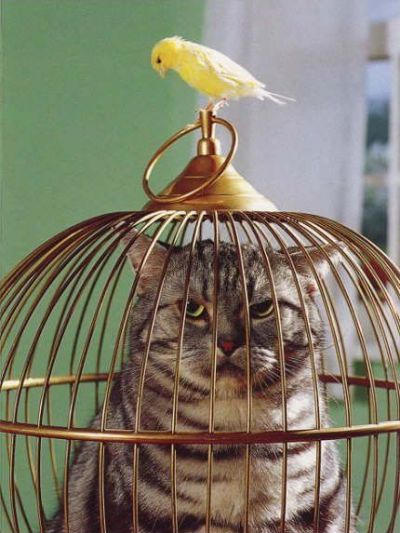
And that has been our experience, desperately looking around Pensacola for a GOOD place to leave QC. We have visited so many places, veterinarians, grooming places – cats in steel cages. One place had larger steel cages, but cats in dark, damp, smelly rooms, cats warehoused in the same dank, dirty place with DOGS, cats in steel cages, looking miserable. Honestly, how can we travel? We can’t leave QC alone too long; he gets really depressed and stops eating and stops taking care of himself. And visiting all these boarding facilities was just depressing. We would walk out with a pit in our stomach.
Today, we passed one place – it looked cute. AdventureMan said “you run in and see if they board cats” (it looked like a dog place). I walked in, and there were three women grooming dogs, and it was quiet. The dogs all looked really happy. No, they don’t board cats yet, not yet, because they want to do it right, had I ever heard of cat condos?
Yes! Yes! Like the Kitty Ritz in Kuwait, a place that understands cats, understands their need for security, for privacy in their litter, for some variety and some stimulation under controlled circumstances. We loved the Kitty Ritz, and we loved the cat hotel we used to take our cat to in Germany, where they had kitty condos and a cage full of mice that kept the cats fascinated for hours. Our cat loved to go there! They even knew how to give her insulin shots twice a day.
So we went looking, one last time, and we found what we were looking for, at Village Groomers and We Tuck ‘Em Inn in Pace, less than half an hour from our house.
The place is CLEAN. Orderly. The cat dorms are roomy, one room for sleeping and observing, another room with litter and food. Each cat has his or her own drawer with his or her name on it with special foods and cat toys and blankets – anything from home to help the cat be content and secure.

We reserved an upper dorm for Qatari Cat. It gives us so much peace of mind knowing he will be well taken care of.
AdventureMan’s Bathroom
“Hey Dad, what happened, you draw the short straw?” our son asked AdventureMan when he saw the bathroom in the Pensacola house.
We really love having our own bathrooms. They may be small, but we don’t have to bump one another out of the way, we don’t have to try to groom while someone is showering and steaming, and while I can have the A/C blasting, AdventureMan can have the vents totally closed. It works for us.
But his bathroom had swinging doors, saloon style. And an old toilet that didn’t always flush completely. And an old bathtub with old tiles.

While he was away, we did a new bath – new walk-in shower with a rainfall showerhead, new toilet, and best of all, a pocketing door. He is going to be SO surprised. 🙂

It has been so hard keeping this secret. I can hardly wait to see his face.
Pensacola, Sunday 0900
It’s one of those rare Sunday mornings when I am on my own, no AdventureMan, no son and daughter-in-law and grandson, just me. As a special treat, I get to go to the 8:00 service at Christ Church, and then, since I don’t have any church-girlfriends yet, I don’t have anyone to go to breakfast with, so I stop by Micky D’s and get in line for take-out.
It’s a long line. Whoda thunk, early on a Sunday morning in Pensacola, there would be a breakfast line at McDonalds?
A flashing light catches my eye, and a Pensacola police cruiser pulls up across the street, and leaves his lights flashing as he cautiously heads to the entrance of the convenience store. His hand is on his gun. No, I am not kidding!
He looks in the windows. Customers are coming out, and he keeps watching through the window as he walks towards the door. As he enters, he draws his gun. Just moments later, he and another policeman come out, with a man between them in handcuffs, white guy, looking sheepish. They put him in the back of the second squad car.
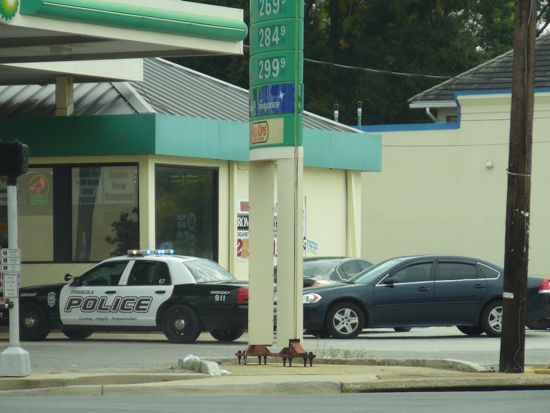
I really wanted a photo of them stuffing him in the back seat, but by this point, I was in traffic and I shot the photo I could get, not the photo I wanted. Me and my bacon, egg and cheese McMuffin headed home for coffee and the Sunday Pensacola Journal, all about school starting this week in Pensacola.
And AdventureMan comes home tonight. The house is sparkling. He has a surprise in store. 🙂 Our son and I will meet him at the airport to welcome him home, home being about 5 minutes from the airport IF there is traffic, LOL.
The Camel Bookmobile by Masha Hamilton
It took me a while to get into this book, because it is, in my opinion, badly written. The characters are thin, the story is thin, and yet . . . it is a book I will never forget.
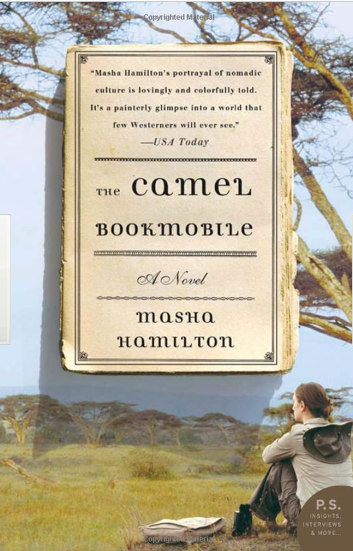
Masha Hamilton writes of a girl with a dream of going to a faraway place; she writes a grant proposal for a Camel Bookmobile, to take books from a remote library in Garissa, Kenya, out to nomadic groups in even more remote locations. As it turns out, the book features a device I like very much – a discussion of what is knowledge, what is learning, what happens when cultures clash and how in every interaction, there is something left that changes those interacting.
As Fiona (“Just call me Fi”) McSweeny follows her dream, there are her actions, how she sees her actions, how her actions are seen from an alternate culture, and how Fi feels she may be missing something in the interaction.
Anyone who has tried to finesse their way living in an alien environment knows that feeling, and the disasters you can bring on with only good intentions. Words, tone of voice, body language – all can be interpreted in ways you never dreamed, blinded by the wisdom of your own culture.
The star of the book is the Kenyan desert. While we do get to know the characters in the small arid desert village of Mididima, it is the way of life that Hamilton captures and which captivates us. The traditional ways are already passing, and the village elders are fighting a losing battle, trying to maintain their old ways. At the same time, there is a lot of wisdom to be learned and stored before the old ways pass, if there is anyone to document, to capture the details.
How can a book be both badly written, so badly written that you are constantly aware of it, and so breathtakingly vivid, so unforgettable?
There is a real Camel Bookmobile, started in 1996, and after visiting, Hamilton began a Camel Book Drive which garnered over 7000 books for the nomadic library. You can visit the website and learn where to donate books for other schools in the Garissa area by clicking here.
Recent Comments
intlxpatr on Shampoo Ginger tigerbutterya0c5ff1d… on Shampoo Ginger intlxpatr on British Soldier Kidnapped, Esc… John on British Soldier Kidnapped, Esc… intlxpatr on British Soldier Kidnapped, Esc… Wikipedia Donate Button

Amazina


Early Voting in Florida


