This is the Way We Wash Our Clothes . . . Wash our Clothes . . .”
We grew up, in America, singing a song about washing clothes:
“This is the way we wash our clothes, wash our clothes, wash our clothes,
This is the way we wash our clothes, all on a Monday morning.”
Tuesday we iron our clothes, Wednesday we mend our clothes. You can read the entire week at Mulberry Bush. Just click the blue type.
Today, Letitia Long will be named as head of the US National Geospatial-Intelligence Agency. It makes me smile to think that these two news articles appear on the same day. Women used to die young, worn out from bearing too many babies, and working themselves to the bone to keep their houses and clothes clean. Just washing clothes was an entire day event, heating huge pots of water, using a washing board, drying clothes by laying them over bushes and rocks, only the very luckiest had a clothesline.

These humble machines save hours of time. You can read the entire story of the earliest washing machines Here, At AOL News.
(Aug. 8) — “Thor” has been the name of several powerful forces in history, including a Norse god and a Marvel Comics superhero. But the strongest Thor might just be an electric-powered machine born 100 years ago that brought laundry into the modern era.
The first known washing “machine” is thought to be the scrub board, created in 1797. New-fangled hand-powered washers were introduced in 1851, but it wasn’t until a century ago that a drum-type machine with a galvanized tub and an electric motor, dubbed Thor, revolutionized the way people deal with dirty clothing.
Invented by Alva J. Fisher and introduced by Chicago’s Hurley Machine Co., the washing machine — which was patented on Aug. 9th, 1910 — is important for three distinct reasons, according to Thor Appliances vice president of marketing Michael Lee.
“First, it celebrates the birth of one of the oldest and most innovative brands/companies in home appliances,” Lee told AOL News. “Second, it represents the beginning of the washing machine industry. And third, it marks the date that clothes washing was transformed from an arduous physical task to an automated task.”
Happy Birthday, Happy Baby!
Today the Happy Baby is 6 months old. He is sitting, and pre-talking, and laughing and about to start school! He will be in a start-up program that actually begins educational formats at a very early age.
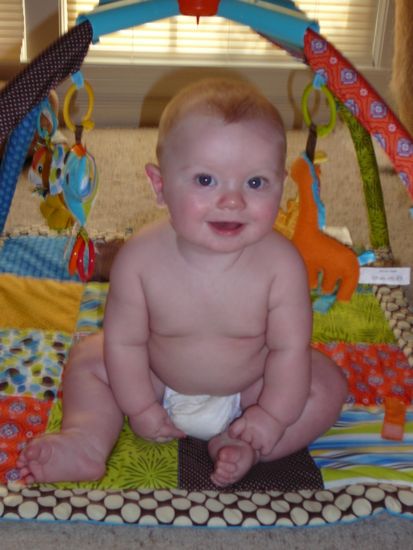
My son and his wife are having a birthday party today. 🙂 No, I haven’t heard of a 6-month-birthday party before, but what a great idea! Most grandmamas loves opportunities to give her grandbabies presents!
I found one book that is hilarious – and since we are all readers, and we want Happy Baby to be a reader, too, we start early. I have found that one of the secrets is buying books that adults will like, too. This one is about a zookeeper, whose zoo follows him home at night after closing. 🙂

If you teach a child the habit of reading, you get a bonus. You get a child who can keep him or her self occupied, and you get a child who can discuss books, ideas and characterization. It may be a challenge sometimes, but it’s a good challenge.
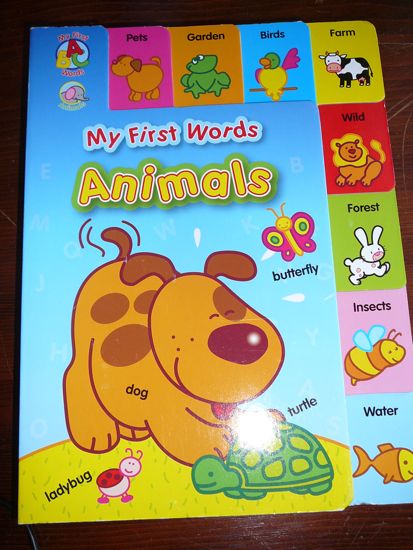
And this one, I am sure, is the kind of toy a grandmama can give a baby because she knows he will love banging on it, even while I suspect mama and papa will groan in horror:

Rainbow to the Rescue in Pensacola
This post is about an amazing blessing. You won’t think it is a blessing at first, you will think it borders on disaster, but stop. Think about it.
Late this afternoon, our contractor friend was in putting bars in the guest suite that people can use to help navigate around, help lift themselves off the toilet, etc. We were busy looking for a stud for the shower bars when it started raining.
“That’s raining pretty hard.” he said.
“It rains like that all the time,” I said blithely.
But it really was coming down, and it wasn’t just for a few minutes, it poured, and it kept pouring. The lightning was really close and we heard a loud CRACK! and then BANG and the power transformer on the post near my house was hit, but my power must come from somewhere else because, by the Grace of God, we didn’t lose power.
“Oh no! This has never happened before!” I exclaimed as I saw water seeping in the guest suite where we were working. (This has been cleaned up a little bit for this family blog.)
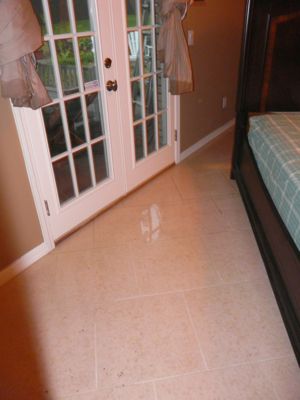
I thought it was coming in under the French doors, but when I grabbed the old towels for soaking up purposes, I saw that there was more . . . coming from under the walls! Horrors! I was almost stopped still in my tracks – there aren’t enough towels in Pensacola to handle the amount of water seeping in!

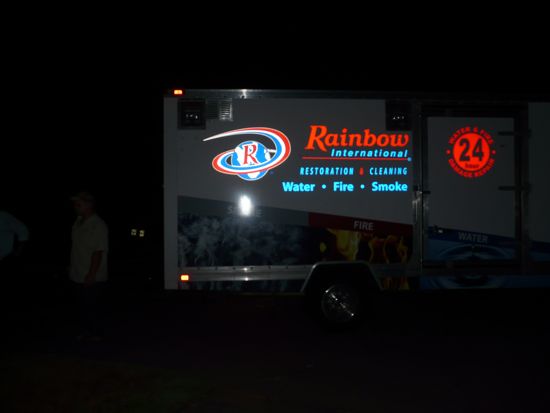
“This is a task for Rainbow!” my contractor said, and ran for his truck, to exchange it for his Rainbow truck (he is both a contractor and a Rainbow franchise operator).
While Dave was gone, his assistant, Bobby, used their wet vac to get as much water up as he could, dumping the full tank several times out the window as we struggled. Finally, the rain slowed, and we could mop up the remaining wetness. He started a fan.

Dave came back with the big Rainbow truck and an intimidating amount of equipment. Now I will go into a parenthetical gripe about men and their toys. The biggest part of me is incredibly grateful to have this resourceful man who helps us with our construction and renovation needs, and then is there, like Superman, to the rescue, when disaster strikes. Another part of me wishes he didn’t have that excited gleam in his eye. My problem is his challenge – he loves the adrenalin.
Honestly, it’s only a small part, and mostly it’s because I wish I didn’t have any problem at all. Dave has a meter that shows where water is still sitting in the grout between the tiles, and how it has soaked the baseboards and begun to creep up the sheet rock. He explains how in Florida, where the humidity is so high, the sheet rock can’t always dry out fast enough to avoid mold formation, and that even though it eventually may dry on its own, the mold can survive until the next moisture hits. Oh aarrgh!
Hours later, we have huge fans running, and we have dry air in oscilations being wafted into our walls to insure they dry thoroughly, but not too much. We have machines taking readings. Our insurance company says we are doing all the right things and the adjuster will come by on Monday or Tuesday.
This was supposed to be a quiet Saturday night. If it had been a normal quiet Saturday night, we might have been upstairs, watching some TV, listening to the lightening and not worrying too much about it. We would have gotten up in the morning and gone to church. We might not have even known our guest suite was flooded for days!
So honestly, I feel blessed. I am blessed that if this disaster had to happen, I had people with me who knew exactly what to do, and did it.
As they left, the Gulf Power people were out fixing the exploding power transformer, and I thought how many heroes there are on this earth, people who do their job under the worst circumstances, people who leave their families to serve because there are jobs that must be done.

God bless you, all of you, health workers, police, firemen, electricians, plumbers, emergency services, soldiers and sailors and airmen – all who sacrifice and serve. May you sleep well at night, and may God bless you and your families who support you.
I had a disaster, but I was surrounded by every resource I needed to deal with it. Thanks be to God.
If you have a disaster, and you live in the greater Pensacola area, I can recommend:
Rainbow International Restoration Services
David Murphy
O: 850-994-4411
Cell: 850-281-0232
“How Do You Want to Die?”
I had taken my mother to her internal medicine specialist, she had an earache, and as an aside, had mentioned she no longer is taking Lipitor, because it gave her problems with her legs, but should she go back on it?
“How do you want to die?” asked the doctor, and we just looked at her with our mouths hanging open. It seems kind of a bald question, doesn’t it? But the doctor was entirely serious.
“Doctors ask themselves this all the time,” she continued. “Do you want to end up in a nursing home, or living with your children, as your body continues to fail and your money dwindles away and you can do less and less every day?”
“I want to die in my sleep, at home” my 87 year old Mom responded.
“Then you want to have a heart attack,” the doctor said. “That’s what really happens when a person dies in their sleep, their heart fails.”
“That’s your choice,” she said. “Doctors discuss it all the time. Most of us want to go while life is still good, and we want to go quickly. We see too many people prolonging their lives and regretting it.”
I’ve never heard a doctor speak so bluntly before. We’re still kind of in shock. It has definitely given us something to think about.
Zeitoun by Dave Eggers
Do you remember being in university, and how when it came time to buy textbooks, the new ones were really, really expensive, and sometimes you couldn’t find it used and you just had to bite the bullet? Especially in political science and international relations, it didn’t take me long to figure out that many of the authors had one little idea, and they stretched it, kneaded it, elaborated upon it, made each different iteration a new chapter – but essentially, they took this one little idea, stretched it into a book and charged $30-$40 bucks for what might have made a good essay in Foreign Affairs or the New Yorker.
I often felt so cheated. I often find that when I look at the New York Times list of Best selling Non Fiction, most of the books look just like that.
When I bought Zeitoun, that day I just needed an escape, I didn’t know it was non-fiction. I had seen Zeitoun mentioned, even advertised in my very favorite magazine, The New Yorker. I fell in love with The New Yorker when I was a kid, even though I didn’t understand half of the comics, I thought they were hilarious. I still do. 🙂 When my New Yorker arrives, I read it cover to cover, and I often order books reviewed or recommended there.

I started Zeitoun shortly after watching the HBO series Treme´ about life just after Hurricane Katrina, so this book was timely and relevant. Zeitoun, a Syrian immigrant to the US whose wife is a Moslem convert, has a thriving painting and contracting business. When Katrina threatens, his wife and kids leave town, but he stays to watch over his multiple properties and businesses.
He survives the hurricane, and actually finds the change of pace enjoyable. He has a canoe he bought at a yard sale, and he rows around the neighborhood feeding dogs locked inside his neighbors houses, checking on his friends, rescuing stranded people or notifying rescue services where people need their help – he has a feeling he is exactly where he is meant to be, that he stayed on in New Orleans as part of God’s purpose for his life. He feels valuable and useful.
Then, one day, as he is checking on one of his rental properties, he is arrested, along with three friends, in the one house they know has water for showers and a working land line, which they all use to call their families. It is Zeitoun’s property. They are arrested by the National Guard.
One of Zeitoun’s friends, Nassar, has ten thousand dollars with him. Any of us who are expats can laugh – every expat has his cache of emergency escape money. Nassar, on hearing the hurricane was coming, withdrew his savings from the bank so it would be safe. The National Guard arrests them and takes all their money, wallets, identification and sends them off to jail, and in the chaos of post-Katrina New Orleans/ Louisiana bureaucracy, there is no paperwork and their families have no idea where they are.
Nassar and Zeitoun come into the worst of it, because they have Arab names, because of the large amount of cash Nassar has, and Homeland Security advisory that terrorist organizations could try to take advantage of the post-disaster confusion. It is seriously Kafka-esque; they are good men who are just in the wrong place at the wrong time with the wrong last names. Most of the meals served in the prison contain ham or bacon or pork. The system just stops working, and they never even get to telephone people who could clear their names and get them out.
I couldn’t stop reading. Eggers captures the sensual aftermath, the sewage, the foul water, the stink of rotting food and rotting bodies, and the bureaucratic nightmare of trying to prove you are innocent when you don’t even know the charges against you, and people are being picked up on mere suspicions.
While Zeitoun is eventually released from prison, and his construction and painting business flourishes, his family is not left untouched by the post-traumatic stresses the events surrounding Katrina. Every life resounds with the impact of Katrina and the damage inflicted on New Orleans. His friend Nassar never got his ten thousand dollars back.
I love books about people who come to America, create a business, and make a go of it. Zeitoun is one of the best – he isn’t afraid of hard work, and he loves his life and family. His story is well worth a read.
Zeitoun is available from Amazon.com for a mere $10.85 plus shipping, and while I own stock in Amazon, I don’t get any kind of payment for mentioning them in reviews. 🙂
Edmonds Sunset
My friend from college and I still get together, lo, these many many years later, and we still never have enough time for all the talking we need to do. Dinner at a new restaurant, the Caravan Kebab (the front of the menu adds ‘halal’ in Arabic – yes! I could read it!) and then a walk along the Edmonds waterfront where people were gathered, a la Key West, for a truly spectacular Edmonds sunset:

The Edmonds Market

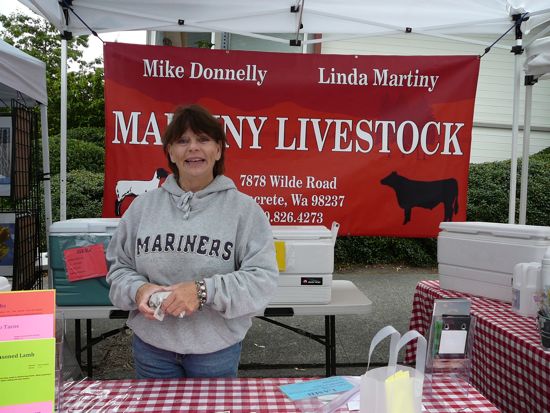
I made a quick round of the market very early, as I wanted flowers to welcome Mom back. First round – maple bars, flowers, farm grown zucinni and carrots, and some lovely farm-raised lamb chops for dinner.

Later, Mom told me about the wonderful Pear and Gorgonzola pizzas made at the market, and after some grocery shopping, I stopped by and ordered the Pear Gorgonzola and the Pizza Fresca, both vegetarian, and, woo hooo, very thin crusted, and baked right there on the street in a special oven they have created:
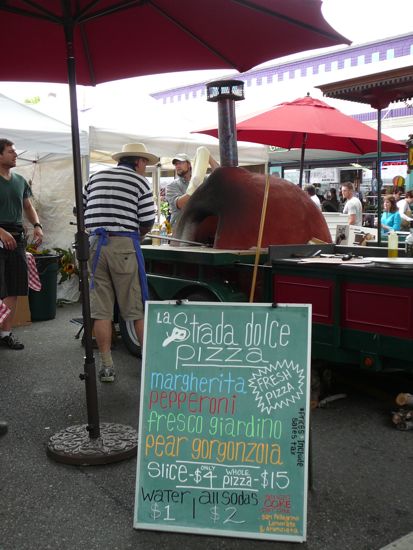
Mom was right. The pizzas were really, really good. We also had enough left over to freeze several slices to microwave on a night when she doesn’t feel like a heavy dinner.
While I was waiting for my pizzas, I visited my favorite soap maker. Last year, I asked for clove soap. AdventureMan and I fell in love with clove soap in Zanzibar, and we have used ever sliver and are yearning for more. This year, she had it! And more! Wonderful soaps, but these two are my favorites:

Sorry there is no photo of the gorgeous finished pizzas, but we gobbled them right up. 🙂
The Edmonds Bakery
I found it. I found the perfect cake. It was nothing like the cakes I auditioned. I found it in my hometown, Edmonds, Washington.
Edmonds is a quiet town, once the sun goes down. On weekends, it can be crowded and lively, and yesterday the sign telling cars lined up for the ferry said the wait would be about two hours. There is a movie theatre, which is small and homey, but plays first run films. It is playing Inception now. Edmonds is full of cool stores – a cheesemonger, several travel stores, home / kitchen wares, and is also home to Rick Steve’s Europe Through the Back Door.
My very first stop is The Edmonds Bakery.
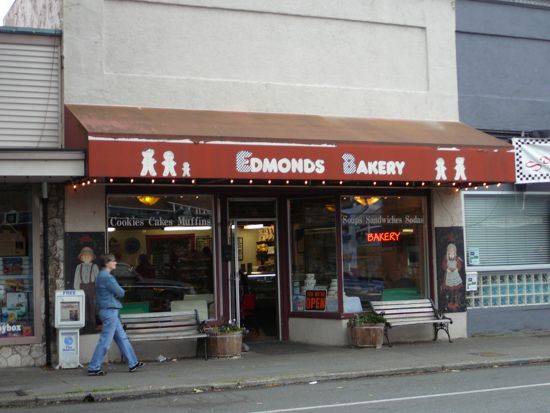
I love this place. I even love that it is closed on Sundays, even when other stores are open, even if it inconveniences me, I love it that they take their day of rest.
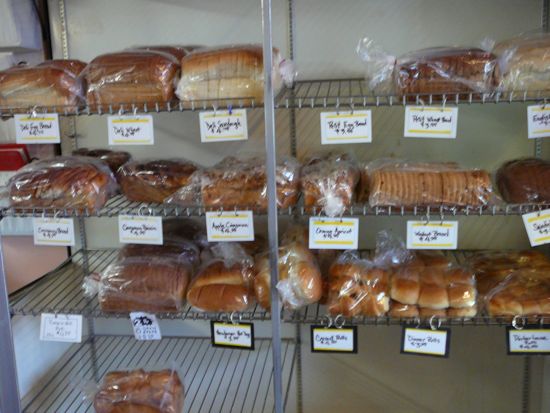
Mom is coming home from rehab today. No, no, I know how that sounds, but she has been recuperating from breaking her wrist. It is also her birthday tomorrow, so it is a double celebration, and Mom loves Maple Bars. The Edmonds Bakery makes great maple bars. In fact, they bake all kinds of wonderful treats, cinnamon rolls, pecan rolls, apple danish, snails, twists – every good thing baked with sugar and fat, they make it.

And there in the window, advertising wedding cakes, I found it. I found the perfect cake for September 6th, the blogging anniversary. It’s the one in back, the white one with the black filigree decor. Sort of Spanish looking – it’s the Arab influence. 🙂 I like them both, black and white, whoda thunk, but the filigree wins my heart.

There are booths and tables in the Edmonds Bakery, so if you are exploring Edmonds, or planning to take the ferry over to the Olympic Peninsula, take a minute to go in for a sweet and a cup of coffee. It’s the true taste of Edmonds. 🙂
By the way, if you go early, you will easily find a parking place, even on Saturdays. I went around 8:30, just as the Edmonds Market was cranking up. The weather was foggy and hazy and a mere 70° F / 20°, so take hoodie or a wrap with you. Seattle mornings can be refreshing (AdventureMan might call them chilly.)
Kuwait 1990
Thank you, Little Diamond, for spreading the news. This should be an amazing program.
From the Al Jazeera site:
On August 2, 1990, the Iraqi army invaded the emirate of Kuwait, which Saddam Hussein, the then Iraqi president, had declared Iraq’s 19th province.
The occupation of Kuwait may have only lasted seven months, yet the memory of it remains strong, not least in the minds of the children of that conflict.
At the end of the school year of 1990, students in an international school in Kuwait said their final farewells as they headed off for the summer holidays. Many of them would never meet again.
Al Jazeera’s Nashwa Nasreldin was one of those whose family was forced to relocate following the invasion.
Twenty years on, she returns to Kuwait, the country of her birth, along with a group of her classmates as they organise a reunion to find out what happened to their friends – and their school – during the war that separated them.
Kuwait: The class of 1990 can be seen from Monday, August 2, 2010 at the following times GMT: Monday: 1900; Tuesday: 0600; Wednesday: 0300; Thursday: 1400; Friday: 0600; Saturday: 1900; Sunday: 0300.
Recent Comments
intlxpatr on Shampoo Ginger tigerbutterya0c5ff1d… on Shampoo Ginger intlxpatr on British Soldier Kidnapped, Esc… John on British Soldier Kidnapped, Esc… intlxpatr on British Soldier Kidnapped, Esc… Wikipedia Donate Button

Amazina


Early Voting in Florida


