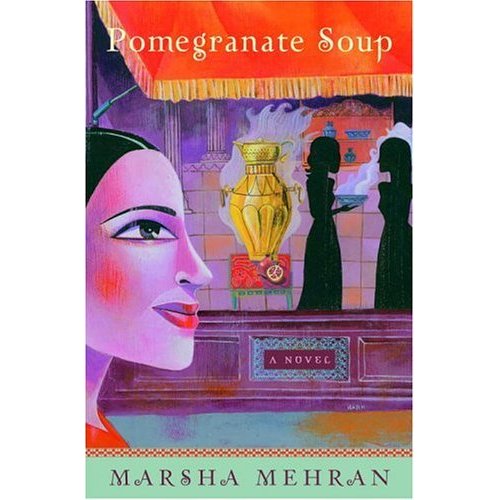
Pomegranate Soup by Marsha Mehran
I saw a mention of this book in an Amazon.com referral as a book I might like, and was almost set to order it when something said “go check the stack of books Little Diamond left for you” and sure enough, I already had the book.
I use books as an incentive to get me through life’s inevitable tasks I don’t like – like “if I finish this project on time, I get to read this book as a reward.” It works for me.
When I first started reading Marsha Mehran’s book about three Persian sisters starting up a cafe in a small Irish town after fleeing Iran, I found it sour. The author has a critical point of view, and generally speaking, I don’t like hanging around with people who criticize others and judge them harshly. At the beginning of the book, Mehran introduces a lot of people, many of whom we are not meant to like.
Even the sisters are not all that sympathetic – at the beginning. But also, near the beginning, she discusses Persian cooking, the idea of balance in a meal, hot and cold, spicy and bland, so you kind of get the idea that if there is sour, then there will also be sweet. In addition, at the end of each chapter there is a wonderful recipe, a wonderful, fairly easy-to-follow recipe, and she included one, Fesanjan, that is my all-time favorite Iranian dish and now, I know how to make it, Wooo HOOOO!
Three sisters, orphaned by fate, held together by love and duty, start a cafe, which, against all odds, becomes a raging success. Raging success does not heal all the old wounds, however, nor the hearts that bear them, and we learn through the book what the sisters have borne and overcome.
It turns out to be a sweet book, one well worth reading. And oh! the recipes! In each chapter, there are also hints that make them even better, so you can’t just copy out the recipes and use them, you really have to read the book. 🙂
It’s a pity that two of the most wonderful countries in the world – Syria and Iran – are off limits. We’ve been back to Syria, and it was everything we remembered (see the Walking Old Damascus blog entries) but oh, how we would love to explore Iran. Sigh. The world turns, and we can only hope to be able to get there in our lifetime. Stranger things have happened.
NO PARKING!
On my way home, driving along the wall of our compound where they recently installed bright shiny new NO PARKING signs – not one or two, but like twenty; one every thirty feet – there are a whole brigade of big huge trucks, you know, the kind that accompany beginning construction? I am not even sure I can get through, there are so many, like six or seven or eight (it is a small street).
But one of the trucks is orange, and I am hoping hoping hoping, so I grab my camera out of my bag as I inch by, and yes! yes! he has parked right next to one of the signs. I take my shot and keep inching by, and just beyond the last truck on the left is a gaggle of truck drivers, I guess they are trying to figure out what to do about something.
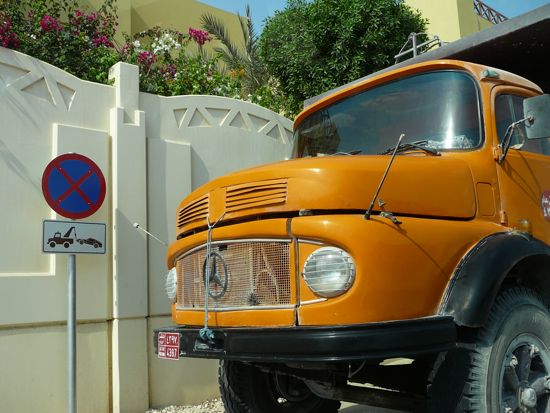
When I get to our gate, I tell them, “there are many trucks parked by the compound wall” (here I point in the direction) “can’t you see them on the security cameras??” and the gate guy says there is a man fixing the camera input right now, but did I get the truck number?
(Did I get the truck number I am thinking??? GO DO YOUR JOB! YOUR JOB IS SECURITY! GO TELL THEM NOT TO PARK THERE!)
I smiled and said “you need to tell them to move their trucks, and not to park right by the compound wall, it is a security risk.” I am a nice lady, yes I am, and so I say this nicely, with a smile, but there is a hint of steel in my voice.
He says “we have people working out there! They will tell them!”
The people out there working are the gardening crew.
I said “No. Your people are about 400 feet away from the trucks, and they are gardeners. They are not going to tell Pakistani truck drivers to move their big trucks.” (The smile is still there, but there is a hardness in my eyes.)
He doesn’t want to go. “Did you get his number?” he asks again. “I say no,” but then I pull out my camera and show him the photo. His eyes widen. The security man comes, and the gate guard shows him and his eyes widen. He assures me they will call the Bolice immediately.
Did they? I don’t know. Honestly, you do what you can. Sometimes it is like knocking your head against a wall, it just feels so good when you stop.
Setting Up for the TriBeca Film Fest
A lot of my life is just like yours – fairly routine. Regular meetings, regular obligations, regular trips to the market to keep my family in food, meal preparations, etc.
Lately, even my mother commented I’ve been eating out a lot. No! No! It’s not true!
We do eat out a couple times a week. I don’t always take photos because many of the places we eat, we have already reviewed at least once.
When guests come to town, we often eat out a little more because we are on the go.
And so like during one trip, I can take photos for a number of different posts. One trip to Souq al Waqif and I have mermaid fabric photos, a restaurant review, a photo of the new tower, maybe a few shots for the school calendar, some traffic revision shots upon leaving – see what I mean? It’s not like I am eating out all the time, but when we go someplace new or when I need something to blog about, I dig them out.
This is one of those “just one more thing” shots – they are setting up at both the Museum of Islamic Arts and at the Souq al Waqif for the upcoming Tribeca Film Fest. They say Robert de Niro will be here (Wooo HOOOOOO!) There is a lot of excitement building, and I can understand – they are going to a lot of trouble to make sure it is a BIG deal.
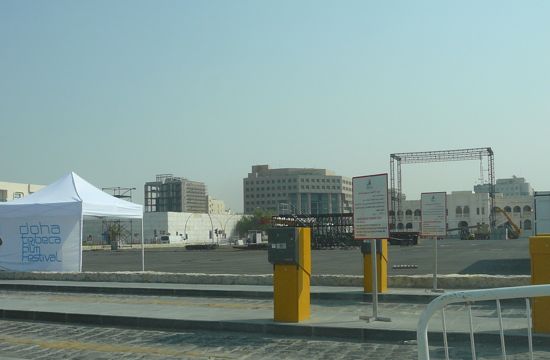
You can find out more about the Tribeca Film Fest 2009 by clicking on the blue type.
New Tower at the Suq al Waqif
We’ve been watching construction on this new tower; it seemed to go up within months. I can’t imagine what it is for, but oh, what fun. It’s the brownish colored tower on the left, before the entrance to Soy. It’s fort-like.

Little Mosque on the Corner
This is for my western friends, but anyone who sees me saying something wrong is welcome to jump in and fix it so it’s right.
We have a little mosque on the corner near our villa. Now, having a mosque on the corner is nothing special, in fact, when giving directions, it is kind of a joke, because you can give landmarks and then say “and you turn right at the mosque” but there are SO MANY mosques that using a mosque as a landmark is almost sure to confuse whoever is trying to find you.
Nonetheless, every neighborhood has its own mosque, and then there are bigger mosques where everyone gathers on Fridays, we call them Friday mosques, and then there are even bigger ones where everyone gathers on the two big holidays called Eids.
But this is our little neighborhood mosque:

I think it is very beautiful.
In the back, around this time of the year, they start a garden. I think it is for poor people to have something to eat, but I don’t know. I love it that they take a tiny little space and make it useful.

We live close enough to hear the call to prayer five times a day – it seems like more. There is the “get ready” call and then there is the real thing. During Ramadan, sometimes there are prayers over the microphone (it is on low) all night. It isn’t so intrusive; when it is hot and the air conditioning is on, you can’t even hear it. It’s kind of reassuring, to me, hearing someone praying all night long.
Souk al Waqif: Soy Restaurant
I’ve heard mixed reviews of Soy, and since I love Chinese, Thai, Japanese, Vietnamese and Korean foods I was eager to give it a try. I’ve been twice, love the menu, love the chairs, and holy smokes, the place is HUGE.
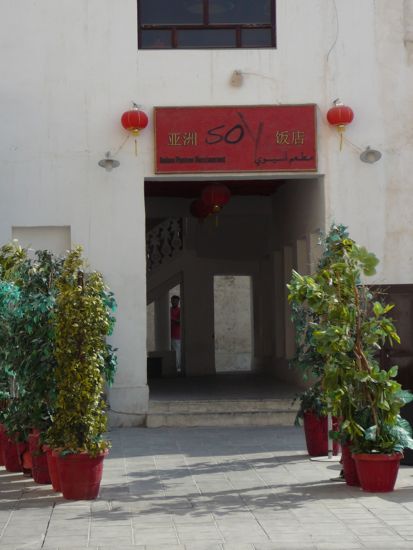
I love the variety of restaurants in the Souk al Waqif, and it is nice to have this alternative. I will never order the Chinese set menu again, however. The main course, grilled shrimp, came with three delicious looking breaded shrimp on skewers. I carefully removed the tail and bit in – there was shell on the shrimp!
Maybe this is really authentic, I thought. Maybe real Chinese people eat the shrimp shell and all, but my lunch-mate scowled and called the waiter over and complained. “These breaded shrimp were deep-fried with their shells still on!”
The waiter disappeared, and we waited. He came back and told us that is the way they were cooked, every time. Well, OK, so we took the shell off and ate the shrimp, but you can bet money that we will never order that set meal again!
The set meals are a nice deal. 49QR takes care of a soft-drink (ironically, you pay for water, but the soft drinks come with the meal), and then your choice of one of three set meals – the Chinese, the Japanese or the Thai.
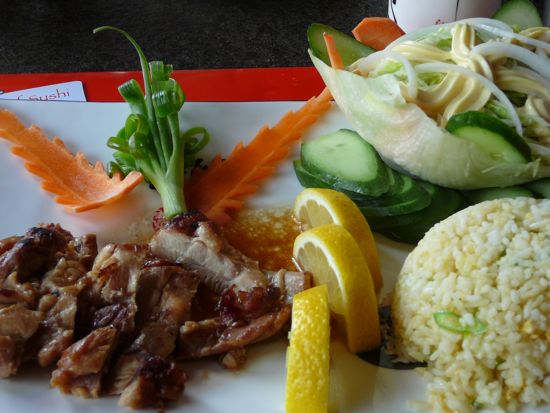
Back another time, I tried the Japanese, which I liked, except the Teriyaki chicken had barely any teriyaki taste. The miso soup was very good, the salad strange, and the green tea ice cream for dessert was good.
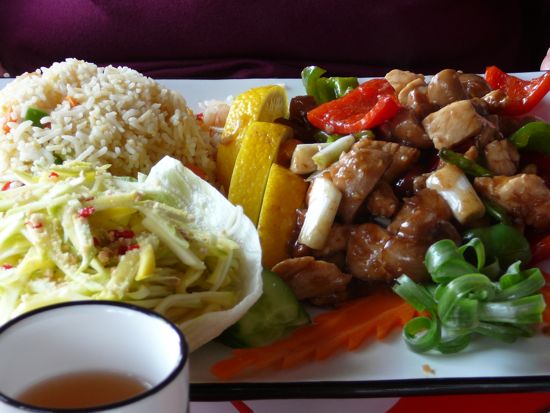
My lunch friend had the Thai, which had a very good soup, a strange salad, a very good main course and a good dessert, I think deep fried ice-cream.
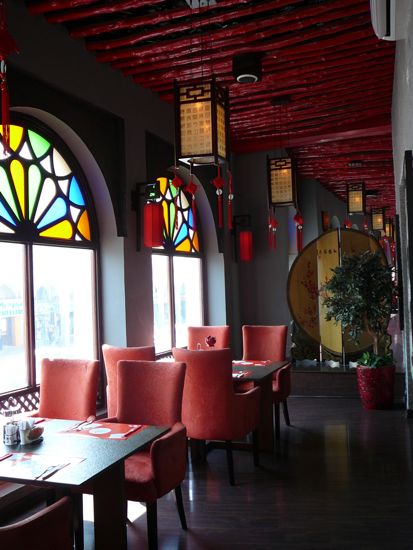
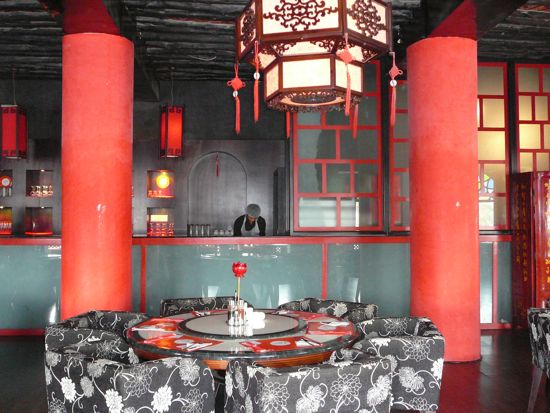
I love the chairs. I love having comfy chairs with arms to eat in. I love it that the restaurant is huge, with lots of different dining areas, tucked away behind the other restaurants.
My favorite part of the set meals are the soups and the rice. Both are excellent.
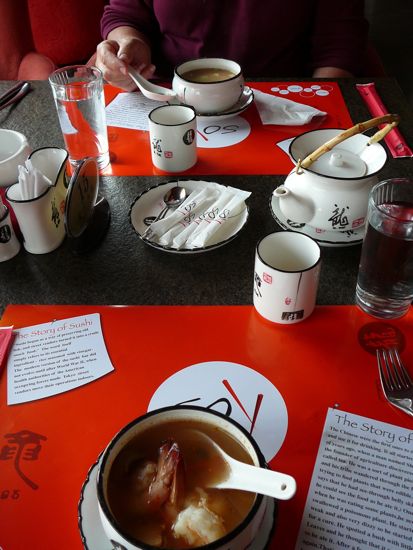
Even after the Chinese shrimp disappointment, I would like to go back again and try ordering a la carte from the menu, to see how we like it. Even if a restaurant is uneven, often there are things they do really well, and if you stick with those things you can have a good dining experience. So my review is mixed, but it’s not like I am saying I will never go back. It was a good experience, and I want to give it another shot.
The Heart of Doha – Disney Does Doha?
“No, it’s not DOHALAND!” I snapped at my friend. ‘It’s called the ‘Heart of Doha’ project.”
We were exploring the project in it’s first phase, the destruction phase, which is turning old haunts into several circles of hell – shopping hell, driving hell, parking hell, disorientation hell. And just as we were inching our way into a new diversion, I saw the big sign describing the future this funky area of Doha and telling us to go to ‘Dohaland.com.’
Oops. I apologized profusely and she very humbly pretended not to be gleeful that she was right and I was wrong. Well, actually, we are both right. It is both ‘Dohaland’ and ‘The Heart of Doha,’ but I shouldn’t have snapped at her over something so inconsequential. Blame it on the rain . . . umm . . . .err . . . the traffic.
Dohaland. I’m sorry, it sort of cracks me up. It’s just like Disney – JungleLand, FutureLand, etc.
I remember when the Suq al Waqif project first started, how outraged I felt, and how delighted I am to go down there now, where the shop-keepers have electricity that is reliable, even air-conditioning wafting out into the corridors, the appearance of ancient woven mats shading the twisting cobblestone street which no longer reaches out and grabs your heels, or changes levels unexpectedly. How can you be a successful curmudgeon when it turns out so positively? Even if it is a little bit Disney-does-Doha, it is so attractive!
What I love about what has been accomplished so far is how it has enhanced the experience for everyone. If you go down into the souks, you see more people. You used to see only a few westerners, now you see all kinds, even tourists, even your neighbors; you see every nationality down in the souks now, and people are actually buying things, not just killing time. There is a great variety of shops and restaurants, and even if the parking spots are tiny, there is parking.
Have you visited the website yet? Dohaland.com? I love the vision, although in one shot with people in suits crossing the streets, I want to shout “Hurry! Hurry! Or you’ll get run over!”
Here is what it is going to look like – and you can go to the Dohaland website and get a great big full screen map:
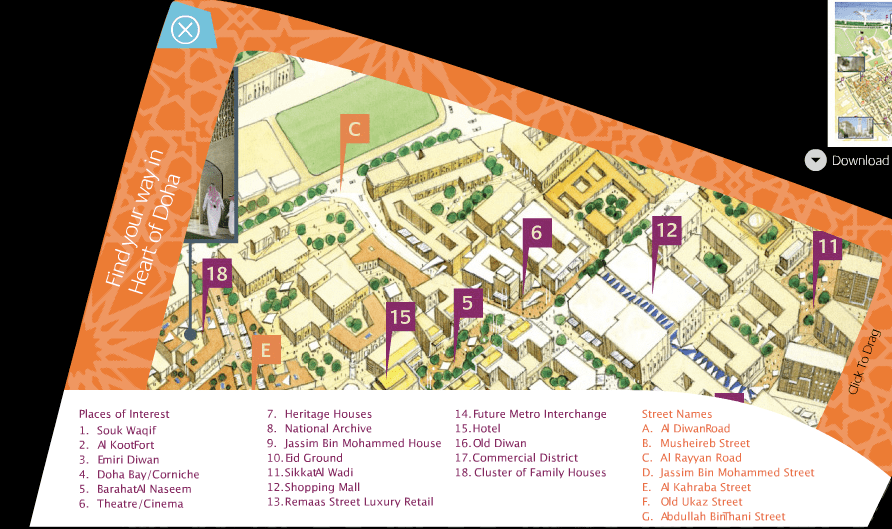
And here is what it looks like now:
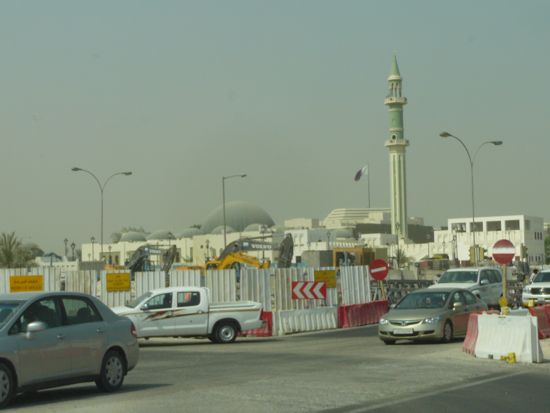

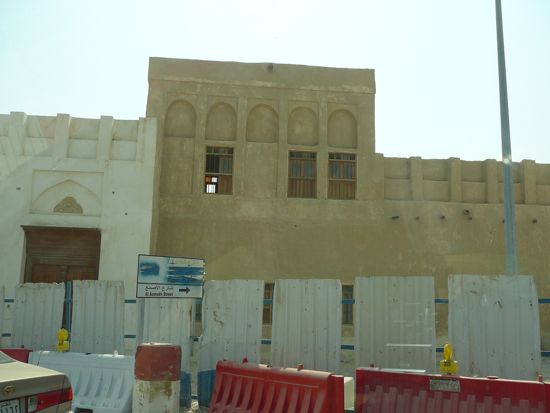
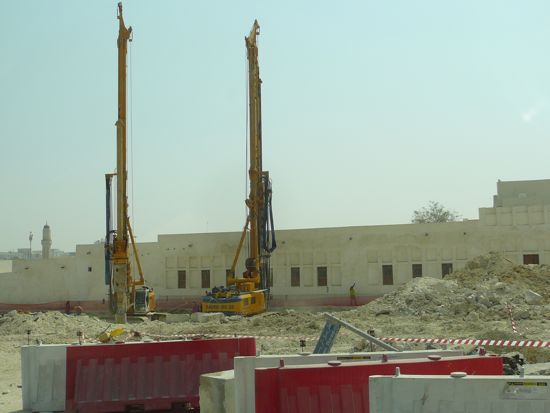
These machines are like huge dentist’s drills, with points that pound down into the hard-packed Qatar soil to break it up so that foundations can be built:
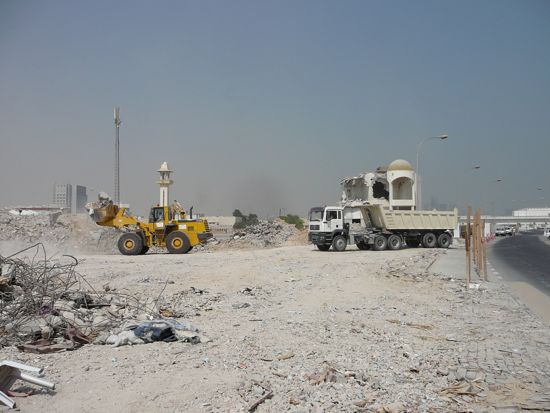

It’s not unlike house-cleaning. When you pull everything out of the closets, out from under the beds, the drawers, those piles of things in the corner, for a while everything looks worse than it did before you started. Slowly, slowly, you create areas of organization and calm amidst the chaos, and slowly, slowly those areas expand, join, until the chaos is eliminated, you know where things are, and your living area is a calm and peaceful and organized oasis. I hope I get to see that day in Doha.
Update: Dohaland AKA Heart of Doha is now known as Musherib
Mermaid Fabric
One of the things my friend and I were seeking on our Souk Quest was mermaid fabric. My friend has a grand daughter who loves to be The Little Mermaid, and I knew that the exact right fabric existed in the souk, I had seen it and didn’t have any excuse to buy it.
We found it. It is perfect – sea green, and shiny scales:
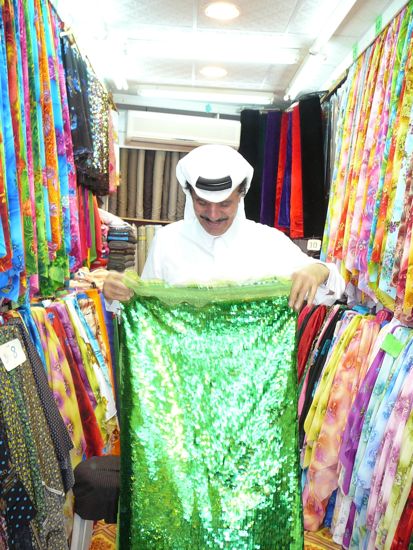
Doha is full of wonderful fabrics for dress-up.
Where Al Rayyan Used to Begin
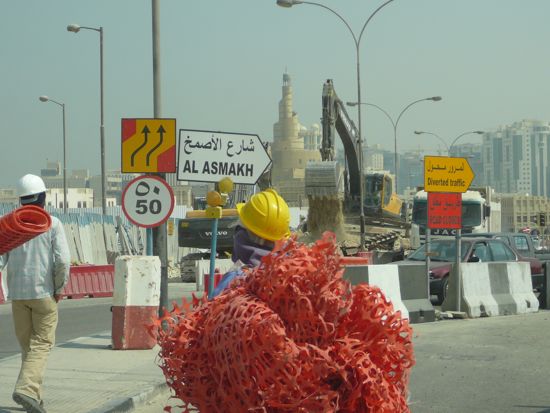
Leaving the Suq al Waqif, we got a shock – where you could once go straight ahead onto Al Rayyan, you can’t!

There is a left turn, a shaky bridge, and then you can go right to access Al Rayyan. It all appears temporary, and when the fix is accomplished, it will probably be a better intersection.
But this is Doha. When you think you know the route, suddenly, and often without notice, your traffic pattern makes a sudden change. The temporary diversion may last for weeks, or months, or . . .
I’m a map person, I remember once discovering that the road I intended to take, the road on the map, wasn’t there yet! In Doha, a map is only an overview, it is not reality based, the roads you see may or may not be open. In the end, I am sure there is going to be a smooth traffic pattern, but oh, in the meantime!
This is a relatively small change, with a relatively easy fix.
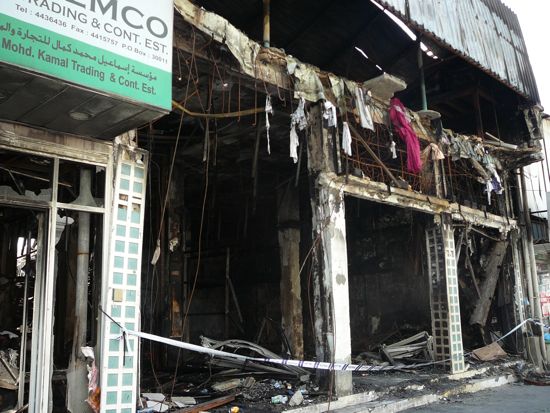
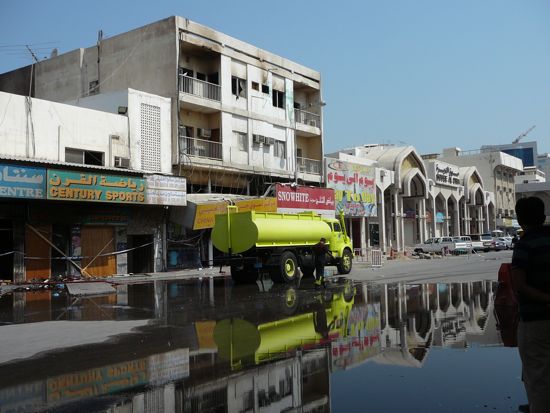
Souk Fire Damage
The fires in the souks between Souk al Dira’a and Souk al Asseiri caused a serious drop in customer traffic to an area already hard hit by the current economic situation world-wide. While Qatar claims to be relatively untouched, there are small signs that non-Qatteris living in Qatar are touched, indeed – expats losing jobs, expats going home, and expats not spending a lot of money because they do not feel secure about tomorrow.
We only had to drive around the long block three times before we found a parking spot. Pretty amazing, huh?
I wanted to see how badly the Dar al Thaqafa had been hurt. There was a fire truck nearby, and the fireman said that there had been a smoldering spot. It smelled like a campfire.
Here are some shots of how the area looks today:


Recent Comments
intlxpatr on Shampoo Ginger tigerbutterya0c5ff1d… on Shampoo Ginger intlxpatr on British Soldier Kidnapped, Esc… John on British Soldier Kidnapped, Esc… intlxpatr on British Soldier Kidnapped, Esc… Wikipedia Donate Button

Amazina


Early Voting in Florida


