Saudi Women Only Hotel
From today’s BBC News:
Saudis open hotel for women only
The Middle East’s first women-only hotel has opened in Saudi Arabia.
It will cater primarily to businesswomen, who work completely covered from head to toe in public and have to observe strict segregation.
The hotel, in Riyadh, has 25 rooms and boasts fine dining and conference facilities, as well as a range of health and beauty treatments.
Its executive director said the response to the idea of a hotel just for women had been overwhelming.
The Luthan Hotel & Spa is owned by a group of 20 Saudi princesses and businesswomen.
It hopes to attract expatriates from the nearby diplomatic quarter as well as local women.
It is the first spa hotel in the kingdom available to women all the time – pools in other hotels are only open to women on certain fixed days or hours.
You can read more about the hotel HERE
Taking Issues to the Paper
Here is where this story started: Corruption at the Morgue.
You have to wonder what is going on here? Both parties are now taking their cases to the press. It’s interesting. It should be easy enough to determine whether the morgue conditions are modern or not, whether the morgue has the equipment it needs to determine blood alcohol content, drug levels, blood infections (you would want your medics and coronors to know if they are exposed to TB, HIV, Hepatitus, etc.) but all this is aside from the accusation that autopsy results and cause of death are being manipulated to prevent successful prosecution of some who commit crimes, and to implicate some who do not.
The female coroner’s accusation of sexual harassment may not even be an issue – does Kuwait have a law against sexual harassment? I would think the courts would be overwhelmed if there were such laws in place! If there is no law against sexual harassment, can you call it assault, and prosecute?
Morgue chief hits back
Published Date: March 17, 2008
By Ahmad Al-Khaled, Staff Writer
KUWAIT: The director of Kuwait’s morgue refuted accusations by a female coroner of departmental wrongdoing and false reports during a press conference yesterday. Department director Eid Bousalib labeled the female coroner Dr Nawal Bousheri a “problem employee.” The director argued that his department is transparent, noting “We have a department of quality control which monitors all our procedures.
He, instead concentrated his statements on attacking Bousheri. Reciting a litany of offenses including failing to show up for work and complaining about the lack of promotion, Bousalib painted Bousheri as a disgruntled employee simply lashing out via the media.
She stopped signing in and out of her log book and declined overtime hours and with that we sent a memo to the administrative department regarding those issues. At that time she was not assigned any cases. On two occasions, one for 46 days and another for 21 days where she never signed-in.” Bousalib pointed out, “This happened in 2007, long before she complained in the media.
He also noted that she applied for a promotion and was rejected and in response, “She placed another complaint with the Civil Service Commission that was investigated and declined…She was still unsatisfied and complained in the administrative courts in 2007 on the same issue (her promotion) and it was rejected,” he said.
Addressing Bousheri’s accusations, Bousalib said that male doctors examined male corpses and that women examined female corpses. “That is totally wrong, women examine women and men examine men – even the doctors have separate offices (male and female sections)-If you examine our overnight shift lists, we always have a male and female doctor on shift.” Bousheri alleged that male doctors would be present in the same examining rooms where female coroners examined female corpses. She said the result was in app
ropriate behavior regarding the corpses.
Bousheri also claimed that coroners falsified reports at the request of police. Bousalib rejected the claim. “It is impossible to doctor the records. An administrative person, no matter his rank, has no authority over technicians and what the technicians write on their reports is what they are responsible for in the courts,” he said.
Regarding accusations of poor sanitation, sterilization of equipment, and bad smells in the state morgue, Criminal Investigation Deputy Director Brigadier Dr. Fahad Al-Dousari said, “The ventilation system is modern. The morgue was authorized and approved by the British Royal College and Kuwait University and is up to international standards.” Notably the facility was denied the approval of the British Royal College prior to 2001 but after upgrades, subsequently received the approval.
The department, which includes a wide variety of sections such as a criminal laboratory, forensic medicine section, and a crime scene officers section, has been in operation for 50 years. In 2001 Kuwait launched the identification DNA laboratory which was the first such lab in the Middle East and Arabian Gulf region.
Earlier slanderous rumors regarding Bousheri’s mental state had been leaked to the press. Bousalib declined to comment on the rumors, noting “She is still an employee and a colleague and we do not interfere in her personal life.” Kuwait Times could not confirm the rumors. Dr. Bousheri is still employed at the department, but Bousalib would not confirm if she was still receiving cases.
Female coroner retaliates…
Published Date: March 18, 2008
KUWAIT: Female coroner Dr Nawal Boushiri has retaliated against accusations hurled at her by morgue director Brig Eid Bousalib in Sunday’s press conference. She pointed out that she was waiting for the minister of interior’s nod, especially since he was aware of all the misdeeds that took place at the criminal administration. She met him twice and he has given the director the go- ahead to defend himself, thus making him both the opponent and the judge. She asserted that she has documents to prove the viol
ations that took place in the autopsy room and other departments at the administration.
However, she said that she has reservations about making them public now, since the case is sub judice. She expressed astonishment at the fact that the director avoided the sexual harassment topic, emphasizing that the issue has deeply troubled her and undermined her position at the administration
She said that the head of the department is a dentist; universally, the post is reserved to a doctor specialized in general medicine and surgery. A dentist’s knowledge is limited to the teeth.
My complaint is still being considered by the court and I have a letter authorized by the Civil Service Commission stating that the minute the post becomes vacant, I have the right to take charge.
The director said that the autopsy room is a modern one and meets international standards. I want to say that the room is a hall, that has two tables for inspecting bodies, without any kind of partition. The ventilation system is poor. The equipments used are substandard. This administration department smells foul whenever a body is present in the autopsy room. Authorities should verify this matter.
She said that there have been cases where lab reports indicate that the blood and urine samples taken by the administration were not that at all. Further some reports state that the urine sample was substituted with some ‘liquid.’
Boushiri went on to say, “The director feels that it is not important to decide the dose of drug in the bloodstream. I say it is of extreme importance especially in cases decisions have to be made whether the dosage was part of treatment or not. It is usually the drug overdose that causes death.
Whatever has been said about my commitment to work is baseless. For all the years that I worked at the administration, I stopped signing the attendance register only after the director started sexually harassing me. I did not sign the register for several months before he ordered that my salary be stopped on 16th September 2007. I don’t know why he chose this date in particular.
5KD = LLLOOOLLLL
I have seen opinions, and heard people talking about how Kuwait has more important things to do than to penalize people who are using their mobile phones. They are outraged! Clean up the highways first, they say, give us better schools, enforce the laws already on the books (but leave our cell phones alone!)
I am sorry. I know I am going to get killed for this opinion, but have you ever followed someone driving while talking on a cell phone? Do you watch them wobble out of their lane, try to steer the car with their knee because they have the phone in one hand and they need to adjust the volume of the radio? In countries where mobile phone use has been monitored and statistics kept, they attribute a huge rise in inattentive driving to cell phone use. They have statistics. They can prove that cell phone use is linked to a rise in accidents.
Brave Qatar brought in a team of experts who interviewed seriously injured accident victims. Every single one of them was on a cell phone when involved in the accident.
My rant is this: a 5KD fine? In Kuwait, that is just laughable. A 5 KD fine (about $20 with the dollar diving into the cellar) is not a deterrent. I want to see a sliding scale: start at 50KD for the first incidence, double it for the second, double it again for the third, etc. Make it hurt.
There are too many drivers for the roads, even with the ongoing improvements. The drivers are ill experienced, and careless. Driving in Kuwait is lethal enough without the additional factor of cell phones. If you need to ask directions, pull over. It’s not that hard, you’re smart, you can figure it out.
Church Blocking the Way
I can’t help being a little cynical and a little sad. I have often wondered how long a very visible church could last in a very visible location. It always made me proud that Kuwait was so tolerant to allow Christian worship to take place side by side with Islam in Kuwait. So now the church is impeding progress, and has to go?
From the Arab Times:
Church, cafe blocking way
KUWAIT CITY, March 17: ‘Minister of Public Works and State Minister for Municipal Affairs Mussa Al-Sarraf is determined to remove all obstacles facing the First Ring Road expansion project,’ Al-Rai daily quoted Assistant Undersecretary for Road Engineering Affairs at the Ministry of Public Works Hussein Al-Mansour as saying. The Minister instructed officials to find solutions to the problems, especially for buildings which block the road’s expansion like the church near Jahra roundabout and a cafe, he added.
According to Al-Mansour, the ministry will not be able to complete the project due to these obstacles and ‘it is likely to cost the ministry a lot of money as the contractor will ask for compensation for the delay.’ He said the ministry is waiting for a temporary location for the church and is trying to find alternate arrangements for the cafŽ to hasten the execution of the project ‘which will help in easing the traffic problems in the country.’
Jazeera: Istanbul 9 KD
e-mail from Jazeera airlines – sale on now!
Istanbul from KD 9!
Considered the gateway of Europe, Istanbul quintessentially eastern city, with glittering mosques and decorative splendor. The city has a rich history to explore, with beautiful wooden Byzantine architecture, fascinating museums, and the most glorious mosques. Sample the delicious mezze and kebobs, stroll around the markets and bazaars, enjoy a cup of apple tea and absorb the lively atmosphere.
The jewel of Turkey now has a special place in our website. Check out jazeeraairways.com/istanbul, and explore the most amazing photos, get hold of the latest accommodation, restaurants, currency, and weather information. Fly to Istanbul…even without leaving your house.
Flight schedule:
Kuwait – Istanbul Istanbul – Kuwait
Thursdays DEP: 07:55 / ARR: 11.30 DEP: 12.15 / ARR 15.45
Saturdays DEP: 18.15 / ARR: 21:50 DEP: 22.35 / ARR: 02.05
Mondays DEP: 18.15 / ARR: 21:50 DEP: 22.35 / ARR: 02.05
MacDonalds MacKrisby
This is for my stateside readers. Wherever you go, except for Syria, there seems to be a MacDonalds. The funny thing is, in different countries, they have different specialties, things you never see in the USA. For example, while we lived in Qatar, they had a special called the MacArabia, which was kind of like a local fast food, but on a more Western bun. It was no where near as tasty as the local equivalent, but I think they add things to the menu to appeal to people forced to eat there when the kids insist. I am only guessing; I can’t even remember the last time I had anything from MacDonalds.
In Kuwait, they have added a new sandwich, the MacKrispy, a breaded fried chicken thing, sort of like a great big dry chicken nugget. Because Arabic does not have a “p”, the literal translation of the word (you can see it down by the little golden arches) is MacKrisby.

Silvery Sunrise 18 Mar 08
The day is all silvers and greys, greys lit from within by the sun, shimmering greys:

It is 66°F / 19°C at 0800.
Roasted Tomatoes
A friend brought me a huge bag of tomatoes, and also a serving of the same tomatoes roasted up – oh WOW. Roasting these already tasty tomatoes concentrates their flavor.
I serve them as a side dish. I add them to salads, and to salad dressings. I serve them as a salad with a little Balsamic vinegar. I add them to the spaghetti sauce. I make them into a roasted tomato soup, with basil (be sure to use real cream; it’s OK, it just makes the taste richer and more satisfying. If you are satisfied, you won’t eat more and the cream won’t make you fat. I promise.) They are like magic, anything they touch tastes wonderful.
Chop cherry tomatoes in half, bigger tomatoes into quarters. Place in a long flat pan (with sides; these get juicy at first) and spray with a really good olive oil and sprinke with sea salt.
Roast at 180°C / 350°F for 40 minutes, longer if you want less juice.
You will find it hard to resist eating them right out of the pan.
Meat and Fish at the Sultan Center
It doesn’t take long before you live in a country long enough that you don’t see with the same eyes as when you came. Last week, as I was shopping, I was looking for something to fix for dinner. Normally, I just see something and grab and go, but my attention was caught by how expensive everything was, and then again, by the fact that American ground beef was twice as expensive as New Zealand ground beef, and both were really really expensive – it’s ground beef!
I’ve been careful about meat ever since I read Deadly Feasts about ten years ago. The book is a medical mystery, it traces the identification of Mad Cow Disease, and how vulnerable we all are. The human variant takes ten years to develop – all because tainted meat enters our food supply, because meat producers are too greedy to pass up a cow who is stumbling and falling down.

Even those who keep it out of the human food chain often process fallen cows for animal food.
And none of that has anything to do, really, with this post. The point is, for once, instead of rushing by, I was paying attention. When you pay attention, you start to see things (again) (or for the first time.) Here, you see things routinely that you don’t see in the United States:
Lamb’s brains:
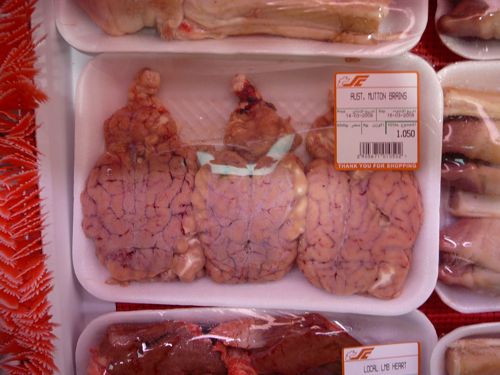
Lamb’s heart:

Sheep’s feet:

Fresh Quail:

Kuwaiti Shoom:

Saudi Shrimp (these look big, but Kuwaiti shrimp, in season, are even bigger, and the sweetest shrimp you have ever tasted):

Iranian Squid:

Nuabi (a fish caught locally)
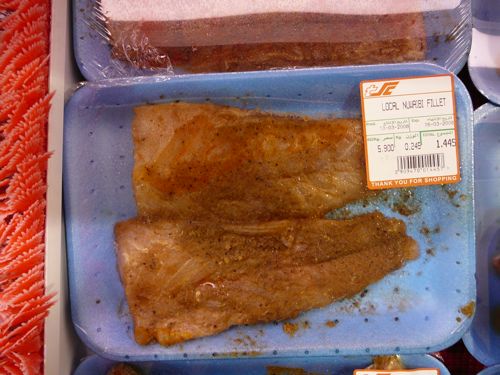
I love Kuwaiti seafood, and this is the one I love the best of all, Kuwaiti Zubaidi:
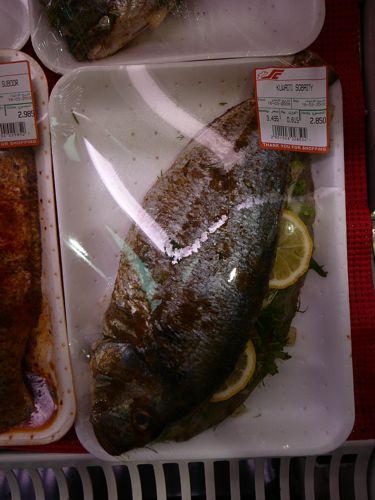
For those of you in the US, you can multiply the prices by four for an approximate idea of how much the food costs in dollars. The dollar is slipping here, as everywhere else, prices are going up, and we are taking the double whammy.
The seafood is out of this world. Even though expensive, local caught seafood is about what we would pay for seafood in the US. Vegetables IN SEASON can be reasonable. When I want iceburg lettuce, I pay about $3/ head. I have wonderful friends who are sharing their bumper crops of vegetables this year, and oh! they are SO good, so tasty! One of my friends has tried some heirloom tomatoes, and they are doing well!
Pet Import and Export Service
Many people write asking about how we got the Qatteri cat into Kuwait, and I have to tell them that the woman who helped us is no longer here. Recently a friend passed along a card to me – there is a new woman providing the import/export help, and for those of you with people coming to work with your companies who have pets, this woman helps get the paperwork for either bringing a pet into the country or getting your pet out. She knows the bureaucracy and she knows how to get the job done.
She is also well connected with all services involved with animals; as well as import/export, she can arrange grooming and boarding, and will meet you at the airport with the papers necessary for bringing your animal into Kuwait – assuming you have arranged this with her in advance.
Here is her e-mail address – please share it with your HR departments for their resources:
petpassage@yahoo.com
Recent Comments
intlxpatr on Shampoo Ginger tigerbutterya0c5ff1d… on Shampoo Ginger intlxpatr on British Soldier Kidnapped, Esc… John on British Soldier Kidnapped, Esc… intlxpatr on British Soldier Kidnapped, Esc… Wikipedia Donate Button

Amazina


Early Voting in Florida


