Exercise to Counter Mild Depression
Today in BBC Health News something we all knew intuitively, but studies are showing it to be true – if you are depressed, exercise can help deal with the symptoms.

Exercise aids depression, say GPs
Doctors are increasingly prescribing exercise for people with depression, mental health campaigners have found. In a survey of 200 English GPs, the Mental Health Foundation found 22% suggest exercise to help people with milder forms of the condition.
This compares with just 5% in a similar survey three years ago.
The foundation said it was important that doctors did not just prescribe antidepressants for patients, and looked for other options.
Tackling isolation
Research has shown that exercise can help people with mild forms of depression by improving self-esteem – through better body image or achieving goals, and by relieving feelings of isolation which can fuel their depression.
It also releases feel-good brain chemicals such as endorphins.
You can read the entire article HERE>
When the Wicked Prosper
I learn so much listening to my Kuwaiti friends. The other night, over dinner, a good friend explained to me about how Islam teaches you that if someone slaps you, you are supposed to turn the other cheek. That is exactly what Jesus told us to do, and I had NO idea it was also in the Qur’an.
So here is my question for today: What does the Qur’an have to say about people who appear to prosper, even though they are bad, through and through.
In my culture, many times I have heard people ask how people who do such evil can also appear to be so blessed? The question crosses all the boundaries of church alliance, religion, morality. Isn’t good supposed to be rewarded? Why do the wicked appear to have abundance, and to be kept safe, while bad things happen to good people?
Psalm 37 has all the answers. My favorite is line 13 – The Lord laughs at the wicked; he knows their day is coming. I think I’ll write it out and put it on my dashboard, and instead of cursing when some yahoo cuts me off with only a millimeter to spare, I will repeat that verse.
Today’s Psalm from the readings of The Lectionary is about that very subject.
Psalm 37
Of David.
1Do not fret because of the wicked;
do not be envious of wrongdoers,
2for they will soon fade like the grass,
and wither like the green herb.
3Trust in the Lord, and do good;
so you will live in the land, and enjoy security.
4Take delight in the Lord,
and he will give you the desires of your heart.
5Commit your way to the Lord;
trust in him, and he will act.
6He will make your vindication shine like the light,
and the justice of your cause like the noonday.
7Be still before the Lord, and wait patiently for him;
do not fret over those who prosper in their way,
over those who carry out evil devices.
8Refrain from anger, and forsake wrath.
Do not fret—it leads only to evil.
9For the wicked shall be cut off,
but those who wait for the Lord shall inherit the land.
10Yet a little while, and the wicked will be no more;
though you look diligently for their place, they will not be there.
11But the meek shall inherit the land,
and delight in abundant prosperity.
12The wicked plot against the righteous,
and gnash their teeth at them;
13but the Lord laughs at the wicked,
for he sees that their day is coming.
14The wicked draw the sword and bend their bows
to bring down the poor and needy,
to kill those who walk uprightly;
15their sword shall enter their own heart,
and their bows shall be broken.
16Better is a little that the righteous person has
than the abundance of many wicked.
17For the arms of the wicked shall be broken,
but the Lord upholds the righteous.
18The Lord knows the days of the blameless,
and their heritage will abide for ever
Qatteri Cat Enjoys Winter Sunlight

Nothing like a snooze in the winter sunlight for the Qatteri Cat. He keeps track of everything going on in the neighborhood until the sleep waves overcome him, and then he just kicks back a little. It’s a great life, being an indoor cat.
Sunrise 7 February 2008
It was a very very pink sunrise this morning, so glowing soft pink that the camera couldn’t even pick it up. When God gave us eyes, he gave us an amazing gift – the subtleties our eyes can capture.

Lent and Laughter
“So how’s that workin’ for you?” cackles AdventureMan, on a roll. He is totally cracking himself up.
“Hey, where’s your wife, AdventureMan?” he goes on, his high story-telling voice as he goes on making up stories. “Oh, I had to send her back to the Us of A for cursing in the car during Lent.”
He is not even listening. He is on a roll. Oh, he thinks he is so funny.
Today is the first day of Great Lent, our 40 day season of repentance and looking inward, fasting and spiritual examination. AdventureMan has asked what sacrifice I will make, and I had just said that last year, giving up swearing in the car, one word in particular, while I was driving had been a real struggle, but that I had actually managed, mostly. Not perfectly, but mostly.
“This year,” I told him, “I am going to practice turning the other cheek, I am going to try to be a peaceful spirit on the road, I am raising the bar.”
That’s when he started cracking up. There was no stopping him.
He had already told me he is giving up liver and brains and kidneys for Lent, all foods he stays far away from anyway. AdventureMan doesn’t take sacrificing for Lent very seriously. “I’m going to fast the way Little Diamond describes in her blog, you know, like the Maronites,” he giggles, barely able to talk, “only instead of fasting from midnight to noon, I will fast from ten at night until ten in the morning!”
He is laughing so hard he can hardly hear me.
“That’s not a sacrifice!” I argue! “You are sleeping most of that time, and you don’t eat breakfast anyway! That’s not a sacrifice!”
‘You worry about YOUR sacrifices and I will worry about mine!” he says, and I know he is right.
The truth is, AdventureMan sacrifices every day of his life. He works hard to provide a good life for his family. He sacrifices his time and energy every single day. He goes to church with me willingly, he prays with me every morning. It’s enough.
An Invitation to Bloggers
This is exactly the kind of event I love passing along to bloggers and blog readers in Kuwait. I hope to see you there! 🙂
Digital Prints of the Everyday Life
(Art Exhibition)
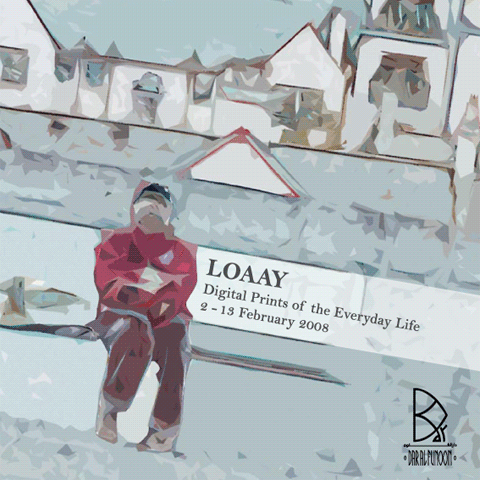
From 2-13 February
Dar Al Funoon Gallery
10 AM – 1 PM and 4-8 PM (Sun.-Thu.)
4-8 PM (Sat.) and 10 AM – 1 PM (Thu.)
Digital Prints of Everyday Life by LOAAY
The art work exhibited by the artist LOAAY shows eclectic artistic expression which makes the exhibition more enjoyable. Each piece has its unique visual identity, yet they all revolve around everyday life. ‘Love tree’ is inspired by nature; ‘It starts here´ comes from his urban environment and both ‘Lunchtime by the pier’ and ‘Cold Edinburgh’ that are works evolving from his frequent travels. The twenty eight piece artworks collection has been described as a visual feast.
The artist, LOAAY is a branding consultant who started to express himself artistically after surviving cancer. He is an internationally recognized artist who has exhibited in Connecticut, USA, in Algiers, Algeria, in Helsinki, Finland, and now at Dar Al Funoon in Kuwait.
Dar al Funoon is located at the Behehani Compound, House No. 28, Al Watiah (behind the Church). The exhibition hours are from 10 AM – 1 PM and 4-8 PM (Sun.-Thu.), 4-8 PM (Sat.) and 10 AM – 1 PM (Thu.). Call 243 3138 or visit http://www.LOAAY.com for more details. The artist can often be found at the exhibit during the evening hours.
Sunrise 6 February 2008
It is 36°F/2° C at 7 in the morning in Kuwait. It is warmer in Seattle, it is warmer in Germany than in Kuwait. Because most of the heat here only blows sand and allergens through the house, most of us don’t even bother turning it on anymore – Kuwait just isn’t very good at heating, but they are very good at air conditioning.
It reminds me of the wonderful Volvo I had for 13 years – it had wonderful seat warmers, and a great heater, but in Florida, it couldn’t air condition worth a hoot. It was built for cold countries, and was great in the winter. I haven’t had a Volvo for a while now, and I understand they have gotten a lot better.
If Kuwait continues to have weather this cold, I bet they get better at heating, too. Meanwhile, we all bundle up in sweaters and shawls for the early mornings and after sundowns. The middle of the day, by the way, is absolutely perfect. 🙂
Particularly beautiful sunrise this morning:

Struggling through the pollution layer:

Kinda scary when the sun is half blood-red:
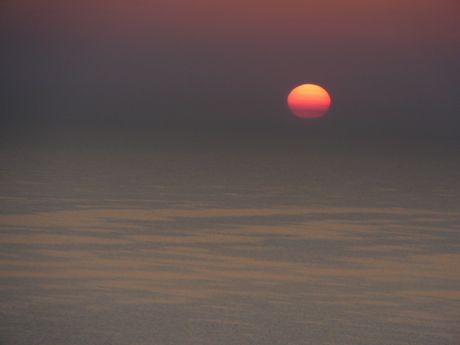
Love the serendipity of a little boat coming along just when I needed it 🙂
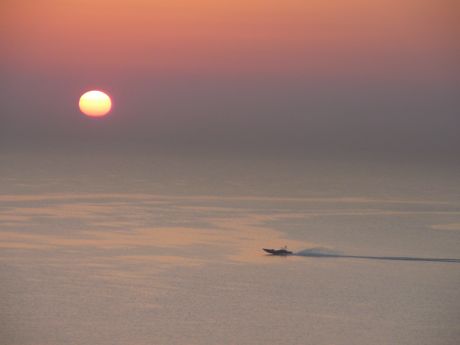
A new day is dawning!

“Because No One Wants to Know”
There is a chilling article on today’s BBC Health News on the silent epidemic of male suicide. Suicide, says the article, is outstripped as the leading cause of death among young men only by road deaths. I have often wondered how many road deaths are also a silent cry of despair?
The silent epidemic of male suicide
By Dan Bell
BBC News
Young men are taught not to talk about their problems
Whatever the individual reasons that drive people to suicide, the one thing that puts you most at risk is being a man under the age of 35.
Of the 13 people who killed themselves in South Wales over the past year, all but one were men aged under 27.
John Hogan, the father who threw himself off a hotel balcony in Greece, was aged 32. When his two brothers Stephen and Paul killed themselves, they were aged 17 and 35.
Suicide is the second most common way for a man between the ages of 15 and 34 to die. It is outstripped, only just, by road deaths.
Suicide ‘epidemic’
About 900 young men take their own lives each year, and they account for about 75% of all suicides in this age group.
“You’ve had what is effectively an epidemic of young male suicide,” says the National Director for Mental Health in England, Professor Louis Appleby. Between 1970 and 1998, the rate more than doubled. At its peak, five men were dying for every woman.
‘It was worse than we knew’
Yet according to Prof Appleby, less than 20% of young men who commit suicide have had any contact with either their GP or mental health services in the previous year. Quite simply, he says, “they don’t seek help when they have problems.”
If suicide is the second most serious public health issue for young men, why don’t we know about it?
According to Jane Powell, coordinator of the Campaign Against Living Miserably (CALM), the only national organisation that specifically reaches out to young men at risk of suicide, it is because no-one wants to know.
You can read the rest of the article HERE
“Arab Education Falling Behind”
In a study recently released, the World Bank reports that education in the Arab World is falling behind. You can read the entire article HERE at BBC Middle East News:
The World Bank has said the quality of education in the Arab World is falling behind other regions and needs urgent reform if it is to tackle unemployment.
In a report, Bank officials said Arab states had to make improving education their top priority, because it went hand-in-hand with economic development.
The region had not seen the increasing literacy and school enrolment witnessed in Asia and Latin America, they said.
Djibouti, Yemen, Iraq and Morocco were ranked the worst educational reformers.
The bright spot? Here is one of the concluding paragraphs:
The report concluded that Jordan and Kuwait were the top educational reformers in the region, while Djibouti, Yemen, Iraq and Morocco ranked lowest in terms of access, efficiency and quality of education.
(An editorial Wooooo Hooooooo to Kuwait!)
Ring Roads to be Modified
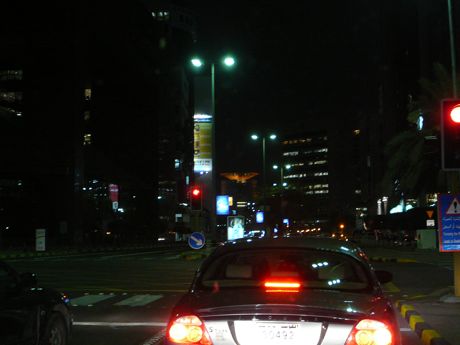
Here is another very small article in the Kuwait Times that is about to have a big impact on all our lives.
Roads to be Modified
The Ministry of Public Works, in cooperation with an international consultation office, recently signed a contract to develop and modify the Second Ring Road, the Third Ring Road, Cairo street and Damascus street. The contract includes the construction of bridges and tunnels on the road’s current intersections and building new intersections if necessary. The contract was signed by Minister of Public Works and MInister of Municipality Affairs Moussa As-Sarraf and has an estimated cost of KD 1.2 million and a duration of 18 months.
It’s going to be a mess, but if it has been well thought through, it should be SO worth it. Already, traffic along the Gulf Road at Bida’a (formerly Bida’a circle) has improved enormously – and I bet the accident rate there has already dropped, too.
Doesn’t that sum sound meager for so much anticipated improvement? Like KD 1.2 million is about the cost of building a serious villa in Kuwait these days, isn’t it? Bridges and tunnels are costly – and labor intensive. That just sounds like a bargain for all the work that is going to be done.
Recent Comments
intlxpatr on Shampoo Ginger tigerbutterya0c5ff1d… on Shampoo Ginger intlxpatr on British Soldier Kidnapped, Esc… John on British Soldier Kidnapped, Esc… intlxpatr on British Soldier Kidnapped, Esc… Wikipedia Donate Button

Amazina


Early Voting in Florida


