Olive Oil Scandal Comment
This is a response to my recent post on The Olive Oil Scandal. I am so delighted when I get a thoughtful and enlightening response like this that I want to give it a separate entry so that it won’t be overlooked by all you bloggers with little time and short attention spans. 😉
It certainly is disgusting. One might note that, though, that none of the above named diluters of olive oil come from Spain, by far the largest producer and exporter of the product.
Currently, in fact, the Andalucian regional government (Andalucía, in which I am an olive grower, produces over 30% of the world’s olive oil) is currently funding a project intended to identify through mass spectometry analysis the molecular ‘signature’ of all the different regional denominations of extra virgin olive oil, enabling bottlers to include this information on barcode-like labels on every bottle marketed and against which the contents could be tested. The systematic adoption of this system, when it is completed, would go along way to protect consumers from the present situation, brought on partly through the fraudulent business practices of various Italian and American producers and sellers.
Also, considering that IOOC olive oil standards have no legal force in the United States, effectively permitting virgin or lampante oil to be sold as EVOO (but not diluted with other oils), the seemingly imminent adoption of international nomenclature by the USDA would be a very positive move. It can’t come soon enough.
Charles Butler’s website, The Olive Oil Gazette, is an absolutely fascinating resource, with all kinds of listings for Olive Oil sites and all kinds of olive oil information, including an article on October 21 about the proposal for the DNA “fingerprinting” of olive oil. Here is what it says about author Charles Butler McKay:
The Olive Oil Gazette is published in Cazorla, Jaén, Spain by Charles Butler Mackay, whose Spanish birth certificate states, correctly, that he was born in Toronto, Canada. Aside from editing this news source, he owns and oversees an olive plantation that has been in his family for a century and a half.
Thank you for your input!
Meanwhile, I don’t want to be sceptical. For a very good price, I found the below olive oil at the Sultan Center, and the lable says all the right things:
Cholesterol Free
Less than 1% acidity
Cold Pressed
It even has an expiration date
And it says it is a product of Syria. Because I am sceptical, I bought it because I thought it had a pretty label:

Fish Market Public Art
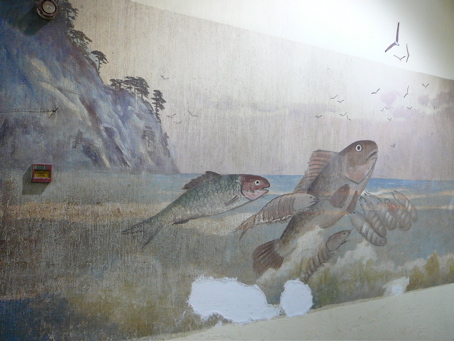
There are so many things I like about the Mubarakiya market. I believe it suffered enormous damage during the Iraqi invasion, and was substantially rebuilt. They did it nicely. The ceilings are high and spacious, and there are beautiful decorations in unlikely places. I found some Fish Market paintings I hadn’t photographed before.
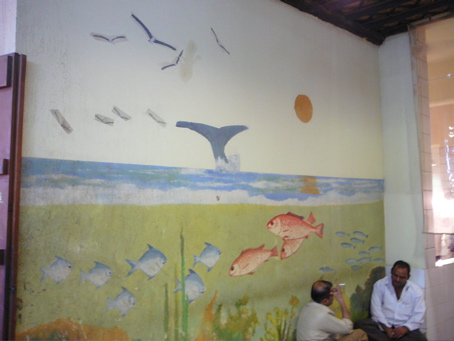
One thing is kind of funny – wouldn’t you think in Kuwait you would have dhows or showies, the Arab Gulf fishing boats? To me, this looks like the Oregon Coast, with the big boulders and rocky coastline! I am thinking those look like Pacific Coast fish, and isn’t that a whale with the seagulls? Are there whales in the Gulf?

I couldn’t take this one without the two guys taking a break, so I just included them – they ARE part of the Mubarikiya scenery:
Mubarakiya Evening
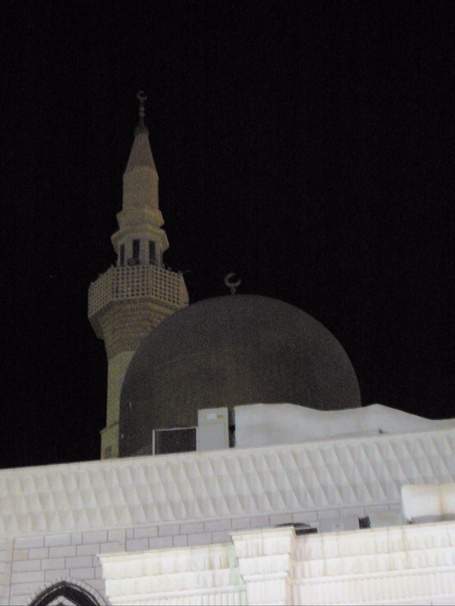
The weather has definitely cooled. We grab out friends and head for one of our very favorite places, the Mubarakiya market downtown, one of the few places still in existence with a flavor of old Kuwait.
We’ve visited in recent months, but the heat defeated us. Last night, our closest 4,000 friends were down there with us, shopping in the markets, having a bite to eat in the outdoor restaurant area (you can only tell which restaurants are which by the different colors of the chairs and tables) relaxing, visiting, just enjoying a beautiful mild weekend evening.
And it was beautful. We have eaten there in the heat, with cooling fans to keep things bearable, we have eaten there in the cold of winter, with little stoves on the table to keep the tea hot and to warm our hands (a little) but this night was utterly perfect. Warm enough, cool enough, and fresh, well prepared local food – it was a perfect evening.
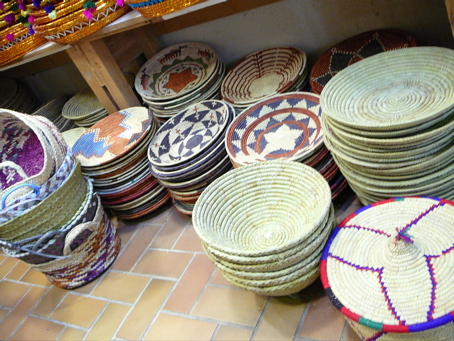
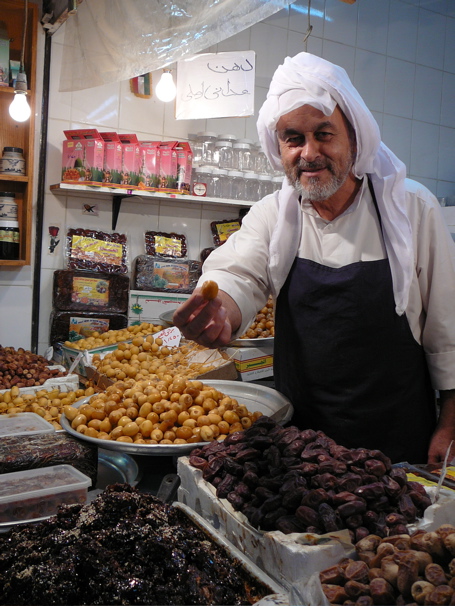
Some new Mubarakiya photos:

WoooooHooooooo CO-OP!
It’s hot. It’s humid. I drive to the co-op for a few small things and holy smokes! I see a spot to park, and it’s near the door! I start to park, and I see the handicapped sign, so I go around again, and find another spot about a million miles away. It’s ok, the walk is good for me.
But as I pass the handicapped spots, a car drives in and out pops a perfectly non-handicapped young woman and her two non-handicapped, fully capable daughters!
If looks could kill!
I don’t want to waste a lot of my time on resentment, so I move on.
This week, here is what I see at the co-op:

Wooooo Hoooooooo! Handicapped spots RESERVED for those who have special needs! Blocked off, so as not to tempt the rest of us! Wooooo HOOOOOOOOO, way to go, Co-op!
Accident Aftermath
This time the crunch was different. This time, the initial BLAM crunch was followed by a heart-sickening series of crunches. I was on the phone dialing 777 even before I got to the window.
They have lovely women working for emergency services now, women who can stay calm and switch languages easily. Just hearing her voice calms me down as I report the accident, tell them to send an ambulance. The upside down car door is flipping open, and people are running to help the victim out. It’s a woman, and she is beautiful. She is also bleeding, and once they get her out, she is very still, too still.
The traffic police call me back and I tell them where the accident is, but thank God the woman is still on the phone and when he doesn’t understand, she fills in efficiently and accurately.
It takes them 21 minutes to arrive. The traffic police send one car, and on a busy street, they all gather around the woman and stare. The MOI also send a car. Not one of these police set up any kind of traffic control, cars on both sides of the road are stopping, people come running, just to look.
The ambulances take 22 minutes. When they leave, there are no sirens. I don’t think she survived. The medics appeared knowledgeable and efficient.
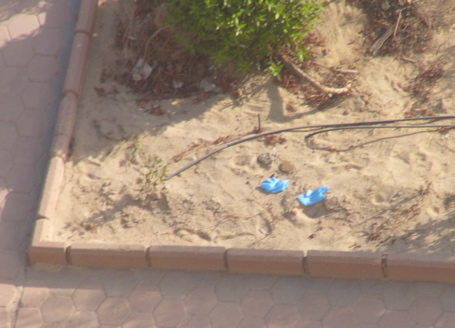
It’s the aftermath that bothers me now. On the ground, they left all the medical waste.

The last thing the medic did as he got into the ambulance was to throw his bloodied gloves on the ground:
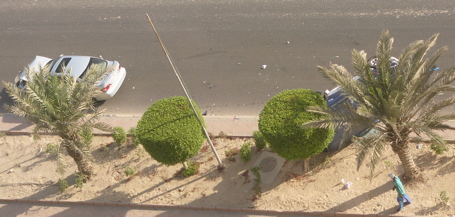
And then . . .the traffic cops left! There are two wrecks on one of the busiest thoroughfares in town, and no protection from the next speeding car! The wrecks are in the fast lane!
Don’t get me wrong. You know how I feel – police, ambulance medics, firemen – they are all heroes in my book. They risk their lives every day for the common good. The save lives, and they take pride in what they do.
They need a little training in accident management. When there is an accident, there needs to be a priority on getting there fast, and controlling the crowd, and routing traffic by efficiently. The medics need to pick up their waste.
There needs to be after-accident care, ensuring that someone stays until the wreckage is removed.
I had a house guest once who sat in my window and said “Oh my God. Oh my God! Oh! Oh! Oh!”
There are three separate u-turns we can see. Each one is another accident just waiting to happen. When the turn lanes back up, sometimes some people start honking, putting pressure on the lead person to make an unsafe turn. Please – resist the pressure. Take your time. Wait for a safe, truly safe interval.
Please, my friends, do one thing for me. Please, buckle your seat belts. And please, buckle up your children, put them in car-seats made to protect them, teach them from an early age to buckle-up, help it become so automatic they don’t even think about it.
Fintas Observatory
You know me, I’m a newspaper addict. Maybe even a news addict. I read many of the articles to the very end; I read some of the filler articles. Life is a mystery to me, in some of the exotic countries I live in (No, not exotic to YOU, but exotic to a little Alaska girl who finds herself in the fairy-tale lands of Arabia!).
So here is the real question. Every now and then, I find a reference to the Fintas Observatory.
I’ve looked on maps – no Observatory.
I’ve GoogleEarthed Fintas – some parts are still pretty vague, but I see nothing that looks like an Observatory.
The Kuwait sky is often murky with haze – the clear nights we are currently having are a fabulous rarity – but maybe they were more common in the past?
Do you know where the Fintas Observatory is? Do they allow visitors, or is it invitational only?
“Can You Help Me Get to Bangladesh?”
I have a dilemma. I don’t know how to handle it.
I carry small bills with me, because I am often asked for money. I keep it so I always have money to give to the people who help me get groceries to my car, the people who deliver propane, people who give good service – I don’t mind. Part of the blessing of having work is the obligation to pass that blessing along to others. We know that God Almighty knows where there is real need, and he moves us to give where giving is needed; he gives us a little shove in our hearts.
Yesterday, a well dressed man with a steady job told me he wants to go home to Bangladesh to see his parents. Could I help him?
I understand about aging parents. I’ve made a few trips myself. I totally understand what it is like to be far away when crises strike. We have always had funds set aside for emergency trips, and, by the grace of God, we haven’t had to dip into those funds often.
“How can I help you?” I asked.
“I need money,” he responded.
Money for a ticket to Bangladesh – that’s not small change. Along with that thought is the thought that were I to “help” this man, word would get around, and I would have many people knocking on my door for serious help with funds.
I don’t think he wants the kind of help I could easily give – showing how to set up an account and contribute to it faithfully, letting the money accumulate until you reach your goal. I don’t think he wants to do what my parents did with me, and what we did with our son – matching funds. (You save up half and we will match your savings dollar for dollar.) He wants an outright big gift.
In our church, we sing a song that says “Freely, freely, you have received, Freely, freely give.” I’ve always believed that with all my heart, it is like a magnified spiritual Locard Exchange Principal especially for blessings; what you have received you give, and it comes back to you doubled, tripled, magnified.
We tend to give larger charitable donations to organizations that make the money work hard – Medicins Sans Frontiers, African schools, our church fund. I consider a ticket to Bangladesh a relatively large charitable donation, large especially for one individual, one individual who is well employed.
So I ask for your prayers for clear guidance. I am not feeling that shove in my heart.
Community
Jeremiah is one of the great prophets of our Old Testament. The Wikipedia article on Jeremiah tells me that his name in Arabic is Eremiya. The problem with being a prophet is that not everyone wants to hear what God tells you to say. Jeremiah spent time in jail for telling people what they didn’t want to hear.
God told Jeremiah, “You will go to them; but for their part, they will not listen to you”.
Today’s reading in the Lectionary has this verse from Jeremiah. My blogging friend Kaos asked me why I care about Kuwait when I am only an expat, passing through. When I saw this verse in the reading for today, as the Jews are being sent into exile in Babylonia, I knew for myself the answer:
From Jeremiah 29 7But seek the welfare of the city where I have sent you into exile, and pray to the Lord on its behalf, for in its welfare you will find your welfare.
Wherever we find ourselves – it’s up to us to make the best of our lives. There are reasons for every expat to care about Kuwait and what happens to Kuwait. Kuwait belongs to the Kuwaitis, and 67% of the population is “expat” or “visitor” or “laboror”(whatever lable you choose.) As long as we live and work side by side, we are a community, diverse and conglomerate, but all wanting to live in peace as best we can. Kuwait belongs to Kuwaitis, and the lives we lead as individuals make up a community that belongs to us all.
Tareq Rajab Museum of Islamic Calligraphy
One of the most beautiful buildings in Kuwait is the new – open only since March – Museum of Islamic Calligraphy in Kuwait. I am in total awe of this family, who have an eye for the history and culture of this area, collect it lovingly, and then display it – free of cost – to all who wish to visit.
The TR Museum of Islamic Calligraphy is on the same street as the Dar al Cid, where many art exhibits are held, also under the auspices of the Tareq Rajab family. It is around the corner from the Tareq Rejab Museum.
It is open every day:
Mornings 9 am – 12 noon
Afternoon 4 pm – 7 pm
Friday 9am – 12 noon
We visited recently. The museum is beautiful, and well organized. We wished only that more of the exhibits had explanations; sometimes we would be looking at something very beautiful, but we didn’t know the significance of what we were seeing.
The calligraphy is manifest in hangings, ancient Qurans, quiltings, posters and carved wood. Each item is a work of art. We were fascinated by some of the Chinese calligraphy, and by the video they run showing how calligraphic quills are made, how the paper is prepared, even how the calligrapher prepares for work.
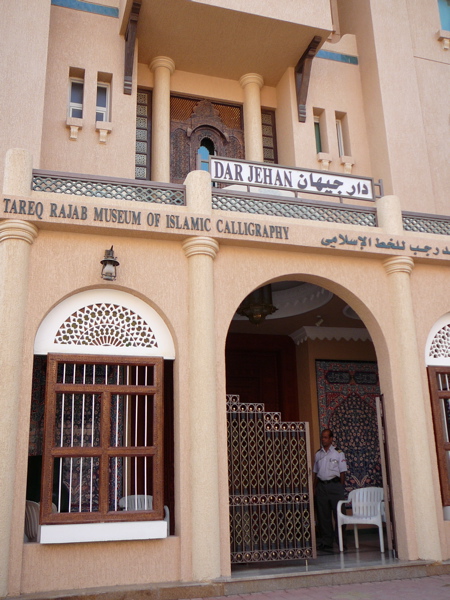
This is the entry to the Museum of Islamic Calligraphy:
Some examples of the beautiful works on display:

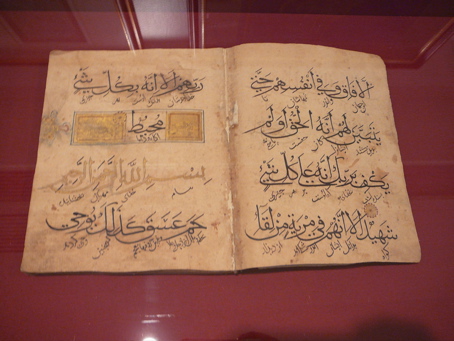

If you are looking for books about Kuwait, and/or Islamic Arts, the Tareq Rajab Museum has a well stocked little shop with books, cards, postcards, etc. for reasonable prices.
We take all our houseguests to these museums, and every time we go, we are moved by the generous hearts that create these museums and then offer them to the public – free of charge. They give so much to their community. It’s like a little piece of heaven. Visit soon!
Visitors, Not Residents?
From yesterday’s Arab Times:
The General Immigration Department of the Ministry of Interior is studying a proposal to replace the term ‘resident’ — the status given to expatriates working in Kuwait, reports Al-Watan daily. The daily added this has been done to ‘fight’ attempts by international organizations asking Kuwait to grant citizenship to expatriates who have been working in the country for a long time. Meanwhile, a reliable source said ‘visitor’ will replace the term ‘resident’. The source also said the General Immigration Department has stopped receiving applications for self sponsorship after noticing an increasing number in applications over the past few months. According to knowledgeable sources the Assistant Undersecretary for Citizenship Affairs Major-General Sheikh Ahmad Al-Nawaf has issued instructions to take into account the demographic structure of the country while issuing work permits because Kuwaitis account for only 33 percent of the population compared to 67 percent expatriates.
Calling all us guest-workers “visitors” is just a dumb idea. Call us guest-workers, call us workers, but if you call us “visitors” then you run into problems with folks who are just coming in for a VISIT, i.e. visitors.
I have always preferred being a resident. When I come into Qatar or Kuwait and all the lines are long except the GCC lines, I can always take a chance that the guards will think I am married to one of you when I step into the GCC line. If the person at the desk says I am in the wrong line, I can always look confused and say “I am a resident!” It has worked – well, most of the time. 😉
This issue is hand-in-hand with the school issue. Times are changing, old traditions are not being observed, and the blame is falling on foreign influences. It’s kind of like that train has left the station – if you want to go back to old ways, you’ll have to get rid of automobiles, computers, mobiles, supermarkets, and most of all, that demon of all forces of modernization – television.
The Taliban managed to reinstate old traditions, and in doing so, to take Afghanistan right back to the stone age. It was not just the women who suffered – men who didn’t want to wear beards, men whose hair was too long, men who wanted to listen to music, men who wanted to discuss politics – all were punished, some were killed.
The real challenge here is how Kuwait, as a modern nations state with a lot of money, is going to move with the modern world, not against it.
Recent Comments
Kitchen on Isiais: Winding Down intlxpatr on Shampoo Ginger tigerbutterya0c5ff1d… on Shampoo Ginger intlxpatr on British Soldier Kidnapped, Esc… John on British Soldier Kidnapped, Esc… Wikipedia Donate Button

Amazina


Early Voting in Florida


