Dinner at Cafe de Paris

Sounds mighty fancy, doesn’t it? The truth is the Cafe de Paris is a lively restaurant just across the street from our hotel. It is full – a mix of tourists and locals stopping by after work. I am running on fumes; we’ve hit 17,000 steps, and I am tired. I am almost too tired to eat, but if we don’t eat, we’ll be awake and starving in the middle of the night, so we step into the Cafe de Paris, and the very kind waitperson seats us immediately in a little alcove, a lovely, comfortable, private table for two right by a wall with a window that seems to have disappeared. We are inside, but we have a great breeze and a view of the Arch.

I order a duck confit, just because I can, because I am in France and not in Pensacola, and duck is on the menu. We were so tired, we can’t even remember what my husband had. We think we remember he had a charcuterie board. First, we had wine, a rich red complicated Bordeaux that might also be why we can’t remember. We know whatever we had was just great.
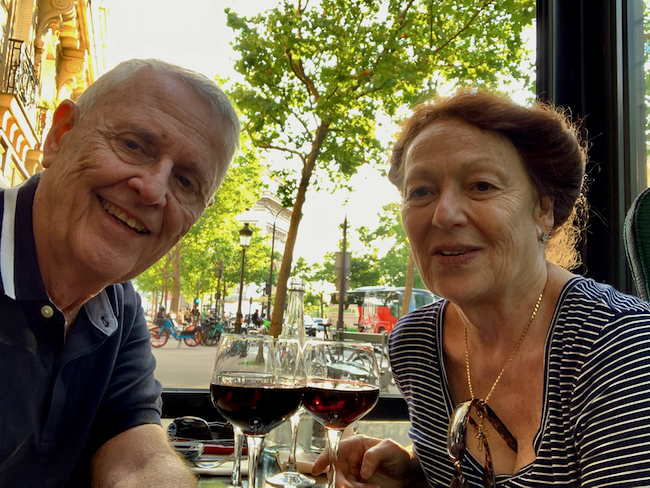
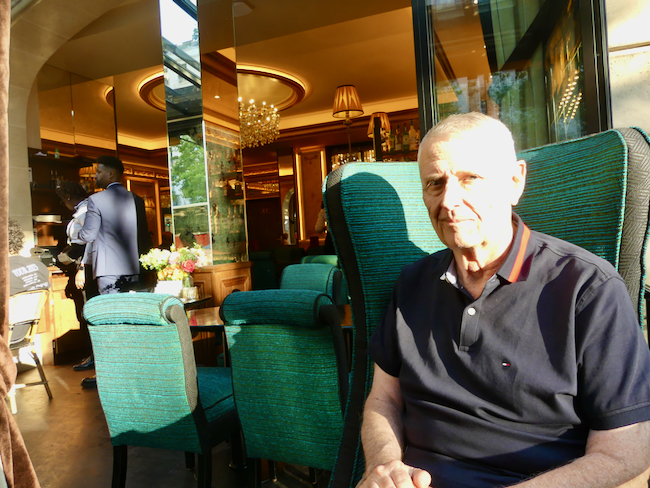
We were happily surprised by the bill at the end of the meal. It was all very reasonable, especially drinking a good wine. Happy, appetite satisfied, and exhausted, we staggered across the street to the Napoleon and had a great night’s sleep.
Evening in Paris
We are so excited. No, it is not our first trip to Paris, but we are so excited to be back and so excited that our family will be joining us in 12 short hours. Meanwhile, just steps from our hotel:
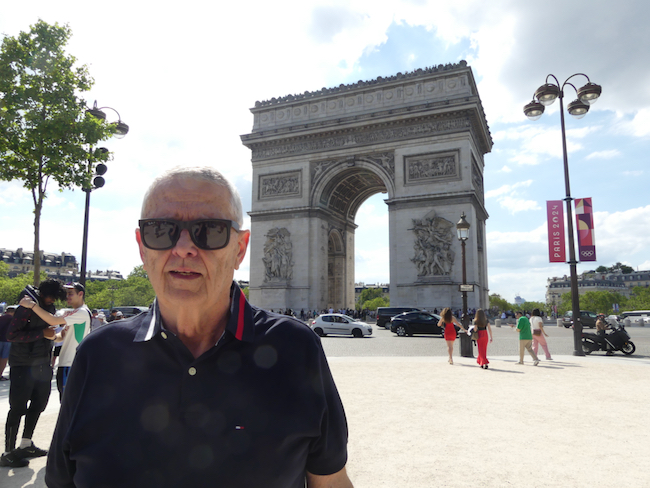
We are exhilarated, and we are also operating on fumes, so we decide to walk down Av. Marceau to the Seine and take it from there.

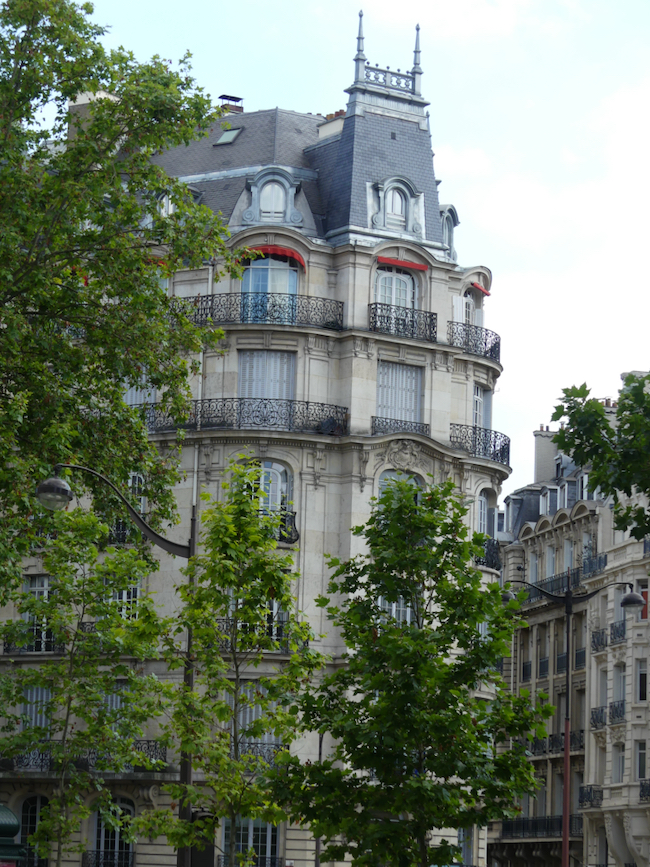
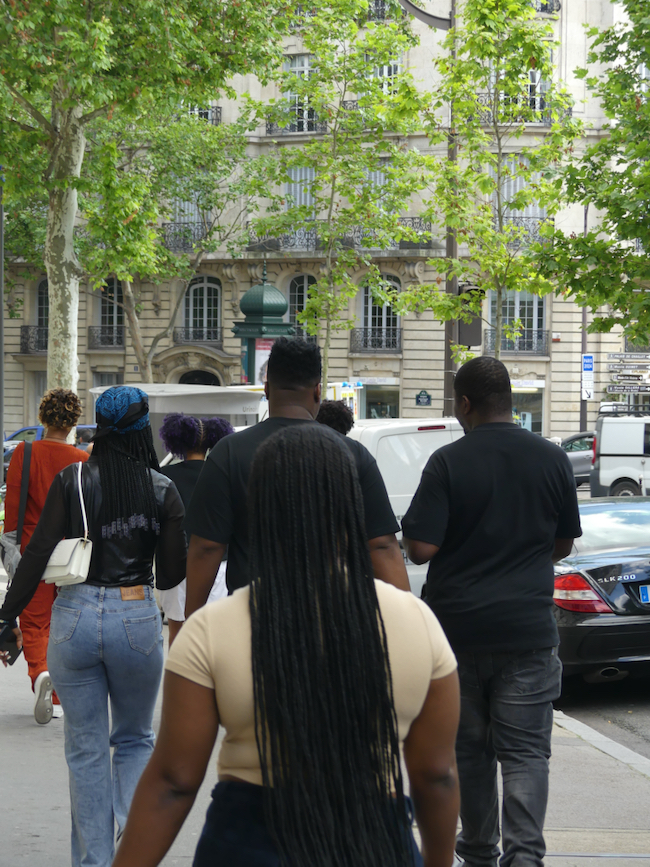
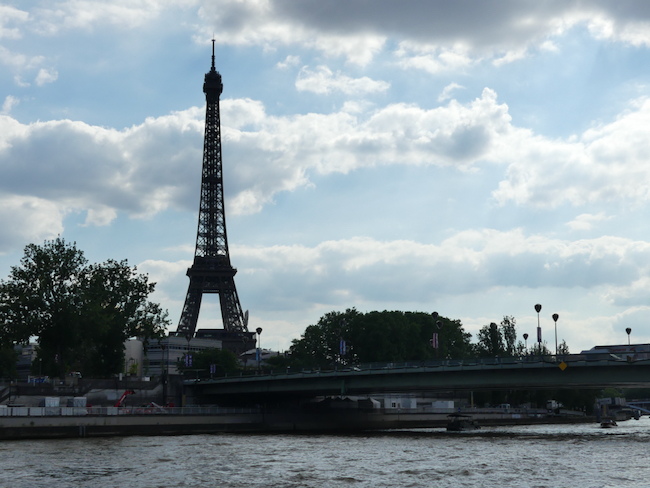
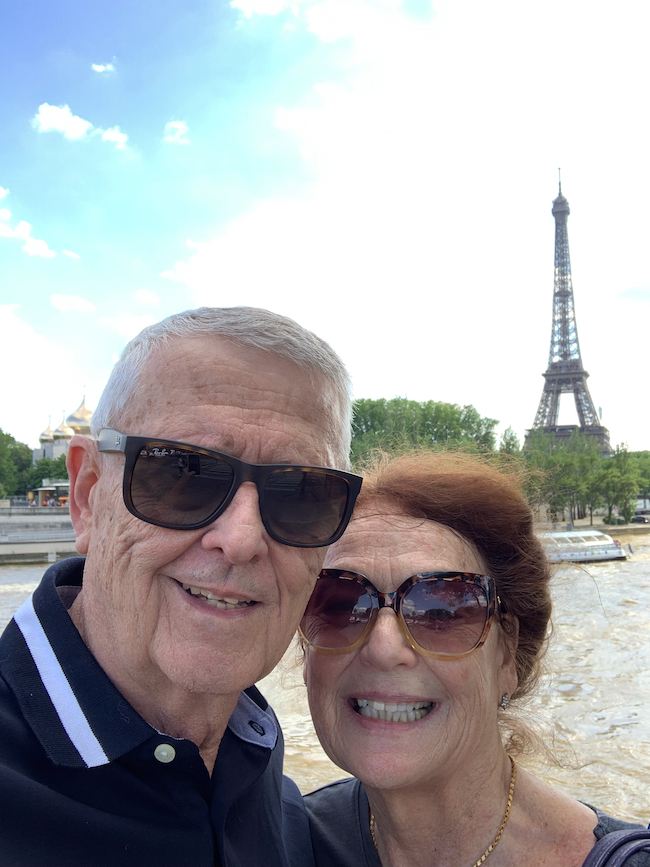
Just to the left of the Pont d’Alma as we come down Av Marceau are the Bateaux Mouches, and one is loading up now. It is loading up busloads of people, so we buy our tickets and hang back, taking our chances that the next boat, so close to dinner time, will be less crowded.
It pays off. This is a great idea. It is shaded, there is a tree-lined park along the bank where the boats are loading, and a nice cool breeze, so welcome on this hot, stuffy day.
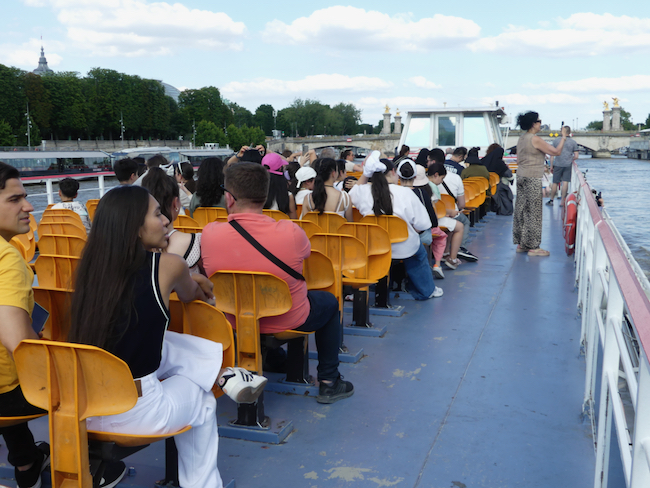
A line has formed, but as it turns out, the gate opens close to where we are standing and we get to choose. We choose the back of the boat, which turns out to be a good choice. Most head for the front, and there are plenty of seats for everyone. The boats are on a schedule, and another is coming in to offload, so ours has to take off without a full load. We are not complaining.
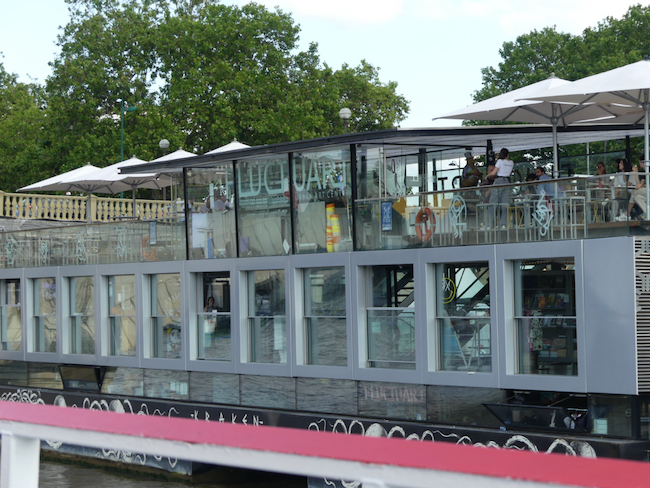
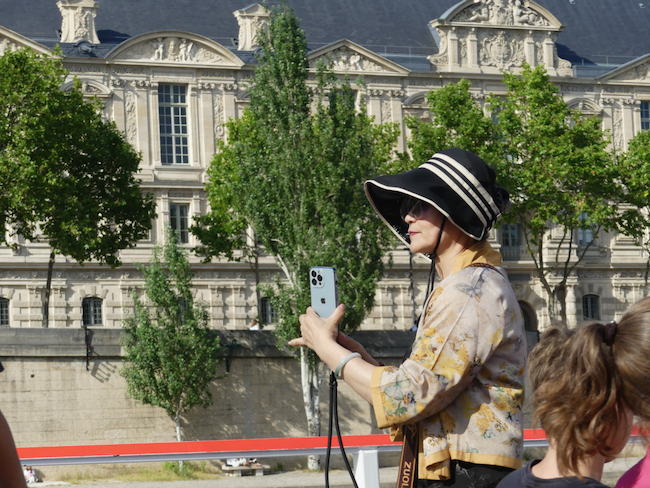
This is the perfect activity for an exhausted, jet-lagged couple with too much adrenaline to sleep. There is so much going on along the banks. We see all kinds of boats, restaurant boats, stands going up for the Olympic Games, (just weeks away,) bridges, and beautiful buildings.
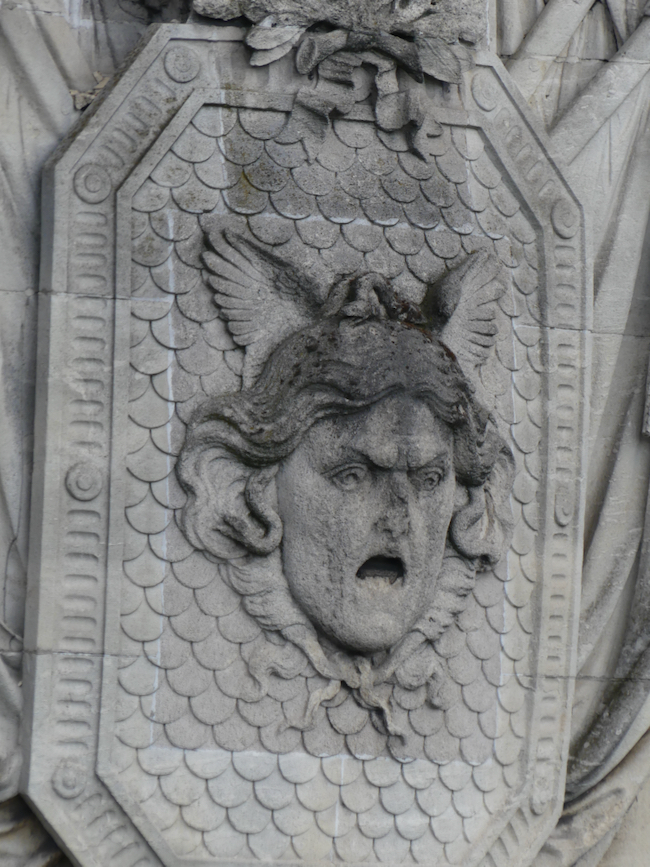


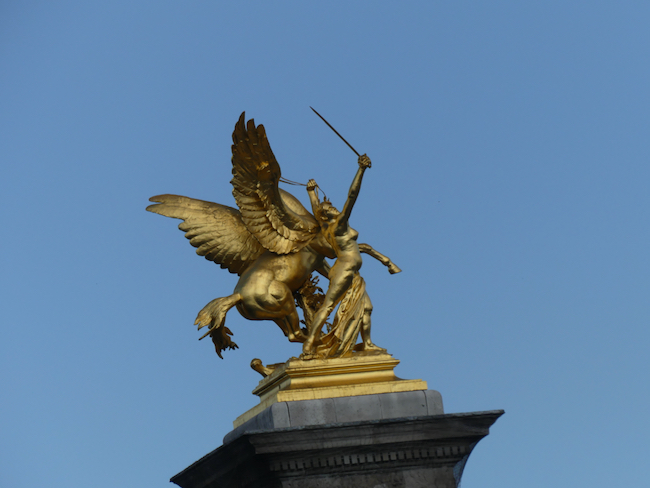


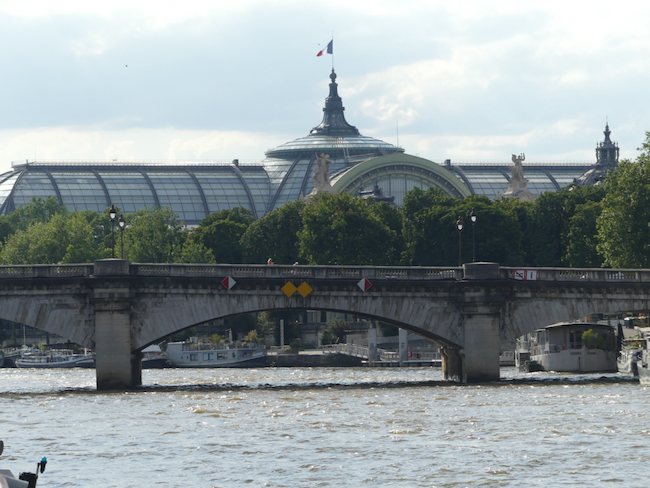
I am guessing this might be the bridge where the press will photograph the boats coming through with the Olympic teams. you can see the stands built on the bridge. We hear grumbles that the Parisians are not happy to be disrupted for the Games.


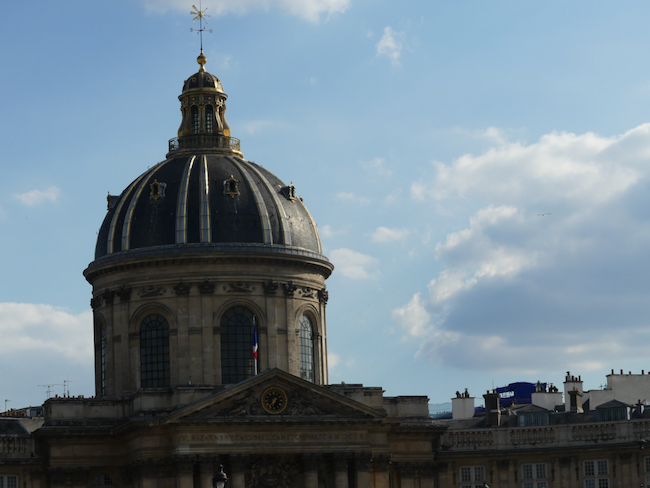
I think this is where the French equivalent of Congress meets. Glorious location.


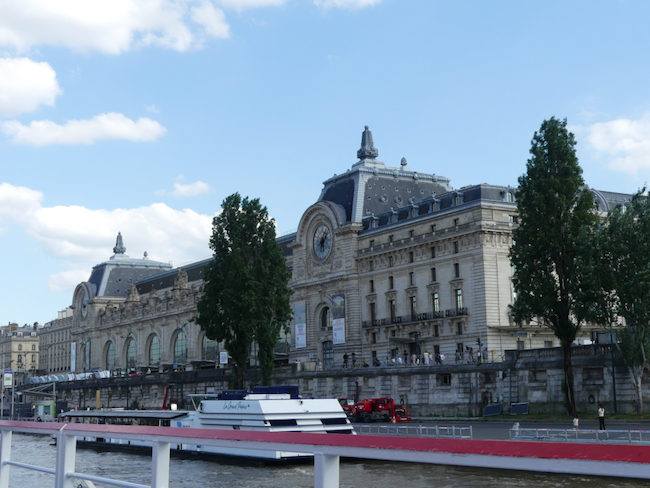
Musee D’Orsay




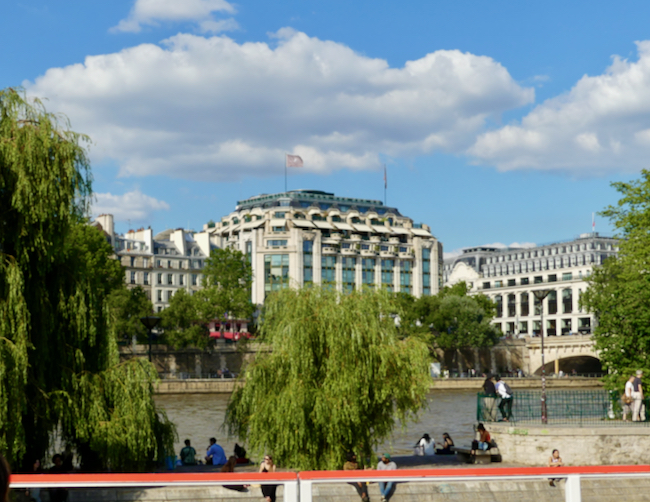
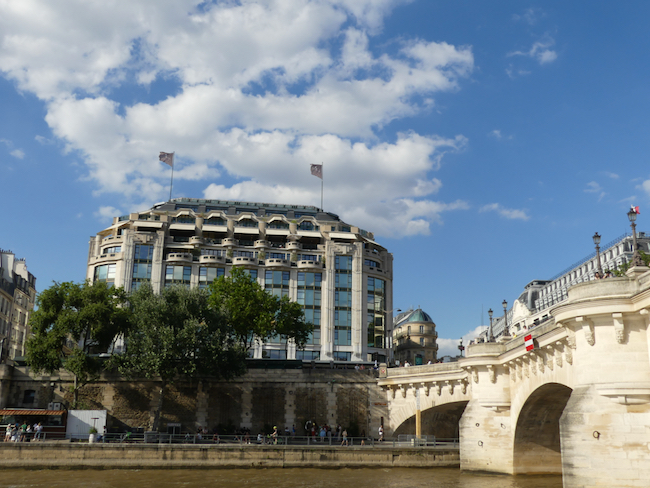
I may not be so good with monuments, but I’m pretty sure above is the Samaritaine Department store 😁.
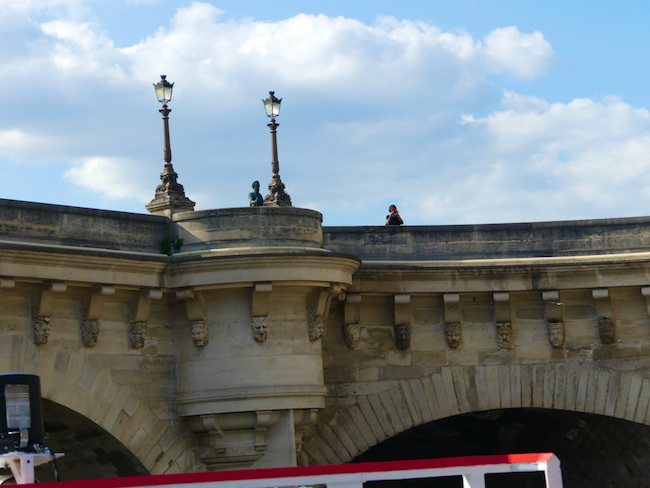
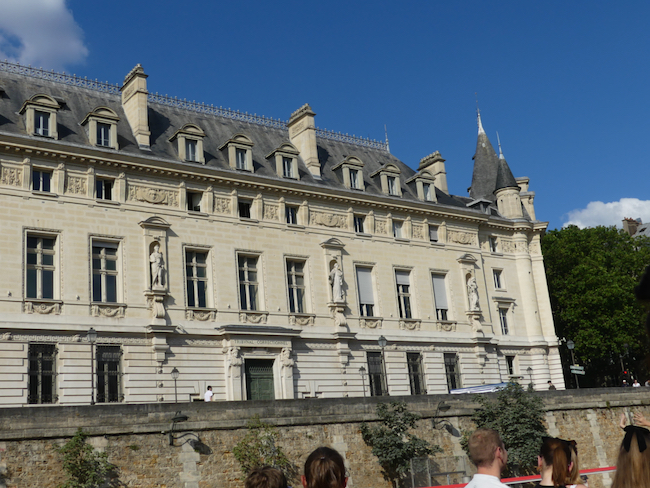


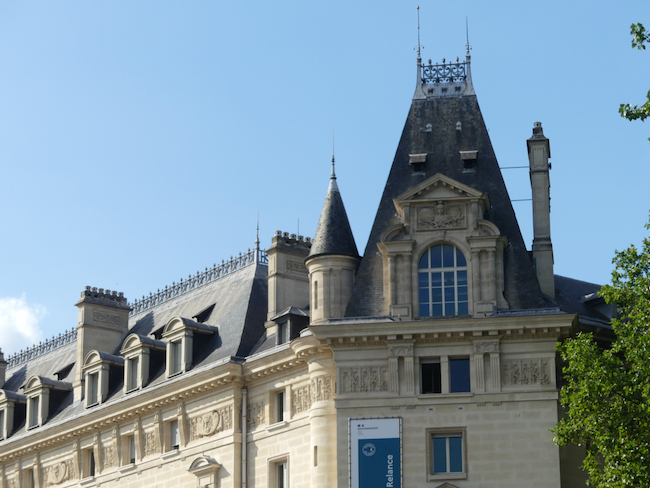

Notre Dame of Paris, still under reconstruction from the terrible fire.

It is a beautiful hot evening. These girls have the right idea!


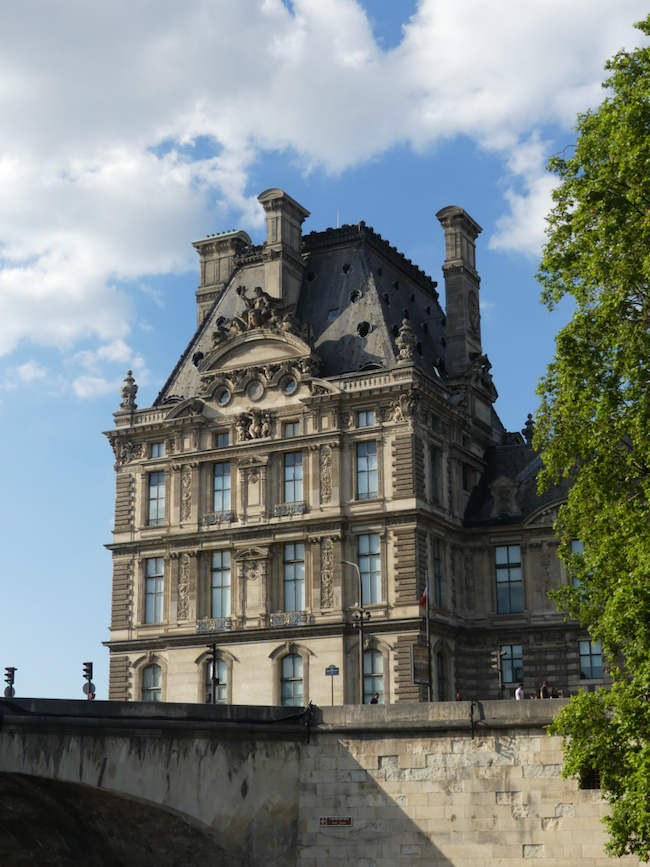
This building is on Isle de la Cite’; I think it might be the palace.


Our boat has turned around just past Isle St. Louis, and we have a good view of the Samaritaine. There is a restaurant on the top with great views.

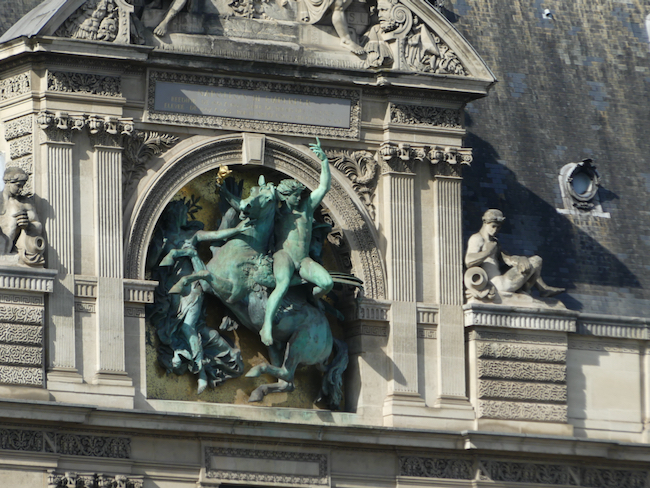
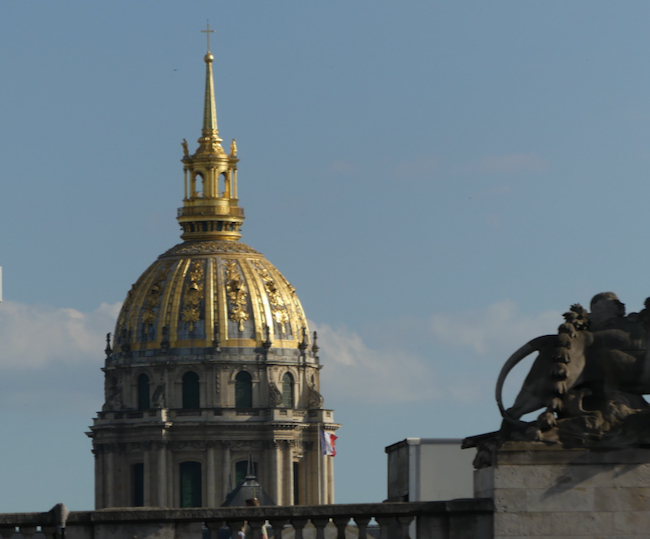
I have no idea what this statue represents, and I find it weirdly joyful. Weird because in reality, having horse’s hooves at one’s back would be painful, but the body language is joyful. Below is the dome of the Invalides, Napoleon’s Tomb and the Museum of the Army.


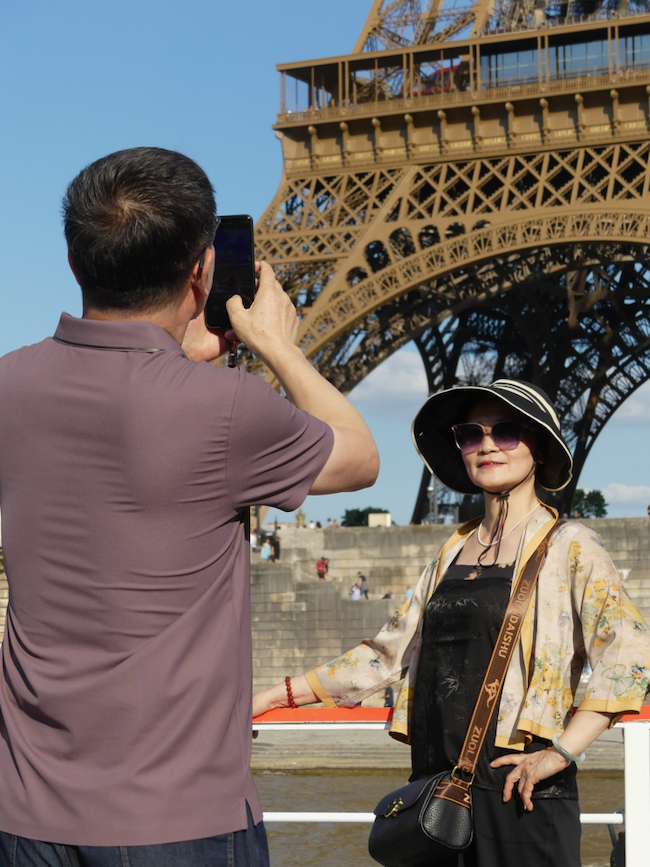
Everyone wants their photo taken with the tower.

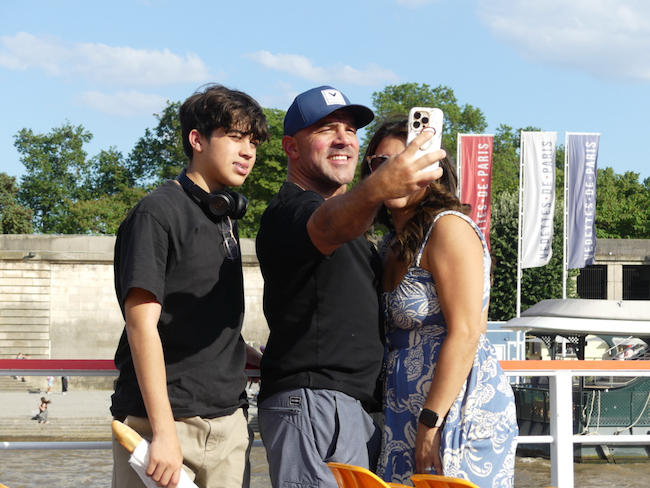
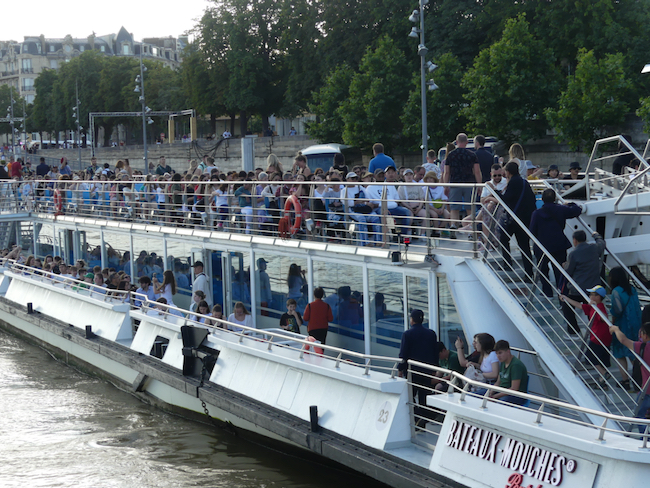
And as we land, the next boat is loading and ready to go.

“Mom, That is Very Bold”

He looked troubled. He knows living here is one of the reddest counties in one of the reddest states in the country, a sign like this could invite trouble.
“I’ve had the sign for weeks; I was afraid to put it out.” What I didn’t say is that this is Florida. People express themselves in ways I find unacceptable, like shooting at your house, or at the very least, stealing signs that express an opinion they don’t like. I didn’t have to say it. He deals with it every day.
You might think that sign means I am pro-abortion. I am not. I believe abortion is a last, desperate resort. And it is a remedy I want women to have – I want women to make decisions for their own bodies. Not men. Not a legislature. Not a governor.
It was a shock when we amassed enough signatures to get this initiative on the November ballot, not only enough, but way more than enough. The people of Florida want to vote on this and be a part of the decision-making. Right now in Florida, there is a six-week deadline on the pregnancy, during which a person might get an abortion – but that assumes the person realizes she is pregnant and can process and make a decision in that very short time.
Statistics show that since the states began limiting abortions, the number of abortions actually rose. Go figure?
No woman chooses abortion lightly. It is a medical procedure. It costs money. It takes time. It is uncomfortable. Women only choose abortion when the alternatives are unthinkable. Not having the right to choose doesn’t stop abortion, it only makes it a greater burden on women.
So I planted my sign and I hope for the best. I have found that in this very conservative neck of the woods, there are many like-minded people who of necessity keep their heads down. I want them to feel a ray of hope when they see my sign, and maybe, maybe along with voting for Proposition Four, they might even put a sign in their own yards, help others register to vote, or help transport voters to the polls in November.
Christmas Markets on the Elbe: Prague Day One
Bags outside the door by 0645, down to breakfast, back to the room to brush teeth, and get ready for the bus ride to Prague. It was a longer ride than I had anticipated, through snowy, icy roads and I regretted having both orange juice AND coffee with breakfast. I was eager to get off the bus in Prague quickly and find the nearest ladles’ room, and thanking God for getting me there in a timely fashion.
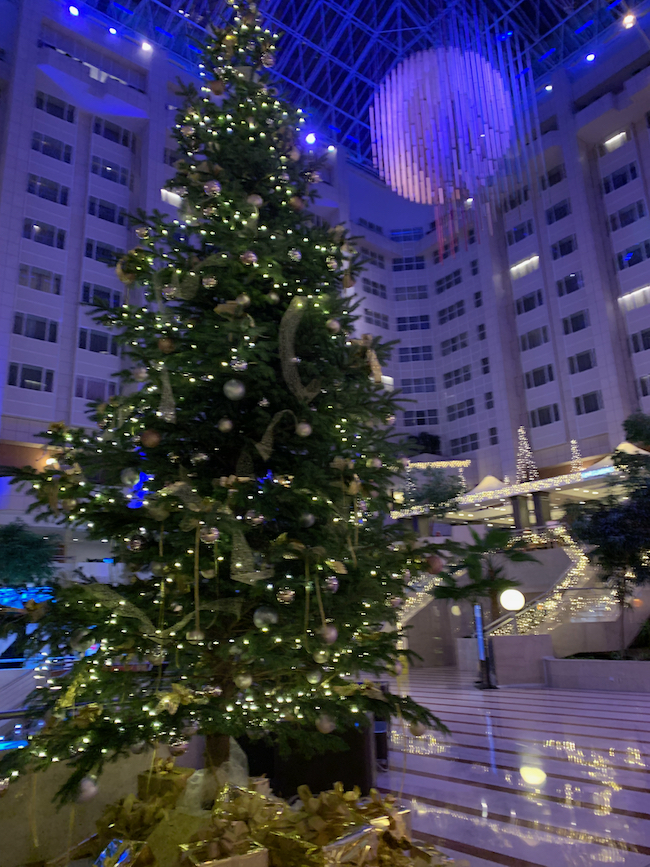
The Prague Hilton is huge. I am so thankful it is mid-winter, not even the peak of winter travel, and that it is not crowded. There is a large poker tournament going on. The Viking people have their own desk and helpers, we always know where to go with a question or a problem.

We set off immediately for our Prague tour, briefly on the bus which dropped us off near the Charles Bridge.


Our guide uses a Quiet Voice system, so we have ear-pieces on. We can hear her from about thirty feet or less, so while we are having our picture taken, we are also listening to her tell us stuff. Mostly to stick together as a group. There must be a hundred groups crossing the Charles Bridge.
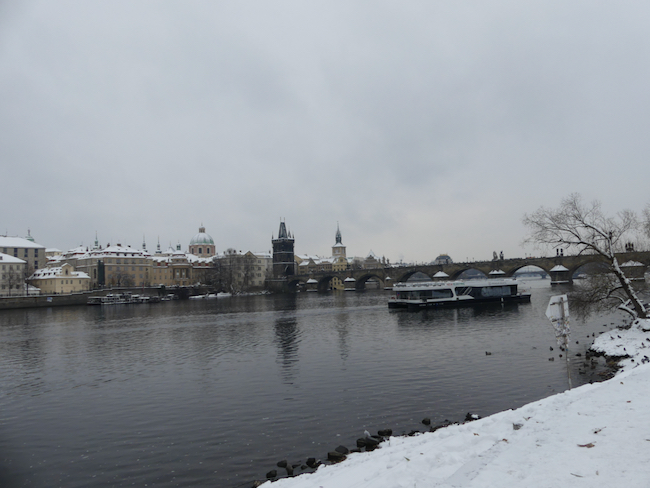


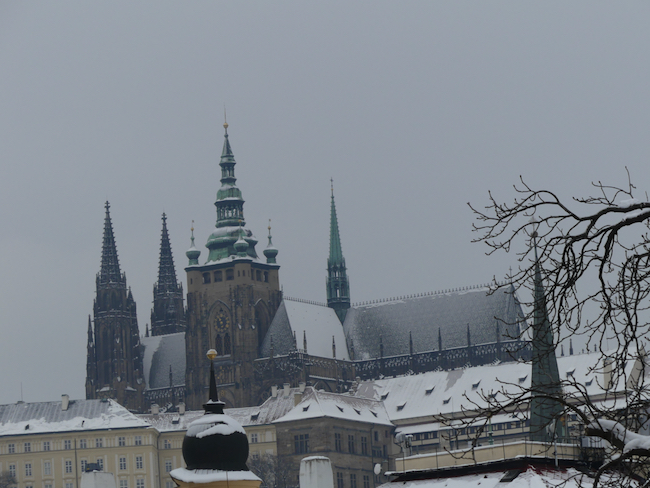
So many tourists! You can’t imagine! We have crossed this bridge before, other years, even on New Year’s Eve Day, with our son – never like this. Prague is discovered.


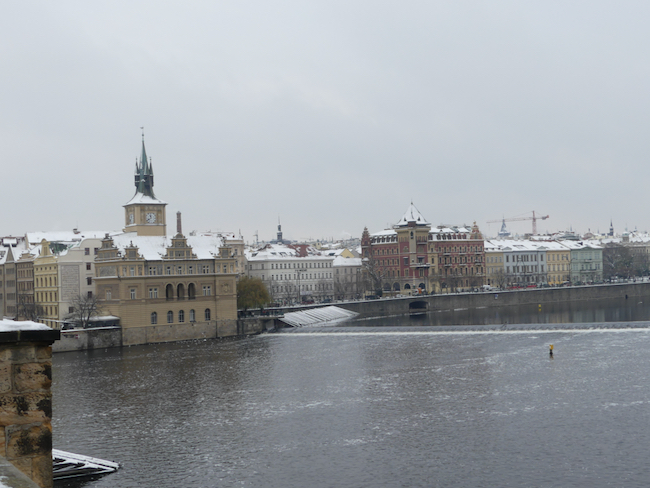


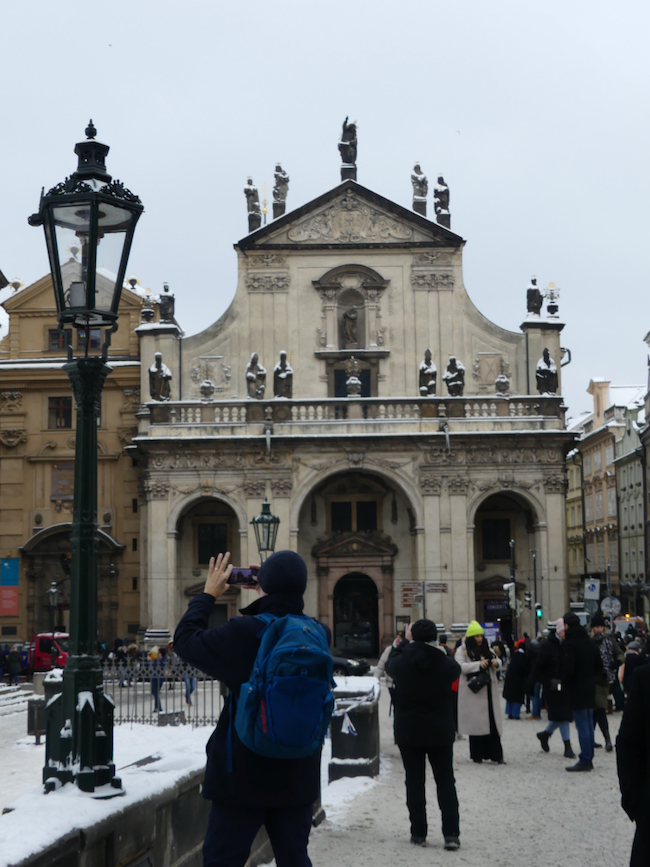


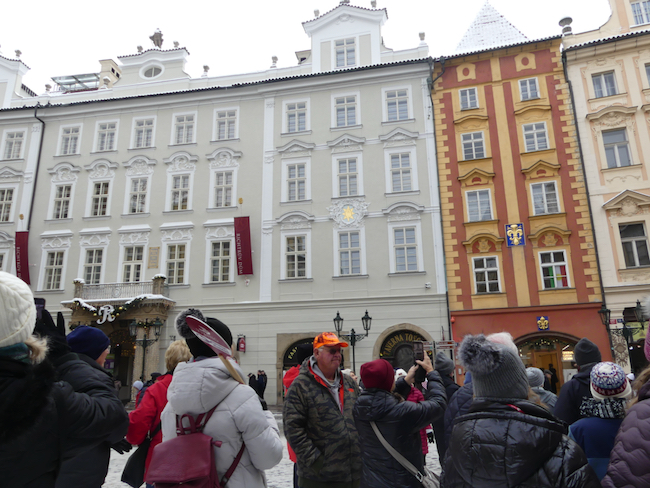
We walked, crossed a small portion of the bridge with lots of tourists, walked a little around Old Prague – not going inside, and then, just around when the Astrological clock would be striking, then the guide took us down in the basement of the Bethlehem church for some kind of exhibition – we were free to use the restrooms and warm up, but we had hardly been out long enough to get cold. As we left the church, we told the guide we would leave and make our way back to the hotel on our own.
We eat the Bulgarians lunch
Ah! Free at last! We love roaming, and we were hungry. We found a wonderful restaurant, Deer, just about full, but room for us.
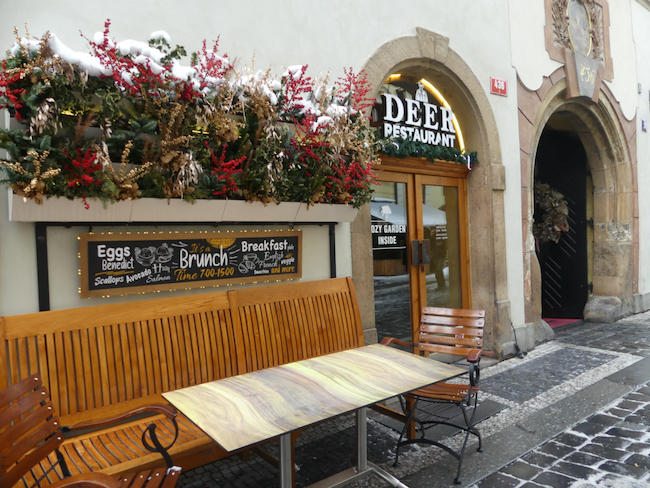


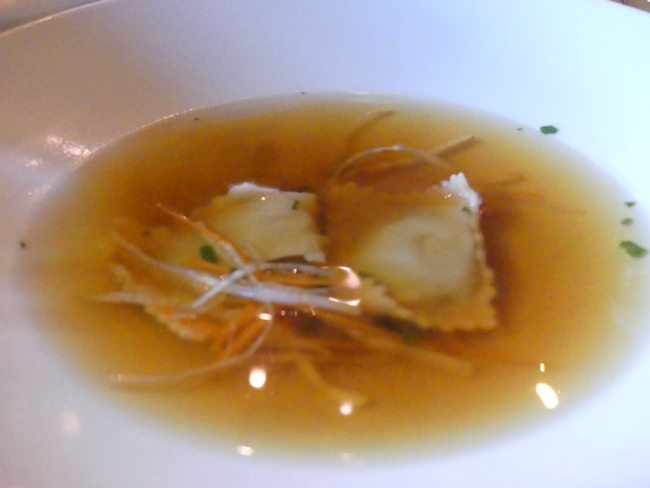
It was beautiful, and the beer was good, and we ordered deer, a consommé, and deer ravioli for me and a “fallow” deer for my husband. My consommé arrived, and it was light and delicious. Then our meals arrived, (sorry, we were hungry and forgot to take photos) and my husband’s was right and mine was not, but it looked great so I figured we might have been misunderstood and we ate our meals with delight.
As it came time to pay, the waitress brought our bill and AdventureMan looked it over – it was the original order, AdventureMan told her I had received, and eaten the more expensive meal, and would she adjust the bill so we would pay (more) for what we had eaten.
With some confusion, she went away, came back with the corrected bill – and told the people at the next table that there had been some confusion, and we had received their meal. We apologized profusely, and we were all laughing. They asked the waitress to please hurry the same meal to them and we had a great conversation, as we waited, them asking us if it had been a good meal and us assuring them it had been delicious. So much goodwill. They didn’t hate us for eating their lunch!
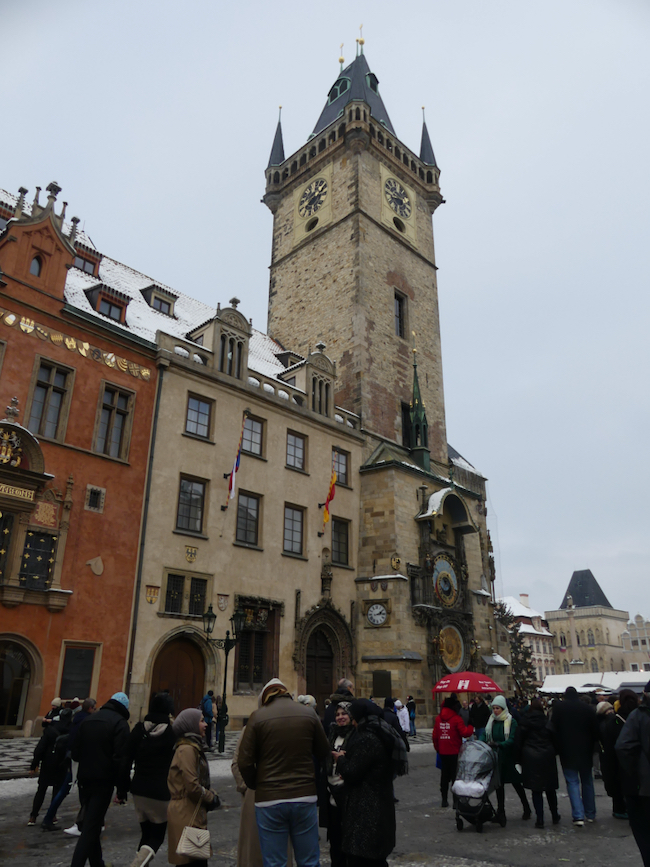
We found the main market, at the Clock Tower, and wandered around.
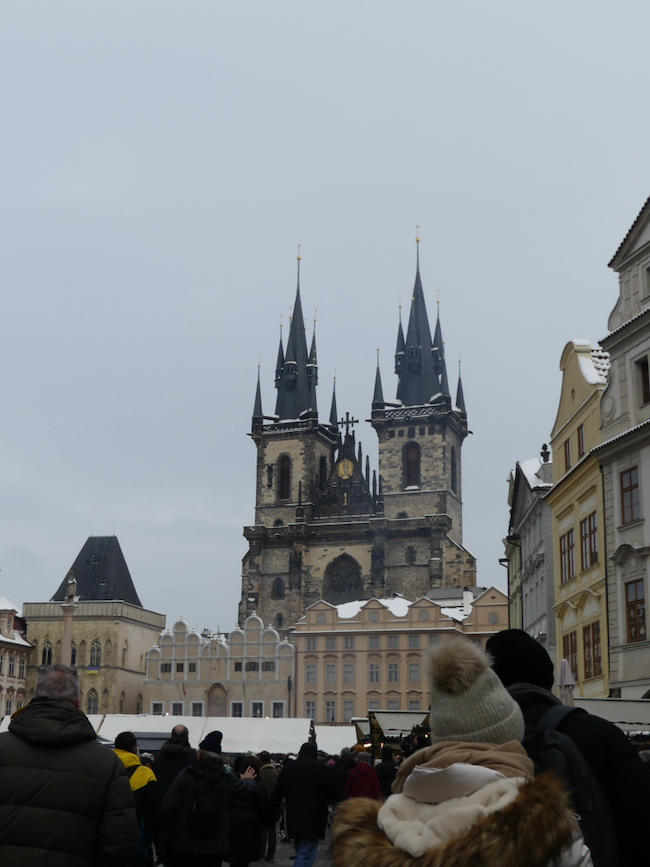


I checked Google and there was a bus from right at the market directly to our hotel, Bus 194, and we caught it. How cool is that? Equally cool is that in Prague, public transportation is free if you are 70 or older (some say 65). You MUST have ID with you to prove your age, but you ride FREE!
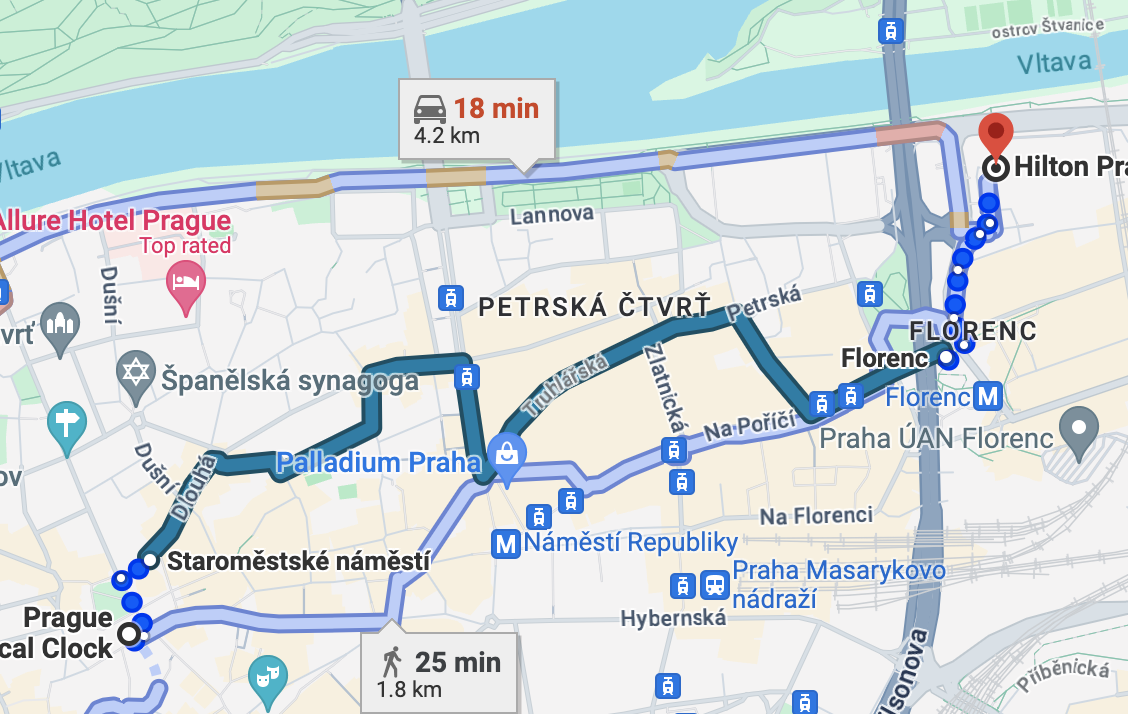
It took us through the narrow back streets of Prague, past interesting hotels and restaurants way off the beaten track. At one point the driver had to get out and move a garbage can in his way – the streets were VERY narrow. It was great fun and dropped us near the Prague Hilton.
We rested – we had already done 15,000 steps. We wanted to head to another Christmas Market. Confident we now understood the bus system, I asked Google Maps how to get to bus 135, but every bus that arrived with that number said (something in Czech) and DO NOT GET ON THIS BUS so we figured out they were going out of service. After waiting over an hour for one in service, we were really cold so we came back and ate a thoroughly mediocre expensive meal at the Hilton. Another day with over 17,000 steps – it has become routine on this trip 😁.
Christmas Markets on the Elbe: Berlin to Potsdam

We spent so many hours planning our time in Berlin, only to realize no matter how many hours we stayed up, we could never do it all. We looked at each other and laughed, knowing a great part of the fun of this trip had been the anticipation and the planning. We actually did the most important things to us in Berlin; we visited “The East” freely. We visited the repaired and restored Reichstag. We saw Checkpoint Charlie, only a relic now, signifying nothing to fear. You can breathe in an open society. Everyone can breathe.
Our bags had to be in the hall by 0630 to be transferred to the ship, which meant packing them the night before and having what you needed to get through the day to the 1600 boarding. None of us got it really right, but it was a lot of fun.
Breakfast was a rat race, with all the Viking passengers needing to be fed and ready for an 0820 departure. Most of us were on the bus, but others straggled, and one couple didn’t make it at all. They overslept, and I don’t know if they made it onto the second bus or were driven to the boat.
GLIENICKE BRIDGE
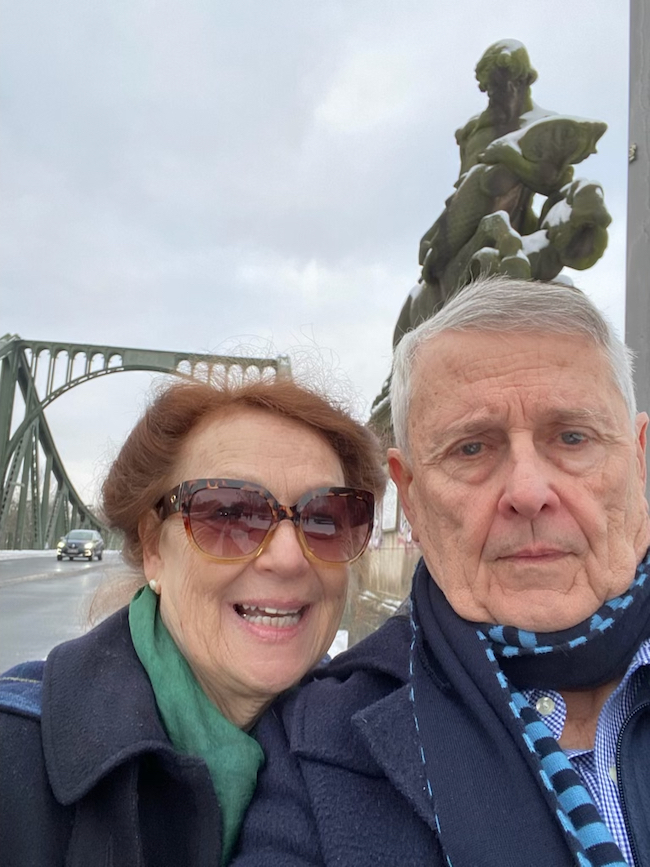
We had a lovely guide again, very good, very thorough, Lothar. We toured old neighborhoods in Berlin, on our way to the old corridor from the island of West Berlin towards the West, on our way to Sans Souci, the summer palace of King Fredrick II. Lothar shared with us being a young boy in Berlin, taking trips out to Italy in the summer, going through this corridor, and receiving terrible treatment at the hands of the East Germans. We had a wonderful surprise, a stop a the Glenicke Bridge, the old “Bridge of Spies” where Frances Gary Powers was exchanged for a Soviet Spy, each crossing the bridge to freedom. We got out of the bus and walked across.

Here is where I realized a big mistake. I was planning a walk through Sans Souci Palace, and rather than wear my wonderful but clunky walking shoes, I was wearing my tights – and sandals. It’s a palace, right? To get to the palace, we walked about half a kilometer on ice with a thin coating of snow. My feet were not cold, but my sandals were not good at gripping, and it was slippery. I made it, with feet just a little damp. No big deal, we also walked in the snow once we got to Sans Souci, and I was not the only one who had made a bad call on footwear. We all survived. From this day on, however, I wore my clunky walking shoes, which have miraculously sticky soles.

We had audio phones to guide us through the palace, and AdventureMan and I laughed. We listened to the whole lecture in room 1, but with each room, our attention span got shorter and shorter. The palace is spectacularly decorated – as you will see. Each room has a theme. There are many more rooms – I never saw a kitchen, for example, or a water closet. But the decor was spectacular.


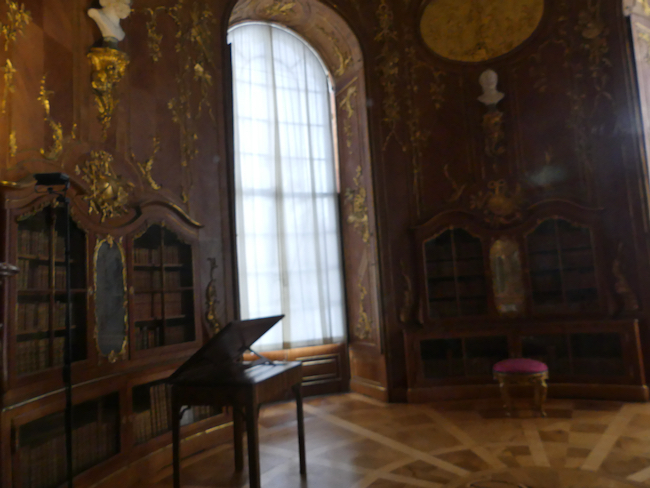

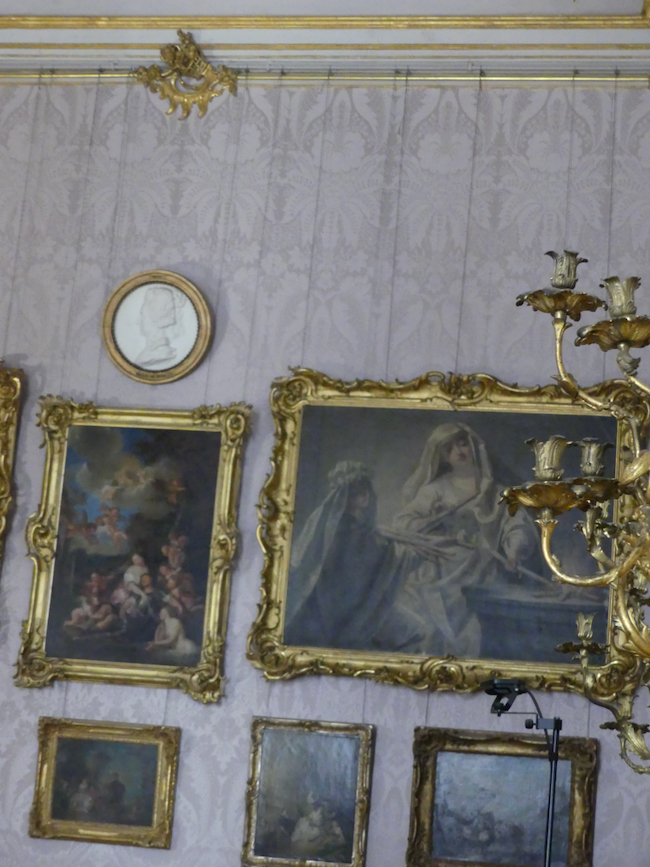


I lived in Germany off and on for many years. As I walked through this sumptuously decorated castle, truly exquisite, I couldn’t help but think how most of the poorest families in the Western World live better than the lords of old. Almost every house now has indoor plumbing and some kind of heat. Those beds, to me, look small, and lumpy. Frederick II who built this little escape hideaway lived a lonely and circumscribed life, with a manipulative, brutal father and heavy expectations on his shoulders. I think of how many people it took to maintain this palace, mostly for one man who entertained little. I think of the lives of those who served him, and wondered what they ate, how they slept at night – the tour did not include the back areas of the palace.

Then on to Cecilianhof, where the Potsdam Conference was held to negotiate the end of World War II. Lothar led the group on a tour outside the building, I walked around the other way, just in need of some quiet and some time by myself. The grounds were covered with snow, snow weighted down the boughs of the trees and coated the bushes – it was beautiful.
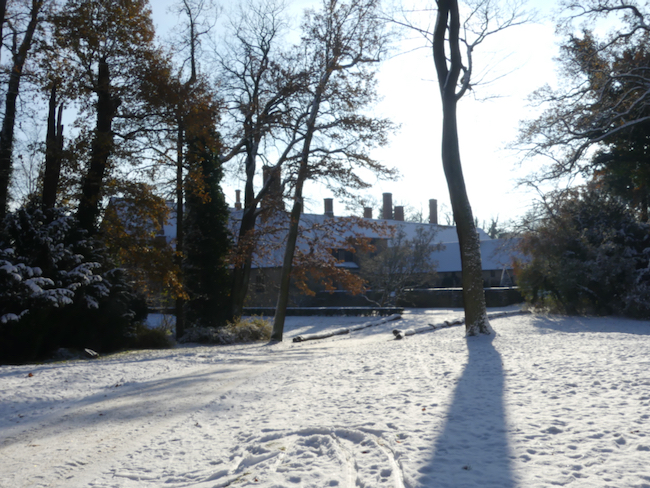


The sun came out and gleamed off the snow. It was quiet, so quiet. We had been privileged to visit Cecilianhof with friends many years ago; we have a photo of our son behind the desk where the documents were signed. It was an impossible private visit, only possible because of our friends, and such moments cannot be repeated, only appreciated.

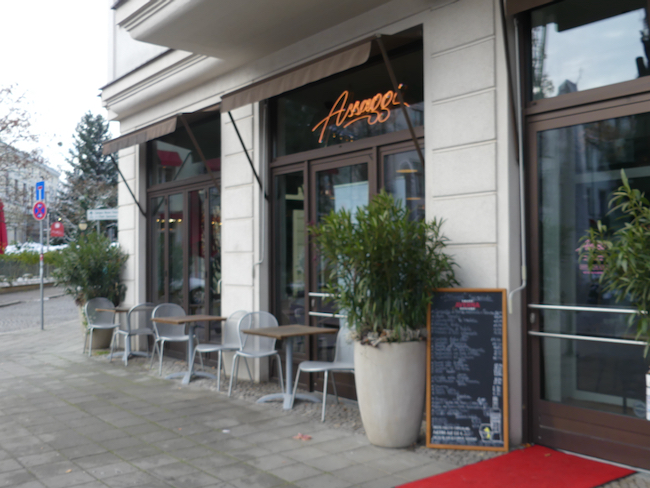
From Cecilianhof we were dropped off in Potsdam, at the Christmas Market. AdventureMan and I went off looking for a place to eat and found it within minutes – a Sicilian restaurant, Assoggi, sunny and bright, where we had amazing food and a delicious white wine, and still had time for a walk through the market before we had to be back on the bus for our drive to board the Beyla in Wittenberg.


Above is planked salmon. We saw it once before, four years ago at the Strasbourg Christmas Market, but rarely since then.
We were glad to board the bus when it showed up. After our wonderful Italian lunch, we were a little chilled by a brisk wind as we looked at the Christmas Market. We were ready to see our ship!
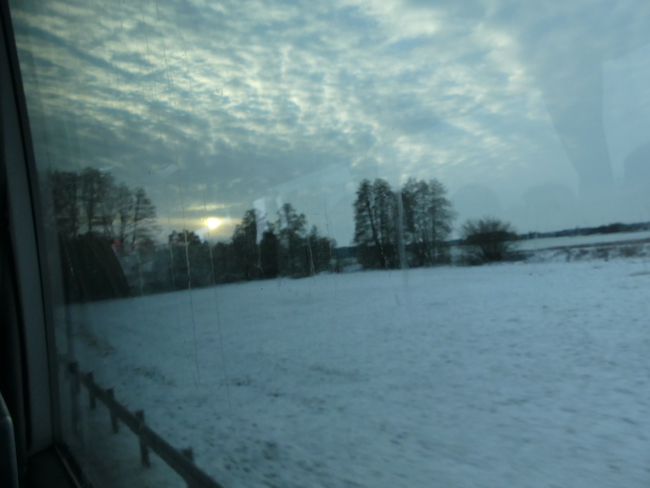
Chilly sunset on the way to Wittenberg.
Waiting for us on board the Beyla:

We were shown to our cabin, we quickly unpacked and headed to the lounge for the Welcome Aboard briefing and directions for the next day.
Our Cruise Director, a soul of amazing patience with the cats she has to herd, introduced us to the crew and staff and filled us in on what to expect on our tour of Wittenberg.
We also learned there would be a mandatory safety drill at 2:30 the next day where we all needed to show up at our designated stations in our life jackets, although the Elbe is a very shallow river and if we were sinking, we could walk to shore, so there were hoots of laughter.
There is a couple we have run into frequently, Don and Janice, and we always have good conversations, so we joined with them for dinner. Don was a cautionary story to us all – his bags did not arrive with him in Berlin. Every day, he would ask and Viking would check, and the bags could not be found. He had one extra set of clothing with him and would wear one set of clothing while each day Viking washed and pressed his other set. He was a great sport about the whole thing, and on the very last day of the trip, he was reunited with his bags.
Dinner on board the Beyla the first night was heaven. Roasted Duck Breast was one of the meals I had most looked forward to while planning this trip. The chef is awesome and did a great job on the duck and the wine reduction. It was a wonderful memorable meal.
We gave the tree-trimming party a pass – long day, once again, and we needed to get to bed.
And Just Like That . . .

And just like that, the temperatures have dropped and I feel like a different person. I joke about being Alaska girl, unable to handle the high temperatures, but the truth is, it is the truth. I have adapted by doing everything I really need to do early in the morning and mostly staying in air-conditioned locations – my car, a restaurant, a well-cooled grocery store, my house – when the temperatures go above 80 something F.
Yesterday, we tried a food truck our son had recommended, The Brown Bagger at Alga Beer (2435 N 12th Ave Pensacola ) for smash burgers. That place was hoppin’! I had the Hoppin Jack, a burger with jack cheese and jalapenos, with a side of brussel sprouts (Brussel sprouts!) and for the first time in months, we sat at a table outside and ate in comfort. While the burger was delicious, it was too much meat for me, and I loved the brussel sprouts, which I think were deep-fried. Does that take away the nutritional virtue of eating Brussel sprouts?
Getting up in the morning to cooler temperatures just makes me happy, it makes my day start right. I was wondering if climate change was going to make the hot mornings drag on into October, or November. The breath of coolness as I do my morning steps gave me hope that the winter season is truly coming.
Taos, So Beautiful, We’ll Be Back
Some places, when you arrive, you just feel at home. We felt that way arriving in Taos. Our active-aging demographic went hand in hand with the young skier/snowboarder/rafter athletic demographic, and the two seemed to co-exist well.
We met a man in town who loves petroglyphs as I do, knows the secrets of where to find them and also has a vibrant and active mind. We found great walking, and beautiful spaces. We can’t wait to go back to Taos.


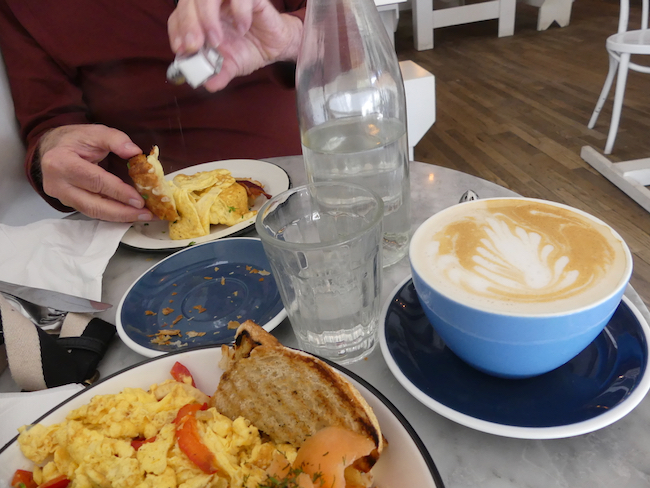

The Ute Tribal Museum in Montrose, Colorado

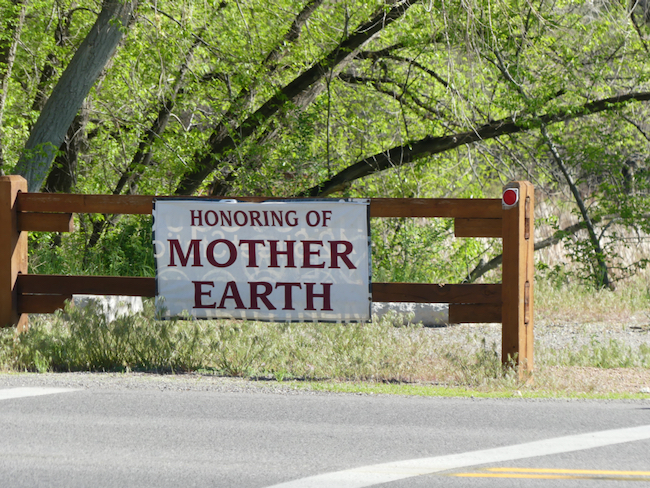

Our next stop was the Ute Tribal Museum in Montrose, a two-hour stop in a museum full of meaningful information on Ute daily life, the long history of the Utes on this continent, and the shameful treatment they received at the hand of our government, cynically breaking treaties and steadily eroding Ute territorial holdings.


There are all kinds of educational segments using materials to give a hands-on understanding of how teepees were raised, for example, and how beading was accomplished.

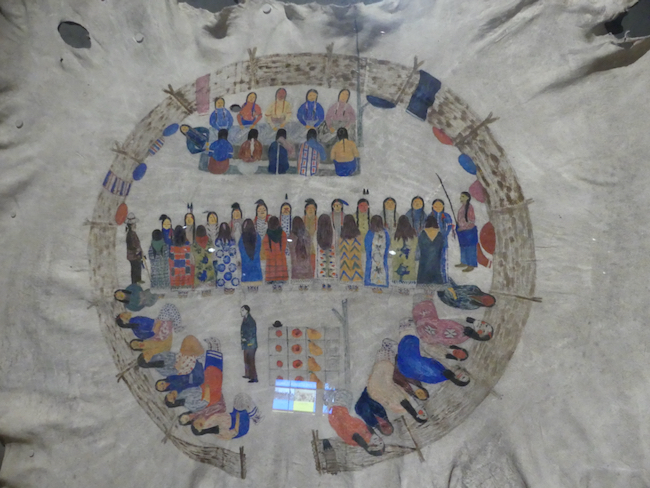
There were weaponry displays and best of all, there were many short visual film segments on a variety of topics, including a 22-minute film on the Bear Dance, which was absolutely fascinating. They had a gift shop full of wonderful jewelry and art pieces, as well as the usual books and souvenirs.


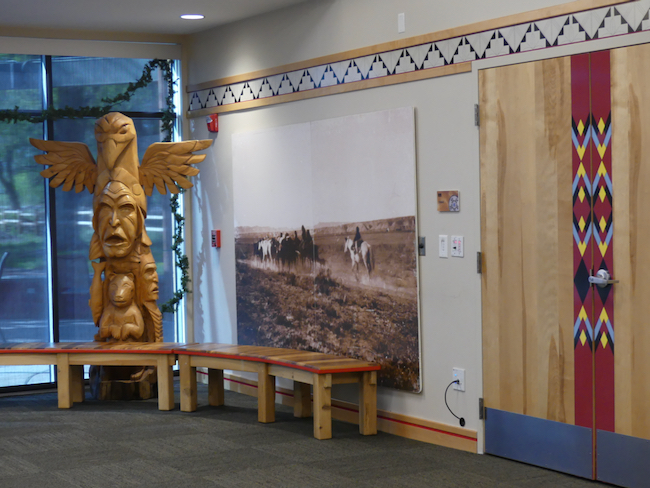


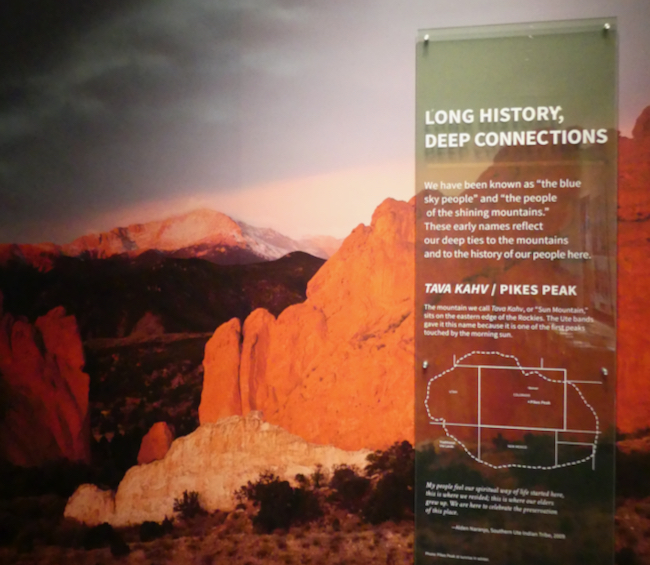
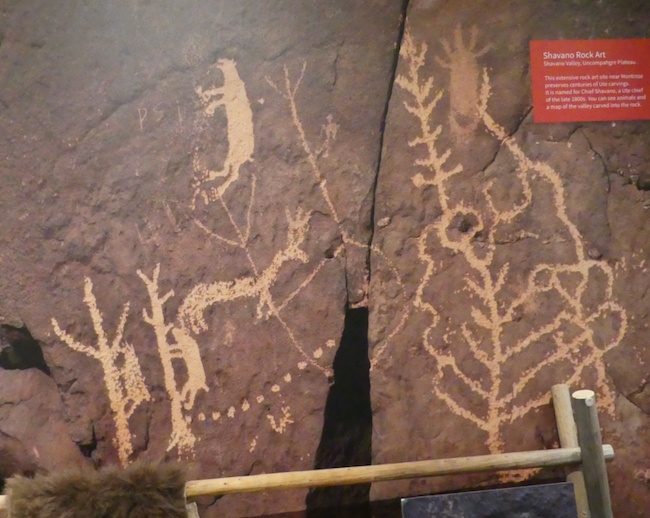
The Ute Museum was one of the highlights of our trip. It came at just the right time, as we were still at the beginning of our trip, and could relate much of what we learned to what we saw along the way.
Montrose, Colorado and Starvin’ Arvins
One of the best parts of this trip were the people we met. We heard so many great stories, and we listened! Mother’s Day in Montrose, we ended up at Ted Laurence’s Steakhouse where I had a beautifully grilled salmon and my husband had soup and a big salad.
It was a good meal, but the best part was our waitress, Maria. We talked with Maria and discovered we had both lived in Monterey, CA. They had left a year ago; California was just too expensive, and rents, like everywhere, just kept going up. She and her husband are hard workers and took a chance that Montrose might give them an opportunity to save, buy their own house and maybe even start their own restaurant. She mentioned a restaurant where she meets up with friends once a week, Starvin’ Arvins. After looking at the planned route for the next day, we decided to give Starvin’ Arvins a try for breakfast the next day.
Back at our large, beautiful, and very empty B&B, we slept fitfully and were happy to pack up and leave the next morning. We never saw or had any contact with management other than the message giving us our entry codes.
We headed back into Montrose for breakfast and gas. Starvin’ Arvins was definitely the place to be.

They had a menu that was a hungry man’s dream, with all the usual suspects, but we went with Cat’s Head biscuits, a huge cinnamon roll, and the oatmeal came with a huge bowl of blueberries.

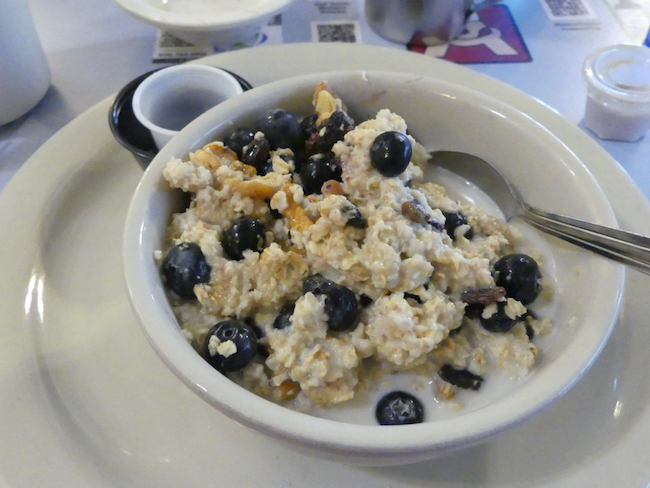
We were lucky to get there when we did; the place filled up quickly.
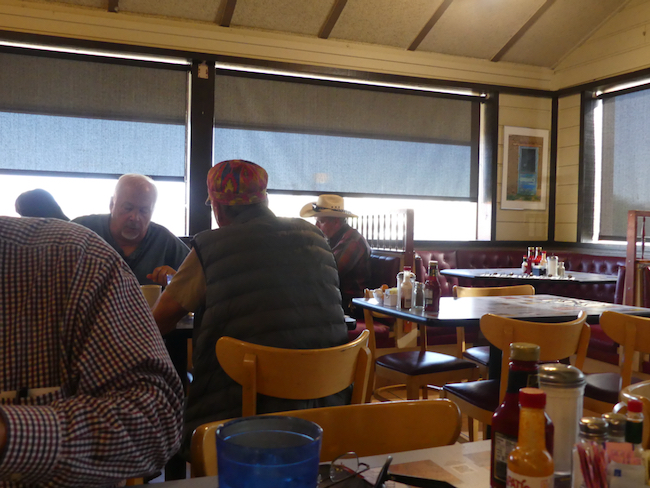
Service was fast and friendly; once again we had a wonderful waitress who took really good care of us and carefully boxed one of the gigantic cinnamon rolls to take with us – it will last for several days, and will be happily dunked in my coffee if it gets a little stale.

(We were never able to finish the cinnamon roll, it was so huge.)
As we are leaving, here is our view to the South.

Barcelona to Abu Dhabi: Four Days on the Red Sea and the Gulf of Aden

There are times, believe it or not, that even I, the word-smitten Intlxpatr, am at a loss for words. For one thing, while part of my writing is documentary, in case I get old and forget my great adventures, another part is because I really do love writing, and sharing what I have learned. For me, another part is that I have discovered as I write, I tap into a part of me that is figuring things out I don’t even know I am thinking, and I look at what I have written, and I am a little astounded, and then I have to ponder, mostly thinking “where did that come from?” Lastly, I try to be entertaining, in case anyone is reading this but me.
We never thought we were cruisers. We have always considered ourselves independent travelers, and we were fearless. On our first attempt at cruising, on a one-ship line that no longer exists (Voyages to Antiquity), we went on a cruise called The Passage of the Moors, starting in Seville, Spain, and going to a variety of places in Morocco, then returning to Spain. It was a real eye-opener.
In our hotel in Marrakesh, we had dinner with a disgruntled cruiser, a man who was annoyed we were spending so much time off the ship, touring cities and sites, and not spending enough time at sea. “This isn’t what I call cruising!” he complained as we ate exquisite food in our five-star hotel after our visit to the Djem al Fna.
AdventureMan and I were high as kites; we had exited the group after lunch in the caravansarai and toured the souks ourselves, ending with settling ourselves in a delightful restaurant overlooking the Djem al Fna and spending a couple hours enjoying the spectacle. We speak Arabic, we can read the signs, and we’ve been here before. We were high on being alone again, not part of the group, and creating our own brand of adventure.

Four days at sea is heaven for a lot of people. This part of the trip excited me, going along the coastline of southern Egypt, Saudi Arabia, the Sudan, Eritrea, Djibouti, and the coast of Yemen, places I have not yet explored and never dreamed I would have the opportunity. This was exciting to me!
I loved that we have these interactive maps in our cabins, so we know where we are in relation to the geography.
And this is what we saw:


Above are little islands off the southern coast of Saudi Arabia / Yemen.

Our greatest fun every day was hitting the spa, early in the morning. We always had it all to ourselves. I would awake early, head up to Horizons for coffee and catching up on e-mails, then go back to the cabin to find AdventureMan. We would go to breakfast. We would go to the spa. On our first day at sea, we had some excitement.
We spent about a half an hour in the pool, relaxing, exercising and soaking up some early morning sun. We are just finishing up and stretching out on a double lounge when the ship’s captain announced a Pirate drill.
A pirate drill! Passengers were asked to leave all outer decks and balconies and shelter in the interior of the ship. I made my way down to our room and sheltered in our bathroom, which is interior, to shower off all the salt water from the spa.
All this and it isn’t even 10:30.
We read a lot of books. We went through the Bab al Mendeb (the Gate of Tears) a choke point in the sea world, particularly strategic for transporting oil and gas. This is what Wikipedia tells us:
Etymology. Arabic بَاب اَلْمَنْدَب (bāb al-mandab) means “Gateway (Bab) of anguish”, or “Gateway of tears”; the strait derives its name from the dangers attending its navigation, or, according to an Arab legend, from the numbers who were drowned by the earthquake which separated Asia and Africa.
There were no announcements on board, no mention of the nature of the terrain through which we were passing. The majority of the passengers were either clustered around the tiny swimming pool or relaxing in their cabins.
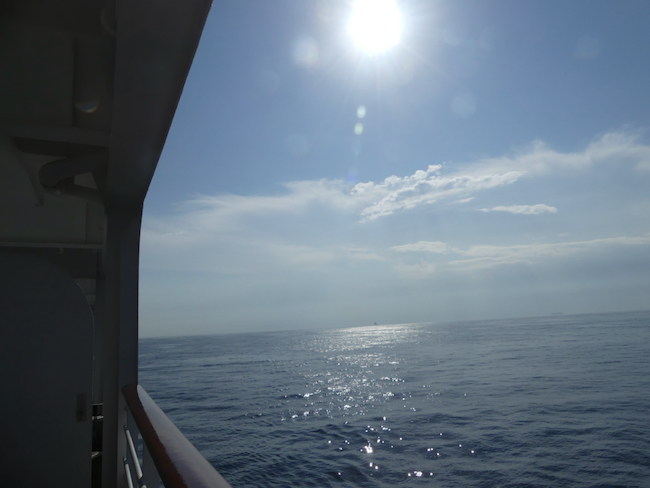
Visibility is poor.


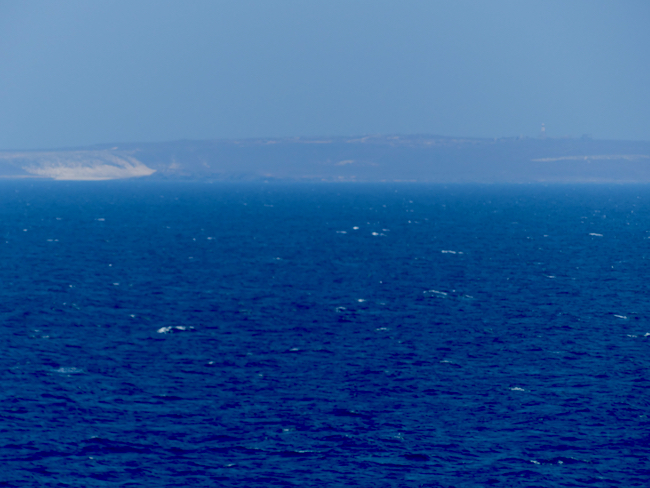
As we exited the straits and turned toward Oman, off the coast of Yemen, the waters became more turbulent.


As we were bouncing along in the back of a truck into Wadi Rum yesterday, we were talking with the Czech couple who had – just co-incidentally – been on several trips with this same ship’s captain. They had dinner with him now and then, and one of the things he told them is that most passengers who take the long cruises, the really long cruises, longer than our 21 days, get really bored and critical after the first couple weeks. The captain said they go to extraordinary lengths to keep the passengers from getting bored.
I cannot imagine. 21 days is long enough for us. There are activities. Today a woman is talking about Egyptian painting of the tombs, and another speaker will talk this afternoon about the future of weather. There are two women who teach bridge, and there is a crafts lesson this afternoon on how to make a ribbon bracelet.
Oceania’s major selling point is “the Best Cuisine at Sea.” There is a lot of emphasis on the food, the specialty restaurants, wine tastings, and special dinners with wine pairings.
We like good food. We like good wine.
We are going back to Toscana, the Italian restaurant, tonight. AdventureMan would like to try the fish he saw Buti deboning the other night. I like the angel hair aglio oglio pasta. They have good roast vegetables. We enjoy the meal.
The days at sea loom large and even good readers can go a little stir-crazy. There is a great library – and, as I said, a lot of focus on food, what will be served where, how it will be served, and who snagged reservations to the specialty restaurants.
The demographic on the Nautica is interesting. We learned from another passenger that 50% of the people on this cruise are first-time cruisers with Oceania (that would include us.) My guess is that most of us first-timers are destination driven, and we check that out as often as possible, talking with our fellow passengers.
Our fellow passengers are probably 60 – 70% American. The second largest percentage would be British or Canadian, and then there is a scattering of Australians, New Zealanders, etc. There are probably 2% Japanese, Chinese, and Korean. There is a Nigerian couple and the Czech couple, but both of those are now Canadian.
It’s an interesting mix and a very well-traveled mix. I haven’t met anyone on their first cruise. We are encouraged to “grab a drink and make a friend,” and it is easy enough to do; there are all kinds of opportunities to meet other people and get to know them, whether in eating venues or on shore excursions.
Mostly, we like to mix on shore excursions and up in the Horizons Lounge, where tea is served at four. We have actually only shown up for tea once – it is heavily attended on sea days, and we don’t like crowds. We head up to Horizons on days when people are elsewhere, and often run into people we’ve met on the excursions or even in our hotel in Barcelona. One kind woman and her husband spent a night off the ship with friends in Haifa; she shared a wonderful cracker recipe with me full of seeds and good things. It tasted of sesame and was light and healthy. Another couple is Ed and Alan, from San Diego, who won’t be getting off the ship until South Africa – a very long trip. They were supposed to go to Qatar, and then, suddenly, Qatar was scrubbed from the itinerary, and Saudi Arabia was added. Then Saudi Arabia was scrubbed and Bahrain was added. You have to stay flexible. We learn a lot by listening to our new friends.
Our housekeeper back in Pensacola, sends us photos that assure us our cats, Ragnar and Uhtred are feeling secure and doing well (Ragnar chews on things when he is anxious.) She tells us Pensacola is very cold – in mid-November! This is unusual, but the world is changing and we have to keep on our toes.
We eat our lunch at the Terrace, the weather is so much warmer, and the sea temperature and the air temperature are the same – 86 degrees F. The captain tells us how deep the water is underneath us – 1000 feet. There is a part of me that wishes he wouldn’t tell us.
We read during the afternoon and AdventureMan naps. Out on the balcony, it is almost too hot, and sultry. People are dressed in tropical prints, shorts, bathing suits and cover-ups.
The sun goes down very suddenly, and it is time to get ready for dinner. The FIFA World Cup in Doha continues to get mixed press, but Nautica will carry some of the matches, a really good call for Nautica, as this is a time when passengers can get bored and cause trouble.

On Sunday, we have a church service, interdenominational, held in the Nautica Lounge. The cruise director, Carson, tells us he originally trained as a Youth Minister, his family built a Baptist Church in Tennessee, but his sermon is very Episcopalian, very scripture based, on the two major commandments and The Good Samaritan. His message is that “we are to go and do likewise,” like the Good Samaritan, who nursed the stranger and cared for him. He tells us that we are 23 nationalities of passengers on board, and 49 nationalities on the crew. He tells us that when we travel, we meet the stranger and discover he is like us. It is harder to hate when the stranger becomes familiar. I loved the sermon. I am able to share it with AdventureMan when I get back to our cabin. We had minutes together before he left for his lecture on Egyptian Tomb artists.
When he got back we decided to go to the Grand Dining Room for a Sunday Brunch, which seems to be a big deal. When we got there, there was a long line, a big crowd, and the Grand Dining Room is entirely enclosed.
AdventureMan looked at me and I looked at him and we walked away, quickly, up to the Terrace dining room where we could sit outside. We discovered much of the food was the same, only not crowded, and plentiful. As we left, passed our table along to Miguel and Marguerita, our next-door neighbors.
It’s a quiet day. I did a couple Sudoku, and plan to go through and eliminate garbage photos. AdventureMan is catching up on sleep. It’s a great day for it.
I like sea days. They give me a chance to catch up. And actually, one is enough, two is enforced luxury, and by the third day, people start to go crazy.
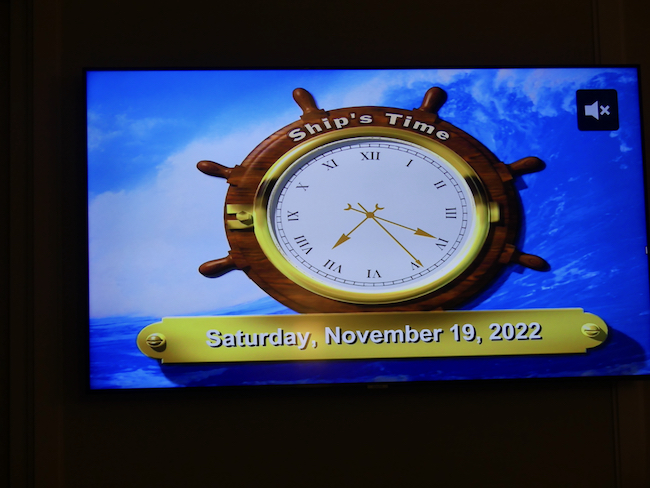
We change times again, losing another hour. I get up early and go up to Horizons to have some coffee and catch up on e-mails. Join AM and we go to breakfast, most of the time at the same table. I eat oatmeal and berries, AM shares a corner of his croissant so I don’t feel deprived. We go to the spa, the highlight of our morning, and loll in the hot sloshing water and then sun for a while on the daybeds. It’s early morning still – we have it to ourselves most of the time, and we don’t worry too much about the sun being too strong early in the morning. The weather has changed. It is definitely hot. I feel lucky that it didn’t get hot and sultry like this until after we left Aqaba.
AdventureMan goes to a lecture on Egyptian magical beliefs; I finish going through all the photos and upload the latest. I teach myself how to Air Drop photos from my computer to my phone. I enjoy the rest.
AM is searching around on our screen (we usually watch the navigation page, as we are going through the Bab al Mendeb and we decide to try the Grand Ballroom for a change, for lunch. When we get there, it isn’t crowded and we like today’s menu. AM has an Indian variety meal, and when finished, asks for more samosas, which they bring him – a lot! I have the peppercorn hanger steak and a “pate’” which seems to be a cooked pate’. We both have chocolate mousse with a tiny amount of raspberry coulis. We are both delighted with our lunch.
He goes to a lecture; I go up to the tenth deck to try to capture photos of Eritrea, Djibouti and Yemen – photos are hazy but show distant mountains.
Dinner comes, I am so totally not interested, but we go to the Terrace for the Middle East Market special. The foods are actually pretty good. I just get tired of eating by dinner time.

I think I am a little bored, and my body tells me I need more physical activity. The walking track doesn’t do it for me. We spend a lot of time taking the stairs, which is good for us both. I see a lot of people really loving the cruising time, pool time, socializing, loving all the food and wine, going to tea . . . I am restless. I need to move. I am missing my laps in the pool!
We are eager to see Salalah.
AdventureMan and I often visit places that we see very differently. We have visited small villages where AdventureMan says “just kill me now! I would drink myself to death if I had to live here!” and I am already mentally buying sheep’s wool and learning how to spin it into thread and yarn, weaving on a large loom.
So I am thinking what I would do to survive if I had to live on a ship for a long time between ports. I think I would have to organize. It’s what I do. I would start a book club. I would find people interested in theology and start a monthly meeting sharing different viewpoints. I would find fellow Episcopalians and schedule early morning services or Compline – surely there is an Episcopal minister aboard among all these people on board. I would start a ports series, where we share with one another what we know about the upcoming port. We would find small tour operators to take us to out-of-the-way places, to meet with local craftspeople, or to have a meal with local people.
Organizing takes a while, you have to be patient. Once I had a few things going well, I would stretch, create some interest groups, like a stitchery group – only I would also include crew members who shared the same interest. While now, there were women teaching bridge, I could imagine a weekly match-up of all bridge players, including crew; it would be both democratic and keep things interesting. Challenging.
I like a little more purpose to my life.
Recent Comments
ExpatAlien on What Country am I Living … intlxpatr on Yellowstone: Old Faithful to C… Michelle on Yellowstone: Old Faithful to C… Cathy on No Grown-Ups in Charge intlxpatr on Waiting for Snow Wikipedia Donate Button

Amazina


Early Voting in Florida


 Here There and Everywhere