Spring Break Hits the Gulf Coast
This last week has to have been the sweetest week of the year; running into all my friends at Home Depot, the cool mornings and the warm afternoons, it all makes you feel energetic, and you tackle all those projects you’ve been mentally lining up.
For me, it was painting the front door. I think it used to be red. It faces west, and the strength of the setting sun over the years faded it to a rosy rose. It needed to go back to shimmering red, but that takes patience, and more than one coat, and it takes a special day, cool enough, warm enough, and entirely without humidity. To paint a door, you have to have it open, and then it has to dry open, and when you are painting a door red red, you have to paint it more than once, even painting over rosy red.
Done. And time for a field trip to the Botanical Gardens Sales in Mobile, with AdventureMan, now in another career as Master GardenerMan.
It’s all good this weather, this time of year – until you get on any road leading to the beach, especially on a Friday, Saturday or Sunday.
Saturday, coming back from Mobile, there was a sudden jamming up as the cars went down into the tunnel running under the tip of the bay. As we are waiting to get through, we hear these banshee screams and yells, and my first thought, after years of living in the Middle East is “oh! it’s a wedding!”
No. No, I was wrong. It is no one’s wedding, but it does seem to be a major mating ritual, as colleges close for a week or so for Spring break and the students head for the beaches. These students were hanging out the windows of their cars – sitting on the window sills – waving bottles and screeching.

Animal spirits. I hope they packed their sun protection, and all kinds of other protections.
Women’s Rights a Threat to Society?
Society changes. Cable television has had a huge influence, travel to other countries changes perceptions, education gives a wider perspective, The genie is out of the bottle; women are equal people. No woman should need someone else’s permission to travel, work, or to use contraception.
Egypt’s Muslim Brotherhood: Women’s Rights Could Destroy Society, Countries Should ‘Reject And Condemn’ UN Declaration
Reuters | Posted: 03/14/2013 5:40 pm EDT


By Michelle Nichols
UNITED NATIONS, March 14 (Reuters) – Egypt’s ruling Muslim Brotherhood warns that a U.N. declaration on women’s rights could destroy society by allowing a woman to travel, work and use contraception without her husband’s approval and letting her control family spending.
The Islamist party of President Mohamed Mursi outlined 10 reasons why Muslim countries should “reject and condemn” the declaration, which the U.N. Commission on the Status of Women is racing to negotiate a consensus deal on by Friday.
The Brotherhood, which was elected to power in June, posted the statement on its website, http://www.ikhwanweb.com, on Thursday.
Egypt has joined Iran, Russia and the Vatican – dubbed an “unholy alliance” by some diplomats – in threatening to derail the women’s rights declaration by objecting to language on sexual, reproductive and gay rights.
The Muslim Brotherhood said the declaration would give “wives full rights to file legal complaints against husbands accusing them of rape or sexual harassment, obliging competent authorities to deal husbands punishments similar to those prescribed for raping or sexually harassing a stranger.”
U.S. Ambassador Susan Rice last week touted at the commission – a global policy-making body created in 1946 for the advancement of women – progress made by the United States in reducing the rate of violence against women by their partners.
“All 50 states in our union now have laws that treat date rape or spousal rape as just as much of a crime as rape by a stranger,” Rice said. “We cannot live in truly free societies, if women and girls are not free to reach their full potential.”
The contrasting views show the gap that needs to be breached in negotiations on the declaration, which this year is focused on urging an end to violence against women and girls. The commission failed to agree a declaration last year on a theme of empowering rural women due to similar disagreements.
WORLD IS WATCHING
Egypt has proposed an amendment, diplomats say, that would allow countries to avoid implementing the declaration if it clashed with national laws, religious or cultural values. But some diplomats say this would undermine the entire declaration.
The Muslim Brotherhood warned the declaration would give girls sexual freedom, legalize abortion, provide teenagers with contraceptives, give equality to women in marriage and require men and women to share duties such as child care and chores.
It said the declaration would allow “equal rights to homosexuals, and provide protection and respect for prostitutes” and “equal rights to adulterous wives and illegitimate sons resulting from adulterous relationships.”
A coalition of Arab human rights groups – from Egypt, Lebanon, the Palestinian Territories, Jordan and Tunisia – called on countries at the Commission on the Status of Women on Thursday to stop using religion, culture, and tradition to justify abuse of women.
“The current positions taken by some Arab governments at this meeting is clearly not representative of civil society views, aspirations or best practices regarding the elimination and prevention of violence against women and girls within our countries,” said the statement issued by the Coalition for Sexual and Bodily Rights in Muslim Societies.
Michelle Bachelet, a former president of Chile and head of U.N. Women, which supports the commission, said the commission was unable to reach a deal a decade ago when it last focused on the theme of women’s rights and ending violence against women.
“Ten years later, we simply cannot allow disagreement or indecision to block progress for the world’s women,” Bachelet told the opening session of the commission last week. “The world is watching … the violence needs to stop.” (Editing by Mohammad Zargham)
Distracted Driving #1 Killer of U.S. Teens
Horrifying article. I would have thought they would be talking about texting, which we can see for ourselves has people, young and old, swerving all over the highway, but no – the culprit is PASSENGERS! The death rate for teens in cars increases with each additional passenger!
The papers are full of heartbreaking obituaries, young people, men and women, who had so much potential, so much life ahead of them, and now they are gone. Heartbroken parents think of the years of joy they will miss.
Fatal Distraction: Teen Drivers And Passengers Are A Deadly Mix
Studies show that one passenger in a teen driver’s car increases fatality risk by 44%, two passengers doubles the risk
Sharon Silke Carty
AOL Auto News
Teen driving safety is one of those problems that is easy to ignore: So often the tragedies are spread out throughout small towns around the country. One lost life here, two lost there. We don’t often piece all those crashes together and realize what’s happening to our children.
Sometimes to get change, you need a tipping point. Maybe this week will be it: Since Sunday, 15 teenagers have died in major car accidents around the U.S. Six died after crashing into a pond in Ohio. Five died when they crashed into a tanker truck in Texas. Four died when they crashed into a creek in Illinois.
And that’s just the crashes that were major and notable enough to make national news. One teen in Colorado died Sunday when the teen driver of a car he was in crashed into the side of a mobile home. Three died in Indiana when the drivers, in two trucks, ran stop signs and collided head-on. A 15-year-old driver in Maryland died when he was fleeing police in a car. And there are others, many which don’t make the news. Crashes that don’t end in fatalities but left serious damage: traumatic brain injuries, crippling spinal cord issues.
“The numbers are so small and spread out geographically,” said Timothy Hollister, a teen driving safety advocate in Connecticut whose book, “Not So Fast: Parenting Teen Drivers Before They Get Behind The Wheel”, comes out in September. “It’s only when you put the numbers together nationally that people even begin to take notice.”
Driving is the No. 1 killer of teens in this country, accounting for about 25 percent of teen deaths each year. About 3,000 to 5,000 teens die annually in car wrecks, enough to fill the halls of a large high school. Or two.
Recently, the Governor’s Highway Safety Association release preliminary figures for 2012 that show a troubling trend: After 10 years of declining, teen driving deaths are on the rise.
Although teen crashes seem random and unpredictable, they actually often follow a predictable pattern: It’s likely a group of teens heading nowhere in particular, probably late at night, and going fast. Often, they’re not wearing seatbelts.
Researchers have identified the dangerous habits of young drivers, who can’t ever be considered safe behind the wheel because they are simply too novice. There’s a common thread for many fatal crashes: More than one passenger in the car, especially if those passengers are male.
The Passenger Effect
A study released last year by AAA said passengers have a huge impact on fatalities: Fatality rates went up 44 percent with one passenger under 21 years old, doubled with two passengers, and quadruples when carrying three or more passengers who are under 21 years old.
Many graduated drivers license (GDL) laws regulate how many passengers teens can have in the car before they are awarded a full license. Parents who are concerned about their teens behind the wheel want to pay close attention to this rule: Make sure your teens are driving alone mostly, with no more than one passenger. Don’t let them carpool to and from school events. Don’t let them head out for the evening with a bunch of other kids teens in one car. Remember that other passengers are a huge distraction that can turn into a fatal distraction.
Laws regarding passengers in vehicles driven by teens are “the single least enforced and most ignored rule,” Hollister said. “It’s the one piece that could make a difference. That’s parents putting convenience ahead of safety, and not understanding the dangers that every passenger in a teen driver’s car adds an additional risk.”
Child Marriage Increases Due to Financial Crisis
I have mixed feelings about child marriage. On one hand, girls are so immature in their teen years, and their bodies are not fully formed for child bearing. On the other hand, they are physically mature, and the hormones are raging.
A good friend married off her daughter at fifteen. She was actually “married” by contract at fourteen, but the families waited for the official marriage until she was fifteen. I was heartsick, but the girl herself was delighted. She liked the man she was marrying. She had no fears, no concerns. She started having babies – and she continued going to school, through university. I know it can work; I have seen it.
On the other hand, selling off a thirteen year old to a man she has never met, especially an OLD man, fills me with disgust. It’s a whole different situation.
Neither is it such a good thing, in our own culture, to have fourteen year old girls raising their babies with no husband around to be a father to the child. We all have some problems to face working out mating.
This is an excerpt from an article I found on Huffpost for International Women’s Day. You can read the whole article here.

Child Marriage On Rise As Global Crises Increase, New Study Says
Jessica Prois
Jessica.Prois@huffingtonpost.com
Half of all girls living in the world’s 51 least-developed countries have been married before the age of 18, according to the U.N. The World Vision study, released to coincide with International Women’s Day on March 8, found that such marriages are on the rise due to an increase in global poverty and crises. Researchers highlighted that parents living in areas prone to political instability or natural disasters are more likely to marry off their daughters at a young age, largely due to fear from these crises. Children living in these areas, such as South Sudan or Somalia, are also more likely to be forced into child marriage, the study said.
Erica Hall, Child Rights Policy director at World Vision, explained that the root causes of child marriage — poverty and gender inequality — are being exacerbated.
“Worldwide, there are increases in security issues and increases in natural disasters linked to global warming,” Hall said. She cited the recent humanitarian crisis in the Sahel region of North Africa and Somalia due to drought and political unrest as an example in which many girls often quit school and are sent to work as domestic workers or are married, to reduce the burden on their families.
For Bangladeshi families such as Humaiya’s, drought and lack of food are the primary reasons to discharge a young girl from her home. One of the most unjust impacts of this is education inequality. World Vision’s research in Bangaldesh revealed that girls who were unable to attend school due to disruptions from natural disasters were more likely to marry early.
Humaiya speaks out about child rights issues such as early marriage and became an advocate through World Vision, which introduced Humaiya to HuffPost. She said she knows that her ongoing education in Bangladesh is rare. Some 66 percent of girls in Bangladesh are married before age 18, according to World Vision. Humaiya works to educate her peers in her village and speaks to government leaders, asking them to do more to stem child marriage and provide greater education opportunities.
But Humaiya told The Huffington Post that she has seen many of her friends married off, and described how disconnected she feels from the girls she has been friends with for five or more years.
“Now they are good cooks,” she said. “They are like my mother, even though we are the same age. I don’t know how to manage a family, but they know.”
She explained that her mother was 16 when she was forced to get married, and lost a son by the time she was 18 years old.
In Bangladesh, the law is that girls can’t marry until they’re 18 and boys can’t marry until they’re 21. But the rules are not implemented, Hall said.
“The law is not the problem,” she pointed out. “You have to have political will to do that and capacity and understanding among law enforcement. The goal is to get governments to enforce these things, and — this is such an NGO word — but it has to be a holistic approach.”
Hall pointed out that requiring marriage registration and working on a grassroots community level is key to creating systemic change. She cited examples such as the Grandmother’s Project in southern Senegal, a nonprofit partner of World Vision that focuses on reducing early marriage, female genital mutilation and early pregnancy by creating an intergenerational dialogue about how to shift the gender-role paradigm.
“That’s been successful — you know how grandmothers are — in getting an idea like that across that it doesn’t have to be part of the tradition,” Hall said.
World Vision also works with religious leaders to address the practice of child marriage.
“There is a strong foundation in religion that children should be protected and they don’t want girls dying in childbirth and these leaders say, ‘This is a tenet of our faith and this is why we are going to start speaking out against it,'” Hall explained.
The issue of child marriage has gained momentum outside of the NGO world as well. Former Secretary of State Hillary Clinton announced last October a public-private initiative that focuses on ending child marriage by increasing education opportunities, providing training among officials and tracking every country’s legal minimum age of marriage — in particular in Humaiya’s home country of Bangladesh.
Strangers in America; No American Friends
This article is so sad, and I have also seen it the other way around, hoardes of American students abroad, hanging out with other Americans, then other ex-pats, and lastly, the local inhabitants. It IS hard. The differences can seem overwhelming. (That is my very first blog entry, and it had to do with the risks you expose yourself to when you open yourself to a cross cultural relationship 🙂 ) Overcoming those differences makes life so much richer.
Thank you, Professor John Mueller, for forwarding this fascinating article:
Strangers in a Strange Land
March 4, 2013 – 3:00am
By
Elizabeth Redden
In interviews with 40 international students at four research universities, Chris R. Glass was struck by the relative absence of Americans from his subjects’ stories. The interviewees, half undergraduate and half graduate students, described close relationships with their international peers, including those coming from countries other than their own. But while they frequently characterized their American classmates as friendly or helpful, only rarely did they seem to play a significant role in their lives.
“Only one student has described a significant relationship with a U.S. peer and that student was from Western Europe and that peer was her boyfriend,” said Glass, an assistant professor of educational foundations and leadership at Old Dominion University. “That to me is a striking omission from the stories that they’re telling.”
As the number of international students at U.S. colleges continues to rise — and as the mix of international students has shifted in favor of undergraduates — there are increasing concerns as to how well they’re being integrated into campus life. There have been periodic reports of racist incidents and – overt discrimination aside – there is the question of disconnection raised by Glass’s research. Another study authored by Elisabeth Gareis, a communication studies scholar at Baruch College, found that nearly 40 percent of international students reported having no close American friends. In explanation, many of the students cited “internal factors” such as limited language proficiency or shyness, but they also described a perceived lack of interest on the part of American students.
At the recent Association of International Education Administrators annual conference, a roundtable session on the integration of international students (co-moderated by this Inside Higher Edreporter) drew a standing-room only crowd, as attendees discussed the difficulties they’ve encountered in encouraging and equipping American and international students to (productively) interact. Domestic students are not necessarily cross-culturally competent – a point made lucidly when one audience member described the tendency of American study abroad students to request compatriots as roommates. At the same time, international students may not always be interested in initiating contact. An audience member from a Midwestern institution shared his observation that a fair number of students from China – a rapidly growing and by far the biggest group of international undergraduates on U.S. campuses – seem to be more interested in interacting with one another than with their American classmates.
Yet, even those students who are interested may find social structures on campus to be exclusionary or mystifying or both. On American campuses dominated by fraternity and sorority life, or obsession over intercollegiate athletics, or where everyone seems to have gone to the same high school, international students may feel foreign in ways that go beyond their nationality. “The lack of interaction is as much due to individual attributes as it is to social context,” said Glass, who is conducting his qualitative research in collaboration with Rachawan Wongtrirat, the assistant director of Old Dominion’s international initiatives office. Given the natural tendency of people to gravitate toward others who are like them (what social psychologists call the “similarity-attraction effect”), “are universities creating contexts where these interactions can happen?” he asked.
In interviews with Inside Higher Ed, researchers and professionals in international education spoke about the challenges in this regard and their efforts to create opportunities for meaningful interactions between domestic and international students through programming. It seems that many universities have a long way to go in living up to the promise presented by increasing numbers of international undergraduates – the promise being increased opportunities for sustained and meaningful cross-cultural interactions in classrooms, dorm rooms, and so forth.
‘Encounters With Difference That Make a Difference’
“It’s a combination of factors that have made this issue so salient,” said Larry A. Braskamp, the president of the Global Perspective Institute and a professor emeritus at Loyola University Chicago. “One is there are just a lot more international students on campus now, particularly at institutions that have not historically had a lot. The second is that everybody is interested in global learning: we know we need to prepare students to be more globally competent. And the third is that these students represent on some campuses a fairly significant contribution to the bottom line. Most of these students pay full tuition and as a result a lot of institutions see them as one way to balance the budget. So they have to make sure that the retention rate is high; they have to develop a good reputation so that other students will come.”
In Braskamp’s research, he’s found that entering American freshmen do not tend to think complexly, are not comfortable amidst difference and do not typically have friends who are unlike them. “We’ve said, O.K., the implication of all this is we need to create ‘encounters with difference that make a difference,’ ” he said. “I’ve thought of it as students being on a journey: they start with rather simplistic views of themselves, of their social interactions and the ways in which they understand the world around them. So in some ways what we need to do in college is increasingly provide them opportunities for encounters to get them to rethink who they are, how they think, and how they relate to others. In many ways, international students coming on campus is an opportunity for students, faculty members, and international administrators to take advantage of that difference and that diversity. But it’s really hard work.”
Such encounters can be curricular, co-curricular or informal: in fact, Braskamp’s research suggests that informal encounters such as discussion of current events with other students may be the most impactful. Still, he emphasized that there’s much more that can be done in the classroom to facilitate such encounters. In a sample of about 48,000 undergraduates at more than 140 four-year colleges, he found that about one-third report never having taken a course that “focuses on significant global/international issues or problems” or that “included opportunities for intensive dialogue among students with different backgrounds and beliefs.”
As one audience member at the AIEA conference said, unless faculty members are on board, all the student services programs in the world won’t be enough: “Students really look to their professors to give them direction and advice and deepen their conversations, so if faculty were taught to embrace these conversations about ‘difference’ and ‘other’ and ‘cross-cultural competencies’ and international challenges in engineering, then those conversations would take on meaning for the students,” she said. Participants in the session described the value of professional development programs such as Duke University’s Intercultural Skills Development Program for faculty and staff.
Case Western Reserve University is another institution that has begun to offer training designed to help professors better serve international students and integrate them into the classroom: according to Molly Watkins, the university’s director of international affairs, the first two trainings focused on Chinese students and attracted 60 to 70 faculty members each. “There’s obviously a need,” Watkins said.
Opportunities for Meaningful Interaction
At the AIEA session, audience members discussed co-curricular strategies such as peer mentoring or “buddy” programs, living-learning communities and other residence life initiatives, and more robust orientations for international students. Many universities have some iteration of one or all of the above: Mount Holyoke College, for example, has a new “Global Partners” program that pairs returning study abroad students with new international students and holds “re-orientation” events for international students during the academic year. The University of Iowa is launching a new required online orientation program that will begin in the summer before the students arrive and continue with five to eight small-group sessions throughout the fall semester.
The University of Arkansas at Fayetteville, which had 611 international undergraduates last fall, has a host of programs with alliterative names like Campus Cousins, Friendship Families and Global Greeks, which pair international students with American students, local families and fraternity or sorority members, respectively. Wesleyan University is “trying to capitalize on the idea of roommates,” hosting a dinner for first-year international students and their roommates at the beginning of the fall semester, according to Alice Hadler, the associate dean for international student affairs and an instructor of English. St. Norbert College, a Roman Catholic institution in Wisconsin, has a living-learning community with 25 international and domestic students (international students are the resident advisers) and a 10-member interfaith group consisting of Muslim students from Saudi Arabia and domestic Christian students. Initiatives such as these reach only a small number of students, concedes Marcy O’Malley, St. Norbert’s director of international programming, but, she said, “What I’ve seen work is one-on-one.”
“Instead of superficial contact with a lot of people, do more meaningful contact with a smaller number, and let them be your ambassadors to the larger student body,” she said.
Christopher J. Viers, the associate vice president for international services at Indiana University at Bloomington, has used theInternational Student Barometer to survey students about their experiences, and cited the surprising finding that international students rate their relationships with American students as those that are most important to them (as compared to relationships with other students from their home country or international students in general). “In looking at the feedback that came in we thought very critically about what we could do to help facilitate opportunities for international and domestic students to interact in meaningful ways to hopefully have conversations and potentially build relationships,” Viers said.
In talking with colleagues across the country, Viers said he’s come to the conclusion that “too often our programming is limited to the one-time, big, annual event.” This event, which often takes the form of an international student fair or show, can be good in celebrating international students’ contributions to campus and perhaps can help a domestic student learn a bit about another culture or cultures, but, he said, “opportunities for meaningful transformative learning are pretty limited.” As such, he continued, “We work hard to provide the big annual event that helps to showcase the contributions of our students and the diversity of the population with the excitement and food and entertainment, but not a week goes by when we’re not putting together, hand-in-hand with students, small, highly interactive opportunities for domestic and international students to get together. We run a weekly noon concert series, for example, where students from our Jacobs School of Music perform classical music or folk music from their home country and then there’s a free lunch that’s provided. That regularly gets people who have an interest in music together.”
“It’s absolutely essential as colleges are putting in place plans to actively grow international enrollment that appropriate levels of service and support are put in place, and then the students have responsibilities as well,” Viers said. “So much of just about anything in life in terms of what you gain from an experience has much to do with what you put into it yourself. This is where at times perhaps those of us in the field of international education are not vocal about some of the very real, very significant additional hurdles and challenges that students from other countries face while they’re here: the enormous pressures that they’re under to succeed academically and to move as quickly as possible though a program. It’s very expensive to come to the U.S. to pursue an undergraduate degree. There are often major expectations from family members and others; there’s a lot of pressure to succeed and do well.” And then there are the extra academic challenges inherent in pursuing a degree in a non-native language. Is it any wonder that not every student will want to come out for mixers and “cultural coffee hours”?
“I think that sometimes we underestimate that pressure, and apply a different kind of meaning to the experience that we perceive a student is having,” Viers said.
Return to Five Sisters in Pensacola on a Rainy Saturday
It was another endlessly rainy Saturday when my husband asked where I would like to go for lunch.
I knew immediately where I wanted to go. I love Five Sisters almost any day, but especially on a rainy Saturday. I like it that they have live music on Sundays, and sometimes on Thursday nights, but I really like it that there is no music on a rainy, dreary Saturday, so we can talk and hear each other. 🙂
Five Sisters is packed – it often is – with people seeking the same thing, a warm, cheery place filled with great smells and great cooking.
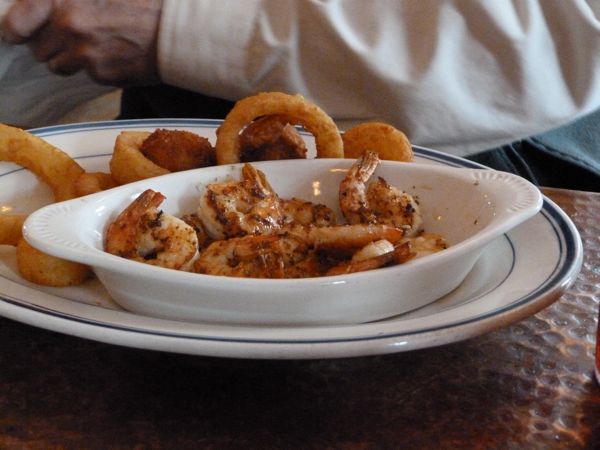
AdventureMan ordered the grilled shrimp platter:
And I ordered the Blackened Fish on Cheese Grits (sorry, it is a little blurry, I must have been shaking with hunger . . . )

I never get tired of Five Sisters.
Wealth and Inequality in America
Horrifying
Thought While Not Moving
We’ve been in Pensacola three years this month, or anyway, I have. AdventureMan retired, but went back twice to help out and to start things up on a major contract. He was retired, but useful.
The longest we’ve ever stayed in any one place was 6 years. The second longest was 4.5 years. There were some 6 month places, 10 month places, and three years was a long posting. I feel the internal clock ticking; I am cleaning out closets and drawers. No, I am not packing. No, I am not moving, but the habits are still there and don’t go away. Go through everything. Weed and cull. Pass along. Give away. Evaluate.
AdventureMan is fully engaged in a very different life from before, and it requires some adjustment – for both of us. You’d think my life wouldn’t be that different, I still do aqua aerobics, I spend time doing volunteer work, serving the church, meeting up with other quilters, etc., same life, different location, right? No No Noooooooooooooooooooo!
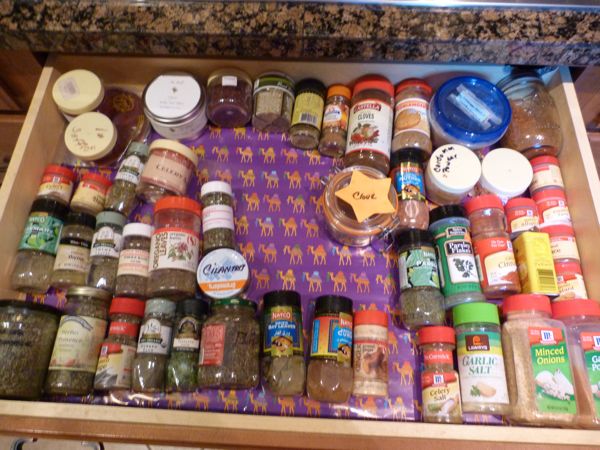
Take the spice drawers. AdventureMan still tells the story of when we first got married and I did my first big grocery shopping, setting up household. As he lugged bags and bags into the house, he jokingly asked if I had everything (his bachelor refrigerator kept beer cold; there was nothing else in it!) and I said no, that I had groceries, but I would have to go back for spices.
When I got back with two bags full of herbs and spices and cooking things like baking powder and baking soda, he was wide-eyed. He was thinking “salt . .. pepper . . . what else is there?” He still laughs about it, lo, these forty years later.
Three years in Pensacola has given me time to think about the spice drawers. They frustrated AdventureMan, and he offered to re-arrange them more logically, which almost started a nuclear war in our family dynamics. Logically, he is now doing more cooking and he should have more input, but it is really, really hard for me to give up territory in the kitchen, and, well, AdventureMan can be a little bit aggressive in amassing his territory.
But, after three years, I agree, the spice drawers are not working, and one reason is I got this state-of-the-art rubberized drawer liner, but it crept back and made the spices rise up and then the drawers got stuck open or closed and it really was frustrating.
Yesterday, I had the house to myself and because I hadn’t planned it, it wasn’t something I dreaded, I just started fiddling with the spice drawers, just editing, getting rid of some really old stuff, combining duplicates and . . . well, because I hadn’t put it on the “To Do List” it was fun. So much fun I decided to go all the way, take out the annoying rubberized liner and have some fun.
I’ve always loved great drawer liners. Good thing, huh? I’ve lined a LOT of drawers. There are some wonderful liners out there, but I love to use wrapping paper. Every now and then I’ll see a design I love, or something that thrills my heart. Because I moved so often, I knew it wasn’t a lifetime commitment, so I just had fun with it. And that is what I did yesterday.
I have some great wrapping paper I brought back that I went to a lot of trouble to get, flying down from Kuwait to Doha to go to the American Women’s Bazaar in November, where I knew there would be the vendor from Saudi Arabia who makes and sells these quirky, whimsical Arabic-themed wrapping papers that I loved to use for all the Christmas gifts and house-guest gifts I would take back three or four times a year. I hand carried several rolls of this paper back to Kuwait, then shipped it back to Doha when we moved back there, then shipped it again, carefully protected, to Pensacola when we retired.

Here in Pensacola, however, it seems less and less relevant. I don’t use it to wrap my Christmas gifts like I used to because the gifts are no longer exotic surprises from the Middle East. And I still have a lot of this paper, paper which delights me, but for which I have no real purpose . . .
So I decided I would use it to line my spice drawers. I can see it every day and smile. It is making itself useful, and two or three years down the road when it is worn and needs replacing, I can find something else that delights my heart.
When AdventureMan comes in, I am just finishing up. I warn him, because he, like me, likes to know where things are.
“What’s the logic?” he asks, and I think “this is one of the reasons I married him; he knows to ask the most pertinent question.”
“Here are whole spices, seeds, peppers,” I tell him as I indicate a section, “and here are exotics, spices from the Gulf and Jordan and Tunisia. This section is grill mixtures and all kinds of chili powders and Creole mixes. Over here you have aromatics and baking spices, and here are the Italian and French herbs. The last section is onion and garlic powders and salts, flavored salts of all kinds, and frequently used multi-use herbs.”
He totally got it. 🙂

Seafood Platter Deli AKA Gulf Coast Seafood Deli on 9 Mile Road
“We’re going to drive ‘all the way’ out there,” AdventureMan tells me and we laugh, because ‘all the way’ is such a relative term. When we lived in Kuwait and in Qatar, we would drive a minimum 30 minutes to get to a restaurant, any restaurant, not only because of distances but also because of traffic, horrendous traffic, in the evenings. While the Seafood Platter Deli is 13 miles away, it takes us less than 20 minutes to get there. Welcome to Pensacola 🙂


This is a very unusual restaurant. It is so old-timey Gulf Seacoast, and at the same time, I thought as we entered “My Moslem friends would love this!”
Many of my Moslem friends think Americans are unbelievers. They think we don’t talk about God. They don’t know we pray – sometimes without ceasing. Just as I was astounded as I learned things about Islam and Moslem culture living in the Middle East, they were also astounded learning things about us, like that we take care of our families. Think about it – most of what many people in the world know about Americans comes from the impact of cable TV. They watch American TV and they think they understand American culture. Horrifying thought, isn’t it?
So how amazing is it to walk into a restaurant where, as you stand at the counter to order, and you look at the big menu on the wall, there is a stand, with a bible on it. And there is paper, and a pencil, and a sign saying “Prayer requests.” I don’t know about your restaurant experiences, but this is unique in my experience – in America. In the Middle East, there are all kinds of restaurants with Qu’ranic verses on the walls, and the sounds of religious services piped into the restaurant. People talk about God all the time. It’s a whole different world; and my Moslem friends would feel right at home in the Seafood Platter Deli.

Of course, in Saudi Arabia, we would rush to buy our pre-sunset felafels, and then sit and munch, listening to all the souk grates coming down as shops closed for the Mahgrib prayer. Everything closed, five times a day, in Saudi Arabia, for prayer.
At the Gulf Coast Seafood Deli / Seafood Platter Deli (I don’t know what the real name is, and both names appear when you Google it) there are scriptures on the wall. When you sit down, the little basket holding condiments tells you to “count your blessings.”

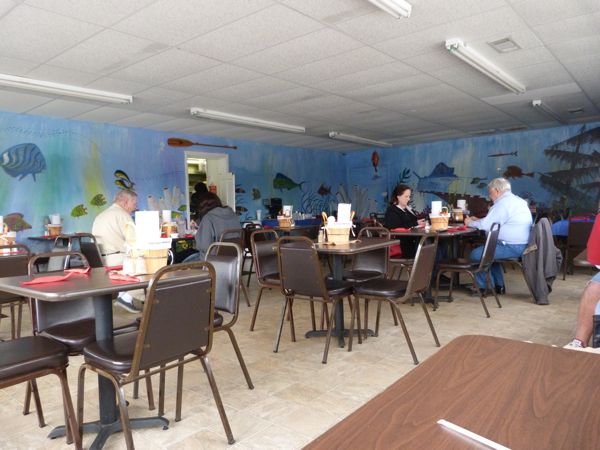
The interior dining room (as opposed to the deli section, and the counter where you order food when you come in) is wall-to-wall sea mural, family friendly, Fish and sea life everywhere. There are also families who pray when their meal is delivered to the table, before they eat. The wait-staff is patient, and personal. You get the impression they truly want you to have a good experience at this restaurant.
We were hungry. We are mildly disgruntled to see piping hot food delivered to tables around us who arrived after we did, but not very. Even though we are hungry, we know that our ordering our food grilled or blackened slows things up in the kitchen, where the majority of the meals are fried. It is really really hard for people like us to watch other customers thoroughly enjoying their fried shrimp, fried catfish, fried grouper, fried scallops, etc. They look SO delicious. Every now and then, maybe once every couple months, we slip up and eat something deep fried, just because yes, yes, it tastes so good, and we know it is like the WORST thing for us. What a pity that deliciousness can be so lethal.
Ah! There it is! Our meals! We tuck right in and then I remember “Oh no! I haven’t taken any pictures!” AdventureMan is used to this, and bless his heart, he stops eating so I can shoot what is left of his grilled scallops, so tasty and delicious, so fresh!
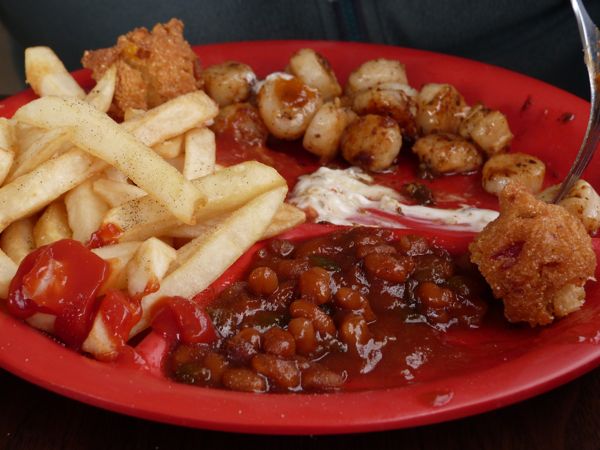
I had so much salmon on my platter that I had salmon and steamed vegetables for dinner, too! The salmon was copious, lightly blackened, seared on the outside, moist on the inside, just the way I love it. It was some of the best salmon I have had in Pensacola (not exactly salmon country, but that little Alaska girl still lives in my heart and I can’t resist salmon when I see it on the menu.)

There’s another thing we loved about the Seafood Platter Deli – remember Dembo’s Smokehouse? We love restaurants that honor their heritage, and the Seafood Platter Deli has this wonderful wall:
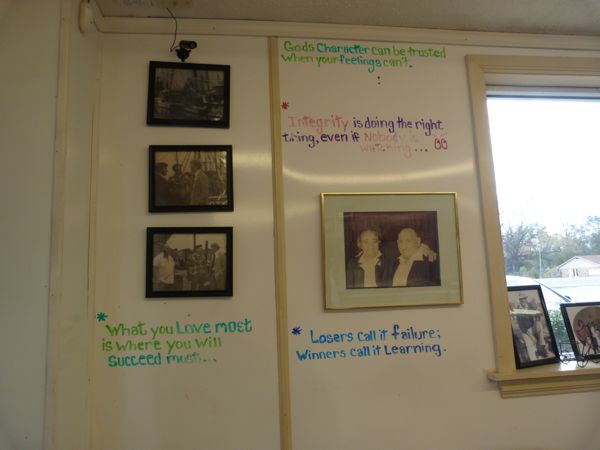
Last, but not least, the food was so good, and so plentiful, that we couldn’t eat it all and ended up taking some home. We also took home some dessert, one dessert, $1.99 for a goodly portion of Vanilla Wafer pudding, that old-fashioned kind, maybe Banana pudding. It was so GOOD, we wish we’d gotten two. 🙂
Gulf Coast Seafood Deli / Seafood Platter Deli
Address: 2250 W Nine Mile Rd, Pensacola, FL 32534
Phone:(850) 969-3299
We love this place, and look forward to driving ‘all the way out there’ for more fabulous Gulf seafood.
Recent Comments
ExpatAlien on What Country am I Living … intlxpatr on Yellowstone: Old Faithful to C… Michelle on Yellowstone: Old Faithful to C… Cathy on No Grown-Ups in Charge intlxpatr on Waiting for Snow Wikipedia Donate Button

Amazina


Early Voting in Florida


 Here There and Everywhere