Red Robin – YUMMMMM
“I think I need a hamburger,” I said to AdventureMan as we were tucking in to bed. I can’t even remember the last time I had a hamburger, but I think it was in April, 2010, at the Red Robin in Pensacola.
Red Robin . . . YUMMM. One of the best ad campaigns in history, in my mind. Pure repetition, a little humor to re-inforce the memory, all positive. Anywhere you go in America, you can say “Red Robin” and someone will say “Yummm.”
I have a personal relationship with Red Robin. When I was a student at the University of Washington, long, long ago, the Red Robin was very near the university, near enough we could walk, even, and even though it was a bar, they weren’t very strict about carding people, and oh, they had the best burgers. It was pure comfort food. They also had a wonderful deck, so on the rare and beautiful spring days when final exams were coming and we just needed to blow off some steam, the Red Robin was one of the places we headed.
It wasn’t like the Red Robin chain. It was the original, and it was a little seedy. Here is what the original Red Robin looked like:

Yep. . . a little stoned.
Here is what he looks like now, he cleaned up good, LOL!

There were old wood floors, not the shiny kind of good wood floor, but the old fashioned cheap kind, sort of spongy when you walked on them, and usually covered with stuff that had been spilled. No, not exactly your family kind of place, it was a college student kind of place.
So for my once-in-more-than-a-year hamburger, we went to Red Robin.


Compare that to the original:

And here was my peppercorn burger:

It was YUMMMMM. Now, I won’t need another burger until September 2012 or so. 🙂
Sadly, as I was looking for some photos of the original Red Robin, I learned that they closed down the original on March 21, 2010. So sad, but I suspect it just didn’t suit the image of the new, family oriented Red Robins, more than 400 of them around the USA. But they still serve a good burger.
Cultural Issues as Qatar races Towards 2022 World Cup
In the same issue of The Peninsula (Qatar), this author addresses cultural sensitivity when it comes to dress, but includes some intriguing mistakes. He (or she) states that all women are required to ‘veil their faces’ in Saudi Arabia, which is untrue. There is no law requiring women to cover their faces. Custom drives many – but not all – Saudi women to cover their faces. Western women are asked to cover their hair and to wear an abaya, and must do so when going off compounds or out of their hotels, but no one is required to cover their face.
The Issue: Is Qatar ready for 2022? Well, the country is all set to launch mega infrastructure projects worth billions of dollars in order to have facilities in place to host the coveted event.

But the key question being asked by many is whether the conservative Qatari society is ready to take in its stride the cultural shock that the preparations for the event and it being actually held here would trigger.
With no less than half-a-million international soccer fans expected to descend on the Qatari soil in 2022, Qatar must build the requisite mindset — and not just physical infrastructure — to be able to absorb the social and cultural tremors such an avalanche of people from different ethnicities and cultures would cause.
Or, will the Qatari society rise in rebellion against the onslaught, especially as Western values and traditions are seen gradually overshadowing local customs and the way people dress up and behave in public?
Already, there is widespread fear in the Qatari community about their identity being diluted due to the sheer size of the expatriate population. Official estimates suggest that out of a total of 1.7 million people living in Qatar, an incredible 1.5 million are foreigners. This means that some 90 percent people in the country are non-Qatari.
Since expatriates come from all over the world (unconfirmed reports suggest there might be people from more than 80 nationalities living here) the threat to Qatari identity and culture is real, say social analysts.
Some, though, argue that since Qatar is a small country with a tiny population, its people must pay the social price for development and prosperity. “Given the situation, you can’t have both—prosperity and identity. You must compromise and choose between the two,” says another social analyst not wanting his name in print.
Concerns in the Qatari community about its age-old culture and identity being compromised due to the ever-rising numerical preponderance of foreigners, are growing.
Rising indebtedness in the community due to limited income and growing consumerism has been relegated to the background as fears deepen over the local customs and folklore falling prey to what seems to be unstoppable intrusion of foreign cultures.
There is immense hostility in the Qatari community towards the way foreigners, especially young women, dress up. Foreign cultures have already reached Qatari homes with children being largely raised by foreign maids.
“Things are still under control since we can influence our children, but we are helpless when it comes to stopping outside influences that are causing damage to our society,” says a Qatari requesting anonymity. “The most harmful outside influences are TV and foreigners living in our midst.”
Objections are raised to young non-Qatari women, particularly Westerners, wearing skirts and sleeveless tops.
A number of Qatari mothers have expressed ire and want the state to intervene and ‘discipline’ young non-Qatari women who dress up ‘indecently’ in public. The mothers say they fear that their daughters might ape such negative behaviour.
There are some Qatari women, though, who see the media (read: foreign TV stations) posing a bigger threat than foreign women wearing skirts and sleeveless tops here in public.
Says Wisam Al Othamn, a lecturer at Qatar University: “It’s necessary to monitor the media, not foreign women.”
There are others, though, who feel that dressing up in public is one’s freedom and choice, so no one should impose restrictions.
Qatari social websites are filled with comments from people talking about threats to their identity. Some have called for setting up a ‘religious police’ to especially monitor young foreign women dressing up ‘indecently’ in public.
The commentators argue that Saudi Arabia has such a police and it is compulsory for every woman, whether local or foreigner, Muslim or non-Muslim, to veil her face in public.
But there are others who laud Qatar for the freedom people have in personal matters such as dressing up in public, and claim that foreigners here dress up decently if comparisons are made with neighbouring countries like Bahrain and Dubai.
There are still others who favour Qatar forcing foreign women to veil their faces while in public. They argue that since countries like France and Belgium have banned Muslim women from using face veils in public, Qatar and other Muslim countries should take counter measures and force all women, whether Muslim or non-Muslim, to cover their faces while moving in public.
An interesting comment on the way Qatari women dress is from a man writing on a local social website. He suggests that there is nothing like Qatari attire for women. Abaya is used by women in Yemen, Iraq and Syria, so it has come here from these countries.
As for naqab or full face and body veil, it did not exist in Qatar until 20 years ago, suggests the man. “So there is nothing called Qatari dress for women,” he says.
There are some who find fault with some schools having co-education and say Qatari girls tend to ape their foreign peers from these schools.
There is ire in sections of the Qatari community over the schools’ regulator, the Supreme Education Council (SEC), giving the freedom to schools on imparting lessons in Qatari history, language (Arabic) and religion.
Writing on social websites, some commentators are critical of the SEC and say that since land, history, language and religion are the four pillars of a society’s cultural identity, the schools must impart lessons in these subjects.
“It’s surprising why the SEC has not made the teaching of these subjects compulsory in schools. It’s a step that would destroy the Qatari identity,” wrote an angered commentator.
About language, the commentator quoted a famous Qatari writer, Dr Mohamed Al Kubaisi, as saying that it is only through their version of English language (different from the British English) that the Americans have built their identity and are dominating the world by popularising it (American English).
Another commentator said he saw the SEC move as a step aimed at diluting the Qatari identity. He even suggests that some teachers are opposing the SEC’s decision individually.
“Go to Germany and France and if you don’t speak the local language you wouldn’t get a response,” the commentator said, hinting that everyone in Qatar must speak the local language, Arabic.
Social analysts believe that Qatar faces a huge challenge over the coming 11 years (during the run-up to the 2022 event) in its struggle to maintain its cultural identity, and much of the onus will be on the Ministry of Awqaf and Islamic Affairs and the Ministry of Interior.
Talk of a dress code being imposed by the Interior Ministry is going on for a while with analysts wondering if at all it would see the light of day. Despite opposition to foreign women dressing up ‘indecently’ in public, there are some in the Qatari community who say they believe a dress code is unwanted and how people dress up in public should better be left to them, respecting their freedom.
There are some in the community, though, who want the government to act and impose a dress code, particularly as the number of foreigners in the country is quite high. Moreover, the fact that the foreigners come from so many nationalities makes it necessary to have some code in place to help protect Islamic values, they argue.
“If not a dress code, it should be accepted in principle by everyone living in the country that one must dress up decently to respect local customs and values,” says a community source.
“It’s normal for a country to have some say in matters like how people, especially women, dress up in public. This will in no way tantamount to curbing individual freedom,” he insists.
Analysts say that the Ministry of Interior introduced the concept of community policing sometime ago with this vision in mind. The entire concept of community policing where the law-enforcement agencies actively coordinate with different expatriate communities as well as civil societies and the locals is based on the idea of how to help protect and preserve Qatari identity and culture in the midst of threats being posed by the swelling population of foreigners in the country.
The focus of the effort (community policing) is on helping preserve basic social and religious values, knowledgeable sources say. Critics, however, maintain that the effort having been launched quite a while ago, is yet to yield results.
Operation Blue Shepherd
I was shocked to hear about this operation on National Public Radio this afternoon, and to know it was Pensacola. What got my attention was one of the police officers saying that they were shocked to capture so many local people; they had expected to attract predators from surrounding states, but not so many locals. Truly sad.
And kudos to all the men in blue and officers of the court who are putting away these people who would prey on children, taking them off the game board.
You can read the entire article yourself at the Pensacola News Journal:
25 men accused of setting up child sex encounters in Pensacola sting
Twenty-five men were arrested this month in Pensacola during a weeklong undercover operation in which suspects are accused of using the Internet to set up sexual encounters with children. The suspects came to meet the minors at a home in northeast Pensacola only to find a slew of law enforcement officials waiting for them.
The sting, called Operation Blue Shepherd, began June 20 with 30 officers from local, state and federal agencies participating, according to a Pensacola Police Department press release. The results were announced at a news conference this morning at PPD.
Pensacola Police Capt. Paul Kelly said officers used various social networking and E-commerce sites to respond to advertisements of a sexual nature and to place similar advertisements.
The suspects specifically described various sexual acts they were going to do with the male and female children, ages 12 to 14, with whom they believed they were talking. All of the suspects, except one who took a taxi, drove to the undercover house with the intent to perform these sexual acts with the children. Upon arrival, they were arrested and questioned.
Kelly said officers were surprised to find so many eager participants from the immediate Pensacola area.
“We expected to have more violators traveling from outside the area. What this tells me is that these violators do not have to travel far to find their victims. They are much closer to home than we imagined. Most of them were not reluctant or frightened to approach the door of a stranger’s house. They literally pulled up to the house and walked quickly to the door eager to meet the child,” Kelly said.
Agencies participating in Operation Blue Shepherd were the State Attorney’s Office, Florida Department of Law Enforcement, Immigration and Customs Enforcement , Naval Criminal Investigative Service, Escambia County Sheriff’s Office, Santa Rosa County Sheriff’s Office, Okaloosa County Sheriff’s Office, Walton County Sheriff’s Office, Alachua County Sheriff’s Office, Gainesville Police Department, Fort Walton Beach Police Department, Tallahassee Police Department and the Federal Bureau of Investigation.
Restaurant Hotel Saxonburg, Saxonburg, Pennsylvania
How lucky can you get? Just next door to the Mainstay in Saxonburg is the Hote Saxonburg, which has a restaurant, and that restaurant has a menu full of good choices. We ate lunch there, two days in a row. We thought the food was super good, but it may also have to do with eating meals with good friends; everything just tastes good when you are laughing and having fun.

Inside, the owner told us when renovating, they found these old beams, and the original straw and wattle construction, and they decided to leave it – it really adds to the interior atmoshpere:


The food was really good, and the restaurant staff was very accomodating about our picky style of ordering. They had two sandwiches, a Reuben, made with corned beef and sauerkraut, and a Rachel, made with turkey breast and cold slaw. I asked if I could have the Reuben, but made with turkey breast, and they did it as if it were no inconvenience at all. I love it when a restaurant treats my requests with respect, instead of huffing and puffing about how no, it isn’t possible.
Before we started, we ordered cups of the Lobster Bisque, which I am sad to say was so delicious that we ate it all up before even thinking about taking a photo.
My Reuben/Rachel:
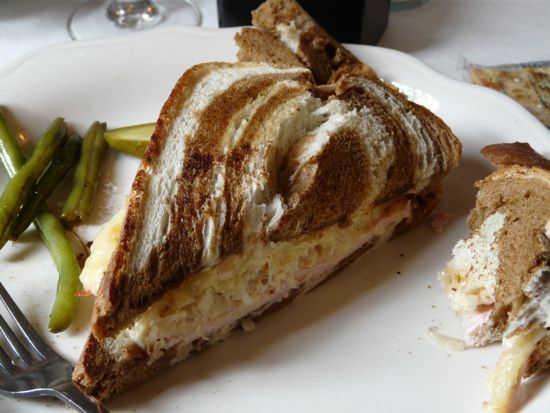
What you can’t see much of on our plates is the green beans with pecans; you can’t see them because they disappeared so fast. As good as our meals were, those green beans with pecans were divine.
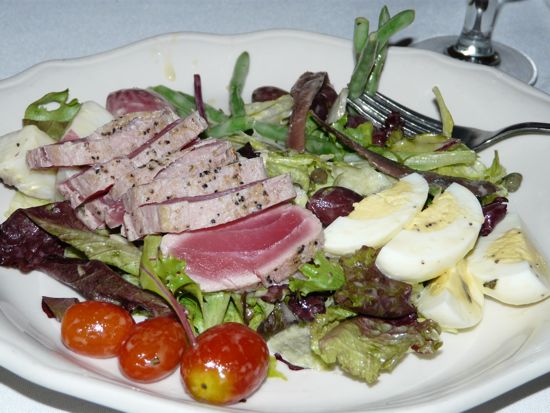
The Ahi Nicoise Salad (YUM!):
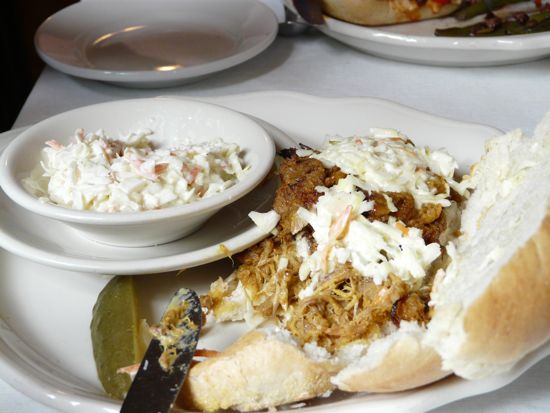
The Pork Barbecue (AdventureMan)
A shrimp and fish dish:

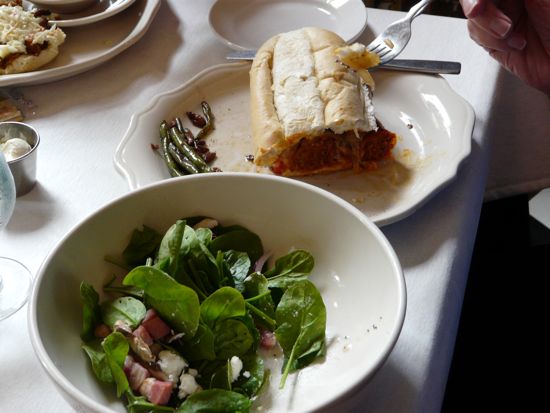
One big guy among us ordered both the spinach salad and the sausage sandwich, and ate every bite, they were both so delicious:
The food was so good, we could only drink coffee afterwards, no room for dessert!
Lunch in Paris (A Love Story With Recipes) by Elizabeth Bond
I just finished this book, and I need to review it so that I can pass it along to my daughter-in-law, who sees France, as I do, through eyes of love. Americans either love France or hate it, for some reason France evokes strong emotions one way or the other.

This author is a New Yorker, and her experiences are not my experiences, because her culture is not my culture. New York is a culture all its own. On the other hand, her experiences as an expat are universal, and her insecurity with the language, the culture and the customs are magnified by her commitment to marrying a French man and living in France for the rest of her life.
For the record, I really loved this book.
Can you read a recipe and have a pretty good idea what it is going to look like and how it will taste? In my family, we read cook books for fun. The recipes Elizabeth Bond has included are great recipes, a great start on French cooking the simple and fresh way. Even someone who has never cooked French food can make most of the dishes she creates in this book. In my very favorite chapter, A New Year’s Feast, there are several recipes for North African dishes I have eaten and loved – and oh, I am eager to try these! Chicken Tajine with Two Kinds of Lemon! Tajine with Meatballs and Spiced Apricots! Oh, YUMMMM!
In one part of the book, the author talks about some very basic differences between how Americans approach life and how the French view life:
I watched the couples walking around the lake. “Maybe it’s the New Yorker in me. I’m too used to rushing around. But everyone here is so relaxed, it’s like they’re moving in slow motion.”
“Why should they rush? They’re not going to get anywhere.”
Sometimes I really have no idea what he is taling about.
“You will never understand. You come from a place where everything is possible.” We lay side by side on the grass, our eyes half closed.
“It’s Henry Miller that said, ‘In America, every man is potentially a president. Here, every man is potentially a zero.’ ”
And then he told me a story.
“When I was sixteen it was time to decide what kind of studies I would pursue. I was the best in the class in Math and Physics, but also the best in Literature. I went to the school library and the woman behind the desk gave me a book. It was called All the Jobs in the World. I looked through it. I found two things I liked: scientific researcher and film director. I brought the book to the front and showed her my choices. ‘Ah non,’ she said, ‘You forgot to look at the key.’ And she pointed to the top of the page. Next to each job were the dollar signs – three dollar signs if the job paid a lot of money, one dollar sign if it paid very little. Next to the dollar sign was a door. If the door was wide open it was very easy to tet this job, if the door was open just a little bit, it was very hard. ‘Regard,‘ she said, ‘You have picked only jobs with no dollar signs and a closed door. Tu n’y arriveras jamais. You will never get there.”
‘You should become an engineer,’ she said. My parents never met anyone who did these other things. We don’t come from that world. They had no friends they could call to get me a job. They were afraid I would fail and they couldn’t help me. They were afraid I would have no place in the society. And I didn’t have the force to do it myself. I didn’t want to disappoint them. So I became an engineer.”
“It’s just like that here. If you want to do something different, if you head sticks up just a little, they cut it off. It’s been like that since the Revolution. You know the saying, Liberte,’ Egalite,’ Fraternite,’ equality is right in the middle. Everyone has got to be the same.
Of all the stories Gwendal has told me, before or since, this one shocked me the most. Never in my life, not once, had anyone ever told me there was something I couldn’t do, couldn’t be.
Have you ever known an expat wife (a woman who has married a man of another culture and lived in his country)? Expat wives are some of the bravest women I have ever met. No matter how long you have been married to a man of another culture, you can still be surprised.
The expat wives I have known have been smart, gifted people, woman who have been blessed to see the world through the eyes of more than one culture, and it changes everything. Their children are amazing – most will speak – and think – in more than one language. They have a sort of international fluidity, as well as intercultural fluency. It isn’t everyone’s choice, but those who chose it often live lives you and I can only begin to imagine. Elizabeth Bond has opened the door a little, and shared some of those experiences with us.
The book I bought has Reader’s Groups questions in the back, and they are good questions. Read the questions first; it gives you food for thought as you read through her experiences.
Kuwait National Seismic Network
I don’t know why I am suddenly getting a lot of hits on an old post I wrote when we had an earthquake in Kuwait, and discovered that Kuwait was vulnerable. Somehow, we thought Kuwait was a low risk earthquake area. I thought about it a lot, on the 10th floor of my tower in Fintas, as I watched how other tall buildings were being constructed. 😦
If you need information on earthquakes and / or tsunamis in Kuwait, here is the best place to start: click the blue type
Alexander McCall Smith and The Saturday Big Tent Wedding Party

Just back from a wonderful two day trip to Botswana, visiting my dear and beloved friend Precious Ramotswe, who owns the #1 Ladies Detective Agency. For her, I make an exception to the paperback book rule (buy paperbacks because hard covers can hurt you if you fall asleep and they fall over) and get on the pre-publication order list so that Amazon will send me the book as soon as it comes out.
The Saturday Big Tent Wedding Party arrived Wednesday night. My husband was expecting a friend, and when the doorbell rang I thought “oh my, he is really early!” but it was the UPS guy, who had left a book-sized package on my doorstep. I had just finished an easy but fun book (The Map Thief by Heather Terrell) and was at odd ends as to what to read next, and this was an easy answer. As my husband drank Arabic coffee and sweet sweet Arabic tea, and ate delicate Middle Eastern treats downstairs, I got to start The Saturday Big Tent Wedding Party.
You know the books. They aren’t difficult to read, but while you are reading, you are transported to another world. Precious Ramotswe’s Botswana is not a world without problems, but the solutions to the problems are often found in softer gentler ways, ways that would seem counter-intuitive in our culture, but make total sense when you are raised in Botswana. There is a value placed on peaceable interaction, and maintaining relationships, on forgiveness, and going to extra mile. It’s a sweet world, and a great escape.
As usual, there are several intertwining plot lines with ingenious and unexpected solutions. I suspect that is what keeps me glued to this series – I cannot anticipate the solutions. That, and the gentleness of her outlook, the sweetness of life in Botswana, and the dignity and integrity of McCall’s primary characters.
I don’t know how McCall manages to keep the series fresh, but he avoids the formulaic and I find each book a treat. My favorite part of this book is how Mma Potokwane manages to wangle and invitation to Mma Makutsi’s wedding:
Mma Potokwane noticed the other woman’s uncertainty. “Yes,” she continued. “There’s that problem. And then there’s another problem. Problems come in threes, I find, Mma. So the next one – Problem number two, so to speak – is the cooking of food. You know what I find, Mma, it is this: the people doing the cooking never have enough pots. They say they do, but they do not. And right at the last moment they discover that there are not enough pots, or, more likely, the pots they have are too small. A pot may be big enough to cook your meat and pap at home, just for a family, but do not imagine that it will be big enough to cook for a couple of hundred people. You need big, catering-size pots for that.”
She was now warming to her theme. “And the third problem is the food itself. You may think that you have enough for the feast, and you may be right when it comes to the meat. People usually have enough meat – often rather too much, in fact. But they forget that after their guests have eaten a lot of meat, they need something sweet, and often they have made no arrangements for that. A wedding cake? Yes, but there will only be one small piece of that for each guest – usually not enough. So people find themselves wishing that they had had the foresight to get a supply of ordinary cake for the guests to eat with their tea. And where is this cake? Not there, Mma.”
Mma Ramotswe glanced at Mma Makutsi; this was not the way to speak to a nervous bride, she thought. “I’m sure that everything will work out well,” she said reassuringly. “And if there are any problems, they will surely just be small ones – nothing to worry about.”
Mma Potokwane looked doubtful. “I hope so,” she said. “But in my experience, it never works out like that. I think it’s better to be realistic about these things.”
Mma Makutsi picked up her pencil to add something to her list. “You said something about pots, Mma. Where would I be able to get these big, catering-size pots?”
Mma Potokwane examined her fingernails. “Well, we have them at the orphan farm. Each of the house mothers has a very large pot. I’m sure that we could do something . . . ”
Run to your bookstore and buy The Saturday Big Tent Wedding Party!
You Must Not Be From Around Here
When I got back to Kuwait, I had to regain my driving courage all over again. I remember growing up, when we would go to fairs and carnivals, where I loved to ride the bumper cars. We were all aggressive; we wanted to win. It never occurred to me that there would be countries where people would drive real cars that way. Touch wood, I never had an accident in Kuwait, and I learned how to drive aggressively but somehow stayed safe.
Driving in Pensacola is a piece of cake – most of the time. Suddenly, we have some TRAFFIC. There are cars on the road from all over, never fewer than two or three in every car, usually dressed in beach gear, and full of high spirits. It is Spring Break. People are flocking to the gorgeous white beaches of Pensacola, spilling out of the lively beach restaurants, and even some of the restaurants in downtown Pensacola. College students, families (local schools are also on spring break) and the snow birds are filling our roads, not entirely sure where they are going.
In one of our favorite nearby restaurants, we saw some college age kids come in, and then another group, all greeted familiarly by the owners, and then their tables were joined so they could all sit together – locals, back home from university for Spring Break.
It’s a sweet time of the year. The weather is in the high 70’s, cooling down at night. We have the a/c off, we keep it off as long as we can.
Cutting for Stone by Abraham Verghese

Someone in my book club in Qatar mentioned this book, Cutting for Stone, a while back, and I bought it, but it has sat for months on my to-read shelf (LOL, there are actually several, but one with the most important books, and another with the ‘guilty pleasures,’ the ones I am addicted to and save as a reward for good behavior, like vacuuming.)
When a good friend said she was reading it, and that it was good, I decided to move it up in priority, sort of like taking medicine, read a book that is good for you.
Oh WOW.
First, it is a great, absorbing story. Twin boys are born, totally unexpected, to an Indian Catholic nun and an English surgeon, working in Addis Ababa. How they were conceived is a mystery. The mother dies in childbirth, the father flees in horror, the children are born conjoined at the head and must be separated. The boys are adopted by an Indian couple, doctors at the hospital, and are raised with love and happiness.
That’s just the beginning!
I’ve always wanted to go to Ethiopia and Eritrea. I want to visit Lalibela, and some of the oldest Christian churches in the world. When my father was sick, he had a home health aid from Ethiopia, Esaiahs, who told me about the customs in his church, and how Ethiopian Christianity is very close to Judaism, with men and women separated in the church, and eating pork forbidden.
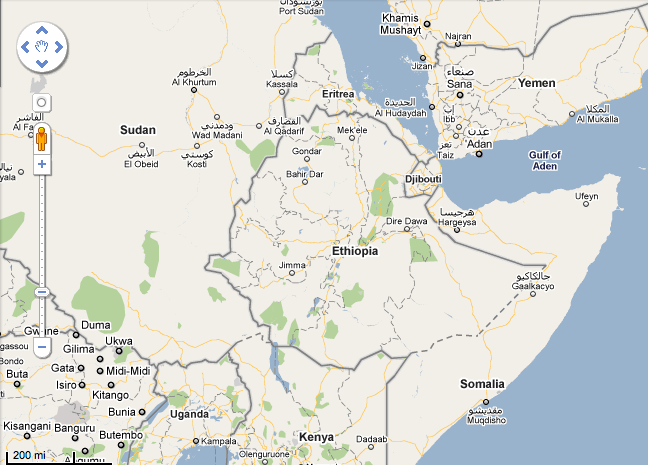
Reading this book, I felt like I had lived there, and I want to go back. The author captures the feelings, the smells, the visuals, the sounds, and if I awoke in a bungalow at the MIssing (Mission) Hospital, I would say “Ah yes! I remember this!”
I kept marking sections of this book that I loved. Here is one:
They parked at Ghosh’s bungalow and walked to the rear or Missing, where the bottlebrush was so laden with flowers that it looked as if it had caught fire. The property edge was marked by the acacias, their flat tops forming a jagged line against the sky. Missing’s far west corner was a promontory looking over a vast valley. That acreage as far as the eye could see belonged to a ras – a duke – who was relative of His Majesty, Haile Selassie.
A brook, hidden by boulders, burbled; sheep grazed under the eye of a boy who sat polishing his teeth with a twig, his staff near by. He squinted at Matron and Ghosh and then waved. Just like in the days of David, he carried a slingshot. It was a goatherd like him, centuries before, who had noticed how frisky his animals became after chewing a particuar red berry. From that serendipitous discovery, the coffee habit and trade spread to Yemen, Amsterdam, the Caribbean, South America, and the world, but it had all begun in Ethiopia, in a field like this.
We live inside the hearts and minds of doctors, some practicing under the worst possible conditions, and learn how they make their decisions and why. Verghese is a compassionate author; while his characters may be flawed, they are forgivable and forgiven.
Another section I loved, the man speaking is Ghosh, the man who adopted the twins with Hema, another doctor:
“My genius was to know long ago that money alone wouldn’t make me happy. Or maybe that’s my excuse for not leaving you a huge fortune! I certainly could have made more money if that had been my goal. But one thing I won’t have is regrets. My VIP patients often regret so many things on their deathbeds. They regret the bitterness they’ll leave in people’s hearts. They realize that no money, no church service, no eulogy, no funeral procession no matter how elaborate, can remove the legacy of a mean spirit.”
Things in Ethiopia get sticky, politically, and one of the twins is forced to flee, implicated in an airplane hijacking only because he was raised with a young woman involved. He is spirited into Eritrea, where he awaits his ride out to Kenya, and he helps the Eritrean rebels when large numbers of wounded are brought into his area. When the time comes to leave, his thoughts will strike a chord in anyone who has ever been an expat:
Two days later I took leave of Solomon. There were dark rings under his eyes and he looked ready to fall over. There was no questioning his purpose or dedication. Solomon said “Go and good luck to you. This isn’t your fight. I’d go if I were in your shoes. Tell the world about us.”
This isn’t your fight. I thought about that as I trekked to the border with two escorts. What did Solomon mean? Did he see me as being on the Ethiopian side, on the side of the occupiers? No, I think he saw me as an expatriate, someone without a stake in this war. Despite being born in the same compound as Genet, despite speaking Amharic like a native, and going to medical school with him, to Solomon I was a ferengi – a foreigner. Perhaps he was right, even though I was loath to admit it. If I were a patriotic Ethiopian, would I not have gone underground and joined the royalists, or others who were trying to topple Sergeant Mengistu? If I cared about my country, shouldn’t I have been willing to die for it?
The book has a lot of observations about coming to America; some of which made me laugh, some which made me groan. Coming back is always a shock to people who have lived abroad for a time, but it is a huge shock to those coming for the first time:
The black suited drivers led their passengers to sleek black cars, but myman led me to a big yellow taxi. In no time we were driving out of Kennedy Airport, heading to the Bronx. We merged at what I thought was a dangerous speed onto a freeway and into the slipstream of racing vehicles. “Marion, jet travel has damaged your eardrums,” I said to myself, because the silence was unreal. In Africa, cars ran not on petrol but on the squawk and blare of their horns. Not so here; the cars were near silent, like a school of fish. All I heard was the whish of rubber on concrete or asphalt.
As I neared the end, I read more slowly, unwilling for this book to end. It is one of the most vivid and moving books I have ever read. AdventureMan has gone online to find the nearest Ethiopian restaurant so we can have some injera and wot.
Chamber Music Concerts at Old Christ Church
AdventureMan and I have discovered a concert series we really like. The University of West Florida Music Department has a chamber music series, giving students a chance to play publicly, and offering chamber music lovers (moi) a chance to see and hear them perform in a delightfully intimate setting, old Christ Church in downtown Pensacola. It’s so far downtown that it’s almost on the waterfront.
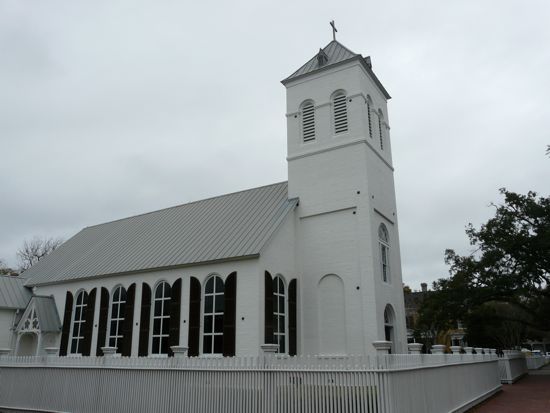
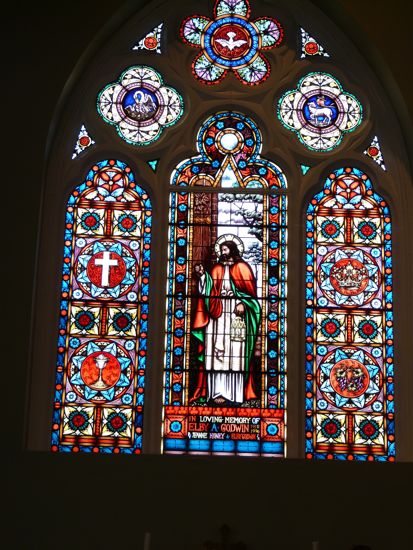
The concerts take place once a month, Wednesdays at noon, and are FREE. There is a donation container in the entry at Christ Church but there is no one shaking it or looking at you meaningfully. If you can’t make a donation, the donation police are not going to hunt you down.
Meanwhile, if you show up for these concerts, you are in for a treat. The Director of the chamber music program, Hedi Salanki-Rubardt, gives her students a lot of leeway, and a lot of inspiration, and you can see they truly love what they are doing, and enjoy being a part of the program.
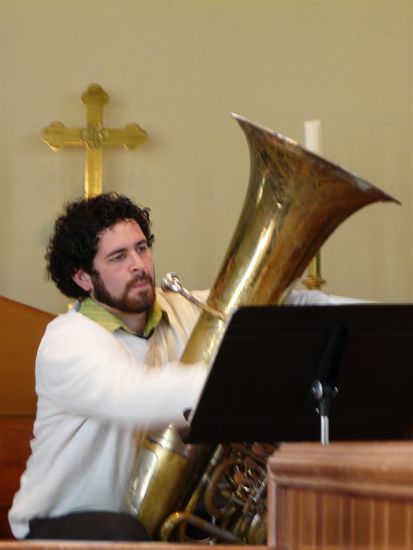
Giustino Carrano – tuba
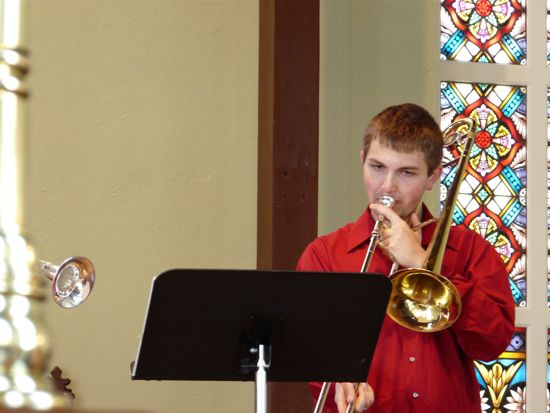
Matthew DeDowell – trombone
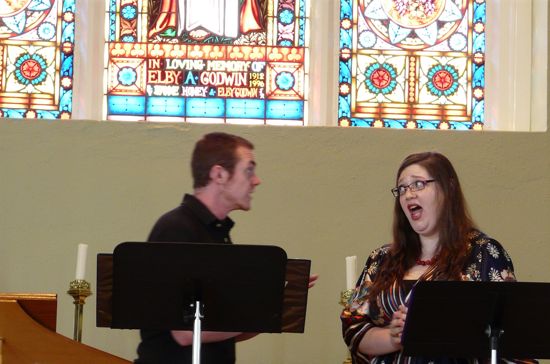
Allison Gilliard- soprano Marshall Corzette – baritone
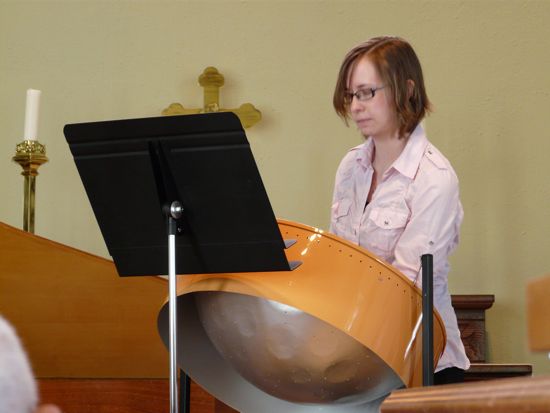
Lynsey Boothe – steel drum
You don’t usually think of a steel drum as a traditional chamber music instrument, but Hedi Salanki played the harpsichord, and Lynsey Boothe played the steel drum and they rocked Vivaldi. It was a lot of fun.
Recent Comments
ExpatAlien on What Country am I Living … intlxpatr on Yellowstone: Old Faithful to C… Michelle on Yellowstone: Old Faithful to C… Cathy on No Grown-Ups in Charge intlxpatr on Waiting for Snow Wikipedia Donate Button

Amazina


Early Voting in Florida


 Here There and Everywhere