Kuwait National Seismic Network
I don’t know why I am suddenly getting a lot of hits on an old post I wrote when we had an earthquake in Kuwait, and discovered that Kuwait was vulnerable. Somehow, we thought Kuwait was a low risk earthquake area. I thought about it a lot, on the 10th floor of my tower in Fintas, as I watched how other tall buildings were being constructed. 😦
If you need information on earthquakes and / or tsunamis in Kuwait, here is the best place to start: click the blue type
Alexander McCall Smith and The Saturday Big Tent Wedding Party
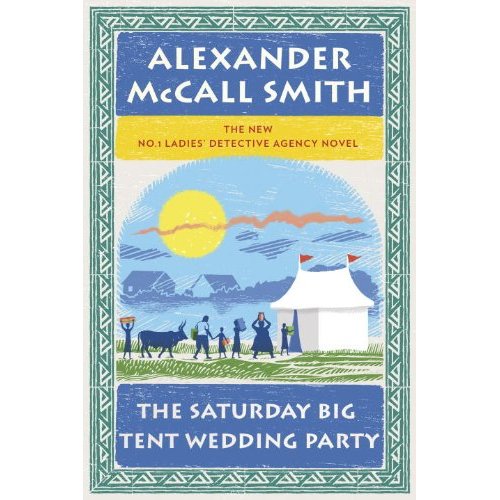
Just back from a wonderful two day trip to Botswana, visiting my dear and beloved friend Precious Ramotswe, who owns the #1 Ladies Detective Agency. For her, I make an exception to the paperback book rule (buy paperbacks because hard covers can hurt you if you fall asleep and they fall over) and get on the pre-publication order list so that Amazon will send me the book as soon as it comes out.
The Saturday Big Tent Wedding Party arrived Wednesday night. My husband was expecting a friend, and when the doorbell rang I thought “oh my, he is really early!” but it was the UPS guy, who had left a book-sized package on my doorstep. I had just finished an easy but fun book (The Map Thief by Heather Terrell) and was at odd ends as to what to read next, and this was an easy answer. As my husband drank Arabic coffee and sweet sweet Arabic tea, and ate delicate Middle Eastern treats downstairs, I got to start The Saturday Big Tent Wedding Party.
You know the books. They aren’t difficult to read, but while you are reading, you are transported to another world. Precious Ramotswe’s Botswana is not a world without problems, but the solutions to the problems are often found in softer gentler ways, ways that would seem counter-intuitive in our culture, but make total sense when you are raised in Botswana. There is a value placed on peaceable interaction, and maintaining relationships, on forgiveness, and going to extra mile. It’s a sweet world, and a great escape.
As usual, there are several intertwining plot lines with ingenious and unexpected solutions. I suspect that is what keeps me glued to this series – I cannot anticipate the solutions. That, and the gentleness of her outlook, the sweetness of life in Botswana, and the dignity and integrity of McCall’s primary characters.
I don’t know how McCall manages to keep the series fresh, but he avoids the formulaic and I find each book a treat. My favorite part of this book is how Mma Potokwane manages to wangle and invitation to Mma Makutsi’s wedding:
Mma Potokwane noticed the other woman’s uncertainty. “Yes,” she continued. “There’s that problem. And then there’s another problem. Problems come in threes, I find, Mma. So the next one – Problem number two, so to speak – is the cooking of food. You know what I find, Mma, it is this: the people doing the cooking never have enough pots. They say they do, but they do not. And right at the last moment they discover that there are not enough pots, or, more likely, the pots they have are too small. A pot may be big enough to cook your meat and pap at home, just for a family, but do not imagine that it will be big enough to cook for a couple of hundred people. You need big, catering-size pots for that.”
She was now warming to her theme. “And the third problem is the food itself. You may think that you have enough for the feast, and you may be right when it comes to the meat. People usually have enough meat – often rather too much, in fact. But they forget that after their guests have eaten a lot of meat, they need something sweet, and often they have made no arrangements for that. A wedding cake? Yes, but there will only be one small piece of that for each guest – usually not enough. So people find themselves wishing that they had had the foresight to get a supply of ordinary cake for the guests to eat with their tea. And where is this cake? Not there, Mma.”
Mma Ramotswe glanced at Mma Makutsi; this was not the way to speak to a nervous bride, she thought. “I’m sure that everything will work out well,” she said reassuringly. “And if there are any problems, they will surely just be small ones – nothing to worry about.”
Mma Potokwane looked doubtful. “I hope so,” she said. “But in my experience, it never works out like that. I think it’s better to be realistic about these things.”
Mma Makutsi picked up her pencil to add something to her list. “You said something about pots, Mma. Where would I be able to get these big, catering-size pots?”
Mma Potokwane examined her fingernails. “Well, we have them at the orphan farm. Each of the house mothers has a very large pot. I’m sure that we could do something . . . ”
Run to your bookstore and buy The Saturday Big Tent Wedding Party!
You Must Not Be From Around Here
When I got back to Kuwait, I had to regain my driving courage all over again. I remember growing up, when we would go to fairs and carnivals, where I loved to ride the bumper cars. We were all aggressive; we wanted to win. It never occurred to me that there would be countries where people would drive real cars that way. Touch wood, I never had an accident in Kuwait, and I learned how to drive aggressively but somehow stayed safe.
Driving in Pensacola is a piece of cake – most of the time. Suddenly, we have some TRAFFIC. There are cars on the road from all over, never fewer than two or three in every car, usually dressed in beach gear, and full of high spirits. It is Spring Break. People are flocking to the gorgeous white beaches of Pensacola, spilling out of the lively beach restaurants, and even some of the restaurants in downtown Pensacola. College students, families (local schools are also on spring break) and the snow birds are filling our roads, not entirely sure where they are going.
In one of our favorite nearby restaurants, we saw some college age kids come in, and then another group, all greeted familiarly by the owners, and then their tables were joined so they could all sit together – locals, back home from university for Spring Break.
It’s a sweet time of the year. The weather is in the high 70’s, cooling down at night. We have the a/c off, we keep it off as long as we can.
Cutting for Stone by Abraham Verghese

Someone in my book club in Qatar mentioned this book, Cutting for Stone, a while back, and I bought it, but it has sat for months on my to-read shelf (LOL, there are actually several, but one with the most important books, and another with the ‘guilty pleasures,’ the ones I am addicted to and save as a reward for good behavior, like vacuuming.)
When a good friend said she was reading it, and that it was good, I decided to move it up in priority, sort of like taking medicine, read a book that is good for you.
Oh WOW.
First, it is a great, absorbing story. Twin boys are born, totally unexpected, to an Indian Catholic nun and an English surgeon, working in Addis Ababa. How they were conceived is a mystery. The mother dies in childbirth, the father flees in horror, the children are born conjoined at the head and must be separated. The boys are adopted by an Indian couple, doctors at the hospital, and are raised with love and happiness.
That’s just the beginning!
I’ve always wanted to go to Ethiopia and Eritrea. I want to visit Lalibela, and some of the oldest Christian churches in the world. When my father was sick, he had a home health aid from Ethiopia, Esaiahs, who told me about the customs in his church, and how Ethiopian Christianity is very close to Judaism, with men and women separated in the church, and eating pork forbidden.
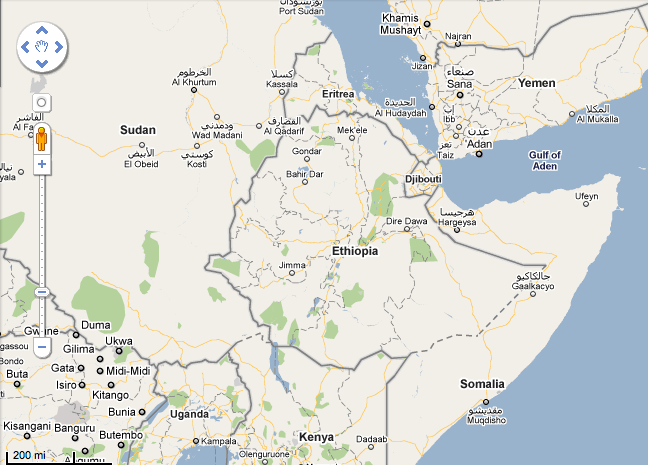
Reading this book, I felt like I had lived there, and I want to go back. The author captures the feelings, the smells, the visuals, the sounds, and if I awoke in a bungalow at the MIssing (Mission) Hospital, I would say “Ah yes! I remember this!”
I kept marking sections of this book that I loved. Here is one:
They parked at Ghosh’s bungalow and walked to the rear or Missing, where the bottlebrush was so laden with flowers that it looked as if it had caught fire. The property edge was marked by the acacias, their flat tops forming a jagged line against the sky. Missing’s far west corner was a promontory looking over a vast valley. That acreage as far as the eye could see belonged to a ras – a duke – who was relative of His Majesty, Haile Selassie.
A brook, hidden by boulders, burbled; sheep grazed under the eye of a boy who sat polishing his teeth with a twig, his staff near by. He squinted at Matron and Ghosh and then waved. Just like in the days of David, he carried a slingshot. It was a goatherd like him, centuries before, who had noticed how frisky his animals became after chewing a particuar red berry. From that serendipitous discovery, the coffee habit and trade spread to Yemen, Amsterdam, the Caribbean, South America, and the world, but it had all begun in Ethiopia, in a field like this.
We live inside the hearts and minds of doctors, some practicing under the worst possible conditions, and learn how they make their decisions and why. Verghese is a compassionate author; while his characters may be flawed, they are forgivable and forgiven.
Another section I loved, the man speaking is Ghosh, the man who adopted the twins with Hema, another doctor:
“My genius was to know long ago that money alone wouldn’t make me happy. Or maybe that’s my excuse for not leaving you a huge fortune! I certainly could have made more money if that had been my goal. But one thing I won’t have is regrets. My VIP patients often regret so many things on their deathbeds. They regret the bitterness they’ll leave in people’s hearts. They realize that no money, no church service, no eulogy, no funeral procession no matter how elaborate, can remove the legacy of a mean spirit.”
Things in Ethiopia get sticky, politically, and one of the twins is forced to flee, implicated in an airplane hijacking only because he was raised with a young woman involved. He is spirited into Eritrea, where he awaits his ride out to Kenya, and he helps the Eritrean rebels when large numbers of wounded are brought into his area. When the time comes to leave, his thoughts will strike a chord in anyone who has ever been an expat:
Two days later I took leave of Solomon. There were dark rings under his eyes and he looked ready to fall over. There was no questioning his purpose or dedication. Solomon said “Go and good luck to you. This isn’t your fight. I’d go if I were in your shoes. Tell the world about us.”
This isn’t your fight. I thought about that as I trekked to the border with two escorts. What did Solomon mean? Did he see me as being on the Ethiopian side, on the side of the occupiers? No, I think he saw me as an expatriate, someone without a stake in this war. Despite being born in the same compound as Genet, despite speaking Amharic like a native, and going to medical school with him, to Solomon I was a ferengi – a foreigner. Perhaps he was right, even though I was loath to admit it. If I were a patriotic Ethiopian, would I not have gone underground and joined the royalists, or others who were trying to topple Sergeant Mengistu? If I cared about my country, shouldn’t I have been willing to die for it?
The book has a lot of observations about coming to America; some of which made me laugh, some which made me groan. Coming back is always a shock to people who have lived abroad for a time, but it is a huge shock to those coming for the first time:
The black suited drivers led their passengers to sleek black cars, but myman led me to a big yellow taxi. In no time we were driving out of Kennedy Airport, heading to the Bronx. We merged at what I thought was a dangerous speed onto a freeway and into the slipstream of racing vehicles. “Marion, jet travel has damaged your eardrums,” I said to myself, because the silence was unreal. In Africa, cars ran not on petrol but on the squawk and blare of their horns. Not so here; the cars were near silent, like a school of fish. All I heard was the whish of rubber on concrete or asphalt.
As I neared the end, I read more slowly, unwilling for this book to end. It is one of the most vivid and moving books I have ever read. AdventureMan has gone online to find the nearest Ethiopian restaurant so we can have some injera and wot.
Chamber Music Concerts at Old Christ Church
AdventureMan and I have discovered a concert series we really like. The University of West Florida Music Department has a chamber music series, giving students a chance to play publicly, and offering chamber music lovers (moi) a chance to see and hear them perform in a delightfully intimate setting, old Christ Church in downtown Pensacola. It’s so far downtown that it’s almost on the waterfront.
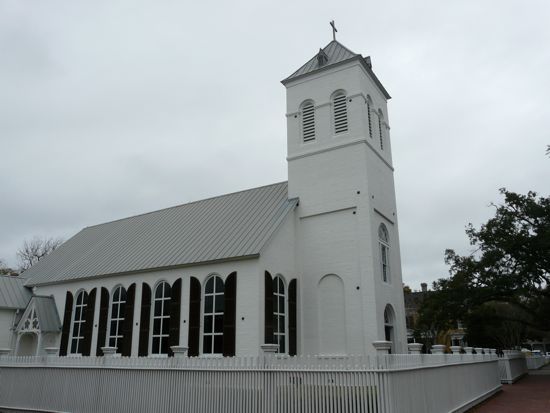
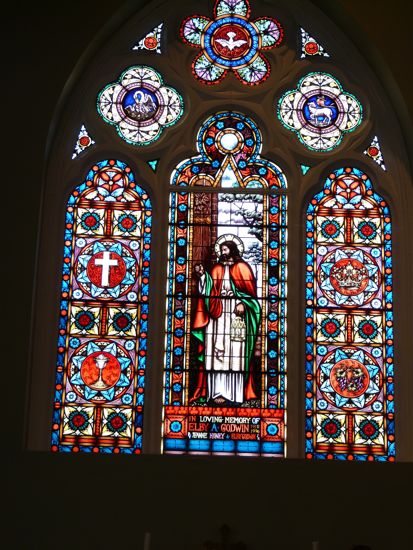
The concerts take place once a month, Wednesdays at noon, and are FREE. There is a donation container in the entry at Christ Church but there is no one shaking it or looking at you meaningfully. If you can’t make a donation, the donation police are not going to hunt you down.
Meanwhile, if you show up for these concerts, you are in for a treat. The Director of the chamber music program, Hedi Salanki-Rubardt, gives her students a lot of leeway, and a lot of inspiration, and you can see they truly love what they are doing, and enjoy being a part of the program.
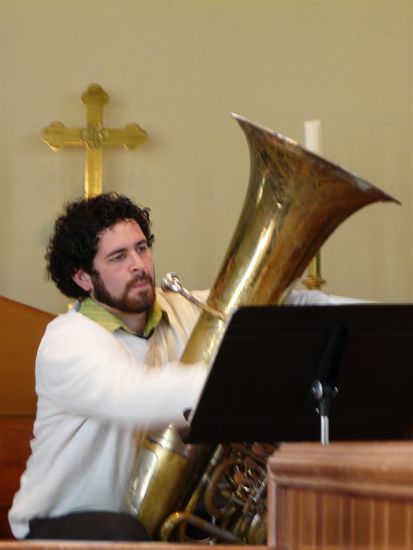
Giustino Carrano – tuba
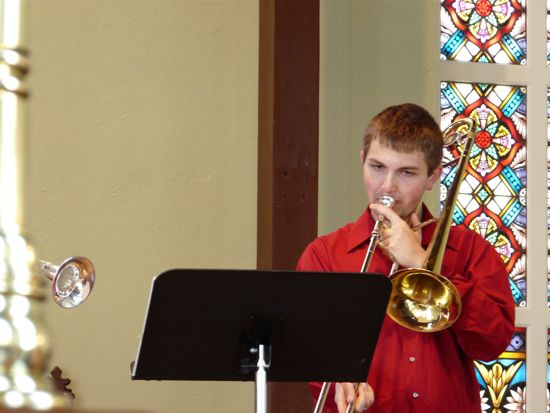
Matthew DeDowell – trombone
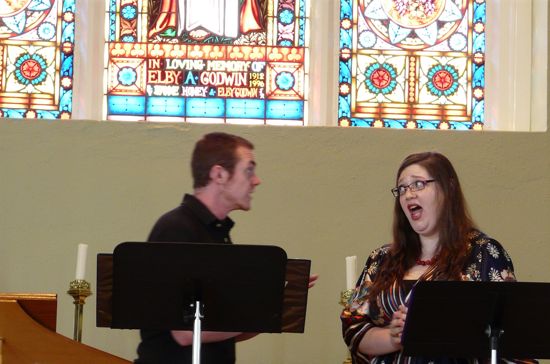
Allison Gilliard- soprano Marshall Corzette – baritone
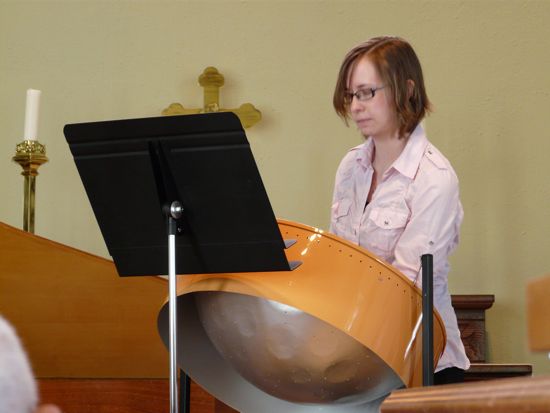
Lynsey Boothe – steel drum
You don’t usually think of a steel drum as a traditional chamber music instrument, but Hedi Salanki played the harpsichord, and Lynsey Boothe played the steel drum and they rocked Vivaldi. It was a lot of fun.
Aftermath: Americans at War in the Muslim World
I guess it is no surprise to you that I love National Public Radio / BBC, etc. I learn things I never even knew I didn’t know. As I sat down to write a very different blog entry, I heard the following interview with journalist Nir Rosen, who talks about Americans and our outdated views of the Middle East and Muslim world.
You may be able to listen to the entire interview live by going to NPR Programs and clicking on The US At War in the Muslim World by Nir Rosen.
The US At War In The Muslim World: ‘Aftermath’ With Nir Rosen
Steve Scher
01/04/2011 at 9:00 a.m.
The US invaded Iraq nearly seven years ago. What have been the consequences of going to war in a Muslim country? Have the US invasions of Iraq and Afghanistan created more militancy among the Muslim population there? Have the radical Islamists gained a stronger following as a result of our presence there?
Journalist Nir Rosen has been asking these questions in his reporting from outside the green zones in Iraq and Afghanistan. His new book “Aftermath” tells a side of the story we rarely hear.
Santa Lucia / Saint Lucy
Today is the feast day of St. Lucy, or, as I was growing up in Alaska, surrounded by Scandinavian fishermen and their families, Santa Lucia. In Swedish families there is a tradition that the eldest daughter, on Santa Lucia day, wears a wreath of candles and brings her parents coffee and special saffron buns in bed. People always make jokes about someone following her with a bucket of water, but I can imagine there were mishaps – imagine, mixing candles and hair. As you can see in the photo, thought, the candles are tall – at least at the beginning.
Never kid yourselves. Children love blood and gore, and love to be a little bit scared. The Grimm Brothers knew this, and if you have ever read their original stories, the hairs on the back of your neck would rise and you would say to yourself “How can these be stories for children??” Think about it – Hansel and Gretel abandoned by their own parents to starve in the woods? Girls with really mean stepmothers, who treated them unfairly?
Back before all the romantic literature on zombies and vampires, we children would stand out in the bus stop (in winter, the sun barely rises during the long Alaskan winters) and tell each other stories of the saints in the bible. Many of them died horrible deaths, and this one ended “and then they took her eyes out of her head, and she was still alive!!!!” I don’t remember ever hearing the miracle of the restoration of her sight, in fact, I thought she was killed, martyred, but here is her story, for those who want to know what Santa Lucia’s day is all about.

LUCY
VIRGIN AND MARTYR, abt. 304
The early Roman lists of martyrs commemorate Lucy, virgin and martyr, on 13 December, and her name, with that of Agatha, appears in the Roman Liturgy as an example of those who have gone before us, in whose company we join in giving thanks and praise to God. Aside from this, little is known of her, except that she lived in Syracuse in Sicily, and probably died around 304. Her name, which means “light,” probably accounts for the story that her eyes were put out and her eyesight miraculously restored, and may be connected with the fact that her feast occurs near the time when (in the Northern Hemisphere) the nights are longest.

In Sweden and elsewhere, the day is observed by having one of the daughters of the house dress in a white robe with a crown of lighted candles and go singing from room to room (presumably followed by an adult with a fire extinguisher) early in the morning when it is still dark to awaken the other family members and to offer them St. Lucy’s Cakes and hot coffee.
Ember Wednesday (of the winter season) is defined as the Wednesday after Lucy’s Day. (An equivalent definition would be: the Wednesday preceding the last Sunday before Christmas.)
The above in dark type is from The Lectionary which publishes daily readings and these stories of the Saints put together by James Kiefer.
Ancient Civilizations Hidden in The Persian Gulf?
I found this first thing this morning on AOL Science News
Theory Points to Civilization Under Persian Gulf
Hugh Collins
Contributor

(Dec. 11) — The waters of the Persian Gulf may be hiding a lost civilization that could change our understanding of human history, according to new research.
This huge fertile stretch of land may have been home to humans from about 74,000 years ago until about 8,000 years ago, according to Discovery News.
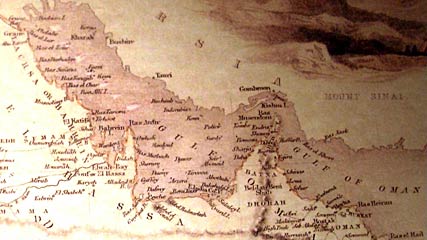
When the waters around them began to rise, these early humans may have migrated to what is now the gulf shoreline, founding new settlements there, according to a paper published in the December issue of Current Anthropology.
Wikipedia
New research suggests the waters of the Persian Gulf, depicted here in an historical map of the region, may be hiding a lost civilization that could change our understanding of human history.
Over the past several years, archaeologists have uncovered new evidence of those shoreline settlements.
“Where before there had been but a handful of scattered hunting camps, suddenly, over 60 new archaeological sites appear virtually overnight,” Jeffrey Rose of the University of Birmingham said, according to LiveScience.
“These settlements boast well-built, permanent stone houses, long-distance trade networks, elaborately decorated pottery, domesticated animals, and even evidence for one of the oldest boats in the world,” Rose said.
Rose says such sophisticated settlements couldn’t have developed so quickly, which is why he believes even older settlements lie beneath gulf waters. If true, Rose’s hypothesis could offer a clue as to how and when human beings first departed Africa and settled in the Middle East.
This has long been a topic for debate, with some scientists saying that humans made the migration 125,000 years ago, while others put it closer to 60,000 years ago, LiveScience said.
The now-submerged slice of land would have been about the size of Great Britain, Rose said.
Since it would have received water from the rivers Tigris, Euphrates, Karun and Wadi Baton, it would have offered a fertile refuge from the nearby harsh deserts.
“I think Jeff’s theory is bold and imaginative, and hopefully will shake things up,” Oxford Brookes University’s Robert Carter told LiveScience.
“It would completely rewrite our understanding of the out-of-Africa migration. It is far from proven, but Jeff and others will be developing research programs to test the theory,” Carter said.
Rose admits that much work remains be done. So far, he has focused on archaeological sites on dry land and studies of geological history.
Finding some physical evidence beneath the waves of the ocean would be a major advance in proving that his theory is correct.
“We would need to find a submerged site, and excavate it underwater,” Rose said, according to LiveScience. “This would likely only happen as the culmination of years of survey in carefully selected areas.”
The waters of the Persian Gulf rose 8,000 years ago, perhaps because of the collapse of a huge glacial dam in Canada, according to Postmedia News.
This event caused water levels to rise across the world. This catastrophic event may have forced humans out of the Gulf basin and given rise to ancient stories such as that of Noah’s Ark.
“Certainly, I think there is compelling evidence to suggest that both the flood and Eden myths may be rooted in these events around the Gulf basin,” Rose said, according to Discovery News.
The Christmas Lights of Pensacola
Last night, after our son and his family left after dinner, AdventureMan had a gleam in his eye. (No! not that gleam!)
“Want to go out and look at the Christmas lights?” he asked.
“Oh! Yes! Yes!” He knows I love the lights.
Pensacola isn’t so over-the-top as the Tampa Bay area used to be. Pensacola uses a lot more white, a lot less music and moving displays. Pensacola is more restrained, and more traditional.
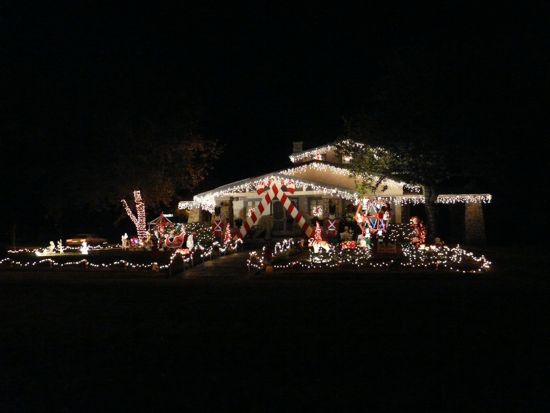
Just so you will know where I am coming from, here is my favorite:

Thoughtful, restrained, elegant. There are a lot of this kind of display, and I love them. I also love the others, although many are more exuberant. There seem to be a lot of white deer, and . . . some of them move their heads. Yes! I am telling the truth!
Some people just get totally into the spirit of the season, and go all out. Here is a sampling of what we saw:








I can’t help but find this funny; Frosty the snowman and the Creche juxtaposed:

Along with Santas on rockets, LOL!

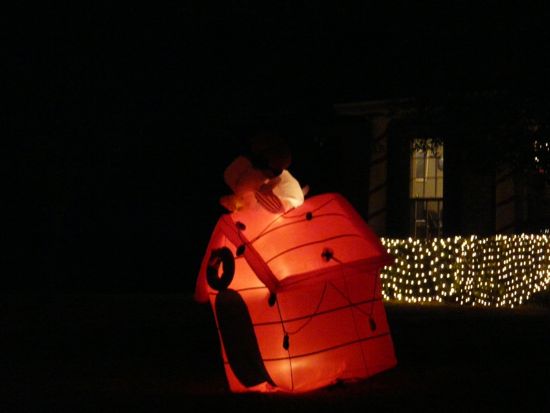
This is a Christmas Snoopy as an aviator on top of his doghouse. What does it have to do with Christmas? LLOOLL!

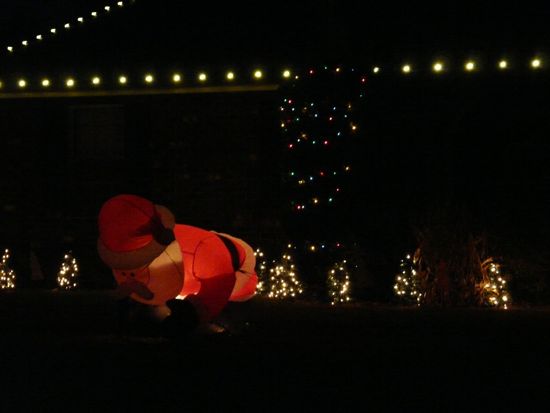
A lot of people are using balloons, with varying results. Santa on a motorcycle, Santa on rockets, all kinds of balloons, problematic because sometimes balloons loose air.
Here are Santas, and then a Santa loosing air, LOL


I love the way WordPress has put snow on all the blogs for December (you can turn it off if you don’t like it) but with these photos, snow falling is perfect. 🙂
Game Day
Today, more than any other Saturday, I saw Game Day T-shirts, not just on men and women, but on entire families. Flying from Pensacola to Atlanta and back, the flights were full of mostly FSU and Auburn. Sitting behind us at lunch today was a family of five, mom, dad, two sons and a baby, all dressed in Auburn colors (Pensacola is in the part of Florida sometimes called FloriBama because it is boarded on two sides by Alabama, and the lines are very fine.
Yes, I was wearing garnet and gold, but it was subtle. 🙂
Recent Comments
intlxpatr on Shampoo Ginger tigerbutterya0c5ff1d… on Shampoo Ginger intlxpatr on British Soldier Kidnapped, Esc… John on British Soldier Kidnapped, Esc… intlxpatr on British Soldier Kidnapped, Esc… Wikipedia Donate Button

Amazina


Early Voting in Florida


