Traffic ENFORCEMENT
Whoda thunk?
I am (almost) speechless!
Can this be a turning point in Kuwait? Are we going to have laws that might actually be meant to be followed? Wooo Hoooo, traffic police, Woooo Hoooooo, court of law!
From The Arab Times: Kuwait Crime:
‘Deport motorist’ – Driving on E-lane
KUWAIT CITY : Assistant Undersecretary for Traffic Affairs, Major-General Thabet Al-Muhanna has ordered the deportation of an Arab man who was caught driving at 140 km/h along the Fifth Ring Motorway, reports Al-Seyassah daily.
According to a security source Al-Muhanna saw the motorist driving along the emergency lane and ordered his immediate arrest.
After his arrest the man admitted to committing the offence. He apologized and said he was in a hurry. However, the man will be administratively deported, say sources.
Questions and Comments: Woo Hooo, al-Muhanna!
Suggestion: With the great advent of tiny, easily carried cameras and cell phone cameras, photographic evidence is easy to provide. How about the Ministry of Interior setting up a website where we can send them photos of people WE see in flagrant violation of the laws?
A Case of Two Cities with Inspector Chen: Qiu Xiaolong
When my sister Sparkle recommends a book, I have learned to listen. I think I ordered this book about six months ago, but never cared enough to actually read it. After reading a recent Donna Leon (like dessert, I use it as a reward for reading something more challenging) I decided it was time to tackle Qiu Xiaolong.
I believe A Case of Two Cities is the first in the series; I tried very hard to make sure it was. When I first started reading it, it was difficult, but it didn’t take long to adjust. When you read a detective story written in a foreign culture, you have to park your old way of thinking, and quickly adapt to a new way of thinking. First, you have to learn what that new way of thinking is. They don’t just tell you at the beginning of the book “Here are the differences in values – you will notice . . .” no, but Qiu Xiaolong is courteous enough to take us by the hand and lead us gently into the Chinese way of thinking, the Chinese way of getting things done, and the technicalities of Chinese detective work.
As we meet Inspector Chen, a published poet, and a detective, ten pages into the book, a new anti-corruption campaign is starting in Shanghai, and Inspector Chen has been given a special assignment – a qinchai dacheng – as “Emperor’s Special Envoy with an Imperial Sword.” Even though imperial days are long gone, this warrant gives him emergency powers to search and arrest without reporting to anyone – and without a warrant. He is to seek and find Xing, a corrupt businessman who has caused huge loss to the national economy and is in danger of tarnishing the Chinese national image, and Xing’s associates.
Just as in the Donna Leon books about Commissario Guido Brunetti, and the Bowen books about Gabriel duPre, and James Lee Burke’s books about New Orleans, and Cara Black’s books about Aimee LeDuc, the detectives and investigators have to walk a fine line between going after the criminal and overstepping their warrant – stepping on the toes of those also engaged in corruption so entrenched that it has become a way of life. Each of these detectives has to maneuver that treacherously fine line – who determines when corruption has become too much? It usually puts their own lives in danger at some point, as those manipulating the system and making a fortune out of it do not want to be caught, do not want to be exposed, and will go to great lengths to protect their ill-gotten gains.
And just as in the above books, the book is more about the actual process than the crime itself. Inspector Chen must go about his task indirectly, having chats here and there, gathering threads of information with which he tries to weave a plausible tapestry of events.
As I was reading A Case of Two Cities, I kept making AdventureMan take me out for Chinese food! The meetings are often held over food, and the descriptions are mouth-watering.



Best of all, when you read these books, you get a tiny little glimpse into another way of thinking, another way of doing business. We are all human, we all have the same needs, and we differ in how we go about getting those needs met. We differ in the way we think. It helps to enter another way of living, another way of thinking, it helps to visit through these books so that we can increase our own understanding that our way of doing things is not the only way, maybe (gasp!) not even the “right” way! Maybe (crunching those brain cells really hard to output this thought) there is more than one “right” way?
Al Mohaleb Restaurant
My friend called me, all excited.
“Kareem took me to the most wonderful restaurant for my birthday last night!” she exclaimed, and I could just hear the delight in her voice. “We just know you and AdventureMan will just love it! It’s Kuwaiti! They only serve fish and related things like appetizers and rice, but the fish is out of this world, and the atmosphere is lovely; gracious and refined. When can the four of us go together?”
We quickly compared calendars and came up with the soonest compatible date. I rarely hear my friend wax enthusiastic about a Kuwaiti restaurant.
The night arrived, and as we picked up our friends, we sat in the garden, which for some unknown reason is flourishing this year in spite of the drought. At her house, you can see stars in the sky, the air is perfumed with growing things, and the night is so sweet, with just a light breeze, that we are almost reluctant to go.
Who would know where this restaurant is? There is no sign at The Palms Hotel, next door to the SAS Radisson, that this restaurant exists. I remember when they had a “Wasabi” sign up for nearly a year, and no Wasabi ever showed up there – but this restaurant exists, and there is no signage. I am a little concerned because the front parking lot is packed, with people waiting to find a spot, but Kareem tells us to drive to the end of the dirt parking lot. There, at the very end of the Palms hotel, next to their highly publicized new Tajine restaurant, is Al Mohaleb, overlooking the sand and sea.
This is what you see at the entrance, the huge Dallah (coffee pot) and in the background, the sign for Al Muhaleb, which, AdventureMan tells me, is the biggest dhow, the one used for trading in days of old, across the seas. Suddenly the light goes on, and I remember my friend taking me to a mall of the same name, and . . . the Mall is shaped like a great, huge ship!

As you enter, there is a diwaniyya-like area for meeting up or waiting for a table, and then you go up three steps to the restaurant:
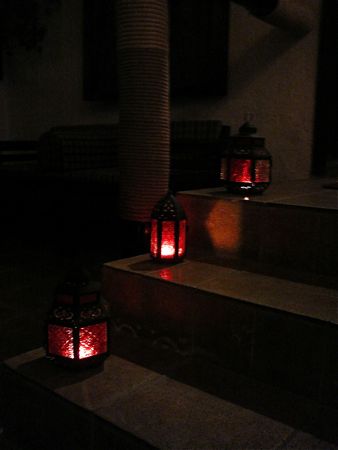
It’s already a little magical. The restaurant is decorated with old fishing equipment, nicely displayed, nicely framed old photos and memorabilia. It has a beam and woven palm leaf ceiling (I am a sucker for those) and a spacious dining room, with an outer area for smokers and shisha. The waiter brings tiny cups, and pours the coffee with cardomon for us, and welcomes us. Another waiter brings Kuwaiti nibbles, simply cut lettuce and vegetables, Kuwaiti pickles and a green mabooch, which I happily recognize because you, my readers, have told me.

This is not fast food, and it is a good thing, because when you are with good friends, there is always so much to talk about. We don’t just catch up, we have to discuss all the politics, the US election, the Kuwait demonstrations, recent editorials, my friend’s garden, my current projects, our children . . . the evenings are always too short. No matter how much we chat, there is always so much more to discuss.
The kitchen at Al Muhaleb is glassed in. We spot our fish coming out of the oven, and oh, it looks magnificent. As good as it looks, it tastes even better:
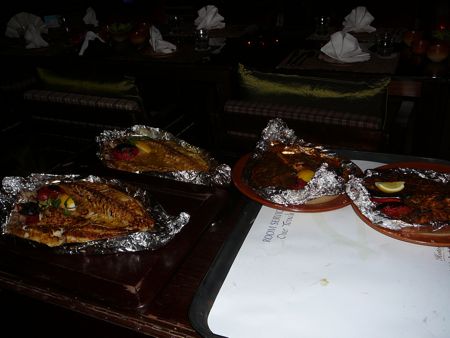
I didn’t even look at the menu, I just ordered what my friends recommended, but they also said you can’t order anything wrong there, it is all good. I had the zubaidi cooked flat; it is served with rice and a green marag (sauce) that was delicious. Because it was so delicious, we all ate too much, and sat looking at all the food we couldn’t finish in dismay. Next time we go, I think we will share one fish to every two people – I hate wasting such exquisitely prepared food.
Kareem has told us many times about the words of Mohammed that a good Moslem should only eat to the point of “enough,” not to the point of “full” but I think we all violated it that evening. We meant to stop, we really did, but it was so delicious we kept nibbling.
Thank God, this is not a fast food restaurant. There is a man playing Al oud live in the background, as we continue to chat, but with less animation as our bellies groan . . .
We are finished eating, truly finished, but then they bring a plate of beautiful fresh fruit, every piece perfect, and we continue our evening together, refreshed by the fruit, drinking hot tea, relaxing – there is no pressure to leave, they are not hurrying us out of the restaurant.
I’ve been looking for a Kuwaiti restaurant, and I just love it that when they found it, our friends shared their find with me. It’s a great place to take visitors who come to Kuwait. It is expensive – so AdventureMan tells me (I didn’t look at the menu, remember?) and so worth it. The menu is mostly limited to fresh fish and fresh salad/appetizers – hummous, mutable, etc. and everything is prepared with thoughtful care.
If there are any drawbacks, it is that with all the hard surfaces, once the restaurant fills up and the music starts, it is harder to make conversation. Also, the smokers get the best part of the restaurant, out near the beach. Having said that, when it is dark, it hardly matters and you can see the city lights of Kuwait from any part of the restaurant. Service is excellent and the food is memorable for its excellence.
Goat Grope
I love living in Kuwait. Just when you start to take everything for granted, you get a little jaded, you even start driving a little like a Kuwaiti, something happens that reminds me I’m really not in Kansas, and I get a big grin. The other day, on a back highway, we came across a whole herd of camels. We used to see these all the time in Qatar, but this is my first time seeing camels just out roaming in such large numbers in Kuwait. Just reminds me how amazing life is, this little girl from Alaska is out watching a camel herd in Kuwait. Just too amazing for me.
In the middle of the most opulent housing areas in town, you will hear roosters crowing. Sometimes, near the Eid festivals, you will hear sheep baaaaaahhhhhh-ing.
Leaving a local store recently, I heard a very very loud, desperate cry, like “NNNNNAAAAAAAAAAAAAAAAAAAAAAaaaaaaHHHHHHHHHHHHHHHHHHHHHHHHHHHHHHHHH” and I looked around and there was a woman, and her son, and a very reluctant, very large, totally freaked out goat. The little lady has one of those camel whips, and she is whipping the hell out of the goat, the son is pulling on the muzzle, the goat has his feet dug in and is rearing back and howling for dear life.
Goats really are not my favorite creatures. I find them very . . . hmmmm.. . . . goaty. They have these filthy beards that always have stuff caught in them, they have these weird cold eyes that sort of pop out of their heads, and there is nothing cute about them, but this goat’s screaming really got me. At the same time, watching these two grown-ups with this very very stubborn goat made me laugh. To get the goat across the road, the son had to pull with all his strength, and the little old woman had to get behind and push. I wish I could have taken that photo, but I was busy turning my car around to go back and get any shot I could get.
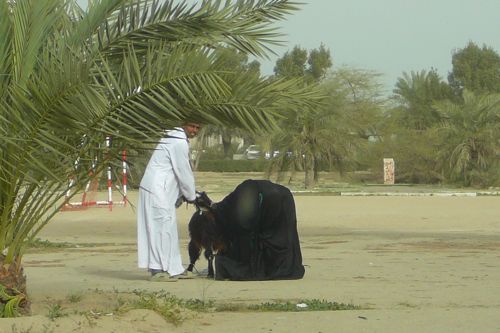
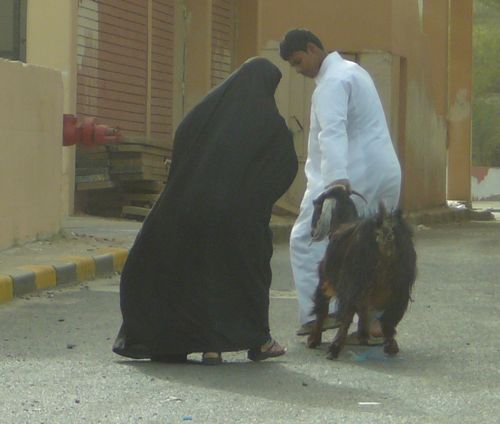
And THAT is why I tell you to always carry your cameras in your car!
History of Architecture in Old Kuwait City (4)
This is my favorite section from The History of Architecture in Old Kuwait City by Saleh Abdulghani Al-Mutawa, Architect. It is quoted from the section called Social Customs, starting on page 206:
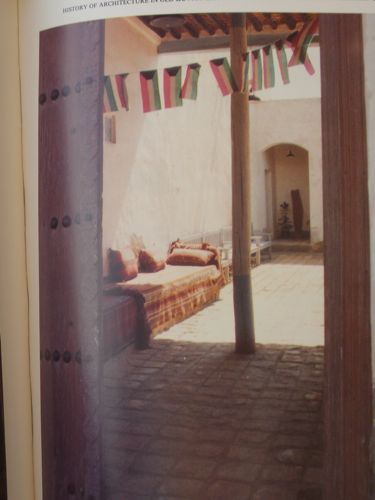
Kuwait is a small nation, with population of one million, that actually has a large influence on people’s behavior; it makes the whole country like one unified family. In the neighborhoods, it is customary to see houses left open and without any security measures, always ready for visitors, which reflects the strength of the relations between neighbors, and the confidence they enjoy. The most distinctive customs are:
1. Large families; average size is eight members. The young generation is trying to minimize the family size. They live in rather large houses, seven to ten bedrooms, which is considered to be an average size house. The house provides privacy for the boys, when they grow up and have their own families.
2. Large family groups, either under one roof or in clustered dwellings, is noticable throughout Kuwait neighborhoods. That reflect the willingness of families and relatives to cooperate and help each other.
3. Newly married sons tend to stay in their parent’s house and share the cooking and dining, so houses have rather large kitchens and dining rooms.
4. Families and relatives visit each other on Fridays and stay for lunch, which is the main meal of the day. The number of visitors varies from 20 – 50 persons, depending on the size of the families. Men and women visit in separate rooms, since separation of males and females is part of the custom. (The author notes that he is talking about old habits and traditions that were prevailing in the old city.)
5.All houses have what is called “Dewania” which is a guest room. In well designed houses, two “Dewanias” were furnished, one for males and one for females, since separation between males and females is mandatory as far as the customs are concerned. The “Dewania” has its separate entrance from the rest of the house, which is to provide privacy for the inhabitants and prevent sudden interactions with guests. It is considered bad for a female to be seen by a male guest, and vice versa. In poorly designed houses, the “Dewanias” don’t have proper privacy and seclusion. The men have the habit of visiting the neighborhood “Dewanias” at night for socialization and discussion of daily matters. In the past the “Dewanias” were the only news sources for the people. Different “Dewanias” are known by the last name of the owners. Hot tea and Arabian coffee are served on a regular basis and in big events like celebrations, “Eads”, wedding parties, and so forth, big feasts held for families, friends and neighbors.
6. “Chay Aldaha”, or afternoon tea at which it is customary for women to visit each other and gossip. Hot tea and cookies are served for refreshment. “Chay Aldaha” is held in the female “Dewania” to ensure privacy for female guests and to prevent sudden embarrassing interactions with male inhabitants.
7. Women are dressed in conservative clothes when they go out; the face and the two hands are the only parts of the body which are exposed. (The author makes a note that he is talking about old habits and traditions which were prevailing in the city) Privacy for women inside the house is an important factor. They should not be seen from the outside while they are doing their daily housework, and should not be in the way when male guests are visiting in the house.
As you can see, the winds of change have blown through Kuwait creating many, many changes. This book captures a slice of time in Kuwait history, and a wealth of information you don’t even know you know. The ways Kuwaitis lived for generations have changed, just in the last 20 years. I was particularly taken with the author’s mention – several times – that women should not be seen tending to their daily housework – how many Kuwaiti women do you know who are doing housework?
There is a current controversy regarding removal of diwaniyyas constructed on public grounds – if this is an old and accepted tradition, perhaps some adjustment can be made, particularly where the diwaniyyas are not impeding public transport or walking paths? Perhaps some can be “grandfathered”, i.e. exceptions made because of historical location?
Meanwhile, my Kuwaiti friends, sorry for boring you with these descriptions of your family dwellings; you already know all this, but the rest of the world does not, and I wanted to share this with those who follow this blog because they find you exotic and fascinating. 🙂 You really need to add this book to your libraries, as a record of a way of life that seems to be slipping all to quickly into the past.
History of Architecture in Old Kuwait City (3)
I am quoting so much from Saleh Abdulghani Al-Mutawa. Architect, that you may think you don’t need to run out and buy the book but I assure you, I am only sharing with you a few of the gems I found within. The author has done so much research with such loving attention that the book is full of treasure, every page offers something worthy.
The Year of Demolish
It is a sad memorial in Kuwait’s history. In Rajab 1289 A.H. (i.e. in the middle of the nineteenth century), heavy rains accompanied by severe winds hit the old Kuwait city, and demolished most of the mud houses. Sea waves went high and hit and wrecked ships. It was a disaster for Kuwaitis.
A second natural disaster took place in Kuwait on 30 November 1954 when heavy rains fell and demolished houses and forced 18,000 Kuwaitis to seek refuge in newly built schools. Houses built of mud and a little cement were severely affected, while houses built of rock were not affected.
My Kuwait friends – tonight, instead of going out in your cars, stay home! Sit with your grandparents and ask them about the house they grew up in. Ask them about the meals they cooked. Ask them about the heavy rains, so heavy that they could destroy houses and force 18,000 Kuwaitis to abandon their homes and go stay in schools. These are amazing stories – learn your stories from your grandparents . . . and then come tell us all the stories in your own blogs. If you don’t have a blog, or if you want to share here, you are welcome.
Some of my Kuwait friends ask why I care more about these things than the Kuwaitis. First – my Kuwaiti friends care. In my country, we call these people “the silent majority.” Every now and then the majority energizes and asserts itself. Kuwaitis care. Change is happening, it happens slowly. Keep the faith.
Second – I live here. I may not be Kuwaiti, but I care about the places where I live. If God has placed me here, I trust that he has his reasons, and it is my obligation to him to learn as much as I can and to serve – wherever he may place me. He placed me in Kuwait.
Tomorrow I will print my very favorite part of this book – where it describes family living. Meanwhile, run out and buy your own copy. There is so much I am not covering. This book is a part of your heritage.
History of Architecture in Old Kuwait City (2)
I love this book. It is such a treasure. For those of you who have ever wondered about the construction of old Gulf dwellings, this book is a MUST have – so much detail, so much to help us understand what we are seeing.
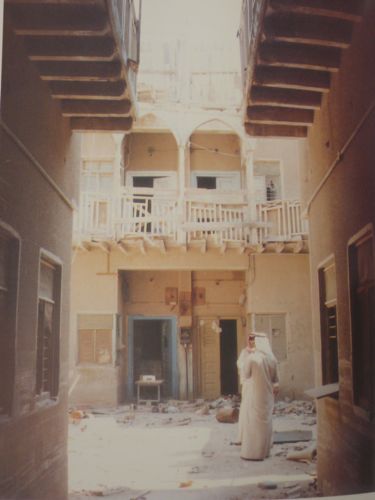
More from author Saleh Abdulghani Al-Mutawa, Architect:
House design and location specified unity existing in the Kuwaiti society. In old times, the poor livednear the rich, where no differences between them. The only difference was that the houses of the rich were vast. Ordinary Kuwaiti house, occupied by the majority of Kuwaitis, consisted of a vast courtyard, surrounded by many rooms, and a hallway secured privacy to the family by separating the house from the street. In that architectural design, the courtyard ventilated the house to find it cool at night and after sunset. This was due to the exchange of radiation between the floor of the courtyard and the outer space. At night the house became cool and sleep was comfortable. During summer, the majority of Kuwaitis prefer to sleep in the courtyard or on the roof. Usually, there is a room on the roof used to store mattresses in or sometimes for napping. A small bath is usually located beside that room. . .
Walls were built of rock and mud, and decorated internally with white gypsum. Ceilings consisted of rows of jandal (trunks), basajeel (bamboo) and manqour (straw mats), covered with a 30cm or a 40cm layer of mud. In winter, when rain was heavy, that layer should be attended to and maintained by adding more mud. Houses of the rich used gypsum for protection. When wood was used in fixing the ceilings, thejandal was only 4 m long, and for the wide rooms they used square pieces of wood of 6m. The floor was covered with mud, then with tiles which was imported from neighboring countries. To let the water flow from the roofs, they used the wooded marazims (gutters) which extended from the roofs to the outside. In the houses there were wells for supplying the underground water, and there were pools to store water in.
As regards the houses of the rich, they were divided into a number of courtyards, each serving a certain purpose. There was a courtyard used to include a Diwaniya for male guests, consisting of a large room annexed with other buildings needed to accomodate the servants or for other purposes.
The other courtyard was located for family female members, including a number of rooms and bathrooms. A third courtyard was used as a kitchen, including the kitchen, storage room for fuel and a store room for the different kinds of food. There were more courtyards for the animals: goats, cows, horses. Kuwaiti houses also had a “baqadeer” (wind tower) which was a natural air-conditioner, not one Kuwaiti house was without it.
History of Architecture in Old Kuwait City
When I came to live in Kuwait, my resourceful niece, Little Diamond went online and found all kinds of fabulous books about Kuwait, books you can’t find in Kuwait. Five interesting books, mostly about an earlier era in Kuwait, when my Kuwaiti friends tell me it was still one community.
“It was like paradise” they say, and they sigh.
I found another book recently, a book I have never seen before, although it was published in 1994, so it is not old. It is The History of Architecture in Old Kuwait City (and the influence of it’s elements on the Architect) by Saleh Abdulghani Al-Mutawa.
Although I intend to give this book as a gift to a friend, I couldn’t resist taking a peek inside, first. Should have resisted – I ended up reading the whole book.

This man loves architectural details the way I do, but he has studied them, and he is on a mission to bring back elements of uniquely Gulf architecture to the Gulf. One reason I love this book is that I know the buildings he has designed; I had a friend who lives in one, and we all marveled at it’s architectural elements.

I particularly love the wind towers.
I lived in Jordan for two years with no air conditioning. I don’t know why, but we didn’t miss it. We had our windows open all night and early mornings, we had rolled down shutters to keep the harsh sunlight out and we had ceiling fans – we managed.
Life would be different without A/C; life styles would change, but it would be manageable.
I want to quote from this book for you. Kuwaiti readers, you probably know all these things, but my readers in other parts of the world – like me – may find this fascinating.
Architecture and Building Materials in Old Kuwait City
Building materials were taken from materials available in nature: sea rock, mud, limestone and gypsum. As old Kuwait’s economy depended on the two journeys for diving and travel to Africa and India, Kuwaitis imported teakwood from India, and jandal (trunk) and basajeel (bamboo) from Africa (Mombassa – Kenya). These completed the elements of the construction. The shape of the old Kuwaiti architecture came to suit the environment and circumstances. Houses were adjacent in a manner that indicated the unity and cooperation of the people. Streets were narrow in such a way that the sun did not fall on the full street, and that made the streets cool and shaded. Mosques were the places for prayers, where they pray five times a day, were near the houses. There was a mosque in each district to enable the elders from walking to it without trouble. Kuwaitis care much for their religion.
Construction depended on Kuwaitis themselves. The engineer, called “ustad’ at that time, supervised the building and the laborers of Kuwaitis prepared for it. They carried rocks, prepared mud bricks, and started building.
Kuwait city was spontaneously and simply divided. In this it is similar to many old world cities, like London. There were three districts: Sharq (east), where the sun rises, Qibla, where the sun sets, and Wosta, which lies between them. The three districts were surrounded by their fence which the Kuwaitis built to defend their city.
By jandal, the author means trunks of trees, which you will see incorporated in the illustration above, painted black. When he talks about the fence around old Kuwait, he is talking about the wall which once existed. You can still find the (re-creations) of the gates to the city, except we can’t fine the one that is supposed to be around B’naid al Gar.
More to follow!
Bulletin: New Kuwait Traffic Laws
From today’s Arab Times:
New traffic law enacted: e-mails
KUWAIT : Several people on Monday received e-mails and SMS messages on the new traffic fines allegedly imposed by the Interior Ministry. Sources at the Ministry refused to deny or confirm the messages but said a new traffic law will be implemented soon.
(Comment: Holy Smokes! Did the bloggers and e-mailers get it right???)
Sue Monk Kidd: Mermaid Chair
It took me a long time to buy this book, and an even longer time to read it. I kept reading the description, and I didn’t like it at all. But it kept popping up on the “recommended for you” list on Amazon, and I had this inner feeling that I was meant to read it, even if I didn’t particularly care to.
After treating myself to Leon and Bowen, I thought now was the time.
At first I found The Mermaid Chair a little Anne Rivers Siddon-ish – and I like Anne Rivers Siddons, and I don’t like imitations, which this felt like. And I thought to myself “Anne Rivers Siddons does it better.”
I kept reading, though. The book was intriguing, and I wanted to know what happened next.
Sue Monk Kidd wrote another book I really liked called The Secret Life of Bees in which I learned a lot about bees, and found the story wonderfully redemptive.
Sue Monk Kidd and Anne Rivers Siddons also share a love of the mystical, and the mystical in religion, and the mystical in human relationships, and the mystical in the sisterhood of women, all of which I find fascinating, and parts of which I would like to believe myself.
In this book, there is a lot going on. The main character is feeling stagnant and small, and invisible in her marriage. Her daughter has left for college, and she is oddly unable to find things in life to interest her. Then, her mother cuts off her finger, her mother’s friends call her to come to Egret Island, and she finds herself suddenly caught up in a whirlwind of emotions and torments that she can barely understand.
She has avoided returning to her Egret Island home to avoid the pain of her father’s death when she was 12, and her mother’s decent into moodiness and madness. She returns, meets a monk and falls in love, copes badly with her mother’s demons, and fights her way through her own personal crisis.
Sue Monk Kidd makes it all work. The work floats with artistic references; Gaugain, Matisse, Chagall, their mysterious, delightful women in particular float throught this book in Mermaid guises, and our heroine, Jessie Sullivan, discovers her own mermaid-within.
I won’t say that this is the best book I have ever read – it isn’t. I will say that I loved reading it. I loved the feel of living on Egret Island, with the tides and the birds and the small town friends, the local dog, the raininess and windiness of it all. I feel like I was there. I know the graveyard, I know the winding paths, I know those little golf carts everyone uses to get around. I know what it’s like to have to take a ferry to get to the mainland, I know the tidal currents of life’s more overwhelming moments.
As our Jessie binds her marriage back together, she says this:
Each day we pick our way through unfamiliar terrain. Hugh and I did not resume our old marriage – that was never what I wanted, and it was not what Hugh wanted either – rather we laid it aside and began a whole new one. Our love is not the same. It feels both young and old to me. It feels wise, as an old woman is wise after a long life, but also fresh and tender, something we must cradle and protect. We have become closer in some ways, the pain we experienced weaving tenacious lines of intimacy, but there is a separateness as well, the necessary distance. . . . .
I tell him, smiling, that it was the mermaids who brought me home. I mean, to the water and the mud and the pull of the tides in my own body. To the solitary island submerged so long in myself, which I desperately needed to find. But I also try to explain they brought me home to him. I’m not sure he understands any more than I do how belonging to myself allows me to belong more truly to him. I just know it’s true.”
This is a good read. It’s worth its reputation, it’s worth picking up and reading through. While some might think it’s very much a chick book, I suspect men reading it might also find a lot with which to identify. You can find this book at Amazon.com (disclosure: yes, I own shares in Amazon) for about $11.20.

Recent Comments
ExpatAlien on What Country am I Living … intlxpatr on Yellowstone: Old Faithful to C… Michelle on Yellowstone: Old Faithful to C… Cathy on No Grown-Ups in Charge intlxpatr on Waiting for Snow Wikipedia Donate Button

Amazina


Early Voting in Florida


 Here There and Everywhere