Wise Men Still Seek Him
“Oh! You’re putting your Christmas things away!” I noticed, as I was picking up my friend.
“No, no, not until after Epiphany!” she said. “Our tradition is to take down the tree when Epiphany is over.”
Tomorrow, January 6, is The Feast of Holy Epiphany and in celebration, I will post two more works of art I found to celebrate the wise men seeking the child by following a mysterious star. Many people are still looking for a scientific foundation for the Star of Wonder and if you click on the blue Star of Wonder it will take you to a very good discussion of some of the possibilities from BBC News.
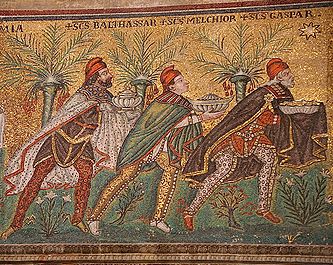
I like this one because the Wise Men have on clothing that really looks Persian:
Here, in a painting by Murillo, they look, not surprisingly, Spanish/European, except for the African!

I wonder if in their travels, these wise men came through Kuwait?
Qurain Fest – Information Where?
Here is what bugs me. There is this perfectly wonderful festival going on. I only know because the newspapers print photos and stories – after each event. I cannot figure out WHERE the event is taking place, WHAT TIME an event will take place . . . these are perfect opportunities to go and learn something, to experience the culture, and we have no idea – in advance – where to go, how to find these things.
I would love to see this dancing!
So, if it is cultural, music and dancing are allowed? 🙂 Is it always just men dancing, or do women dance, too?
Isn’t this camel racing season? When are the camels raced? Where?
From Al Watan
Kuwaiti folk dancing troupe entertains audience
KUWAIT: As part of the Qurain Cultural Festival”s festivities, the Red Palace group, a folk dancing troupe, performed in Jahra on Sunday.
The performance, which was attended by Deputy Director of the festival Mohammed AlـAsousi, lasted for two hours. The dancers presented a wide spectrum of national and patriotic themes much to the enjoyment of the audience.
Head of the folklore group, Nasser Suleiman AlـFaraj explained that their participation in the event came as a result of the group”s strong belief in reviving an old heritage and folklore. He stressed that the past would always be relevant in the present.
Last updated on Tuesday 30/12/2008
Stonehenge a Center for Healing
This is from BBC News: Nature, and you can read the entire article by clicking on the blue type, but I wanted you to know about the upcoming BBC Special on Stonehenge, September 27th.

Archaeologists have pinpointed the construction of Stonehenge to 2300BC – a key step to discovering how and why the mysterious edifice was built.
The radiocarbon date is said to be the most accurate yet and means the ring’s original bluestones were put up 300 years later than previously thought.
The dating is the major finding from an excavation inside the henge by Profs Tim Darvill and Geoff Wainwright.
The duo found evidence suggesting Stonehenge was a centre of healing.
Others have argued that the monument was a shrine to worship ancestors, or a calendar to mark the solstices.
A documentary following the progress of the recent dig has been recorded by the BBC Timewatch series. It will be broadcast on Saturday 27 September.
The mystery of Stonehenge, it’s origins, is purpose, has fascinated people for centuries. How amazing that one twelve day dig has discovered so much information – new pieces for a hugely complicated puzzle with lots of work left to be done.
As I write this post, I am also reminded of one of the all time funniest movies I have ever seen – This is Spinal Tap, one of those mocumentaries, this one about a rock group. Not a very bright rock group. It is a very funny movie.
They ask a set designer to create a magnificent recreation of Stonehenge, and give her a napkin with how they want it to look. The result is . . . hysterical:
Peter Bowen and Nails
Three men trundle a naked woman through the desert to a remote place, where she was placed in a container, 6 x 6 x 6 with only a candle, a cot, water and a holy book, until she could come to her senses and behave.
Four girls were strangled, one each day, for refusing the sexual advances of their father and his brother. The two youngest girls, their older sisters dead, complied.
Women with inconvenient views, women who start having thoughts of their own disappear. Many in this tribe are home-birthed and home-schooled, so there aren’t records of their existence, and when they disappear, no-one is the wiser.
Saudi Arabia, you ask? Pakistan? Afghanistan? Where on earth are women treated this vilely?

Peter Bowen, in Nails, gives vent to his frustration of minor fundamentalist Christian cults roaming the American West, many of them ending up in Montana where they believe they will have the privacy to practice their beliefs without interference, and where those who are well-funded can influence poverty-stricken school districts to toss out Science classes and incorporate Intelligent Design. Bowen has utter contempt for their studied ignorance, their need to be the sole authority on what the scriptures say, and their insistence on the utter submission of women.
His worst scorn is for their treatment of women – he attributes it to their fears about their own sexuality. Women are often the victims, Bowen states, when men worry about their size, worry about how to keep women faithful, tractable, and docile. (And let’s face it, who can successfully control a woman? 😉 )
This is the latest Gabriel du Pre novel, or at least the latest I have read. Gabriel du Pre is a retired brand inspector (he goes back every now and then when needed, when the brand inspector is overstretched, insuring that the cows sold are from the herds they are being sold from), Metis (French and Indian mix), a renowned fiddler, and a deputy sheriff when the sheriff – or the FBI – needs help solving a particularly tricky murder. It takes a while to get your ear used to his dialect, and he spends a lot of time in bars, but the man has a real knack for figuring things out.
Gabriel du Pre is everything a straight-living woman like myself shouldn’t like. He drinks, morning to night, keeps his flask of whisky under the driver’s seat in his car. He drives way over the speed limit. He doesn’t go to church, he goes to an ancient Indian spiritualist / medicine man when he needs guidance. He isn’t married to the wry, very smart woman with whom he lives. He breaks the rules, he goes outside the boundaries.
For all his flaws, du Pre has a deep down, rock solid core of decency, and a way of looking at life and situations that is practical and . . . forgiving. He is charitable toward his brothers and sisters. He detests cruelty, especially when the strong take advantage of the weak or the arrogant walk all over the humble. There is something about this flawed hero that keeps the reader coming back for more.
His Gabriel du Pre novels are not heavy reading. You can toss one off in about half a day, but they are not so simple as they appear. You find yourself thinking about the issues he raises, and you find yourself looking to see when the next Gabriel du Pre mystery will appear.
You can find this on Amazon.com for $16. new or from $3.07 used, plus shipping of course. (Yes, I own stock in Amazon.com.) 🙂
Building 7 Collapse Solved, No Mystery
Feds Say They’ve Solved 9/11 Mystery
By DEVLIN BARRETT, AP
GAITHERSBURG, Md. (Aug. 21) – Federal investigators said Thursday they have solved a mystery of the Sept. 11, 2001, attacks: the collapse of World Trade Center building 7, a source of long-running conspiracy theories.
The 47-story trapezoid-shaped building sat north of the World Trade Center towers, across Vesey Street in lower Manhattan. On Sept. 11, it was set on fire by falling debris from the burning towers, but skeptics have long argued that fire and debris alone should not have brought down such a big steel-and-concrete structure.
Federal investigators said Thursday they have resolved a lingering question from the Sept. 11, 2001, terror attacks: What caused World Trade Center 7 to collapse? They determined the building, which sat north of the World Trade Center towers, was brought down by fire started by debris from the twin towers.
Scientists with the National Institute of Standards and Technology say their three-year investigation of the collapse determined the demise of WTC 7 was actually the first time in the world a fire caused the total failure of a skyscraper.
“The reason for the collapse of World Trade Center 7 is no longer a mystery,” said Dr. Shyam Sunder, the lead investigator on the NIST team.
Investigators also concluded that the collapse of the nearby towers broke the city water main, leaving the sprinkler system in the bottom half of the building without water.
The building has been the subject of a wide range of conspiracy theories for the last seven years, partly because the collapse occurred about seven hours after the twin towers came down. That fueled suspicion that someone intentionally blew up the building in a controlled demolition.
Critics like Mike Berger of the group 9/11 Truth said he wasn’t buying the government’s explanation.
“Their explanation simply isn’t sufficient. We’re being lied to,” he said, arguing that there is other evidence suggesting explosives were used on the building.
Sunder said his team investigated the possibility that an explosion inside the building brought it down, but found there was no large boom or other noise that would have occurred with such a detonation. Investigators also created a giant computer model of the collapse, based partly on news footage from CBS News, that they say shows internal column failure brought down the building.
Investigators also ruled out the possibility that the collapse was caused by fires from a substantial amount of diesel fuel that was stored in the building, most of it for generators for the city’s emergency operations command center.
The 77-page report concluded that the fatal blow to the building came when the 13th floor collapsed, weakening a critical steel support column that led to catastrophic failure.
“When this critical column buckled due to lack of floor supports, it was the first domino in the chain,” said Sunder.
The NIST investigators issued more than a dozen building recommendations as a result of their inquiry, most of which repeat earlier recommendations from their investigation into the collapse of the two large towers.
In both instances, investigators concluded that extreme heat caused some steel beams to lose strength, causing further failures throughout the buildings until the entire structure succumbed.
The recommendations include building skyscrapers with stronger connections and framing systems to resist the effects of thermal expansion, and structural systems designed to prevent damage to one part of a building from spreading to other parts.
A spokeswoman for the leaseholder of the World Trade Center, developer Larry Silverstein, praised the government’s work.
“Hopefully this thorough report puts to rest the various 9/11 conspiracy theories, which dishonor the men and women who lost their lives on that terrible day,” said Silverstein spokeswoman Dara McQuillen.
In discussing the findings, the investigator Sunder acknowledged that some may still not be convinced, but insisted the science behind their findings is “incredibly conclusive.”
“The public should really recognize the science is really behind what we have said,” he said, adding: “The obvious stares you in the face.”
Copyright 2008 The Associated Press. The information contained in the AP news report may not be published, broadcast, rewritten or otherwise distributed without the prior written authority of The Associated Press. Active hyperlinks have been inserted by AOL.
Maitland and The Company of Liars: A novel of the plague
I had just finished The Swallows of Kabul and still had a long flight to go. Fortunately, I was in the Johannisburg airport, with it’s truly wonderful bookstore, and came across The Company of Liars: a novel of the plague. Well, it isn’t exactly a novel of the plague. The story opens in 1348, a year in which le morte bleu hit the British Isles, only later to be called the plague. The author captures the times, the filth, the lack of bathing, the superstitions, the ways of life.
The plot centers around a group who wanders through the island, just trying to stay alive. The spreading plague impacts on their wandering, but to call this a novel of the plague is just not accurate. The plague is the reason for the journey, but the journey is the center of the novel, not the plague.
Before I started reading the book, I read the Historical Notes in the back, and that is where I came across the most interesting information in the entire book:
The 1348 plague was only the latest in a series of disasters to hit Britain. The period between 1290 and 1348 had seen a rapid and drastic climate change which was so noticeable that the Pope ordered special prayers to be said daily in every church. Eyewitness accounts claimed that 1348 was a particularly bad year, for it rained every day from Midsummer’s Day to Christmas Day. Climate change brought about crop failure, liver fluke in sheep and murrain in cattle, as well as causing widespread flooding which virtually wiped out the salt industry on the east coast. This, combined with a population explosion, meant that as many people died from starvation as from the plague itself.
Interestingly, the book will not be released in the US until September 2008. The cover shown is nothing like the cover of the book I bought.
American issue cover:

Cover on book bought in Johannisburg:
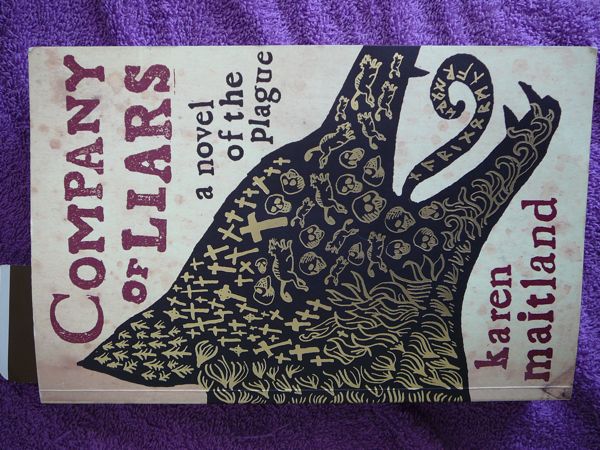
I like the cover of mine better.
Some reviewers call this book “enthralling” or “gripping.” I wans’t all that enthralled or gripped, but it did make good airplane reading. I learned a lot about the grim brutality of life in 1348, but as I told AdventureMan, this is more a book about a slice of time than a book with a great plot. The plot isn’t that great, it is the historical detail that is interesting, and fiction just makes it more easily absorbed. (my opinion)
Expats Run More Red Lights
This is from today’s Kuwait Times.
KUWAIT: The Interior Ministry defended a new policy of deporting expatriates who run red lights by arguing that “the highest percentage of traffic violations are committed by expats, adding that this constitutes a hazard on the lives of motorists,” reported Al-Jarida.
The ministry in a statement said it had the legal right according to the Foreigners Residency law to deport expats for such offenses. And added that the ministry used this right as it is its administrative right according to the law. (sic)
I am blown away that they can say this with a straight face.
Traffic ENFORCEMENT
Whoda thunk?
I am (almost) speechless!
Can this be a turning point in Kuwait? Are we going to have laws that might actually be meant to be followed? Wooo Hoooo, traffic police, Woooo Hoooooo, court of law!
From The Arab Times: Kuwait Crime:
‘Deport motorist’ – Driving on E-lane
KUWAIT CITY : Assistant Undersecretary for Traffic Affairs, Major-General Thabet Al-Muhanna has ordered the deportation of an Arab man who was caught driving at 140 km/h along the Fifth Ring Motorway, reports Al-Seyassah daily.
According to a security source Al-Muhanna saw the motorist driving along the emergency lane and ordered his immediate arrest.
After his arrest the man admitted to committing the offence. He apologized and said he was in a hurry. However, the man will be administratively deported, say sources.
Questions and Comments: Woo Hooo, al-Muhanna!
Suggestion: With the great advent of tiny, easily carried cameras and cell phone cameras, photographic evidence is easy to provide. How about the Ministry of Interior setting up a website where we can send them photos of people WE see in flagrant violation of the laws?
A Case of Two Cities with Inspector Chen: Qiu Xiaolong
When my sister Sparkle recommends a book, I have learned to listen. I think I ordered this book about six months ago, but never cared enough to actually read it. After reading a recent Donna Leon (like dessert, I use it as a reward for reading something more challenging) I decided it was time to tackle Qiu Xiaolong.
I believe A Case of Two Cities is the first in the series; I tried very hard to make sure it was. When I first started reading it, it was difficult, but it didn’t take long to adjust. When you read a detective story written in a foreign culture, you have to park your old way of thinking, and quickly adapt to a new way of thinking. First, you have to learn what that new way of thinking is. They don’t just tell you at the beginning of the book “Here are the differences in values – you will notice . . .” no, but Qiu Xiaolong is courteous enough to take us by the hand and lead us gently into the Chinese way of thinking, the Chinese way of getting things done, and the technicalities of Chinese detective work.
As we meet Inspector Chen, a published poet, and a detective, ten pages into the book, a new anti-corruption campaign is starting in Shanghai, and Inspector Chen has been given a special assignment – a qinchai dacheng – as “Emperor’s Special Envoy with an Imperial Sword.” Even though imperial days are long gone, this warrant gives him emergency powers to search and arrest without reporting to anyone – and without a warrant. He is to seek and find Xing, a corrupt businessman who has caused huge loss to the national economy and is in danger of tarnishing the Chinese national image, and Xing’s associates.
Just as in the Donna Leon books about Commissario Guido Brunetti, and the Bowen books about Gabriel duPre, and James Lee Burke’s books about New Orleans, and Cara Black’s books about Aimee LeDuc, the detectives and investigators have to walk a fine line between going after the criminal and overstepping their warrant – stepping on the toes of those also engaged in corruption so entrenched that it has become a way of life. Each of these detectives has to maneuver that treacherously fine line – who determines when corruption has become too much? It usually puts their own lives in danger at some point, as those manipulating the system and making a fortune out of it do not want to be caught, do not want to be exposed, and will go to great lengths to protect their ill-gotten gains.
And just as in the above books, the book is more about the actual process than the crime itself. Inspector Chen must go about his task indirectly, having chats here and there, gathering threads of information with which he tries to weave a plausible tapestry of events.
As I was reading A Case of Two Cities, I kept making AdventureMan take me out for Chinese food! The meetings are often held over food, and the descriptions are mouth-watering.


Best of all, when you read these books, you get a tiny little glimpse into another way of thinking, another way of doing business. We are all human, we all have the same needs, and we differ in how we go about getting those needs met. We differ in the way we think. It helps to enter another way of living, another way of thinking, it helps to visit through these books so that we can increase our own understanding that our way of doing things is not the only way, maybe (gasp!) not even the “right” way! Maybe (crunching those brain cells really hard to output this thought) there is more than one “right” way?
Al Mohaleb Restaurant
My friend called me, all excited.
“Kareem took me to the most wonderful restaurant for my birthday last night!” she exclaimed, and I could just hear the delight in her voice. “We just know you and AdventureMan will just love it! It’s Kuwaiti! They only serve fish and related things like appetizers and rice, but the fish is out of this world, and the atmosphere is lovely; gracious and refined. When can the four of us go together?”
We quickly compared calendars and came up with the soonest compatible date. I rarely hear my friend wax enthusiastic about a Kuwaiti restaurant.
The night arrived, and as we picked up our friends, we sat in the garden, which for some unknown reason is flourishing this year in spite of the drought. At her house, you can see stars in the sky, the air is perfumed with growing things, and the night is so sweet, with just a light breeze, that we are almost reluctant to go.
Who would know where this restaurant is? There is no sign at The Palms Hotel, next door to the SAS Radisson, that this restaurant exists. I remember when they had a “Wasabi” sign up for nearly a year, and no Wasabi ever showed up there – but this restaurant exists, and there is no signage. I am a little concerned because the front parking lot is packed, with people waiting to find a spot, but Kareem tells us to drive to the end of the dirt parking lot. There, at the very end of the Palms hotel, next to their highly publicized new Tajine restaurant, is Al Mohaleb, overlooking the sand and sea.
This is what you see at the entrance, the huge Dallah (coffee pot) and in the background, the sign for Al Muhaleb, which, AdventureMan tells me, is the biggest dhow, the one used for trading in days of old, across the seas. Suddenly the light goes on, and I remember my friend taking me to a mall of the same name, and . . . the Mall is shaped like a great, huge ship!

As you enter, there is a diwaniyya-like area for meeting up or waiting for a table, and then you go up three steps to the restaurant:

It’s already a little magical. The restaurant is decorated with old fishing equipment, nicely displayed, nicely framed old photos and memorabilia. It has a beam and woven palm leaf ceiling (I am a sucker for those) and a spacious dining room, with an outer area for smokers and shisha. The waiter brings tiny cups, and pours the coffee with cardomon for us, and welcomes us. Another waiter brings Kuwaiti nibbles, simply cut lettuce and vegetables, Kuwaiti pickles and a green mabooch, which I happily recognize because you, my readers, have told me.

This is not fast food, and it is a good thing, because when you are with good friends, there is always so much to talk about. We don’t just catch up, we have to discuss all the politics, the US election, the Kuwait demonstrations, recent editorials, my friend’s garden, my current projects, our children . . . the evenings are always too short. No matter how much we chat, there is always so much more to discuss.
The kitchen at Al Muhaleb is glassed in. We spot our fish coming out of the oven, and oh, it looks magnificent. As good as it looks, it tastes even better:
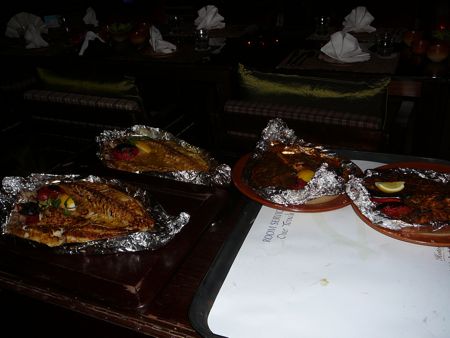
I didn’t even look at the menu, I just ordered what my friends recommended, but they also said you can’t order anything wrong there, it is all good. I had the zubaidi cooked flat; it is served with rice and a green marag (sauce) that was delicious. Because it was so delicious, we all ate too much, and sat looking at all the food we couldn’t finish in dismay. Next time we go, I think we will share one fish to every two people – I hate wasting such exquisitely prepared food.
Kareem has told us many times about the words of Mohammed that a good Moslem should only eat to the point of “enough,” not to the point of “full” but I think we all violated it that evening. We meant to stop, we really did, but it was so delicious we kept nibbling.
Thank God, this is not a fast food restaurant. There is a man playing Al oud live in the background, as we continue to chat, but with less animation as our bellies groan . . .

We are finished eating, truly finished, but then they bring a plate of beautiful fresh fruit, every piece perfect, and we continue our evening together, refreshed by the fruit, drinking hot tea, relaxing – there is no pressure to leave, they are not hurrying us out of the restaurant.
I’ve been looking for a Kuwaiti restaurant, and I just love it that when they found it, our friends shared their find with me. It’s a great place to take visitors who come to Kuwait. It is expensive – so AdventureMan tells me (I didn’t look at the menu, remember?) and so worth it. The menu is mostly limited to fresh fish and fresh salad/appetizers – hummous, mutable, etc. and everything is prepared with thoughtful care.
If there are any drawbacks, it is that with all the hard surfaces, once the restaurant fills up and the music starts, it is harder to make conversation. Also, the smokers get the best part of the restaurant, out near the beach. Having said that, when it is dark, it hardly matters and you can see the city lights of Kuwait from any part of the restaurant. Service is excellent and the food is memorable for its excellence.
Recent Comments
intlxpatr on Shampoo Ginger tigerbutterya0c5ff1d… on Shampoo Ginger intlxpatr on British Soldier Kidnapped, Esc… John on British Soldier Kidnapped, Esc… intlxpatr on British Soldier Kidnapped, Esc… Wikipedia Donate Button

Amazina


Early Voting in Florida


