Inheritance of Loss

Most of the time, if I don’t like a book, I won’t even bother telling you about it. This book, The Inheritance of Loss, by Kiran Desai, is an exception for one reason – it IS worth reading.
Inheiritance of Loss showed up on the book club reading list for the year, and I ordered it. I read the cover when the book came, and it didn’t sound that good to me, so I read other books instead. The next time it came to mind was when a friend, reading the book, said she was having trouble with it, and asked me if I had started it. This friend is a READER, and a thinker. It caught my attention that she would have problems reading a book, so I decided to give it a try.
This is a very uncomfortable book. The characters live in the shadow of the Himalayan mountains. The most sympathetic character is a young orphaned girl, sent to live with her grandfather. With each chapter, we learn more about all the characters, how they came to be here, what they think, what their lives have looked like.
The author of this book has a very sour look on life. She has snotty things to say about every character. You can almost feel her peering around the corner, eyes slit with evil intent. She is that vicious neighbor who comes by and never says anything nice about anybody, and when you see her talking with your neighbor, you get the uneasy feeling she could be saying something mean about you, and she probably is.
The book covers a wide range of topics – Indian politics, Ghurka revolts, English colonization, Indian emigration to the US and UK, everyday vanities and pride in petty things, how people destroy their own lives, how people can be cruel to one another, oh it’s a great read (yes, that is sarcasm).
At the same time, this vicious unwelcome neighbor has a sharp eye for detail. You may not like what she is telling you, but you keep listening, because you can learn important tidbits of information from her. In my case, I learned a lot about how life is lived in a small mountain village in India, the struggles of illegals in America and how class lines are drawn, ever so finely, when people live together. I learned a lot about the legacy of colonialism, and the creep of globalization. This unwelcome neighbor has a sharp tongue, always complaining, and yet . . . some of her complaints have merit.
I don’t believe there was a single redeeming episode in the book. There was not a paragraph to feel good about. I am glad to be finished with the book – but, yes, I finished it, I didn’t just set it aside in disgust, or give it away without finishing.
Here is the reason I am telling you about this book – as uncomfortable as this book is to read, I have the feeling, upon finishing, that ideas and images from this book will stick with me for a long time. I have the feeling that it contributes to my greater understanding of how things work, how people think differently from other people, and on what levels we are very much the same.
Here is an excerpt from the book, at a time during which the Judge is a young Indian, studying in England:
The new boarding house boasted several rooms for rent, and here, among the other lodgers, he was to find his only friend in England: Bose.
They had similar inadequate clothes, similar forlornly empty rooms, similar poor native’s trunks. A look of recognition had passed between them at first sight, but also the assurance that they wouldn’t reveal one another’s secrets, not even to each other.
. . . Together they punted clumsily down the glaceed river to Grantchester and had tea among the jam sozzled wasps just as you were supposed to, enjoying themselves (but not really) as the heavy wasps fell from flight into their laps with a low battery buzz.
They had better luck in London, where they watched the changing of the guard at Buckingham Palace, avoided the other Indian students at Veeraswamy’s, ate shepherd’s pie instead, and agreed on the train home that Trafalgar Square was not quite up to British standards of hygiene – all those defecating pigeons, one of which had done a masala-colored doodle on Bose. It was Bose who showed Jemubhai what records to buy for his new gramophone: Caruso and Gigli. He also corrected his pronunciation: Jheelee, not Giggly. . . .
This it was that the judge eventually took revenge on his early confusions, his embarrassments gloved in something called “keeping up standards,” his accent behind a mask of a quiet. He found he began to be mistaken for something he wasn’t – a man of dignity. This accidental poise became more important than any other thing. He envied the English. He loathed Indians. He worked at being English with the passion of hatred and for what he would become, he would be despised by absolutely everyone, English and Indians both.
I consider this a review, and not particularly a recommendation. I read the book, I finished the book and I learned from the book. I didn’t like the book. I recommend it only as a challenge, for people who like to read and stretch their minds in new directions.
As It Snows . . .
Catching up with the news, I was looking at the Thursday Kuwait Times when I came across a photo. I am not going to print the photo in my blog, but if you want to look at it, or one like it, you can see it at Yahoo News, just click here on the blue type.
The photo of the execution, titled Iran hangs 13 on a single day is extraordinary enough. I don’t think we print those kind of photos in American newspapers. Maybe in the tabloids; these photos are considered disturbing. I know they disturb me. This one in the Kuwait Times has big white balls in it and the caption reads: QOM, Iran: Three Iranian drug traffickers hang limply from the nooses as it snows in a square in this central city yesterday.
I remember cutting out a similar one from a paper in Saudi Arabia when I lived there. It didn’t have a photo, but the article was about the Taliban hanging of a convicted man in the stadium in Kabul. It stated the man was wearing a blue sharwal khamis. There was no mention of why this man was hung, of what he was convicted.
The Yahoo version of the same hanging of 13 states: Three Iranian drug traffickers hang limply from the nooses after being executed in a square.
To me, the mention of snow falling as people are executed, of the executed man seems . . . maybe poetic? Maybe some way of softening the horror? I don’t know. It’s not something we would do. Bad news is left bare, without a lot of dressing it up. I would love to get your input on this. For me, it’s a different way of thinking.
The Great Migration (1)
Every year, thousands and thousands of animals roam the African plains, following the water. Huge herds of zebra, gnu, and antelopes make a grand tour, mindless of international borders. “Wouldn’t that be a sight to see?” Adventure Man and I asked each other, and decided “Yes!”
One of our favorite outfitters, CCAfricxa (for Conservation Corps Africa) offers special tented camps following the great migration, and we really enjoy travelling with them, so we book into several of the camps, and at the end, book ourselves into another of our favorite places, the CCAfrica lodge on Mnemba Island with more photos of Mnemba and Zanzibar here.
We overnighted in Arusha, then flew out of Arusha International Airport to Grumeti lodge. This is what Arusha International Airport looks like:
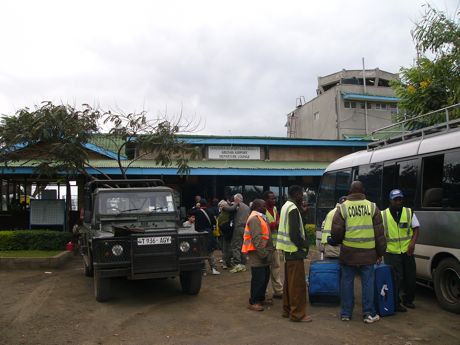
This is where you look up your flight going out:

The trip was off to a great start when we got to Grumeti Camp. The colors of Grumeti are red and purple; we go to our cabin to clean up and then we have lunch outside, down near a bog full of hippos, who grunt from time to time. This is our bed in the Grumeti Lodge:

Two days at Grumeti, and oh what fun from the very beginning. We see huge herds of Gnu. Here is what a Gnu sounds like:
Gnu: Hunnh? Hunnh? Hunnh? Hunnh?
It never varies.
Gnu: Hunnh? Hunnh? Hunnh? Hunnh? Hunnh?
Here is what a gnu looks like:

There are thousands of them. They know where they are going, and sometimes they go single file and sometimes they go in great bunches. We did get to see gnu (plural) crossing a stream, but the alligator wasn’t anywhere near and I think he had recently eaten:

Here is something very cool. This is what the alligator’s trail looks like:
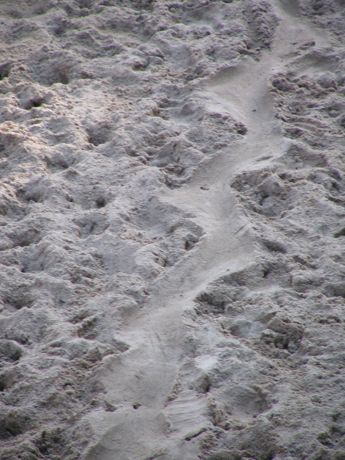
The Great Migration also includes huge herds of zebra, and the males are constantly trying to keep the females from roaming off. So zebras will all be quietly munching grass and then one male will go heee-hawing around trying to keep other young virile zebras from making off with his females until one day he gets too old and the younger zebras can steal his women, errr, zebra-females.
Thousands of zebra everywhere. . . these ones are drinking while not 100 feet away, a lion is resting. He looks like he has feasted recently, and is not too interested in the remaining thirsty zebra – not right now, anyway.


Next chapter: We go to the CCAfrica tented camps to follow the great migration.
Kuwait: Making a Difference
I want to share with you a comment on my environment day post from one of our local bloggers, NicoleB / Rainmountain. She is a professional photographer, and describes below her one-woman (successful!) effort to clean up, and keep clean, the Mangaf beach. Brava, Rainmountain! Because of her example, others are taking their own trash to the trash cans, rather than leaving it, the trash collectors are encouraged, and working harder, and the beach is visibly cleaner. Brava! Brava!
Here is her comment from my environmental blog day post:
I’ve started cleaning our small beach here in Mangaf and now, half a year later, it’s almost clean at any time.
The trash guys are doing more and some people seemed to have picked up and do some cleaning too.
Sad part is to come down there and see that someone had a party and left all their stuff there.
So, you just go and start all over again.
It makes me sometimes wonder if people a) have no common sense and b) no pride in their country.
I had various weird conversations about this topic.
Here’s a copy from my blog of one of them:
Man: Excuse me, do you speak English?
Me: Yes?!
Man: What are you doing there?
Me: Collecting trash….?!
Man: Why are you doing that? They (pointing at that poor guy still waiting) do THAT.
Me: And the beach is still dirty….
Man: But that is the way it is.
Me: No. It’s not.
Man: Since when are you here?
Me: Six weeks and since then the beach is much cleaner, don’t you think?
Man: How do you like it here?
Me: It’s beautiful, if everyone would pick up his trash.
End of conversation. It seems he didn’t know what to answer, or thought it would be useless, but maybe he got the idea
Starbuck’s Holiday
Waiting in line to order some coffee, I saw these on a bottom shelf. I haven’t seen these in any of the other Starbuck’s. I think they need to do an Eid Mubarak mug and special coffee, don’t you?

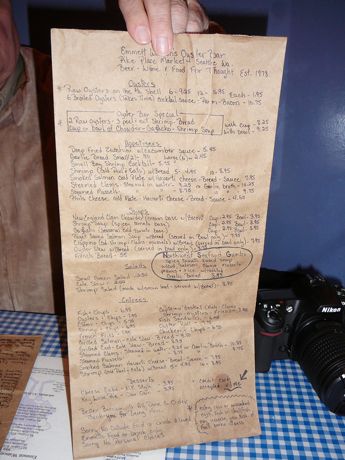
Emmet Watson’s
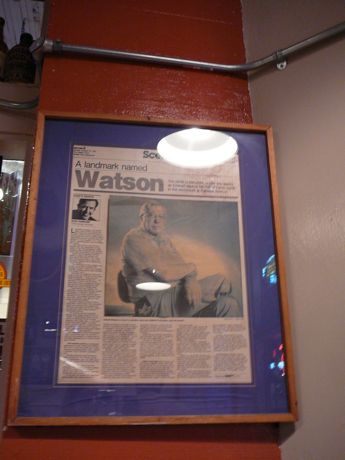
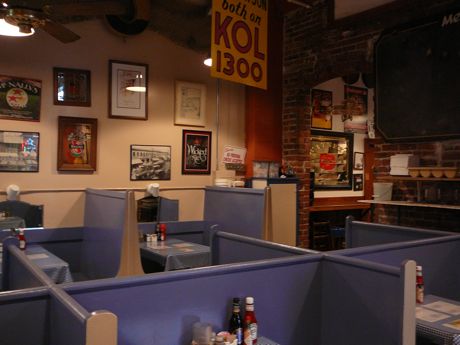
There was a crusty old journalist/columnist at the Seattle Post-Intelligencer named Emmet Watson, who loved good food. He opened his own little place, hidden down in the Pike Place Market, back behind a lot of other shops. It even has a small outdoor eating area for the summer months. If you want some of Seattle’s best, most authentic northwest seafood, this is where you head. He isn’t around anymore, but his small restaurant still is, and worth a trip to the market.
Emmet Watson article:
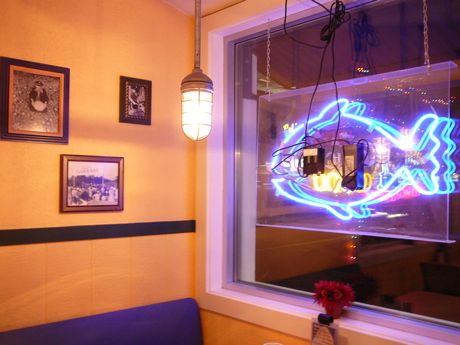
Interior of restaurant:
Hand written menu on brown paper bag:
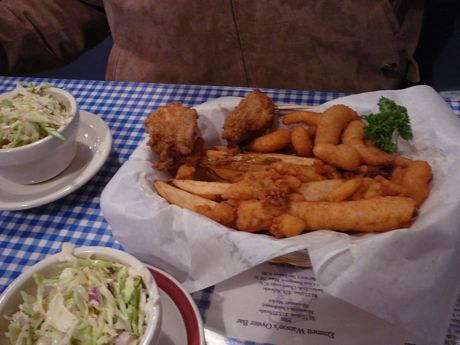
Captain’s seafood basket:
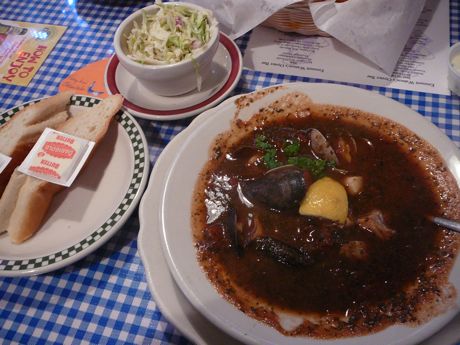
Cioppino:

Adventure Man Goes to Ivar’s
“You hungry?” I asked Adventure Man as he arrived.
He nodded his head.
“BBQ? Italian? Ethiopian? What’s your preference?” I tossed out several alternatives.
“Any place I can get some good clam chowder?” he responded.
“Sure!” I said, delighted his wants were so easily satisfied. “How about Ivar’s?”
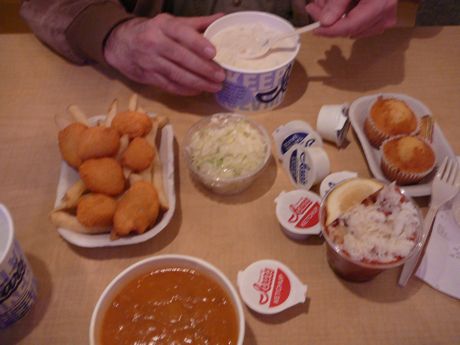
We had a great dinner. He ordered Clam Chowder and Scallops and Chips, and coleslaw, and cornbread, and I had a crab cocktail and smoked salmon chowder. YuMMMMMMMMMMMM.
Our booth:
Our dinner:
Old Cars
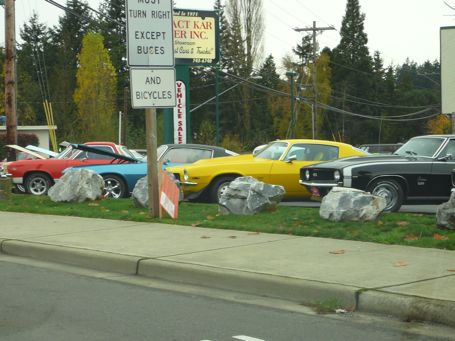
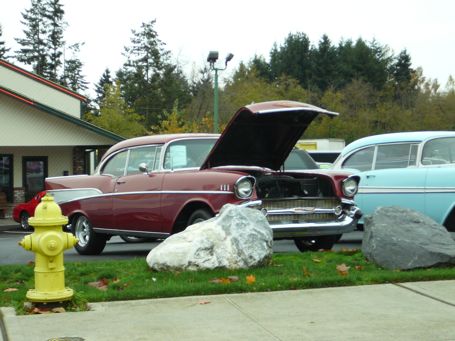
Several years ago, some friends were visiting Seattle and returned, saying “I have never seen so many OLD cars anywhere else.”
(They had never been to Turkey, where they have an art of keeping old cars running.)
I had never really noticed, but there truly are a lot of older cars in this area, and I don’t know why. Maybe one reason is that Seattle had a few leaded gas pumps longer than other states, and most of these old cars ran on leaded gas. You still see them – a lot of them – still on the roads.
Jack Frost Nipping
When you think of Thanksgiving in Seattle, you usually think of rainy and stormy. Everyone has a tale to tell about the year the electricity went off just when the turkey was cooking and 22 people were coming for dinner.
This year, however, was picture perfect.
It is COLD (brrrrrrrr, shiver, brrrrrr) Morning and night, you either have to scrape the frost off the windshield, or wait long enough for the car to heat up and melt it off. (Brrrrrrrr, shiver)
It is GREAT sweater weather.
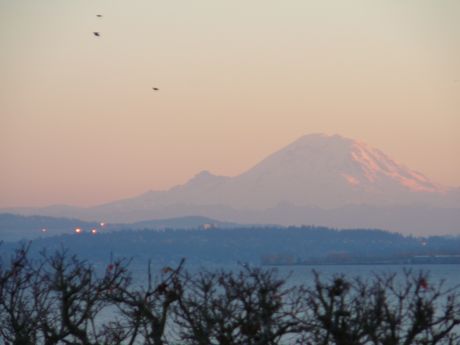
In Seattle, this is what you say “Look at the mountain!” Everyone knows which mountain you are referring to – Mt. Rainier.
Look at the mountain!
Recent Comments
ExpatAlien on What Country am I Living … intlxpatr on Yellowstone: Old Faithful to C… Michelle on Yellowstone: Old Faithful to C… Cathy on No Grown-Ups in Charge intlxpatr on Waiting for Snow Wikipedia Donate Button

Amazina


Early Voting in Florida


 Here There and Everywhere